Hodges' Model: Welcome to the QUAD: relation

Hodges' model is a conceptual framework to support reflection and critical thinking. Situated, the model can help integrate all disciplines (academic and professional). Amid news items, are posts that illustrate the scope and application of the model. A bibliography and A4 template are provided in the sidebar. Welcome to the QUAD ...

Showing posts with label relation. Show all posts

Friday, August 21, 2026

"Poetics of Relation" by Édouard Glissant

'The Slave Trade came through the cramped doorway of the slave ship, leaving a wake like that of crawling desert caravans. It might be drawn like this:

African countries to the East; the lands of America to the West. This creature is in the image of a fibril.

African languages became deterritorialized, thus contributing to creolization in the West. This is the most completely known confrontation between the powers of the written word and the impulses of orality. The only written thing on slave ships was the account book listing the exchange value of slaves. Within the ship's space the cry of those deported was stifled, as it would be in the realm of the Plantations. This confrontation still reverberates to this day.' p.5.
'Not just a specific knowledge, appetite, suffering, and delight of one particular people, not only that, but knowledge of the Whole, greater from having been at the abyss and freeing knowledge of Relation within the Whole.' p.8.

 
Édouard Glissant. (1990, 2025) The Open Boat. Poetics of Relation. Dublin: Penguin.

The above image runs within the text in the book.

My image source: https://annstreetgallery.org/Nolan-Oswald-Dennis

Thursday, January 29, 2026

Paper: 'Intra-Personal Compromises'

ARGUMENTA

Issue 21

November 2025

https://www.argumenta.org/issue/issue-21/

Intra-Personal Compromises  

Juha Räikkä

University of Turku 

Abstract

The most usual philosophical questions about compromises have been those related to inter-personal compromises, in which parties are compromising with each other, rather than intra-personal compromises, which are often psychologically demanding. This paper aims to fill the gap in the discussion and briefly analyze the nature of intra-personal compromises. The starting point here is the assumption that inter-personal compromises cannot be made without intra-personal compromises, although intra-personal compromises are common even when they are not linked to inter-personal compromises. The main question addressed in the paper is whether the intra-personal compromises that we accept in all kinds of contexts are similar to those intra-personal compromises that we make when we compromise with others. I argue that they are more or less similar, although there are also some distinctive features in intra-personal compromises that are involved in inter-personal compromises. When a person makes an intra-personal compromise in the context of an inter-personal compromise she is forced to act under uncertainty, as she cannot know beforehand what options are really available. The price of the compromise is known only after the negotiation process. This is a special feature, or so I will claim. 

Keywords: Inter-personal compromise, Intra-personal compromise, Bargaining, Uncertainty. 

Räikkä, R. 2025, “Intra-Personal Compromises”, Argumenta 11, 1, 149–162.
https://www.argumenta.org/wp-content/uploads/2026/01/Argumenta-11-1-Juha-Raikka-Intra-Personal-Compromises.pdf
 

For a long time I have viewed the INTERPERSONAL domain of Hodges' model as being concurrent, interchangable, working as the INTRAPERSONAL domain. This paper is a helpful discovery, c/o Philos-L "The Liverpool List" which is run by the Department of Philosophy, University of Liverpool https://www.liverpool.ac.uk/philosophy/philos-l/

There are several examples/cases discussed. While brief, a HOSPITAL CEO example is relevant to studies for Hodges' model, as with, a CRITICAL CITIZEN:

'The above examples are rather similar but have small differences. In the ‘Judge’ example, the overriding principle is based on the importance of institutional rules. In the ‘Hospital CEO’ example, the main concern and the strongest value is pragmatic. In the ‘Critical Citizen’ example, the question is about omission rather than action.' p.157. 

The observation about the CEO speaks volumes, across public and private health sectors (and social care?). There is no discussion of reflection, reflexivity, or critical thinking explicitly. But individual, and collective distinctions, and impacts are explored, especially responsibility and mutuality. Three arguments precede concluding remarks. Further progress might be made exploring and relating these to the concepts of bargaining, uncertainty and compromise through Hodges' model and identity: both person-al and organisational?

Thursday, March 20, 2025

A short & sweet tweet/X for . . .

         ... the challenge of a lifetime ...

    ... for several researchers mathematicians?


This thread, also written - copied out beforehand provides the basis for an enlarged post to follow.

Wednesday, December 18, 2024

Hornberger (1989) 'Continua of Biliteracy'. Review of Educational Research

The axes of Hodges' model present a problem in:

  • theory
  • practice
  • evidence - research terms (data!).

The easiest to resolve is practice, which is were Hodges' model can lay claim to being a pragmatic solution. Of course, it isn't the axes that are the difficulty, it is the labels that Brian Hodges originally applied in the early-mid 1980's, followed by other users of the model since. From:

INDIVIDUAL <> GROUP - variations here in 'Welcome to the QUAD' [W2tQ] Patient <> Carer - Family : Client <> Health professional. You can progress to the "patient zero" and a population in an pandemic.

These are fundamental elements in clinical encounters, whether face-to-face, online, and across settings.

The same applies to the horizontal axis: HUMANISTIC <> MECHANISTIC.

As presented - in the sidebar, and the two-by-two table found in many posts - the model has a distinct dichotomous quality. It seems to set up, or invite opposition, or polarities. Sometimes I've viewed the axes as continua, but they are not graduated, incremental in a quantitative sense.

Do the axes of Hodges' model serve a need (do their work) by allowing the user to differentiate through opposition and relational appraisal (testing)? Perhaps, qualified in a respective profession / subject area, the user of Hodges' is employing other axes?

This brings us to intersectionality and the cognitive work of placing the person (couple, family, community ... biosphere) at the centre of our deliberations.

In biliteracy studies, Hornberger (1989) is perhaps more accurate in seeing a series of multidimensional and interrelated continua (p.273) which form a framework.

There are three figures in this paper and many other points of use:

"Contexts of biliteracy are defined, then, by these three continua. Any particular instance of biliteracy is located at a point of intersection among the three." p.280.

In health care this is readily understood given the varied contexts of the centre, the nexus of Hodges' model. When we say Hodges' model is situated, the centre of the model is the sweet and sour spot. For Hornberger, the context determines the use and significance of the continua.

This opens up Hodges' model as a potential tool to better understand the dimensions of diversity, inclusion and intersectionality.

Hornberger, N. H. (1989). Continua of Biliteracy. Review of Educational Research, 59(3), 271–296. https://doi.org/10.2307/1170183

No! This post hasn't been in draft since 1990. ;-)

Wednesday, October 02, 2024

It's not that I want a copy ...

... I just want to know what it means to you?

individual
|
INTERPERSONAL : SCIENCES
humanistic ------------------------------- mechanistic
SOCIOLOGY : POLITICAL
|
group
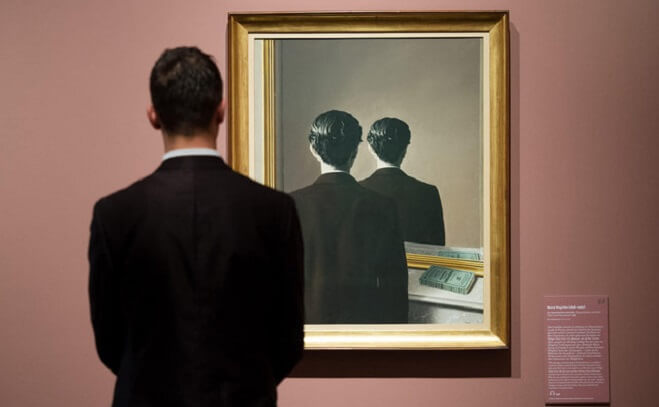
Not to Be Reproduced, 1937 by Rene Magritte


Image: https://www.renemagritte.org/not-to-be-reproduced.jsp

Thursday, May 09, 2024

Being constantly rational - in pursuit of evidence . . .


. . . while being chased by the absurd . . .


Individual
|
      INTERPERSONAL    :     SCIENCES               
HUMANISTIC  --------------------------------------  MECHANISTIC      
 SOCIOLOGY  :    POLITICAL 
|
Group
Descartes’ - cogito ergo sum^

A psychological case formulation for ...?

(Being constantly …) rational^

... in pursuit of evidence


Drama: A case formulation for the audience.


Absurd: When £££$$$ meets health 

- the where of when the audience aren't interested in the how, and why of the case formulation.


The theatre of the absurd does not need language.
Hodges' model?
In absurd terms the structure must go! No ifs ands or buts ...
Replace the intellectual concepts with poetic images
 but before you do optimise for distance from sense. 

"In the Theatre of the Absurd, the audience is confronted with actions that lack apparent motivation, characters that are in constant flux, and often happenings that are clearly outside the realm of rational* experience. Here, too, the audience can ask 'What is going to happen next?' But then anything may happen next, so that the answer to this question cannot be worked out according to the rules of ordinary probability based on motives and characterizations that will remain constant throughout the play. The relevant question here is not so much what is going to happen next but what is happening? 'What does the action of the play represent?'" Esslin. (p.416).

*and relational?

^D’ANDREA, F. (2017). BEING HUMAN. A FEW REMARKS ABOUT DESCARTES’ COGITO ERGO SUM. Studi Di Sociologia, 55(2), 135–146. https://www.jstor.org/stable/26479662

Esslin, Martin. Chapter 8 The Significance of the Absurd. The Theatre of the Absurd. London: Pelican, 1982. (3rd Ed.).

Previously: relational - rational