Hodges' Model: Welcome to the QUAD: audience

Hodges' model is a conceptual framework to support reflection and critical thinking. Situated, the model can help integrate all disciplines (academic and professional). Amid news items, are posts that illustrate the scope and application of the model. A bibliography and A4 template are provided in the sidebar. Welcome to the QUAD ...

Showing posts with label audience. Show all posts

Monday, January 26, 2026

'Drama classes help GPs handle difficult patients' c/o BBC

'Hull Truck Theatre has just won the Innovation prize at the Stage Awards for their new training scheme for GPs. Associate Director Tom Saunders and GP Dr Eman Shamsaee discuss why drama classes are helping doctors treat patients.' 

BBC Radio 4 'Front Row' https://www.bbc.co.uk/sounds/play/m002q2jz (15 mins ...)

Holly Phillips, East Yorkshire and Lincolnshire and Ian Youngs, Culture Reporter

Published - 21 January 2026

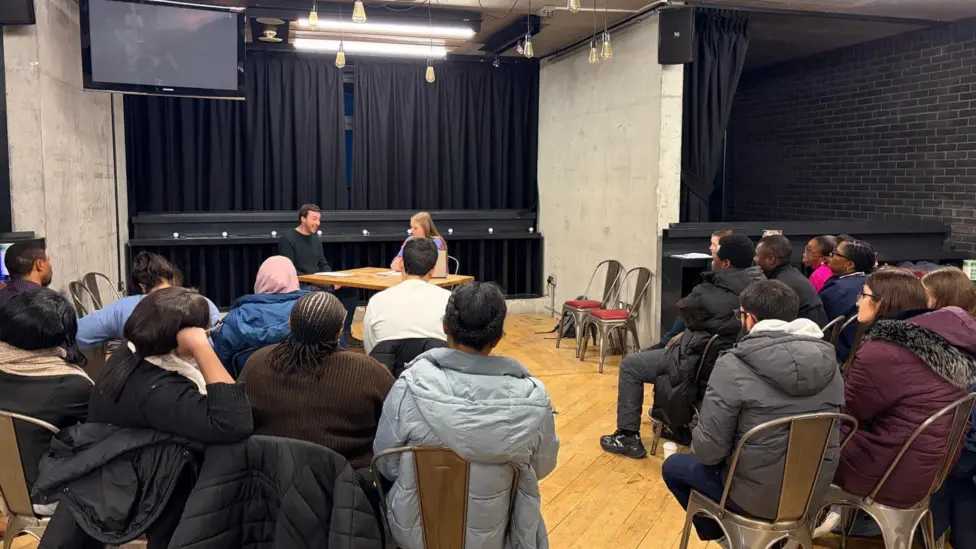
'A theatre company is using drama training to help doctors deal with challenging patients.

Hull Truck Theatre's classes feature actors performing difficult GP consultations, with GPs giving feedback before taking over the consultation themselves.

The theatre recently won the Innovation Award at the Stage Awards for the programme.

Dr Eman Shamsaee, who has taken part in the training scheme, described it as a "really creative way of doing GP training".'

BBC News:  Drama classes help GPs handle difficult patients

INDIVIDUAL
|
 INTERPERSONAL    :     SCIENCES               
HUMANISTIC --------------------------------------  MECHANISTIC      
SOCIOLOGY  :   POLITICAL 
|
GROUP


The training programme has completed its pilot stage and is now in the delivery phase


A reminder of co-working to deliver STORM training with a Clinical Psychologist colleague. 

See also: 'communication' : 'primary care' : 'GP' : 'drama'

Thursday, May 09, 2024

Being constantly rational - in pursuit of evidence . . .


. . . while being chased by the absurd . . .


Individual
|
      INTERPERSONAL    :     SCIENCES               
HUMANISTIC  --------------------------------------  MECHANISTIC      
 SOCIOLOGY  :    POLITICAL 
|
Group
Descartes’ - cogito ergo sum^

A psychological case formulation for ...?

(Being constantly …) rational^

... in pursuit of evidence


Drama: A case formulation for the audience.


Absurd: When £££$$$ meets health 

- the where of when the audience aren't interested in the how, and why of the case formulation.


The theatre of the absurd does not need language.
Hodges' model?
In absurd terms the structure must go! No ifs ands or buts ...
Replace the intellectual concepts with poetic images
 but before you do optimise for distance from sense. 

"In the Theatre of the Absurd, the audience is confronted with actions that lack apparent motivation, characters that are in constant flux, and often happenings that are clearly outside the realm of rational* experience. Here, too, the audience can ask 'What is going to happen next?' But then anything may happen next, so that the answer to this question cannot be worked out according to the rules of ordinary probability based on motives and characterizations that will remain constant throughout the play. The relevant question here is not so much what is going to happen next but what is happening? 'What does the action of the play represent?'" Esslin. (p.416).

*and relational?

^D’ANDREA, F. (2017). BEING HUMAN. A FEW REMARKS ABOUT DESCARTES’ COGITO ERGO SUM. Studi Di Sociologia, 55(2), 135–146. https://www.jstor.org/stable/26479662

Esslin, Martin. Chapter 8 The Significance of the Absurd. The Theatre of the Absurd. London: Pelican, 1982. (3rd Ed.).

Previously: relational - rational

Friday, May 03, 2024

Help us build the future - Medical Aid Films' Annual Survey 2024

On Tuesday, 30 April 2024 at 14:37:02 BST, Helen Coombe, UK <helen AT medicalaidfilms.org> wrote:

At Medical Aid Films, we are asking ourselves how we can respond to the scaling up of innovative digital information and communication technologies whilst continuing to place our primary audiences at the centre of our work – ‘ensuring people-centred systems that are enabled by digital health[i]’, one of the objectives of the WHO Digital Health Strategy 2020 – 2025. It is important to us that any digital strategy reflects the needs and aspirations of the healthcare professionals we serve. We invite any healthcare professional to complete our 2024 online annual survey to help inform forthcoming digital initiatives. Your insights will provide us with a comprehensive understanding of what matters most around training and health education and how we can best serve your needs. 

c/o Medical Aid Films 

The survey can be accessed here - now closed.

the deadline to respond is Monday 13th May

Thank you for helping support our work.


[i] WHO Global strategy on digital health 2020-2025, https://www.who.int/health-topics/digital-health#tab=tab_1


Helen Coombe, Head of Research, Monitoring, Evaluation and Learning. Medical Aid Films, c/o Zavros Mintikkis Associates Ltd, 1st Floor, 446a Green Lanes, London, N13 5XD

HIFA* profile: Helen Coombe is Head of Evaluation and Research at Medical Aid Films, UK.

helen AT medicalaidfilms.org

*My source.

Sunday, October 17, 2021

Book: ii "Making Research Matter" ... to varied audiences ...

Individual
|

INTERPERSONAL : SCIENCES
humanistic ------------------------------------- mechanistic
SOCIOLOGY : POLITICAL
|
Group
 
Patient
Carer
Lifelong learner

purpose


Researchers*
Scientists*
Lecturers
Student (Scholar)
Project managers

process

Public
Community Leaders - Groups
Ethnographers
Social policy makers

practice

Managers
Leaders
Policy Makers
Curriculum Developers
Activists
Change agents

policy

Noting Tara Lamont's book and the intended audiences, I was reminded of the diverse potential user base for Hodges' model, with a few additions.

This was represented using four images on the old homepage of the now archived website (1998-2015):

https://www.webarchive.org.uk/wayback/en/archive/20141008034649/http://www.p-jones.demon.co.uk/index.htm

'Lifelong learner' should apply across all the domains of the model, but it is primarily about intrinsic motivation, a personal and voluntary initiative.

There is no 'evidence-based' explanation for the above, other than praxis. It has arisen over time,  associated with the care domains of Hodges' model. The situation is similar for the 4Ps in the model (italicised).

See also:

Book: i "Making Research Matter - Steps to Impact for Health and Care Researchers" Open Access

*independent roles also.

Saturday, October 16, 2021

Book: i "Making Research Matter - Steps to Impact for Health and Care Researchers" Open Access

Individual
|

INTERPERSONAL : SCIENCES
humanistic ------------------------------------- mechanistic
SOCIOLOGY : POLITICAL
|
Group
 
i m p a c t

impact
impact

"Making Research Matter"*

My source:

https://twitter.com/TaraJLamont/status/1448999679899865088?s=20

Thanks also to @policypress 

*An ever greater need for political impact!

Friday, July 22, 2011

Nurses & Social Media - mise en scène

... health on the thrust stage


From: Wordsmith.org
1. The setting of a scene in a play, movie, etc.
2. The setting or background of an event.

ETYMOLOGY:
From French mise en scène, literally "put on stage".
The health care domains model provides a 2 x 2 stage.

It may be a conceptual stage, but it is nonetheless demanding. It demands we perform the translation from theory to practice and check constantly exactly where we are AND where we need to be.

Should we become so ill that hospital treatment is needed the dependency and the sense of vulnerability this provokes often makes us feel that we are 'performing'. Not only that but as a  patient we find our selves on a thrust stage. When illness strikes it seems we are surrounded by this audience of clinicians who can potentially see us from all angles and be privy to very personal information about us.

The demands cut both ways though. Modern health care IS collaborative. Stagecraft here then means there should be minimal furniture and scenery to hide behind. Strange then that in terms of personalised care background details really do matter.

So, everyone matters. Teamwork counts. We try to keep patients off the stage. Patients and carers as expert carewrights may already know their lines - they can teach us. Suddenly everyone is an actor. Suddenly all the players must pass by way of the vomitory and the responsibilities that passage demands. On this stage care also needs to be exercised as per the direction of the NMC.

Original image source:
http://hs-theatre-ib1.ism-online.org/2010/10/14/night-of-the-assassins-thrust-stage/

Monday, May 28, 2007

Four knowledge domains = four audiences?

I don't know if there is any sense in this, but people look for 'signs' all the time - don't we? With the last front-end revision of the website (early 2005) I had twigged that there are at least four audiences that an introduction to Hodges' model needs to address.

Looking at the care domains the following seemed to fall just right:

Patients and Carers : Students - Lifelong Learners

Public [Citizens] : Policy makers, Managers

These may be lost to many visitors (but not you!) given the surfing attention span. If people do access and digest the first page above, which acts as a general introduction, they may not reach the second audience specific page.

Should I swap these around?

What is provided on the first page of each, is a basic h2cm graphic showing some relevant concepts for that particular domain. (It's this representation that trivialises h2cm).

The introductions do need revising and updating. I found some typos on the student - sciences piece, so not the best effort.

I think overall though this approach works - and highlights the need for collaboration and engagement on so many levels.

What do you think, any suggestions?

Ecotherapy to follow...