Hodges' Model: Welcome to the QUAD: archive

Hodges' model is a conceptual framework to support reflection and critical thinking. Situated, the model can help integrate all disciplines (academic and professional). Amid news items, are posts that illustrate the scope and application of the model. A bibliography and A4 template are provided in the sidebar. Welcome to the QUAD ...

Showing posts with label archive. Show all posts

Friday, July 10, 2026

Leapspace ii - References

Of the references listed by LEAPSPACE #6 stood out:

Merritt, M.K., Procter, N. (2010) Conceptualising the functional role of mental health consultation-liaison nurse in multi-morbidity, using Peplau's nursing theory. Contemporary Nurse. https://doi.org/10.5172/conu.2010.34.2.158 

Had I missed this? When I hear (read) of new citation for Hodges' model, it is added to the blog's bibliography. So, what about this one?

I could not access the full-paper initially, but did so at:

https://lmscontent.embanet.com/MVU/NURS600/Readings/W3_Peplau.pdf

I can see that Merrit and Proctor reference the following [#16 of 1-46]:

Jones, P. (1998). Hodges’ health career – Care domains – Model, nursing – Art or science? Retrieved October 4, 2009, from http://www.pjones.demon.co.uk/holsci.html

This additional cognitive and motivational nourishment is welcome. They are spot on with '1998', the year the former website (p-jones.demon.co.uk) went live. 

Pre-2015 and indicative of (what will increasingly follow) from AI, LLMs, agentic ai - LEAPSPACE found a page on the now archived website:

https://web.archive.org/web/20150409004111/http://www.p-jones.demon.co.uk/index.htm

While a positive, perhaps (again) we should worry about regurgitation? Although on another level perhaps the definition of 'grey literature' is also being (has been) redefined?

There is a positive in the author's acknowledgement of Hodges' model on several counts, being associated with:

  • Highlighting the need for inclusion of mental health/illness (parity of esteem);
  • Peplau's seminal work;
  • A search to link mental health with other specialities (emergency, liaison, burns);
  • Recognition of the inverse (psychological care within medicine); 
  • The fact of being listed with Phil Barker (Tidal Model). 

Negatively, on the archived homepage (above) many links to content may not work:

The (rather short but referenced) page Merrit and Proctor list is available here:

https://web.archive.org/web/20111018204743/http://www.p-jones.demon.co.uk/holsci.html

I will insert this paper in the bibliographical listing; and revisit this.

Tuesday, December 02, 2025

Auction: Twenty-two photographs of psychiatric patients at the Surrey County Lunatic Asylum [1850s]

DIAMOND, Dr Hugh Welch (1808–1886)

Twenty-two photographs of psychiatric patients at the Surrey County Lunatic Asylum [1850s]

Estimate - GBP 100,000 – GBP 200,000

Christie's London - December 10th 2025

https://www.christies.com/en/lot/lot-6564110?ldp_breadcrumb=back

Asylum patient by Hugh Welch Diamond, c1850-58
Hugh Welch Diamond (English, 1808-1886)
Public domain, via Wikimedia Commons

'The women Iook out at us across 170 years of history with a variety of expressions - bold and shy, serene and distressed. Yet all of them were regarded at the time as "lunatics". These faces were the  subjects of a pioneering project by the 19th-century psychiatrist Hugh Welch Diamond, superintendent of the female division of an asylum in London and the world's first photographer to take pictures of patients for the purpose of diagnosis and therapy.

Twenty-two of Diamond's asylum portraits - the largest surviving group - will be put up for auction on December 10 at Christie's in London, as part of a sale of books, manuscripts and photographs from the library of The Royal Society of Medicine. If they achieve their estimated prices, RSM, a membership charity, will raise more than £2mn to invest in physical and digital infrastructure.' ...

'Diamond was working at a time when society's views of people suffering from mental illness were changing. The earlier practice of shutting patients away in secure "madhouses" was giving way to more humane treatment. Diamond seems to have believed that photography would help doctors both to diagnose and to treat patients. His diagnoses were based partly on the idea, popular in Victorian medical circles, that an individual's physiognomy - their physical features, particularly the face - could reveal their mental state.

"He wanted to make people better and put them back into the world," says Sharrona Pearl, a medical historian at Texas Christian University who has studied Diamond's work. "He also enjoyed experimenting and liked the idea of bridging his expertise in medicine and photography.' p.32.
individual
|
INTERPERSONAL : SCIENCES
humanistic -------------------------------------------  mechanistic
SOCIOLOGY : POLITICAL
|
group-population

Mental Illness
PERSON - SUBJECT
Patient's names not recorded
Portrait - Consent?

Diagnosis and Treatment
person - DATA - SUBJECT
Photography as records
Eagerness to classify - label
Social history
Change in social attitudes
Stigma and fear of mental illness
Current relatives?

Confidentiality
Institutional change
Power imbalance
Shift from 'custodial' to health care 


My source:
Clive Cookson, Mind Hunter, FT Magazine, November 15, 2025, 1151, pp.30-34.

I have noticed Prof. Brendan Kelly is a regular FT respondent, as with this article:

'These photographs were likely to have been taken without meaningful consent and in the context of power imbalance. Yet publication can reclaim their individuality, address historical injustice and underscore our common humanity. Compassion, respect and humility should guide decisions. 
 Proceeds should support medical, educational, or justice-oriented programmes. Most importantly honouring forgotten patients of the past demands better care for people with mental illness today, who often languish, neglected, in homeless hostels or prisons. We can do better.'

Brendan Kelly Professor of Psychiatry, Trinity College, Dublin, Ireland.
Letters, FT Weekend. 22-23 November 2025, p.10.

See also: 'asylum' : 'photos'

Friday, September 19, 2025

'Recall Me Maybe' | FT Drama

Stephen Fry and Gemma Whelan star in a new FT drama written by David Baddiel, exploring AI, memory and truth. Fry plays a grandfather with dementia who uses AI to fill in gaps in his memory. While reviewing the archive of his life his family makes a shocking discovery. Which memories are really true? And how AI is defining who we are?

See also: FT Standpoint unveils David Baddiel digital-first drama about AI and dementia -https://www.dropmedia.co.uk/ft-standpoint-unveils-david-baddiel-digital-first-drama-about-ai-and-dementia/

My source: Times Radio. Dom Joly in for Ayesha Hazarika. 1300-1600 BST From 1405-21.
https://www.thetimes.com/radio/show/20250919-32052/2025-09-19

I still need to catch up with last weekend's FT.
https://www.ft.com/video/a4d2ba19-051e-47c5-98ae-c27c59f1b3f0

Friday, August 29, 2025

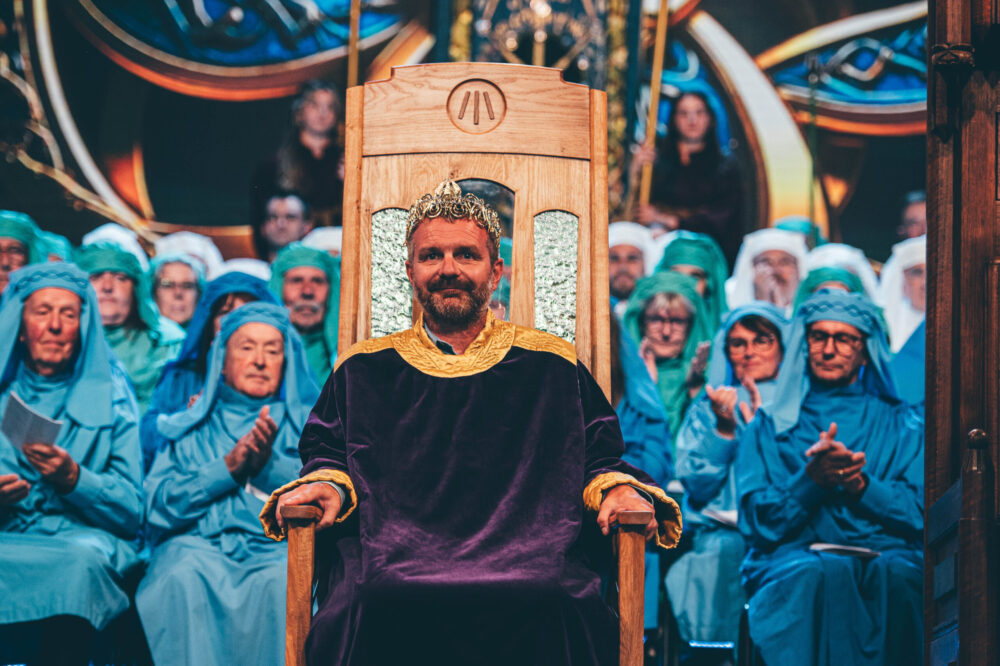
Winner of Wrecsam National Eisteddfod crown - 4th Aug.

Crown winner Owain Rhys
Image: 
https://nation.cymru/culture/winner-of-wrecsam-national-eisteddfod-crown-announced/

Owain Rhys is the winner of the Wrecsam National Eisteddfod crown for his poems about living with a loved one who is suffering with dementia.

The crown – sponsored by Elin Haf Davies – and a cash prize of £750 was presented to Owain in north Wales on Monday (August 4) by Prydwen Elfed Owens.

The prize was awarded for a “pryddest” or collection of poems not in the traditional Welsh style cynghanedd, of no more than 250 lines, on the theme of “Adfeilion” or ruins.

The adjudicators were Ifor ap Glyn, Gwyneth Lewis and Siôn Aled.

The crown was designed and produced by Neil Rayment and Elan Rowlands.

The pair previously created the impressive crown for the Rhondda Cynon Taf Eisteddfod in 2024 – won by Gwynfor Dafydd for his series of poems on “Atgof” – or remembrance.

Head judge Ifor ap Glyn said: “Llif 2 opens with the simple couplet ‘When you forget / every day as you wake’ – and it discusses living with someone suffering from dementia, namely the poet’s mother.

“It’s a quiet and sensitive treatment of what must be done to help the mother continue to live with dignity as her memory deteriorates.

“The collection presents a tender picture of a difficult situation faced by so many families today, and we sense the depth of the poet’s feelings toward his mother and her former strength.”

Text: https://nation.cymru/culture/winner-of-wrecsam-national-eisteddfod-crown-announced/

See also: https://eisteddfod.wales

My Source: BBC Four Episode 1 - 15mins
https://www.bbc.co.uk/iplayer/episode/m002gwyq/eisteddfod-eisteddfod-2025-with-huw-stephens-episode-1

Saturday, February 03, 2024

Curation of posts on W2tQ

     Curation: Quote(s) to follow?
Several years ago I reviewed the blog's posts starting from post #1 in April 2006. Some posts, such as, journal calls for papers, conference announcements ... were clearly of time-limited value, even as to the degree they may document the history of ideas. The exercise also highlighted my adopted role of curator, which had not occurred to me before. 

Previously, tentatively, I tried to weigh the value of content. The value to scholarship of Hodges' model, and not wishing to sound grandiose - nursing theory (someone should - given the vacuum over the past 20-30 years?). There are person-centred items, with some that make me cringe (the personal ones, the ones premature and not quite 'fully-formed'), while others stand the test of time (I think). 

Eighteen years is not long and yet the change in several dynamic histories is very obvious, across society, politics, ecosystems, policy, education, nursing and of course technology. Many posts were deleted, others with:
  • too many links (for which you can be penalised?)
  • broken links;
  • missing images / videos;
  • typos ...

- where updated accordingly.

Revision #2 beckons in the near future, an effort to rationalise the wheat from the chaff.

It is - same old, same old regards the elephant in the room: that is, the missing new 'platform' - as it keeps reminding me.

W2tQ - "Welcome the the QUAD" - this blog.
Book image: Waterstones.

Saturday, January 27, 2024

125 Years: 1899-2024 Free Issues at Liverpool University Press


2024 marks the 125th anniversary of LUP’s formation and we are pleased to bring you a new selection of free to read journal issues to celebrate.

With one complete issue of each journal available to read for free, this collection captures the breadth and scope of the research that our journals publish, and the growth of LUP from its formation in 1899. We hope that you enjoy reading them.

Visit our Free Issues page to read free content Indexing and Archiving.

Issues included this year

THE INDEXER

In this issue, 39.1, Paula Clarke Bain touches on the experience of reading during a pandemic in her review of Piranesi by Susanna Clarke, alongside a final article from a series on active eBook indexes. Gord Ripley and Gordon Adshead offer a tour of their online index database, Libris Canadiana, whilst Peter Rooney discusses the creation of an index for the Mueller report, a highly anticipated US government document that was published without an index. Ælfwine Mischler also explains the complexities of indexing Arabic names, and Walter Greulich continues his series about how to create embedded indexes using Word and, Pilar Wyman reports on the project updating indexing standards in the US.

Read this issue for free >

ARCHIVES

In this issue, 56.1, C.R.J Currie article discusses tenants’ copies of court rolls in England and Wales before 1400 using research in 38 repositories to analyse 176 copies of seigneurial court rolls, whilst Rory MacLellan analyses a new set of First World War diaries for the Mesopotamia campaign. Mathodi Freddie Motsamayi looks at preserving South African community archives in a context of Ubuntu alongside book reviews by Russell E. Martin, J.P. Salley, Christine Jackson, Tracey Logan, Karen Mailley-Watt, and Arike Oke.

Read this issue for free >

COMMA

In this issue, 2019.1, discusses the remarkable work of Charles Kecskeméti, head of the secretariat of the International Council on Archives (ICA) for 41 years, from 1957 to 1998, alongside Mandy Banton who explores the problems and solutions of shared archival heritage, reporting on the EGSAH panel at the Yaounde Conference. Wang Xiangnyu and Han Jiabao also undertake research on celebrity archives held by provincial archives in China, whilst Joan Boadas i Raset discusses the management of photographic heritage.

Read this issue for free >

Browse the full collection of free to read issues for 2024 >

Best wishes,
Alice Burns
alice.burns AT liverpool.ac.uk

On behalf of Liverpool University Press

My source:
https://www.jiscmail.ac.uk/cgi-bin/webadmin?A0=RECORDS-MANAGEMENT-UK 

Friday, May 20, 2022

Join us 6/16 - Virtual tour of The Healing Project's new digital archive

"Join us on Thursday, June 16, 2022 from 12-1p PT / 3-4p ET for a virtual tour of The Healing Project’s brand new digital archive! We’ll discuss what the art, stories, and realities of incarcerated people in the US mean for health professionals’ work to advance health equity in the context of historical and contemporary social justice movements."
 
INDIVIDUAL

|
 INTERPERSONAL    :     SCIENCES               
HUMANISTIC --------------------------------------  MECHANISTIC      
SOCIOLOGY  :   POLITICAL 
|
GROUP

(mental) health equity*


(physical) health equity*

arts
social justice
history
social health equity^
healing communities

incarcerated people
detention
police
health workers
political health equity^


*individual (lived) experience

^collectively experienced (and also 'lived')

Where does violence sit, stand, shout, strike, stun ... in h2cm?

My source: 

Spiritof1848 Listserv WWW.SPIRITOF1848.ORG #Spiritof1848

Wednesday, March 02, 2022

Draft figure: Selected processes and sources that can contribute/influence the content of Hodges' model

This draft figure is intended to ultimately show how the final application of Hodges' model, that is, the selection and placement of concepts in the care (knowledge) domains is not determined by a specific rule, 'law', or theory. The user of the model as a reflective, problem solving agent must justify their 'completed' matrix - addressing the four care domains. This could be a combined effort, with a colleague, fellow student, patient, or carer. 

Being situated the figure should highlight how the final result, output is not only dynamic, changing over time, but it is dependent upon context. Contrast using the model in a seminar, with a nurse and student reflecting on a forthcoming or post a best interests or safeguarding meeting.

The most important point here, across all healthcare, education and other use-cases, is that when applied the user of the model begins with a blank 'sheet' ... template 

Any thoughts welcome. [image updated 18 March 2022].

Draft figure: Selected processes and sources that can contribute/influence the content of Hodges' model

Sunday, October 17, 2021

Book: ii "Making Research Matter" ... to varied audiences ...

Individual
|

INTERPERSONAL : SCIENCES
humanistic ------------------------------------- mechanistic
SOCIOLOGY : POLITICAL
|
Group
 
Patient
Carer
Lifelong learner

purpose


Researchers*
Scientists*
Lecturers
Student (Scholar)
Project managers

process

Public
Community Leaders - Groups
Ethnographers
Social policy makers

practice

Managers
Leaders
Policy Makers
Curriculum Developers
Activists
Change agents

policy

Noting Tara Lamont's book and the intended audiences, I was reminded of the diverse potential user base for Hodges' model, with a few additions.

This was represented using four images on the old homepage of the now archived website (1998-2015):

https://www.webarchive.org.uk/wayback/en/archive/20141008034649/http://www.p-jones.demon.co.uk/index.htm

'Lifelong learner' should apply across all the domains of the model, but it is primarily about intrinsic motivation, a personal and voluntary initiative.

There is no 'evidence-based' explanation for the above, other than praxis. It has arisen over time,  associated with the care domains of Hodges' model. The situation is similar for the 4Ps in the model (italicised).

See also:

Book: i "Making Research Matter - Steps to Impact for Health and Care Researchers" Open Access

*independent roles also.

Wednesday, August 25, 2021

Twitter on hold: Blog a trickle ...


Feels good already ... 

Thanks for following and visiting ... 

Still available at  h2cmng AT yahoo.co.uk 

Take care 

Peter J.


Wednesday, May 26, 2021

The Filing Cabinet: A Vertical History of Information

individual
|

INTERPERSONAL : SCIENCES
humanistic ----------------------------------------------- mechanistic
SOCIOLOGY : POLITICAL
|
group

The Filing Cabinet: A Vertical History of Information

-TECHNICAL
SOCIO-


Don't forget the horizontal history and better prepare for the future too?
 

The Filing Cabinet: A Vertical History of Information. Craig Robertson. University of Minnesota Press. 2021.

My source: Peter Kurilecz, RECORDS-MANAGEMENT-UK mail list

https://www.jiscmail.ac.uk/cgi-bin/webadmin?A0=RECORDS-MANAGEMENT-UK 

Jones, P. (1996) Humans, Information, and Science, Journal of Advanced Nursing, 24(3),591-598.

Wednesday, July 29, 2020

Call for Papers - Dismantling Systemic Racism in Archives and Record-Keeping Practices, Archives and Records Special Issue

Archives and Records

Call for Papers
Dismantling Systemic Racism in Archives and Record-keeping Practices
Archives and Records Special Issue, 42:3 (November 2021)

Editors: Norma Gregory, Victoria Hoyle, Sarah-Joy Maddeaux

The social, economic and personal impacts of systemic racism are traumatic and profound.  The protests seen around the world in the wake of the murder of George Floyd in Minneapolis on 25 May 2020 reflect the deep and persistent effects of racial inequity in global society. They have again highlighted the roots of injustice in political, social and cultural systems of oppression, which activist movements like Black Lives Matter have sought to dismantle.

It has long been recognised that archives, archival institutions and record-keepers are implicated in how racism operates and reproduces in society.  Verne Harris and Michelle Caswell have described archives’ relation to dominant systems of power, whilst Jarrett Drake, Tonia Sutherland and Jamila Ghaddar have called for recognition of the inherently racist, oppressive and discriminatory nature of many archival institutions and record-keeping practices. In the UK, Black Archives and archivists of colour have persistently drawn attention to the ongoing impacts of racism and colonialism. A 2020 UK petition asking practitioners to commit to dismantling systemic racism received 1708 signatures on Change.org, articulating collective and individual responsibilities to effect change in the profession.

Nevertheless, discussions of systemic racism, white privilege, white supremacy, justice and equity continue to be controversial in the record-keeping field. Wide-ranging implications arise from questions such as:
  • How have archives and archival institutions contributed to the systemic oppression of people of colour?
  • How is archival theory and practice challenged by Black Lives Matter and other protest and justice movements?
  • What role do record-keeping practitioners and educators play in perpetuating or dismantling systemic racism?
  • What kinds of action and labour are required to dismantle systemic racism and to reconstruct an equitable and just archives and records field?
  • To what extent do white privilege and white supremacy impact on archival spaces and understandings of what archives are and do?
  • Are models and frameworks for reparation, restitution and justice transferable and valuable for archives?
  • Are calls to ‘diversify the profession’ and ‘decolonise the archive’ sufficient impetus to change? How successful have such programmes been?
  • What is the relationship between archival institutions and archival activism led by Black and Indigenous people, and people of colour?
  • How is digital technology and social media impacting on documenting anti-racist action, protest and organisation? Is this documentation making its way into permanent archival collections available for public reference?
  • How has television and radio programming (for example, BBC2 ‘The Unwanted: The Secret Windrush Files’ by David Olusoga) illuminated the nature, practice and concerns around the presentation (or inaccessibility/disposal) of colonial archive records?
  • To what extent should legal or professional frameworks around record-keeping practice be reviewed?
This special issue of Archives and Records seeks to explore and respond to the challenge of racism and systemic oppression in record-keeping contexts. It aims to provide space to explore questions of race in discourse, practice and professional identity; at national, institutional, local and personal levels. It hopes to engender both reflection and action, and to amplify the voices and experiences of Black and Indigenous people and people of colour.  It will have a particular focus on the UK and Ireland, where discussions of racism in archives have thus far been limited, but invites international perspectives on Britain’s colonial legacy and on Anglophone ideas of archives and race.

The editors invite papers on any aspect of racism and anti-racism in the archive. Contributions might consider, but need not be confined to, the following themes:
  • Histories of racism and anti-racism in record-keeping
  • Decolonising the archive
  • The intersection of critical race studies and archival theory
  • Archival activism and community archives led by people of colour
  • Collecting and curating protest and activist movements for racial justice
  • Frameworks and models for dismantling systemic racism in the record-keeping field
  • Reparation, restitution and transitional justice
  • Intersections of race, gender, sexuality and class.
Expressions of interest should be made to victoria.hoyle AT york.ac.uk by 30 September 2020.

We particularly welcome submissions from people of colour, and those from marginalised communities.

Expressions of interest should be approximately 500-1000 words and contain a brief outline of the proposed article. The editors invite prospective authors to contact them to discuss their ideas informally before the deadline. The editors will also work with prospective authors who do not have experience of writing academic articles to prepare a paper for publication. We will contact all contributors to discuss their proposal by the end of October 2020.

The deadline for draft papers, for authors who would like editorial feedback prior to final submission, will be 28 February 2020. Completed papers will be due by 2 April 2021. All submissions will be double-blind peer reviewed prior to acceptance for publication, and both authors and reviewers will remain anonymous throughout the process.

We anticipate the special issue will be published in November 2021, in both online and print formats.

We are also looking for volunteers to review books or online resources on related topics. Please contact helen_kavanagh AT outlook.com, Deputy Reviews and Obituaries Editor, if you would like to contribute in this way.
--
Sarah-Joy Maddeaux
Co-Editor, Archives and Records
sjmaddeaux AT gmail.com

My source:
records-management-uk AT jiscmail.ac.uk
Mon, 27 Jul at 14:10

Monday, July 27, 2020

Survey: Dissertation on Artificial Intelligence and Record-keeping

My source:
records-management-uk AT jiscmail.ac.uk

Mon, 27 Jul at 14:10
 
Hi Everyone,

I hope everyone is doing well.

Thank you to everyone who has filled out my survey so far, the response has been fantastic. This is just a reminder that the closing date for the survey below is 3rd of August 2020.

As part of my Masters, I am writing a dissertation on the challenges faced by record-keepers in the digital age and how Artificial intelligence might be used to rectify these challenges.  I am currently conducting a survey to collect as many perspectives and opinions as possible from professionals working within the sector, where the data collected will form the basis of my dissertation research.

I would greatly appreciate you taking the time to complete my survey. There are 25 questions in total and it should not take more than 10-15 minutes to complete. All responses will be kept anonymous.

Please click the following link to start the survey: https://opinio.ucl.ac.uk/s?s=68574

Also, if you or your institution have implemented Artificial Intelligence and you have information that will help me in my dissertation please contact me via email: mohamed.tahayekt.19 AT ucl.ac.uk.

If you have any questions about this survey, or my research, please contact me at mohamedbentahayekt AT gmail.com or mohamed.tahayekt.19 AT ucl.ac.uk

Kind regards,

Mohamed Ben Tahayekt

Sunday, May 20, 2018

Drupal - update: users, roles, content and permissions

I just thought I'd provide an update on the new site.

There's still nothing new on the hosting account. I managed to update on localhost from 8.5.0 to 8.5.3. As I went to the Manchester Drupal Sprint two weekends ago I had a couple of errors. Webform was proving awkward but that was probably me the way I tried to remove it in order to update. It appears there have been some problems, but switching on "Logging and errors" I had more errors that weekend and working through with advice and support at the Sprint things resolved!

Poking around has been really useful and thus far I've not had to start from scratch. Webform is updated but I realised previously I have only scratched the module's surface. Then there is Paragraphs! This is the challenge with Drupal and the range of modules available as explained at DrupalCon Nashville. I know, I know, I've picked up pen and paper and am fleshing out users, roles, content and permissions. This is a distraction. There has always been help available - that's the Drupal community. I've someone to chat with now and looking forward to updating Richard and help to get the new site live. Richard was at Szeged my first Drupalcon in 2008. I remember the advice of Chris, Dan and James back then and Phil, Nathan and others since: Just do it!

So I can't keep scribbling on paper - or here...


Sunday, April 08, 2018

A new Paradigm? No just Paragraphs...

While I have not had the practical reason to apply it (to my shame) I have known of 'maintenance mode' for donkey's y-ears. I have been listening. As tweeted earlier this week, I've been trying to remove Webform so I can update / replace it. I'm avoiding core 'experimental' modules in an attempt to avoid future problems. I'd managed to remove webform bootstrap, but trying to delete from the usual Drupal interface did not work. I checked the tables and those for webform were empty. Impatience set-in and I removed the folder within modules. That was the big mistake. For a time there, I could not access the localhost site on my laptop. I thought it had gone...

I had a MySQL backup and imported this while a CTRL 'Z' restored the folder. This did the trick. I have the HTML source for the archive pages as files too.

At several Drupal events Paragraphs has been presented as very useful site building module. With four 'basic pages' whatever follows will benefit from and no-doubt demand more thought about content types. Checking out some videos Paragraphs really does seem to fit the bill when allied with field group.

I'm looking forward to the local Drupal meetup in Manchester this Tuesday.

Thursday, April 13, 2017

Saturday, August 30, 2014

Welcome to the QUAD to be archived by The British Library

http://www.webarchive.org.uk/ukwa/The old website is archived on the Internet Archive Wayback Machine going back to 1999 and so is W2tQ.

The British Library also has a web archive, UK based of course. The website's there and now I've news that Welcome to the QUAD will be too.

Saturday, February 22, 2014

Call for contributions: 'Interpreting the Information Age' new avenues for research and display

November 24 – 26 2014
Science Museum, London

In autumn 2014, the Science Museum will open a new permanent gallery, Information Age. The gallery will expose, examine and celebrate how information and communication technologies have transformed our lives over the last 200 years. To mark this launch, the Museum is hosting a three day conference which will discuss how the history and material culture of information can be made relevant for today’s audiences.

From the development of global telegraph and computer networks, the creation of constellations of satellites that silently orbit our earth, and the growth of radio, telephony and cellular networks; each technology can be understood through a network of people, practices, devices and infrastructure. Approaches which focus on overly technical histories, individual innovation or inevitable progress fail to acknowledge the role of users in the history of technologies and marginalise a majority of readers or visitors who are engaged by human stories and social history. By contrast, Information Age has taken a user-centric approach, not only in the stories and objects selected for display, but in the way the gallery has been designed and developed. Participation with a diverse range of audiences has been at the heart of the process, providing new avenues for research, fresh perspectives on our collections and original ways to interpret the information networks of which we are all part. We invite papers that include insights from researchers, academics, museum professionals, community partners and participants.

The conference structure is proposed to include:

Day 1: New avenues in the history of information and communication technologies

Day 2: Interpreting and displaying the history of information and communication technologies

Day 3: Reflections on the process and practicalities of participatory practice

We are especially interested in papers that address the following themes, but are happy to consider other proposals. Please contact the organisers for guidance. 

New avenues in the history of information and communication technologies

  • From devices to networks: taking a broader approach to the history of information and communication. How has historical analysis expanded our understanding of information networks as inherently social-cultural phenomena? How can museums move beyond displays of devices, to reveal how networks unite people, places and ideas?
  • User-driven innovation: technological change does not only occur at the moment of invention, but in the hands of users, who adapt and appropriate new technologies. What tools and techniques can we use to reveal previously hidden user stories?
  • Spaces and places of information: How are institutions celebrating the local and global stories in the history of information and communication technology? What partnerships are being formed to support this?

Interpreting and displaying the history of information and communication technologies

  • Collecting information: what are the challenges of collecting the material culture of information and communication? How can opening collecting processes to wider audiences enhance understanding, and what are the benefits for both researchers and the wider public?
  • Displaying information: innovative approaches to the history, present or future of information and communication technologies.
  • Preserving information: the challenges for museums, libraries and archives in preserving our increasingly digital lives.
  • Whose story? As institutions strive to tell the story of information and communication technologies from the perspective of users and co-producers, how can we ensure that we are representing a diverse range of voices? 

Reflections on the process and practicalities of participatory practice

  • Breaking down barriers: what approaches are being taken to ensure museum collections are accessible to wider audiences? What interpretation approaches can be adopted?
  • Collaborative interpretation and design: how are institutions and audiences working together in exhibition development? What are the benefits to the museum, participant and ultimately the gallery visitor? What are the perceived risks to the museum’s authority?
  • Ensuring legacy: how do museums capture the process of participatory practice in a meaningful way? What evaluation methodologies can be adopted? How can museums support partners and participants in the longer-term? 

How to contribute

To submit a proposal, please send a 250 abstract outlining the topic of your paper, along with a 100 word biography, to [ research AT sciencemuseum.ac.uk ] by Friday 28th March 2014.

We welcome proposals which could be delivered either as paper presentations or for consideration as panel discussions with other contributors, along with proposals for workshops which practically address the conference themes.

My source: HUMANIST list

Monday, September 09, 2013

Hodges' model - Website, Blog and the UK Web Archive

Early this morning the blog threw a wobbly, at least on Firefox. The sidebar was being displayed below the main content. I take this as a sign that it's time to move on digitally. This evening the problem seems to have corrected itself.

Returning from holiday there was another sign, a tap on the shoulder. This was positive in that as I left for Italy (minus laptop) I had submitted the old website, first published online in 1998 to the UK web archive.

Well, they have accepted the proposal and would like to archive the website. I really appreciate this. I've to fill in a form and will also use this as an opportunity to do some Northerly autumnal cleaning. There may be some broken links and other edits to make.

This is quite apt then given the long winter of the website and this blog, especially as I prepare for Drupalcon Prague on the 22 September. As I've written here before one of the first 'menu options' of any new site will be to provide a new archive for Brian Hodges' original lecture notes.

If you are new to nursing, health and social care and reflection and are interested in using Hodges' model please let me know. There are contact options in that sidebar - if it's behaving itself...

Saturday, August 07, 2010

Drupal musings 10: Archive & FAQ

There are now three archive pages more or less complete. I'm using HTML 5 and CCS3 (well trying) to mark and style the pages, with the addition of the new semantic tags:

article, aside, figure, footer, header, hgroup, menu, nav, section {display:block;}

(I'm not sure if these disappeared at one point in the editor, so everything is a work in progress.)

Next up - the FAQs. As a live document this will be styled differently. As yet I am not quite sure how, but I still need to sort the way to handle quotes. The method I found includes blockquote: hover: after in the style sheet, then combines blockquote, cite and p on the page. The problem is you can't copy and paste, something that visitors may wish to do. A related issue is how to display when the page was updated and accessed - an essential piece of page furniture. A search reveals many other examples and now is the time to experiment.

I also have to remember that I still don't know what the final theme and look for the site will be. So global settings, columns and such like need to be kept in-check for the moment. There may be Drupal modules to add page access / updated details, so time to check on this and accessibility. And all with just ten days more to work - then Drupalcon! :-)

The questions and answers are being be completely revised; so if you have any you would like to see please get in touch: h2cmng at yahoo.co.uk
