Hodges' Model: Welcome to the QUAD: social justice

Hodges' model is a conceptual framework to support reflection and critical thinking. Situated, the model can help integrate all disciplines (academic and professional). Amid news items, are posts that illustrate the scope and application of the model. A bibliography and A4 template are provided in the sidebar. Welcome to the QUAD ...

Showing posts with label social justice. Show all posts

Thursday, May 22, 2025

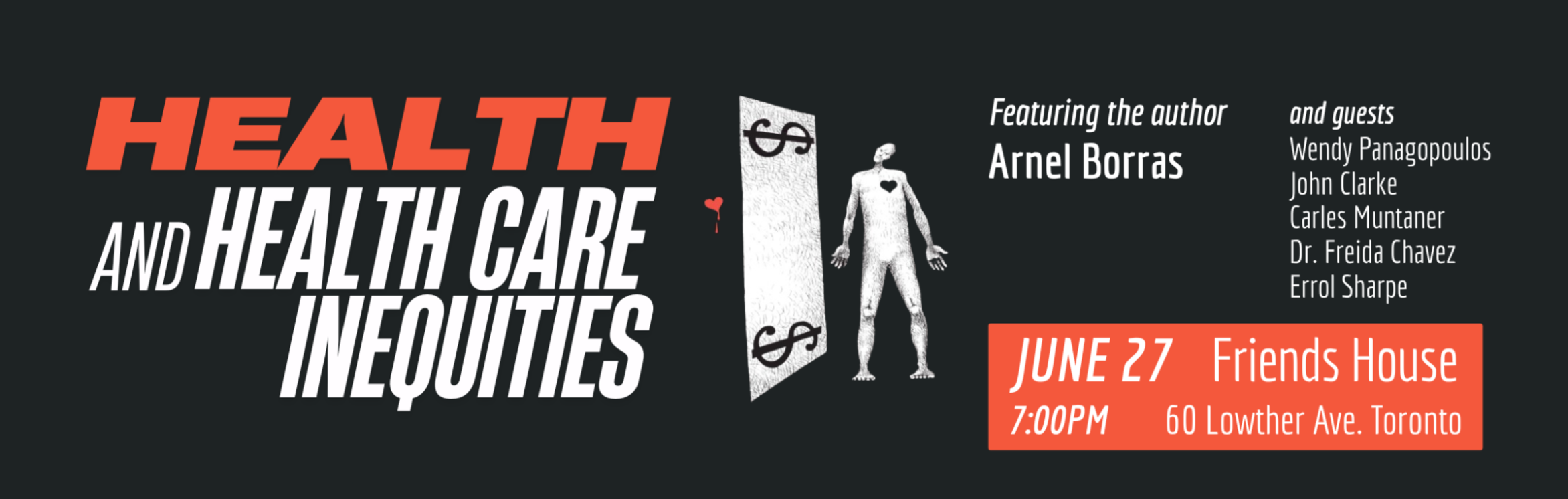
Invitation: Health and Health Care Inequities – Book Launch (June 27)

Hi everyone,

You are warmly invited to the Toronto launch of Health and Health Care Inequities, taking place on Friday, June 27, 2025, from 7:00 to 9:00 PM EDT.

This event is free and open to the public, with both in-person and online attendance options.

👉 Please register in advance:

Select tickets – Health and Health Care Inequities - Toronto Book Launch – Friends House

The launch is co-hosted by the Leo Panitch School with the support of Fernwood Publishing.

Featuring the author Arnel Borras and guests:

  • Wendy Panagopoulos
  • John Clarke
  • Carles Muntaner
  • Dr. Freida Chavez
  • Errol Sharpe

We hope to see you there!

Warm regards,
Arnel

Arnel Borras
*****************

My source: Politics of Health Group Mail List Messages

Visit the PoHG website for lots of interesting links and publications: http://www.pohg.org.uk/

Follow us on Twitter: @pohguk

You can subscribe to / unsubscribe from the PoHG mail list here: http://www.jiscmail.ac.uk/POHG

Wednesday, March 12, 2025

Ambulances, Bikes, Cars and Dennis

There are many rites of passage. Some are universal, others culture specific, or a facet of religious identity. Perhaps there are rites of passage that change over time, or are as yet unclear. When should a young person have their own mobile phone, especially when that phone is 'smart'? Perhaps that is a step too far, to see a phone as a rite of passage? Or, perhaps it signifies an erosion of the human experience of growing-up. 

Mastering a bicycle is, if not a rite of passage, an experience I remember so well. An experience revisited and enjoyed even more as an adult with my own children. It really is something when the hand-lets-go, a signifier of more transitions to follow. 

I learned to ride on two-wheels, in the cobbled backs that ran behind and between the rows of terraced houses. When I was aged 9-10, out on my bike I skidded and came off, trying to stop for a car. It was my fault, the driver was pretty upset too and carried me home. An X-Ray revealed I had hairline fractured of my tibia. I can remember being up so late 'The Untouchables' were on B&W TV. Back then a full-length 'pop' and crutches were required. After the pain subsided, a knitting needle was very useful. The plaster was well-scribed too. I had to attend the fracture clinic at Walton Hospital, Liverpool and still recall Dennis the ambulance gent. He was a great laugh.

I was reminded of this on BBC Radio 4's Today programme, 07:24:35 & 08:55:25, 11 March. Two guests recounted the start of their cycling careers, as adult and a child. British Cycling has started a campaign having found:

Apparently, 97% of children from the richest backgrounds can ride a bike.

While only 86% of children from the poorest backgrounds are able.

This equates to 350,000 children, who would like to ride a bike but can not.


Individual
|
      INTERPERSONAL    :     SCIENCES               
HUMANISTIC  --------------------------------------  MECHANISTIC      
 SOCIOLOGY  :    POLITICAL 
|
Group
Experiences, skills
MENTAL HEALTH
Memory - of 'taking flight'
Life skill: "It's like riding a bike!"
Healthcare role model
Ambulance staff 'Dennis'

Sustainability
PHYSICAL HEALTH
Accessibility
350,000 children
would like to ride a bike.

Fracture clinic Tibia

Childhood - Friends
Adult - Parenthood
Cycling clubs
Socialisation
Social Justice
Engagement - Play


Inequality
97% of children
richest backgrounds can ride a bike.

Only 86% of children from
the poorest backgrounds


When there is a new link I will add it here. In the meantime, can you get on your bike!


Previously: APPG : Cycling : Sport

Monday, November 11, 2024

ii "Nye" | Full Show [now ended] | National Theatre at Home

Watching yesterday on YouTube, I enjoyed NYE and was challenged by it personally and as a grandfather, son, nurse and tax-payer.

It wasn't all sweetness and light regards Aneurin "Nye" Bevin's character. Politically, he clearly pushed boundaries in response to the values he carried on his sleeve. As the family's of many health care professionals may recognise, needs outside the family can be prioritised at the family's cost. The theory-practice gap is expressed in so many ways. 

Whether by intent, or accident, the play points to the timeless challenge of social care and women's role in delivery of this care. This strikes home in the drama not just as care of the elderly, but being confronted (alone) with the slow, painful dying of a loved-one; and the reality of occupational diseases - 'black lung'. Women are exploited as carers, their hearts and feet may as well be bound; in the same way the mine owners exploited the workers. There was a stark reminder for me, of how continuity of care is often lacking today.

Nye becomes personal, as even up to 1970s working class parents would have worried, did worry about the prospect of their (invariably male - with some exceptions?) offspring going down the pit, especially in Lancashire and Yorkshire. Watching and listening to this you can appreciate how education was seen a passport to alternative white-collar work. My paternal grandfather worked in a slate quarry. I recall many invites to punch him in the 'stomach': a slate wall. He walked quite a few miles to work and wasn't that old when he died; although he (soon) followed grandma J.

For quite a while I've been drawn to the theatre. Aged 15 I was Francis Nurse - yes, the irony - in the school play, Arthur Miller's, The Crucible. It was Miss Smith, a drama teacher who first brought my attention to the idea of 'social awareness'. I recall Miss Clayton too who was a student teacher. On visits to London I've been struck by the relevance of Ibsen today. 

If there were to be a play in me, perhaps 'Axes and Crosses' must be-up-there as a working title? For  my father the 11+ exam was the icon to ward off the evil that was work down a mine; or lying under a an excavator / crane at 0400 to get the machine fixed for the shift due to start. The 11+ and need to pass this has provided its own anxiety, burden, and it must be said - motivation not just for me, but many more senior adults. I can see this now. So thank you Tim Price, National Theatre and Nye (2025!) for many further insights into stagecraft. 

See also:
https://www.bohs.org/media-resources/press-releases/detail/deadly-lung-disease-in-uk-kitchen-worktop-workers-is-avoidable/

September 2024: 'The Lightest Element'
https://www.hampsteadtheatre.com/whats-on/2024/the-lightest-element/

Previously:
What wright to care?

drama (theatre), arts

Thursday, September 21, 2023

Raymond Williams Foundation - TARGETED GRANTS OFFER

 Dear Friends of RWF,

Can I remind you of our targeted grant scheme. Perhaps you could help us by sharing this with your network.
 
Best wishes 
Bob Foster


Applications are now open for five targeted grants of up to £1000 to support self-organised adult learning activities or events. Proposals should aim to enable the development and running of self-organised adult learning events or activities which have a progressive, social justice, environmental, or cultural purpose. Priority will be given to applicants on low incomes/universal credit, younger people (under 25's) and black and brown people.

DEADLINE FOR APPLICATIONS: Midnight 1 October 2023

Go to https://www.raymondwilliamsfoundation.org.uk/grants for application form

Bob Foster
RWF Treasurer


My source: PIPs

Wednesday, August 03, 2022

Call for Papers - Basic Needs: Normative Perspectives

for a special issue on
Basic Needs: Normative Perspectives
(Editors: Lukas Meyer – Daniel Petz – Alessandro Pinzani)

Lessico di Etica Pubblica
http://www.eticapubblica.it/
 
In recent years the debate on basic needs and their place in normative theories of ethics and politics has been rekindled. This controversial concept has finally been openly adopted by authors who adopt different approaches to discuss issues of social justice. There are good reasons for this.

As a currency of justice, needs have several advantages. First, in contrast to preferences, desires, and some other currencies, basic needs are fully objective, i.e., whether a person has a basic need for a certain thing is independent of her own or anybody else’s mental attitudes towards that thing. A second important reason for preferring basic needs as the currency of justice is that they are also universal, although their definition might be culturally influenced. Thirdly, basic needs are intrinsically morally demanding: that P has a basic need for O by itself entails that P ought to be able to have, be, realize, etc. O. Finally, basic needs also have an important advantage in the particular context of sufficientarianism. One of the main objections against sufficientarianism is that it is unable to provide a plausible substantive specification of its threshold of sufficiency. The concept of basic needs, in contrast, essentially entails the idea of a qualitative difference. Being able to fulfill such needs takes precedence over being able to fulfill non-basic needs and desires. Moreover, it distinguishes a life that has a certain minimum quality from a life that lacks this quality.

We invite authors to explore these and other aspects of the concept of basic needs and its use for normative theories of social justice, including intergenerational justice.

Contributions can be in English, Italian, German, and French. The deadline is September 30, 2022

For inquiries please contact: Alessandro Pinzani <alepinzani AT gmail.com>
 
*currently.

Saturday, May 21, 2022

Book - "Criminal: How Our Prisons Are Failing Us All"

INDIVIDUAL
|
 INTERPERSONAL    :     SCIENCES               
HUMANISTIC --------------------------------------  MECHANISTIC      
SOCIOLOGY  :   POLITICAL 
|
GROUP

LIFE CHANCES

LIFE SKILLS

(mental) health
learning disability
acquired brain injury
post traumatic disorder
...


Personalised medicine:

"If you use substance 'x' or this class of drugs, then there is a 'y' probability that 'z' will happen." ...
... future ...?

Traumatic Brain Injury Screening
Collective Life Chances

Society ...?

Life Skills 'fit' for 21st C.

EDUCATION
EDUCATION
EDUCATION

Pre-School!
Pre-School!!
Pre-School!!!

equity

Social Justice


I heard Angela Kirwin being interviewed about her book on Times Radio earlier today.

Prisons have changed. Haven't they? Prison reform 'happened'. It is a fact of history after all - Elizabeth Fry et al.? At least according to Social and Economic History GCSE in the 1970s.

Mental asylums changed. They have closed. 

Prisons have (apparently) changed markedly since the 19th - 20th century.

With the 'asylum system' of institutionalised 'care' they share a few things in common..

The 'estate' was Victorian (Winwick Hospital is long gone - leaking, cockroach infested, red carpet at the main entrance - with frequent reference to custodial care and how to change - challenge this.).

Now community care, or care in the community (take your pick) holds sway. 

We are a fifth of the way into the 21st century - can you believe it?

Decades from now will they look at the prison system now and see it as archaic as we see the 'lunatic asylums' pre-20th century (terrible for much of the 20th in fact), and yet we often forget the rationale for their original establishment?

From a mental health perspective what do the social determinants (of health) mean?

Mechanistically speaking, it seems determinism is very much doing its work - too many enter the political system and it's not the one - to represent the community in Parliament.

I've viewed Hodges' model as a resource to highlight parity of esteem at an individual level (physical AND mental health).

Increasing in relevance, I can see its utility in the pursuit of collective parity of esteem.

The most troubling commonality here: care in the community is unfinished. It sort of got started. It fledged, but never took flight.

There were many compassionate, caring, professional staff in the asylums. Exceptional role models. They saw the theory - practice gap. Pointing it out. Aptitude - Attitude. They were the heart in the Victorian shell, even as science struggled (and still does) with the ghost in the machine.

Historically speaking the ‘workhouse’ is closer than we think.

The UK rightly lauds its National Health Service, created in 1948. The Poor Law was also abolished in 1948 (Hillam and Bone, 1999).

Prisons, mental health care, preventive health, health education and community care .. so much still to do.

This sounds an interesting new book too! :-)

Hillam, Christine., and J.M. Bone. THE POOR LAW AND AFTER: workhouse hospitals and public welfare. Liverpool: Liverpool Medical History Society, 1999. ISSN 1364-999x

Friday, May 20, 2022

Join us 6/16 - Virtual tour of The Healing Project's new digital archive

"Join us on Thursday, June 16, 2022 from 12-1p PT / 3-4p ET for a virtual tour of The Healing Project’s brand new digital archive! We’ll discuss what the art, stories, and realities of incarcerated people in the US mean for health professionals’ work to advance health equity in the context of historical and contemporary social justice movements."
 
INDIVIDUAL

|
 INTERPERSONAL    :     SCIENCES               
HUMANISTIC --------------------------------------  MECHANISTIC      
SOCIOLOGY  :   POLITICAL 
|
GROUP

(mental) health equity*


(physical) health equity*

arts
social justice
history
social health equity^
healing communities

incarcerated people
detention
police
health workers
political health equity^


*individual (lived) experience

^collectively experienced (and also 'lived')

Where does violence sit, stand, shout, strike, stun ... in h2cm?

My source: 

Spiritof1848 Listserv WWW.SPIRITOF1848.ORG #Spiritof1848

Monday, December 13, 2021

6th World Congress of the World Association of Cultural Psychiatry (WACP2022)

ROTTERDAM, THE NETHERLANDS 
15 - 17 September 2022 
pre-conference day 14 September 2022

What do we mean by 'culture'?
(draft - ideas...)
 
Individual
|

INTERPERSONAL : SCIENCES
humanistic ------------------------------------------ mechanistic
SOCIOLOGY : POLITICAL
|
Group
As individuals we are socialised into one or more cultures, depending upon our formative years, parenting and guardianship. Individual capacities and opportunities to learn and life experiences all influence a person's self-identity, their relationship to others and the society in which they reside (when not excluded). A key concept here is salience not just for the person, but the people close to them and the community. Reality can be defined individually, and socially; but it is mediated and ultimately negotiated and determined (often legally) elsewhere. This is why education is so important (to all the literacies?), to all in realising their potential. This begins in infancy and early childhood and must be protected.
A scientific perspective, reference and emphasis on evidence at the expense of personal experience. An approach that might be characterised and described as reductionist. It may see the individual in a mechanistic way, as 'broken' with a deficit, often defined in neurobiochemical and increasingly genetic terms that may not be fully understood by the individual concerned. 'Space' here can be interpreted literally; as ability to respire, to live in - shelter, how much space is 'my space' to live in? Personal recognition, status and hence identity, may be accorded and prioritised by papers I possess, the borders proximate to and bounding my current location and the history (evidence) of my being here.
Sociologically speaking, culture and society are discrete concepts. Cultures vary markedly across the globe, and this richness is to be celebrated. It is here we try to 'sense-make' our own context and that of others and the 'world' - if the opportunities are afforded to us (the social determinants of health are realised). Culture is noisy. Its silence can be deafening. Its vibrancy can be joyous, exemplify humanity at its best. Its modes and mediums of communication can also be subverted and weaponised. COVID-19 continues to reveal the value and values of social capital, local community, belonging and relationships, cooperation and our interdependence.
Culture can also refer to the capacity of an individual and society to not only exercise choice, but the range of choices available, access in a cognitive and physical sense. The political culture can profoundly influence freedom, autonomy and self-expression that an individual may represent through several identities and social roles. The combination of these identities and roles contribute to 'make' them the 'person' they are (or should be). Were an individual is vulnerable the culture 'here' also determines the extent of participation socio-economically,  especially when the individual is alone, in poor health and cannot self-advocate. Societies and cultures need security, law and justice to ensure no one is left behind.


My source: twitter @wacp06

Wednesday, July 07, 2021

SIMPOL Supporters Q&A - Corporation tax

Dear Peter,

As a supporter of the Simultaneous Policy (SIMPOL) campaign to solve global problems, we’d love you to join us at our next SIMPOL Supporters Q&A zoom meeting. It’ll be on Tuesday 13th July at 8pm UK time.

We’ll be discussing the recent international agreement on a minimum level of corporation tax signed by over 130 countries. But will it work? To answer that question and others, we’re delighted to have Richard Murphy of the Tax Justice Network with us. He’ll explain the agreement, whether it’ll be effective, and answer your questions. Your hosts will be Rob Cobbold of the Conscious Evolution Podcast and me, John Bunzl, SIMPOL’s founder.

Edited: please ask people to register by sending an email to info@simpol.org and we will then send them the link.

You’ll be very welcome. We look forward to seeing you then!

Best wishes,

John

John Bunzl – Trustee

International Simultaneous Policy Organisation

https://www.simpol.org

Topic: Simpol Supporters Q&A zoom

Time: Jul 13, 2021 08:00 PM London

Sunday, June 13, 2021

Undocumented

individual
|
 
 INTERPERSONAL : SCIENCES
humanistic ----------------------------------------------- mechanistic
SOCIOLOGY : POLITICAL
|

My source:

Pig, C. WARNING: Art Is Dangerous, Profile, Carlos Barberena De La Rocha, PrintMaking Today, Summer 2021, 30: 118. pp.14-16.

https://www.cellopress.co.uk/page/printmaking-today

Image:

https://www.bandoleropress.com/propaganda/category/printmaking


Tuesday, March 30, 2021

A window on social history ...

individual
|
INTERPERSONAL : SCIENCES
humanistic ----------------------------------------------- mechanistic
SOCIOLOGY : POLITICAL
|
group

Ask a child to draw a house ..?

Light
Air*
A row of coal miners' houses with no windows to the street,
Halifax, 1937 by Bill Brandt
 
 
HUMAN RIGHTS


Source:


https://www.billbrandt.com/bill-brandt-archive-print-shop/sp03-coal-miners-houses-with-no-windows-to-the-street-c1937

*and its quality

Monday, March 08, 2021

International Women's Day 2021#ChooseToChallenge

individual
|
INTERPERSONAL : SCIENCES
humanistic ----------------------------------------------- mechanistic
SOCIOLOGY : POLITICAL
|
group

choose

Bulgaria 1957 Women’s Day

Algeria 2004 International Women's Day
to CHALLENGE


Images: https://www.stampsoftheworld.co.uk/wiki/Category:International_Women%27s_Day


Friday, November 06, 2020

Intima - Creativity in a Time of Crisis: Rethinking Vulnerability in Response to Care and Social Justice

individual
|
INTERPERSONAL : SCIENCES
humanistic ----------------------------------------------- mechanistic
SOCIOLOGY : POLITICAL
|
group - population


Welcome to the Fall 2020

Intima: A Journal of Narrative Medicine

We invite you to explore the issue.


In much the same way narrative medicine practitioners invite their patients to become storytellers, vulnerably disclosing their illnesses, we invited contributors to engage in their own acts of vulnerability to submit their poetry, art, media, fiction, nonfiction, Field Note, and academic pieces to the Fall 2020 issue of Intima: A Journal of Narrative Medicine.

More specifically, we invited submissions around the theme: Creativity in a Time of Crisis: Rethinking Vulnerability in Response to Care and Social Justice. Pen to paper, brushes to canvas, and strokes to the keyboard produced a wealth of submissions, many of which hearkened the specialized theme, to narrate the challenging public health and racial unrest that marred 2020. Whether the invitation arrived with much anticipation or as a surprise, we were heartened at the warm response we received and the quality of work we accepted for publication.


The pieces comprising the Fall 2020 issue are varied yet many evoke the images of 2020 as you read stanzas in a poem, gaze onto art, or pour over lines of narrated personal experience. Go to theintima.org to dip into the Fall journal today.


My source: Intima - mail list.

Friday, February 14, 2020

'Desk-topping' i [ c/o BBC Radio 4 today 5 Feb. ]

individual
|
INTERPERSONAL : SCIENCES
humanistic ----------------------------------------------- mechanistic
SOCIOLOGY : POLITICAL
|
group - population


'desktop'

Definition #1 below is as obvious as it is brief. A desk might be topped with various things, so-called executive toys (still?), personal affects, or company related branding.
It may have the proverbial in-tray, out-tray (paper still lingers?). The desk may be clear, or cluttered as a workspace. It will be the home of technology, it's PC - desktop - namesake, that shares the floor nearby, wired the sign of connectedness and energy.


'Desk-topping'

To have 'papers' on the desk, might be to denote action of some sort, but how long are those 'papers' held for?
The subjects of the issue at hand could be experiencing a protracted delay. The desktop in this case exemplifies not just bureaucracy, but obfuscation.


desk·top (dĕsk′tŏp′)
n.
1. The top of a desk.
2. Computers
a. The area of a display screen where images, windows, icons and other graphical items appear.
b. A computer that is designed to be used at a desk or table and is not easily moved, in contrast to a laptop or other portable device. Also called desktop computer.

https://www.thefreedictionary.com/desktop

My source:
BBC Radio 4 Today 5 February- discussion regarding historical child abuse in the Church.

Desk-topping or desktopping?

Wednesday, April 11, 2018

Borders & Boundaries 2018: Debating the limits and possibilities of Education

The Department of Educational Research invite international speakers every summer, and this year we are opening the event up to invite critical interdisciplinary scholars to engage in a range of events which bring together our three research centres: Higher Education Research and Evaluation; Technology Enhanced Learning; and Social Justice and Wellbeing in Education.

This year’s theme is Borders and Boundaries, which will be unpacked by our internationally renowned speakers and a programme of conference presentations on 3rd and 4th of July in the historic city of Lancaster.

Borders and Boundaries: Debating the limits and possibilities of Education

Borders and boundaries is an important theme in educational research and practice, having multiple meanings and interpretations. At one level, this notion reflects critical conceptualisations of place, territories and educational (im)mobilities which have come to the surface in recent years as a response to political and policy changes that seek to limit the movement of people and ideas. Alternatively, borders and boundaries may be taken to refer to theoretical demarcations and interactions, and the increasing emphasis on interdisciplinarity within research, and the associated instability of categories such as academic, practitioner, researcher and educator in the context of efficiency and structural changes within schools, universities and other institutions. This theme also has analytical value for framing debates about the perceived fluidity of formal and informal educational space in the digital age, simultaneously democratising knowledge and blurring the boundaries between professional and personal identities for many educators and academics. Finally, we envisage the theme of borders and boundaries as providing a way into discussions about social distinctions and emotional separations, which shape educational experiences, transitions, and outcomes in a broad range of ways.

Read more...

I have placed the conference themes within Hodges' model:


individual
|
INTERPERSONAL : SCIENCES
humanistic ------------------ Borders & Boundaries ------------------ mechanistic
SOCIOLOGY : POLITICAL
|
group
This theme also has analytical value for framing debates about the perceived fluidity of formal and informal educational space in the digital age, simultaneously democratising knowledge and blurring the boundaries between professional and personal identities for many educators and academics.
... critical conceptualisations of place,
 territories ...

... borders and boundaries may be taken to refer to theoretical demarcations and interactions, and the increasing emphasis on interdisciplinarity within research, and -

Borders and boundaries is an important theme in educational research and practice, having multiple meanings and interpretations.

Finally, we envisage the theme of borders and boundaries as providing a way into discussions about social distinctions and emotional separations, which shape educational experiences, transitions, and outcomes in a broad range of ways.
- the associated instability of categories such as academic, practitioner, researcher and educator in the context of efficiency and structural changes within schools, universities and other institutions.  


factor immobility
occupational immobility
academic / educational (im)mobilities


My source: Jill Anderson, Lancaster University.

Tuesday, December 05, 2017

Quadratic Social Erosion..?

individual
|
INTERPERSONAL : SCIENCES
humanistic --------------------------------------- mechanistic
SOCIOLOGY : POLITICAL
|
group

(a) lived experience

mobility

SOCIAL MOBILITY


SOCIAL MOBILITY COMMISSION


Please see (for context):

BBC News

Social mobility board quits over lack of progress
"Mr Milburn, a former health secretary, took up his role at the commission in July 2012, under the coalition government led by David Cameron and Nick Clegg.Speaking on the BBC's Andrew Marr Show, he said divisions in Britain were becoming wider - pointing to the ongoing squeeze on wages.
The government lacked the "bandwidth" to tackle social division while also dealing with Brexit, he said, describing his task as being like "pushing water uphill".
[My emphasis]

As can be seen, in broad terms, above, Hodges' model can help to promote awareness of holistic bandwidth, facilitating reflective practice, critical and transdisciplinary thinking and person-centeredness. Social mobility is clearly sociopolitical.


Saturday, October 21, 2017

WHO - Who

individual
|
INTERPERSONAL : SCIENCES
humanistic --------------------------------------- mechanistic
SOCIOLOGY : POLITICAL
|
group
Who?


WHO!

Saturday, June 17, 2017

The Compartmentalisation of Grief and Tragedy: RIP

INDIVIDUAL
|
INTERPERSONAL : SCIENCES
humanistic ----------------------------------------- mechanistic
SOCIOLOGY : POLITICAL
|
POPULATION


a person

A LOVED ONE

(timeframe: grief)

(timeframe: Why)

(timeframe: answers)
to questions that should not need be asked 
(again and again....)

'problem'

Fear

uncertainty

advice

flight OR fight

values

ethics

morality

PSYCHO-

a house
a house
.
.
.
a house
a house
Fire a house fighting
.
.
Fire a house fighting
||||||||||||||||||

strength of towers
cladding - facade

material science

introducing: dead space

"probably"
'problem'

property: transparency vs opaque

(time-frame: risk, evidence)

-PHYSICAL
SOCIO-

a HOME

a group of people

family friends

social housing

a community

the most terrible of good-byes

Towers of Strength

SPIRITUAL

(timeframe: social justice)

D.ANGER

'problem'

introducing: a 'new' home

-POLITICAL

property

material evidence

facade - cladding

cost
££ value $$

Health & Safety Law

Building regulations

(timeframe: Public Inquiry)
(timeframe: ACTION)

GOV.UK

'problem'

'political correctness'?

local-regional-national

introducing: another Public Inquiry


Some reflections on the tragic event at Grenfell Tower, London, UK.

Personal note: In posting this, of course, I do not wish to trivialise the enormity of what has happened, the point is that even in disasters - across the world, tools are needed to reflect, think critically, to support learning in order to ultimately assure a safer future for all...


Tuesday, February 07, 2017

Why we need a generic conceptual framework: "Universal person centered care"?

individual
|
INTERPERSONAL : SCIENCES
humanistic --------------------------------  mechanistic
SOCIOLOGY : POLITICAL
|
group-population

PERSON-CENTERED CARE

PERSON-CENTERED CARE

PERSON (FAMILY)-CENTERED CARE

Universal credit...?


My source: The Guardian via Natalie Bennett


Monday, April 04, 2016