Hodges' Model: Welcome to the QUAD: buildings

Hodges' model is a conceptual framework to support reflection and critical thinking. Situated, the model can help integrate all disciplines (academic and professional). Amid news items, are posts that illustrate the scope and application of the model. A bibliography and A4 template are provided in the sidebar. Welcome to the QUAD ...

Showing posts with label buildings. Show all posts

Wednesday, October 29, 2025

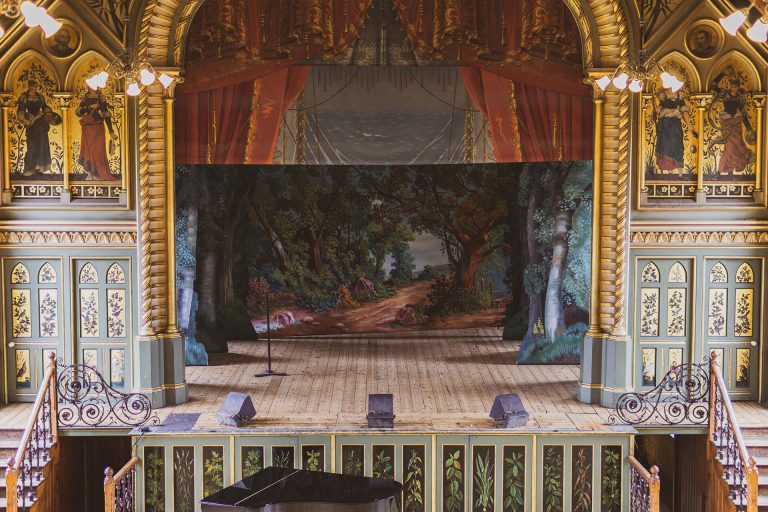
Normansfield Theatre in Teddington

Normansfield Theatre in Teddington

'My favourite building is the amazing Normansfield Theatre in Teddington that John Langdon Down (1828-1896) built to provide positive and stimulating education for learning disabled people (Down syndrome is named after him). At a time when most disabled people would have been shut away in horrific asylums, Down adapted his own house as a residential home, and built a beautiful theatre for creative rehabilitation. It's one of the few surviving private theatres from the period, with original painted scenery and other ornate fixtures, recently remodelled. For me, it's also a reminder of how the wealthy often used their money for good causes, which feels less common now. Jos Boys, guest curator and co-director of The DisOrdinary Architecture Project'


My source: The pick of London Open House. House&Home, FTWeekend. 6/7 September 2025. p.8.

Image: Langdon Down Centre

Previously: 'learning disability' : 'theatre' : 'architecture'

Tuesday, January 16, 2024

Architectural Epidemiology: Rethinking architecture for community and planetary health

Dear colleagues,

I am pleased to invite you to the first Policy Dialogues session of 2024, from the JHU-UPF Public Policy Center:

Architectural Epidemiology: Rethinking architecture for community and planetary health
Thursday 25th January at 6pm CET
Location: Online :: Language: English


Buildings account for nearly 40% of global greenhouse gas emissions (GHGs) and up to 1/5 of chronic disease. In an era of climate emergency, rising global levels of chronic disease and increasing social inequalities, there is an urgent need to reassess and transform buildings and their social and environmental impacts. The new, transdisciplinary field of Architectural Epidemiology offers a roadmap for overcoming these challenges: it aims to transform the building sector from being a major contributor to climate change and chronic disease to becoming one of the primary forces behind their decline.

The JHU-UPF Public Policy Center is delighted to invite Dr. Adele Houghton (Harvard University) to present her cutting-edge work on Architectural Epidemiology in this Policy Dialogue. She will be joined by Dr. Carme Borrell (Barcelona Public Health Agency), who will respond to and discuss the presentation, offering a European perspective on the possibilities and challenges that this field presents for community and planetary health. The session will be moderated by Dr. Mary Sheehan (Johns Hopkins Bloomberg School of Public Health).

We hope you can join us to learn about and discuss this exciting new field of research and action!

Register here, and please feel free to share within your networks.

Best regards,
Aeve Ribbons
Coordinator of Policy Dialogues

My source: Politics of Health Group Mail List Messages

Visit the PoHG website for lots of interesting links and publications: http://www.pohg.org.uk/

Tuesday, March 30, 2021

A window on social history ...

individual
|
INTERPERSONAL : SCIENCES
humanistic ----------------------------------------------- mechanistic
SOCIOLOGY : POLITICAL
|
group

Ask a child to draw a house ..?

Light
Air*
A row of coal miners' houses with no windows to the street,
Halifax, 1937 by Bill Brandt
 
 
HUMAN RIGHTS


Source:


https://www.billbrandt.com/bill-brandt-archive-print-shop/sp03-coal-miners-houses-with-no-windows-to-the-street-c1937

*and its quality

Tuesday, February 02, 2021

Let's build on solid foundations

Individual
|
INTERPERSONAL : SCIENCES
humanistic ----------------------------------------------- mechanistic
SOCIOLOGY : POLITICAL
|
Population


If property, especially housing and places of work are 'located' in an earthquake - seismic hazard zone then there must be laws and regulations that define and assure a level of resilience in the construction and / or time to evacuate.

If people are living in high-rise accommodation then there must be governance, law, standards and tests to check the safety, strength, flame resistance of materials used in construction and fabrication.


 Image: https://www.vippng.com/preview/iTwxbRo_june-1-2-transparent-philadelphia-skyline-outline/

Saturday, November 28, 2020

What is your 'Best' domain ...?


There are times we need to think outside the box.
 
But, when necessary are there 'boxes' you tend not to think in?
 
If so, what is stopping you?
 
 individual 
|
INTERPERSONAL : SCIENCES
humanistic ----------------------------------------------- mechanistic
SOCIOLOGY : POLITICAL
|
group
Best Notch (closed) showroom, 1975
Best Notch (open) showroom, 1975
?
?


My sources:

Images:

Architecture + Branding: The utilitarian box store and design fodder known Best

(source: siteenvirodesign.com)


Wines, J., Heathcote, E. Designing outside the box, Arts, FTWeekend, 21-22 November, 2020. p.15.

Monday, December 30, 2019

Beautiful thought & Houses - Ruskin

individual
|
INTERPERSONAL : SCIENCES
humanistic ----------------------------------------------- mechanistic
SOCIOLOGY : POLITICAL
|
group - population


"There are two ways of getting it, if you do want it. The first is wholly in your own power; to make yourselves nests of pleasant thoughts. Those are nests on the sea indeed, but safe beyond all others; only they need much art in the building. None of us yet know, for none of us have yet been taught, what fairy palaces we may build of beautiful thought – proof against all adversity. Bright fancies, satisfied memories, noble histories, faithful sayings, treasure-houses of precious and restful thoughts, which care cannot disturb, nor pain make gloomy, nor poverty take away from us – houses,- built without hands, for our souls to live in" - Ruskin.


THE WORKS OF JOHN RUSKIN, 
HONORARY STUDENT OF CHRISTCHURCH, OXFORD. 
VOLUME IV. 
THE EAGLES NEST. IX. — THE STORY OF THE HALCYON. I99.
LONDON : PRINTED FOR THE AUTHOR BY SMITH, ELDER & CO., 15, WATERLOO PLACE; 
AND SOLD BY MR. G. ALLEN, HEATHFIELD COTTAGE, KESTON, KENT. 
1872.

My source:
The Ruskin Library, Lancaster University.

Tuesday, November 13, 2018

Purple Tuesday - National Day Disabled Shoppers


individual
|
INTERPERSONAL : SCIENCES
HUMANISTIC ----------------------------------------------- MECHANISTIC
SOCIOLOGY : POLITICAL
|
group

Ability to exercise choice
(visually impaired - buying clothes)

Cognitive access

Do not assume a person
does not have mental capacity

Thought... that really counts
'Exercise'

Physical access
mobility, reach

"Transact on the pavement"
Conduct business with the shopper
outside the store/shop without access

Equipment - maintenance  Extent of provision

Token-
Do not assume that the person
who is with
a disabled person is their carer.

The shopping experience
cafe, restaurant, shops
interaction

training
-ism

activism
The Purple Pound 
£249bn a year on retail and leisure 
customers - clients - citizens

Law: 
The Disability Discrimination Act 1995
The Equality Act 2010
c


My prompt and source:
BBC Radio 4 You and Yours - Consumer Affairs


Saturday, June 17, 2017

The Compartmentalisation of Grief and Tragedy: RIP

INDIVIDUAL
|
INTERPERSONAL : SCIENCES
humanistic ----------------------------------------- mechanistic
SOCIOLOGY : POLITICAL
|
POPULATION


a person

A LOVED ONE

(timeframe: grief)

(timeframe: Why)

(timeframe: answers)
to questions that should not need be asked 
(again and again....)

'problem'

Fear

uncertainty

advice

flight OR fight

values

ethics

morality

PSYCHO-

a house
a house
.
.
.
a house
a house
Fire a house fighting
.
.
Fire a house fighting
||||||||||||||||||

strength of towers
cladding - facade

material science

introducing: dead space

"probably"
'problem'

property: transparency vs opaque

(time-frame: risk, evidence)

-PHYSICAL
SOCIO-

a HOME

a group of people

family friends

social housing

a community

the most terrible of good-byes

Towers of Strength

SPIRITUAL

(timeframe: social justice)

D.ANGER

'problem'

introducing: a 'new' home

-POLITICAL

property

material evidence

facade - cladding

cost
££ value $$

Health & Safety Law

Building regulations

(timeframe: Public Inquiry)
(timeframe: ACTION)

GOV.UK

'problem'

'political correctness'?

local-regional-national

introducing: another Public Inquiry


Some reflections on the tragic event at Grenfell Tower, London, UK.

Personal note: In posting this, of course, I do not wish to trivialise the enormity of what has happened, the point is that even in disasters - across the world, tools are needed to reflect, think critically, to support learning in order to ultimately assure a safer future for all...


Sunday, April 09, 2017

Anti-Dwelling Box (or Boxes?)

individual
|
INTERPERSONAL : SCIENCES
humanistic --------------------------------------- mechanistic
SOCIOLOGY : POLITICAL
|
group

HOUSING


HOUSING

HOUSING
Anti-Dwelling Box (1972) by Kiko Mozuna


"There are postmodernist houses and sci-fi houses - I particularly like Kiko Mozuna's bright yellow Anti-Dwelling Box (1972), in which nests of boxes sit inside each other like a surreal puzzle." p.13.

The Japanese House: Architecture and Life after 1945: Barbican, March 23-June 25 2017.

My source:
Heathcote, E. (2017) The home reinvented, FT Weekend, House&Home, 18-19 March, pp.12-13.

Photo c/o: http://erinwilliamsondesign.com/design-crisis/the-antidwelling-box

Sunday, March 19, 2017

Architects' social conscience - in Hodges' model

individual
|
INTERPERSONAL : SCIENCES
humanistic -------------------------------------------  mechanistic
SOCIOLOGY : POLITICAL
|
group-population
"Architects,
therefore, 
can never supply the 
whole answer 
without a 
complex and lengthy 
engagement 
with specific ...


"There is a sense that the age of the icon is now long dead, that architects need to take their eyes off the skylines and engage with the streets."

"... contemporary architectural culture, swings wildly between two poles. On one hand there is the urge to express (architecture as art)..."

"Aravena made his name with the "half-a-good-house" idea, an elegantly innovative design for a dwelling with a matching negative space beside it into which the inhabitants can expand as necessary when they have the means.


... social,

... and on the other the urge to confess
(social conscience)."

political and economic conditions."

"The current* refugee crisis perhaps
illustrates architects' powerlessness."


*From decades of 'news' experience we can take refugee crises, natural disasters and forced migration to be essentially ongoing and globally pernicious in population impact. Temporary and permanent architectural and housing solutions for people in these extreme situations are therefore critical to improving the lives of millions. PJ

Heathcote, E. (2016*). Architects' social conscience, FT Weekend, Venice Biennale of Architecture, 21-22 May, pp.1-3.

Sunday, February 19, 2017

Space, Memory, Home, Organisation I - Do Ho Soh

individual
|
INTERPERSONAL : SCIENCES
humanistic -------------------------------------------  mechanistic
SOCIOLOGY : POLITICAL
|
group-population

"... Suh creates architecturally scaled, fabric installations informed by his personal experiences, that recreate specific domestic spaces where he has lived, including his childhood home (a traditional hanok-style Korean house), a house in Rhode Island where he lived as a student, and his apartment in New York. Suh weaves translucent structures made of monochrome polyester, at once architectural, and ephemeral, inviting viewers to wander through their dreamlike interior passageways (often complete with details such as light switches and door handles). ..." 
Rubbing/Loving Project: Apartment A, 348 West 22nd Street, New York, NY 10011, USA


Do Ho Suh

Text: http://www.lehmannmaupin.com/

Image: TimeOut - An artist's house is not a home: It's a bunch of drawings
https://www.timeout.com/newyork/blog/an-artists-house-is-not-a-home-its-a-bunch-of-drawings

My source: Bloomberg - Brilliant Ideas
https://www.bloomberg.com/news/videos/2016-10-10/do-ho-suh-on-brilliant-ideas

Thursday, January 15, 2015

Architecture and Design: 4 beds in 4 domains

'Privileged' is definitely the wrong word. Perhaps it is the advantage of experience and the passing of almost four decades and more....

Times have changed since arriving at Winwick Hospital on a bike as a student nurse for an early shift at 0655. I would  leave my bike just down a small corridor to the right of the main entrance. I don't think I locked it. Then depending on the ward allocation I walked through the red carpeted front of the hospital to the increasingly rough and seemingly lost corridors beyond.

Hospitals have changed markedly. Winwick and other asylums have gone - thank goodness.

Cockroaches, leaking roofs, two-storey blocks where when necessary the patients would carry the meals up the stairs. A charge nurse set about ensuring that the patient's were provided with proper safety equipment if there were no lifts. The dormitories were large: 40+ bedded and more. There were lockers of some description I think, but personalised clothing was still to follow in 1977.

Despite the emphasis on community care, a project that in reality is still a work in process, the need for hospital beds remains. I have worked to keep people out of hospital, to help provide crisis support at home. When beds are needed the experience for members of the public and their families is radically different today. As taxpayers we recognise the need for efficiency in design, procurement, commissioning and managing new buildings. So it is within the NHS. Visiting new modern facilities, and this includes private nursing homes, you really appreciate the benefits good design can bring for patients-residents, staff, students and visitors.

individual
INTERPERSONAL : SCIENCES
humanistic ------------------------------------------- mechanistic
SOCIOLOGY : POLITICAL
group
My space
Private space - observations permitting/negotiated
Space to wander
Space for wheelchairs
Colour
Personalisation
Temperature

Why is Joe staying in bed?
Why is Mary not going in the lounge?
...?
4 Bed Multi Bed Bay c/o ProCure21+


Public space
Quiet spaces (who says?)
'Community'
Lounge
Dining areas
Activities room
Noise levels
Meeting rooms
Interview rooms
...?


Public Engagement
Staffing
Volunteers
Project Management
Value for Money
Savings
Security
Policies
Safety
Services
ProCure21+
...?

Image source: http://www.procure21plus.nhs.uk/standardshare/
Saturday, March 10, 2007

Human Ecology (and East Manchester)

This afternoon I had the great pleasure of meeting four people in Manchester who are alumni or currently studying with the Centre for Human Ecology. The CHE is based in Glasgow and so we met to explore the possibility of a NW England CHE group.

My connection with CHE is limited to finding and linking to CHE many years ago. I've an interest in ecosystem health and the effects of urban and rural environments on mental health. I've also pondered a while on the mental health impact of global warming.

Before the meeting Andy took us from Piccadilly Station around the Ancoats - New Islington area part of historic East Manchester. Many former cotton mills are being regenerated. We were able to go into Royal Mills - 198 Historic & New Build Apartments; a stunning building and one of the first mills. No surprise there since Ancoats was the first industrial suburb. We were shown the show apartment, remarkably quiet, warm, stylish ... an award winning example of regeneration, although I'm not sure how affordable this development will be for many locals. That said, it seems the key to regeneration is to increase the local population, to attract new people into the area.Royal Mills East Manchester

I visit the area frequently heading to Leeds on the train Nov-May and taking my youngest son Matthew to the Velodrome, but that's in the car. Walking is of course a completely different experience: the old pub, empty block of flats, new homes, old homes, homes now memories, the air of expectation and frustration - the people! We listened to two locals who chatted about the road and major alterations under way around the old Ancoats Hospital.

According to Andy who arranged things today there are 12 people interested and so more meetings will follow. Great to meet you all - Andy, Jessie, Criggy, and Helen. Thanks to Andy for doing this, letting me use Hodges' model as an ice-breaker and to all for your interest. I look forward to learning more about courses that CHE offers, your various interests/projects and the emergent NW group.

Next time I must use my camera! The single frame I did shoot will follow...
