Hodges' Model: Welcome to the QUAD: drawing

Hodges' model is a conceptual framework to support reflection and critical thinking. Situated, the model can help integrate all disciplines (academic and professional). Amid news items, are posts that illustrate the scope and application of the model. A bibliography and A4 template are provided in the sidebar. Welcome to the QUAD ...

Showing posts with label drawing. Show all posts

Sunday, July 05, 2026

Degree Award in Reflective :: Reflexive Theory and Practice

Joint Hons. Running the Gauntlets in OverThinking

individual
|
INTERPERSONAL
: SCIENCES             
humanistic ------------------------------- mechanistic
SOCIOLOGY : POLITICAL   
|
group 
Photo: Peter Jones - Somerset House


See previous: 6th June 2010 - 'As one chapter closes another opens ...'

 
My source: Somerset House - 1st July 2026 M.C. Escher The Exhibition

Tuesday, January 27, 2026

c/o Intima 'Reflect on the World' . . .

CARE/of Intima:

REFLECT ON THE WORLD WITH US EVERY FRIDAY AT NOON.

No pressure, but we want to remind you that every Friday, around noon EST, we post a Crossroads blog—a short reflection that contributors from our current issue do on something from our archives.

Think of “Friday at noon” as a blip in your busy life where you take time to yourself to reflect on our small part of the universe. Pause and spend 5 minutes reading one each Friday — it’s the equivalent of a deep-breathing exercise, a short yoga stretch, a tiny palate cleanser of lemon sorbet between the complex courses served up to us every day, or a moment stolen between patients or in a waiting room when you step out of your routine. Read the titles of recent ones below, then go and read a few. If you like what you read, set up a reminder alert.

INDIVIDUAL
|
    INTERPERSONAL    :     SCIENCES               
HUMANISTIC --------------------------------------  MECHANISTIC      
SOCIOLOGY  :   POLITICAL 
|
GROUP


My source: Intima (and image) - mail list.

See also: 'reflect' : 'crossroads'

Monday, October 06, 2025

On the 'front' - or behind the line(s)?

In many sources on socio-economics, politics, health policy ... I still note the challenge to represent the INDIVIDUAL and COLLECTIVE within a figure. Of course the author's subject, purpose, the context all influence the final depiction and the message to be conveyed. 

I wonder if Hodges' model can provide a starting point to explore relationships, oppositions, arguments and synergies?

Hodges' model provides an 
expansive and potentially powerful 'front' 
through its horizontal axis 
[ HUMANISTIC ↔ MECHANISTIC ].

This axis - drawn across and through the model vertically, may make it easier(?) to analyse and synthesize the relations at work and produce a diagram?

Individual
|
      INTERPERSONAL    :     SCIENCES               
HUMANISTIC =========================  MECHANISTIC      
 SOCIOLOGY  :    POLITICAL 
|
Group
INDIVIDUAL

INDIVIDUAL

GROUP - POPULATION

GROUP - POPULATION


Tuesday, July 22, 2025

Mary Kelly - Post-Partum Document

From a visit to Liverpool Tate 13.6.2008:

 (Experimentum Mentis III: Weaning from the Dyad)

Individual
|
      INTERPERSONAL    :     SCIENCES               
HUMANISTIC  --------------------------------------  MECHANISTIC      
 SOCIOLOGY  :    POLITICAL 
|
Group


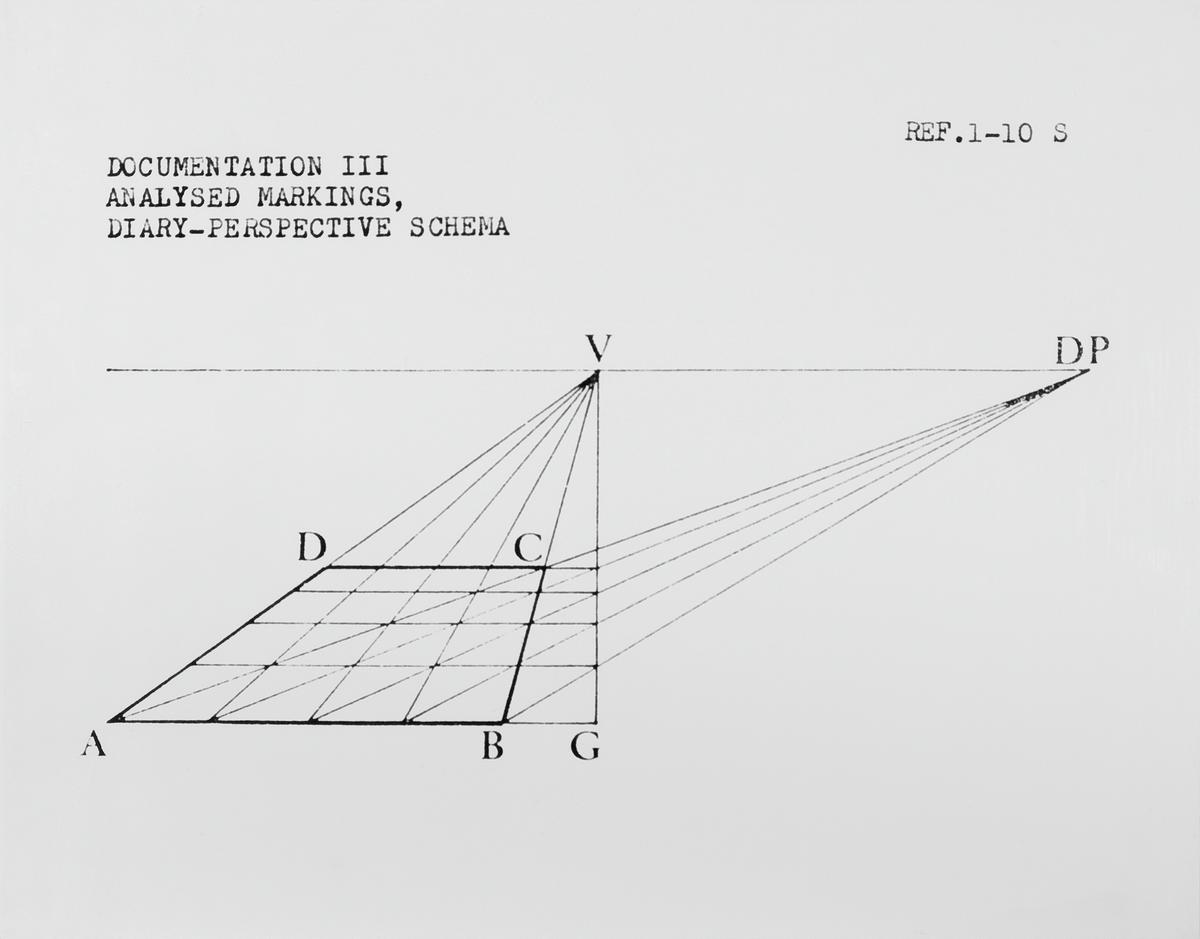
Post-Partum Document. Documentation III: Analysed Markings And Diary Perspective Schema (Experimentum Mentis III: Weaning from the Dyad)

1975, Mary Kelly  © Tate 

'Chalk and crayon drawings by Mary Kelly’s son are overlayed with transcriptions, annotations and reflections based on their interactions as he began nursery. These panels are the third group of a six-part series, each documenting a formative moment in Kelly’s son's early life. Kelly has stated that Post-Partum Document is not ‘autobiographical’. She instead uses her story to suggest ‘an interplay of voices – the mother’s experience, feminist analysis, academic discussion, political debate’. The work subverts romanticised depictions of the mother-child relationship, presenting the experience as inevitably bound up with societal norms and gendered expectations.'

See also: Mary Kelly

  dyad : perspective : art

Friday, July 04, 2025

Diagrams - AMO/OMA at Prada Foundation Venice

"There is no such thing as an innocent map, observes Philippe Rekacewicz in his catalogue essay that accompanies Diagrams, a new exhibition at the Prada Foundation in Venice.

A renowned cartographer, the Paris-born Rekacewicz is well aware of his medium's capacity to transform narratives for good and ill. His own work includes maps that illustrate the deaths of migrants as they bid for new lives in Europe. "A map," Rekacewicz continues, "is above all a social and political act - and therefore inherently subjective."' p.5.

Individual
|
      INTERPERSONAL    :     SCIENCES               
HUMANISTIC  --------------------------------------  MECHANISTIC      
 SOCIOLOGY  :    POLITICAL 
|
Group
Am I Free?

My history ...
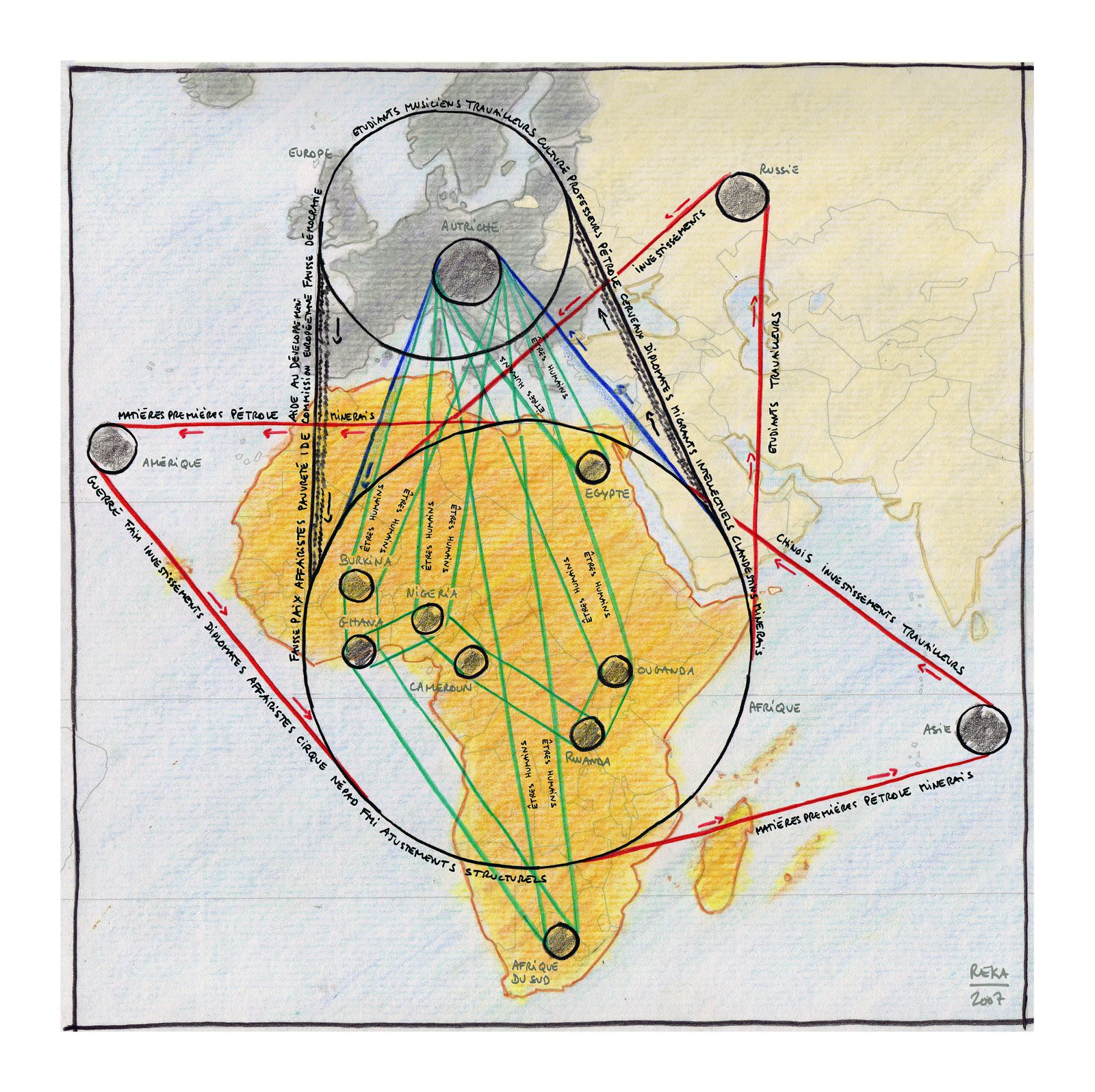
Philippe Rekacewicz / The African big wheel, 2007
The wheel symbolizes permanence and continuity in the context of a profoundly unequal exchange, drawing, color pencil and ink, exhibition copy.
Courtesy Philippe Rekacewicz
(Image credit: Philippe Rekacewicz)

SOCIETY

... is our history ...

Freedom

National & International Law

Justice


'Other pictures are equally revealing for what they conceal. Consider the diagram entitled "Universal commercial history", a visual analysis drawn up by the Scottish engineer William Playfair in 1805 which traces the rise and fall of global wealth since 1500 BC against what he terms "Remarkable Events Relative to Commerce". Playfair, who is said to have invented the pie chart, includes moments such as "Rome founded" "Mahomet's Flight" and "America discovered". He never mentions slavery.

With such a broad-brush approach, lacunae are inevitable. It is a shame that the work of Viennese social scientist Otto Neurath - who, along with his wife Marie and colleague Gerd Arntz, invented the Isotype (International System of Typographic Picture Education) - is not on show. Based on pictograms, Neurath's Isotypes are an lmportant forerunner to the digital vernacular (from emojis to icons) so familiar to us today. Nor does the exhibition include maps of the devastation of Gaza since October 2023, such as those made by investigative research agency Forensic Architecture, which are proving among the most critical diagrams of our time.' p.5.

Philippe Rekacewicz - https://www.grida.no/resources/10988

My source:
Rachel Spence. Hidden truths in the best laid plans. Diagrams | What charts, maps and graphics can - and can't - tell us. Collecting, FTWeekend. 26-27 April 2025. p.5. 
With many thanks acknowledging length of quotation.

Image source:
https://www.wallpaper.com/architecture/oma-amo-diagrams-prada-foundation-venice

See also: 'icon' : 'symbols' : 'diagram' : 'map' : 'Forensic Architecture'

Archived listing Links II Sciences - inc. 'Diagrams' & 'Visualization I' and 'II': 

Saturday, September 28, 2024

'It takes a village ...

individual
|
INTERPERSONAL : SCIENCES
humanistic ------------------------------- mechanistic
SOCIOLOGY : POLITICAL
|
group

... to raise a child.'

"The artist returned to this subject almost  twenty years after he had drawn his red chalk  studies of children walking and standing,  shown nearby. As was typical in Rembrandt's  later works, facial expressions and gestures  are indicated with sparse and abbreviated  lines. It is remarkable that with such economy  the artist conveys an encouraging atmosphere  from the figures who surround the child, as it  takes its first steps. The British artist David  Hockney described this as 'a perfect drawing' in an interview in 2016."

1912,0416.2'


Rembrandt van Rijn (1606-1669)
A child being taught to walk, around 1656
 
Pen and brown ink on grey-brown paper.


The British Museum, Room 90. 28th September 2024.
https://www.britishmuseum.org/exhibitions/new-life-rembrandt-and-children


Sunday, January 14, 2024

'Slugfields Luxury Prison' c/o Isabel Rock - artist

"In November 2022, I spent a month on remand at HMP Bronzefield for my part in the Just Stop Oil protests on the M25. I was happy to go to prison for something I know is morally right. Drawing in prison became my saviour against the monotony. I rarely draw from life anymore, but we were given a little notebook in our 'welcome' bags of grey tracksuits, pastel pants and toothbrush." p.19.
"This drawing is Slugfields Luxury Prison, (152×120cm) the institutional blue doors, plastic chairs, toilet in the corner and the panoptican architecture mirror that of Bronzefields. It's not quite finished yet, but it's been a cathartic experience to draw some of my thoughts on prison life and incarceration by the state." Instagram (and image source).

INDIVIDUAL
  |
     INTERPERSONAL    :     SCIENCES               
HUMANISTIC --------------------------------------  MECHANISTIC      
SOCIOLOGY  :   POLITICAL 
|


Rock, I., 'Drawn Behind Bars' 
PRINTMAKING TODAY, Autumn 2023, Cello Press Ltd. Volume 32, Issue 127, p.19-21.

With thanks to Isabel Rock.

Wednesday, August 02, 2023

"Rational Concepts" 1977 by Norman Dilworth

"Rational Concepts" 1977 by Norman Dilworth. Tate
© Norman Dilworth

Hodges' model: seeking rational* concepts to deliver person-centred, integrated care and make sense of subjective and objective realities.

ARTIST Norman Dilworth 1931 – 2023 [Born in Orrell, Wigan]
MEDIUM Screenprint on paper
DIMENSIONS Image: 600 × 600 mm
COLLECTION Tate
ACQUISITION Purchased 1981
REFERENCE P07424

[NOT ON DISPLAY]

Tate: https://www.tate.org.uk/art/artworks/dilworth-rational-concepts-p07424

*Irrational too.

I sketched Dilworth's image on 5th March at Tate Liverpool, the exhibition: "Keywords. Art, Society and Culture in 1980s Britain" from 28 Feb 2014 to 11 May 2014.

Wednesday, June 14, 2023

[ Towards . . .] A Geometry of Care*

Context -
"Introduction: We present a new model of skilled performance in geometry proof problem solving called the Diagram Configuration model (DC)." p.577.

INDIVIDUAL
|
INTERPERSONAL    :     SCIENCES               
HUMANISTIC --------------------------------------  MECHANISTIC      
SOCIOLOGY  :   POLITICAL 
|
GROUP
"A safe abstraction only ignores irrelevant details, i.e., details which only discriminate between objects that are functionally equivalent with respect to the problem solving task." p.582.

So much to consider here, I may be overstretching analogies but then Hodges' model can act as both a conceptual rack and resolver.


"For instance, to use the side-angle-side rule for inferring triangle congruence a problem solver must locate three congruence relationships - two between corresponding sides of the triangles and one between corresponding angles. In searching for a list of statements for these three relationships, one might need to consider numerous possible combinations of three statements that exist in the list. However, if these relationships are marked on a diagram, one can quickly identify them since the side-angle-side configuration comes together in each triangle at a single vertex. In other words, related information is often easier to find in a diagram because it is typically in the same locality whereas the same information may be separated in a in a list of statements. This is the locality feature of diagrams." p.584.


not just 'local' -


- but intra- interdomain -
with constant stress on safety.


Koedinger, K.R. & Anderson, J.R. (1995) Abstract Planning and Perceptual Chunks. In  Diagrammatic Reasoning: Cognitive and Computational Perspectives. Janice Glasgow, N Hari Narayanan, B. Chandrasekaran (Eds.). Massachusetts: AAAI PRESS / MIT Press. pp.577-625.

Book cover: https://dl.acm.org/doi/book/10.5555/546459

*There may be several? But -
"One of the places where the Geometry tutor expert (GTE) gets bogged down while attempting difficult problems is in the fruitless application of algebra inferences. Algebra expressions can be combined and manipulated in infinite variety and as a result, algebra inferences often lead problem solvers into black holes in the search space from which they may never return." (17.4.3 Avoiding Algebra in the Diagram Configuration Space),  p.593. 


Sunday, October 30, 2022

An observational record and learning from 30,000 years ago

"A fascinating example is the shoulder blade of an ox unearthed in the 1980s (Figure 1) by archaeologists investigating a stone age encampment in the south of France. Carbon dating showed this to be approximately 30,000 years old. The bone was marked with inscriptions that the archaeologist couldn't decipher. It was clear they were neither a tally, nor a pattern, nor any recognisable form of writing. Late one night one of the archaeologists noticed the moon, and something in its shape caught his curiosity.

Aurignacian Lunar Calendar / diagram, drawing after Marshack, A. 1970; Notation dans les Gravures du Paléolithique Supérieur, Bordeaux, Delmas / Don’s Maps
Figure 1 my source: https://sservi.nasa.gov/articles/oldest-lunar-calendars/

Then it struck him. Here, on this fragment of bone, was a lunar calendar complete with 72 observations ... something like 1,600 generations ago. One of our common ancestors (statistically, all of us can claim a relationship to this thoughtful person) 30,000 years ago had the intellectual curiosity to watch the moon, night after night, and then transcribe these movements, at scale, onto the stone age equivalent of the back of an envelope, as he (or she) attempted to "think it through". What makes us human is our ability to think, learn and adapt to our changing environment. The story of the stone age learner gets even better when you imagine a small community of people (adults, adolescents, children on their laps) sitting around a campfire every night working out the meaning of the lunar phases together." pp.72-73.

Abbott, J. & Ryan, T. (2000). Chapter 4, How mass education eclipsed apprenticeship, The Unfinished Revolution: Learning, Human Behavior, Community, and Political Paradox, Stafford, UK: Network Educational Press. (The figure in the book does not include the bone.)

Previously: 'diagrams' , 'archaeology'

[I am also still trying to clear papers and books, as some posts will suggest.]

Saturday, May 14, 2022

New book: "Talking with a Map"

- A Cognitive Analytic Approach
to Everyday Conversational Awareness

 INDIVIDUAL
|

   INTERPERSONAL    :     SCIENCES               
HUMANISTIC --------------------------------------  MECHANISTIC      
SOCIOLOGY  :   POLITICAL 
|
GROUP

MENTAL MAPS

PSYCHO-THERAPIES


MAPS

PHYSICAL-THERAPIES


META-COGNITION


Fingers-crossed please! 

I've contacted Pavilion Publishing and Media Ltd with a review copy request of this new book - available for pre-order:

"Talking with a Map takes cutting-edge techniques for structuring and navigating conversations out of the therapy room and into everyday life, describing a versatile method that anyone can use to develop better skills, interactions and relationships."

Working with two co-authors three papers will hopefully (yes - cross them again) be complete soon. Then I can resurrect the piece on case formulation, diagrams and Hodges' model. 

If anyone is interested please get in touch:

peter.jones AT h2cm.info

Previously on W2tQ:

map :: therapy

Wednesday, December 15, 2021

Alice ...

Individual
|

INTERPERSONAL : SCIENCES
humanistic ------------------------------------------ mechanistic
SOCIOLOGY : POLITICAL
|
Group
Lewis Carroll’s Illustrations for “Alice’s Adventures Under Ground” (1864)


Women's Rights begin..?


My source: 

Critics' choice, Life&Arts, FTWeekend, 19-20 December 2015. regarding: https://www.bl.uk/alice-in-wonderland

Image: https://publicdomainreview.org/collection/carroll-illustrations-for-alice-undergound


See also:

Butt up against the Boxes...?


Tuesday, November 16, 2021

ONE coat: MANY hopes ...

Individual
|

INTERPERSONAL : SCIENCES
humanistic ------------------------------------------ mechanistic
SOCIOLOGY : POLITICAL
|


My source: FTWeekend, 13-14 November 2021, p.8.

Thanks to the illustrator Lucinda Rogers.

Image source: https://twitter.com/LucindaDraws/status/1459617226319880204?s=20

Monday, August 02, 2021

(Incidental - Accidental) Erasure

individual
|
INTERPERSONAL : SCIENCES
humanistic ------------------------------------------- mechanistic  
SOCIOLOGY : POLITICAL
|
group
Angelina Jolie and Bees
"Do Not Erase"


Angelina Jolie and Bees (and beekeepers) 

https://en.unesco.org/themes/biodiversity/women-for-bees

https://www.nationalgeographic.com/environment/article/bee-conservation-women-entrepreneurs-angelina-jolie

"Do Not Erase". Amie Wilkinson, of the University of Chicago, at the Institut Henri Poincaré in Paris. Images courtesy of Jessica Wynne

Jessica Wynne photograph: https://www.thisiscolossal.com/2019/10/mathematicians-chalkboards-by-jessica-wynne/

https://jessicawynne.com/

My sources:
Snapshot, "Do Not Erase" by Jessica Wynne, Life&Arts, FTWeekend, 19-20 June, 2021, p.16.

Jolie adds to buzz at UN beekeeping programme, The Times, July 23, 2021, p.37.


Friday, November 06, 2020

Intima - Creativity in a Time of Crisis: Rethinking Vulnerability in Response to Care and Social Justice

individual
|
INTERPERSONAL : SCIENCES
humanistic ----------------------------------------------- mechanistic
SOCIOLOGY : POLITICAL
|
group - population


Welcome to the Fall 2020

Intima: A Journal of Narrative Medicine

We invite you to explore the issue.


In much the same way narrative medicine practitioners invite their patients to become storytellers, vulnerably disclosing their illnesses, we invited contributors to engage in their own acts of vulnerability to submit their poetry, art, media, fiction, nonfiction, Field Note, and academic pieces to the Fall 2020 issue of Intima: A Journal of Narrative Medicine.

More specifically, we invited submissions around the theme: Creativity in a Time of Crisis: Rethinking Vulnerability in Response to Care and Social Justice. Pen to paper, brushes to canvas, and strokes to the keyboard produced a wealth of submissions, many of which hearkened the specialized theme, to narrate the challenging public health and racial unrest that marred 2020. Whether the invitation arrived with much anticipation or as a surprise, we were heartened at the warm response we received and the quality of work we accepted for publication.


The pieces comprising the Fall 2020 issue are varied yet many evoke the images of 2020 as you read stanzas in a poem, gaze onto art, or pour over lines of narrated personal experience. Go to theintima.org to dip into the Fall journal today.


My source: Intima - mail list.

Thursday, August 13, 2020

Tony Buzan: Mind mapping - mental literacy

Tony Buzan, The Times, April 17 2019, p.57

There are a great many diagrammatic reasoning and argumentation tools available in various forms, paper concept maps and a variety of software. As noted previously on W2tQ ever since watching Tony Buzan's Use Your Head programmes on BBC TV in the 1970s I have been fascinated by the use of drawings to represent a situation, problem and solutions. I was primed to be hooked by Hodges' model in 1987-1988.

I've been sitting on this obituary for over a year. It was sad to hear of Mr Buzan's death and still quite young by today's standards at 76 years. I never managed to make contact with Mr Buzan, although I'm sure I tried, the inevitable email - undoubtedly well-lost.

Now, letting revisions 'relax' [the draft SDGs, public health and Hodges' model resubmission(?)] I'm looking at Drupal (again) and papers that address fundamental questions about h2cm; the axes, care domains.

As an influence I've an old pb copy of Use Your Head and a recently acquired hb copy of The Mind Map Book published by the BBC.

Some of the points of interest to me include:

BULL, B.L. and WITTROCK, M.C. (1973), IMAGERY IN THE LEARNING OF VERBAL DEFINITIONS. British Journal of Educational Psychology, 43: 289-293. doi:10.1111/j.2044-8279.1973.tb02269.x

Bull and Wittrock's study was on 9-10 year olds (p.84). I've often wondered about the age at which Hodges' model could be taught.  I'm sure there are other, 'current' sources but this is a start.

There is a refreshing cultural contrast between the three Eastern basic instructions:

'obey, 'cooperate' and 'diverge'.

While the mind mapping equivalents are the three A's:

'ACCEPT', 'APPLY' and 'ADAPT'. pp.92-93.

If "drawing boundaries on a Mind Map has obvious mnemonic advantages;" is this, to some degree, what the care (knowledge) domains of Hodges' model also achieve? p.103 (and p.149).

Some chapters I can directly 'translate', e.g. -

Chapter 13 - Organising your own ideas -

Self-reflection, Self-care -

- similarly Chapter 18 Self-Analysis

The Mind Map Book
(Ideas stand for 'concepts' the latter no specific entry in the index.).

Chapter 19 Problem-Solving actually refers to interpersonal problem-solving using Mind Maps.

Chapter 19 might be extended to case formulation and especially so chapter 21 Family study and story-telling. I'm thinking of the way in health, whether physical or mental health context there is a narrative to told and listened to, acknowledged and acted upon.

Chapter 22 Thinking and Chapter 23 on Teaching, perhaps has a current analogue in Threshold Concepts and for the former Conceptual Spaces - both chapters stress learning.

The meaning of 'deep' and 'surface' learning has perhaps changed today, but deep being intrinsically motivated still stands - and could be related to the Socratic form of dialogue for engagement. p.228.

On pages 229-232 Mr Buzan demonstrated how people with special education needs can also utilise Mind Mapping. Hodges' model was created, very much with this population in mind, and in the Political domain.

'Mind Maps' ™ Acknowledged.


Wednesday, July 01, 2020

Mutation maps and Genograms in ...

the Health Career Model


individual
|
INTERPERSONAL : SCIENCES
humanistic ----------------------------------------------- mechanistic
SOCIOLOGY : POLITICAL
|
group - population

Mutation map - Ian Bott
Medical Family Genogram - ConceptDraw


Mutation map
Is part of a larger illustration created by Ian Bott for an article in the FT:
Cookson, C. (2020) Mutations map holds key to pandemic fight, FTWeekend, 22 April, p.6.

The full illustration is accessible below:
https://twitter.com/ian_bott_artist/status/1252923754457563136?s=20

Ian's website:
http://www.ianbottillustration.co.uk/
Thank you Ian for your help.

Genogram example:
https://www.pinterest.co.uk/pin/510454939014812330/

Tuesday, January 28, 2020

c/o RCN: Nursing Emotions, Art and History

individual
|
INTERPERSONAL : SCIENCES
humanistic ----------------------------------------------- mechanistic
SOCIOLOGY : POLITICAL
|
group - population

https://www.rcn.org.uk/news-and-events/news/uk-history-of-emotions-in-nursing-new-exhibition-launch-220120

https://www.rcn.org.uk/news-and-events/news/uk-history-of-emotions-in-nursing-new-exhibition-launch-220120
https://www.rcn.org.uk/news-and-events/news/uk-history-of-emotions-in-nursing-new-exhibition-launch-220120https://www.rcn.org.uk/news-and-events/news/uk-history-of-emotions-in-nursing-new-exhibition-launch-220120

My source: RCN as per main link.

Image original (please do see the original - which I have quartered here):
https://www.rcn.org.uk/news-and-events/blogs/emotions-and-the-art-of-nursing-stained-glass

I remember an article in an issue of 'Computer Arts' many years ago on creating stained glass images, the example included fish I think?

Wednesday, November 20, 2019

A key to Health & Art...?

INDIVIDUAL
|
INTER-PERSONAL : SCIENCES
HUMANISTIC -------------------------------------------------- MECHANISTIC
SOCIOLOGY : POLITICAL
|
GROUP

"When you have no power, no rights, no privacy, and no control - when your humanity is denied and your liberty revoked - creativity can still save you. That is the radical message message of The Pencil is a Key, a potent and timely exhibition at the Drawing Center in New York. ...
As Milton declared, "the mind is its own place, and in itself / Can make a Heaven of Hell, a Hell of Heaven". The pencil can be a tool in this act of self-creation. Drawing unlocks the brain's shackles, empowering the passive prisoner with private forms of dignity and escape." p.15.


T
h
e

P
e
n
c
i
l


http://thebottomline.drawingcenter.org/2019/10/16/the-pencil-is-a-key-drawings-by-incarcerated-artists-extended-resource-list/
Chester Brost, Devon Daniels, Joseph Dole, Francisco “Paco” Estrada, Darrell W. Fair, R Dot Nandez,
 Damon Locks, C. McLaurin, Flynard “Fly 1” Miller, Andrés Reyes, Sarah Ross,
 B.R. Shaw, Bring, Johnny Taylor. The Long Term, 2017–2018.
Video animation, 13:05 minutes. Courtesy of the artists.
Image courtesy of C. McLaurin.

i
s

a

K
e
y


My source:
Ariella Budick, The mind unlocked, Life&Arts, FT Weekend, 2-3 November 2019, p.15.


... and looking forward next week to:

RCGP’s 7th Health and Justice Summit: Journeys Through Justice – Leadership and Transformation
Bristol, 25-26 November 2019

- on which more to follow ...

Sunday, September 29, 2019

Scenic Sports ... in Hodges' model

individual
|
INTERPERSONAL : SCIENCES
humanistic ----------------------------------------------- mechanistic
SOCIOLOGY : POLITICAL
|
group - population


Rugby World Cup, photo, Foxsports.com.au, Getty Images
https://www.foxsports.com.au/rugby/rugby-world-cup/wales-unchanged-while-wallabies-swing-the-axe-for-world-cup-blockbuster/news-story/d43fef9a9311da0cd344a888773faab0

My source:
Luyken, J., Environmental exhibition in Austria attracts far-Right ire, The Daily Telegraph, 28 September 2019, p.18.