Hodges' Model: Welcome to the QUAD: maps

Hodges' model is a conceptual framework to support reflection and critical thinking. Situated, the model can help integrate all disciplines (academic and professional). Amid news items, are posts that illustrate the scope and application of the model. A bibliography and A4 template are provided in the sidebar. Welcome to the QUAD ...

Showing posts with label maps. Show all posts

Sunday, October 11, 2026

Ex Carta & The Writer's Map

'Ex Carta - The Nurse's Map'

The bookshop is lost to me now, but I have seen Huw Lewis-Jones's The Writer's Map before, and was well impressed. So it was worth leafing through the Times's Luxx supplement to learn of an exhibition on this theme:

Ex Carta - Zentralbibliothek Zürich

Includes:  Signposts for Navigating Moral Landscapes

Tuesday, 17. November 2026 - 18:00 - 20:00 o'clock

How do people find their bearings when faced with moral conflicts and life-changing decisions? 

Drawing on the ancient motif of Heracles at the Crossroads, Professor Emeritus Paul Michel explores the symbolic significance of paths, crossroads and choices of direction. The lecture examines how such visual and narrative motifs have been used since antiquity to illustrate questions of virtue, responsibility and the conduct of life. It also considers why these enduring images continue to resonate today. At its core is the question of what forms of guidance can help us navigate the moral landscapes of the contemporary world. 

Free of charge. Please register in advance. The event will take place on site at the Zentralbibliothek Zürich and will be held only in German. 


Huw Lewis-Jones, (2018) The Writer's Map - An Atlas of Imaginary Lands, Thames & Hudson.
https://www.thamesandhudson.com/products/the-writers-map

These two resources bring home the unique nature of care and caring and the journey of assessment, planning, intervention and evaluation, with the 'return' point often uncertain. Based on person-centredness alone this is unique. Of course, there is much additional variation and complexity as 'The Nurse's Map' may of course be that of another profession. The application of Hodges' is unique to the participants.

My source: Richard Askwith. Adventures into imaginary universes, Luxx. The Times, 3.10.26. pp.82-85.

Saturday, September 05, 2026

UN votes to adopt new world map to reflect Africa's true size | BBC News

UN tells the world: Stop making Africa look small

'By 164 votes to one, Member States on Friday endorsed a resolution promoting map projections that more accurately reflect the true size of continents – the culmination of an African-led campaign against the 16th-century Mercator projection, still the most widely used map in the world. 

The United States cast the sole vote against, dismissing the initiative as part of a “radical ideological project.” 

Six countries – Estonia, Georgia, Lithuania, Moldova, Serbia and Ukraine – abstained. 

The resolution does not ban the Mercator projection or impose a replacement. Instead, it encourages governments, schools, international organizations and technology companies to use the Equal Earth projection and other so-called equal-area maps when relative size matters, and to teach the limitations of any flat map in representing a spherical planet.'

Continued ... UN


Previously: 'cartography'

Sunday, October 12, 2025

Paper: The spatiotemporal distribution of human pathogens in ancient Eurasia

 Abstract

Infectious diseases have had devastating effects on human populations throughout history, but important questions about their origins and past dynamics remain1. To create an archaeogenetic-based spatiotemporal map of human pathogens, we screened shotgun-sequencing data from 1,313 ancient humans covering 37,000 years of Eurasian history. We demonstrate the widespread presence of ancient bacterial, viral and parasite DNA, identifying 5,486 individual hits against 492 species from 136 genera. Among those hits, 3,384 involve known human pathogens2, many of which had not previously been identified in ancient human remains. Grouping the ancient microbial species according to their likely reservoir and type of transmission, we find that most groups are identified throughout the entire sampling period. Zoonotic pathogens are only detected from around 6,500 years ago, peaking roughly 5,000 years ago, coinciding with the widespread domestication of livestock3. Our findings provide direct evidence that this lifestyle change resulted in an increased infectious disease burden. They also indicate that the spread of these pathogens increased substantially during subsequent millennia, coinciding with the pastoralist migrations from the Eurasian Steppe4,5.

Sikora, M., Canteri, E., Fernandez-Guerra, A. et al. The spatiotemporal distribution of human pathogens in ancient Eurasia. Nature 643, 1011–1019 (2025). https://doi.org/10.1038/s41586-025-09192-8

My source: Carl Zimmer. What has ailed us over time, The New York Times International Edition, July 30th 2025. p.12.

Friday, September 26, 2025

Book: Atlas of Finance

Individual
|
      INTERPERSONAL    :     SCIENCES               
HUMANISTIC  --------------------------------------  MECHANISTIC      
 SOCIOLOGY  :    POLITICAL 
|


Dariusz Wójcik, James Cheshire, Oliver Uberti. (2024). Atlas of Finance: Mapping the Global Story of Money. Yale University Press. https://atlasoffinance.com/

Previously: 'atlas' : 'finance' : 'visualization'

My source:Guthrie, J. Tresure maps. Life& Arts. FT Weekend. 26/27 October 2024. p.12.

Thursday, July 17, 2025

Ryle's 'logical geography'

I like the way Ryle apparently analogised philosophy to cartography.*

'Similarly, Ryle advocated that philosophy should chart the 'logical geography' of our concepts. In The Concept of Mind he argued that the Cartesian dualism of mind and body results from 'category-mistakes': it treats mental concepts which signify behavioural dispositions as if they referred to processes that are just like physical ones, only more ethereal. Ryle rejected Wittgenstein's therapeutic image according to which 'the philosopher treats a question like a disease' (1953: §255). Yet he accepted that philosophy is a meta-discipline which does not 'talk sense with concepts' but tries to 'talk sense about concepts' (1949: 9-10). The paradox of analysis disappears since the task is not to provide novel information about a realm extrinsic to us. According to Wittgenstein, philosophy reminds us of rules that we have mastered in practice but which mislead us in the course of philosophical reflections. According to Ryle, it takes us from the knowledge how to use words to an explicit knowledge that they are used according to certain rules. Either way, analysis is not a trivial pursuit, because the explanation of philosophically interesting concepts is complex and rich, especially when it places these concepts in their diverse contexts (everyday, scientific, philosophical).' p.43.
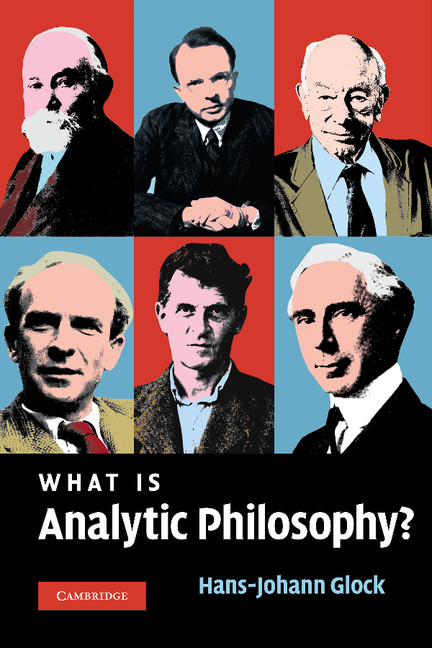
Hans-Johann Glock. 2008. What is analytic philosophy? Chapter 2. Historical survey. pp.21-60. CUP. Pb. 
https://www.cambridge.org/us/universitypress/subjects/philosophy/philosophy-general-interest/what-analytic-philosophy

* 'Ryle analogises philosophy to cartography. Competent speakers of a language, Ryle believes, are to a philosopher what ordinary villagers are to a mapmaker: the ordinary villager has a competent grasp of his village, and is familiar with its inhabitants and geography. But when asked to interpret a map of that knowledge, the villager will have difficulty until he is able to translate his practical knowledge into universal cartographic terms. The villager thinks of the village in personal and practical terms, while the mapmaker thinks of the village in neutral, public, cartographic terms.[20]: 440–2 '. https://en.wikipedia.org/wiki/Gilbert_Ryle

I've wondered about 'cogeography' - combining cognition and geography, even care cartography. There is also of course psycho-politics, geo-psychiatry and psycho-geography ...

Hopefully a more current text would be more diverse.^

Friday, July 04, 2025

Diagrams - AMO/OMA at Prada Foundation Venice

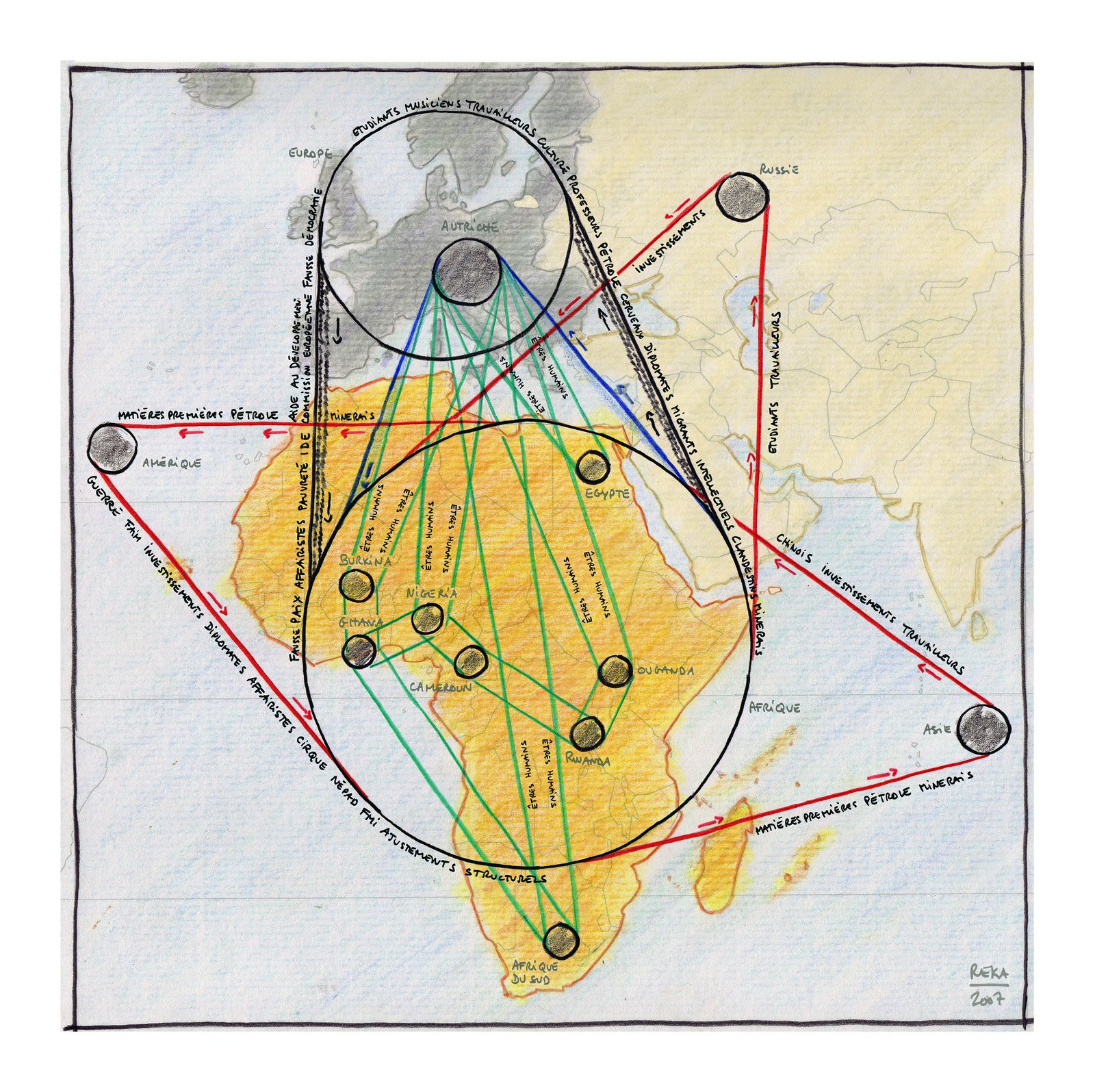
"There is no such thing as an innocent map, observes Philippe Rekacewicz in his catalogue essay that accompanies Diagrams, a new exhibition at the Prada Foundation in Venice.

A renowned cartographer, the Paris-born Rekacewicz is well aware of his medium's capacity to transform narratives for good and ill. His own work includes maps that illustrate the deaths of migrants as they bid for new lives in Europe. "A map," Rekacewicz continues, "is above all a social and political act - and therefore inherently subjective."' p.5.

Individual
|
      INTERPERSONAL    :     SCIENCES               
HUMANISTIC  --------------------------------------  MECHANISTIC      
 SOCIOLOGY  :    POLITICAL 
|
Group
Am I Free?

My history ...
Philippe Rekacewicz / The African big wheel, 2007
The wheel symbolizes permanence and continuity in the context of a profoundly unequal exchange, drawing, color pencil and ink, exhibition copy.
Courtesy Philippe Rekacewicz
(Image credit: Philippe Rekacewicz)

SOCIETY

... is our history ...

Freedom

National & International Law

Justice


'Other pictures are equally revealing for what they conceal. Consider the diagram entitled "Universal commercial history", a visual analysis drawn up by the Scottish engineer William Playfair in 1805 which traces the rise and fall of global wealth since 1500 BC against what he terms "Remarkable Events Relative to Commerce". Playfair, who is said to have invented the pie chart, includes moments such as "Rome founded" "Mahomet's Flight" and "America discovered". He never mentions slavery.

With such a broad-brush approach, lacunae are inevitable. It is a shame that the work of Viennese social scientist Otto Neurath - who, along with his wife Marie and colleague Gerd Arntz, invented the Isotype (International System of Typographic Picture Education) - is not on show. Based on pictograms, Neurath's Isotypes are an lmportant forerunner to the digital vernacular (from emojis to icons) so familiar to us today. Nor does the exhibition include maps of the devastation of Gaza since October 2023, such as those made by investigative research agency Forensic Architecture, which are proving among the most critical diagrams of our time.' p.5.

Philippe Rekacewicz - https://www.grida.no/resources/10988

My source:
Rachel Spence. Hidden truths in the best laid plans. Diagrams | What charts, maps and graphics can - and can't - tell us. Collecting, FTWeekend. 26-27 April 2025. p.5. 
With many thanks acknowledging length of quotation.

Image source:
https://www.wallpaper.com/architecture/oma-amo-diagrams-prada-foundation-venice

See also: 'icon' : 'symbols' : 'diagram' : 'map' : 'Forensic Architecture'

Archived listing Links II Sciences - inc. 'Diagrams' & 'Visualization I' and 'II': 

Thursday, May 29, 2025

Health Policy Watch: WHO’s Big Push to Integrate Traditional Medicine into Global Healthcare Framework

This is quite a development for the lived experience of all individuals, global health and for Hodges' model. Not only for Hodges' model as a universal framework (template) and model for / of care, but the capacity of Hodges' model to conceptually and culturally encompass all data, information, knowledge and wisdom.

c/o HIFA list:

Full text: https://healthpolicy-watch.news/whos-big-push-to-integrate-traditional-medicine-into-global-healthcare-framework/

'The World Health Assembly delivered a landmark victory for traditional medicine and indigenous cultures Monday evening, approving a strategy that calls for increased investment in research and integrating ancient healing practices into modern healthcare systems worldwide.
'The approval marks a breakthrough moment for advocates of traditional medicine, with nations across Asia, Africa, the Middle East and Latin America celebrating the decision. Iran called it “a visionary yet realistic roadmap” to integrate thousands of years of medical like its own.

'But the strategy text shows WHO walking a careful tightrope, embracing practices that represent “accumulated wisdom and healing practices passed down through generations” while demanding they meet modern scientific evidence standards that could take decades to satisfy...'
Best wishes, Neil

HIFA profile: Neil Pakenham-Walsh is coordinator of HIFA (Healthcare Information For All), a global health community that brings all stakeholders together around the shared goal of universal access to reliable healthcare information.

See also: 'Oceania' : 'indigenous' : 'ancient' : 'map' : 'nature'

Saturday, December 14, 2024

The Science of Conceptual Systems - and Hodges' model

Wallis, S.E. The Science of Conceptual Systems: A Progress Report. Found Sci 21, 579–602 (2016). https://doi.org/10.1007/s10699-015-9425-z

From the conclusion:
'The approaches presented here do not provide a ‘‘map’’ for advancing the sciences. Indeed, none is available because we are advancing across that new terrain. What it does provide is a compass suggesting a new and potentially exciting direction to travel. Historically/traditionally, scholars have travelled about the countryside of the social/behavioral land making useful observations and gathering interesting data. They have often staked claims regarding the importance of their terrain. They could not advance more purposefully because they were guided only by intuition. So, they did not know what direction was ‘‘forward’’ although it seemed to have something to do with empirical analysis. Today, with the creation of a new science, we have a new direction.

When we do have a choice between theoretical maps, generally, and metaphorically, this paper suggests that we should choose to create and use roadmaps with many dots connected by many lines; not maps with few disconnected dots.' p.594.

There is also a glossary [pp.594-599] that includes:
'Integral thinking

Understanding (or attempting to understand) the world from a transdisciplinary perspective where those many perspectives are interrelated'
'Integrative propositional analysis (IPA)

Combined processes of qualitative and quantitative analysis involving rigorous hermeneutic deconstruction of propositions found in formal texts including the rigorous reintegration of propositions from those texts following a structured methodology. Also a process of meta-analysis for investigating conceptual systems to determine the Complexity of conceptual systems (diversity of concepts) and the Systemicity of the conceptual system (connectedness between concepts)'

'Mental model 

A representation within one’s mind about how the world works. Useful for understanding and engaging the world and for making predictions'

'Parsimony 

Generally, the understanding that a theory is better when it is smaller. Or, as small as possible while including ideas that are necessary or useful. Ockham’s Razor is a common example'

INDIVIDUAL
|
INTERPERSONAL : SCIENCES              
humanistic ---------------------------- mechanistic
SOCIOLOGY : POLITICAL   
|
GROUP

more SUBJECTIVE

more OBJECTIVE
QUALITY

QUANTITY


'Reflexive dimensional analysis (RDA) 

A process for creating a unified conceptual system from multiple conceptual systems through a process of categorization, abstraction, dimensionalization, and the identification of causal connections'
'Theory 

An ordered set of assertions. Weick (1989, p. 517. Drawing on Southerland)'
Cited above: 
Weick, K. E. (1989). Theory construction as disciplined imagination. Academy of Management Review, 14(4), 516–531.

Previously:
terrain : landscape : line-of-sight (with overlap; of interest in itself)

Wednesday, February 22, 2023

"In all flat maps (and I am one)" - Donne

'Discordia concors' - 'Concordia discors' ... plus ... 'Site map'*

"Drawing both on the medieval Mappae mundi and the Ptolemaic tradition revived in the Renaissance, the recurrent cartographic motif in John Donne’s poetry well reflects the preoccupations of a revolutionary period in the history of Western cartography. Yet, for all its cosmic magnitude, Donne’s poems, both holy and secular, are turned, not so much towards an exploration of the world as towards an exploration of the Self as the ultimate object of reflection." [Abstract].


Ladan Niayesh, ““All flat maps, and I am one”: Cartographic References in the Poems of John Donne”, Études Épistémè [Online], 10 | 2006, Online since 01 October 2006, connection on 22 February 2023. URL: http://journals.openedition.org/episteme/955; DOI: https://doi.org/10.4000/episteme.955

 INDIVIDUAL
|
 INTERPERSONAL    :     SCIENCES               
HUMANISTIC --------------------------------------  MECHANISTIC   
SOCIOLOGY  :   POLITICAL 
|
GROUP

"Let us take as a first example one of the last poems written by Donne, "Hymn to God my God, in my Sickness", composed either during one of the poet’s serious illnesses in 1623 or alternatively shortly before his death in 1631 ..."


"... Here the poet compares himself, as he lies on his sick-bed, or possibly his death bed, to a flat geographical map studied by his physicians who are compared to cartographers: "my physicians by their love are grown / Cosmographers, and I their map, who lie / Flat on this bed" (ll. 6-8), and later "In all flat maps (and I am one)" (ll. 14)."

The global
Psycho-Social-Geo-Political
legacies and future?


"Yet for all its symbolic Noachid and Christian background, Donne’s cartographic imagery has room for the latest scientific contributions. Newly discovered territories are directly named here: "is the Pacific Sea my home?" (l. 16), "Anyan, and Magellan, and Gibraltar" (l. 18). And if this metaphorical map is a flat one — "In all flat maps (and I am one)" — it is solely for the sake of commodity, as this flat shape actually stands for an acknowledged and accepted spherical reality: "west and east / In all flat maps (...) are one" (ll. 13-14)."


*I found some irony in 'site map' being the final map on the journal's webpage.

Sources:
 
London July 2022 Foyles, Waterstones and other bookshops:
Super-Infinite: The Transformations of John Donne (Hardback)
https://www.faber.co.uk/product/9780571345915-super-infinite/

BBC Radio 4 Super-Infinite by Katherine Rundell [Episode 3]

Previously on W2tQ: 'maps'

Thursday, January 26, 2023

Edge(s) Computing ... IEEE EDGE 2023

IEEE EDGE 2023 - CALL FOR PAPERS

c/o AI-SGES list


“It’s the edges of the maps that fascinate ...”
― David Mitchell, The Bone Clocks
[Goodreads.com]


 INDIVIDUAL
|
 INTERPERSONAL    :     SCIENCES               
HUMANISTIC --------------------------------------  MECHANISTIC   
SOCIOLOGY  :   POLITICAL 
|
GROUP
'domains'

"Edge computing, as the convergence of computing and communications executed close to data collection and places of storage and application, provides a paradigm that offers several research and application opportunities across a wide range of domains." ... [IEEE EDGE 2023] ...

'domains'
'domains'


Wednesday, November 02, 2022

Three Norths <----> Souths too...?

Map norths converge on Dorset village in historic first (BBC News)

Ordnance Survey said the historic triple alignment made landfall in Langton Matravers near Swanage on Wednesday

"A small village has made map reading history and become the first place where true, magnetic and grid north have met at a single point.

According to the Ordnance Survey (OS) the historic triple alignment made landfall in Langton Matravers, near Swanage in Dorset, on Wednesday.

It will stay converged for three and a half years as it travels through the UK.

OS spokesman Mark Greaves said it was not related to climate change.

Records held by the OS, Britain's national mapping service, date back to the 1930s but Mr Greaves said this was the 'first time ever in British mapping history' the three norths had aligned.

'Magnetic north has a habit of wandering around, but this is unusual, it's not been in this orientation for hundreds of years,' he added" 

Continued...

Map image: http://www.itraveluk.co.uk/maps/england/4876/dorset/langton-matravers.html 

Previously: 'compass' & 'SOUTH'

Saturday, September 24, 2022

'ABCD' mapped to '1234'*

For context [UK politics and policy] please see below ...

INDIVIDUAL
|
 INTERPERSONAL    :     SCIENCES               
HUMANISTIC --------------------------------------  MECHANISTIC      
SOCIOLOGY  :   POLITICAL 
|
GROUP

BACKLOGS

Person-centred: "Am I there yet?"
Service-centred: "Are we there yet?"


AMBULANCES

'Just in TI:ME' [not]

Hand-me-over-why-don't-you?


(Social) CARE


DOCTORS

DENTISTS


"Sally Warren, director of policy at The King’s Fund,
said that Our Plan for Patients ‘amounts to little more
than tinkering at the edges’ despite containing some
‘sensible’ policies."     https://www.nursinginpractice.com/


Whether tinkering or not, don't forget and do take care around all the edges.
Do 'C' the low-hanging fruit.

[Just to be clear: This isn't about ✔ in boxes.
It's about integrating care, values, quality and safety. ]

https://www.nursinginpractice.com/latest-news/therese-coffeys-plan-for-social-care-only-short-term-solution/

^ and '5' the Spiritual too.

Context:

"Thérèse Anne Coffey is a British politician who has been Deputy Prime Minister of the United Kingdom and Secretary of State for Health and Social Care since 6 September 2022." Wikipedia.

"For Coffey, 'ABCD' stands for ambulances, backlogs, care, doctors and dentists – and rightly so." The Guardian

See also: c/o The Health Foundation

What are the public’s priorities for the NHS? And is the government listening?


Thursday, June 23, 2022

New WHO Quality Toolkit


"On Monday 20 June WHO launched the Quality Toolkit - a new interactive, online resource for anyone at any level of the health system interested in improving the quality of health services.

The Quality Toolkit provides users with tools to facilitate specific actions to enhance the quality of health services. It is a companion resource to WHO Quality Health Services: a planning guide which provides an outline of key actions to be taken across the health system. The Toolkit then supports these actions with numerous tools. It also enhances understanding of the key interlinkages across the health system when implementing any tool.

The Toolkit incorporates key WHO-published tools and other materials related to quality of health services. It will be updated periodically to reflect new and emerging information relevant to improving quality of health services, including WHO technical products currently under development.

The Quality Toolkit is available at: https://qualityhealthservices.who.int/quality-toolkit

HIFA members are invited to navigate the Toolkit and consider how they might use the tools as part of their improvement efforts. WHO welcomes feedback on the Toolkit qualitytoolkit AT who.int "

Via - HIFA - https://www.hifa.org/

I - IDENTIFY tools and resources relevant to quality of care
M - MAP those tools against improvement needs or identify gaps
P - PLAN implementation of activities for improving quality of care
R - RECOGNIZE interlinkages between technical areas and the process of change
O - OPTIMIZE multi-level action
V - VISUALIZE journeys for improving quality of care
E - ENGAGE stakeholders across the health system


INDIVIDUAL
|
 INTERPERSONAL    :     SCIENCES               
HUMANISTIC --------------------------------------  MECHANISTIC      
SOCIOLOGY  :   POLITICAL 
|
GROUP

IDENTIFY (context)

PLAN^ (mental health)

RECOGNIZE*

needs

gaps


IDENTIFY (context)

MAP / VISUALIZE

PLAN^ (physical health)

OPTIMIZE

technical areas
gaps
needs


IDENTIFY (context)

ENGAGE

needs
gaps


IDENTIFY (context)

RECOGNIZE*

needs
gaps


Above rendering idealised and all embedded within spiritual and ethnocultural context.

*Recognition required politically to avoid individual frustration and facilitate (policy ...) coherence.

^Planning should (must) take into account need for parity of esteem between mental and physical health (with triage situations acknowledged).


Source: Jules Storr, Independent Consultant, S3 Global & working with WHO as part of the Quality Toolkit development team - via HIFA

Saturday, May 14, 2022

New book: "Talking with a Map"

- A Cognitive Analytic Approach
to Everyday Conversational Awareness

 INDIVIDUAL
|

   INTERPERSONAL    :     SCIENCES               
HUMANISTIC --------------------------------------  MECHANISTIC      
SOCIOLOGY  :   POLITICAL 
|
GROUP

MENTAL MAPS

PSYCHO-THERAPIES


MAPS

PHYSICAL-THERAPIES


META-COGNITION


Fingers-crossed please! 

I've contacted Pavilion Publishing and Media Ltd with a review copy request of this new book - available for pre-order:

"Talking with a Map takes cutting-edge techniques for structuring and navigating conversations out of the therapy room and into everyday life, describing a versatile method that anyone can use to develop better skills, interactions and relationships."

Working with two co-authors three papers will hopefully (yes - cross them again) be complete soon. Then I can resurrect the piece on case formulation, diagrams and Hodges' model. 

If anyone is interested please get in touch:

peter.jones AT h2cm.info

Previously on W2tQ:

map :: therapy

Wednesday, May 04, 2022

Triangulation: When is a light an axis?


...when there are two lights ...

32c St. Joseph single
https://postalmuseum.si.edu/object/npm_1996.2066.165

See also:

https://en.wikipedia.org/wiki/St._Joseph_North_Pier_Inner_and_Outer_Lights


Monday, May 02, 2022

Review ii - "Brainscapes: The Warped, Wondrous Maps Written in Your Brain―And How They Guide You"

Brainscapes

Now I know how Umami (p.87) an "example food magazine website to demonstrate some of the features of Drupal core" - got its name. I'm sure this was explained at a Drupal Meetup. Savoury indeed!

There had to be two! The brain has two strategies: brain maps and distributed codes.

"Representing information with a distributed code is entirely different from representing it with brain maps. In a brain map, neighboring neurons represent neighboring regions in space, frequency, time, and so forth. And brain maps essentially represent information using location, or where in the brain area the neurons are most active. In contrast, there is no consistent relationship between neighboring neurons in brain areas that use distributed codes. These areas represent information through the distributed pattern of activity across that entire region of the brain, rather than through the location of activity within it. This pattern of activity is a kind of code." pp.93-94.

This distinction is significant for Hodges' model, as the distributed codes act to deal with novelty, what is new - ongoing (lifelong) learning (p.95). Hodges' model can help distinguish between subjective and objective concerns. Schwarzlose unifies the two - via a catfish (also a goal here - but not necessarily with such an assistant).

"The map in the olfactory bulb is organised into odor zones based on molecular structure, an objective property of these compounds in the physical world. But the second map is organized into zones based on the significance of the odors to the animal." p.100.

Chapter 6 'On the Move: Brain Maps for Action' would have been useful as a student nurse at Winwick Hospital, the history in the book brings back many reminders - late 1970s. Epilepsy, then was less well understood, and managed. In describing the M1 brain map and movement I wondered about consent, but can see that is a distraction. Chapters -

6. On the Move: Brain Maps for Action | 107
7. Maps in the Making: How Brain Maps Develop and Adapt | 131
8. Knowing Again: Brain Maps for Recognition | 151
- offer much to relate to clinical encounters: movement, reaching, infant versus the brain in adults, the senses and catastrophic events such as cerebrovascular accident - stroke. Morphologically there is much still to learn (brain maps are 'primed' before birth), which perhaps is why we recognise the remarkable nature of gestation and birth. 'Maps in the Making' provides wondrous insights, including the need in hospitals to rethink the sensory environment and experience for premature infants.

While reading - I was struck at the experience of the newborn and mothers in Ukraine. The 'health career' model concerns life chances - from birth to later life...

As a community mental health nurse I have found subtle and less-subtle impacts on a person affected by semantic dementia (p.204) and their family. Given the ongoing invasion and war, I also thought about people living with dementia and having to flee their homes. The multiple contexts that pertain in such a crisis situation when considering 'maps' and sense-making. Especially, when the need for action is preemptive - preventive and so must be explained and justified, not once but perhaps repeatedly?

We are all innate mathematicians even if we feel we have no ability. 

https://www.google.com/search?client=firefox-b-d&q=mathematics+in+catching+a+ball

I take some succor in this (p.127).

There's a hodgepodge in here too (p.161 hb). The myriad of objects we encounter and their recognition calls for the combination of brain maps and distributed codes. Chapter 8 is more psychological, touching :-) how we categorise objects, dimensions and scales, size and animacy. Galton's contribution is discussed, his ideas on eugenics also acknowledged. Visual perception, mental imagery and visual learning style remain subjects of note for researchers. I'm not sure why figure 32 stood out ( :-) - please pardon the quality of the photo. Paul Kim's illustrations are an excellent support for the prose.):

FIGURE 32 A comparison of visual perception and mental imagery in
the V1 visual map. Paul Kim

Somewhere I've saved an article on mental imagery from New Scientist I think, about this ability - the mind's eye and how it is missing for some 'brilliant' people (p.182) and posted previously:

In my mind's eye I can picture care: Frame by Frame

I might read Chapter 9 again, attention, action and perception in combination. 

Chapter 10 had me thinking again about 'Conceptual Spaces' (quality dimensions) and threshold concepts (not in the book - but this is a positive!):

"Many of the concepts that rule our financial, social, and emotional well-being have no shape, no color, no odor or weight. How do we grasp these intangible concepts? As it turns out, we often do so by aligning abstract concepts with physical dimensions and then putting our brain maps to work." p.191.

There is a 'mental number line', vertical too, and culture is a factor in how we learn and the brain associates space and quantities, in which L-R, low-high are also brought into play. The question remains here: Is Hodges' model culturally neutral? 

Still with h2cm - mind reading, writing and 'drawing' perhaps? p.236. In "Fortune-Telling with the Brain" we read about how fMRI is allowing us to learn how the brain maps employ teamwork. There is an architecture whose stability can inform predictions of future abilities - reading is described. Reading this you see ethical implications (as Schwarzlose warns p.238), but it may help to target personalised learning, as an adjunct to personalised medicine? I double checked (index) and the connectome is not mentioned, but the benefits of this research is still to be realised. In 'prison health' here in the UK (and globally?) it is long overdue but it is encouraging to hear about the focus on investigation for previous brain injury within the prison population. Remember - lead in fuel and the socio-economic impacts of pollution (ongoing - air and plastic pollution)?

Corporations have literally only 'scratched the surface' of the future potential to 'read' us individually. Through Hodges' model I can qualify and justify the model's increasing relevance. Technology and science not only call for SOCIO-technical approaches. The brain-computer interface and AI (p.239) demands we also consider the several forms of literacy and informatics that are needed in the 21st century: bio-informatics, bio-political, psycho-political and more.

This is very informative and timely read - the diagrams too. This is a book for all. For student nurses specifically, it will enable them to maximize learning in their practical placements and throughout their course of study.

Writing this review I can also see the important messages in chapter 12 - recognition of infancy and the opportunities this affords.

Many thanks to Rebecca Schwarzlose and Profile Books for my review copy.

Schwarzlose, R. (2021) Brainscapes: The Warped, Wondrous Maps Written in Your Brain―And How They Guide You". London: Profile Books.

Friday, April 29, 2022

The cognitive map ...

"... in infra-humans should be viewed as a spatial map in which representations of objects experienced in the environment are ordered within a framework generating a unitary space. However, the central property of the locale system is its ability to order representations in a structured context. We hope to show, in this final section of the book, that mapping structures can represent verbal, as well as non-verbal, information. For both of these forms the locale system will be shown to be central to a particular form of memory: that concerned with the representation of experiences within a specific context. We shall argue that memory comes in two basic varieties: (1) memory for items, independent of the time or place of their occurrence; (2) memory for items or events within a spatio-temporal context." p.380-381.

John O'Keefe and Lynn Nadel. (1978) The Hippocampus as a Cognitive Map. Chapter 14, An extension of the theory to humans. Oxford: Clarendon Press. pp.380-410.

The Hippocampus as a
Cognitive Map
(with a dedication)
TO
E. C. TOLMAN
Who first dreamed of cognitive maps in rats and men
D. O. HEBB
Who taught us to look for those maps in the brain
AND
A. BLACK
Who insisted that we pursue our route with rigour


Source: my notes mid-1990s.

Book cover: https://www.goodreads.com/book/show/2645838-the-hippocampus-as-a-cognitive-map

Thursday, April 28, 2022

Review i - "Brainscapes: The Warped, Wondrous Maps Written in Your Brain―And How They Guide You"

Brainscapes


A marvellous cover (US too), a fascinating, clearly written and hence readable book. As expected today the layout, print size and design add enjoyment to the time invested.

As a nurse with an interest in science you are aware of much of the content in broad terms but 'Brainscapes' provides more detail and made me wonder about the prospects to follow from improvements in brain imaging, The Connectome, new technologies and techniques. Rebecca maintains the focus throughout.

I'm pleased to add this to my CPD reading list.

Nature and science are humbling. It is still quite recent that we realised the milky way is one of billions of galaxies. Now we can appreciate not only the complexity of the brain, but how it is embodied in mind, body and our experience of reality.

There is history here to begin. Russia and Japan were at war in 1904. Russia had a new high-velocity rifle with smaller bullets, 7.6mm reaching speeds of 620 meters per second. Whether co-incidence, and/or ironic, there are of course many brains trying to make sense of the current conflict in Eastern Europe. A change in injuries followed with these bullets capable of passing straight through the skull, sparing the life of the soldier and yet with life altering injuries. 

As triage was founded on the battle-ground. So aftercare is grounded in the journey back 'home' for those who can make it and the extent to which 'veterans' and their families are recognised.* This lead to investigations (Inouye, see below) as soldiers experienced localised damage to the brain. Soldiers suffered scotomas affecting their vision, stimulating research and new approaches, devices 'cranio-coordinometer'. There are illustrations and some photographs throughout, the illustrator Paul Kim, adding to the text.

In 'Maps of You' maps are everywhere especially on screens, and yet as Schwarzlose notes the map's materials matter little. On p.17 "All I need is a pen and a scrap paper" I smiled - given the 'map' that Hodges' model provides, on paper, sand, black/whiteboard and mind's eye. Mental imagery is there too. Salience, figures early p.19 and with brain maps, visual maps and where we direct our gaze prompts more detailed consideration of context. The explanations of the sensory brain maps is fascinating, especially how the brain has evolved to deal with constraints of space, energy, distance and organisation. At the fovea in the eye, the map is magnified. 

Perhaps in Hodges' model there are two fovea? One is the center of the model, the person-centred nexus an assurance function/correction as the fovea that is context shifts and jumps in response to the dynamics of the situation. Reading about the audio map, p.73 I thought about the 'timbre of care' (Yes, I've a bad case of h2cm-meme-mapitis). As a further sign of the times, chapter 5 (A Body Under Siege) on taste and smell and the protective function of what we do or don't ingest, I travelled from the individual to the national and the binary choices (yes or no) being exercised right now.

More to follow ...

Alexander P. Leff (2015) Tatsuji Inouye (1881–1976), Discovery UCL.
https://discovery.ucl.ac.uk/id/eprint/1491645/1/Leff_tatsuji_inouye_1881-1976.pdf

Many thanks to Rebecca Schwarzlose and Profile Books for my review copy.

*Apologies for digression...

Tuesday, March 15, 2022

PhD Opportunity: An Atlas of Health and Social Inequalities


Excited to announce that we have funding for a +3 studentship in the UCL Department of Geography for the project “An Atlas of Health and Social Inequalities”. The research will be carried out in association with the Health Foundation and will comprise the creation of a range of innovative datasets presented through a series of ground-breaking maps and graphics. The project will centre on the Health Foundation’s Social and Economic Value of Health: Place programme, which is designed to generate new knowledge about the ways in which the physical and mental health of a population shapes their social and economic outcomes. The Health Foundation have funded a number of research projects already that focus on understanding the relationship between a given population’s health and the health of individuals within that population.

The PhD will benefit from insights from these projects and focus on the creation of a nationwide atlas to demonstrate the social and economic value of health. It will produce a series of research-led maps created from innovative and granular datasets to demonstrate the new ways that health data can be visualised. These will convey a range of variables including health metrics such as mortality, self-reported health, prevalence of specific health conditions, and social and economic outcomes including employment, pay, structural changes to industrial sector composition and social fragmentation.

The work will be supervised by myself (James.Cheshire AT ucl.ac.uk) and Dr Anwar Musah (a.musah AT ucl.ac.uk), to whom enquiries may be directed. The successful applicant will hold a First or Upper Second Class honours degree in a quantitative social science or computer science discipline and/or similar Masters qualification.

For further details on eligibility etc please see here.

CLICK HERE TO APPLY (Deadline 4th April)


My source: Spirit of 1848

Saturday, August 21, 2021

"Mapping Beyond Cartography" - to Situated Cognitive Maps

"... the ‘spatial turn’ in the humanities has been partially overtaken by an ‘object turn’ in which relations between things are not primarily considered in spatial terms." pp. 53-54.


Individual
|

INTERPERSONAL : SCIENCES
humanistic ------------------------------------- mechanistic
SOCIOLOGY : POLITICAL
|
Group

"Tuters (2010), for example, calls for ‘post-locative practices’ that move beyond a ‘mannerist situationism’ to emphasize ‘situated’ rather than located media. This requires replacing ‘the concept of geographic location as the core concept of locativity, with the more relational notion of proximity, not only in relation to place but also in relation to matters-of-concern’ (2012: 275). This shift is advantageous in that it allows that locative media (or some successor form of it) might address relations and phenomena that are not fixed to terra firma, but it also suggests that space has become completely irrelevant, that geographic maps might, as Tuters suggests, be replaced by cognitive maps (2012: 274). p.63.


"... even in a world without the surefooted sense of grip that cartography once provided, I want to suggest that there are other ways by which to find some sense of orientation. In unfamiliar territory and without a map, the wayfarer draws on the tales of travellers who have gone before, surveys the shape of the landscape with an eye for landmarks, builds cairns where there are none, and eventually learns how to triangulate between them and make some kind of map –whether cognitive, sketched or plotted. In a situation in which the maps we increasingly inhabit subject us to a form of colonization, there seems no alternative but to ‘map or be mapped’." p.383.

"For Edward Tufte, computer-generated visualizations of data are simply the latest iteration of a brand of ‘cognitive arts’ that includes maps, alongside mathematical projects, scientific charts and diagrams, and even MRI scans (1990: 40)." P.173.

"Indeed, for Fredric Jameson, post-modernity’s ‘un-map-ability’ is its key defining characteristic: ‘this latest mutation in space—postmodern hyperspace—has finally succeeded in transcending the capacities of the individual human body to locate itself, to organize its immediate surroundings perceptually, and cognitively to map its position in a mappable external world (1991: 83). This crisis of representation in cartography calls for new kinds of maps; for Jameson, a form of ‘cognitive mapping’ that might allow the individual to locate themselves not just spatially, but economically, culturally and politically." p.82.

Daniel James Frodsham, April 2015. Mapping Beyond Cartography:The Experimental Maps of Artists Working with Locative Media. PhD thesis. University of Exeter. https://ore.exeter.ac.uk/repository/bitstream/handle/10871/19185/FrodshamD_TPC.pdf