Hodges' Model: Welcome to the QUAD: Search results for maps

Hodges' model is a conceptual framework to support reflection and critical thinking. Situated, the model can help integrate all disciplines (academic and professional). Amid news items, are posts that illustrate the scope and application of the model. A bibliography and A4 template are provided in the sidebar. Welcome to the QUAD ...

Showing posts sorted by relevance for query maps. Sort by date Show all posts

Sunday, December 19, 2010

Call for Maps: Mapping Science Exhibit, 7th Iteration on "Science Maps as Visual Interfaces to Digital Libraries" (2011)

Background and Goals

The Places & Spaces: Mapping Science exhibit was created to inspire cross-disciplinary discussion on how to best track and communicate human activity and scientific progress on a global scale. It has two components: (1) physical exhibits enable the close inspection of high quality reproductions of maps for display at conferences and education centers and (2) the online counterpart (http://scimaps.org) provides links to a selected series of maps and their makers along with detailed explanations of how these maps work.

Places & Spaces is a 10-year effort. Each year, 10 new maps are added, which will result in 100 maps total in 2014. Each iteration of the exhibit attempts to learn from the best examples of visualization design. To accomplish this goal, each iteration compares and contrasts four existing maps with six new maps of science. Themes for the different iterations/years are:

  * 1st Iteration (2005): The Power of Maps
  * 2nd Iteration (2006): The Power of Reference Systems
  * 3rd Iteration (2007): The Power of Forecasts
  * 4th Iteration (2008): Science Maps for Economic Decision Makers
  * 5th Iteration (2009): Science Maps for Science Policy Makers
  * 6th Iteration (2010): Science Maps for Scholars
  * 7th Iteration (2011): Science Maps as Visual Interfaces to Digital Libraries
  * 8th Iteration (2012): Science Maps for Kids
  * 9th Iteration (2013): Science Maps for Daily Science Forecasts
  * 10th Iteration (2014): Telling Lies With Science Maps

Places & Spaces was first shown at the Annual Meeting of the Association of American Geographers in April 2005. Since then, the physical exhibit has been displayed at more than 175 venues in over 15 countries, including eleven in Europe, plus Japan, China, Brazil, Canada, and the United States. A schedule of all display locations can be found at http://scimaps.org/exhibitions

Submission Details

The 7th iteration of the Mapping Science exhibit is devoted to science maps that serve as visual interfaces to digital libraries. These maps might communicate the

  * quality and coverage of data sets,
  * the structure (ontology, taxonomy, classification hierarchy) of data sets,
  * (semantic) linkages between data sets,
  * the evolution of a data set, or
  * access and usage patterns of data sets.

They are intended to support the navigation, management, and utilization of mankind’s scholarly knowledge and to make it more readily available to researchers, educators, industry, policy makers and/or the general public.

We invite maps that show a visual rendering of a dataset together with a legend, textual description, and acknowledgements as required to interpret the map. Science map dimensions can be abstract, geographical, or feature-based, but are typically richer than simple x, y plots. Scientific knowledge can be used to generate a reference system over which other data, e.g., funding opportunities or job openings, are overlaid or be projected onto another reference system, e.g., a map of the world, but must be prominently featured.


Each initial entry must be submitted by Jan 30th, 2011 and needs to include:

  * Low resolution version of map
  * Title of work
  * Author(s) name, email address, affiliation, mailing address
  * Copyright holder (if different from authors)
  * Description of work: Scholarly needs addressed, data used, data analysis, visualization techniques applied, and main insights gained (100-300 words)
  * References to publications in which the map appeared
  * Links to related projects/works

Entries should be submitted via email to the curators of the exhibit: Katy Börne (katy at indiana.edu) and the exhibit designer Michael J. Stamper (mstamper at indiana.edu) using the email subject header “Mapping Science Entry”.

Please feel free to send any questions you might have regarding the judging process to Katy Börner (katy at indiana.edu). Please keep subject header (as used here).

This call - with additional details -  is also available at http://scimaps.org/call

Monday, May 02, 2022

Review ii - "Brainscapes: The Warped, Wondrous Maps Written in Your Brain―And How They Guide You"

Brainscapes

Now I know how Umami (p.87) an "example food magazine website to demonstrate some of the features of Drupal core" - got its name. I'm sure this was explained at a Drupal Meetup. Savoury indeed!

There had to be two! The brain has two strategies: brain maps and distributed codes.

"Representing information with a distributed code is entirely different from representing it with brain maps. In a brain map, neighboring neurons represent neighboring regions in space, frequency, time, and so forth. And brain maps essentially represent information using location, or where in the brain area the neurons are most active. In contrast, there is no consistent relationship between neighboring neurons in brain areas that use distributed codes. These areas represent information through the distributed pattern of activity across that entire region of the brain, rather than through the location of activity within it. This pattern of activity is a kind of code." pp.93-94.

This distinction is significant for Hodges' model, as the distributed codes act to deal with novelty, what is new - ongoing (lifelong) learning (p.95). Hodges' model can help distinguish between subjective and objective concerns. Schwarzlose unifies the two - via a catfish (also a goal here - but not necessarily with such an assistant).

"The map in the olfactory bulb is organised into odor zones based on molecular structure, an objective property of these compounds in the physical world. But the second map is organized into zones based on the significance of the odors to the animal." p.100.

Chapter 6 'On the Move: Brain Maps for Action' would have been useful as a student nurse at Winwick Hospital, the history in the book brings back many reminders - late 1970s. Epilepsy, then was less well understood, and managed. In describing the M1 brain map and movement I wondered about consent, but can see that is a distraction. Chapters -

6. On the Move: Brain Maps for Action | 107
7. Maps in the Making: How Brain Maps Develop and Adapt | 131
8. Knowing Again: Brain Maps for Recognition | 151
- offer much to relate to clinical encounters: movement, reaching, infant versus the brain in adults, the senses and catastrophic events such as cerebrovascular accident - stroke. Morphologically there is much still to learn (brain maps are 'primed' before birth), which perhaps is why we recognise the remarkable nature of gestation and birth. 'Maps in the Making' provides wondrous insights, including the need in hospitals to rethink the sensory environment and experience for premature infants.

While reading - I was struck at the experience of the newborn and mothers in Ukraine. The 'health career' model concerns life chances - from birth to later life...

As a community mental health nurse I have found subtle and less-subtle impacts on a person affected by semantic dementia (p.204) and their family. Given the ongoing invasion and war, I also thought about people living with dementia and having to flee their homes. The multiple contexts that pertain in such a crisis situation when considering 'maps' and sense-making. Especially, when the need for action is preemptive - preventive and so must be explained and justified, not once but perhaps repeatedly?

We are all innate mathematicians even if we feel we have no ability. 

https://www.google.com/search?client=firefox-b-d&q=mathematics+in+catching+a+ball

I take some succor in this (p.127).

There's a hodgepodge in here too (p.161 hb). The myriad of objects we encounter and their recognition calls for the combination of brain maps and distributed codes. Chapter 8 is more psychological, touching :-) how we categorise objects, dimensions and scales, size and animacy. Galton's contribution is discussed, his ideas on eugenics also acknowledged. Visual perception, mental imagery and visual learning style remain subjects of note for researchers. I'm not sure why figure 32 stood out ( :-) - please pardon the quality of the photo. Paul Kim's illustrations are an excellent support for the prose.):

FIGURE 32 A comparison of visual perception and mental imagery in
the V1 visual map. Paul Kim

Somewhere I've saved an article on mental imagery from New Scientist I think, about this ability - the mind's eye and how it is missing for some 'brilliant' people (p.182) and posted previously:

In my mind's eye I can picture care: Frame by Frame

I might read Chapter 9 again, attention, action and perception in combination. 

Chapter 10 had me thinking again about 'Conceptual Spaces' (quality dimensions) and threshold concepts (not in the book - but this is a positive!):

"Many of the concepts that rule our financial, social, and emotional well-being have no shape, no color, no odor or weight. How do we grasp these intangible concepts? As it turns out, we often do so by aligning abstract concepts with physical dimensions and then putting our brain maps to work." p.191.

There is a 'mental number line', vertical too, and culture is a factor in how we learn and the brain associates space and quantities, in which L-R, low-high are also brought into play. The question remains here: Is Hodges' model culturally neutral? 

Still with h2cm - mind reading, writing and 'drawing' perhaps? p.236. In "Fortune-Telling with the Brain" we read about how fMRI is allowing us to learn how the brain maps employ teamwork. There is an architecture whose stability can inform predictions of future abilities - reading is described. Reading this you see ethical implications (as Schwarzlose warns p.238), but it may help to target personalised learning, as an adjunct to personalised medicine? I double checked (index) and the connectome is not mentioned, but the benefits of this research is still to be realised. In 'prison health' here in the UK (and globally?) it is long overdue but it is encouraging to hear about the focus on investigation for previous brain injury within the prison population. Remember - lead in fuel and the socio-economic impacts of pollution (ongoing - air and plastic pollution)?

Corporations have literally only 'scratched the surface' of the future potential to 'read' us individually. Through Hodges' model I can qualify and justify the model's increasing relevance. Technology and science not only call for SOCIO-technical approaches. The brain-computer interface and AI (p.239) demands we also consider the several forms of literacy and informatics that are needed in the 21st century: bio-informatics, bio-political, psycho-political and more.

This is very informative and timely read - the diagrams too. This is a book for all. For student nurses specifically, it will enable them to maximize learning in their practical placements and throughout their course of study.

Writing this review I can also see the important messages in chapter 12 - recognition of infancy and the opportunities this affords.

Many thanks to Rebecca Schwarzlose and Profile Books for my review copy.

Schwarzlose, R. (2021) Brainscapes: The Warped, Wondrous Maps Written in Your Brain―And How They Guide You". London: Profile Books.

Saturday, December 21, 2019

Review: iv Kinchin's Visualising Powerful Knowledge to Develop the Expert Student

It seems there is no escape from 'learning styles'. Just when you thought they are dated and defunct like a Whac-A-Mole up they pop.

Here on serialists and holist - 'big picture' learners (p.37). Kinchin writes:

"Like the deep-surface binary, the holist-serialist dichotomy covers a diversity of perspectives, details of which can be analysed using concept mapping. Concept maps provide an indicator of a student's learning approach for a given context. Raynor and Riding (1997:21) have speculated that:

"The idea that 'style awareness' may help reach reach the 'hard to reach', and perhaps contribute to reducing failure generally by enhancing the learning process, is an elusive but tantalising prospect which clearly merits further attention.' (p.37)
Kinchin cites research on the influence of existing knowledge on learning. How students may simultaneously hold misconceptions and more acceptable (professional) conceptions. Perhaps a way to resolve the learning styles 'debate' is to have tools that can potentially cater for all learning styles? The chapter heading 'Patterns of Learning' points to other requirements, especially in respect of personal learning journeys. As Kinchin discusses conceptual ecologies. This is a very appropriate description for what Hodges' model provides (p.38); and a gestalt (p.43). The domains encourage 'travel' and exploration, as the student formulates a "cycle of concepts" (within one, or around several domains) a means to help integrate a context or situation. The domains of Hodges' model act as placeholders for several concepts simultaneously, whether contentious or not (p.38) or as a source of  'troublesome knowledge'." (p.37).

I've been drawn to Dewey and pragmatism in educational thought, given the accent on a natural and active approach to learning. Chapter 4 moves to Presenting the Curriculum (subtitle: hiding the discipline from view). This surely speaks to the interdisciplinary, interprofessional nature of education in the 21st Century and even the increasing instances(?) when transdisciplinary approaches are needed? Hodges' model predates Project 2000 and the shift of UK nurse education to degree pathways. Mid 1980s the model was created to facilitate curriculum design and Kinchin sees concept maps as evidencing curriculum design and a means to communicate design, communication and implementation.

Four reasons for use of concept maps in relation to curriculum design - summarised here:

1. Concepts maps support 'big picture thinking'. ...
2. Concept maps are embedded in contructivist learning theory ...
3. Concept maps support collaborative planning ...
4. Concept maps reduce the 'cognitive load' placed on teachers* ... (p.54).

I like to the emphasis in this book on structure. The concept maps - learning patterns and curricula, knowledge and very well referenced. 'Cumulative learning' could refer to cramming, committing facts to memory for regurgitation, but it doesn't. It is about student's "understandings integrate and subsume with previous knowledge, or 'segmented learning' where new ideas or skills are accumulated alongside rather than build on past knowledge." (p.55).

Not quite the center of the book, but page 56 introduces a key concept (in Chapter 7) in semantic gravity.

*This came up a lot generally - students too - within educational technology in MRES studies at University of Lancaster.

to be continued...

Roland Tormey (2014) The centre cannot hold: untangling two different trajectories of the ‘approaches to learning’ framework, Teaching in Higher Education, 19:1, 1-12.
DOI: 10.1080/13562517.2013.827648

Novak, J.D. and Symington, D.J. (1982) Concept mapping for curriculum development. Victoria Institute for Educational Research Bulletin, 48: 3–11.

Kinchin, I., (2016) Visualising powerful knowledge to develop the expert student. Rotterdam: Sense Publishers.


See also:

Intro post

Review One

Two

Three

Five

Six

Thanks to Brill for my review copy.

Saturday, March 09, 2019

ii) A map as well as an app...? - c/o John Kulvicki

"Maps are picture-language hybrids." p.149.

"The features covering maps are like lexemes of a language that play a predicative role." p.149.

"Maps are pictorial in their use of space." p.149.

"Maps, pictures, and diagrams differ from language not in whether
they make use of predication, but in the way they organize predicates.
In maps, predicates are introduced holistically, in groups, as degrees of
freedom to which any location on a map must commit.
This proposal constitutes a different way of understanding the
coarse-grained distinction between maps, pictures, and diagrams
on the one hand, and linguistic representations on the other." p.150.


"In maps, failing to indicate the presence of something—a town, a river, a road, or an island—is tantamount to indicating its absence." p.150.

Kulvicki, John, Maps, Pictures, and Predication, Ergo, Volume 2, No. 07, 2015

Saturday, August 21, 2021

"Mapping Beyond Cartography" - to Situated Cognitive Maps

"... the ‘spatial turn’ in the humanities has been partially overtaken by an ‘object turn’ in which relations between things are not primarily considered in spatial terms." pp. 53-54.


Individual
|

INTERPERSONAL : SCIENCES
humanistic ------------------------------------- mechanistic
SOCIOLOGY : POLITICAL
|
Group

"Tuters (2010), for example, calls for ‘post-locative practices’ that move beyond a ‘mannerist situationism’ to emphasize ‘situated’ rather than located media. This requires replacing ‘the concept of geographic location as the core concept of locativity, with the more relational notion of proximity, not only in relation to place but also in relation to matters-of-concern’ (2012: 275). This shift is advantageous in that it allows that locative media (or some successor form of it) might address relations and phenomena that are not fixed to terra firma, but it also suggests that space has become completely irrelevant, that geographic maps might, as Tuters suggests, be replaced by cognitive maps (2012: 274). p.63.


"... even in a world without the surefooted sense of grip that cartography once provided, I want to suggest that there are other ways by which to find some sense of orientation. In unfamiliar territory and without a map, the wayfarer draws on the tales of travellers who have gone before, surveys the shape of the landscape with an eye for landmarks, builds cairns where there are none, and eventually learns how to triangulate between them and make some kind of map –whether cognitive, sketched or plotted. In a situation in which the maps we increasingly inhabit subject us to a form of colonization, there seems no alternative but to ‘map or be mapped’." p.383.

"For Edward Tufte, computer-generated visualizations of data are simply the latest iteration of a brand of ‘cognitive arts’ that includes maps, alongside mathematical projects, scientific charts and diagrams, and even MRI scans (1990: 40)." P.173.

"Indeed, for Fredric Jameson, post-modernity’s ‘un-map-ability’ is its key defining characteristic: ‘this latest mutation in space—postmodern hyperspace—has finally succeeded in transcending the capacities of the individual human body to locate itself, to organize its immediate surroundings perceptually, and cognitively to map its position in a mappable external world (1991: 83). This crisis of representation in cartography calls for new kinds of maps; for Jameson, a form of ‘cognitive mapping’ that might allow the individual to locate themselves not just spatially, but economically, culturally and politically." p.82.

Daniel James Frodsham, April 2015. Mapping Beyond Cartography:The Experimental Maps of Artists Working with Locative Media. PhD thesis. University of Exeter. https://ore.exeter.ac.uk/repository/bitstream/handle/10871/19185/FrodshamD_TPC.pdf


Friday, November 01, 2019

Here is the News: another "Brilliant Map"

Or, to be more precise -

"Brilliant Maps"

An Atlas for Curious Minds – 100 New Ways to See the World

A new book released 5 November 2019:
Brilliant Maps - Book
"Which nations have North Korean embassies? How many countries have bigger economies than California? Who drives on the “wrong” side of the road? And where can you find lions in the wild?
In Brilliant Maps for Curious Minds, you’ll learn all this and much more. One hundred visually arresting maps strike a balance between sobering analysis (number of executions by state) and whimsical insight (the countries of the world where there aren’t any McDonald’s).
Thought-provoking and flat-out fun, this one-of-a-kind atlas—compiled by the editor of the popular Brilliant Maps website—makes surprising connections that illuminate the contours of culture, history, and politics. Brilliant Maps for Curious Minds will change the way you see the world—and your place in it".

See also:

https://www.infographic.ly/


My source:
Wright, I. The World as you've Never Seen It, The Sunday Times Magazine, 27 October 2019, pp.26-31.
 

Wednesday, February 22, 2023

"In all flat maps (and I am one)" - Donne

'Discordia concors' - 'Concordia discors' ... plus ... 'Site map'*

"Drawing both on the medieval Mappae mundi and the Ptolemaic tradition revived in the Renaissance, the recurrent cartographic motif in John Donne’s poetry well reflects the preoccupations of a revolutionary period in the history of Western cartography. Yet, for all its cosmic magnitude, Donne’s poems, both holy and secular, are turned, not so much towards an exploration of the world as towards an exploration of the Self as the ultimate object of reflection." [Abstract].


Ladan Niayesh, All flat maps, and I am one”: Cartographic References in the Poems of John DonneÉtudes Épistémè [Online], 10 | 2006, Online since 01 October 2006, connection on 22 February 2023. URL: http://journals.openedition.org/episteme/955; DOI: https://doi.org/10.4000/episteme.955

 INDIVIDUAL
|
 INTERPERSONAL    :     SCIENCES               
HUMANISTIC --------------------------------------  MECHANISTIC   
SOCIOLOGY  :   POLITICAL 
|
GROUP

"Let us take as a first example one of the last poems written by Donne, "Hymn to God my God, in my Sickness", composed either during one of the poet’s serious illnesses in 1623 or alternatively shortly before his death in 1631 ..."


"... Here the poet compares himself, as he lies on his sick-bed, or possibly his death bed, to a flat geographical map studied by his physicians who are compared to cartographers: "my physicians by their love are grown / Cosmographers, and I their map, who lie / Flat on this bed" (ll. 6-8), and later "In all flat maps (and I am one)" (ll. 14)."

The global
Psycho-Social-Geo-Political
legacies and future?


"Yet for all its symbolic Noachid and Christian background, Donne’s cartographic imagery has room for the latest scientific contributions. Newly discovered territories are directly named here: "is the Pacific Sea my home?" (l. 16), "Anyan, and Magellan, and Gibraltar" (l. 18). And if this metaphorical map is a flat one — "In all flat maps (and I am one)" — it is solely for the sake of commodity, as this flat shape actually stands for an acknowledged and accepted spherical reality: "west and east / In all flat maps (...) are one" (ll. 13-14)."


*I found some irony in 'site map' being the final map on the journal's webpage.

Sources:
 
London July 2022 Foyles, Waterstones and other bookshops:
Super-Infinite: The Transformations of John Donne (Hardback)
https://www.faber.co.uk/product/9780571345915-super-infinite/

BBC Radio 4 Super-Infinite by Katherine Rundell [Episode 3]

Previously on W2tQ: 'maps'

Sunday, December 08, 2019

Review: ii Kinchin's Visualising Powerful Knowledge to Develop the Expert Student

Kinchin makes the point early on that if teaching relies on a linear, rote approach then the talked of experiential learning from life experience and the student's developing knowledge structures are rendered irrelevant (p.16 and figure 5).

Hodges' model is a metacognitive tool so any future research could call upon constructivist methodology. Kinchin describes Novak's (1993) summary of constructivist epistemology as "the belief that from birth to senescence or death, individuals continually construct and reconstruct the meaning of events and objects they observe." (p.16). There are three key assertions behind this:

  1. human beings are meaning-makers;
  2. the goal of education is the construction of shared meanings;
  3. and shared meanings may be facilitated by the active intervention of well-prepared teachers.
It is easy to see how this sequence can contribute to active teaching and learning. This resonates with Hodges' model too (inevitably - yes really!). In the model's title:

Hodges' Health Career - Care Domains - Model

The 'health career' is not career, as in jobs and work. 'Health career' is drawn from the idea of  'life chances'. In combination or isolation the knowledge (care) domains of Hodges' model can capture the potential range of concepts, events and objects that might be encountered by a student - lifelong learner. Hodges' model can even preempt birth if needed, incorporating epigenetic factors, the stress and trauma associated and experienced with conflict, forced migration of mother's to-be; ethical, spiritual and religious matters also.

The student's network of concepts, for example, on a first clinical placement may be rudimentary, but informed by experience in the family of a particular illness perhaps. The concepts they grasp-for initially may be rather broad, lay-terms but this is were the well-prepared teachers and mentors come into play. Kinchin refers to epistemological resonance between the curriculum and the concept mapping tool.

Can Hodges' model really facilitate both? That would be quite an educational coup surely?

A definition of  'concept' by Novak and Carnas (2007) is one to reference (pp.16-17). The definition is sufficiently broad so as to apply to all disciplines and subject areas.

In constructing concept maps Kinchin begins with a proto-map. These are produced through brainstorming to create what colleagues refer to as 'a parking lot of concepts'. From these concepts the most important concept is identified which leads to a focus question and root concept. This frames the resulting concept map. This reminds me of Tony Buzan's approach. There are marked differences and there may be merit in further future reflection (study) as Kinchin also suggests through the steps described.

Chains of prepositions are also formulated with the links between concepts following depending on the context. For example, STUDENTS--;LECTURES could be linked meaning Students should attend Lectures. The meaning could be that Students are bored in Lectures (p.18). The examples of concept maps are clear, readily followed and relevant for all students, biology and nursing students especially. The importance of constructing the links between concepts is stressed: the need for the links to help the map move from the descriptive to the explanatory. Chapter 2 is devoted to applying concept mapping. In the past I recall researchers in cognitive linguistics, nlp - natural language processing, expert systems, neural networks and artificial intelligence research being described as either 'hard' or 'fuzzy'.

Sources are provided for the dynamic relationships "as those which establish implication, functional interdependence and covariation among the concepts" (p.19). In concept maps these imply "movement, action and change".  The explanation of constructing maps and links hints at the amount of mentalising involved. I will return to this mentalising in a future (standalone) post. Kinchin's glue is referenced through Miller and Canas (2008) who differentiate between static, non-causative dynamic and causative dynamic relationships with helpful examples (p.20). I suspect that as a process this is achieved in parallel. In developing the concept maps Kinchin points out how initially the process involves something akin to brainstorming (p.22). I realise in reading this that as presented here on #W2tQ I have sold Hodges' model short, as the links between concepts are missing.

I like the formality that is not just implied but is explicit in terms of having metrics for assessment purposes, to measure the quality of concepts maps. The closing section of chapter 2 (p.26) explains and illustrates map topography. The feature of dynamism in a concept map becomes a property that can be measured. How is the quality of a concept map determined? What constitutes a good concept map, in contrast to poor? Chapter 2 points to the prospect of something tangible as Kinchin (2014) has sought to address weaknesses in the literature (pp.30-31). This is very good. Good because these questions are applicable to Hodges' model also.

to be continued...

Novak, J.D. and Symington, D.J. (1982) Concept mapping for curriculum development. Victoria Institute for Educational Research Bulletin, 48: 3–11.

Kinchin, I., (2016) Visualising powerful knowledge to develop the expert student. Rotterdam: Sense Publishers.

See also:

Intro post

Review One

Three

Four

Five

Six

Thanks to Brill for my review copy.

Thursday, April 28, 2022

Review i - "Brainscapes: The Warped, Wondrous Maps Written in Your Brain―And How They Guide You"

Brainscapes


A marvellous cover (US too), a fascinating, clearly written and hence readable book. As expected today the layout, print size and design add enjoyment to the time invested.

As a nurse with an interest in science you are aware of much of the content in broad terms but 'Brainscapes' provides more detail and made me wonder about the prospects to follow from improvements in brain imaging, The Connectome, new technologies and techniques. Rebecca maintains the focus throughout.

I'm pleased to add this to my CPD reading list.

Nature and science are humbling. It is still quite recent that we realised the milky way is one of billions of galaxies. Now we can appreciate not only the complexity of the brain, but how it is embodied in mind, body and our experience of reality.

There is history here to begin. Russia and Japan were at war in 1904. Russia had a new high-velocity rifle with smaller bullets, 7.6mm reaching speeds of 620 meters per second. Whether co-incidence, and/or ironic, there are of course many brains trying to make sense of the current conflict in Eastern Europe. A change in injuries followed with these bullets capable of passing straight through the skull, sparing the life of the soldier and yet with life altering injuries. 

As triage was founded on the battle-ground. So aftercare is grounded in the journey back 'home' for those who can make it and the extent to which 'veterans' and their families are recognised.* This lead to investigations (Inouye, see below) as soldiers experienced localised damage to the brain. Soldiers suffered scotomas affecting their vision, stimulating research and new approaches, devices 'cranio-coordinometer'. There are illustrations and some photographs throughout, the illustrator Paul Kim, adding to the text.

In 'Maps of You' maps are everywhere especially on screens, and yet as Schwarzlose notes the map's materials matter little. On p.17 "All I need is a pen and a scrap paper" I smiled - given the 'map' that Hodges' model provides, on paper, sand, black/whiteboard and mind's eye. Mental imagery is there too. Salience, figures early p.19 and with brain maps, visual maps and where we direct our gaze prompts more detailed consideration of context. The explanations of the sensory brain maps is fascinating, especially how the brain has evolved to deal with constraints of space, energy, distance and organisation. At the fovea in the eye, the map is magnified. 

Perhaps in Hodges' model there are two fovea? One is the center of the model, the person-centred nexus an assurance function/correction as the fovea that is context shifts and jumps in response to the dynamics of the situation. Reading about the audio map, p.73 I thought about the 'timbre of care' (Yes, I've a bad case of h2cm-meme-mapitis). As a further sign of the times, chapter 5 (A Body Under Siege) on taste and smell and the protective function of what we do or don't ingest, I travelled from the individual to the national and the binary choices (yes or no) being exercised right now.

More to follow ...

Alexander P. Leff (2015) Tatsuji Inouye (1881–1976), Discovery UCL.
https://discovery.ucl.ac.uk/id/eprint/1491645/1/Leff_tatsuji_inouye_1881-1976.pdf

Many thanks to Rebecca Schwarzlose and Profile Books for my review copy.

*Apologies for digression...

Sunday, March 15, 2009

Clickstream Data Yields High-Resolution Maps of Science - PLoS ONE

Johan Bollen, Herbert Van de Sompel, Aric Hagberg, Luis Bettencourt, Ryan Chute, Marko A. Rodriguez, Lyudmila Balakireva

Abstract: Background

Intricate maps of science have been created from citation data to visualize the structure of scientific activity. However, most scientific publications are now accessed online. Scholarly web portals record detailed log data at a scale that exceeds the number of all existing citations combined. Such log data is recorded immediately upon publication and keeps track of the sequences of user requests (clickstreams) that are issued by a variety of users across many different domains. Given these advantages of log datasets over citation data, we investigate whether they can produce high-resolution, more current maps of science.


Read more...

Citation: Bollen J, Van de Sompel H, Hagberg A, Bettencourt L, Chute R, et al. (2009) Clickstream Data Yields High-Resolution Maps of Science. PLoS ONE 4(3): e4803. doi:10.1371/journal.pone.0004803

Editor: Alan Ruttenberg, Science Commons, United States of America

Received: June 25, 2008; Accepted: February 6, 2009; Published: March 11, 2009

Additional link:

Arthur M. Sackler Colloquium on "Mapping Knowledge Domains"

My source: Humanist list

Wednesday, June 09, 2021

Cognitive Cartography Is ...

individual
|
 
 INTERPERSONAL : SCIENCES
humanistic ----------------------------------------------- mechanistic
SOCIOLOGY : POLITICAL
|
group
Cognitive Cartography is ..


Physical


and Social.


https://www.scientificamerican.com/article/in-search-of-the-brains-social-road-maps/

Schafer, M., Schiller, D., The Brain's Social Road Maps, Scientific American, 322: 2, FEB 2020. pp.22-27.

https://www.scientificamerican.com/article/in-search-of-the-brains-social-road-maps/

Previously:

https://hodges-model.blogspot.com/2009/07/cogeographic-or-cogneographic-concepts.html

Friday, March 01, 2019

i) A map as well as an app: A De Facto Map of Health

A consulting - interview room 


Patient:
This all seems quite complicated!

:Healthcare Practitioner
Yes, I can understand that. It is complex and complicated. You're having to take a lot of information in. And.., crucially make a decision that is right for you, as well informed as can be.

Has the app helped?

Patient:
Yes, sure. The app has helped - being in touch with other people - with similar experiences and yet different experiences and stages.

:Healthcare Practitioner
You don't sound fully convinced there..?

 Patient:
Well, someone with a relative - you know...? A health practitioner, erm.. Jo! Well, Jo argued that while the app is useful, for both the community and auto upload of tests... Jo made a joke too: "we need a map as well as an app".

:Healthcare Practitioner
A map - like on your phone? 

Patient:
Well no, not exactly. Jo said in medicine and healthcare there's long been talk and work on 'maps of medicine', atlases of various kinds and maps of where disease outbreaks are - I suppose.

:Healthcare Practitioner
Ah, yes of course. Maps are central in public [ mental ;-) ] health.
I'm not sure how a map can help here - beyond the app?

Patient:
When I said it's complicated - and yes complex too - we discussed how bizarre it is that with something so perplexing on so many levels there's no map! Not even a compass to get your bearings. 

:Healthcare Practitioner
A compass? How on Earth would that help?
 
Patient:
To center things. The whole cussed situation. To weigh up what needs to be thought about, discussed, given up and even grieved for.

:Healthcare Practitioner
I see.
Patient:
Yes, and that's an important point too - as a compass can help orientate us both. And ... are we focussed on your clinical priorities or my domestic and social circumstances. A compass and a map might help capture the context and 'my' health career insofar as what is happening to my life chances at present? ... Yes, I've been reading a bit...

:Healthcare Practitioner
This sounds quite an idea but I'm not sure where we'd begin. Perhaps we can pull some people together to discuss this? When you mentioned centering things in a way that would also help 'ground' things too. The small matters of money and politics that are sat with us already! 
What do you think?

Patient:
Well actually, I think we've got a starting point!

Thursday, August 13, 2020

Tony Buzan: Mind mapping - mental literacy

Tony Buzan, The Times, April 17 2019, p.57

There are a great many diagrammatic reasoning and argumentation tools available in various forms, paper concept maps and a variety of software. As noted previously on W2tQ ever since watching Tony Buzan's Use Your Head programmes on BBC TV in the 1970s I have been fascinated by the use of drawings to represent a situation, problem and solutions. I was primed to be hooked by Hodges' model in 1987-1988.

I've been sitting on this obituary for over a year. It was sad to hear of Mr Buzan's death and still quite young by today's standards at 76 years. I never managed to make contact with Mr Buzan, although I'm sure I tried, the inevitable email - undoubtedly well-lost.

Now, letting revisions 'relax' [the draft SDGs, public health and Hodges' model resubmission(?)] I'm looking at Drupal (again) and papers that address fundamental questions about h2cm; the axes, care domains.

As an influence I've an old pb copy of Use Your Head and a recently acquired hb copy of The Mind Map Book published by the BBC.

Some of the points of interest to me include:

BULL, B.L. and WITTROCK, M.C. (1973), IMAGERY IN THE LEARNING OF VERBAL DEFINITIONS. British Journal of Educational Psychology, 43: 289-293. doi:10.1111/j.2044-8279.1973.tb02269.x

Bull and Wittrock's study was on 9-10 year olds (p.84). I've often wondered about the age at which Hodges' model could be taught.  I'm sure there are other, 'current' sources but this is a start.

There is a refreshing cultural contrast between the three Eastern basic instructions:

'obey, 'cooperate' and 'diverge'.

While the mind mapping equivalents are the three A's:

'ACCEPT', 'APPLY' and 'ADAPT'. pp.92-93.

If "drawing boundaries on a Mind Map has obvious mnemonic advantages;" is this, to some degree, what the care (knowledge) domains of Hodges' model also achieve? p.103 (and p.149).

Some chapters I can directly 'translate', e.g. -

Chapter 13 - Organising your own ideas -

Self-reflection, Self-care -

- similarly Chapter 18 Self-Analysis

The Mind Map Book
(Ideas stand for 'concepts' the latter no specific entry in the index.).

Chapter 19 Problem-Solving actually refers to interpersonal problem-solving using Mind Maps.

Chapter 19 might be extended to case formulation and especially so chapter 21 Family study and story-telling. I'm thinking of the way in health, whether physical or mental health context there is a narrative to told and listened to, acknowledged and acted upon.

Chapter 22 Thinking and Chapter 23 on Teaching, perhaps has a current analogue in Threshold Concepts and for the former Conceptual Spaces - both chapters stress learning.

The meaning of 'deep' and 'surface' learning has perhaps changed today, but deep being intrinsically motivated still stands - and could be related to the Socratic form of dialogue for engagement. p.228.

On pages 229-232 Mr Buzan demonstrated how people with special education needs can also utilise Mind Mapping. Hodges' model was created, very much with this population in mind, and in the Political domain.

'Mind Maps' ™ Acknowledged.


Friday, May 01, 2009

GIS a look (and learn)!

Starting work yesterday my colleagues and I had a real surprise.

The boss greeted us as positive, jovial, forward thinking and smiling as ever. Something seemed strange, but as we got to our floor we were handed some note paper and briefed - very briefly - about a "local surprise for you hard-working, dedicated clinicians".

So it was off to the desk and on with the log-in. The surprise came with the provision of a series of maps and questions and exercises. The maps just like google maps, multimaps and other variants provided various views and choices of emphasis; street, satellite and several boundaries: our organization's borders the frontiers of partner PCTs, GP practices, social services. After all these decades GIS had arrived on the clinician's desktop.

Ordnance Survey graphicThere was more to follow though. My mug-shot was there in addition to my colleagues (ah... I'd wondered what that recent (online*) form was for). Drag and dropping this beautiful pic on the map the nursing homes pulsed (as if to confirm that I am alive at least clinically) and changed colour. I know something about drill down, aggregation and such like and there they were: caseload parameters: gender, referral source, diagnosis (if known), drug classes, MMSE. I was getting heady as it was possible to look at clients living at home AND/OR residential care. I nearly flipped when there was more available about the referrers and not just the frequency of referrals but the expected frequencies too. There was going to be quite a compare and contrast exercise there post-2011 Census.

On another map I suddenly thought of 'use the bus Ethel': a carer who when she could went everywhere and also used the trains. Active body : Active mind and there it was - the travel logistics and public transport routes across the patch. This was not just GIS on the clinician's desktop it was GIS for the caseload manager. What proportion of my caseload was within 2, 4, 6, 8 and 10 .... miles of base?

Individual insight aside there was team oversight too, a tool to engage in peer group supervision - with (and get this) tools for the 'integrated health and social care team' to investigate local commissioning and how that factors in geographically. Amazing! Yes there are tools to do all this now, but they are not in the hands of the people they should be. Reports are just for managers? What a waste!!

I was just really getting ready to do that piano-playing-finger-flexing thing that you do when you are about to be extraordinarily creative. I mean I had waited for this, public MENTAL health.... my mouth was dry and here it was - GIS nirvana...

Then it happened....

It was time to wake up and get to work.

I won't stop dreaming though....

*I should have recognised it was a dream at this point.

Additional links:

Welcome to the GIS Files

Free Our Data

ESRI

Mapinfo


Image sources: Ordnance Survey

Crossroads - was c/o http://www.photochart.com/photo_1189_Crossroads.html
and Copyright Olga Dunaeva

Friday, July 04, 2025

Diagrams - AMO/OMA at Prada Foundation Venice

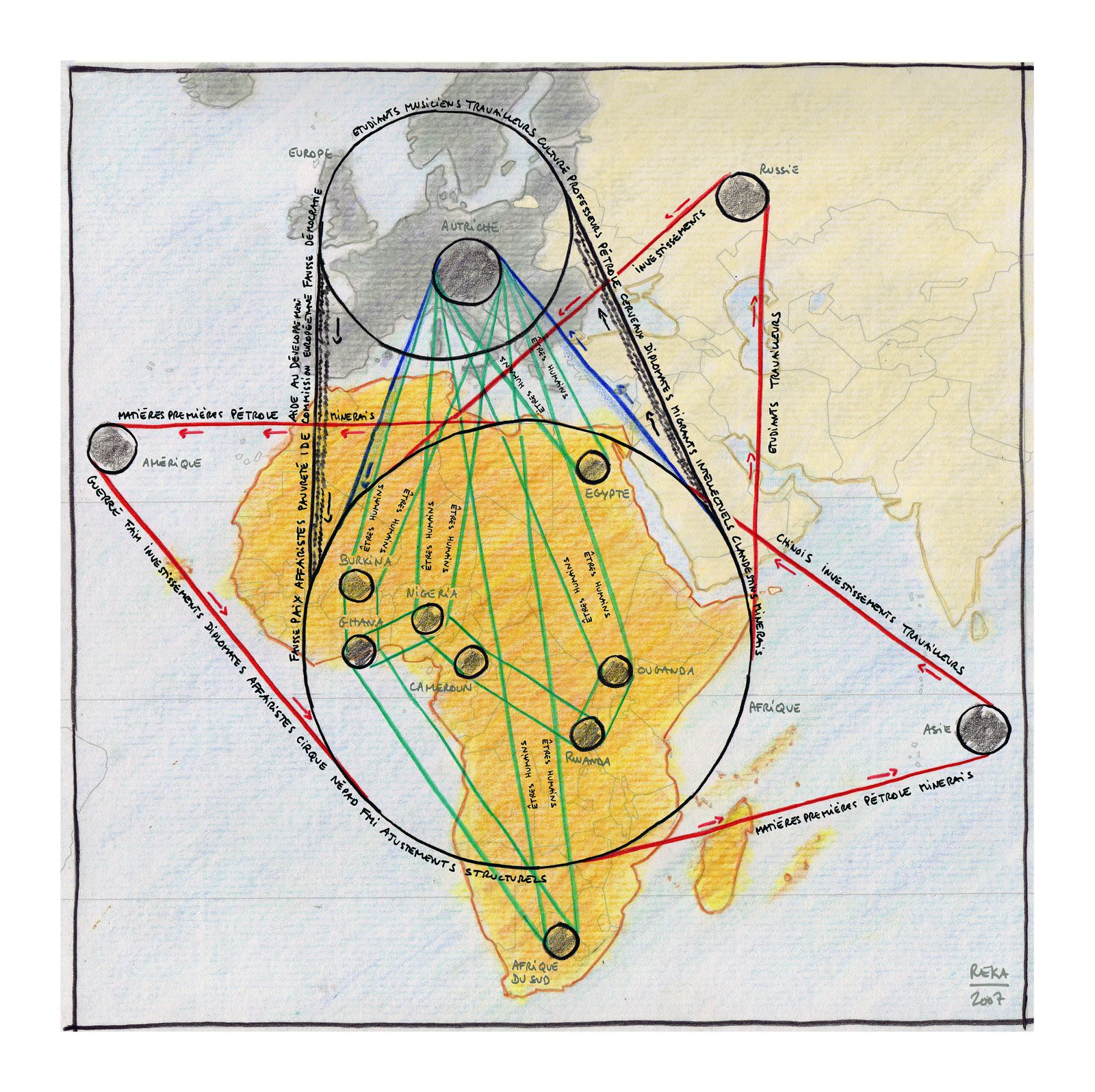
"There is no such thing as an innocent map, observes Philippe Rekacewicz in his catalogue essay that accompanies Diagrams, a new exhibition at the Prada Foundation in Venice.

A renowned cartographer, the Paris-born Rekacewicz is well aware of his medium's capacity to transform narratives for good and ill. His own work includes maps that illustrate the deaths of migrants as they bid for new lives in Europe. "A map," Rekacewicz continues, "is above all a social and political act - and therefore inherently subjective."' p.5.

Individual
|
      INTERPERSONAL    :     SCIENCES               
HUMANISTIC  --------------------------------------  MECHANISTIC      
 SOCIOLOGY  :    POLITICAL 
|
Group
Am I Free?

My history ...
Philippe Rekacewicz / The African big wheel, 2007
The wheel symbolizes permanence and continuity in the context of a profoundly unequal exchange, drawing, color pencil and ink, exhibition copy.
Courtesy Philippe Rekacewicz
(Image credit: Philippe Rekacewicz)

SOCIETY

... is our history ...

Freedom

National & International Law

Justice


'Other pictures are equally revealing for what they conceal. Consider the diagram entitled "Universal commercial history", a visual analysis drawn up by the Scottish engineer William Playfair in 1805 which traces the rise and fall of global wealth since 1500 BC against what he terms "Remarkable Events Relative to Commerce". Playfair, who is said to have invented the pie chart, includes moments such as "Rome founded" "Mahomet's Flight" and "America discovered". He never mentions slavery.

With such a broad-brush approach, lacunae are inevitable. It is a shame that the work of Viennese social scientist Otto Neurath - who, along with his wife Marie and colleague Gerd Arntz, invented the Isotype (International System of Typographic Picture Education) - is not on show. Based on pictograms, Neurath's Isotypes are an lmportant forerunner to the digital vernacular (from emojis to icons) so familiar to us today. Nor does the exhibition include maps of the devastation of Gaza since October 2023, such as those made by investigative research agency Forensic Architecture, which are proving among the most critical diagrams of our time.' p.5.

Philippe Rekacewicz - https://www.grida.no/resources/10988

My source:
Rachel Spence. Hidden truths in the best laid plans. Diagrams | What charts, maps and graphics can - and can't - tell us. Collecting, FTWeekend. 26-27 April 2025. p.5. 
With many thanks acknowledging length of quotation.

Image source:
https://www.wallpaper.com/architecture/oma-amo-diagrams-prada-foundation-venice

See also: 'icon' : 'symbols' : 'diagram' : 'map' : 'Forensic Architecture'

Archived listing Links II Sciences - inc. 'Diagrams' & 'Visualization I' and 'II': 

Friday, May 14, 2010

Health, social care and personal map making

Vermeeer painting


There have been two series running on BBC 4 in the UK over recent months and currently with a cartographic and historical focus:

see - The Beauty of Maps

This Vermeer - The Art of Painting - was featured in one programme and reveals the power and status of maps as Wikipedia also explains.

It is natural to see the health career model as a map, but this map is not just the preserve of the wealthy. Hodges' model can be used universally by all - a common framework.


Use of the term map and its synonyms is in turn common in medicine in many forms:

The map of medicine
The Malaria Atlas Project (MAP)
HealthMap

The above sites reveal how maps, charts and atlases relate the individual, geography and health.

In addition to its geographic connotation projection also has a psychological meaning. Hodges' model provides a substrate on which to project personalised, national and global health.

An individual; a people; a nation: for each a journey .... and for each a map ....

Image source:
http://en.wikipedia.org/wiki/The_Art_of_Painting_%28Vermeer%29


Saturday, May 14, 2022

New book: "Talking with a Map"

- A Cognitive Analytic Approach
to Everyday Conversational Awareness

 INDIVIDUAL
|

   INTERPERSONAL    :     SCIENCES               
HUMANISTIC --------------------------------------  MECHANISTIC      
SOCIOLOGY  :   POLITICAL 
|
GROUP

MENTAL MAPS

PSYCHO-THERAPIES


MAPS

PHYSICAL-THERAPIES


META-COGNITION


Fingers-crossed please! 

I've contacted Pavilion Publishing and Media Ltd with a review copy request of this new book - available for pre-order:

"Talking with a Map takes cutting-edge techniques for structuring and navigating conversations out of the therapy room and into everyday life, describing a versatile method that anyone can use to develop better skills, interactions and relationships."

Working with two co-authors three papers will hopefully (yes - cross them again) be complete soon. Then I can resurrect the piece on case formulation, diagrams and Hodges' model. 

If anyone is interested please get in touch:

peter.jones AT h2cm.info

Previously on W2tQ:

map :: therapy

Monday, December 16, 2019

Review: iii Kinchin's Visualising Powerful Knowledge to Develop the Expert Student


Also aimed at general as well as readers in education, this is an accessible read. The book's compact size, eight chapters across 134 pages invites completion even though I took quite a few weeks.

Book reviews here are a bit 'unconventional' with the two axes I have to grind [ ;-) ]. Returning to chapter 2 momentarily and map topography. Kinchin explains how concept maps of various types can be better understood and evaluated - a process of 'topological normalisation' (p.27). On W2tQ I may sound like 'I have it in' for process and processes. I do, in the importance they seem to assume within project management. I do 'get this'. A focus on processes is inevitable and readily appreciated in Hodges' model.

No process then ... no time, sequences, events, change, movement, spatial references and so on ... Kinchin's inclusion of  'topological normalisation' is very constructive (imho) as it indicates a method (as with measuring concept maps) and suggests something beyond an algorithmic approach.

The phrase (inevitably?) reminded me of database normalization:

".. the process of structuring a relational database."
https://en.wikipedia.org/wiki/Database_normalization

So, topological normalisation and associated structures provides the icing.

Little wonder then that next up in chapter Kinchin's Table 1 lists the characteristics of

'Deep Learning' and 'Shallow Learning'

So cake and icing clearly.

On deep learning the first item is ''Linking new information with prior knowledge'. This is central in Hodges' model and the reflection (individual or group) and critical thinking that the model can help generate. With all the claims for VR AR, this (reflection / reflective practice facilitated by Hodges' model) is conceptually immersive (and a definition of learning?).

From this, another item is realised. As learners engage with content; find, 'own' and sustain their enthusiasm for their learning, understanding and the subjects and parts of the curriculum they find themselves learning within. The sum total is: structured networks of knowledge (p.36).

This gets even better with the subheading: 'Oppositional Binaries'.

Hodges' model provides two binaries - but (apologies - another time!) let's get back to the book.

While 'Deep learning' has its advocates, Kinchin quotes Tormey (2014:4) who warns:

'a framework that is simple enough to be a powerful metaphor may be too simple to adequately account for learning in different contexts' and that its blind acceptance by new entrants to the profession has 'imposed blinkers that make alternative conceptualisations invisible'.
Finding further evidence to support Hodges' model within this debate is invaluable.

to be continued...

Roland Tormey (2014) The centre cannot hold: untangling two different trajectories of the ‘approaches to learning’ framework, Teaching in Higher Education, 19:1, 1-12.
DOI: 10.1080/13562517.2013.827648

Novak, J.D. and Symington, D.J. (1982) Concept mapping for curriculum development. Victoria Institute for Educational Research Bulletin, 48: 3–11.

Kinchin, I., (2016) Visualising powerful knowledge to develop the expert student. Rotterdam: Sense Publishers.


See also:

Intro post

Review One

... Two

... Four

... Five

... Six

Many thanks to Brill for my review copy.

Monday, July 07, 2014

Book: The social atlas of Europe

See Europe as never before!


The social atlas of Europe
Dimitris Ballas, University of Sheffield
Danny Dorling, University of Oxford
Benjamin Hennig, University of Oxford

"An insightful look at today's Europe - through the underlying realities that Europeans live every day, all brought to life in charts and maps that reveal the human geography of this vitally important area of the world." Robert B. Reich, University of California at Berkeley.

The social atlas of Europe is the first human geography atlas to consider the European economy, culture, history, human and physical geography as a single land mass and a more unified European people. It provides an accessible overview of Europe and a human geography contribution to debates about a wide range of topics. It includes:

- Maps on over 80 topics ranging from life expectancy, greenhouse gas emissions to Eurovision Song Contest voting patterns
- Uses innovative full colour visualisation methods
- Explores Europe's society, culture, economy, politics and the environment
- State-of-the-art Geographical Information Systems (GIS) and new human cartography techniques

More information about the book is available on its website www.europemapper.org

Available at the special price of £19.99 (plus p&p) at
https://policy.bristoluniversitypress.co.uk/the-social-atlas-of-europe
Kathryn King
Marketing Manager
Policy Press, University of Bristol
www.policypress.co.uk


My source: EUROPEAN-SOCIOLOGIST list at JISCMAIL.AC.UK

Saturday, August 01, 2020

Cate Blanchett: What is statelessness? | #iBelong UNHCR

individual
|
INTERPERSONAL : SCIENCES
humanistic ----------------------------------------------- mechanistic
SOCIOLOGY : POLITICAL
|
group - population
My mental health


I
Geography

Maps of Identity - Maps of States
Borders


Location of parent's birth; my birth


My physical health
Belong

families

social inclusion / exclusion

relationships

SOCIO-economics

SOCIAL capital

Quality of Lfe

Cultural background / heritage


My source:
https://twitter.com/Refugees/status/1289470924865933313?s=20