Hodges' Model: Welcome to the QUAD: neuroscience

Hodges' model is a conceptual framework to support reflection and critical thinking. Situated, the model can help integrate all disciplines (academic and professional). Amid news items, are posts that illustrate the scope and application of the model. A bibliography and A4 template are provided in the sidebar. Welcome to the QUAD ...

Showing posts with label neuroscience. Show all posts

Wednesday, January 17, 2024

Book review iv. General Psychotherapy: Principles and Common Theoretical Aspects - Rediscovering Humanity

   General Psychotherapy

My late teens - early twenties coincided with the emergence of chaos, fractals and yes - emergent phenomena. Consequently, I had to refer back to Chapter 3, as Hartmann-Kottek writes:

"If we imagine a fractal that encompasses all categories similarly to a quantum in this regard, all cells, organs, particularly the human brain, the entire person, groups of people, races, nature and the earth would also be in field and structure at the same time. This does not appear to be an abnormal notion. Several experiences with field phenomena of the relationship level would consequently gain their natural allocation.

Indeed, we are familiar with notions that cross categories with regard to states of matter: Water as ice, snowflakes, liquid, vapour, mist and clouds are normal aspects of daily life."p.215.

This resonates at present with reading on categories, seeking theory and to what extent can mathematics and logic be applied to Hodges' model and more importantly, to the humanities? There is some toing-and-froing in the book, but for me having read the book - it works. If a student asked me what is a good subject to study at high school. It would be Social and Economic History, especially if you are thinking of pursuing mental health nursing, psychiatry, or psychology. General nursing too, I would add, acknowledging the need for holistic and integrated theory, practice and management. 

Chapter 7: is a regular rollercoaster in terms of history and cultures:

The Spirit of the Times and Cultural Epochs as Reference Systems Along with Their Transformation of the Ideal Level of Human Development – A Historical Journey Into the Past to Learn for the Future

In healthcare we need to constantly ask (it's called mandatory training) about the protected characteristics, the various literacies, including emotional, spiritual, cultural; and all the determinants of health. And we need to be cognizant of all of them: individual, environmental, commercial, educational, social, and educational (hence why 'categories' are salient).

The discussion of non-European cultures are particularly rewarding - Africa, Australia, Polynesia, Ancient far East, Native Americas, Egypt, Yoruba and others. Page 437 brings Martial arts, where synergy between mind, body and spirit is central. Reflecting culture and the association between health, well-being, the human condition and pastoral care chapter 7 covers the main religions and relationships between several. The influence of aesthetics in certain cultures is also introduced. The book is a springboard for further reading. Section 7.1.2 on an Integrative, Holistic Stance as a Countermovement provides the names and dates of  more than fifteen personalities: Alexius Meinong (1853-1920) ... Wilhelm Witte (1915-1985). Through the history described, it is interesting to reflect on the significance of the holding of knowledge and power imbued through its use. The end of chapter is an effort to take stock of social development - a non-trivial task given the dynamic world we try to exist within. 

 I found I was rolling together chapters 6,7 and 8 even as they hold-their-own in content and placement. As a community mental health nurse I still reflect upon:

  • There is no overarching theory of health communication.
  • Gatekeeping is alive and well.
  • The current often vociferous 'debate' between psychiatrists, psychologists, patients/clients, carers and nurses too.
Chapter 8 returns to the integration of psychotherapy with the politics of research, or how the exercise of power within psychotherapy research has resulted in crises. I wished I'd paid more attention, but I do recall at some events, conferences instances of animosity between different therapeutic camps. Hartmann-Kottek does not labour the final chapter. There are positive messages here too. A page and a half overview informs us that globally there is research attending to the knowledge and not the interests of particular therapeutic organisations and associations. Statistics, evidence, fake science are discussed, the history in psychotherapy and how this frames the future. When I started reading the book behavioural science was in the news for the wrong reasons. 

Chapter 8 reminds me of the proverb 'Reap what you sow'. Now across health and social care how many gates and gate-keepers are there? Outside of 'emergency' triage: how many are legitimate, needed? How as the original role - processes changed? In England there is ongoing debate about IAPT - Improving Access to Psychological Therapies. Fascinating and troubling the apparent increase in diagnosis of autism and attention deficit hyperactivity disorder (ADHD). Still many questions to be asked, especially on access to therapy within  the auspices of universal health coverage.

Here on the blog and in my application of Hodges' model, it may seem that the POLITICAL domain is the constant elephant. The thing to be climbed over, circumvented, accepted for all its ills (no pun intended). Politics, the political is a tool. It is, in Hodges' model, an essential domain in terms of care delivery and knowledge. The idea of that "Competitive constellations happen." (p.465) is of course a reality. In championing and studying Hodges' model this is well recognised. Chapter 8 is a mélange of socio-political concepts which briefly reveal what must be better resolved not just in psychotherapy, but health and social care: all the determinants.

Hodges' model = a natural home for contextual research?

 "At long last, 'contextual research' (Wampold et al.) has put an end to the belief solely in standardised and manualised treatment programmes." p.345.

While the above gives me great encouragement - a note in book: "Generalising partial perspectives only ever lead to impasse." (p.458) reminds me to take nothing for granted.

Chapter 8 places an emphasis on balance.

Hartmann-Kottek uses the term '(r)evolutionary' in chapter 8. This is fitting as the chapter begins with history - with or without the Dodo. Perhaps quantum descriptions can be found by (necessarily) and paradoxically increasing the theory-practice gap. Taking 'theory' even further away from the noise, complexity of practice. We often consider theory, as an opportunity to be idealist. How often (in the past?) have nurses found the nursing theory - model they are trying to apply ungainly as the day-to-night pressures of care delivery make themselves known? Perhaps ironically by venturing further into theory new vistas will appear, with timely and much needed perspectives given the demands of health in the 21st Century.

 'I' - 'Individual' 'SELF' 'Patient' 'Client'
  |
    INTERPERSONAL    :     SCIENCES               
HUMANISTIC --------------------------------------  MECHANISTIC      
SOCIOLOGY  :   POLITICAL 
|
dyad / couple  family  GROUP community population
PSYCHO -
PSYCHO -

... experience-related, 
mind and 

- TECHNICS^
- MECHANICS^

confrontational connections in the
physiological patterns ... (p.480).


foundational collective context i

dyad, triad, couples, families,
small and large groups

foundational collective context ii

gates, gate-keepers, gate-keeping
access, accessibility


Many thanks to Prof. Hartmann-Kottek and Springer for the review copy. I will add the related posts below soon.

An enjoyable, informative read and a great contribution to my CPD. There are many more points to highlight and I may do so in the future.

Hartmann-Kottek, L. (2022). General Psychotherapy, Principles and Common Theoretical Aspects - Rediscovering Humanity. Springer. https://doi.org/10.1007/978-3-030-87466-7.

^Used in the text.

Thursday, November 16, 2023

Book review iii. General Psychotherapy: Principles and Common Theoretical Aspects - Rediscovering Humanity

   General Psychotherapy

In chapter 3 neurophysiological development is explored and epigenetic influences (3.2). For a decade or so I've highlighted to students the need for them to be aware of 'omics' which will clearly impact their future careers and subsequent learning. This is detailed also outlining limbic development, through to cognitive-linguistic functioning; and not just learning but forgetting. It is easy to take the self for granted, but here is a description of a self in formation, the neocortex, imagination and role of the pineal gland. Biological radiation of living beings (there is a error in the heading I believe*) is fascinating for reasons already acknowledged. Then it is as if time begins and psychological development can begin (life chances permitting). From the author's practice two cycles are illustrated - growth and transformation drawing on Gestalt thought and all referenced. 

Ever since reading on Goethe's part-whole thought I've been aware of mereology. Chapter 3 also examines intrapsychic and social space in respect of part-whole relationships. I'm continuing this journey so it helpful to find the distinction here also.

"According to the resonance principle, identification with key partial aspects can very quickly lead to an unresolved, formative core conflict. In an individual setting, empty chairs or symbolic locations may serve as backdrops for projection. Distance, posture and line of vision are highly relevant in this regard. In a group setting, forms of constellation work with representatives may be more helpful." p.155.
The book's philosophical content is well realised, fused with history and the development of psychology and neurosciences. Plato's cave is explained and related to tabula rasa: the blank slate (3.6.3). I feel I'm in Plato's cave in trying to look at Hodges' model as a mathematical object. There is encouragement too in Hartmann-Kottek identifying the role of blank slate. Hodges' model is also about forgetting, unconditional positive regard hence a blank slate. Chapter 3 concentrates on approaches to explain our development and personality, quantum-theoretic, Far-Eastern traditions, and Western working towards how we achieve coherence as an integral individual, building and relying on inner and external social and interpersonal resources (Fig. 3.4: Tower of consciousness. p.212.). Energy a key in this part of the book, is summarised in a further figure on background dimensions - combining two-axes of Whole-Parts and Space-time - Spaces of possibilities (p.222).

Chapter 4 is a welcome discussion of systems, interspaces, self, communication again through a cultural lens. Chapter 5 would benefit all healthcare students - an understanding of health and illness. While not tackled here - how we integrate and simultaneously address both requirements in service delivery is the challenge of 21st Century health provision? This is higher level from the outset: Attempts at Classification (5.1). While a  traditional book, reading had an immersive feel for me (with many posts on W2tQ): Diagnostic tools, 2-sided understanding of health and illness, the diagnostic, therapeutic (always kept in sight) reversal of symptoms, fields of tension and resources at various stages of development.

For readers looking for actual therapies, chapter 6 is the practical center of the text. The current state of psychotherapy is likened to the blind people trying to find an elephant in the dark. 'Many paths' in a subtitle is welcome, almost suggesting there is scope for all approaches and perhaps they can meet 'somewhere'? Motivations and politicisation aside, the variety of psychotherapeutic are indeed a treasure. They are listed, comprehensively as far as I can see, including many new to me. They are further sub-divided and considered: clusters through time, behavioural, then considered as per depth and effect levels, verbal - non-verbal, emotions, breathing and meditation, variations in consciousness. 

I've considered blind-spots before and highlight Hodges' model as having a role in situational awareness - hence safety and care assurance. Hartmann-Kottek remains grounded in how blind-spots can affect therapists and patients - individually and in alliances. The therapeutic relationship, transference and countertransference are emphasised once again. Compassion too - as part of a credible relationship - with selective authenticity. Technical points are raised too, the use of counterpart in Gestalt therapy. Some 40 pages of chapter 6 are very practical, with exercises and examples of conversations between patient and therapist to illustrate specific approaches and situations. This is far from a specific therapy manual but there is this quality to the content.

 
 'I' - 'Individual' 'SELF' 'Patient' 'Client'
  |
    INTERPERSONAL    :     SCIENCES               
HUMANISTIC --------------------------------------  MECHANISTIC      
SOCIOLOGY  :   POLITICAL 
|
dyad / couple  family  GROUP community population
psycho-


symbolic
personal meaning
emotion
lived experience
emotional distance

-somatic


*Living near Manchester in NW England, the city's symbol is a bee (industry..). It appears in the text that 'Being' has become 'Beeing' in some instances - so an extra homely feel here.

Many thanks to Prof. Hartmann-Kottek and Springer for the review copy.

One more post to follow.

Hartmann-Kottek, L. (2022). General Psychotherapy, Principles and Common Theoretical Aspects - Rediscovering Humanity. Springer. https://doi.org/10.1007/978-3-030-87466-7

Empty chair image:
https://www.mentalhelp.net/blogs/gestalt-therapy-the-empty-chair-technique/

Thursday, November 02, 2023

Book review ii. General Psychotherapy: Principles and Common Theoretical Aspects - Rediscovering Humanity

General Psychotherapy

Chapter 1 confirmed many points for me regarding psychotherapy, especially given the general treatment here. Hartmann-Kottek asks questions of psychotherapy as a science. Hence, the demarcation of science is also raised. The history of psychotherapy spans the 19th century to current day, with references to prehistory. Wundt is a reminder of my introduction to psychology (aged 14-15). 

Physics also features, with quantum theory noted on p.5. and throughout the book. Significant for me, reference to energy, took me back to nursing theory and the work of Prof. Martha Rogers. I've struggled with this in the past. Not just personally, Unitary Beings, is this a 1960s - 1970s thing(?), but what it meant to other students and qualified nurses, in the UK at least? Another factor as I tried to find 'space' - validation for Hodges' model (despite an assumed BEST BEFORE date) there was the perception of those outside nurse academia who questioned the very notion of nursing theory (Raskin, 2001). Pardon the digression, but in the text the scales and potential significance at which the quantum is 'present' are surprising and helpfully amplify the need for an open-mind.

The author highlights recognition in recent decades of quantum phenomena - descriptions in neurophysiological at the molecular - cellular level, meditation, energy, resonance, states of consciousness and unconscious. You will find E=mc2 here too.

The question of the disparate disciplines, schools and their often warring, fractured state is not dodged. The reality of, and accounting for the the multiplicity of approaches to therapy is debated and celebrated. I like the thought of how as a student / learner the first psychotherapy we are exposed to as a clinician (usually?) is imprinted. This experience influences (understandably) how we respond to subsequent psychotherapeutic modalities. I've followed discussion on 'X' regards efforts in academia to work towards a way to integrate psychotherapy, at least improving co-habiting, but as cited by Wampold et al. (2018) p.336:
"In the thousands of (RCT) studies conducted, we are still yet to find a specific treatment for a particular disorder, which was, on average, clinically and systematically superior to any other psychotherapy." p.7.
The aim in this paper was to "find a suitable coordination system that incorporates variety." p.7.

From this and my focus on Hodges' model my motivation to read this book may be obvious:
  • A mapping exercise of core communication concepts to Hodges' model
       (the common framework?)
  • psychology 
  • psychotherapy
  • interprofessional?
Hartmann-Kottek writes:
"Even if the school of psychotherapy were to succeed in establishing a common framework, a certain amount of variation with regard to approach would nevertheless be required. I am referring to the entire field of play between body-therapeutic interventions, scenic realisations, artistic expressions and more restrained verbal interactions. This is the result of the diversity of our human state." p.33.
The politics of psychotherapy recur with exploration of interdisciplinary common factors. A book that takes a neutral stance is highlighted in one of several 'tips'. Interspersed within the text, readers will find other related asides 'important', 'note', and 'cave'. Each chapter (bar conclusion) has a bibliography. For me the references are comprehensive. There are figures too, not many (a listing would help) but they reflect the book's goals. As already suggested there is philosophical and ethical debate. How is science defined in this context and using current tools. Objectivity - Subjectivity are a constant too; while Buber et al. took me back to RN mental health (RMN) and lecture days (CPN Cert.). This is not just a reverie but vital at a time when several lecturers in mental health nursing, are concerned that the mental health nursing curriculum is being genericised.

I like reference to interspaces and constellations - again throughout. While not a psychotherapy, the brief section 1.8.3 Abandoned Aspects of Therapy, made me recall Token Economies, conceived as a therapy.

Chapter 2 discusses good and bad therapists (invariably, wherever people go the apple barrel follows), looking in depth at the therapeutic relationship, and as a common factor. Given the attention devoted to self-care at present^, it is fitting that given that people attracted to train as psychotherapists have experienced stress themselves (2.2.1); should be aware of their own self-care and mental hygiene (2.2.4). Behavioural and client-centered therapies provide focus, with gestalt therapy working towards sections on the 'special therapeutic relationship' and agape. To what extent do you need to be open to holistic orientation, in order to negotiate holistically embedded confrontation (2.4.5)?

More to follow.

Many thanks again to Prof. Hartmann-Kottek and Springer for the review copy.

Hartmann-Kottek, L. (2022). General Psychotherapy, Principles and Common Theoretical Aspects - Rediscovering Humanity. Springer. https://doi.org/10.1007/978-3-030-87466-7

Raskin, Jef. "Humbug: Nursing Theory". Archived from the original on July 10, 2001. Retrieved December 14, 2015. (Wikipedia).

^Not a complaint, welcome in terms of the vertical axis of Hodges' model.

Friday, October 20, 2023

Book review i. General Psychotherapy: Principles and Common Theoretical Aspects - Rediscovering Humanity

   General Psychotherapy

Predictably, the title of this book caught my attention.

I did do some homework before requesting a review copy, but it was still a surprise that this book by Prof. Dr. med., Dipl. Psych. Lotte Hartmann-Kottek is not edited. It is a comprehensive tome at 491 pages. As a mental health nurse with experience of cognitive, behavioural and family therapy, I am not an expert, but Prof. Hartmann-Kottek's experience in psychotherapy, the history, theoretical development, clinical application, theoretical underpinnings (including physics) and political machinations are well demonstrated.

A disappointment for me is the lack of an index. This seems a major omission, and yet a comprehensive index here, might itself be difficult to navigate. There are some errors in word-use, repetition but they do not detract from the book and reading experience overall. The book is apparently translated from German. The book is expensive, but students may have access through their institutions and special schemes(?).

The book's subtitle: Principles and Common Theoretical Aspects - Rediscovering Humanity is delivered. The title General Psychotherapy - attracted me for several reasons:

'General' - the (seeming) opposition of generalist-specialist is relevant to the theory and application of Hodges' model.

'Psychotherapy' - I was interested to see how Prof. Hartmann-Kottek dealt with the disparate schools of psychotherapy, given some awareness of the politics and efforts to integrate and reconcile therapeutic approaches, philosophies, and legacies. 

Consequently, the chapters address multiplicity, systems, efficacy, commonalities and interspaces. If a book should benefit its reader, rewarding time/cost then this text has contributed to my continuing professional development. Discussion of systems, individual, whole, humanistic, interdisciplinarity, integration, the therapeutic relationship, transcripts and therapy scenarios provides ongoing stimulus for my efforts with Hodges' model.
"The increasing joint adoption of methods and methodological aspects through the partitioned barriers of the otherwise politic(al)ly competing schools in recent decades has, of course, been met with mixed reception, especially when the adoption was coupled with contemporary political and social repression.

However, it may be precisely this difficult topic of the mutually uncoordinated, intellectual adoption and incorporation of vicinity aspects on a macro scale that may indicate that the time has come for an integrative reconciliation or fusion of the essence of psychotherapeutic approaches. As perhaps needs no mention, this path will require an extensive field of play." p.viii. Preface.


'I' - 'Individual' 'SELF' 'Patient' 'Client'
|
     INTERPERSONAL    :     SCIENCES               
HUMANISTIC --------------------------------------  MECHANISTIC      
SOCIOLOGY  :   POLITICAL 
|
dyad / couple  family  GROUP community population

psychological systems
MIND psycho-
identity
psycho-therapy / therapies
subjectivism
cognitive  access

physical systems
-somatic BODY
identity?
evidence
objectivism
physical access

social systems
culture
history
community of practice
social access

political systems
power
professionalism
health systems/services funding
political access

Many thanks to Prof. Hartmann-Kottek and Springer for the review copy.

More to follow.

Hartmann-Kottek, L. (2022). General Psychotherapy, Principles and Common Theoretical Aspects - Rediscovering Humanity. Springer. https://doi.org/10.1007/978-3-030-87466-7

Friday, August 05, 2022

"Your metacognitive fingerprint"

 INDIVIDUAL
|
 INTERPERSONAL    :     SCIENCES               
HUMANISTIC --------------------------------------  MECHANISTIC      
SOCIOLOGY  :   POLITICAL 
|
GROUP

"Why are some people more self-aware than others? Studies show that metacognition is a relatively stable trait, so if you tested your metacognition today, it is likely to be similar if you do the same test again tomorrow. Strikingly, it also seems that metacognition is independent of IQ and general cognitive ability: your metacognition can still be in good form as long as you recognise you are performing badly at a task.
We still don't understand the origins of these individual differences, but one promising idea is that "explicit" metacognition is something we learn, based on feedback from our parents, teachers and social group.
A genetic "starter kit" may establish forms of self-monitoring early in life and then our parents and teachers finish the job. But even in adulthood, these things aren't totally fixed (see main story), so this is one kind of fingerprint you can change." p.38.

finger

p r i n t


- with my emphasis.

Fleming, Stephen. The power of self-reflection, New Scientist, 250,3333, 36-40. 8 May. 2021.
https://www.sciencedirect.com/science/article/abs/pii/S0262407921007946

I heard Stephen Fleming on the radio when the associated book was released last year - must buy a copy.

Still reading and enjoying 'Human Landscapes' with posts to follow.

See also: meta- meta- meta- +!

Monday, May 02, 2022

Review ii - "Brainscapes: The Warped, Wondrous Maps Written in Your Brain―And How They Guide You"

Brainscapes

Now I know how Umami (p.87) an "example food magazine website to demonstrate some of the features of Drupal core" - got its name. I'm sure this was explained at a Drupal Meetup. Savoury indeed!

There had to be two! The brain has two strategies: brain maps and distributed codes.

"Representing information with a distributed code is entirely different from representing it with brain maps. In a brain map, neighboring neurons represent neighboring regions in space, frequency, time, and so forth. And brain maps essentially represent information using location, or where in the brain area the neurons are most active. In contrast, there is no consistent relationship between neighboring neurons in brain areas that use distributed codes. These areas represent information through the distributed pattern of activity across that entire region of the brain, rather than through the location of activity within it. This pattern of activity is a kind of code." pp.93-94.

This distinction is significant for Hodges' model, as the distributed codes act to deal with novelty, what is new - ongoing (lifelong) learning (p.95). Hodges' model can help distinguish between subjective and objective concerns. Schwarzlose unifies the two - via a catfish (also a goal here - but not necessarily with such an assistant).

"The map in the olfactory bulb is organised into odor zones based on molecular structure, an objective property of these compounds in the physical world. But the second map is organized into zones based on the significance of the odors to the animal." p.100.

Chapter 6 'On the Move: Brain Maps for Action' would have been useful as a student nurse at Winwick Hospital, the history in the book brings back many reminders - late 1970s. Epilepsy, then was less well understood, and managed. In describing the M1 brain map and movement I wondered about consent, but can see that is a distraction. Chapters -

6. On the Move: Brain Maps for Action | 107
7. Maps in the Making: How Brain Maps Develop and Adapt | 131
8. Knowing Again: Brain Maps for Recognition | 151
- offer much to relate to clinical encounters: movement, reaching, infant versus the brain in adults, the senses and catastrophic events such as cerebrovascular accident - stroke. Morphologically there is much still to learn (brain maps are 'primed' before birth), which perhaps is why we recognise the remarkable nature of gestation and birth. 'Maps in the Making' provides wondrous insights, including the need in hospitals to rethink the sensory environment and experience for premature infants.

While reading - I was struck at the experience of the newborn and mothers in Ukraine. The 'health career' model concerns life chances - from birth to later life...

As a community mental health nurse I have found subtle and less-subtle impacts on a person affected by semantic dementia (p.204) and their family. Given the ongoing invasion and war, I also thought about people living with dementia and having to flee their homes. The multiple contexts that pertain in such a crisis situation when considering 'maps' and sense-making. Especially, when the need for action is preemptive - preventive and so must be explained and justified, not once but perhaps repeatedly?

We are all innate mathematicians even if we feel we have no ability. 

https://www.google.com/search?client=firefox-b-d&q=mathematics+in+catching+a+ball

I take some succor in this (p.127).

There's a hodgepodge in here too (p.161 hb). The myriad of objects we encounter and their recognition calls for the combination of brain maps and distributed codes. Chapter 8 is more psychological, touching :-) how we categorise objects, dimensions and scales, size and animacy. Galton's contribution is discussed, his ideas on eugenics also acknowledged. Visual perception, mental imagery and visual learning style remain subjects of note for researchers. I'm not sure why figure 32 stood out ( :-) - please pardon the quality of the photo. Paul Kim's illustrations are an excellent support for the prose.):

FIGURE 32 A comparison of visual perception and mental imagery in
the V1 visual map. Paul Kim

Somewhere I've saved an article on mental imagery from New Scientist I think, about this ability - the mind's eye and how it is missing for some 'brilliant' people (p.182) and posted previously:

In my mind's eye I can picture care: Frame by Frame

I might read Chapter 9 again, attention, action and perception in combination. 

Chapter 10 had me thinking again about 'Conceptual Spaces' (quality dimensions) and threshold concepts (not in the book - but this is a positive!):

"Many of the concepts that rule our financial, social, and emotional well-being have no shape, no color, no odor or weight. How do we grasp these intangible concepts? As it turns out, we often do so by aligning abstract concepts with physical dimensions and then putting our brain maps to work." p.191.

There is a 'mental number line', vertical too, and culture is a factor in how we learn and the brain associates space and quantities, in which L-R, low-high are also brought into play. The question remains here: Is Hodges' model culturally neutral? 

Still with h2cm - mind reading, writing and 'drawing' perhaps? p.236. In "Fortune-Telling with the Brain" we read about how fMRI is allowing us to learn how the brain maps employ teamwork. There is an architecture whose stability can inform predictions of future abilities - reading is described. Reading this you see ethical implications (as Schwarzlose warns p.238), but it may help to target personalised learning, as an adjunct to personalised medicine? I double checked (index) and the connectome is not mentioned, but the benefits of this research is still to be realised. In 'prison health' here in the UK (and globally?) it is long overdue but it is encouraging to hear about the focus on investigation for previous brain injury within the prison population. Remember - lead in fuel and the socio-economic impacts of pollution (ongoing - air and plastic pollution)?

Corporations have literally only 'scratched the surface' of the future potential to 'read' us individually. Through Hodges' model I can qualify and justify the model's increasing relevance. Technology and science not only call for SOCIO-technical approaches. The brain-computer interface and AI (p.239) demands we also consider the several forms of literacy and informatics that are needed in the 21st century: bio-informatics, bio-political, psycho-political and more.

This is very informative and timely read - the diagrams too. This is a book for all. For student nurses specifically, it will enable them to maximize learning in their practical placements and throughout their course of study.

Writing this review I can also see the important messages in chapter 12 - recognition of infancy and the opportunities this affords.

Many thanks to Rebecca Schwarzlose and Profile Books for my review copy.

Schwarzlose, R. (2021) Brainscapes: The Warped, Wondrous Maps Written in Your Brain―And How They Guide You". London: Profile Books.

Thursday, April 28, 2022

Review i - "Brainscapes: The Warped, Wondrous Maps Written in Your Brain―And How They Guide You"

Brainscapes


A marvellous cover (US too), a fascinating, clearly written and hence readable book. As expected today the layout, print size and design add enjoyment to the time invested.

As a nurse with an interest in science you are aware of much of the content in broad terms but 'Brainscapes' provides more detail and made me wonder about the prospects to follow from improvements in brain imaging, The Connectome, new technologies and techniques. Rebecca maintains the focus throughout.

I'm pleased to add this to my CPD reading list.

Nature and science are humbling. It is still quite recent that we realised the milky way is one of billions of galaxies. Now we can appreciate not only the complexity of the brain, but how it is embodied in mind, body and our experience of reality.

There is history here to begin. Russia and Japan were at war in 1904. Russia had a new high-velocity rifle with smaller bullets, 7.6mm reaching speeds of 620 meters per second. Whether co-incidence, and/or ironic, there are of course many brains trying to make sense of the current conflict in Eastern Europe. A change in injuries followed with these bullets capable of passing straight through the skull, sparing the life of the soldier and yet with life altering injuries. 

As triage was founded on the battle-ground. So aftercare is grounded in the journey back 'home' for those who can make it and the extent to which 'veterans' and their families are recognised.* This lead to investigations (Inouye, see below) as soldiers experienced localised damage to the brain. Soldiers suffered scotomas affecting their vision, stimulating research and new approaches, devices 'cranio-coordinometer'. There are illustrations and some photographs throughout, the illustrator Paul Kim, adding to the text.

In 'Maps of You' maps are everywhere especially on screens, and yet as Schwarzlose notes the map's materials matter little. On p.17 "All I need is a pen and a scrap paper" I smiled - given the 'map' that Hodges' model provides, on paper, sand, black/whiteboard and mind's eye. Mental imagery is there too. Salience, figures early p.19 and with brain maps, visual maps and where we direct our gaze prompts more detailed consideration of context. The explanations of the sensory brain maps is fascinating, especially how the brain has evolved to deal with constraints of space, energy, distance and organisation. At the fovea in the eye, the map is magnified. 

Perhaps in Hodges' model there are two fovea? One is the center of the model, the person-centred nexus an assurance function/correction as the fovea that is context shifts and jumps in response to the dynamics of the situation. Reading about the audio map, p.73 I thought about the 'timbre of care' (Yes, I've a bad case of h2cm-meme-mapitis). As a further sign of the times, chapter 5 (A Body Under Siege) on taste and smell and the protective function of what we do or don't ingest, I travelled from the individual to the national and the binary choices (yes or no) being exercised right now.

More to follow ...

Alexander P. Leff (2015) Tatsuji Inouye (1881–1976), Discovery UCL.
https://discovery.ucl.ac.uk/id/eprint/1491645/1/Leff_tatsuji_inouye_1881-1976.pdf

Many thanks to Rebecca Schwarzlose and Profile Books for my review copy.

*Apologies for digression...

Saturday, August 14, 2021

By the quarters ... Rugby

Player
|

INTERPERSONAL : SCIENCES
humanistic ------------------------------------- mechanistic  
SOCIOLOGY : POLITICAL
|
Team Player - Professional Sportsperson
"World Rugby"

Mild head injuries, which often cause concussion, are the most common reported match injury in professional rugby union in England, ALAMY


"Sir Ian McGeechan has led calls for radical change before a rugby union player dies on the pitch, branding the game unnecessarily dangerous and saying that World Rugby would be accused of negligence if it allows the situation to continue.
In a strongly worded letter to Bill Beaumont, the World Rugby chairman, McGeechan and other British and Irish Lions greats, have urged the governing body to reduce the number of available replacements from eight to four to limit the impact that fresh players can make by coming off the bench in the final quarter." p.1.

"Almost a quarter of professional rugby players may have brain damage, the first study of its kind suggests.

Scientists used advanced brain imaging and analysis to compare elite rugby players with rowers and other noncontact athletes as well as people who played no sport.

Using methods often applied to the study of patients with neurodegenerative diseases such as Alzheimer’s,, the team found that rugby players had significant damage to their brain’s white matter, its 'wiring'."
The Times, Thursday July 22 2021.

Hathaway, A., Lions legends: Make rugby safer, Sport, The Times, 14 August, 2021, p.1.

Image source: https://www.thetimes.co.uk/article/quarter-rugby-players-brain-damage-study-0m8fzrqbg


Wednesday, June 09, 2021

Cognitive Cartography Is ...

individual
|
 
 INTERPERSONAL : SCIENCES
humanistic ----------------------------------------------- mechanistic
SOCIOLOGY : POLITICAL
|
group
Cognitive Cartography is ..


Physical


and Social.


https://www.scientificamerican.com/article/in-search-of-the-brains-social-road-maps/

Schafer, M., Schiller, D., The Brain's Social Road Maps, Scientific American, 322: 2, FEB 2020. pp.22-27.

https://www.scientificamerican.com/article/in-search-of-the-brains-social-road-maps/

Previously:

https://hodges-model.blogspot.com/2009/07/cogeographic-or-cogneographic-concepts.html

Sunday, April 25, 2021

Peter 4.0* surely?

Or, more modestly Health 4.0?

No, it's ...

individual
|

INTERPERSONAL : SCIENCES
humanistic ----------------------------------------------- mechanistic
SOCIOLOGY : POLITICAL
|
group

Mind
Personality
Identity
Hope
Love

...
Peter 2.0


*'Peter 5.0' more accurately, the four domains embedded within the 'spiritual'.

My sources:

C4 UK Documentary and Reid, M. The making of a human cyborg, Saturday Review, The Times, April 3, 2021, p.16.


Saturday, January 25, 2020

h2cm = 'GI - General Intelligence'?


"In 1990 a paper curiously- titled "Elephants don't play chess", published by Australian roboticist Rodney Brooks, ushered in the idea that artificial intelligence could become smarter by learning as the human brain does. Building simple connections that gradually become more complex could help AI emulate the way we think."


"AGI [artificial general intelligence] is a really tough problem, making something that is as flexible and efficient across a wide range of domains as a mammalian brain is a tough challenge.."


"In a new paper published in Nature yesterday, DeepMind unveiled how an area of AI , known as reinforcement learning, has shed new light on the way the brain learns. ... At the heart of the paper is a new idea of how dopamine works. Known as the "motivation molecule" or "surprise signal", dopamine has come to be of significant interest." Chowdhury, 2020.

AI or G(A)I ? Specific and General ...
... depending on the situation ...

individual
|
INTERPERSONAL : SCIENCES
humanistic ----------------------------------------------- mechanistic
SOCIOLOGY : POLITICAL
|
group - population

cognitive
decision making

intellect
motivation

learning
science
neuroscience

dopamine

data  information


Brooks, Rodney (1990), "Elephants Don't Play Chess" (PDF), Robotics and Autonomous Systems, 6 (1–2): 3–15, CiteSeerX 10.1.1.588.7539, doi:10.1016/S0921-8890(05)80025-9

Dabney, W., Kurth-Nelson, Z., Uchida, N. et al. A distributional code for value in dopamine-based reinforcement learning. Nature (2020). https://doi.org/10.1038/s41586-019-1924-6

My source:
Chowdhury, H. Why scientists just had a brainwave in quest for artificial intelligence, Business, The Daily Telegraph, 16 January, 2020, p.5.

Sunday, June 02, 2019

Saturday, April 13, 2019

In my mind's eye I can picture care: Frame by Frame

individual
|
INTERPERSONAL : SCIENCES
humanistic ----------------------------------------------- mechanistic
SOCIOLOGY : POLITICAL
|
group

Aphantasia -
unable to visualise mental images


Ed

Animation
Frame by Frame
Aphantasia - 2.5% of people may have it
Requires memory plus areas in the frontal, parietal, temporal, and occipital lobes to work together.

Catmull ...

has "blind mind's eye"

... a former Pixar President


Additional links:

Can’t count sheep? You could have aphantasia

Aphantasia: Losing the mind’s eye 

Low, V. Picture this: the top animators who can't draw mental images, The Times, Wednesday, April 10, 2019, p.24.

Tuesday, December 18, 2018

c/o BBC Radio 4: Inherited Fear

individual
|
INTERPERSONAL : SCIENCES
humanistic ----------------------------------------------- mechanistic
SOCIOLOGY : POLITICAL
|
group

 
Inherited Fear

"Scared - but not named."


 The ghost of a ghost or
the memory of a

Biology
Germ cells
Neuro-epigenetics
PAG or periaqueductal gray -
the primary control centre for pain modulation

Know your surroundings
Facial recognition

shadow


Transmission of trauma across generations

Who is Who


All around the World
War, Perpetual Conflict
Ethnic cleansing
Refugees
Climate migrants ...

The Past
The Present
The Future


My source: BBC Radio 4: Inherited Fear

Thursday, April 12, 2018

They Heard Voices - "ILS ENTENDAIENT DES VOIX"

"An independent documentary looking at the hearing voices (HV) movement, chronic psychosis and the schizophrenia label.

A film offering multiple perspectives: is schizophrenia hard science or an arbitrary, catch-all term with no real meaning? What does it mean for those experiencing psychosis? The film is a series of wide-ranging interviews with voice hearers, medical historians, anthropologists and psychiatrists from Britain and America.

Featuring: Erin Emiru, Rai Waddingham, Kevin Healey, Mark Roininen, Angela Woods (Ph.D), Edward Shorter (Ph.D), Dr Avery Krisman, Dr Albert Wong, Suman Fernando, and Stefen Ecks (Ph.D)."

individual
|
INTERPERSONAL : SCIENCES
humanistic ----------------------------------- mechanistic
SOCIOLOGY : POLITICAL
|
group


My source:
Email from Jonathan Balazs

Sunday, November 12, 2017

Wednesday, January 04, 2017

ERCIM News No. 108 Special theme: "Computational Imaging"

Dear ERCIM News Reader,

ERCIM News No. 108 has just been published at http://ercim-news.ercim.eu/en108

This issue features:

ERCIM News 108
  • A Special Theme "Computational Imaging" with 21 articles providing an insight in the many complex facets of computational imaging, coordinated by the guest editors Joost Batenburg (CWI) and Tamas Sziranyi (MTA SZTAKI) .
  • Keynote "Imaging as a Ubiquitous Technique: New and Old Challenges" by Andy Götz, Head of Software at European Synchrotron Radiation Facility and Armando Solé, Head of Data Analysis at European Synchrotron Radiation Facility
  • A "Research and Innovation" section with news about research activities and innovative developments from European research institutions
This issue is also available for download in pdf and ePUB

Thank you for your interest in ERCIM News. Feel free to forward this message to others who might be interested.

Next issue: No. 109, April 2017 Special Theme: "Autonomous Vehicles"

Best regards,
Peter Kunz
ERCIM News editor in chief

Monday, February 22, 2016

Phi and the cruellest cut

"The measure of how a system integrates information is called phi.

One way of calculating phi involves dividing a system into two and calculating how dependent each part is on the other. One cut would be the "cruellest", creating two parts that are the least dependent on each other. If the parts of the cruellest cut are completely independent, then phi is zero, and the system is not conscious." p.10

individual
|
INTERPERSONAL : SCIENCES
humanistic ---------------------------------------  mechanistic
SOCIOLOGY : POLITICAL
|
group
Consciousness
an Integrated Information Theory


Reference:
Ananthaswamy, A. (2016) The 1-second test of consciousness, New Scientist, 20 February, 229: 3061, p.10.

arxiv.org/abs/1601.02626

Friday, April 17, 2015

Distortion: Perception, Representation, Modelling & Abstraction

Francis Bacon’s Distorted Representation of Faces Presumably Reflects Occipital Dysfunction

Francis-Bacon's three studies for a portrait of John Edwards


Avinoam B. Safran, Nicolae Sanda and José-Alain Sahel (2012) Francis Bacon’s Distorted Representation of Faces Presumably Reflects Occipital Dysfunction. Investigative Ophthalmology & Visual Science 2012; 53: E-Abstract 4846.

http://www.scientificamerican.com/article/famous-paintings-can-reveal-visual-disorders/?page=2

Image source:
Francis-Bacon's three studies for a portrait of John Edwards 
https://thedublinreader.wordpress.com/2013/11/13/francis-bacon-irelands-greatest-artist/

My source:
A twist in the tale of Bacon's faces, News, The Sunday Times, 12 April 2015: p.6.

Friday, March 27, 2015

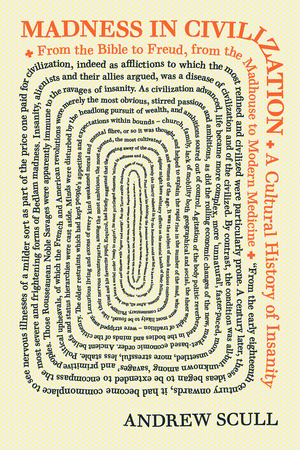
Book: Madness in Civilization - A cultural history of insanity

individual
INTERPERSONAL : SCIENCES
humanistic ------------------------------------------- mechanistic
SOCIOLOGY : POLITICAL
group
Need for asylum
http://press.princeton.edu/titles/10439.html
Book cover: Madness in Civilization
physical health
diagnosis
treatments

stigma, sense making, community care,
social history

power, institutionalised care, custodial,
parity of esteem, 'asylum'


Image source:
https://press.princeton.edu/books/hardcover/9780691166155/madness-in-civilization