Hodges' Model: Welcome to the QUAD: performance

Hodges' model is a conceptual framework to support reflection and critical thinking. Situated, the model can help integrate all disciplines (academic and professional). Amid news items, are posts that illustrate the scope and application of the model. A bibliography and A4 template are provided in the sidebar. Welcome to the QUAD ...

Showing posts with label performance. Show all posts

Thursday, July 16, 2026

How is your Odyssey (thus far ...)?

THE ODYSSEY

As a tool for lifelong learning Hodges' model must be capable of providing a structure through which a narrative can woven. A person's career, as in work, is another distinct example. And again the 'health career' through health, illness, physical and mental trials and tribulations is perhaps the prime example. As the example, it forms the basis of myth underpinning the world's cultures, pre- and ancient histories.

Tomorrow, is the day of "Two Odysseys". No: this is not 2001, 2010, 2061 or 3001.

One odyssey, heads off to the South West, to a place where the land ends, apparently. Memories to be made, a story to unfold.

The other, is based on a voyage: an incredible tale, an epic journey - the epic (in the west). This ODYSSEY will be found in the cinema (and not on a phone, TV, PC, laptop ...); and vitally also in an amazing book. Recounting, what was originally the oral tale of Odysseus on his fantastical 10-year journey home after the Trojan War.

Hodges' model provides a structure to weave this narrative, the twists and turns of patients, carers, students and personnel - all the narrative forms.

Image: https://www.rottentomatoes.com/m/the_odyssey_2026

See also: The Hero's Journey and Joseph Campbell

Thursday, June 04, 2026

Individual and shared mental models c/o Proctor, & Vu, (2023).

The first day of the conference on 'Ecologies of Care' 4th-5th June is complete. It was helpful to contribute early and then focus on the programme. The questions and acknowledgement have made the (personal) effort worthwhile. Tomorrow also looks promising. There was an emphasis on attention which I tried to reflect and featured in a fascinating keynote by Professor Yves Citton. I will check the sources highlighted; and tomorrow, inquire about a point made re. use of socio in contrast to social.

Regards ongoing reading, perhaps, the evidence to support Hodges' model in practice is already out there? There might be a caveat, that the literature may suggest (if does not yet confirm) that if taught cross-curricula and professional groups then Hodges' model can function as a meta-model? 

What do you think of the following from a chapter on 'Social attention and team performance' (with my emphasis)? :

'... Other two-person team examples include doubles tennis partners and pairings of an airline pilot and copilot. Larger teams can be found in the numerous team sports surgical teams, busineses, and research teams of many scientific laboratories. For teams, coordinated performance is crucial, which becomes more difficult when teams extend to three or more people. As such, teams need to have shared mental models representing the team knowledge (Gardner et al., 2017), which support team situation awareness (Demir et al. 2017).
 
The concept of individual mental model refers to understanding a particular event on the basis of the activation of relevant schemas from long-term memory and, sometimes, simulation of possible scenarios (see also Chapter 10). Bower and Morrow (1990) pointed out that a crucial role in mental models is to shift and focus attention. ...
 
Shared mental models refer to collective understanding among team members of the task to be performed and how it can be accomplished. This understanding includes the responsibilities of the individual team members and dependencies between teammates on other members progress. The term team mental models is sometimes used when the context is teamwork that needs to be coordinated and executed (Jonker et al., 2010). The idea is that teams will perform better if they share mental models. ...
 
The surgery intern study illustrates that shared mental models are learned, leading to the question of how this learning can be facilitated.' p.368. ...
 
'Team leadership can be effective at getting members to be engaged in activities that will promote shared mental models. Boies and Fiset (2018) found evidence that leaders can facilitate the development of shared mental models by involving team members in the consideration of the to-be-accomplished task and their roles in its accomplishment. This involvement, again, likely directs members' attention to information relevant for achieving team goals and enables more domain-specific group discussion, which then furthers the emergence of a shared mental model. ...
 
Situation awareness is a broader concept than mental models, focusing on an explicit understanding of events and contextsShared situation awareness differs from individual situation awareness discussed in Chapter 9, in the information required for operators to have effective coordination (Chiappe et al., 2016). For example, paramedics delivering a patient to an emergency room need to coordinate with the hospital and its staff members to ensure that the hospital has the capacity and that the doctors receiving the patient have the vital information they need to treat the patient. Once the patient is in the emergency room, nurses, doctors and technicians need to coordinate with each other to make sure that the patient is being properly cared for.' p.369. 

Proctor, R. W., & Vu, K.-P. L. (2023). Social attention and team performance. In R. W. Proctor & K.-P. L. Vu, Attention: Selection and control in human information processing (pp. 343–374). American Psychological Association. https://doi.org/10.1037/0000317-012

Friday, May 29, 2026

'Elegy' by Gabriel Goliath - Venice Biennale

“Elegy is wound and medicine when mourning itself is under threat”

- Christina Sharpe & Rinaldo Walcott


Elegy is a life-work of mourning. It is a cry, a lament, a tender refrain of remembrance, repair and black feminist love.

For over a decade now, Gabrielle Goliath has staged performances of Elegy across South Africa and the world, invoking the absent presence of women and LGBTIQ+ people lost to fatal acts of racial-sexual violence. In each performance, a group of seven women singers enact a ritual of mourning, collectively sustaining a single, haunting tone for the course of an hour. As one singer falters, another steps up to pick up the note, and so it continues, a cyclic threading of shared breath and voice.

Each performance of Elegy is accompanied by a eulogistic text, scripted by a family member or friend of the individual commemorated: for Sinoxolo, Koketso, Noluvo, Lerato, Kerabo, and more… Other performances address historical cases of violence against women and otherwise-feminised bodies in colonial and slaveocratic contexts. For these, speculative texts by collaborating scholars reach across generations, geographies and archival erasures, recalling these ‘past’ losses and accounting for a present of anti-black, anti-femme violence.

Refusing spectacle and the objectification of bodies deemed rapeable and killable, Elegy asserts conditions of hope and avowal: affirming black, brown, indigenous, femme, queer and trans lives as loveable and grieveable. It is a work of regard, of specificity and care. For those immersed in its sonic vigil, it offers a space for shared grief and radical refusal - for the urgent, ongoing life-work of mourning.

. . .

Source: Gabriel Goliath - https://www.gabriellegoliath.com/

May 5 - July 31, elegyinvenice.com
individual
|
INTERPERSONAL : SCIENCES
humanistic ------------------------------- mechanistic
SOCIOLOGY : POLITICAL
|
group


reflection


temporal


Collective grief


violence

My source: Nadia Beard. A musical act of mourning, Venice Biennale, FTWeekend. 2/3 May 2026, p.5.

Tuesday, December 09, 2025

In search of socio-political logics

'The logic of appropriateness refers to actions which members of an institution take to conform to its norms. For example, a head of state will perform ceremonial duties because it is an official obligation. By contrast, the logic of consequences denotes behaviour directed at achieving an individual goal such as promotion or re-election.' p.87.

individual
|
INTERPERSONAL : SCIENCES
humanistic -------------------------------------------  mechanistic
SOCIOLOGY : POLITICAL
|
group-population


'Institutions are far more than the theatre within which the political drama unfolds; they also shape the script (Peters, 1999). This emphasis within the institutional framework on the symbolic or ritual aspect of political behaviour contrasts with the view of politicians and bureaucrats as rational, instrumental actors who define their own goals independently of the organization they represent.' p.87.


'Further, institutions bring forth activity which takes place simply because it is expected, not because it has any deeper political motive. When a legislative committee holds hearings on a topic, it may be more concerned to be seen to be doing its job than to probe the topic itself. Much political action is best understood by reference to this 
logic of appropriateness rather than a logic of consequences. For instance, when a president visits an area devastated by floods, he is not necessarily seeking to direct relief operations or to achieve any purpose other than to be seen to be performing his duty of showing concern. In itself, the tour achieves the goal of meeting expectations arising from the actor's institutional position. "Don't just do something, stand there", said Ronald Reagan, a president with a fine grasp of the logic of appropriateness.' pp.86-87.


See also: 'drama' : 'bridges'

Hague, R., & Harrop, M. (2007). Comparative Government and Politics (7th ed.). New York, NY: Palgrave Macmillan.

Peters, B. Guy. (1999). Institutional theory in political science: the new institutionalism. London: Pinter.

Friday, May 16, 2025

Theatre - the best way to learn ...

Pardon me, while I stay local - in Liverpool . . . 

I've always been interested in drama since school days (aged 13-14) and playing Francis Nurse in Arthur Miller's Crucible. Recent reading (inc. Theatre of the Absurd, The Shifting Point), see 'drama' - with more to follow) encouraged me to find out more. As a community mental health nurse on a visit, I've sometimes thought of this script being written as we engage with each other. Framed within  interpersonal skills and the society 'outside', there's a sense in which a screenplay is also writ large. 

The fact of whether the session is therapeutic, progressive, person-centred, structured, ethical, purposeful, has tea and custard creams ... is the drama of course.

In a way the creators of formal psychotherapies are playwrights - directors:

After all, they keep producing 'original' therapy manuals, don't they?


In the new year I noticed a community message about a theatre group Valley Theatre Group, planning a 'Living Newspaper' for a drama festival that took place last month. There is another performance next month in Liverpool, as per the edited message below:

People have been asking what’s going on and when for our Hope Street performances June 6-8th. So here’s the details.

W
e start each evening with the play about a 1930s Socialist Theatre group, “Unity”. (Cast: Peter Merrill, Ted Grant, Steve Donegan, Meggan Pye, Day Sheehan and Donna Lauder)

Then, on Friday 6 June, in the second half, we have our first Living Newspaper. This is the one that has most of the sketches submitted by outside writers and developed at the workshops. Then on Saturday 7th, second half, we have the Leverhulme group (The one that won the award at the festival) with their Living Newspaper. Finally, on Sunday 8th, in the second half, we have the last of the Living Newspapers, the one with slightly longer pieces like Scouse Man. This final one also has an original sketch from a 1930s Living Newspaper, the Munich Pact.

Tickets are on sale at the Hope Street Theatre website (link below) and from Ticket Quarter. Please come along and try to get other people along as well.  It'll be a good night's theatre! 

Thanks for all your support. The WTM team

Ticket link:  www.hopestreettheatre.com

Phone: 0344 561 0622

Thursday, December 26, 2024

Moving Online Symposium: 30th Jan 2025 - Coventry University, UK

In recent years, there has been increased attention paid to the ownership of dance. There has been important work done in the area of dance and copyright1 as well as the examination of the way ownership is managed via social norms through the ‘commons’2 and as a form of ‘gift’. The increased circulation of dance online through archives, video platforms and social media sites has led to multiple debates about the copying and re-embodiment of dances,4 reigniting important conversations about appropriation, acknowledgment and credit.5 At the same time, there has been a flourishing of work on dance and performance ontology. For example, long-standing debates about the ephemerality of dance and performance have been reframed through discussions about the ‘post-ephemeral’6and materiality.7 There have also been new perspectives offered on questions about the nature of dances and the way in which they exist.8,9


The Moving Online symposium explores how these two areas intersect in the context of online dance and performance. The event builds on and shares the findings from Moving Online: Ontology and Ownership of Internet Dance (the project and event is funded by the Arts and Humanities Research Council [grant number AH/W01002X/1]).

The register for this event please complete this form. The draft schedule is available here.

The event is free to attend. We are offering limited number of £150 bursaries to support travel and participation by freelance artists. More information is available here. Deadline for applications 8th January 2025.

The symposium is taking place in-person at Coventry University. We plan to live stream some of the panels. If you would like to join the live stream, please select this option on the registration form.

For more information about Moving Online please see here and follow the project on X: @MovingOnlineCU and/or Instagram: @movingonlinecu

Please contact Hetty Blades with any questions: hetty.blades AT coventry.ac.uk

For notes and references please see here

Previously: 'dance' : 'movement' : 'ownership'

My source: 

Philos-L "The Liverpool List" is run by the Department of Philosophy, University of Liverpool https://www.liverpool.ac.uk/philosophy/philos-l/ Messages to the list are archived at http://listserv.liv.ac.uk/archives/philos-l.html. Follow the list on Twitter @PhilosL.

Follow the Department of Philosophy @LiverpoolPhilos 


Saturday, November 09, 2024

Nye | Full Show | Free (until 11th Nov) | National Theatre @home

Further to a post earlier this year regarding a play - 

Dramatherapy iii - A Specification for Care: Nye

- the play Nye is available to watch for free UNTIL 11th NOV 

on the National Theatre's YouTube channel (with Michael Sheen as Nye Bevan)

https://youtu.be/hpN--d5bXSY?si=yHiiXn1ZhN2_NDnP


My source: Politics of Health Group Mail List Messages

Visit the PoHG website for lots of interesting links and publications: http://www.pohg.org.uk/

Visit PoHG on Facebook: https://www.facebook.com/282761111845400

Follow us on Twitter: @pohguk

I walked by the NT this afternoon on the way to Bankside Gallery.

Tuesday, April 16, 2024

Dramatherapy iii - A Specification for Care: Nye

Individual
|
      INTERPERSONAL    :     SCIENCES               
HUMANISTIC  --------------------------------------  MECHANISTIC      
 SOCIOLOGY  :    POLITICAL 
|
Group


"Classical psychodrama requires five instruments, the stage, the subject, the director, the auxiliary egos and the audience. Although Moreno frequently stated that psychodrama could take place in many natural settings, he advocated the use of a stage of his own design, circular, 12-15 feet in diameter, 1-2 feet high with two surrounding stepped lower levels, seating for the audience, a 'Juliet' gallery and equipment for varying the colour and brightness of the lighting. This format was was aimed at providing a space and generating an atmosphere in which the subject could rise up to move and act with increased freedom and imagination.

'The locus of a psychodrama, if necessary, may be designated everywhere, wherever the patients are, the field of battle, the class-room or the private home. But the ultimate resolution of deep mental conflicts requires an objective setting, the therapeutic theatre. ...'". p.107-108.

Nye - National Theatre


Davies, M.H. Dramatherapy and Psychodrama, Chap. 5. pp.104-123. In Jennings, S. (Ed.), (1987) Dramatherapy. Theory and Practice for Teachers and Clinicians. Routledge, London. p.106.

Friday, February 09, 2024

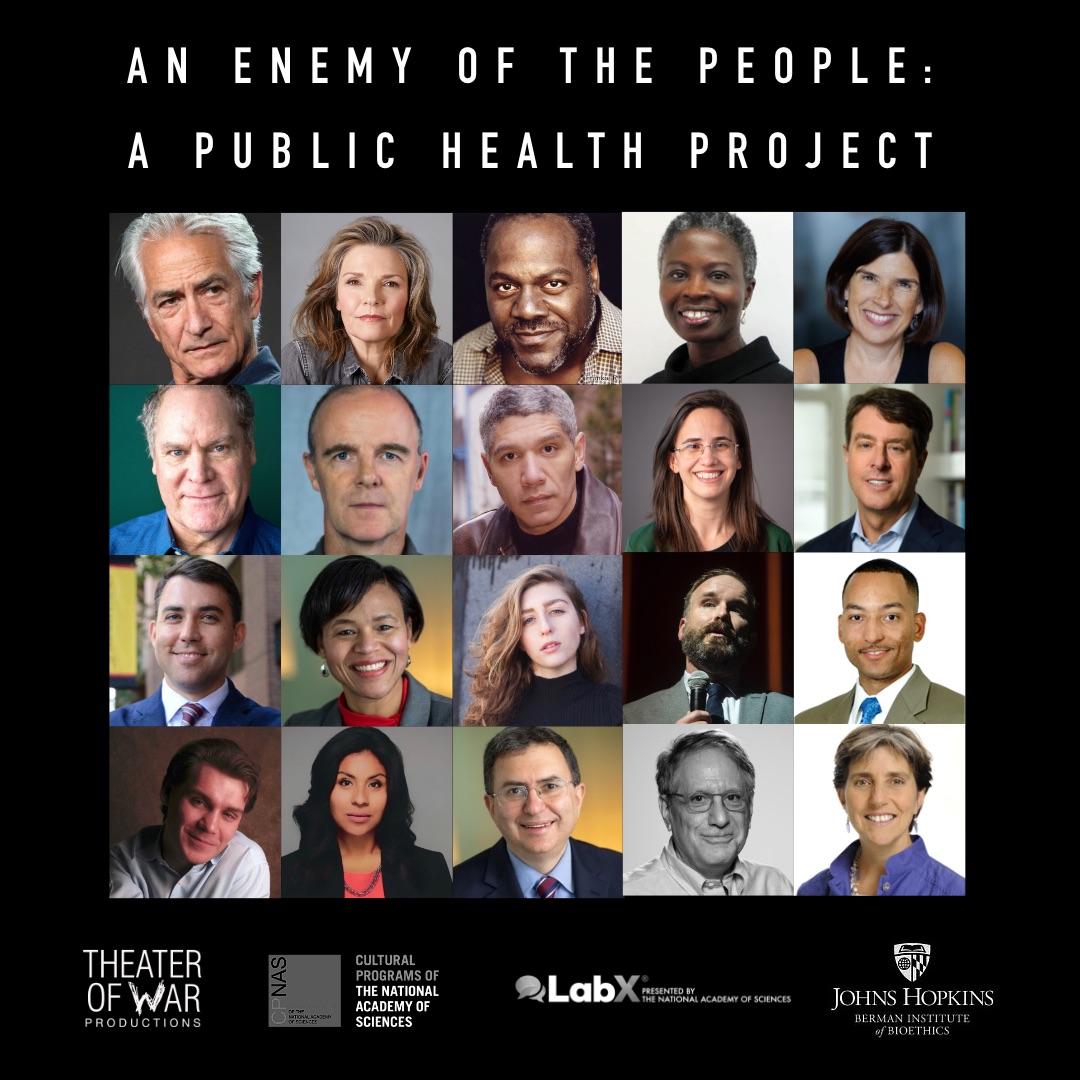
Theater of War Productions - An Enemy of The People Feb 22 + 24

Cast Update! 

We are thrilled to announce that Kathryn ErbeFrankie Faison, and Peter Francis James have joined the cast of An Enemy of the People on February 22 and 24, alongside David Strathairn, Francis Collins, Vivian Pinn, Victor Dzau, Brían F. O’Byrne, Jay O. Sanders, Keshia Pollack Porter, Gloria Addo-Ayensu, and many more! The project will present live dramatic readings of scenes from Henrik Ibsen’s 1882 play An Enemy of the People to frame powerful audience discussions about the challenges to public in our culture today. Register below to attend in person or online! Check individual listings for confirmed cast members each night, as casts will vary and are subject to change.

An Enemy of the People: A Public Health Project
Thursday, February 22, 2024
7:00 pm - 9:30pm EST

Johns Hopkins University Bloomberg Center
555 Pennsylvania Avenue NW
Washington, DC 20001

Featuring performances by David Strathairn (Nomadland), Frankie Faison (The Wire), Kathryn Erbe (Law & Order: Criminal Intent), Peter Francis James (Oz), Jay O. Sanders (True Detective), Brían F. O'Byrne (The Wonder), Marjolaine Goldsmith (Company Manager of Theater of War Productions), Monica Feit (Executive Director, Health and Medicine Division, National Academies of Sciences, Engineering, and Medicine), Jeffrey Kahn (Director, Johns Hopkins Berman Institute of Bioethics), Keshia Pollack Porter (Chair, Department of Health Policy and Management, Johns Hopkins Bloomberg School of Public Health), Tshaka Cunningham (Chief Scientific Officer, Polaris Genomics), Gloria Addo-Ayensu (Director of Health, Fairfax County Health Department), Emily Packard Dawson (Program Officer, National Academies of Sciences, Engineering, and Medicine), Nancy Kass (Deputy Director for Public Health, Berman Institute of Bioethics), Graham Sack (Filmmaker, Dracopoulos-Bloomberg iDeas Lab Fellow), Grelia Steele (Global Continuity and Crisis Manager, Guidehouse), Peter Marks (Former Chief Theater Critic, The Washington Post), Matthew Frieman (Viral Pathogen Research Professor of Microbiology & Immunology, University of Maryland School of Medicine), and Joshua M. Sharfstein (Vice Dean for Public Health Practice and Community Engagement at the Johns Hopkins Bloomberg School of Public Health).

Register to attend in person or online

An Enemy of the People: A Public Health Project
Saturday, February 24, 2024
7:00 pm - 9:30pm EST

National Academy of Sciences 
2101 Constitution Ave, NW
Washington, DC 20418

Featuring performances by David Strathairn (Nomadland), Frankie Faison (The Wire), Kathryn Erbe (Law & Order: Criminal Intent), Peter Francis James (Oz)Jay O. Sanders (True Detective), Brían F. O'Byrne (The Wonder), Francis Collins (Former Director, National Institutes of Health), Monica Feit (Executive Director, Health and Medicine Division, National Academies of Sciences, Engineering, and Medicine), Jeffrey Kahn (Director, Johns Hopkins Berman Institute of Bioethics), Keshia Pollack Porter (Chair, Department of Health Policy and Management, Johns Hopkins Bloomberg School of Public Health), Victor Dzau (President, National Academy of Medicine), Vivian Pinn (Senior Scientist Emerita at the NIH Fogarty International Center), Ruth Faden (Berman Institute Founder; Philip Franklin Wagley Professor of Biomedical Ethics), Grelia Steele (Global Continuity and Crisis Manager, Guidehouse), Peter Marks (former chief theater critic, The Washington Post), Gloria Addo-Ayensu (Director of Health, Fairfax County Health Department), Graham Sack (Filmmaker, Dracopoulos-Bloomberg iDeas Lab Fellow), Nancy Kass (Deputy Director for Public Health, Berman Institute of Bioethics), Joshua M. Sharfstein (Vice Dean for Public Health Practice and Community Engagement at the Johns Hopkins Bloomberg School of Public Health), Marjolaine Goldsmith (Company Manager, Theater of War Productions), and Emily Packard Dawson (Program Officer, National Academies of Sciences, Engineering, and Medicine).


Register to attend online


I will register have registered (online). There is a production of An Enemy of the People in London, but it is expensive from NW England.

This afternoon I enjoyed a delayed appointment with DUNE 2021 Part 1 IMAX, a brilliant cinematic experience that includes a performance by Oscar Isaac as Duke Leto Atreides.

See also: Ibsen , theatre ...

Saturday, September 09, 2023

The 'quantum ballerina' - Dr Merritt Moore


INDIVIDUAL
|
     INTERPERSONAL    :     SCIENCES               
HUMANISTIC --------------------------------------  MECHANISTIC      
SOCIOLOGY  :   POLITICAL 
|
GROUP


"Her life to date reads like something dreamt up during a Disney story conference: pretty American teen fulfils a life-long dream of a career in quantum physics at both Harvard and Oxford. And the fantasy cash register goes right on ringing because our heroine has not one career, but two. Between all-night stints in the lab she leads a double life as a professional ballet dancer.
At this point one the grown-ups in our imaginary brainstorm might lean in and suggest that maybe the two-career thing was a mite, er, far-fetched? But Dr Merritt Moore, quantum physicist and alumna of four major-league ballet companies (Zurich, Boston, Norwegian, and English National), is living proof that this crazy scenario can be lived in real time by anyone with the ability to devote themselves body and soul to the dreams that devour them." p.12.

Skjalg Bøhmer Vold, Courtesy Merritt Moore


Dr Merritt Moore

Levene, L. (2021) The 'quantum ballerina' and her robot pas de deux", FTWeekend, Life&Arts, 27-28 March, p.12.

See also:
https://pointemagazine.com/merritt-moore-ballet/

Previously:
https://hodges-model.blogspot.com/2021/12/raymonda-ballet.html


Friday, August 05, 2022

"Your metacognitive fingerprint"

 INDIVIDUAL
|
 INTERPERSONAL    :     SCIENCES               
HUMANISTIC --------------------------------------  MECHANISTIC      
SOCIOLOGY  :   POLITICAL 
|
GROUP

"Why are some people more self-aware than others? Studies show that metacognition is a relatively stable trait, so if you tested your metacognition today, it is likely to be similar if you do the same test again tomorrow. Strikingly, it also seems that metacognition is independent of IQ and general cognitive ability: your metacognition can still be in good form as long as you recognise you are performing badly at a task.
We still don't understand the origins of these individual differences, but one promising idea is that "explicit" metacognition is something we learn, based on feedback from our parents, teachers and social group.
A genetic "starter kit" may establish forms of self-monitoring early in life and then our parents and teachers finish the job. But even in adulthood, these things aren't totally fixed (see main story), so this is one kind of fingerprint you can change." p.38.

finger

p r i n t


- with my emphasis.

Fleming, Stephen. The power of self-reflection, New Scientist, 250,3333, 36-40. 8 May. 2021.
https://www.sciencedirect.com/science/article/abs/pii/S0262407921007946

I heard Stephen Fleming on the radio when the associated book was released last year - must buy a copy.

Still reading and enjoying 'Human Landscapes' with posts to follow.

See also: meta- meta- meta- +!

Thursday, April 08, 2021

"Public Domain" - The Vaudeville Theatre

individual
|
INTERPERSONAL : SCIENCES
humanistic ----------------------------------------------- mechanistic
SOCIOLOGY : POLITICAL
|
group


Public Domain is a dark, funny, verbatim musical about the internet: Those who own it; those who live in it; and YOU!

Following an acclaimed digital debut at Southwark Playhouse this thrilling, new British musical, composed entirely from the real-life words of YouTube vloggers, Instagram influencers, Facebook’s tech giants, and everyday internet users now has its live world premiere in the West End.

Written and performed by the hugely talented Francesca Forristal (Oddball) and Jordan Paul Clarke (Showstopper! The Improvised Musical), this blackly comic musical follows two teenage influencers; Millie (sporty spice, health guru, buddha bowls – millennial) and Z (GCSEs existential dread, swag – generation Z), as well as featuring exclusive ‘footage’ of inside Mark Zuckerberg and wife Priscilla Chan’s family home…

You’re gonna get their honest, true selves… with some serious bass, obvs. Authentic, right?

Remember, it’s like ‘Black Mirror’ but real and set to music.

The Vaudeville Theatre operates strictly under the government COVID-19 guidelines. For further information check our COVID-19 secure information page. All bookings in a party must only be from the same household or the legally defined support bubble.

Thursday, November 05, 2020

Unheard stories of women - monologues: An opportunity

Friday, August 07, 2020

Poetry Health Service c/o HOME

individual
|
INTERPERSONAL : SCIENCES
humanistic ----------------------------------------------- mechanistic
SOCIOLOGY : POLITICAL
|
group - population
Poetry Health Service

The Poetry Health Service is now open!

The PHS is a brand new, free, creative service offering contemporary poetry as a tool for connection and healing.

Fill in a colour based flow chart and receive your own complimentary poem.


My source: HOME, Manchester

Tuesday, October 15, 2019

Book: "The Empty Space"

The Empty Space, Peter Brook

 In July I caught up with Mr Brian Hodges who created Hodges' model. Having met previously in November 2013 we agreed not to leave it as long next time and so I returned on 7th October.

One question I had was whether in addition to Hughes there were any other influences that led Brian to the model overall?

Brian could not recall a specific reference, but mentioned the theatre being an influence. I, in turn had picked up a second-hand book on one of several recent trips to London, but the title evaded me. Once home I checked and the book is "The Empty Space" by Peter Brook. A Gower Street bargain at £4.99. Brian also checked and emailed to confirm this is the book on his shelf too.

While in London (and elsewhere) I try to visit the theatre and  now look for performances of Ibsen's plays. Whatever I do see, A Doll's House this month, before the performance starts the set design is always intriguing. I've posted on this before, Hodges' model providing a 'stage set', one that should the play require can include the operating theatre.

As a mental health nurse the themes of Ibsen's plays still resonate today. From the performances I have attended the public finds ongoing relevance in: The Master Builder, Ghosts, The Lady from the Sea, Rosmersholm, Hedda Gabler and An Enemy of the People. This is true of the work by others. The drama of life and death that Hodges' model can also stage.

Brian emailed me about a situation that stood out for him in the book, so I will revisit this. What caught my eye is the cover of Brook's book (and yes, the graphic first). Without even opening the book, the 'scene' is (possibly?) set on the book's cover "A Book About the Theatre: Deadly, Holy, Rough, Immediate" ...


 individual
|
INTERPERSONAL : SCIENCES
humanistic ----------------------------------------------- mechanistic
SOCIOLOGY : POLITICAL
|
group - population

Holy


Immediate

Rough

Deadly


Hughes, E. (1958) Men and their work. New York: Free Press. (Hughes was used by Brian to define ‘health career’ the idea of life chances.)

Wednesday, July 10, 2019

"Performance Piece" by Senga Nengudi

individual - self
|
INTERPERSONAL : SCIENCES
humanistic ----------------------------------------------- mechanistic
SOCIOLOGY : POLITICAL
|
group- population


"Performance Piece" (1978) by Senga Nengudi


Thackara, T. (2019) Creative challenge, FT Weekend, Collecting, 27-28 April, p.3

Image:
https://news.artnet.com/exhibitions/senga-nengudi-1312703

Saturday, June 29, 2019

The Adrian Piper Foundation Berlin Multi-Disciplinary Fellowship 2020 ...


individual - self
|
INTERPERSONAL : SCIENCES
humanistic ----------------------------------------------- mechanistic
SOCIOLOGY : POLITICAL
|
group- population

"The APRA Foundation Berlin Multi-
Disciplinary Fellowship has the purpose 
of promoting research on the conception, 
constitution and structure of the self,

surviving and flourishing
 in a global environment; and

with the educational goals of (i) increasing knowledge and public awareness of individual and societal strategies for 


(ii) discovering, identifying and promoting the cross-disciplinary and cross-cultural flexibility through which these strategies are expressed."
Text: http://www.adrianpiper.com/foundation/M-DFellowshipMission&Guidelines.shtml


http://www.adrianpiper.com/index.html

http://adrianpiper.com/foundation/M-DFellowshipMission&Guidelines.shtml#guidelines

Tuesday, November 27, 2018

Thought Cages: c/o BBC Radio 4

individual
|
INTERPERSONAL : SCIENCES
humanistic ----------------------------------------------- mechanistic
SOCIOLOGY : POLITICAL
|
group

Motivations
Experience

"Elephant in the brain"

Friends, Family (+ the test)
Receiving treatment
Patient - Professional relationship


NHS
Companies
Health expenditure


Be Successful or Be Loved: The NHS Dilemma

Wednesday, August 15, 2018

The NHS at 70 or on the Fringe(s)?

individual
|
INTERPERSONAL : SCIENCES
humanistic ----------------------------------------------- mechanistic
SOCIOLOGY : POLITICAL
|
group
A Fortunate Man
fringe


fringe
fringe


fringe
After the Cuts


See also: Edinburgh Fringe: A round-up of the NHS themed shows reflecting the chaos of ordinary people's lives

My source: Foyles, London, The Fringe, Free

Thursday, June 14, 2018

Wellcome Collection: Handle with Care


Health care is complex
because
care delivery
involves the
handling
of a variety of forms of
knowledge, information and data. 


individual
|
INTERPERSONAL : SCIENCES
humanistic ---------------- ...WHAT IT MEANS ... ------------------ mechanistic
SOCIOLOGY : POLITICAL
|
group

to be cared for


to be caring


to care


to be a carer


The handling becomes specialised 
because of those
be's
the 'patient', the 'nurse', the 'carer'...
identities
loved, lost, earned and learned ...
The integration of all this 
can be summarised as so many forms of 'why'
often described as the spiritual -
Let us handle the Planet With Care.