Hodges' Model: Welcome to the QUAD: sharing

Hodges' model is a conceptual framework to support reflection and critical thinking. Situated, the model can help integrate all disciplines (academic and professional). Amid news items, are posts that illustrate the scope and application of the model. A bibliography and A4 template are provided in the sidebar. Welcome to the QUAD ...

Showing posts with label sharing. Show all posts

Monday, March 03, 2025

Finding a space for Lived Experience

Individual
|
      INTERPERSONAL    :     SCIENCES               
HUMANISTIC  --------------------------------------  MECHANISTIC      
 SOCIOLOGY  :    POLITICAL 
|
Group

Whatever your personal - emotional - journey, your experience, ongoing expectations ... hope: hope-fully this is you. You can, or have discovered the potential here. Whether or not the strengths you possess, are recognised due to what others see elsewhere. 


Lived experience brings so many pathways. So many rooms and spaces to explore. Whatever the physical challenges: whether well: 'all-good thanks'; or dealing with one or more diagnoses - acutely, in recovery, relapse, may all points of the compass be open to you.


Whatever your life experience: your health career began down here [and across there ->], shaped by your life chances. These days they call them the determinants. They are many, and can influence your social network, whether you have one ...


As you (literally) negotiate - even if you fail repeatedly - the systems, that the system throws your way, trying to make ends-meet; in work or out, never under-estimate what a person can do. Here lived experience can pay dividends, across the divides that really matter.


Welcome to your space ...
and may it include hope shared and delivered ...

Wednesday, February 14, 2024

Distance: Shoulders and ships that pass ...

James Lovelock, 2005 (cropped).jpg
Lovelock in 2005: Wikipedia

Over the past 10-20 years I've become more aware of the distance from scholars and people whose work is relevant to Hodges' model. Distance in the sense of their concomitant 'celebrity', hence the issue of how to make contact; and the stage of their career and my discovery of their relevance. Three people come to mind ... 

I've long admired the work of James Lovelock, and when writing on ecological themes in -

Jones, P. (2008) Exploring Serres’ Atlas, Hodges’ Knowledge Domains and the Fusion of Informatics and Cultural Horizons, IN Kidd, T., Chen, I. (Eds.) Social Information Technology Connecting Society and Cultural Issues, Idea Group Publishing, Inc. Chap. 7, pp.96-109.
- I wondered about trying to contact Dr Lovelock. As the majority of people are aware his thought and books, especially the Gaia hypothesis with Lynn Margulis caught the public's imagination from first publication and through the 1970s. Was there a Horizon TV programme? James Lovelock's influence was not just in ecology, but also earth (planetary) sciences through work for NASA. In early 2021 I thought I would reach out, through his most recent book and publisher/agent. I passed a message, which was forwarded but I never heard anything more.

As a nurse - with experience in older adult community mental health, I was acutely aware that this senior gentleman - in every sense of the word - may not want to be mithered by a scouser*, now living near Wigan Pier. I stressed not wanting to disturb the Dr. I also thought, given Dr Lovelock being of independent mind - a maverick, he might on the contrary love to be disturbed. 

Sadly, I was too late, hearing the news of Dr Lovelock's death in 2022. Of course, I was seeking validation (and still am) for the project here. I can't help thinking though, that Dr Lovelock really would have 'got' Hodges' model.

James Lovelock: BBC Radio 4 The Life Scientific

<>

Philosophy has long been an interest B.A.(Joint Hons.) Comp./Phil.. In a way you have no choice as a nurse, especially trained in mental health and general nursing: the theory and practice invariably touch reality, consciousness, perception, subjectivity, objectivity, knowledge, being, perception, data, information, time and so on.

Once acquainted with Hodges' model, scale is the dimension that asserts itself. I wrote about this and referenced Mario Bunge in about 1998, on the old, now archived website:

https://web.archive.org/web/20100329050839/http://www.p-jones.demon.co.uk/infintro.htm

Scale is a constant and multicontextual focus, but interest was piqued once again as I try to look at Hodges' model mathematically (yes, who am I trying to kid!) - as an object and relationally. I was reminded of Prof. Bunge's work noting a paper that included 'isomorphic-ism':

Bunge, M. (1969). Corrections to “Foundations of Physics”: Correct and Incorrect. Synthese, 19(3/4), 443–452. http://www.jstor.org/stable/20114653

https://link.springer.com/article/10.1007/s10838-021-09553-7

Mahner, M. Mario Bunge (1919–2020): Conjoining Philosophy of Science and Scientific Philosophy. J Gen Philos Sci 52, 3–23 (2021). https://doi.org/10.1007/s10838-021-09553-7

There may be a brief email exchange with Prof. Bunge, a request for a paper or two. Any emails are now stored (CD-ROM and portable drive) in a Turnpike folder, an old email client. Last year I was disappointed again, to learn of Dr Bunge's passing in 2020. His focus on science, philosophy, and systems - hard / soft is also very informative.

<>

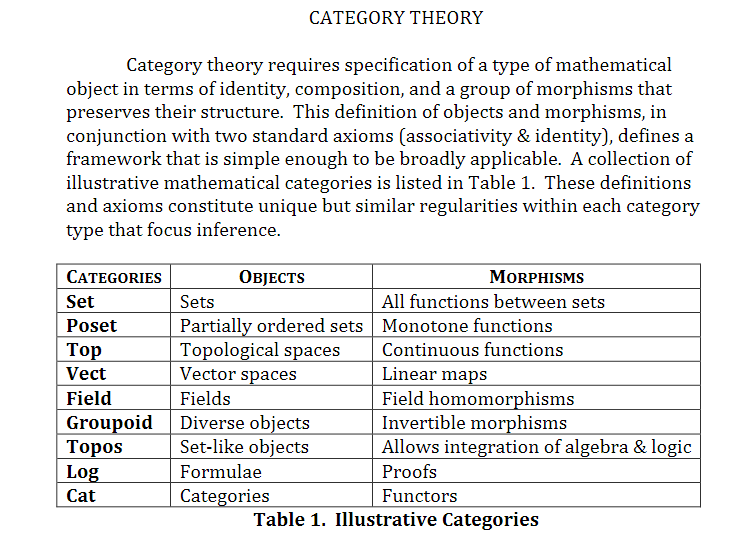
More recently, I came across the fascinating work of David Sallach, one paper (a conference from 2012) includes:


Sallach, D.L. Categorical Social Science: Theory, Methodology and Design. September 2012
Conference: Fourth World Congress on Social Simulation. Taipei, Taiwan.
https://www2.econ.iastate.edu/tesfatsi/Sallach2012CategoricalSoSci4.WCSS-SS.pdf

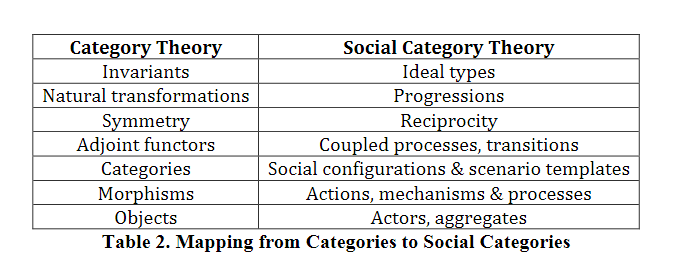
Plus, developed further in table 2:

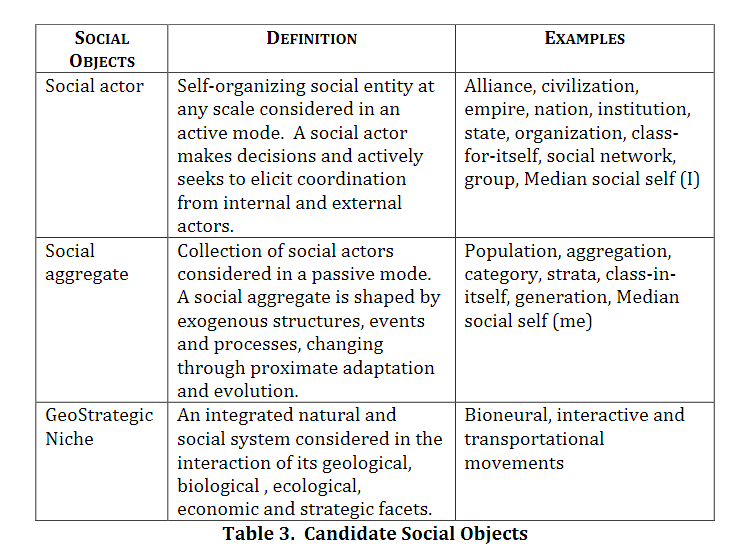
If time permits as an exercise, please consider Sallach's table 3 below. It may be interesting to map this to the domains of Hodges' model(?) [template]:
:

If you can see the potential utility of Hodges' model, you may also appreciate why Sallach's paper  resonates. Having emailed Dr Sallach, without reply, I did some checking. More sad news followed.

I, and no doubt many people will continue to discover and appreciate the legacy left behind by the above and many other pioneers. 

<>

I must acknowledge - Enid Mumford - whose work on socio-technical systems continues to inform my study and application of Hodges' model. This includes recognition of the many x-disciplinary bridges (or, barricades?) that can be found within Hodges' model. 

Clearly, much reading still to do.
<>

Returning to Hodges' model as a mathematical object, the 'distance' above is suddenly interstellar (and yes, sudden, as in faster than light!). I'm following videos, papers, and specific work-streams by  universities (I won't mention presently...) seeking to apply category theory to the social sciences. This suggests, at least, I'm not (completely!) wasting my time. If you have thoughts yourself on Hodges' model, the journey from Sallach's tables 1 - 2 not just 3, I'd be delighted to hear from you. 

There is another approach I will share this (N) spring. This author - researcher I have been able to contact.

*Scouser - https://en.wikipedia.org/wiki/Scouse
(Re. Liverpool - further post to follow).

James Lovelock image:  Bruno Comby, CC BY-SA 1.0, via Wikimedia Commons.

Sunday, August 14, 2022

Shining a light on Dark Patterns

 INDIVIDUAL
|
 INTERPERSONAL    :     SCIENCES               
HUMANISTIC --------------------------------------  MECHANISTIC      
SOCIOLOGY  :   POLITICAL 
|
GROUP

PERSONAL DATA^


PERSONAL
DATA


DATA, DESIGN
BIOMETRICS^


PERSONAL
DATA


 DARK 
 PATTERNS 


PERSONAL DATA*


CONTROL
TECH GIANTS
TRANSPARENCY
LAW
CONSUMER PROTECTION
...


*And the data of family members.
^Data that is specific to an individual, organic, can include fingerprint, facial images, DNA, behaviours (including keyboard use, online).


Prompt: Mention of 'dark patterns' on BBC World Service promoting their tech coverage.

Previously: 'interface(s)'

Friday, April 22, 2022

Ageing with Smartphones in Urban Brazil

UCL Press is delighted to announce the publication of a new open access book that may be of interest to list subscribers: Ageing with Smartphones in Urban Brazil, by Marília Duque.

Download it free: https://bit.ly/3MhgteU

*************************************************

Ageing with Smartphones in Urban Brazil

By Marília Duque

*************************************************

With people living longer all over the world, ageing has been framed as a socio-economic problem. In Brazil, older people are expected to remain healthy and autonomous while actively participating in society. Based on ethnographic research in São Paulo, Ageing with Smartphones in Urban Brazil shows how older people in a middle-class neighbourhood conciliate these expectations with the freedom and pleasures reserved for the Third Age. Work is what bonds this community together, providing a sense of dignity and citizenship.

Smartphones have become of great importance to the residents as they search for and engage in new forms of work and hobbies. Connected by a digital network, they work as content curators, sharing activities that fill their schedule. Managing multiple WhatsApp groups is a job in itself, as well as a source of solidarity and hope. Friendship groups help each to download new apps, search for medical information and guidance, and navigate the city. Together, they are reinventing themselves as volunteers, entrepreneurs and influencers, or they are finding a new interest that gives their later life a purpose. The smartphone, which enables the residents to share and discuss their busy lives, is also helping them, and us, to rethink the very representation of ageing.


Free download: https://bit.ly/3MhgteU

----------------------
uclpress.co.uk | @uclpress

My source: Alison Major 
 
VIRTUAL-METHODS list - www.jiscmail.ac.uk/VIRTUAL-METHODS
 
(It appears there is a series of related texts. PJ)

Wednesday, December 09, 2020

Action Brief: WHO COVID-19 Health Services Learning Hub (HLH)

 Online call for submissions

Thank you for your interest in contributing to an action brief for the WHO COVID-19 Health Services Learning Hub (HLH). Please find below an overview of the HLH and further information on how to submit your action brief. If you have further questions, please contact us at hlh AT who.int.

Overview

Since the beginning of the COVID-19 pandemic, countries have requested urgent support from WHO to maintain their health services whilst mounting their pandemic response.
 
The WHO COVID19: Health Services Learning Hub is a dynamic new web-based platform that will allow the critical sharing of experiences and learning from innovative practices to inform the collective global response in real time. This will include action briefs on promising examples of innovation to maintain essential health services, synthesis briefs on key emerging learning needs, dynamic learning labs to solve common challenges and a ‘one stop shop’ for up to date information from WHO and partners.


The learning hub will be based on WHO’s Operational guidance for maintaining essential health services during an outbreak, which provides a set of targeted actions countries should take at national, regional, and local levels to reorganize and maintain access to essential quality health services for all.  

The immediate focus of the learning hub will be on maintaining essential health services during the outbreak. In the medium to longer term the hub will focus on health service recovery in the post-acute phase of the pandemic and health services strengthening in the post-pandemic phase.

Action Briefs ... continued


Thanks to Jagoda - HLH 


Thursday, December 03, 2020

IFORS Developing Countries Online Resources

New documents joined - further ones are welcome

IFORS Developing Countries Online Resources 

The aim of the IFORS Developing Countries Online Resources page is to offer the OR worker all publicly-available materials on the topic of OR for Development. It also aims to provide a venue for people who are working in the area to share their completed or in-process work, learn from others, and stimulate comments and discussions on the work. Regarding IFORS Developing Countries OR resources website, its regular updates - and your possible submission of "free" (not copyright protected) material, you might occasionally visit

http://ifors.org/developing_countries/index.php?title=Main_Page

With this open resources page we aim to make research and application results better accessible to the many friends in the Developing Countries. We would be glad about interest. Contributions from the science, communication and education sectors are warmly welcome by our community which has very little access to emerging documents on arts and science, research and technology. "Operational Research" (OR) is the discipline of applying advanced analytical methods to help make better decisions. By using techniques such as problem structuring methods and mathematical modelling to analyze complex situations, Operational Research gives executives the power to make more effective decisions and build more productive systems. 

The International Federation of Operational Research Societies (IFORS; http://ifors.org/) is an almost 60-year old organization which is currently composed of 51 national societies. 

Regional Groups of IFORS are: ALIO (The Latin American Ibero Association on Operations Research), APORS (The Association of Asian-Pacific Operational Research Societies), EURO (The Association of European Operational Research Societies), NORAM (The Association of North American Operations Research Societies). 

IFORS conferences are taking place every three years. On IFORS 2021, Seoul, South Korea, August 22-27, 2021, please refer to http://www.ifors2020.kr/

Thank you very much for your attention. 

With kind regards, best wishes,

Gerhard-Wilhelm Weber 

PS: Feedback is welcome via gerhard.weber AT put.poznan.pl

My source:

www.jiscmail.ac.uk/AI-SGES 


Thursday, November 05, 2020

Unheard stories of women - monologues: An opportunity

Thursday, September 10, 2020

World Suicide Prevention Day #WorldSuicidePreventionDay #WSPD2020

'Suicide' https://hodges-model.blogspot.com/search/label/suicide 

'Activism' https://hodges-model.blogspot.com/search/label/activism