Hodges' Model: Welcome to the QUAD: Search results for mumford

Hodges' model is a conceptual framework to support reflection and critical thinking. Situated, the model can help integrate all disciplines (academic and professional). Amid news items, are posts that illustrate the scope and application of the model. A bibliography and A4 template are provided in the sidebar. Welcome to the QUAD ...

Showing posts sorted by relevance for query mumford. Sort by date Show all posts

Tuesday, March 24, 2009

Ada Lovelace Day: Enid Mumford - Socio-technical perfume down the mine

I had to enter a pledge and join the call today to post in response to Ada Lovelace Day - an international day of blogging to draw attention to women excelling in technology.

Women’s contributions often go unacknowledged, their innovations seldom mentioned, their faces rarely recognised. We want you to tell the world about these unsung heroines. Entrepreneurs, innovators, sysadmins, programmers, designers, games developers, hardware experts, tech journalists, tech consultants. The list of tech-related careers is endless.

Recent research by psychologist Penelope Lockwood discovered that women need to see female role models more than men need to see male ones. That’s a relatively simple problem to begin to address. If women need female role models, let’s come together to highlight the women in technology that we look up to. Let’s create new role models and make sure that whenever the question “Who are the leading women in tech?” is asked, that we all have a list of candidates on the tips of our tongues.

It was soon after this blog first appeared that I learned of the news of Enid Mumford's death. I never had the pleasure of meeting Prof. Mumford, but came across her work whilst doing my own studies and a degree at Bolton. We have something in common in being raised in Merseyside. In the NW of England there is also a tradition of mining...

Studying geology at school we went on a field trip down the pit at Golborne Colliery. Strange to be told after an underground train ride we where under the East Lancashire A580. Enid Mumford's early work took her underground, but her impact extended far beyond her perfume bottle:

'A woman down the mines?" Enid Mumford's classic sociological research for the National Coal Board had a strong impact on unbelieving miners. Later, as an active advocate for women's rights, Enid, who has died aged 82, enjoyed recounting her early experiences: "They were terribly nice to me whenever I turned up, but they were awfully embarrassed at what I might catch them doing." Enid would "drench herself with perfume", so that the ventilation system would give the miners a chance to prepare themselves for her arrival at the coalface. In such ways, Enid began her contributions to social theory, with its challenges to action researchers like herself.
The Guardian obituary
As posted previously this year sees a chapter published on Hodges' model and socio-technical structures in nursing informatics (See bibliography in the blog's side bar). I really latched on to Enid Mumford's approach and needless to say Professor Mumford's invaluable work figures in my overview:

Background: Existing socio-technical structures and methods

This section scratches the pages of the socio-technical literature by introducing two seminal contributions and briefly references other sources. The two authors discussed are Mumford (1983) in the socio-technical sense and Giddens (1984) who is more generic socially and organisational oriented. Enid Mumford created ETHICS, a systems design methodology: Effective Technical and Human Implementation of Computer-based Systems. The need for ETHICS is to help manage change with three objectives.

First, ETHICS stresses that the future users of computer systems, whether directly or indirectly involved should play a major part in designing these systems. User involvement is closely related to subsequent job satisfaction and efficiency gains and hence the realization of benefits. The users of systems are credited as experts; if this knowledge and experience is recognized and utilized then job satisfaction gains are likely as the users are active agents in the change process and not passive. There is an interesting correspondence here with the continuing emphasis on patients and carers being acknowledged as experts in their care assessment, management and evaluation.

The second objective focuses on the human – behavioural response to change. It is important that specific job satisfaction objectives are factored into the design from the outset and not left to chance, lost amid technical specifications and objectives. In this way potential negative change impacting the quality of work life can be anticipated and avoided or at least ameliorated. Technology has frequently been associated with de-skilling and of course the loss of traditional jobs. The prospect of technical, management led change can cause consternation in the user community. If alienated employees may be absent, seek alternate employment, and overall be less productive.

ETHICS is not restricted to the computer system; the third objective highlights the need for a new computer system to be ‘surrounded by a compatible, well functioning organizational system’ (Mumford, 1983). Design must be viewed globally as a whole. The technical design is just one part of a very complex design process that must also incorporate the details of human-machine interaction; what would be called gap analysis, the differences in existing processes and proposed new processes and procedures. In addition, as per objectives one and two, individual jobs and workgroup activities must be reviewed; how are existing roles and relationships altered and newly defined? What new management arrangements are needed, since (middle) management is rarely untouched?

<>

I wish I could spend more time on Hodges' model, socio-technical thought and its application. Women in ICT? This is not a new call.

Women must have role in IT - not just to ensure the social in SOCIO-technical.

Not just to ensure that the 'c' in ICT happens.

Whether in programming, instructional technology, internet infrastructure, semantic web, the games industry and a whole host of other areas - Ada Lovelace, Enid Mumford - and of course others past and present must not be lone pioneers. ...

Additional links:

BCS Women

Daphne Jackson Trust

The Register (2008) Women IT EU Job Shortage
For BR

Friday, March 23, 2007

Professor Enid Mumford

I am very saddened to hear of the death of Enid Mumford.

In February 2004 Prof. Mumford responded to my email about her website and sociotechnical design explaining her work and offering help if needed.

This was then and remains a great encouragement to me.

Now I wholly appreciate her situation, response and kindness as she stated - having joined the health care community for older people herself.

Bless you Enid and your family...


https://www.theguardian.com/news/2006/may/03/guardianobituaries.obituaries 
 

Saturday, November 07, 2009

Innovation and the 'middle' in NHS computing

Let's start with a quote:

Information systems are no longer associated mainly with data processing; they are increasingly seen as a management tool and an aid to action. This means that the costs of failure are much greater, and these costs are incurred when expensive systems are not used or are inadequately used. Surveys have shown that in as many as half of systems there are large gaps between users' expectations and the system's performance.
When do you think the above was written?
Here's the reference:

Mumford Enid (1991) Need for relevance in management information systems: what the NHS can learn from industry. BMJ. June 29; 302(6792): 1587–1590
1991: quite sobering.

Previous - part-time - work reviewing data standards proposals focuses the mind in terms of the role of standards in interoperability, service impact and other essential assessment qualities. As the NHS has sought to implement standards as with the National Programme for IT you are also aware of the clamour for creativity and innovation. Innovation is there in the title of agencies.

I have long pondered about the extent to which - like Nature and vacuums - standards abhor innovation and creativity. How much is the 'standard' about doing things by the 'book' ... page 57 : para.3 ...

My eye caught the viewpoint piece in this week's Computing -
If you approach the world positively, a downturn is a good time for innovation. The shortage of people and money can create the pressure that leads to creativity. There are three areas where action will help organisations succeed in exploiting IT to enable business innovation:
Kick out Prince2

What more is there to say about innovation and Prince2? The focus of the Prince2 project management methodology – on organisation and control, and defining what to deliver before you have begun – is death to innovation.
It is a bad solution trying to solve the wrong problem. It takes the IT profession in the wrong direction if we want to contribute to business
innovation. It has to go. The agile development movement provides much stronger foundations for succeeding with projects that result in business innovation.
Ashurst, Colin, Viewpoint: How to use IT to enable innovation, Computing, 5 November, 2009.
Of course there IS a world of difference between information standards and project management standards, but there is no escape from the need for (effective) management of transition and change WITH business continuity. Within that management - engagement approach (as per agile) -

+++++++ socio-technical +++++++

- perspectives, as highlighted by Mumford (and others) all those years ago must have a place.

See also:

BCS Sociotechnical Specialist Group

Tuesday, March 24, 2009

Intellect UK - Women in IT Scorecard: Ada Lovelace Day II

A definitive up-to-date evidence base for data and commentary on women in IT employment and education

Women in IT Scorecard (PDF 1MB) Published: March 2009
Type: Scorecard
Area: Transformational Business

Summary

Technology is central to the success of the UK economy and is becoming even more important the current economic situation. It is important to understand the trends in employment, education and any issues that could impact the future of the industry especially in such turbulent times.

British Computer Society (BCS), e-skills UK and Intellect., with support from Department for Business Enterprise and Regulatory Reform (BERR), have worked in partnership to produce a ‘Women in IT scorecard’ to understand and demonstrate the trends in our industry by gender from secondary education through into the IT workforce. The purpose of this document is to provide a robust evidence base for the facts behind the trends, to demonstrate differences in the participation rates between the genders and to present an analysis of these trends and the current situation to inform policy debate and future action by the partners and their communities.

The concern
While females represent 45% of the UK working population, they only make up 21% of the IT Industry workforce. For a profession that a few years ago was beginning to edge towards a ‘critical mass’ of 30% women - reaching 23% - we now find an alarming situation. In 2008 the make-up of the profession has changed:

* Males outnumber females in the IT industry by nearly 4:1.
* In the IT workforce, the number of males has fallen by 23,000 while the number of females has fallen by 63,000 since 2001.
* In IT occupations the number of males has increased by 77,000 while the number of females has fallen by 28,000 since 2001.
* Females account for around one in every five IT professionals.
* In Higher Education females account for 25% of all lecturers and 12% of professors in Computer Science / IT related subjects.
* In 2008 there were 17,455 male and just 1,581 female chartered IT professionals – 8% female.


See also - Ada Lovelace Day: Enid Mumford - Socio-technical perfume down the mine

Wednesday, March 24, 2010

Lovelace, women's IT and QUADratic equations

When you stop and think about it - really stop and think, the foresight of Charles Babbage was astonishing, even though he did not quite achieve his objectives. What is even more amazing then is the role that Ada Lovelace played in the development of computing and scientific computing.

This post is to celebrate Ada Lovelace Day. As per this post 12 months ago, I am and always will be celebrating Enid Mumford and her work on the need and importance of socio-technical insights when we attempt to apply IT in the work place*. Her work also exemplifies what women can and do contribute to IT.

In terms of the 3R's I am 'literate', but real maths evades me at least the level of ability I wish I had. Namely, the expertise to exercise some of puzzles in the social sciences.

BBC radio 4's Woman's Hour has regularly featured maths education for women and girls, bemoaning the maths abilities of the female population. Some maths has come to me through programming in BASIC, sorting, recursion, functions and using SPSS (DOS version!).

They should teach more programming in schools. Computing and maths are often equated (sorry!) and fittingly the BBC have also featured the genius of Ada Lovelace.

So all these things are connected: the pioneering insights of Ada Lovelace, the state of mathematics education for girls and how girl's are engaged in IcT today globally.

Additional links:

Gender IT: https://www.genderit.org/
Association for Progressive Communications: http://www.apc.org/
Alice innovative 3D programming environment

Image source:
http://www.bbc.co.uk/radio4/womanshour/01/2010_07_mon.shtml


* Jones, P. (2009) Socio-Technical Structures, the Scope of Informatics and Hodges’ model, IN, Staudinger, R., Ostermann, H., Bettina Staudinger, B. (Eds.), Handbook of Research in Nursing Informatics and Socio-Technical Structures, Idea Group Publishing, Inc.

Tuesday, April 08, 2025

Book TSR ii - Mental illness/health: History, process and progress

As posted yesterday through a book review, I developed an awareness for the role of process much earlier than previously thought. It wasn't Enid Mumford's work on the benefits of a socio-technical approach to successful deployment of information systems. I only discovered this well after the advent of home computing with the ZX81 and BBC micro 1981-1995.

It was 1978-79 to be more exact; on an admission ward during my three year student Registered Mental Nursing course at Winwick Hospital. On first recollection, I thought it was a clinic, with patients coming in for Clomipramine (Anafranil) infusion on to the ward. As students on placement we were allocated to support the clinic, completing regular observations, including pulse and blood pressure. Clearly, it was a long time ago. There is a paper (paywall), quite a significant one for me:
O’Flanagan PM. A Clomipramine (Anafranil) Infusion Unit. Journal of International Medical Research. 1973;1(5):375-381. doi:10.1177/030006057300100519 
I remember this Consultant's name being mentioned, but this was before my time(?). From the paper's first - accessible - page I can see the patients involved were actually in-patients. Which given the procedures, safety, observation makes better sense. There is reference to a film, in a hospital newsletter 'The Standard':
'Anafranil Film
In response to the interest shown in the film on Anafranil Infusion, Dr. P. O'Flanagan was present in the In-Service Training Room on Monday, October 29th for a second showing of the film, and to answer any questions from the audience.'
I wonder if the film is archived somewhere?

It isn't a surprise to see my former Community MH manager and friend David McKendrick listed on the Publications Committee. I do miss David - a great mentor!

In the previous post about 'The Sleep Room' I contrasted the mind-body dichotomy. In terms of evidence on 'both sides' of this divide, many people have made the observation of how you can see a broken arm, or leg, and other physical ailments, but mental health issues are often not obvious:
Powell J, Clarke A. Information in mental health: qualitative study of mental health service users. Health Expect. 2006 Dec;9(4):359-65. doi: 10.1111/j.1369-7625.2006.00403.x. PMID: 17083562; PMCID: PMC5060370.

The evidence-base of general medicine - physical health and psychiatry must be dynamic. The volume of publications bears testimony to the relentless change across all the sciences, research, technologies, knowledge, theory, practice, management and policy. On Twitter there is constant 'debate' between psychiatry and anti-psychiatry. 

Studies of intravenous clomipramine continue, the intervention much changed from the 1960-70s:

Fallon BA, Liebowitz MR, Campeas R, et al. Intravenous Clomipramine for Obsessive-Compulsive Disorder Refractory to Oral Clomipramine: A Placebo-Controlled Study. Arch Gen Psychiatry. 1998;55(10):918–924. doi:10.1001/archpsyc.55.10.918

Persson M-L. Adler Mats y Hetta J. Pulse Intravenous Clomipramine as an alternative antidepressant treatment to ECT: A pilot study. Eur. J. Psychiat. [online]. 2007, vol.21, n.4 [citado 2025-04-07], pp.263-267. Disponible en: <http://scielo.isciii.es/scielo.php?script=sci_arttext&pid=S0213-61632007000400003&lng=es&nrm=iso>. ISSN 0213-6163.

Karameh WK, Khani M. Intravenous Clomipramine for Treatment-Resistant Obsessive-Compulsive Disorder. Int J Neuropsychopharmacol. 2015 Jul 28;19(2):pyv084. doi: 10.1093/ijnp/pyv084. Erratum in: Int J Neuropsychopharmacol. 2016 Apr 27;19(10):pyw031. doi: 10.1093/ijnp/pyw031. PMID: 26221004; PMCID: PMC4772819.
Perhaps, someone can please enlighten me? Given the time between William Sargant's practice, and today how much more do we know? We know the gap can't be fully closed (phenomenologically?), but has the evidence-gap been reduced? What are the evidential mile[Km]stones in psychiatry - mental health nursing? What are 'the standard' measures? If we look at a model that is bio-psycho-socio-political, what difference might this make, to the 'debate', theory, practice, research, management and politics (policy)? 

'Woke' is a tainted word these days, but in mental health care and nursing we all need to wake up and in a safe space.

Thursday, November 28, 2019

ii RCGP’s 7th Health and Justice Summit: Journeys Through Justice – Leadership and Transformation

Before moving to day 2 ...

- the keynote by Cllr Asher Craig Deputy Mayor (Communities, Equalities & Public Health) at St George West Ward and Bristol City Council provided a city-wide perspective on public health, public mental health, the lived experience of child poverty and with it adverse childhood experiences, the impact of institutional racism and deaths in custody. I've taken more notice locally of community initiatives and sadly note speaking to what was once a local authority day care centre is now a social enterprise with uncertainty about its future. Cllr Craig spoke of Bristol's One City Approach and Learning Circles.

I attended Dr James Matheson's workshop, a GP at Hill Top Surgery and three medical students at Manchester Medical School - “Resources for primary care support to people in contact with the criminal justice system and their equally-affected others”

"Whilst the GP workforce is short, never have we had so many GPs in training. Is general training enough without extra specialist skills training on top? How then do we create and deliver a curriculum to inspire and prepare the next generation adequately for the challenges they will face?"
With posts to follow reviewing Kinchin's book the care environment presented by prison health  seems to encourage a network approach to learning, not merely linear - procedural - chain like approaches. As air safety methods demonstrate (outside of recent design?) checklists have their vital place as a heuristic and decision-making algorithm, but prison immediately challenges a student's attitudes, their expectations of themselves and others. Meeting prisoners crystalises a focus on self-awareness, what is subjective, objective, verbal and non-verbal communication. As per the synopsis the enthusiasm and feedback of the students to their learning was great to hear.

In addition to the student's contributions Dr Matheson highlighted inequality and referenced the "Deaths of Despair" that we have reached.

Another by Dr Matthew Langley, Consultant Forensic Psychiatrist for Rampton Hospital addressed:
“Remote vital signs and activity monitoring”.
"Early experiences with remote vital signs monitoring technology in High Secure (Women’s) Coral Ward (NHSHSW) is trialling Lio Health (Oxehealth)’s remote vital signs and activity monitoring system. This is an innovative solution to support our staff but also presents challenges to integrate effectively. This presentation will discuss initial feedback from staff and patients and investigate our experience as a service with this new technology."
This project was already underway when Dr Langley returned to work at Rampton. Apparently the technology is very effective, Dr Langley trying it himself. Risk is a cost-rationaliser and here the risk is acute. Generally in health care professionals will need to weigh the ethical pressures in adopting technology. Technology will be a factor in making health care (and universal health care) sustainable, but as with electronic health records and their benefits the latter need to be assured. Does a technology 'solution' really free senior staff to focus on more 'complex' work?

I did not ask in session Dr Langley about his awareness of work on socio-technical approaches and Enid Mumford's work. At coffee we had a chat and will follow up with some information. I am very much an advocate for technology - students expect no less, the public look at what we do, the way we work and rightly wonder: wither the technology?

Another concern, however, is the word 'recognition'. Facial recognition is already politically and ethically loaded. States are deploying this technology with 'emotional recognition', so careful consideration and critique is needed (imho).

Sarah Bromley, National Medical Director Health in Justice at Care UK, covered:
“Patient Safety and Quality in Prisons”
"Deaths in Custody are still rising and the PPO have identified repeat recommendations that continue to contribute to deaths. How do we learn lessons and implement change and how do we know when we have been successful. Dr Sarah Bromley will discuss the challenges faced, the Care UK PROTECT programme and quality assurance measures in use."
Sarah appealed to my 'information-oriented' focus, as it was noted how teams can still reach a point with a new referral / patient ' client and question:

"Have we got more information"?
"No."
"Oh, right."

They then elect to carry on without this (acute - in contrast to the uncertainty it represents?) need being pursued and fulfilled. A useful distinction was made by Sarah between training for staff - Wellbeing approach, ASSIST training 2-days on self-harm and suicidality, TRIM training; and support for staff who experience extreme trauma, clinical supervision and clinical forums.

There are subjects that need regular update and so I was very grateful for:

Dr Iain Brew, Deputy National Medical Director of Health in Justice Medicines Safety and
“Hepatitis C – developments and outcomes”.

This was very helpful personally as a nurse, and in the national and global objectives that have been set. With Hodges' model incorporating an individual -- group (population) axis and a Political care domain two further talks were greatly appreciated:

Juliet Lyon CBE, Chair of the Independent Advisory Panel on Deaths in Custody, who presented ‘Keeping Safe – how consultation with women and men in prison and health and justice professionals informs our work and advice to ministers.’ Ms Lyon explained feedback from prisoners on how "... you get the odd officer who really takes care and really wants to do something but there should be an officer on every landing who spends at least twenty minutes with one prisoner at a time through the time he is there and understand him and get to know him rather him just being a number ...".

A comment Ms Lyon made concerned the training of prison officers. The time is limited. I spoke briefly to Ms Lyon as there is a resource that imho should be a part of all course 101's and again I will reach for the email. This resource might help many prisoners too. One of the needs identified was prevention, improving prisoner - officer relationships and preparation for release. It must surely help in all of these if prisoners themselves were better equipped to reflect and have a better relationship with themselves? Self-esteem counts for a great deal and whether inside or out it seems many prisoner's self-esteem is challenged, even if sufficiently coherent and emotionally mature?

A quote also struck a chord: "All my life just got the better of me since aged 13" and a self-harmer.

And, Dr Brad Hillier, Consultant Forensic Psychiatrist at Heathrow Immigration and Removal Centres on “Mental Health and Substance Misuse in the Immigration Estate”. A topic that is clinically remote to me and yet conceptually 'visible'. Visible through geopsychiatry, the impacts of conflict, enforced migration.

Dr Hillier outlined the history of immigration removal in the UK from "Immigration Act Prisoners"
1970 - small detention unit in Harmondsworth, similar units in Dover and Gatwick.
Most IAPs held in prisons (180 in 1982).
1993 - Campsfield House converted from prison to IRC
Current system dates from around 2001-6
Home Office Policy to detain and deport developed
Detention Centre Rules (2001 - statutory instrument)
Immigration Detainees

More background on 'Routes into Detention'; the impact of detention on mental health (Von Werthem et al. 2018; Adult at Risk and Rule 35 - consideration for release on medical/professional evidence that there is a history/evidence of
  • Torture/trauma
  • self-harm
  • Health condition (mental and physical) ...;
and Issues on removal / release.

This insight was new for me.

Although the programme is primarily divided between plenary sessions and workshops, the workshops - at least those I attended are essentially presentations. The room layouts reflected this. A workshop for me should have an audience work.

More to follow ...

Wednesday, February 14, 2024

Distance: Shoulders and ships that pass ...

James Lovelock, 2005 (cropped).jpg
Lovelock in 2005: Wikipedia

Over the past 10-20 years I've become more aware of the distance from scholars and people whose work is relevant to Hodges' model. Distance in the sense of their concomitant 'celebrity', hence the issue of how to make contact; and the stage of their career and my discovery of their relevance. Three people come to mind ... 

I've long admired the work of James Lovelock, and when writing on ecological themes in -

Jones, P. (2008) Exploring Serres’ Atlas, Hodges’ Knowledge Domains and the Fusion of Informatics and Cultural Horizons, IN Kidd, T., Chen, I. (Eds.) Social Information Technology Connecting Society and Cultural Issues, Idea Group Publishing, Inc. Chap. 7, pp.96-109.
- I wondered about trying to contact Dr Lovelock. As the majority of people are aware his thought and books, especially the Gaia hypothesis with Lynn Margulis caught the public's imagination from first publication and through the 1970s. Was there a Horizon TV programme? James Lovelock's influence was not just in ecology, but also earth (planetary) sciences through work for NASA. In early 2021 I thought I would reach out, through his most recent book and publisher/agent. I passed a message, which was forwarded but I never heard anything more.

As a nurse - with experience in older adult community mental health, I was acutely aware that this senior gentleman - in every sense of the word - may not want to be mithered by a scouser*, now living near Wigan Pier. I stressed not wanting to disturb the Dr. I also thought, given Dr Lovelock being of independent mind - a maverick, he might on the contrary love to be disturbed. 

Sadly, I was too late, hearing the news of Dr Lovelock's death in 2022. Of course, I was seeking validation (and still am) for the project here. I can't help thinking though, that Dr Lovelock really would have 'got' Hodges' model.

James Lovelock: BBC Radio 4 The Life Scientific

<>

Philosophy has long been an interest B.A.(Joint Hons.) Comp./Phil.. In a way you have no choice as a nurse, especially trained in mental health and general nursing: the theory and practice invariably touch reality, consciousness, perception, subjectivity, objectivity, knowledge, being, perception, data, information, time and so on.

Once acquainted with Hodges' model, scale is the dimension that asserts itself. I wrote about this and referenced Mario Bunge in about 1998, on the old, now archived website:

https://web.archive.org/web/20100329050839/http://www.p-jones.demon.co.uk/infintro.htm

Scale is a constant and multicontextual focus, but interest was piqued once again as I try to look at Hodges' model mathematically (yes, who am I trying to kid!) - as an object and relationally. I was reminded of Prof. Bunge's work noting a paper that included 'isomorphic-ism':

Bunge, M. (1969). Corrections to “Foundations of Physics”: Correct and Incorrect. Synthese, 19(3/4), 443–452. http://www.jstor.org/stable/20114653

https://link.springer.com/article/10.1007/s10838-021-09553-7

Mahner, M. Mario Bunge (1919–2020): Conjoining Philosophy of Science and Scientific Philosophy. J Gen Philos Sci 52, 3–23 (2021). https://doi.org/10.1007/s10838-021-09553-7

There may be a brief email exchange with Prof. Bunge, a request for a paper or two. Any emails are now stored (CD-ROM and portable drive) in a Turnpike folder, an old email client. Last year I was disappointed again, to learn of Dr Bunge's passing in 2020. His focus on science, philosophy, and systems - hard / soft is also very informative.

<>

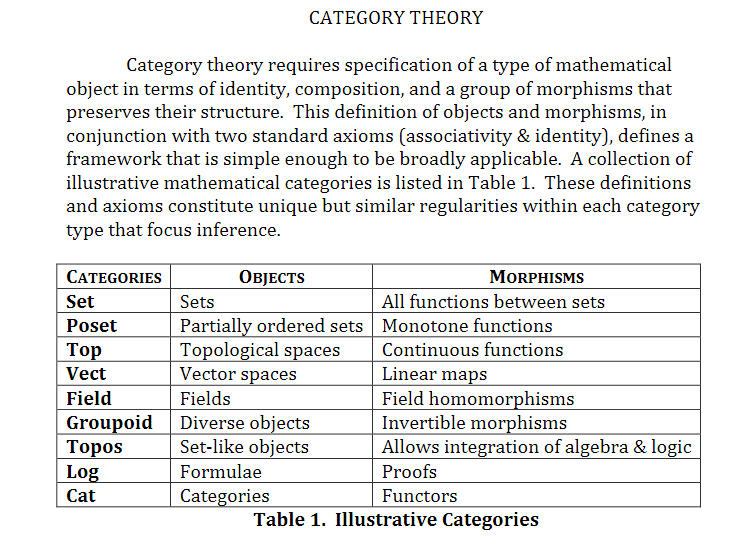
More recently, I came across the fascinating work of David Sallach, one paper (a conference from 2012) includes:


Sallach, D.L. Categorical Social Science: Theory, Methodology and Design. September 2012
Conference: Fourth World Congress on Social Simulation. Taipei, Taiwan.
https://www2.econ.iastate.edu/tesfatsi/Sallach2012CategoricalSoSci4.WCSS-SS.pdf

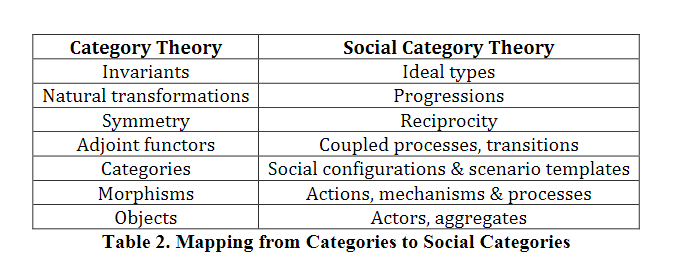
Plus, developed further in table 2:

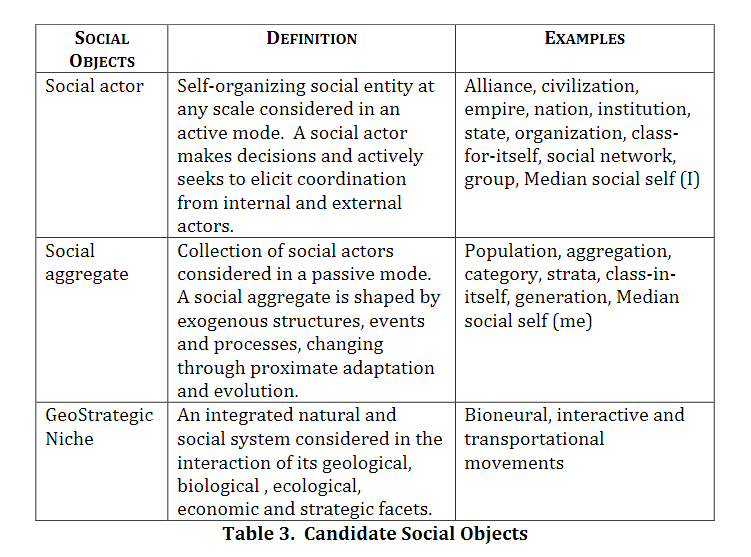
If time permits as an exercise, please consider Sallach's table 3 below. It may be interesting to map this to the domains of Hodges' model(?) [template]:
:

If you can see the potential utility of Hodges' model, you may also appreciate why Sallach's paper  resonates. Having emailed Dr Sallach, without reply, I did some checking. More sad news followed.

I, and no doubt many people will continue to discover and appreciate the legacy left behind by the above and many other pioneers. 

<>

I must acknowledge - Enid Mumford - whose work on socio-technical systems continues to inform my study and application of Hodges' model. This includes recognition of the many x-disciplinary bridges (or, barricades?) that can be found within Hodges' model. 

Clearly, much reading still to do.
<>

Returning to Hodges' model as a mathematical object, the 'distance' above is suddenly interstellar (and yes, sudden, as in faster than light!). I'm following videos, papers, and specific work-streams by  universities (I won't mention presently...) seeking to apply category theory to the social sciences. This suggests, at least, I'm not (completely!) wasting my time. If you have thoughts yourself on Hodges' model, the journey from Sallach's tables 1 - 2 not just 3, I'd be delighted to hear from you. 

There is another approach I will share this (N) spring. This author - researcher I have been able to contact.

*Scouser - https://en.wikipedia.org/wiki/Scouse
(Re. Liverpool - further post to follow).

James Lovelock image:  Bruno Comby, CC BY-SA 1.0, via Wikimedia Commons.