Over the past 10-20 years I've become more aware of the distance from scholars and people whose work is relevant to Hodges' model. Distance in the sense of their concomitant 'celebrity', hence the issue of how to make contact; and the stage of their career and my discovery of their relevance. Three people come to mind ...
I've long admired the work of James Lovelock, and when writing on ecological themes in -
Jones, P. (2008) Exploring Serres’ Atlas, Hodges’ Knowledge Domains and the Fusion of Informatics and Cultural Horizons, IN Kidd, T., Chen, I. (Eds.) Social Information Technology Connecting Society and Cultural Issues, Idea Group Publishing, Inc. Chap. 7, pp.96-109.
- I wondered about trying to contact
Dr Lovelock. As the majority of people are aware his thought and books, especially the Gaia hypothesis with Lynn Margulis caught the public's imagination from first publication and through the 1970s. Was there a Horizon TV programme? James Lovelock's influence was not just in ecology, but also earth (planetary) sciences through work for NASA. In early 2021 I thought I would reach out, through his most recent book and publisher/agent. I passed a message, which was forwarded but I never heard anything more.
As a nurse - with experience in older adult community mental health, I was acutely aware that this senior gentleman - in every sense of the word - may not want to be mithered by a scouser*, now living near Wigan Pier. I stressed not wanting to disturb the Dr. I also thought, given Dr Lovelock being of independent mind - a maverick, he might on the contrary love to be disturbed.
Sadly, I was too late, hearing the news of Dr Lovelock's death in 2022. Of course, I was seeking validation (and still am) for the project here. I can't help thinking though, that Dr Lovelock really would have 'got' Hodges' model.
James Lovelock:
BBC Radio 4 The Life Scientific
<>
Philosophy has long been an interest B.A.(Joint Hons.) Comp./Phil.. In a way you have no choice as a nurse, especially trained in mental health and general nursing: the theory and practice invariably touch reality, consciousness, perception, subjectivity, objectivity, knowledge, being, perception, data, information, time and so on.
Once acquainted with Hodges' model, scale is
the dimension that asserts itself. I wrote about this and referenced
Mario Bunge in about 1998, on the old, now archived website:
https://web.archive.org/web/20100329050839/http://www.p-jones.demon.co.uk/infintro.htm
Scale is a constant and multicontextual focus, but interest was piqued once again as I try to look at Hodges' model mathematically (yes, who am I trying to kid!) - as an object and relationally. I was reminded of Prof. Bunge's work noting a paper that included 'isomorphic-ism':
Bunge, M. (1969). Corrections to “Foundations of Physics”: Correct and Incorrect. Synthese, 19(3/4), 443–452. http://www.jstor.org/stable/20114653
https://link.springer.com/article/10.1007/s10838-021-09553-7
Mahner, M. Mario Bunge (1919–2020): Conjoining Philosophy of Science and Scientific Philosophy. J Gen Philos Sci 52, 3–23 (2021). https://doi.org/10.1007/s10838-021-09553-7
There may be a brief email exchange with Prof. Bunge, a request for a paper or two. Any emails are now stored (CD-ROM and portable drive) in a Turnpike folder, an old email client. Last year I was disappointed again, to learn of Dr Bunge's passing in 2020. His focus on science, philosophy, and systems - hard / soft is also very informative.
<>
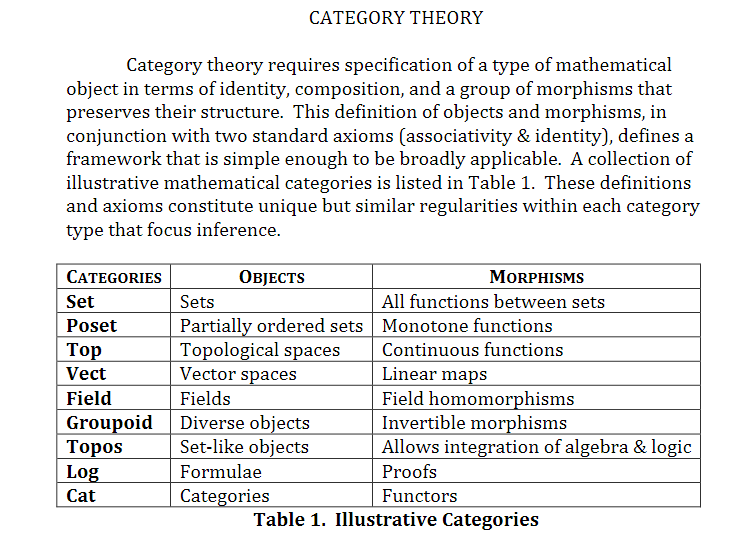
More recently, I came across the fascinating work of David Sallach, one paper (a conference from 2012) includes:
Sallach, D.L. Categorical Social Science: Theory, Methodology and Design. September 2012
Conference: Fourth World Congress on Social Simulation. Taipei, Taiwan.
https://www2.econ.iastate.edu/tesfatsi/Sallach2012CategoricalSoSci4.WCSS-SS.pdf
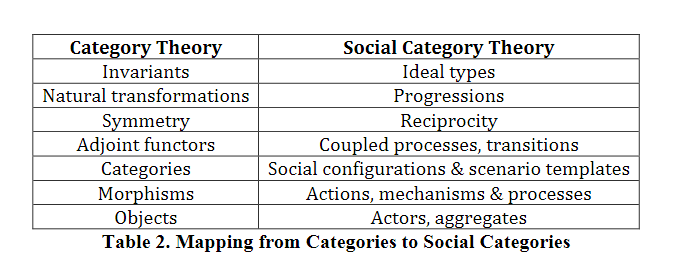
Plus, developed further in table 2:
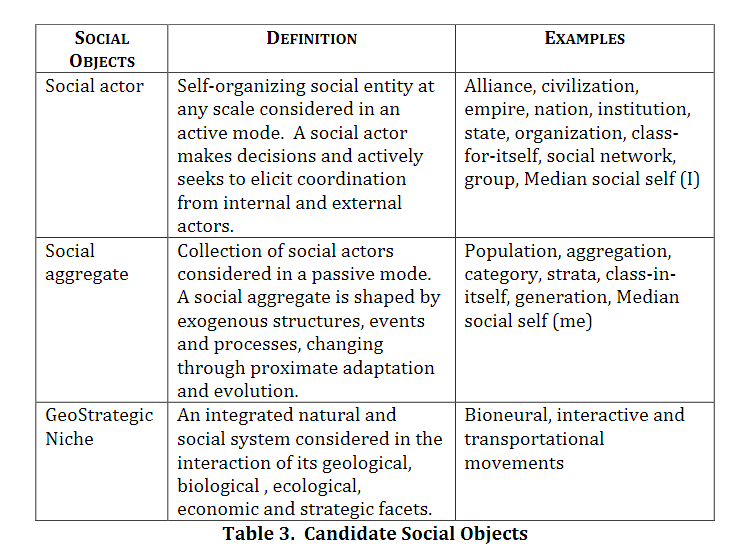
If time permits as an exercise, please consider Sallach's table 3 below. It may be interesting to map this to the domains of Hodges' model(?) [
template]:
:
If you can see the potential utility of Hodges' model, you may also appreciate why
Sallach's paper resonates. Having emailed Dr Sallach, without reply, I did some checking. More
sad news followed.
I, and no doubt many people will continue to discover and appreciate the legacy left behind by the above and many other pioneers.
<>
I must acknowledge -
Enid Mumford - whose work on socio-technical systems continues to inform my study and application of Hodges' model. This includes recognition of the many x-disciplinary bridges (or, barricades?) that can be found within Hodges' model.
Clearly, much reading still to do.
<>
Returning to Hodges' model as a mathematical object, the 'distance' above is suddenly interstellar (and yes, sudden, as in faster than light!). I'm following videos, papers, and specific work-streams by universities (I won't mention presently...) seeking to apply category theory to the social sciences. This suggests, at least, I'm not (completely!) wasting my time. If you have thoughts yourself on Hodges' model, the journey from Sallach's tables 1 - 2 not just 3, I'd be delighted to hear from you.
There is another approach I will share this (N) spring. This author - researcher I have been able to contact.
*Scouser - https://en.wikipedia.org/wiki/Scouse
(Re. Liverpool - further post to follow).
James Lovelock image:
Bruno Comby,
CC BY-SA 1.0, via Wikimedia Commons.
/https://tf-cmsv2-smithsonianmag-media.s3.amazonaws.com/filer_public/dd/24/dd24ebff-1d12-4f2a-92a8-bcd645154a26/img_9233.jpg)

.jpg#/media/File:James_Lovelock,_2005_(cropped).jpg)


 orcid.org/0000-0002-0192-8965



.jpg)