Hodges' Model: Welcome to the QUAD: feminism

Hodges' model is a conceptual framework to support reflection and critical thinking. Situated, the model can help integrate all disciplines (academic and professional). Amid news items, are posts that illustrate the scope and application of the model. A bibliography and A4 template are provided in the sidebar. Welcome to the QUAD ...

Showing posts with label feminism. Show all posts

Friday, May 29, 2026

'Elegy' by Gabriel Goliath - Venice Biennale

“Elegy is wound and medicine when mourning itself is under threat”

- Christina Sharpe & Rinaldo Walcott


Elegy is a life-work of mourning. It is a cry, a lament, a tender refrain of remembrance, repair and black feminist love.

For over a decade now, Gabrielle Goliath has staged performances of Elegy across South Africa and the world, invoking the absent presence of women and LGBTIQ+ people lost to fatal acts of racial-sexual violence. In each performance, a group of seven women singers enact a ritual of mourning, collectively sustaining a single, haunting tone for the course of an hour. As one singer falters, another steps up to pick up the note, and so it continues, a cyclic threading of shared breath and voice.

Each performance of Elegy is accompanied by a eulogistic text, scripted by a family member or friend of the individual commemorated: for Sinoxolo, Koketso, Noluvo, Lerato, Kerabo, and more… Other performances address historical cases of violence against women and otherwise-feminised bodies in colonial and slaveocratic contexts. For these, speculative texts by collaborating scholars reach across generations, geographies and archival erasures, recalling these ‘past’ losses and accounting for a present of anti-black, anti-femme violence.

Refusing spectacle and the objectification of bodies deemed rapeable and killable, Elegy asserts conditions of hope and avowal: affirming black, brown, indigenous, femme, queer and trans lives as loveable and grieveable. It is a work of regard, of specificity and care. For those immersed in its sonic vigil, it offers a space for shared grief and radical refusal - for the urgent, ongoing life-work of mourning.

. . .

Source: Gabriel Goliath - https://www.gabriellegoliath.com/

May 5 - July 31, elegyinvenice.com
individual
|
INTERPERSONAL : SCIENCES
humanistic ------------------------------- mechanistic
SOCIOLOGY : POLITICAL
|
group


reflection


temporal


Collective grief


violence

My source: Nadia Beard. A musical act of mourning, Venice Biennale, FTWeekend. 2/3 May 2026, p.5.

Sunday, March 08, 2026

Women Reading Deleuze c/o Edinburgh University Press

Celebrating Women in Philosophy

This International Women's Day, we're amplifying the work of women philosophers.


Our Women Reading Deleuze virtual issue pulls out articles from the Deleuze and Guattari Studies journal, chapters from the Deleuze Connections series and blog posts from our Deleuze Centenary celebrations, all written by women.


20 articles, chapters and blog essays by women

Browse the virtual issue


I have now read Bill Ross's 'Order and the Virtual - The Philosophy and Science of Deleuzian Cosmology'. A challenging and yet rewarding experience, further post to follow.

Monday, November 17, 2025

Leurs (2023) Data as Boundary Objects, Datafication as Boundary Work

individual
|
INTERPERSONAL : SCIENCES
humanistic -------------------------------------------  mechanistic
SOCIOLOGY : POLITICAL
|
group-population

PERSON
SUBJECT

person
[DATA] OBJECT

'Situating data'
inequality

'Conceptual Stepping Stones' -
Social (and Political) 
choreography?


SLAVERY
REGISTERS - PASSPORTS
RACISM
COLONIALISM
FEMINISM

Star .. feminist slogan
“the personal is political.”


Leurs, K. (2023). Data as Boundary Objects, Datafication as Boundary Work. In K. van Es & N. Verhoeff (Eds.), Situating Data: Inquiries in Algorithmic Culture (pp. 123–140). Amsterdam University Press.

https://www.researchgate.net/publication/376113967_6_Data_as_Boundary_Objects_Datafication_as_Boundary_Work

See also: https://en.wikipedia.org/wiki/The_personal_is_political

Situated: Does the 'work' that can be done by a concept vary by definition, according to the (care / knowledge) domain it is found / placed in? Does this is turn influence the 'objects' that are found in the act of crossing(s)?

Tuesday, July 22, 2025

Mary Kelly - Post-Partum Document

From a visit to Liverpool Tate 13.6.2008:

 (Experimentum Mentis III: Weaning from the Dyad)

Individual
|
      INTERPERSONAL    :     SCIENCES               
HUMANISTIC  --------------------------------------  MECHANISTIC      
 SOCIOLOGY  :    POLITICAL 
|
Group


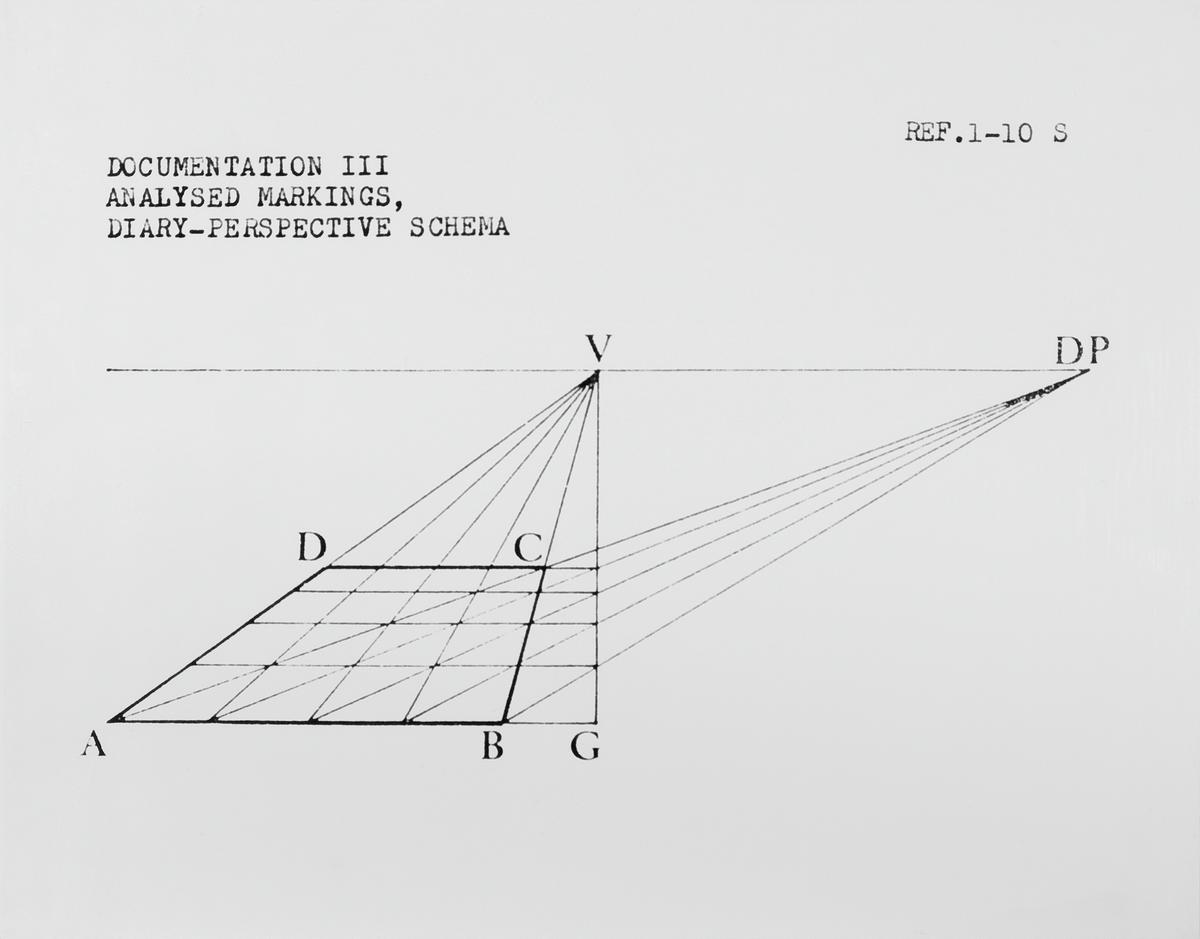
Post-Partum Document. Documentation III: Analysed Markings And Diary Perspective Schema (Experimentum Mentis III: Weaning from the Dyad)

1975, Mary Kelly  © Tate 

'Chalk and crayon drawings by Mary Kelly’s son are overlayed with transcriptions, annotations and reflections based on their interactions as he began nursery. These panels are the third group of a six-part series, each documenting a formative moment in Kelly’s son's early life. Kelly has stated that Post-Partum Document is not ‘autobiographical’. She instead uses her story to suggest ‘an interplay of voices – the mother’s experience, feminist analysis, academic discussion, political debate’. The work subverts romanticised depictions of the mother-child relationship, presenting the experience as inevitably bound up with societal norms and gendered expectations.'

See also: Mary Kelly

  dyad : perspective : art

Wednesday, March 26, 2025

Objectify me by Nicola L.

Individual
|
      INTERPERSONAL    :     SCIENCES               
HUMANISTIC  --------------------------------------  MECHANISTIC      
 SOCIOLOGY  :    POLITICAL 
|
Group
'You can touch
my breasts,
caress my stomach,
my sex.
But, I repeat it,
it is the last time,'

- read a note
L. left in a drawer.


Nicola L.
 'La Femme Commode' (1969)


My source: Stoppard, L. Objectify me, House&Home, FTWeekend, 5-6 October 2024, pp.1-2.

Sunday, June 23, 2024

Book for review: ii "Philosophy of Care - New Approaches to Vulnerability, Otherness and Therapy"

What I like here is being drawn (rescued then!) from the torrent that is the near reaches of the 

    bit, byte ... data, information, knowledge, wisdom

continuum, to its latter realm. The forever incomplete project of wisdom in 'care':
"Care, which is prior to all curing, identifies a fundamental availableness that has not yet been appropriated in the expert and technical discourses of care specialists." p.9.
This goes back to Pierron's 1st chapter focus upon 'Care: A New Arrival in the History of Philosophy'?

J. Braga & M. Santiago de Carvalho (Eds.), Philosophy of care: New approaches to vulnerability, otherness therapy. Springer.

A real gift for me (Hodges' model) is:
"Narration .. In opposition to the mathematization of the world, which reduces human problems to theoretical questions and to a universalized and rational formulation of moral dilemmas, the philosophies of care present a conflict of interpretations which deconstructs official and stereotyped narratives. Amy (or the voice of care) does not conceive a dilemma as a mathematical problem but rather as a narration of human relations, whose effects extends over time. (Gilligan 2008: 53)." p.13.
In addition to Tronto "Care is <<a species of activity that includes everything we do to maintain, contain, and repair our 'world' so that we can live in it as well as possible. That world includes our bodies, ourselves, and our environment>> (Tronto 2009: 143)." p.15. (see i) - I must add Gilligan to the list. 

In this weekend's FT, there's an item about the sorry state of the UK's statistical infrastructure (a post will follow, and mention of another book). I remember* Derek Hoy (RIP) doing a presentation about using data, and nursing informatics to make nursing visible. I wonder how he would make sense of the contrast between nursing whilst in COVID and post?
"Gilligan puts forward a distinction between a feminine ethics of care, which makes use of the idea of the natural solicitude of women by associating self-sacrifice and concern for others, and a feminist ethic of care, thought of as a critical approach that brings to light the mechanisms which favour the "invisibilisation" of care. The latter makes it possible to analyse the ways in which we lose the capacity to care for the other when relations of mutual caring are damaged." p.14. 

As usual below I've mapped some concepts to the domains of Hodges' model. 
Many thanks again to Springer for my copy.

Please note, also - as usual I am trapped in chapter 1! :-)

Individual
|
      INTERPERSONAL    :     SCIENCES                   
HUMANISTIC  --------------------------------------  MECHANISTIC      
 SOCIOLOGY  :    POLITICAL 
|
Group

"Amy - voice of care"

relational

situated


data, information, informatics

visibility

statistical infrastructure


context

equity - equality

social justice

context

feminism

data - reporting

accountability of government(s)


See also:
body & soul - Book: Philosophy of care: New approaches to vulnerability, otherness therapy

*https://hodges-model.blogspot.com/2010/08/drupal-musings-12-semantic-web-icnp.html

Wednesday, December 30, 2020

Seeing red ... the colour of social progress and justice ...?

individual
|
INTERPERSONAL : SCIENCES
humanistic ----------------------------------------------- mechanistic
SOCIOLOGY : POLITICAL
|
group


Toya Sarno Jordan / Reuters

Photograph: Toya Sarno Jordan / Reuters - Seeing red A member of a feminist collective paints the helmet of a riot police officer during a protest against gender and police violence in Mexico City. More than 1,000 Mexican women were murdered because of their gender last year, and there was also a rise in sexual harassment and assault by police.

World News, The Daily Telegraph [UK], 13 November 2020, p.17.

http://www.toyasarnojordan.com/

Photo: https://uk.reuters.com/news/picture/top-photos-of-the-day-idUKRTX898PP

Sunday, September 13, 2020

"Can you hear me?" Nalini Malani

individual
|
INTERPERSONAL : SCIENCES
humanistic ----------------------------------------------- mechanistic
SOCIOLOGY : POLITICAL
|
group - population
A still from stop-motion animation work 'Can you hear me?' (2017-20)


Commission
Nalini Malani: Can You Hear Me?

23 September 2020 – May 2021

Whitechapel Gallery unveils a major new work, Can You Hear Me? by Nalini Malani (b. 1946, Karachi, Undivided India), as part of its prestigious annual programme of artist commissions.

My source:

Spence R. (2020) Written on the body, FT Weekend, Life&Arts, 5-6 September, p.13.

https://www.ft.com/content/2793f080-6690-4047-bc8d-8afab2b60026

Monday, August 05, 2019

VOGUE: As they say - don't judge a ''book' just by its cover ...


... there is a resource to help you really reflect!


individual - self
|
INTERPERSONAL : SCIENCES
humanistic ----------------------------------------------- mechanistic
SOCIOLOGY : POLITICAL
|
group- population

"The 16th spot on the cover will appear
 in print as a silver reflective mirror, to
 show how you, the reader, are part of 
 this extraordinary moment in time –
 and to encourage you to use your own
 platform to bring change."


FORCE
CHANGE


Vogue, September cover

CHANGE
FORCE


*Whatever your chosen career at this 
point in time and throughout your 
lifelong aspirations and learning.
Best wishes!


Cover image source: Vogue.

Thursday, August 01, 2019

The 'transdisciplinary' (and other forms - in Hodges' model?)

A transdisciplinary model of practice

"This model is different from the multidisciplinary and the interdisciplinary models, where occupational power, status and professional recognition are key issues.
‘Representatives of different disciplines are encouraged to transcend their separate conceptual, theoretical and methodological orientations in order to develop a shared approach to ... building a common conceptual framework’ (p.1351). Rosenfield.
The shared philosophical perspective that is created by all disciplines and public representatives enables practitioners to provide integrated services. All team members, including consumers, parents and community members, are involved in discussion, consensus building, decision making and implementation of the plan or the programme. Team members work together to explore different theories, conceptual frameworks, concepts or approaches that might be in the best interest of the patient, family and the community. This sharing of knowledge enables team members to learn from one another. Boundaries between disciplines are loosened, and overlap between services is recognized and incorporated into the plan, so that patients and families benefit from using similar but different resources in increasingly more practical and more meaningful ways." (p.1351).

Rosenfield, P.L. (1992) The potential of transdisciplinary research for sustaining and extending linkages between the health and social sciences. Soc Sci Med. Dec;35(11): 1343-57.

cited in:
Anderson, G.W., Monsen, R.B., Rorty, M. V. (2000) Nursing and Genetics: a feminist critique moves us towards transdisciplinary teams, Nursing Ethics, vol. 7, 3: pp. 191-204.
https://journals.sagepub.com/doi/10.1177/096973300000700302

Monday, April 09, 2018

Paper: Understanding the micro and macro politics of health [Mapped to h2cm]

"Almost a decade after WHO Commission on Social Determinants of Health published its influential report (2008), health inequalities within and across countries remain high on the research agenda. Acknowledging the complexity of the issue, scholars increasingly stress the need for the development of a theoretical framework that will integrate the multiple factors involved in shaping health inequalities, from individual social positions and experiences to institutions (Beckfield et al., 2015; Krieger, 2012, 2011)." p.92.

From Google:
intersectionality
ɪntəsɛkʃəˈnalɪti
noun
noun: intersectionality; plural noun: intersectionalities
  1. the interconnected nature of social categorizations such as race, class, and gender as they apply to a given individual or group, regarded as creating overlapping and interdependent systems of discrimination or disadvantage.

    "through an awareness of intersectionality, we can better acknowledge and ground the differences among us"

individual
|
INTERPERSONAL : SCIENCES
humanistic ------------------ INTERSECTIONALITY ------------------ mechanistic
SOCIOLOGY : POLITICAL
|
group
category salience and individual experience

"Intersectionality as an analytical tool of social stratification (Yuval-Davis, 2015) challenges the idea of a single, fixed social hierarchy. It perceives social positioning as a spot within a matrix of intersecting power axes (Crenshaw, 1992). Hence, there are no sociological categories (e.g. race, gender) that have an a priori greater significance in shaping individual experience." p.93.


qualitative

methods & methodology
analysis - synthesis

"Yuval-Davis (2015) elaborates on that and describes intersectionality as a context informed analytical tool (situated intersectionality) that focuses on the categories that reflect the social divisions shaping most people's lives (e.g. race and gender) in certain contexts and simultaneously it is sensitive enough to render visible other divisions shaping the experience of individuals and groups at marginal positions (e.g. sexuality)." p.93.
quantitative
race, ethnicity, class, gender, sexuality


social history 
social class
social exclusion  
stratification


"... intersections between social categories -

socio
"Studies have focused mainly on welfare states classified across certain typologies (eg. Esping-Andersen, 1990) as mechanisms that rank people into social hierarchies and (re)distribute social determinants of health." p.94.

Institutions, immigrant status
political minority struggle
 colonisation, enslavement


are .. reflections of intersecting systems of power" p.94

economic

Anna Gkiouleka, Tim Huijts, Jason Beckfield, Clare Bambra, Understanding the micro and macro politics of health: Inequalities, intersectionality & institutions - A research agenda, Social Science & Medicine, Volume 200, 2018, 92-98, ISSN 0277-9536.
https://doi.org/10.1016/j.socscimed.2018.01.025.
(http://www.sciencedirect.com/science/article/pii/S027795361830025X)
Keywords: Health inequalities; Intersectionality; Institutions; Health politics; Social positioning


My source: Prof. Dennis Raphael
Politics of Health Group Mail List Messages
Visit PoHG on Facebook: https://www.facebook.com/282761111845400
Follow us on Twitter: @pohguk

Thursday, November 23, 2017

Pay "Nurse Kathy" ?

individual
|
INTERPERSONAL : SCIENCES
humanistic --------------------------------------- mechanistic
SOCIOLOGY : POLITICAL
|
group

Kathy ...


Estimate:
HK$31,000,000 - 41,000,000
€3,420,000-4,530,000
$3,970,000-5,260,000


My source: FT Weekend, Arts, 18-19 November 2017, p.16.


Thursday, July 24, 2014

Gender models role models and cognitive models... Discuss?

As a male nurse I have been aware of gender throughout my career ever since my student days (late 1970s-early 80s) - mental health - and then as a student again for two years general nurse training. The cultural, professional and global changes over the past three decades and more have been quite profound all influencing the perspectives and realities of gender in nursing today.

Since 1987-88, when I discovered Hodges' model I was also bound to wonder about gender in terms of:

  • the number of male nurse theorists and their contribution (should this matter!)?; 
  • other male nurse theorists globally and the influence of other cultural perspectives;
  • the need to consider gender of course in terms of 'standpoint' within research;
  • Is Hodges' model gender biased as its structure and basis comprised of categories of care concepts is a very masculine activity? (Even though the intention in identifying the boxes is to transcend and integrate them.) Please see below (and no pun intended).
    • Therefore nursing (still primarily a female profession) may ignore/discredit the potential of the model?
Possibly, the stand-out feature of Hodges' model is its invitation to categorise and typify. There could be gender-based consequences in how the model is perceived and received, which in turn could affect interest and participation in research on this subject? In designing studies of the model the feminist standpoint might be useful?:
“What, then, about the further charge that making clear-cut classifications of this kind is a very masculine thing to do? … It reaches its peak in empirical science as we know it, itself a very male affair, and it embodies the desire to have control of things and to know what is likely to happen. It issues in the kind of binary opposites we have found feminists, especially postmodernist feminists, decrying so vigorously-antimonies such as thought/language, nature/culture, reason/emotion, theory/practice, white/black, and especially men/women.” Crotty, (1998) p.171.

Crotty, M. (1998) The Foundations of Social Research: Meaning and Perspective in the Research Process. SAGE Publications Ltd.

This post was prompted by an item on GANM (Global Alliance for Nursing and Midwifery)