Hodges' Model: Welcome to the QUAD: attention

Hodges' model is a conceptual framework to support reflection and critical thinking. Situated, the model can help integrate all disciplines (academic and professional). Amid news items, are posts that illustrate the scope and application of the model. A bibliography and A4 template are provided in the sidebar. Welcome to the QUAD ...

Showing posts with label attention. Show all posts

Thursday, June 04, 2026

Individual and shared mental models c/o Proctor, & Vu, (2023).

The first day of the conference on 'Ecologies of Care' 4th-5th June is complete. It was helpful to contribute early and then focus on the programme. The questions and acknowledgement have made the (personal) effort worthwhile. Tomorrow also looks promising. There was an emphasis on attention which I tried to reflect and featured in a fascinating keynote by Professor Yves Citton. I will check the sources highlighted; and tomorrow, inquire about a point made re. use of socio in contrast to social.

Regards ongoing reading, perhaps, the evidence to support Hodges' model in practice is already out there? There might be a caveat, that the literature may suggest (if does not yet confirm) that if taught cross-curricula and professional groups then Hodges' model can function as a meta-model? 

What do you think of the following from a chapter on 'Social attention and team performance' (with my emphasis)? :

'... Other two-person team examples include doubles tennis partners and pairings of an airline pilot and copilot. Larger teams can be found in the numerous team sports surgical teams, busineses, and research teams of many scientific laboratories. For teams, coordinated performance is crucial, which becomes more difficult when teams extend to three or more people. As such, teams need to have shared mental models representing the team knowledge (Gardner et al., 2017), which support team situation awareness (Demir et al. 2017).
 
The concept of individual mental model refers to understanding a particular event on the basis of the activation of relevant schemas from long-term memory and, sometimes, simulation of possible scenarios (see also Chapter 10). Bower and Morrow (1990) pointed out that a crucial role in mental models is to shift and focus attention. ...
 
Shared mental models refer to collective understanding among team members of the task to be performed and how it can be accomplished. This understanding includes the responsibilities of the individual team members and dependencies between teammates on other members progress. The term team mental models is sometimes used when the context is teamwork that needs to be coordinated and executed (Jonker et al., 2010). The idea is that teams will perform better if they share mental models. ...
 
The surgery intern study illustrates that shared mental models are learned, leading to the question of how this learning can be facilitated.' p.368. ...
 
'Team leadership can be effective at getting members to be engaged in activities that will promote shared mental models. Boies and Fiset (2018) found evidence that leaders can facilitate the development of shared mental models by involving team members in the consideration of the to-be-accomplished task and their roles in its accomplishment. This involvement, again, likely directs members' attention to information relevant for achieving team goals and enables more domain-specific group discussion, which then furthers the emergence of a shared mental model. ...
 
Situation awareness is a broader concept than mental models, focusing on an explicit understanding of events and contextsShared situation awareness differs from individual situation awareness discussed in Chapter 9, in the information required for operators to have effective coordination (Chiappe et al., 2016). For example, paramedics delivering a patient to an emergency room need to coordinate with the hospital and its staff members to ensure that the hospital has the capacity and that the doctors receiving the patient have the vital information they need to treat the patient. Once the patient is in the emergency room, nurses, doctors and technicians need to coordinate with each other to make sure that the patient is being properly cared for.' p.369. 

Proctor, R. W., & Vu, K.-P. L. (2023). Social attention and team performance. In R. W. Proctor & K.-P. L. Vu, Attention: Selection and control in human information processing (pp. 343–374). American Psychological Association. https://doi.org/10.1037/0000317-012

Thursday, May 21, 2026

June 4-5 'Ecologies of Care' - London, UK

With more to follow from RCN Congress, this morning I received the agenda for next month's conference 'Ecologies of Care'. I am speaking, first session on the Thursday, which is a good to know and see the broad range of presentations. 

The focus on attention, is helpful for a possible further event in October. In the meantime, the Call for Papers began:

Chancellor’s Hall, Senate House London

June 4 & 5, 2026

Keynote lecture by Professor Yves Citton

How do increasing demands on our attention influence what we know, and how we act, in response to climate change? Despite a strong scientific consensus that climate change is ongoing and anthropogenic, political and legal action remains fragmented. Ecologies of Care asks to what extent the environmental crisis is a crisis of attention. Speaking to the dynamics of the attention economy, Yves Citton notes that “the new scarcity is no longer to be situated on the side of material goods to be produced, but on the attention necessary to consume them.” The word ‘attention’ is etymologically linked to the notion of care, or that which one attends to. This relationship (of subject and object) is fundamentally collective, insofar as collective attentional regimes influence what each one of us pays attention to on a daily basis, and how we navigate the barrage of informational flows from popular media.

Terms such as "the Anthropocene" and "planetary boundaries" function both as scientific descriptors and attempts to provoke action commensurate to the urgency that scientists believe their research demonstrates. The recent decision not to formalize the Anthropocene as an official geological unit, for example, highlights growing unease concerning intensifying media attention directed at scientific expertise. Under conditions of increasing disparity between what we know, and how we act, in response to climate change, the role of scientific expertise plays an increasingly normative, and not only informative, function. Scientific expertise attempts to direct what we attend to, and consequently, how (or if) we care. This is a collective practice of narrating and internalizing mythologies, whereby informational flows draw attention to some thing that needs to be cared for: Earth, the planetary, capital, or each other.

Continued ...

 c/o Law and the Environmental Humanities Network

n.b. With little time, I'm not going to transfer the pdf text, but may add here.

Wednesday, February 18, 2026

Move Over LLMS! AI Legends Yann LeCun and Alex LeBrun Debut AMI Labs' Bold Ambitions for World Models in Healthcare


My source: https://x.com/OffCallDotCom/status/2022708074105242035?s=20

Saturday, January 31, 2026

International Conference: the Concept of Attention - IEF

Filosofia na Agenda

international conference
the concept of attention

Theme and Objectives

Attention constitutes one of the most fundamental yet under-theorized dimensions of human experience. Despite its centrality to perception, cognition, action, and intersubjectivity, the philosophical investigation of attention as a concept in its own right remains surprisingly underdeveloped. This international conference represents the first major initiative of a four-year research program (2025-2029) dedicated to establishing the philosophy of attention as a major field of contemporary philosophical inquiry.

The philosophical engagement with attention has deep historical roots. Already in ancient Greek thought, we find attention implicitly at stake in the Socratic contrast between an 'examined' and an 'unexamined' life and in the dialectical reform of ordinary reason pursued throughout Plato's dialogues. Medieval philosophy anticipates later developments through its emphasis on representation and intentionality (intentio), particularly in the works of Augustin, Aquinas and Duns Scotus. Yet it is only with Descartes's Meditations that attention receives explicit philosophical treatment, emerging as the crucial mediating link between radical doubt and epistemic certainty. This Cartesian innovation opens a rich trajectory of reflection, pursued by thinkers as diverse as Malebranche, Berkeley, Locke, and Wolff.

The scope of philosophical inquiry into attention expands dramatically from the late 18th century onwards. No longer confined to epistemological questions, attention becomes central to investigating the fundamental structures of subjectivity itself. French spiritualism, phenomenology, and philosophies of existence explore how attention relates to apperception, sensation, emotion, and volition—a trajectory that runs from Maine de Biran and Bergson through the phenomenological movement, encompassing figures from Paul Ricoeur to Michel Henry. Meanwhile, William James's psychological and philosophical investigations, along with later thinkers like Merleau-Ponty, Simone Weil, and Iris Murdoch, demonstrate attention's significance across multiple philosophical domains.

Indeed, contemporary philosophy recognizes attention as fundamental to a remarkable range of inquiries. In ethics, attention emerges as an essential vehicle for exercising personal and collective virtues. Aesthetics invokes attention in debates about the nature of beauty and our engagement with works of art—their creation, appreciation, and critique. Social and political philosophy identifies attention as a central component of the modern media landscape, where it functions as a valuable and increasingly contested economic resource. Environmental philosophy calls upon attention to help conceptualize our evolving and often precarious relationship with the natural world. Across these diverse contexts, attention appears as a fundamental human capacity whose nature and quality largely determine the kinds of bonds we can establish with each other and our surrounding world.

This conference seeks to bring these rich historical engagements into systematic dialogue with contemporary philosophy. We welcome contributions from all philosophical traditions and approaches, including but not limited to: the reflexive tradition, hermeneutics, phenomenology, empiricist and analytic philosophy, philosophy of mind, cognitive science, pragmatism, and non-Western philosophical traditions. We aim to explore how different philosophical frameworks have conceptualized attention's structure, dynamics, and normative dimensions, and how these varied perspectives can illuminate both historical debates and current research.

Full details: international conference: the concept of attention

Image: https://www.wikiart.org/en/theo-van-doesburg/heroic-movement-1916

Friday, November 14, 2025

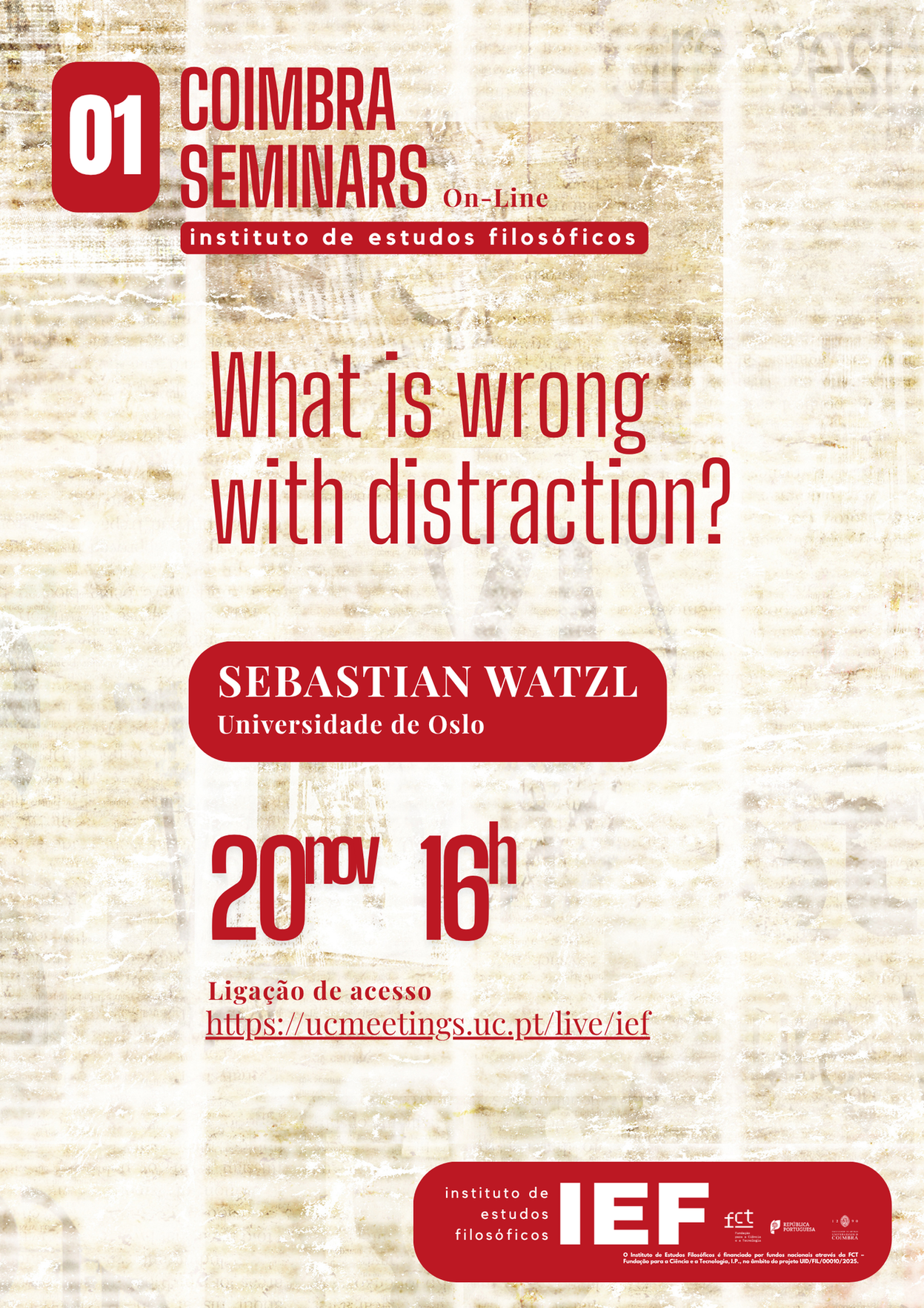
Filosofia - What is wrong with distraction? Sebastian Watzl c/o IEF


'Sebastian Watzl is a professor of philosophy at the University of Oslo (Norway). He specializes in philosophical issues about attention. He is the author of Structuring Mind (OUP), and recipient of an ERC grant on GoodAttention.

His research investigates the nature of attention, how it shapes consciousness, and the normative role and assessment of attention. Some of his current work is on the ethics of attention, the commodification of attention and its ethical assessment, the epistemic role of attention, and the use of attention as a political weapon.'

Sebastian Watzl - UoO Norway


Website: https://www.uc.pt/fluc/ief/agenda/coimbra-seminars-01/
LinkedIn: https://www.linkedin.com/posts/iestudosfilosoficos_ief-filosofia-philosophy-activity-7394448924947779584-fLSV
Instagram: https://www.instagram.com/p/DQ96aNVka0A/?igsh=MXJsejg0ZWE4bnBvZw==
Facebook: https://www.facebook.com/share/p/16uSVu9mNK/?mibextid=wwXIfr


individual
|
INTERPERSONAL : SCIENCES
humanistic -------------------------------------------  mechanistic
SOCIOLOGY : POLITICAL
|
group-population

My Mind
My Attention
My choice(s)?

Sources of distraction
Devices - access
Exposure - time
Social media
Assessment of attention
Children's education

Corporate Ethics of Attention
'Attention economy'
Policymakers & Policy
Attention as a political weapon


C/o IEF and thanks to Marta Santos (Secretariat).

Thursday, August 07, 2025

'Finding the Signal through the Noise' - WHO EARS

It is deprived communities who desperately want to do their best for family, but struggle to have access to and make sense of many sources of information. News and information not just through 'traditional' channels, but social media. Trying to be objective, non-judgemental it can still be surprising how TVs and smartphones are the key personal and furniture items.

Outside of London, Liverpool has a low uptake of immunisation against measles:

Liverpool, now has cases and a child's death from measles:

https://liverpool.gov.uk/council/public-health-liverpool/measles-on-the-increase/

https://www.liverpoolecho.co.uk/news/liverpool-news/alder-heys-plea-after-child-32050189

Located in-between, I often visit Manchester and Liverpool. I wonder now if I should visit Liverpool less. My daughter and her partner expecting their second child have a decision to make next year.

I noticed on X a reference to 'social listening'. This was missed while drafting a paper on COVID, technology, social media and information disorder. More positively, work on 'infodemic' was captured and posted. 

Blowing the dust of another draft, I will reassess this stream of work and seek specific literature, especially contributions to improved outcomes - public (mental) health.


McGowan B. S. (2022). World Health Organization's Early AI-supported Response with Social Listening Platform. Journal of the Medical Library Association : JMLA, 110(2), 273–275. https://doi.org/10.5195/jmla.2022.1398

See also:

Fryer, Jon. “Information Literacies – Learning, to Thrive in a Digital Age” IRMS Bulletin 230 (2022): 16-21.

Jones, P. (1996) Humans, Information, and Science, Journal of Advanced Nursing, 24(3),591-598.

Sunday, June 22, 2025

In Theatre, Silence is a genre, and therapeutic ally

'As a playwright it may be your intention to build a vehicle to take us to the stars. But do make sure you have people aboard.' (p.9).^
Alan Ayckbourn in The Crafty Art of Playmaking.

Sound of silence in activism

Quite fitting in the two decades since publication, given the rise of AI and the impact upon the arts, specifically human imagination, creativity, and livelihoods. Meaning: silence as a tool for protest, and activism is also a genre and a can be a therapuetic ally. 

Going backwards - Sir Alan writes: 'Theatre for me has always been, in a way, a reflection of life writ somewhat smaller'. p.10.

While the point concerns the faith and trust placed in theatre directors by the company, there is an analogue in healthcare. The belief of the patient, in their doctor and the medical team. Or, at least the knowledge and skills they should, and appear to possess. For Ayckbourn '... the director looked as if he knew.' (p.10).

Obvious rule no. 4: 'Use the minimum number of characters that you need' (p.13).

What can I say? Society, has peeled back the patient - doctor (substitute health profession as needed) to the person whose monologue seeks confirmation of illness x,y, or z. Apparently here in the UK 1 in 4 adults have a mental health condition. The debate is ongoing as to what is going on. But the subject of Hodges' model as a possible crucible for a work of drama can certainly keep to character count down.

Not only that, but is this a book on counselling - interpersonal skills?

'An audience that doesn't care stops listening in the end. '. p.14. 

As part of -

'Obvious Rule no. 5: They need to care about your characters. (So you should too.)'

So, for both playwrights and carewrights, there is a duty of care (for all of course - despite the actions of so many governments).

In health the patient is the character study. There is, should be, must be - a plan of  care, a care plan. As a 'play', Hodges' model begins as a template of at least five acts [Spiritual (Four domains) ]. That is whether or not they are all 'written'. The attitude though should be unconditional positive regard.

There's no Waiting for Godot here, unless the character is social care?

Could it be that as organisational hierarchies have been flattened, the notion of character has been under siege? The onion that is our identity, personality, persona unpicked, skin-by-skin by social media, social change, and policy affecting education. Character building used to be a thing didn't it? No longer needed now is it?

Sir Alan, supports this hypothesis in his 'Obvious Rule No. 28:

People in general are reluctant to reveal themselves.' (p.65).

I still wonder about the potential of Hodges' model in secondary level education. More than ever, with all the talk about resilience, recovery, mental health issues, the rising UK welfare bill, may beg the question: What is character today? But, it is not defined by a stiff upper lip.

Not to sound 'ableist', but the 'crafty' in Ayckbourn's title, can be read in health terms; the disciplines drawing on science and the arts. Plus, they involve craft - use of the self, empathy and rapport. Not limited to, but in mental health care, it could be 'crafty' in the exercise of power, so frequently a theme central in drama and the human condition.

^A nice reminder too, of a Poul Anderson's SF classic Tau Zero (and a previous post).

The Crafty Art of Playmaking by Alan Ayckbourn. Faber, 2004, softcover, ISBN 0571215106.

https://www.concordtheatricals.co.uk/s/45898/the-crafty-art-of-playmaking

https://www.isthiswhatwewant.com/

Image: https://upload.wikimedia.org/wikipedia/commons/thumb/b/b0/Is_This_What_We_Want%3F.jpg/250px-Is_This_What_We_Want%3F.jpg

https://www.amazon.com/Zero-Coronet-Books-Poul-Anderson/dp/0340163364
Monday, June 02, 2025

Online: Hodges' model in Safety presentation

Later this week I've an online presentation to deliver. The brief is to introduce Hodges' model and relate the model to the matter of safety - some thoughts ...

individual
|
INTERPERSONAL : SCIENCES
humanistic ------------------------------- mechanistic
SOCIOLOGY : POLITICAL
|
group
PATIENT safety

Task: Attention - Concentration
Rest - Sleep

psychological environment - safety

to ERR is human
HUMAN as weakest link

risk to SELF

Cognitive support - lists, names,
informational analysis of environment

Critical thinking
Situational awareness

Therapeutic - OBSERVATIONS
ethics- video surveillance
PATIENT - PROCESS safety
 - e.g. diagnosis, handover
physical safety: 1st law 1st aid.
SELF-harm : SELF-neglect
Assessments, Plan, Evaluation
environment:safety, construction, buildings
occupational/disciplinary safety
Comms - Information theory
 safety as security: lone working
signals - alarms, protocols

medical safety: medicines, devices
risk reduction - management

Human factors
Human- Computer/Tech/AI Interaction
Research - Records
Interfaces

Public Health Safety: Food, Pollution

risk to others
stereotypes - assumptions

risk from others - bullying

social media

teamwork: simulation

PRACTICE safety
Law - Health & Safety
Reporting - Statistics
Transparency
Mandatory Training / Learning
Whistleblowing
safety standards ISO
safety organisations

The Learning Organisation
Other sectors e.g. Aviation, Formula 1 ...
Risk of 'groupthink'

 Is it a risk to assume parity of estem in patient safety? What of 'a' patient's safety?

safety
https://hodges-model.blogspot.com/search?q=safety

Tuesday, November 12, 2024

Call for Papers “THE CULTURAL EXPLOSION OF AI: ...

Navigating the Intersection of Artificial Intelligence, Society, and Culture”


Artificial intelligence has burst into the cultural space with the speed of an explosion. As with any powerful explosion, its initial impact is a spectacular blinding flash, followed by a shock wave with real effects. Perhaps we are still at the very beginning, but often the intensity of the blinding flash is proportional to the real effect that follows, both in terms of sweeping away existing forms and as long-term cultural “radiation”.

According to Lotman, a cultural explosion is a period of transformation when rapid and large-scale changes occur in cultural systems, leading to a significant increase in the creation of new information. It is estimated that artificial intelligence produces as much cultural text in one year as humanity has produced throughout its millennia-long history until the advent of the digital age. More interestingly, this new textual production is entering its most productive phase with the invention of Transformer architecture, which is almost a literal algorithmic realization of Lotman's concept of translation — the main mechanism of semiotic metabolism in the Semiosphere.

Training Large Language Models (LLMs), which is the foundation of AI, suspiciously resembles the way Umberto Eco models culture in the structure of a rhizome, which computer scientists call a "neural network." His encyclopedic model is based precisely on what LLMs extract from huge arrays of existing text—the statistic constancy of sign usage. In a polemic with textual immanentists, Eco postulates as part of the reader's encyclopedic competence the ability to inferentially reproduce the possible contexts of sign usage that make up the text. For many, the “magic” of artificial intelligence in its current form lies in its understanding of our questions to it, achieved with the Attention Mechanism, which, as a principle of cooperation between author and reader, is quite literally described in "The Role of the Reader" (1994).

The hardest to find were a fruitful correspondences between generative semiotics and generative media like Chat GPT, as paradoxical as that may sound, but surely there are such correspondences, and they are likely to be discovered in the future. In any case, as a theory of meaning generation on the one hand and an endless machine for creating meaningful texts on the other, the cultural explosion of AI will not leave this breed of semioticians unemployed.
We welcome contributions on the following key topics, but not limited to them:

- Semiotic models of AI generated cultural content
- Semiotic analysis of AI texts generation
- Semiotic theory of generative media
- Socio-cultural consequences of AI's advent
- Transdisciplinary collaboration between semiotics and informatics
- AI in creative practices in the arts
- AI in creative practices in marketing and advertising
- AI in research and education
- Cultural-economic implications of AI
- AI in pop culture
- AI in videogames and XR

Send here your proposal for papers (200-300 words): DigitASC AT nbu.bg

Deadline for the abstracts : 31 January 2025;

Deadline for full papers: 15 June 2025;

Deadline for the final revised papers: 31 August 2025;

Publication: December 2025

Digital Age in Semiotics & Communication, a journal from the Southeast European Center for Semiotic Studies at the New Bulgarian University and founded by Prof. Kristian Bankov, explores the new forms of knowledge, social and linguistic interaction, and cultural phenomena generated by the advent of the Internet and information technologies.

A topic is chosen for each issue by the editorial board, but the topics will be always related to the issues of the digital environment. The working language of the journal is English. It uses double-blind review, meaning that both the reviewer’s and the author’s identities are concealed from each other throughout the review process.

Link to the archive of the first six issues: https://ojs.nbu.bg/index.php/DASC/issue/archive

For more information and submission of papers: DigitASC AT nbu.bg

My source:
--


Departamento de Filosofia, Comunicação e Informação
Faculdade de Letras da Universidade de Coimbra
3004-530 Coimbra, Portugal

E-mail: iestudosfilosoficos AT gmail.com
Sítio Web: http://www.uc.pt/fluc/ief
YouTube: https://youtube.com/@uidief
Academia: https://coimbra.academia.edu/ief

Wednesday, May 01, 2024

Hodges' model: A tool for Curation

CURATION
"Curation helps solve the problems of today and tomorrow. It's the mass sourcing of the expertise needed to navigate and comprehend the saturated, complex markets* of the twenty-first century." p.166.

Bhaskar also lists (and briefly introduces) the principles of curation:
  • Saving time
  • Freeing cognitive resources
  • Sparing us anxiety
  • Maximising utility
  • Cutting down complexity
  • Finding quality
  • Overcoming information overload
  • Creating contrast 
  • Redefining creativity
  • Channeling attention
  • Providing context
  • Beating overproduction (pp.167-168).

*To markets above, I would add disciplines and professions.

By definition an aide-mémoire should save us time. 

The structure of Hodges' model provides a conceptual scaffold, a substrate affording us cognitive economy.

Through selection (self guided discovery) we are assuring data, information gathering, properly supervised this should spare us anxiety.

We are trying to ensure the effective use of our time, and efficiently zero-in on the concepts that are salient.

By reducing complexity, we increase the relevance and value of what is noted, recorded, acted upon. Data, facts, observations that are not redundant can be dismissed.

Contrast is co-confirmed by using innate oppositions, polarities and dichotomies with attention on the other and the middle.

When needed, Hodges' model can explode subject headings, concepts assisting exploration and creativity, potentially assisting at a transdisciplinary level.

Context rationalisation by testing and filtering a situation, helps to focus attention.

Duplication and repetition do not foster sustainable services, but there should always be scope for verification and person-centredness.
"As the eighteenth-century English painter Joshua Reynolds put it, 'Simplicity is an exact medium between too little and too much.' Curation helps ensure that exact medium." p.159. 

Bhaskar. M. (2016) Curation: The power of selection in a world of excess. London: Piatkus.

Book image: Waterstones.

See also: Is Hodges' model a selection machine?

Friday, March 01, 2024

'Writing Samer'

Molly Fairhurst
 

... across the domains

"Diagnosed with a terminal cancer, Samer Iskandar couldn't find the words to describe what he was living through. Instead, he proposed an unusual collaboration." p.33.


Individual
   |
      INTERPERSONAL    :     SCIENCES               
HUMANISTIC  --------------------------------------  MECHANISTIC      
 SOCIOLOGY  :   POLITICAL 
|
Group

"Samer's cancer^ is like all cancers in that it pitches the self into a battle against the non-self, - *


"Memory, language, attention and cognition all erode to ultimately leave you somewhere east of your prior self and west of someone new." p.34.


- atavistic alien cells invading their host from within. But it is unlike most cancers in how directly this cellular plunder correlates to the personal one." 

It is like all cancers in that its lexical field is that of topography, malignancies spreading, diffusing and gaining ground. It is unlike them in that these movements are finally technical, gears cramped within the clock of a terminal diagnosis." p.34.


^glioblastoma
*discuss

Youmna Melham Chamieh, Writing Samer, FT Weekend Magazine, 24/25 February, 2024, Issue 1,062, pp.32-37.

Illustrations by Molly Fairhurst
https://mollyfairhurst.com/Financial-Times (above source).

Sunday, November 19, 2023

Attending: Active listening c/o Baggini & TPM

Reading through more past issues of The Philosopher's Magazine, I came across Baggini's short contribution of Attending one of "50 New Ideas".

That Hodges' model has a role in attention must follow from its main purpose as an aide-mémoire. To 'know', to recognise that your memory has been jogged is surely to attend.

I realise that Hodges' model represents a philosophical smörgåsbord, rather like the 50 ideas in this issue.^

Baggini draws on a film for inspiration on empathy, feelings for other, humanity and moral philosophy. For Hodges' model our context can encompass media, but the focus remains empathy, ability to relate in the clinical, social care context. Attention and interpersonal skills come the fore here.

If you are not hungry, the model (smörgåsbord) can be considered as empty. This is a precondition for 'attending' - having unconditional positive regard. Apart from information that relates to the patient's, student's, and your safety the domains of Hodges' model are vacant spaces. How they are populated depends on how we attend. There are important lessons for students here. The first is their phone. Its being on their person, may impact their ability to attend to the other (person). The window to outside isn't a screen either.

 Individual
  |
     INTERPERSONAL    :     SCIENCES               
HUMANISTIC --------------------------------------  MECHANISTIC      
SOCIOLOGY  :   POLITICAL 
|
GROUP

previous experience
cognitive furniture -
elephants in the room (for all?)

attend/attending
attention
active listening
authenticity
observation

empathy - rapport
therapeutic relationship

unconditional +ve regard

I see, I hear you ...

physical space
physical environment measurements
furniture - layout
position / posture
observation


Attending needs to be active listening. This includes all the senses, although sniffing the air is probably  best avoided - body odour may announce itself. Attention, then is synonymous with observation and in this context must span an individual's physical and their psychological presentation. You may draw social, political and spiritual assumptions, it is human to do so. Intuition has a role in healthcare but initial conclusions must be recognised as potentially premature and be verified. 

To initiate, be-in, partake-in such situations is to attend to the verbal, and non-communication; the data you already have and information communicated, including in a referral. Is this confirmed, challenged, what is your opinion? What about your colleagues? Most importantly, what does the person (patient, client... say)? What is unspoken? Do you understand? Did you seek clarification? 'Where' have you been / not been in Hodges' model? What picture is emerging at this stage?

It is gratifying that this is the first of the 50 'new' (2016) ideas in TPM #72. 

More to follow - drawing on TPM and (I think, Hodges' model as a 'philosophy? Surely not!)

Baggini, J., Attending, The Philosopher's Magazine, 1st Quarter 2016. Issue 72. pp.21-22.

TPM #72 cover image: https://ericthomasweber.org/correcting-political-correctness/

Wednesday, October 11, 2023

'System 1 and 2 Modes of Thinking' in Hodges' model

 System 1 - 

"operates automatically and quickly,
with little or no effort and no sense of voluntary control. 

 System 2 - 

allocates attention to the effortful mental activities that demand it, including complex computations. The operations of System 2 are often associated with the subjective experience of agency, choice, and concentration." pp. 20-21.

"When we think of ourselves, we identify with System 2, the conscious, reasoning self that has beliefs, makes choices, and decides what to think about and what to do. Although System 2 believes itself to be where the action is, the automatic System 1 is the hero of the book. I describe System 1 as effortlessly originating impressions and feelings that are the main sources of the explicit beliefs and deliberate choices of System 2. The automatic operations of System 1 generate surprisingly complex patterns of ideas, but only the slower System 2 can construct thoughts in an orderly series of steps. I also describe circumstances in which System 2 takes over, overruling the freewheeling impulses and associations of System 1. You will be invited to think of the two systems as agents with their individual abilities, limitations and functions." p.21.


INDIVIDUAL
|
     INTERPERSONAL    :     SCIENCES               
HUMANISTIC --------------------------------------  MECHANISTIC      
SOCIOLOGY  :   POLITICAL 
|
GROUP

System 2:
  • Brace for the starter gun in a race.
  • Focus attention on the clowns in the circus.
  • Focus on the voice of a particular person in a crowded and noisy room.
  • Look for a woman with white hair.
  • Search memory to identify a surprising sound.
  • Maintain a faster walking speed than is natural for you.
  • Monitor the appropriateness of your behavior in a social situation.
  • Count the occurrences of the letter a in a page of text.
  • Tell someone your phone number.
  • Park in a narrow space (for most people except garage attendants).
  • Compare two washing machines for overall value.
  • Fill out a tax form.
  • Check the validity of a complex logical argument. p.22.

System 1:
  • Detect that one object is more distant than another.
  • Orientate to the source of a sudden sound.
  • Complete the phrase "bread and . . .".
  • Make a "disgust face" when shown a horrible picture.
  • Detect hostility in a voice.
  • Answer to 2 + 2 = ?
  • Read words on large billboards.
  • Drive a car on an empty road.
  • Find a strong move in chess (if you are a chess master).
  • Understand simple sentences.
  • Recognize that a "meek and tidy soul with a passion for detail" resembles an occupational stereotype. p.21.


Kahneman, D. (2011). Thinking, fast and slow. London: Penguin Books.

See also:
https://thedecisionlab.com/reference-guide/philosophy/system-1-and-system-2-thinking

Monday, May 29, 2023

Humanistic motivations for study - c/o Harris et al.

 "Asking '[I]n what sense . . . can mathematics be considered a democratic regime . . .' open to all, Pimm and Sinclair quote (Supergiant) Henri Poincaré to the effect that 'only mathematicians are privy to the aesthetic sensibilities that enable' the decision of 'what is worth studying.' The article, published in a journal for educators, is motivated by the 'view that mathematics can do something for me in a humanistic sense that repays the the careful attention and deep engagement it may require; one that may expose students to a fundamental sense and experience of equality . . . and provide them with another sense of human commonality.'" p.33.  

Harris, M. (2015) Mathematics without Apologies: Portrait of a Problematic Vocation. Princeton University Press.

Hodges' model - Axes - Structure :: Domains - Content

Tuesday, March 28, 2023

PHT-2 Obesity paper - Chance is still up. Please help us WIN the @Nutrients_MDPI "Nutrients 2023 Best Paper Award"

Dear Professors and Colleagues,

https://doi.org/10.3390/nu13041200

the chance is still up to win the @Nutrients_MDPI "Nutrients 2023 Best Paper Award" for our Childhood Obesity paper from the School Study.

Nutrients Editorial Office prepared for us this banner (above) to use for social media etc.

Motevalli, Mohamad, Clemens Drenowatz, Derrick R. Tanous, Naim Akhtar Khan, and Katharina Wirnitzer. 2021. "Management of Childhood Obesity—Time to Shift from Generalized to Personalized Intervention Strategies" Nutrients 13, no. 4: 1200.
https://doi.org/10.3390/nu13041200

Pls help us with your continuous support to WIN, kindly asking
2nd time now to POST & SHARE widely the prepared text-blocs below with the attached grafic, thx so much!

Best Katharina

Like, Post, share and recommend at/via:
