Hodges' Model: Welcome to the QUAD: Search results for character

Hodges' model is a conceptual framework to support reflection and critical thinking. Situated, the model can help integrate all disciplines (academic and professional). Amid news items, are posts that illustrate the scope and application of the model. A bibliography and A4 template are provided in the sidebar. Welcome to the QUAD ...

Showing posts sorted by relevance for query character. Sort by date Show all posts

Saturday, January 17, 2026

European Character and Virtue Association (ECVA) Conference 2026

Theme: Bridging the Knowledge – Action Gap in Character Development

Re: invitation to the ECVA 2026 conference: reminder ...

Established in 2022, the European Character and Virtue Association offers a forum for promoting research, training and networking in the field of character education. We bring together educational institutions in Europe and scholars from around the world, providing unrivalled opportunities for members to share best practices and shape European policies affecting higher education and research. 

The 2026 conference of ECVA will take place in Trnava University, Slovakia, in cooperation with the Jubilee Centre for Character and Virtues, University of Birmingham, the Private University College of Teacher Education of Christian Churches, and the Virtues and Values Education Center of Francisco de Vitoria University. 

The Executive Board of the European Character and Virtue Association (ECVA) cordially invites you to attend the 2026 ECVA Conference in Trnava, Slovakia. 

  • President: Prof. Dr. James Arthur (Harvard University)
  • Vice President: Prof. Dr. Verónica (Francisco de Vitoria University Madrid)
  • Secretary: Prof. Dr. Tom Harrison (Jubilee Centre for Character and Virtues, University of Birmingham)
  • Treasurer: Prof. Dr. Roland Bernhard (University of Teacher Education of Christian Churches Austria)

Conference Information Trnava, Slovakia, 2026, 24th to 26th of June 

We expect more than: 📍100+ researchers 🏫 40+ universities 🌍 20+ countries 🎤 60+ presentations & keynote addresses 

📝 Submit your abstract and find all conference details at the link below:

👉 https://ecva-character.org/ecva-conference-2026

Deadline for Abstract Submission: 31st of January, 2026.

All abstracts will undergo a review process over the course of the following month. Once your proposal has been accepted, you will receive detailed information about registration, conference fee (275,- EUR) processing, accommodation options, and other necessary information.

Notification of Acceptance: 1st of March 2026.

Contributions that demonstrate high quality and close relevance to the main theme of the conference will be accepted for review in preparation for the next scientific monograph produced by the ECVA.

Warm regards,

Dr. Martin Brestovanský
(Trnava University, Slovakia)

on behalf of the ECVA Steering Group

Prof. James Arthur (Harvard University)
Prof. Verónica Fernández (Universidad Francisco de Vitoria, Madrid)
Prof. Tom Harrison (Jubilee Centre for Character and Virtue, University of Birmingham)
Prof. Roland Bernhard (University of Teacher Education of Christian Churches, Vienna)
Prof. Claudia Navarini (Università degli Studi Europea di Roma)
Prof. Ines Weber (Paris Lodron Universität Salzburg)

Conference description 

Bridging the Knowledge – Action Gap in Character Development 

Moral education often assumes that ethical knowledge or cognitive competence alone will result in moral behaviour. Yet lived experience, philosophical reflection, and empirical research consistently show otherwise. A persistent gap exists between what individuals know is right and what they actually do—a phenomenon recognized since antiquity. 

Aristotle observed that “we reason here not to know what virtue is, but to become good” (Nicomachean Ethics, 1103b), highlighting that moral reasoning is directed toward formation, not just information. Immanuel Kant similarly acknowledged that a person may clearly understand moral duty and yet lack the will to act accordingly, pointing to the human struggle between reason and inclination. 

David Hume went further, arguing that “reason is, and ought only to be the slave of the passions,” insisting that moral knowledge without rightly ordered desires lacks the power to move us to action. And Martin Buber wittily adds: “The worst notorious liar in the classroom will write a brilliant treatise on the destructive power of falsehood”. 

This enduring challenge – now referred to as the knowledge–action gap – remains a pressing concern across education, psychology, and the social sciences. Scholars have described related phenomena in various conceptualizations, such as the reason–action gap, attitude–behaviour gap, intention–behaviour gap, or the knowledge–attitudes–practice (KAP) gap. Each term reflects a common concern: knowing what is right does not reliably lead to doing what is right. 

Bridging this divide is a complex task, compounded by the dynamic, deeply personal, and context-sensitive nature of character formation. Educational and behavioural sciences are increasingly turning to integrative approaches that go beyond cognitive instruction. Interventions such as moral sensitization, dramatization, habit training, and reflective practice are being explored to enhance the coherence between values and actions. 

There is growing consensus that this so-called “gappiness problem” cannot be resolved through one-size-fits-all solutions (e.g., moral emotions alone or identity-based interventions). Instead, promising “multi-component” models are emerging that draw on diverse disciplines and methodologies to address the challenge. 

Conference Goals 

By bringing together interdisciplinary perspectives and diverse methodologies, the ECVA 2026 conference aims to deepen our understanding of the knowledge–action gap and to promote innovative, research-informed strategies for strengthening moral coherence and character development in real-world settings. 

We look forward to welcoming those committed to advancing theory-informed practice and practice-informed theory in the service of ethical integrity and flourishing lives.

Previously: 'character

Friday, August 19, 2022

The Jubilee Centre Framework for Character Education in Schools - 3rd edition

'The aim of our studies is not to know
what virtue is, but to become good.'


Aristotle


"WHAT CHARACTER
EDUCATION IS

Character is a set of personal traits or dispositions
that produce specific moral emotions,
inform motivation, and guide conduct.

Character education includes all explicit and
implicit educational activities that help
young people to develop positive personal
strengths called virtues." p.7.


 INDIVIDUAL
|
 INTERPERSONAL    :     SCIENCES               
HUMANISTIC --------------------------------------  MECHANISTIC      
SOCIOLOGY  :   POLITICAL 
|
GROUP

CHARACTER

VIRTUES:
Intellectual; Moral; Civic, and Performance

Caring for and respecting others, as well as
caring for and respecting oneself
Positive psychology, mental health

VIRTUE Literacy i-iii: ‘Perception’; (ii) Virtue ‘Knowledge and Understanding’; and
(iii) Virtue ‘Reasoning’.

- emotional literacy, judgement

Improved attainment, better behaviour


Direct teaching of character provides the
rationale, language and tools to use in
developing character elsewhere in and
out of school. p.7.

EMOTIONAL


Character is sought freely to pursue a
better life.

'Success' in each domain ...

Build - virtue literacy

Character is educable: it is not fixed and
the virtues can be developed. Its
progress can be measured holistically,
not only through self-reports but also
more objective research methods. p.7.

Character can be -

Caught...
...through a positive school community, formational relationships, and a clear ethos.
Taught...
...through the curriculum using teaching and learning strategies, activities, and resources.
Sought...
...through chosen experiences that occur within and outside of the formal curriculum. p.12.

CONTAGION

Belonging to,
participating in - a school
community
Common good
Role-modelling

Flourishing societies
[Address: Social Determinants of Health]*

partnership with parents, families

caring for and respecting others, as well as
caring for and respecting oneself

Civic
Citizens
Committed leadership

Increased employability,
empowering, and liberating

partnership teachers, employers,
and other community
organisations

Each child has a right to character education


"Practical Wisdom (phronesis) is the integrative virtue,
developed through experience and critical reflection, which
enables us to perceive, know, desire and act with good sense.
This includes discerning, deliberative action in situations
where virtues collide." p.9.


University of Birmingham 2013, 2017, 2022
ISBN: 9780704429789
https://www.jubileecentre.ac.uk/527/character-education/framework

*Some thoughts to follow, to include on SDoH, and SDG.


Saturday, August 20, 2022

ii The Jubilee Centre Framework for Character Education in Schools - 3rd edition

Some thoughts on the previous post ...

Regards, "Character is fundamental: it is the basis for human and societal flourishing;" and "Character is sought freely to pursue a better life;" p.7.

While education is rivalrous - character education is - should be non-rivalrous?

Philosophers have and continue to debate the meaning of 'success', 'good', and related concepts. At a time when students will be acutely aware of the socio-economic transformations needed to accept environmental limits and re-shape the global economy; the provision of tools for reflection, critical thinking, problem solving and 'Being well' should not be a constraint.

There is - must be - a place for a tool that invites, facilitates and rewards conceptual exploration, vocabulary development and the personal and social development that can follow.

Caught, Taught and Sought - are memes still a 'thing'? 

Hodges' model clearly has a hold here. 

Perhaps, you can embrace it too?

It is encouraging to see how character education draws in PSHE, Citizenship, general studies and more. We should not just acknowledge the role of the humanities in a well-rounded education, but as we turn-the-stones let's be aware of the corners too.

Here in the UK students study for O-Levels, A-Levels, T-Levels, BTEC and more. The government's policy to level up - demands that in education we run the gamut of the alphabet and much more. 

Given the global scope of education (usually*), with Hodges' model a product of Manchester Polytechnic now Manchester Metropolitan University, there are strong links between the healthcare sector, education and research - hence the sciences. The question now concerns the nature of these links. I feel they are bound to be strengthened. Even within healthcare, medicine, nursing and the allied health professions - on-the-ground it appears there is a need to do more to effect positive change through the sustainable development goals and not just draw attention to the social determinants of health, but to determine how we can act on them.

*https://theirworld.org/

University of Birmingham 2013, 2017, 2022
ISBN: 9780704429789
https://www.jubileecentre.ac.uk/527/character-education/framework

Cover image:
https://www.researchgate.net/publication/362745797_The_Jubilee_Centre_Framework_for_Character_Education_in_Schools_3rd_revised_version 


Schoolboy's guilt after controversial goal 50 years ago in Wirral football game finally put right:
ITV hub - https://www.itv.com/news/granada/2022-08-27/50-years-of-extra-time-for-schoolboy-football-match


Sunday, June 22, 2025

In Theatre, Silence is a genre, and therapeutic ally

'As a playwright it may be your intention to build a vehicle to take us to the stars. But do make sure you have people aboard.' (p.9).^
Alan Ayckbourn in The Crafty Art of Playmaking.

Sound of silence in activism

Quite fitting in the two decades since publication, given the rise of AI and the impact upon the arts, specifically human imagination, creativity, and livelihoods. Meaning: silence as a tool for protest, and activism is also a genre and a can be a therapuetic ally. 

Going backwards - Sir Alan writes: 'Theatre for me has always been, in a way, a reflection of life writ somewhat smaller'. p.10.

While the point concerns the faith and trust placed in theatre directors by the company, there is an analogue in healthcare. The belief of the patient, in their doctor and the medical team. Or, at least the knowledge and skills they should, and appear to possess. For Ayckbourn '... the director looked as if he knew.' (p.10).

Obvious rule no. 4: 'Use the minimum number of characters that you need' (p.13).

What can I say? Society, has peeled back the patient - doctor (substitute health profession as needed) to the person whose monologue seeks confirmation of illness x,y, or z. Apparently here in the UK 1 in 4 adults have a mental health condition. The debate is ongoing as to what is going on. But the subject of Hodges' model as a possible crucible for a work of drama can certainly keep to character count down.

Not only that, but is this a book on counselling - interpersonal skills?

'An audience that doesn't care stops listening in the end. '. p.14. 

As part of -

'Obvious Rule no. 5: They need to care about your characters. (So you should too.)'

So, for both playwrights and carewrights, there is a duty of care (for all of course - despite the actions of so many governments).

In health the patient is the character study. There is, should be, must be - a plan of  care, a care plan. As a 'play', Hodges' model begins as a template of at least five acts [Spiritual (Four domains) ]. That is whether or not they are all 'written'. The attitude though should be unconditional positive regard.

There's no Waiting for Godot here, unless the character is social care?

Could it be that as organisational hierarchies have been flattened, the notion of character has been under siege? The onion that is our identity, personality, persona unpicked, skin-by-skin by social media, social change, and policy affecting education. Character building used to be a thing didn't it? No longer needed now is it?

Sir Alan, supports this hypothesis in his 'Obvious Rule No. 28:

People in general are reluctant to reveal themselves.' (p.65).

I still wonder about the potential of Hodges' model in secondary level education. More than ever, with all the talk about resilience, recovery, mental health issues, the rising UK welfare bill, may beg the question: What is character today? But, it is not defined by a stiff upper lip.

Not to sound 'ableist', but the 'crafty' in Ayckbourn's title, can be read in health terms; the disciplines drawing on science and the arts. Plus, they involve craft - use of the self, empathy and rapport. Not limited to, but in mental health care, it could be 'crafty' in the exercise of power, so frequently a theme central in drama and the human condition.

^A nice reminder too, of a Poul Anderson's SF classic Tau Zero (and a previous post).

The Crafty Art of Playmaking by Alan Ayckbourn. Faber, 2004, softcover, ISBN 0571215106.

https://www.concordtheatricals.co.uk/s/45898/the-crafty-art-of-playmaking

https://www.isthiswhatwewant.com/

Image: https://upload.wikimedia.org/wikipedia/commons/thumb/b/b0/Is_This_What_We_Want%3F.jpg/250px-Is_This_What_We_Want%3F.jpg

https://www.amazon.com/Zero-Coronet-Books-Poul-Anderson/dp/0340163364

Sunday, January 01, 2023

Art as 'social media' 1923

Agnes Savill (Agnes Forbes Blackadder), Music, Health and Character, London: Bodley Head Limited. 1923. (Book cover: AbeBooks)
Music, Health and Character
"The varied picture presented by life is viewed by each individual through the transforming medium of his own private consciousness. Our judgements are biased, being coloured, inevitably, by our personal  interests, occupation and experience. To the physician has been entrusted the health of the body; his outlook upon the world is tinged by his desire to prevent disease by eliminating abnormal predisposing causes. So close and so intricate is the union of mind and body that modern medicine recognizes the necessity of right thinking and right conduct for the highest development of the body. Hence, from his unique corner of advantage, that of the sympathetic confidant of innumerable life tragedies, the physician views with dismay the ruin of individuals, and the disaster brought on families and entire communities by frequent contact with the morbid, even at times the depraved teaching which is embodied in many branches of art with lighthearted irresponsibility. More and more profoundly are the medical psychologists impressed by the creative and the destructive power of such intangible forces as ideas. More and more urgently, therefore, does modern medicine plead, in its capacity as guardian of the public health, for the improvement of mental and moral conditions. With wiser education people will demand that Art shall be pure, sincere and life-giving, and that artists shall value seriously their responsibility and their power to mould the character of the community. The true artist always aims high and discourages the association of art with all that is trivial, insincere and debasing." p.225-226.

Agnes Savill (Agnes Forbes Blackadder), Music, Health and Character, London: Bodley Head Limited. 1923.
(Book cover: AbeBooks)

Friday, May 02, 2025

Book review iii: 'Categories we live by'

In thinking about (with?) Hodges' model, I often feel there is a flip-flop nature to where exactly concepts sit; or more accurately the perspective (care/knowledge domain) from which they are viewed.

Murphy introduces dual-character concepts, 'which are things that have both a prototype (or rule) and an ideal.' p.30. and quotes from:

Knobe J, Prasada S, Newman GE. Dual character concepts and the normative dimension of conceptual representation. Cognition. 2013 May;127(2):242-57. doi: 10.1016/j.cognition.2013.01.005. Epub 2013 Mar 1. PMID: 23454798.
Do dual character concepts operate at varied levels, and in their association (semantic) proximity - relationship to other concepts? All this changing according to context.

Murphy explores the dual category nature of people who claim to be scientists, but are really following a hobbyhorse. That is not lost on me. Others, a baker is following scientific principles while not technically being a scientist p.31. The discussion on art - artists is also informative; turn the page, and that on RINOs - Republican In Name Only - is very timely! There are the problems that science itself can contribute. If you don't know your oxeye daisy from osedaxes you can find out here: fascinating. 

'Health' is dual category in a great many respects (and with a chapter to follow). Many have been and will continue to be discussed here:
  • person :: service-centredness
  • parity of esteem (mental - physical)
  • confusion - dementia :: delirium (infection, dehydration)
  • mental capacity :: best interests
  • community care :: 'in care'
  • clinical risk - positive risk taking
  • healthcare :: social care
There's a need for careful deliberation too as does this apply to any situation in which there is a smell of  dichotomy: good, or bad?

Chapter 3 'Categories in the World and in the Head' helps straight away - declaring a false dichotomy. For me, it's worth revisiting natural categories, natural kinds and essential categories and psychological essentialism. Get these right and surely that's a useful toolkit, or more accurately - first aid kit?

I'm grateful for the placeholder essence (p.46) from:
Medin, D. L., & Ortony, A. (1989). Psychological essentialism. In S. Vosniadou & A. Ortony (Eds.), Similarity and analogical reasoning (pp. 179–195). Cambridge University Press. https://doi.org/10.1017/CBO9780511529863.009
'Psychological essentialism should not be equated with the classical view that concepts are representations of classes of objects that have singly necessary and jointly sufficient conditions for membership. ... More generally, we propose that the knowledge representations people have for concepts may contain what might be called an essence placeholder. There are several possibilities for what is in such placeholder. In some cases, but by no means in all, it might be filled with beliefs about what properties are necessary and sufficient for the thing to be what it is. In other cases it might be filled with a more complex, and possibly more inchoate, "theory" of what makes the thing the thing that it is (see Murphy & Medin,1985). It might, additionally, contain the belief (or a representation of the belief) that there are people, experts, who really know what makes the thing the thing that it is, or scholars who are trying to figure out exactly what it is. Just as with theories, what the placeholder contains may change, but the placeholder remains.' pp.184-185.
Hodges' model provides four placeholders. In reading and watching videos on category theory, it appears there is a role for 'placeholders'. I realise the applications - contexts differ, but analogies are powerful too.

Regards, classification as an exercise in convenience, despite the emphasis upon evidence, how often even in clinical matters does it come down to convenience? More to follow on this.

I've never wanted Hodges' model to be a grab-bag for keywords, concepts - categories! So it helps ease that concern, in chapter 4 to see words and categories contrasted. I always wondered about the media's preoccupation with the Inuit and 'snow'. 'Salient' is here as expected in 'Language, Culture and Categories' and with the Sapir-Whorf hypothesis p.53. And, of course, nursing and everything else relies on language p.57. Prof. Murphy's mention of children figuring out when it comes to language, and adults just how crazy it - the rules - can seem. While impossible, by definition, I had this thought of toddlers instigating a class action to get things put right. I like the way Murphy reaches across cultures for answers, highlighting the field of ethnobiology p.61. The appeal of this is exaggerated as it stretches across Hodges' model diametrically [sociology - sciences]. I'm still on the look out for models possessed of an 'otherness', that retain legitimacy, validity where and for whom they are employed. (There is much to debate there still.) The objective and subjective dimensions also loom large. I remember a meeting concerned with nursing terminology 1990s, with reflection on the terms used for injection across the UK. That in itself demonstrated wide regional variations that also give pause for thought.

More to follow, with Part 2 'case studies'.

Murphy, Gregory L. Categories we live by: how we classify everyone and everything. Cambridge, MA: The MIT Press, 2024.

Many thanks to MIT Press for the review copy.

See also:

Categories are destiny' Freud p.6. of 'Categories we live by'


Monday, May 26, 2025

Variety really is the spice of Hodges' model

In the previous post - RCN Congress iii 2025 Accountability for patients in ambulances I wrote of how corridor care has become variegated, as it is bound to, in a system(?).

Variegation means difference, and yet in organisational accountability, there should be reliance upon a procedure, if not a standard operating procedure. The experience of individual patients should be nuanced, standardised and yet catering for individual differences.^ The resolution at congress was questioning the need for guidance amid legal ambiguities.

This is also helpful in two senses. 

  1. In exploring ways that Hodges' model might help encompass and explain the dual character category*, [or other, or not] as may apply to person-centredness and service-centredness?
  2. Plus, (and potentially confusing for me) in seeking a basic understanding of dual categories in a mathematical sense.

Book review iii: 'Categories we live by'

from the above post:
Knobe J, Prasada S, Newman GE. Dual character concepts and the normative dimension of conceptual representation. Cognition. 2013 May;127(2):242-57. doi: 10.1016/j.cognition.2013.01.005. Epub 2013 Mar 1. PMID: 23454798.

^This highlights a quality of what it is to care/and caring. It relies upon relationship building, the nurse getting to know the patient, person and vice-versa (to a degree) as befits the emergence of empathy, rapport, generation of trust; and the nurse's ability to anticipate not only care needs (that arise from direct observation), but those that are unique to the patient as an individual. In the previous post which mentioned corridor care, the physical, emotional, social and political environment is not established. Noise, on several levels stymies care, disrupting communication and interpersonal skills - even presence and touch - amid the chaos of the corridor. 

Sunday, February 21, 2016

Domain-specific vignette development in polyarthitis: Arends, et al. (2015)

This paper by Arends et al. (2015) sheds further light on the use of vignettes and the difficulties (for me) in categorising care phenomena. There is a great deal of overlap in the three domains that the authors apply to patients with arthritis. Their domain-specific focus is also of interest.

Independent functioning extends across the interpersonal and sciences domains of Hodges' model as mental functioning and physical. Sports, holidays, hobbies and other activities while usually social in nature can be solitary pursuits. In this example even if the context is social as per the domain, it is the impact upon the individual that the researcher's note:

"Changes in life domains caused by a chronic disease can have psychological and social consequences for patients and can affect their identity"... (p.1896)
In the quote below, copied across the domains of Hodges' model, volunteering is political in nature, but the reward in this instance - voluntary work in a nursing home - could be intrapersonal, derived from the interaction with and making a difference to the residents, staff and visitors.

So, it is vital to capture - or freeze the context in some way, vignettes it appears are one way to achieve this.

"The 11 vignettes all have a main character that is diagnosed with RA. In each situation, the impact of the disease on daily life is described as the main character always encounters a limitation or difficulty. The stories are set in three different domains:
the social domain,
the leisure activities domain,
and the independent functioning domain...
individual
|
INTERPERSONAL : SCIENCES
humanistic ---------------------------------------  mechanistic
SOCIOLOGY : POLITICAL
|
group

In the independent ...

psyche        identity 


functioning domain, the topics are gardening, household tasks, and running errands.


Topics of the vignettes in the social domain are activities with partner, children, family, and friends. In the leisure activities domain, the topics are sports, holidays, hobby,

and volunteering." (p.1900)


Reference:
Arends, R., Bode, Y., Taal, C., & Laar, E. (2015). Exploring preferences for domain-specific goal management in patients with polyarthritis: What to do when an important goal becomes threatened? Rheumatology International, 35(11), 1895-1907. DOI: 10.1007/s00296-015-3336-8 

Sunday, March 02, 2025

Alliance for Responsible Citizenship

Last month on two occasions, I came across the Alliance for Responsible Citizenship (which is a registered company)


In the Sunday Times, "Philippa Stroud: ‘Everyone’s moaning — I think humanity can sort things out’":

https://www.thetimes.com/uk/politics/article/philippa-stroud-alliance-responsible-citizenship-km8z26b8b

and Financial Times "'Part megachurch, part political rally: inside London’s ‘rightwing Davos’".

https://www.ft.com/content/7ff1614c-38a2-4b5c-81d3-80cea1196dad 

Apparently, a right wing, conservative movement with a three-day conference, one commentary suggested it has struggled to define itself, which is understandable given the ongoing (increasing?) prompts for its creation.

You recognise early on in your nursing career and not just as a student (pre-Project 2000 UK), but as a Nursing Assistant that character is a key element in your professional development. By the time you qualify, you more accurately see that without a doubt it is your formative education that is a critical factor. That and your 'home' circumstances - and not necessarily the two-parents good, one bad formulation. This is why with students excluded from school, society is taking a wrong turn. There is obviously a problem but what is the 'correct' approach?

An 'alliance' already suggests a given level of organisation. By definition 'grassroots movements' must struggle to establish and retain their identity.

This is a project Hodges' model can help address - with a balanced but not necessarily a neutral output.


Individual
|
      INTERPERSONAL    :     SCIENCES               
HUMANISTIC  --------------------------------------  MECHANISTIC      
 SOCIOLOGY  :    POLITICAL 
|
Group

identity
personality
attitude aptitude
character
faith
individual beliefs
religious engagement
courage
hope
threshold concepts
my destiny
well-being
trust


future
physical thresholds 
waste
climate change
circular economy
AI
truth - information disorder
science
technology
PAST - work - FUTURE
our future destiny -
(what does the clock say?)
future generations?

grassroots social movement
arts
family
community
culture - diversity
social - cultural identity
society - support
social change
social capital
social contract
social values
our shared destiny
our children's children
welfare - living wage
employment - leisure
quality of life

power
political systems
past policy UK: 'Troubled Families'
economics
organisations, institutions
corporations
political (manifest!
colonialism ) destiny
policy
systems
political engagement
health of leaders
trust
international law - justice
control of fraud, corruption, crime
human rights
political thresholds


Tuesday, December 03, 2019

Stranger in a strange land: 'Adult' CMHT

I've started working in an 'adult' community mental health team. This is a change in character from older adults and in Hodges' model we can draw the discussion on this out in several directions.

The 'adult' - 'older adult' distinction on one hand may seem discriminatory. So, once you are aged 65 you move to another service? On the other hand there are many scholars / professionals who have over many decades fought to have older people's needs recognised, represented and funded as a distinct speciality. There are protocols accepted and practiced that should - must also take into account the patients (carers) wishes allied with needs and circumstances.

The 'character' is also different between adult - older adult, but both carry unique challenges*. This must always be the case if the patients and their situation are viewed as unique.

3.5 days in - I'm already aware of changes in community mental health provision. My previous experience 16-65 goes back to 1995, apart from having some patients during studies in psychosocial intervention in psychosis.

There seems to be more chronicity and I have a sense that suddenly 'nursing' has a welfare and benefits problem solving flavour to it.

The summit I've just posted about is invaluable learning, as I have inherited a caseload of people living with varying forms of diagnosed personality disorder. I'll expand on this experience over the next few weeks. This is timely as I have re-validation next year.

Over many years I have heard of Paris the clinical record system. Now I will be having training and become a 'user'. Looking forward ...

*With challenges also come rewards!

Wednesday, November 29, 2023

Mathematical 'objects' c/o TPM

INDIVIDUAL
|
     INTERPERSONAL    :     SCIENCES               
HUMANISTIC --------------------------------------  MECHANISTIC      
SOCIOLOGY  :   POLITICAL 
|
GROUP

"Fine's position is called 'procedural postulationism'. When we postulate, when we do a certain sort of reflection on mathematical objects, our acts in a sense bring those objects into existence. But what's going on is not quite like an author imagining a character. It's more like intellectually bumping into something, where the bumping and the something result in a new grip on mathematical objects. But he suggests that the objects, once we have them, in a  sense have always been there. I ask him how he makes sense of the idea." p.23.

"The right picture isn't one in which we just create the objects the way you might create a statue, bring into existence something that didn't exist before. What you're doing when you postulate is extending the domain of quantification, you're extending the objects about which you're talking. It's not that you're bringing them into existence. You're targeting the domain of quantification, a domain of discourse which hadn't been previously targeted. These objects are themselves mathematical objects that don't exist in time, in fact, if they exist they necessarily exist. So it's not that they previously didn't exist, it's just that you now managed to target a new domain of eternal, necessary existence." p.23.


"Logical and philosophical investigations into parts and wholes have been dominated by a certain tradition that goes under the name 'mereology'. ... I hold the view according to which there are many different ways in which parts can form wholes, and many of those ways are not mere sums. I think it's unfortunate for philosophy that philosophers focus so much on mereology as traditionally conceived."
"But how can a thing be more than the sum of its parts? Where does the more come from? Fine explains, 'If you take a tower of blocks that a child might make, that's composed of the blocks, but it's not a mere sum of the blocks. The blocks have to be in a certain order, one has to be on top of the other. I'm inclined to think of that tower as the blocks in a certain arrangement. So when you think of it in that way it's not a mere sum of the blocks. If you want to actually understand mereological structure as it's presented to us, it's very rare that we're going to be talking about mere sums. We're going to be talking about objects structured in a certain way to constitute a whole.'" p.25.


Garvey, J., with Fine, K. The silence of the lambdas, The Philosopher's Magazine, 4th Quarter 2011. 55: pp.19-27.

Friday, October 13, 2023

Hodges' model: How the I-G axis is idealised

As a conceptual model, Hodges' model is idealised.

As an example, take the concept individual in the vertical axis. Whether a patient, client, carer, student or teacher, the individual is where the self also resides.


'I' - INDIVIDUAL 'Self'
|
     INTERPERSONAL    :     SCIENCES               
HUMANISTIC --------------------------------------  MECHANISTIC      
SOCIOLOGY  :   POLITICAL 
|
GROUP

spiritual - emotional self
(my mind)
Identity?


material / physical self
(my body)
identity?


social self
(realised, or not; loneliness, excluded, isolated, ostracized, or loner by choice/character. Socio-Politically we arrive at 'civil society', if indeed it is civil.)


political self
(whether or not politically
motivated / engaged. Self as a citizen arises here, with the law in whether in States voting is mandatory.)


 James, W. (1892). The conscious self. In W. James The principles of psychology (Volume 1), Chapter 10. Harvard university Press: MA.

"From the very beginning of the chapter, James established that he was going to take a fresh approach to his subject. "In its widest possible sense," he wrote,
'a man's Self is the sum total of all that he CAN call his, not only his body and his psychic powers, but his clothes and his house, his wife and children, his ancestors and friends, his reputation and works, his lands and horses, and yacht and bank-account.' (p. 279) 
The explication James offered for this claim is telling: All these various things and persons are part of an individual's self insofar as they give that individual the same emotions (pp. 279-280). In pointing thus toward the emotional foundations of the self, James indicated right at the start that he was going to follow Bain (1859, chap. 7) and others in reaching beyond the old rationalist approach to "the soul" in order to ground his treatment of the human self on the experience and makeup of the whole person, emotional as well as intellectual." (p.107)

 
Leary, David E. "William James on the Self and Personality: Clearing the Ground for Subsequent Theorists, Researchers, and Practitioners."Reflections on The Principles of Psychology: William James after a Century. Ed. William James, Michael G. Johnson, and Tracy B. Henley. Hillsdale, NJ: L. Erlbaum Associates, 1990. 101-37. Print.

Wednesday, August 25, 2010

Care design: c/o DDC Copenhagen

On Monday afternoon I explored the city of Copenhagen walking to several sites - the Tivoli Gardens, the Tycho Brahe Planetarium and other parts of this lovely city. I ended up spending a couple of hours at the Danish Design Center.

Like my occasional visits to London's museums, the DDC although very small provided a couple of pearls. One display across a wall upstairs outlined the main forms of design theory and practice:

  • The USER as designer
  • TECHNOLOGY in the design process
  • New MATERIALS and smart design
  • NATURE
  • SOCIAL design and CARE design
  • GREEN design
  • ART design
  • EMOTIONAL design
  • REPLACEMENT due to changing fashions (built in obsolescence!)
  • SERVICE and CONCEPT design
The following text was displayed to describe SOCIAL design and CARE design:
The population pyramid has changed shape. The working-age group is shrinking compared to the group of people of retirement age. In addition, there is the large segment of the so-called weak - particularly in the 3rd world. Thus, social design and care design will be big and important design areas in the future, because the solutions will seek to strengthen the health care sector and improve conditions in the 3rd world and for underpriviledged people in general. Parameters such as increased dependency, quality of life and dignity are crucial elements in solutions relating to social design and care design. DDC display; August 23 2010.
Many themes come together here. Some are represented in the tags below. Care design is much more than what we might consider as 'standard design' aspects, such as; user interface [UI] and user experience [UX]. Care design is even more dependent upon user engagement.

There is another dependency that as yet has a '?' in the data entry box.

Care design needs coherent forms of personal, social and civic responsibility. These are yet to emerge as think tanks, governments and health experts seek (urgent) solutions.

In comparison to the above the 200 character limit on labels (tags) on Blogger presents a very small challenge. I can well imagine the outline of a book on 'care design': the result would be a big tome; but this would not just be (PJ inspired) hyperbole. Care design is not new, but the DDC text above must accentuate the individual, and not just care design at the public and private sector hospital level. Care design in an individual context is mission critical. Heady content - for books, websites and policies - as befits our times.

Thank you DDC, Copenhagen: wonderful indeed...

Wednesday, October 04, 2023

Two abstracts for 2024 inc. Philosophy at Play Conference

This month, in addition to an abstract for:

MYTH, RITUAL AND PRACTICE FOR THE AGE OF ECOLOGICAL CATASTROPHE


- there is an invitation to submit a paper abstract for:


The sixth Philosophy at Play Conference will be hosted by the Faculty of Education at the Complutense University in Madrid on June 3-5, 2024


No one likes to waste time^, but whether or not these abstracts are accepted, the thought and effort will extend my thinking and application of Hodges' model. Beyond initial thoughts below, I need to check on the key issues in the philosophy of play:

INDIVIDUAL
|
     INTERPERSONAL    :     SCIENCES               
HUMANISTIC --------------------------------------  MECHANISTIC      
SOCIOLOGY  :   POLITICAL 
|
GROUP

play therapy (distraction ...)

being outdoors:
psychological impact of green
symbolic play
mental games - play

intellectual skill, creativity
imagination in play

individual play child - verbalisation

cognitive and character development - morality, personal ethics
'illness' norms - anhedonic
addictive quality of gaming
role of advertising

play theology - utopia

play senses, kinaesthetics, embodiment
accessibility
information at play: uncertainty, bluff, prediction - movement, strategy
functional play - toys/objects
activities - performance

space: arena, field, theatre

games / sport - physical contest
gaming as work / effort / energy
gaming as tech/software
simulation
gaming 'in' Virtual Reality
(tech's role in disrupting (idealised?) play?
Games/Gaming as rules/process

quantitative research - evidence

social inclusion/exclusion

sociology of play (and in arts)

socialisation

language: "= playing field"
role play :: fancy dress

socio-cultural dimensions - history
traditional play/games

social behaviour, status, participation

turn-taking, stigma (cheating)

sports etiqette, 'fair play'

team games (team building - work)

Serres - Myth, History
Harlequin - mischief
politics of play studies: oppression, marginalisation, erasure, vulnerable groups, exploitation*

'export' of games
hegenomy, hierarchies
software colonialism (Africa)**
debates: guns in play, weapons,
'shoot em up'
FROM: child's-play
TO: gamesmanship
whose rules, control of space?

governance & politics of play

economies of play
'A nation at play'

media - controls -
consumerism, advertising
gambling
THEOLOGY


*An example - previously:

^Since posting: I realise that 'neutrality' in play (studies) and the call here appears an important concept. Clinically, Hodges' model can literally reflect unconditional positive regard, as a template the model provides a 'blank slate'; as long as we are being authentic and not 'playing games'.

In terms of this conference, can Hodges' model act as a referee - by providing a neutral space? It would appear so, but this is quickly challenged - if not illusory.

That neutrality is lost in the blink of an eye - shattered even, by a twist, a step of a foot. A shift from the nexus, center of the model - the neutrality is comprised. All of a sudden the observer is forced to play. Or at least there is an invitation to contextualize; psychologically, physically, socially, politically or spiritually.

A game to play in itself?

**c/o Bytes for All mailing list:
"Software colonialism is killing Africa" - Neville Roy Singham  

BBC - Software Development in Africa

Sunday, May 12, 2013

International Nurses' Day 2013: "The drama of it All"


There is a new nursing drama series starting on BBC TV next week - Frankie:
District nurse Frankie Maddox is a saint. At least she would be if it weren’t for her fondness for red wine, loud music, ghastly singing and fast cars.

Whether it’s an elderly man with dementia, a pregnant woman whose husband is on duty in Afghanistan or a sickly young child who’s never at school, nothing is too much trouble for this caring, smiley character. “Why do you always insist there’s something we can do, when sometimes there isn’t?” snaps Dr Evans (Jemma Redgrave). Because “the world is my patient,” Frankie explains, although she has the grace to grimace after delivering such a clunking line (from Radio Times).
That line may be clunking as a piece of dramatic prose, but there is a need to make some noise that extends beyond nursing's one-to-one encounters.

We are well aware of the challenges that the NHS faces, the themes are well known and read like a script that is increasingly played out on wards, the media and in parliament. The latest playwright is Francis. This is the drama we cannot ignore locally.

What of nursing globally on IND 2013?

The nursing communities within the various nations must also listen to the world. We can make a difference as individuals by challenging our often parochial perspectives; by trying to travel, seeking to engage with others electronically and learn what global nursing organizations are doing on our behalf.

Best wishes to nurses everywhere.


Monday, January 05, 2026

Primary & Secondary Health Care - How long...?

THE DAWSON REPORT

MINISTRY OF HEALTH.

CONSULTATIVE COUNCIL ON MEDICAL AND ALLIED SERVICES.

Presented to Parliament by Command of His Majesty. [... selected extracts]

3. The general availability of medical services can only be effected by new and extended organisation, distributed according to the needs of the community. This organisation is needed on grounds of efficiency and cost, and is necessary alike in the interest of the public and of the medical profession. Measures for dealing with health and disease become, with increasing knowledge, more complex, and, therefore, less within the power of the individual to provide, but rather require combined efforts. Such combined efforts to yield the best results must be located in the same institution. As complexity and cost of treatment increase, the number of people who can afford to pay for a full range of service diminishes. Moreover, enlightened public opinion is appreciating the fact that the home does not always offer the best hygienic conditions for dealing with serious illness, which requires special provision in order to give the patient a full chance of recovery.

4. In days gone by such conditions as appendicitis were treated with poultices and drugs in the patient’s home. Now they are treated by operation, which is more effective, but requires more equipment, a team of workers, and a larger expenditure. Such conditions as diseases of the lungs formerly received clinical examination and treatment by drugs. They now may require, in addition, the attention of the pathologist and the radiologist. This means greater efficiency, but more organisation and higher cost.

5. Preventive and curative medicine cannot be separated on any sound principle, and in any scheme of medical services must be brought together in close co-ordination. They must likewise be both brought within the sphere of the general practitioner, whose duties should embrace the work of communal as well as individual medicine. It appears that the present trend of the public health service towards the inclusion of certain special branches of curative work is tending to deprive both the medical student and the practitioner of the experience they need in these directions.

6. Any scheme of services must be available for all classes of the community, under conditions to be hereafter determined. In using the word “available,” we do not mean that the services are to be free; we exclude for the moment the question how they are to be paid for. Any scheme must further be such that it can grow and expand, and be adapted to varying local conditions. It must be capable of comprising all those medical services necessary to the health of the people.

7. The foregoing are some of the considerations which have guided us in drawing up the scheme outlined below.

The services maybe classified into-

Those which are Domiciliary as distinct from those which are Institutional.

Those which are Individual as distinct from those which are Communal.

1. We begin with the home, and the services, preventive and curative, which revolve round it, viz., those of the doctor, dentist, pharmacist, nurse, midwife, and health visitor. These we style domiciliary services, and they constitute the periphery of the scheme, the remainder of which is mainly institutional in character. A Health Centre is an institution wherein are brought together various medical services, preventive and curative, so as to form one organisation. Health Centres may be either Primary or Secondary, the former denoting a more simple, and the latter a more specialised service.

2. The domiciliary services of a given district would be based on a Primary Health Centre -an institution equipped for services of curative and preventive medicine to be conducted by the general practitioners of that district, in conjunction with an efficient nursing service and with the aid of visiting consultants and specialists. Primary Health Centres would vary in their size and complexity according to local needs, and as to their situation in town or country, but they would for the most part be staffed by the general practitioners of their district, the patients retaining the services of their own doctors.

3. A group of Primary Health Centres should in turn be based on a. Secondary Health Centre. Here cases of difficulty, or cases requiring special treatment, would be referred from Primary Centres, whether the latter were situated in the town itself or in the country round. The equipment of the Secondary Centres would be more extensive, and the medical personnel more specialised. Patients entering a Secondary Health Centre would pass from the hands of their own doctors under the care of the medical staff of that centre. Whereas a Primary Health Centre would be mainly staffed by general practitioners, a Secondary Health Centre would be mainly staffed by consultants and specialists. It would be a consultant service in function and would be carried out by specialists or by general practitioners acting in a consulting capacity.

4. Secondary Health Centres must of necessity be situated in towns, where alone an efficient consultant service and adequate equipment could be expected, and the necessary means of communication exist. The selection of these towns will need careful consideration, and full information will be required as to the extent of existing provision of hospital and allied facilities, and of its distribution in relation to population and means of public conveyance. In rural areas the natural currents of traffic and business and existing medical facilities will usually indicate the town or towns in which a Secondary Health Centre may best be placed. In this connection we would like to point out the importance of carrying out a “Hospital Survey” at an early date. The results of this survey would afford data for recognising the areas in which the existing provision is inadequate, and the degree of the inadequacy. The Secondary Health Centres would vary in size and elaboration according to circumstances.

5. Secondary Health Centres should in turn be brought into relation with a Teaching Hospital having a Medical School. This is desirable, first in the interest of the individual patient, that in difficult cases he may have the advantages of the highest skill available, and secondly in the interest of the medical men attached to the Primary and Secondary Centres, that they may have the opportunity to follow the later stages of an illness in which they have been concerned at the beginning, to make themselves acquainted with the treatment adopted, and to appreciate the needs of a patient after his return to his home. In those towns where Teaching Hospitals exist, Secondary Health Centres would sometimes be merged in them. 

Continued at: 

https://sochealth.co.uk/national-health-service/healthcare-generally/history-of-healthcare/interim-report-on-the-future-provision-of-medical-and-allied-services-1920-lord-dawson-of-penn/

LONDON PUBLISHED BY HIS MAJESTY'S STATIONERY OFFlCE

1920. Price 2s. Net. Cmd. 693

See also:
https://www.adph.org.uk/resources/175th-anniversary-timeline/ 

My emphasis.

Wednesday, February 15, 2023

c/o Joan Didion 1934-2021: "Let Me Tell You What I Mean"

"All I know about grammar is its infinite power. To shift the structure of a sentence alters the meaning of that sentence, as definitely and inflexibly as the position of a camera alters the meaning of the object photographed. Many people know about camera angles now, but not so many know about sentences. The arrangement of the words matters, and the arrangement you want can be found in the picture in your mind. The picture dictates the arrangement. The picture dictates whether this will be a sentence with or without clauses, a sentence that ends hard or a dyingfall sentence, long or short, active or passive. The picture tells you how to arrange the words and the arrangement of the words tells you, or tells me, what's going on in the picture. Nota bone:


It tells you.

You don't tell it."

 INDIVIDUAL
|
 INTERPERSONAL    :     SCIENCES               
HUMANISTIC --------------------------------------  MECHANISTIC   
SOCIOLOGY  :   POLITICAL 
|
GROUP


"Let me show you what I mean by pictures in the mind. I began “Play It as It Lays” just as I have begun each of my novels, with no notion of “character” or “plot” or even “incident.” I had only two pictures in my mind, more about which later, and a technical intention, which was to write a novel so elliptical and fast that it would be over before you noticed it, a novel so fast that it would scarcely exist on the page at all. About the pictures: the first was of white space. Empty space."...


My source: BBC Radio 4


Episode 4

Book cover: goodreads.com

Text source:
New York Times archive -
Why I Write,
https://www.nytimes.com/1976/12/05/archives/why-i-write-why-i-write.html

Previously on W2tQ: Book: "The Empty Space"

Sunday, July 12, 2026

Level Headed Questions about Identity

individual
|
INTERPERSONAL
: SCIENCES             
humanistic ------------------------------- mechanistic
SOCIOLOGY : POLITICAL   
|
group

Individual - Person
IDENTITY
 Personality
Character
Traits
 
Spiritual identity
 
Religious identity


brain in a vat 
thought experiment
  
SPIRIT level
 
 
'LEVEL HEAD'

Social identity (cohesion)

Collective & Cultural identity
 
Role & Family identity
 
Relational identity
Languages

media(-ted) identities

Local / Regional identity

National identity:
North-South :: West-East divide

Organisational / Inst. identity
Political
 
GLOBAL
NORTH:SOUTH 


The Legend of St Edmund and the Wolf

Source: 'The Bay Horse' local pub and Coffee House.

Previously: 'identity' : 'philosophy' : 'alcohol' : 'South' : 'language'

Sunday, December 14, 2025

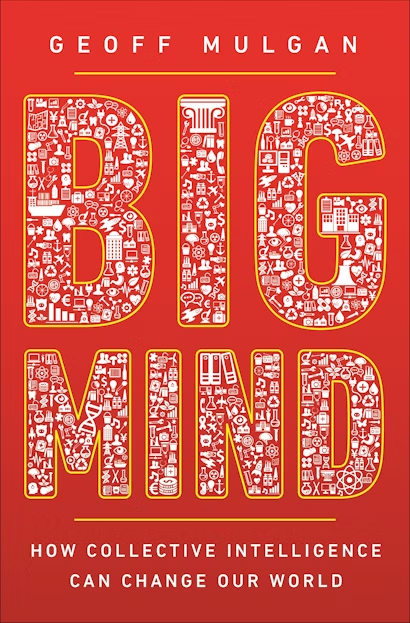
ii Big Mind: How Collective Intelligence Can Change Our World

'Everything we know is knowledge from the past, which may not apply in the future - the problem repeatedly stumbled on by models, algorithms, economic theories, and geopolitical dispositions, which made sense in one era, but then become dysfunctional in another. As social science has repeatedly discovered, the more you use a model, the less likely you are to question it. What starts as a pragmatic tool to answer a question becomes a truth in itself.

And so the models we use to think can also become traps. A model is held on to because it provides meaning and reassurance. Police forces notoriously cling to evidence they collect early in a case in the face of powerful contrary evidence that emerges later, and thus extraordinary miscarriages of justice result. The middle-aged cling to the theories they learned as undergraduates. Organizations become attached to models that become comfortable through use. I remember once meeting the planning team of a government that admitted that their forecasts had been no better than random guesses, but argued that the detailed forecasts were still needed to help with planning. The model became a comfort, even though it had no real use. 

Familiarity also breeds blindness. ...

Expertise can equally entrap. ...
 
The implication, as the Buddha pointed out, is that intelligence has to be at war with and suspicious of itself to be truly intelligent.' pp.120-121.

FIVE FUNDAMENTAL PRINCIPLES FOR EFFECTIVE COLLECTIVE INTELLIGENCE

'The first is the extent of what I call (1) autonomous commons of the intelligence in the system. By this I mean how much the elements of intelligence are allowed free rein, and not subordinated too easily to ego, hierachy, assumption, or ownership.' p.66. Chap. 5. Organizing Principles.
2. Balanced use of the capabilities of intelligence
3. Focus and the right granularity
4. Reflexivity and learning
5. Integration for action
 
'So a group is a we, but it is not just a scaling up of an I. How, then, should we think about the character of this we?' p.102. Chap. 9. The Collective.
 
Individual
|
      INTERPERSONAL    :     SCIENCES               
HUMANISTIC  --------------------------------------  MECHANISTIC      
 SOCIOLOGY  :    POLITICAL 
|
Group
 
EGO
 

 HIERARCHY


ASSUMPTION
 

OWNERSHIP


n.b. With my emphasis.

 
Geoff Mulgan (2017) Big Mind: How Collective Intelligence Can Change Our World, Princeton University Press.

Image: Princeton University Press.

See also: 'AI' : 'group' : 'axes' : 'individual'

 Previously:
Big Mind: How Collective Intelligence Can Change Our World