'Categories are destiny' Freud p.6. of 'Categories we live by'
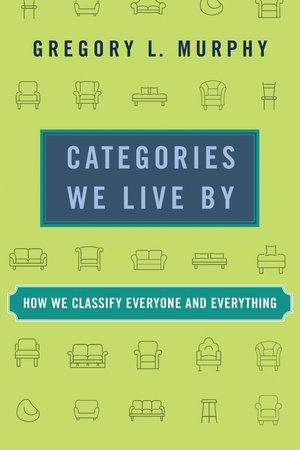
Reading and enjoying for review:
Murphy, Gregory L. Categories we live by: how we classify everyone and everything. Cambridge, MA: The MIT Press, 2024.
Let's start at the beginning -
'Nowadays we are suspicious of categories, especially categories of people. Gender, ethnic, racial, and class categories are seen as a source of discrimination and inequity. If we saw each person as a unique individual, perhaps we wouldn't have all the problems caused by racism, sexism, and all the other -isms that afflict society.
In spite of these problems, I will argue that we cannot get rid of categories in general. They simplify and distract us from individual identities, which can be bad, yet if we didn't have them, we would find it impossible to navigate the world and deal with its incredible diversity.' p.7.
Reading what follows also from the book's introduction, I thought about public sector funded (socialist) healthcare and the private provision:
'So, my sweater and my hair might both be brown, so we can say that they are both in the category of brown things. They are equivalent in the sense that I call both of them "brown." However, the category of brown things is not very interesting. When you know that something is in that category, you know exactly one thing about it-its color. There's nothing else to be known. Maybe the brown thing is alive or maybe it's inanimate; maybe its microscopic or maybe it's as big as a planet; maybe it moos or maybe it sings oI maybe it is silent. The category doesn't tell you any of those things These single-criterion categories are kind of degenerate. Yes, items that share the criterion (brownness, being three inches long, taking at least half an hour, or whatever) are equivalent, but only in the one property that defines the category. Indeed, you can define trivial categories that only have one ridiculous feature in common, like things that you have touched in the last forty-nine seconds, or objects that are exactly fifteen miles from Cincinnati. Those are not categories that people form, because they are not useful.' p.11.There is much ongoing debate about parts of the UK's NHS being 'sold-off' - taken-over by private companies with consequences for the quality of care, e.g. cataract services:
https://www.theguardian.com/society/article/2024/jul/10/eye-doctors-say-private-cataract-operations-have-hurt-the-nhs?CMP=share_btn_url
Having worked for the NHS - now NHS Professionals since 1977, the current problems faced by the service and experienced by some patients, carers, friends and family members is upsetting.
Murphy's observation contrasting the utility of categories at the individual and collective level is a great opener. Especially for the basic structure of Hodges' model and the vertical axis.
I've written previously(?) how I think that it is true, throughout my career even as a ward manager (there were some exceptions!) and community MH nurse, I/we have been cocooned from having to be concerned about the budget. When you stop and think about it, how do the 'things' in the category of economics impinge on the biomedical, biopsychosocial model? The ward was a mechanism; it kind-of run itself, which for change agents (those who use the word transformation a lot) is an ongoing issue. The two categories that matter - even as they are global - are illness and prevention. The NHS puts supertankers to shame, in its inability to pivot - turn.
At the end of the day (and night - 24/7/365!) though healthcare must be paid for.
Murphy's explanation about degenerate categories is fascinating too (and this is just the intro!). It sees me (in danger of making a category mistake) as I think about singletons, and 'degenerate' as applies in mathematics, and the debate of finance. The tension of seeing the individual as a unique being, in order to be person-centred, but the service, the system would place them in all in the category of 'payer'.
Viewed across the funding divide, is the other inevitably viewed as degenerate? On page 80 now. More to follow. I'm still kicking all this around; while the government kicks the 'can' of social care down the road.
Many thanks to MIT Press for the review copy.


 orcid.org/0000-0002-0192-8965

