Hodges' Model: Welcome to the QUAD: diagrams

Hodges' model is a conceptual framework to support reflection and critical thinking. Situated, the model can help integrate all disciplines (academic and professional). Amid news items, are posts that illustrate the scope and application of the model. A bibliography and A4 template are provided in the sidebar. Welcome to the QUAD ...

Showing posts with label diagrams. Show all posts

Tuesday, August 25, 2026

Medicine - Mathematics & History

'We now come to the input of mathematics into medical history, and to the related questions of arithmetic and quantification, ratio and proportion, geometrical argument and diagrams, and probability. Mathematics (consisting in arithmetic, geometry, astrology and music) had an established place in the quadrivium of the medieval arts course; its application to medicine is demonstrated in such textbooks as the Articella, which include treatises on weights and measures, and in studies of proportion and ratio such as those of the medieval Oxford calculators which Italian doctors among others caused to be revived at the beginning of our period. In the sixteenth century, it was a vigorously debated subject; there is a well-documented discussion of the certainty of mathematics, concerning its status in respect to the logical adequacy of its proofs, in which some natural philosophers and doctors (notably Cardano) take part. It will come therefore as no surprise that it was prescribed for doctors by most Renaissance pedagogical writers;  this prescription is often specifically linked to Galen's geometrical (axiomatic) method whose operations are the constitution of objects from elements, the comparison of existing objects and their reduction into their constitutive elements.

Associated with mathematics are diagrams, that is, abstract quantified spatial representations. There is a modern debate about the contribution of technical innovations in illustration in the Renaissance (most notably perspective) to the scientific revolution: this is only relevant here insofar as some participants in this debate argue for the importance of diagrammatic symbolisation of mental abstractions above those, like perspective, which are still representations of the real world, and see the former as a step on the path to full algebraic notation of geometry. Not all Renaissance thinkers were persuaded of their usefulness: Argenterio describes the diagrams of Manardo and Akakia reproduced below as 'vain and false tables and figures'; but I shall argue here that they were related to the uptake of doctors from the arts course insofar as well-known logical diagrams reproduced above (4.3:3) were adapted by them for their own purposes.' pp.171-172.

Maclean, Ian. 2002. Chapter 5, Beyond logic: geometry, proportion, quantity. In Logic, Signs, and Nature in the Renaissance: The Case of Learned Medicine. Cambridge/New York: Cambridge University Press.

Related to ongoing reading, Maclean provides two (among several) historical illustrations (with apologies for the quality) on pp.174-175, the first is from the Wellcome Collection:

Dubois, Jacques, 1478-1555 (Boe͏̈, Jacques, Bois, J. d., Boë, J., del, Boë, J., Del Boë, J., DelBoe͏̈, J., . . . Sylvius/de Bois). (1548). Methodus sex librorum galeni in differentiis et causis morborum et symptomatum in tabellas sex ordine suo conjecta paulo fusius ne brevitas obscura lectorem remoretur & fallat. de signis omnibus medicis, hoc est salubribus, insalubribus, & neutris, commentarius / ... per jacobum sylvium ..Paris: Retrieved from https://www.proquest.com/books/methodus-sex-librorum-galeni-differentiis-et/docview/2090356749/se-2

Jacobus Sylvius, 1539

Which Maclean then translates / interprets (p.174):

Maclean. Figure 5.1, p.174.

'Manardo goes further, and causes and symptoms adapts the square of contraries to represent not only all the possible combinations of temperaments (combinations of cold and hot and wet and dry are cleverly excluded) but also inserts a mediate point to represent the absolutely temperate body: see fig. 5.2.
This adaptation of the square of contraries (which has precedents in the medieval period) shows the appropriation for their own use by doctors of the logical instruments at their disposal.

As we have seen, it is a feature of medical thinking to take into account many circumstantiae or variables, and, over time, the numbers of variables taken into consideration increases.' p.174-175.

Figure 5.2 Giovanni Manardo, p.175.

individual
|
INTERPERSONAL
: SCIENCES             
humanistic ------------------------------- mechanistic
SOCIOLOGY : POLITICAL   
|
group

quality

logic

quantity
past - present - future
diagrams

symptoms - signs


subjective

objective

Previously: 'medicine' : 'history' : 'diagram'

Saturday, May 23, 2026

The alchemy of terminology, symbols, and signs ...

Or, 'What is a nurse doing … in a chemistry class?' [Ack. See Estrada]

In reading, I was reminded that chemistry adopted mathematical symbols for its own use. Not only that, but as a core science (with physics and biology, emerging from natural philosophy) there is a historical development from the time of alchemy:

Please see (with a graphical abstract):

C.Wentrup, The Transition from Alchemical to Modern Chemical Symbolism: from Bergman and Guiton de Morveau to Hassenfratz and Adet, Higgins, Richter, Dalton, and Berzelius. ChemPlusChem. 2024, 89, e202400033. https://doi.org/10.1002/cplu.202400033

This journey matters today as the use of symbols, in mathematics or other fields can be a barrier to learning and hence personal and disciplinary progress:

Ollie Hunter. Lost in translation: Demystify scientific symbolic language to help your chemistry students overcome any potential learning barriers. Royal Society of Chemistry, 23 May 2022.

As acknowledged many times, it is easy to take a word, or concept from one discipline and 'fit' it to - or in another. Or is it? Estrada concludes:

“The complexities of modern science and modern society have created a need for scientific generalists, for men trained in many fields of science.” This is a paradigm of science in the XXI century, where the advent of such fields like the study of complex systems requires multidisciplinary approaches. But the previous phrase was not written in the XXI century. It is the starting sentence in The education of a scientific generalist” published in Science in 1949 (Bode et al. 1949).' p.161. 

'Mathematics has been defined as the science of patterns. Thus, mathematicians search for “numerical patterns, patterns of shape, patterns of motion, patterns of behavior, voting patterns in a population, patterns of repeating chance events, and so on” (Byers 2010). Once a pattern is identified either in chemistry or in mathematics, the researcher can proceed to the clarification of the systematic rule which is behind that pattern. This is evident in the analogy used here between code-breaking and structure elucidation. This attachment to patterns makes both chemists and mathematicians very prone to the use of pictures. An organic chemist hardly can say anything about the chemical reactivity (or any physical or chemical property) of a molecule from its exact quantum-mechanical Hamiltonian. However, she will construct a complete narrative about the physical and chemical properties of a molecular structure drawn in a piece of paper, even if such a molecule is completely imagined. The power of pictures in mathematics is discussed in the book Mathematics and the Unexpected by Ivar Ekeland (1990) where its value is recognized as fundamental in the early stages of the development of mathematical ideas. This also introduces a very important analogy among chemists and mathematicians. Namely, that they use a proper language in their respective fields. While physicists use the mathematical language in their investigations, chemists use the sophisticated language of chemical formulas and specific symbols to represent charges, rearrangements, partial equilibria, etc. These “invented” languages mainly appear only in Chemistry and in Mathematics, making them unique intellectual activities.' p.162.

With thanks to the author, Ernesto Estrada IFISC for additional thoughts and insights:

Estrada, E. What is a mathematician doing…in a chemistry class?. Found Chem 26, 141–166 (2024). https://doi.org/10.1007/s10698-023-09497-4

Sunday, May 17, 2026

Wittgenstein's - Tractatus

Apparently, Wittgenstein walked away from philosophy after publication of the Tractatus. He thought he had solved the problems of philosophy, logic and reality.

In trying to ‘see’ Hodges’ model, in mathematical terms, there may be lessons in Wittegenstein’s approach, both in content and style. Of course, as a non-mathematician, I probably should leave well-alone; and stick to nursing. But that is the problem: from 1987-88 there is a need for a different perspective, even if this is a personal challenge. As with many ‘reviews’ here, we can look at Wittengenstein’s work, reflect upon it, and consider how it relates to the purposes, structures and content of Hodges’ model.

The Tractatus’s first line then, offers a warm welcome.

‘The world is everything that is the case.’ [I]

Making the decision to become a nurse and enrolling as a student makes you an educational and workforce demographic case.

Once a student in the university lecture theatre, you hopefully whether consciously, or not are exposed to the theory – practice gap; as you yearn to be on your first placement. Now it you who is seeking ‘cases’. As we live, and statistics roll and tally, the question of caseness (and categories) is key, one that is carried around even if not always active, recognised as such.

As noted in the previous post, we can for Hodges’ model (and other models, frameworks it must be said) think of ‘case’ as a, or the situation. 

A mathematical approach to Hodges’ model involves looking at things, concepts, people as objects. This includes patients and carers. In terms of a project worthy of pursuing in nursing and other disciplines involved in healthcare, this mathematization presents a non-trivial challenge. A fully-deserved response would be: 'What have you done to the aptitude for care and caring attitude? You've cancelled - subtracted it!' Humour aside:

'In order to know an object, I must know not its external but all its internal qualities.' [2.01231] 

Is this equivalent to us getting to know our patient / client and their socio-political context? 

‘The way in which objects hang together in the atomic fact is the structure of the atomic fact.’ [2.032] 

It is a help that Wittgenstein points to structure (crumbs of understanding are welcome here, as incremental steps). In formulating Hodges’ model we first identify the axes. It is the axes that then provide a space, four domains in total, to frame the objects that we decide; or, as the situation dictates, what concepts are placed in the domains of Hodges' model.

There is a successive series that follows, combining place, space and logic: ‘The proposition determines a place in logical space: the existence of this logical place is guaranteed by the existence of the constituent parts alone, by the existence of the significant proposition.’ [3.4]

‘The propositional sign and the logical coordinates : that is the logical place.’ [3.41]

‘The geometrical and the logical place agree in that each is the possibility of an existence.’ [3.411]

‘Although a proposition may only determine one place in logical space, the whole logical space must already be given by it.
(Otherwise denial, the logical sum, the logical product. etc., would always introduce new elements -in co-ordination.) 
(The logical scaffolding round the picture determines the logical space. The proposition reaches through the whole logical space.)' [3.42]

While Wittgenstein came to view ‘the picture theory of meaning’ as incorrect, as a conceptual framework and diagrammatic resource Hodges’ model is closely tied to this form of representation.

Of course, the logic at work here, is far from mathematical, but there is surely a logic.

'Formal concepts cannot, like proper concepts, be presented by a function.' [4.126]

'There is therefore really a sense in which in philosophy we can talk of a non-psychological I.
The I occurs in philosophy through the fact that the "world is my world'".
The philosophical I is not the man, not the human body or the human soul of which psychology treats, but the metaphysical subject, the limit - not a part of the world.' [5.641] 

'Although the spots in our picture are geometrical figures, geometry can obviously say nothing about their actual form and position. But the network is purely geometrical, and all its properties can be given a priori.

Laws, like the law of causation, etc., treat of the network and not of what the network describes.' [6.35]

There is much more in this work, and much that remains a challenge. Many commentators have written and said in interviews that the Tractatus rewards re-reading and some sentences stay with you for life (The Great Philosophers BBC TV). 

I'm still seeking mine.

https://www.gutenberg.org/files/5740/5740-pdf.pdf

Thursday, December 11, 2025

Bourdieu: systems, axes, maps, practical logics

I have checked these quotes and am fairly sure they are accurate. The first, I feel, improves with re-reading, and presents a clearing at the end? 

The clearing could be a template, and as per the second it may be old; but retains its practical function.

'Intellectualism is inscribed in the fact of introducing into the object the intellectual relation to the object, of substituting the observer's relation to practice for the practical relation to practice. Anthropologists would be able to escape from all their metaphysical questioning about the ontological status or even the 'site' of culture only if they were to objectify their relation to the object, that of the outsider who has to procure a substitute for practical mastery in the form of an objectified model. Genealogies and other models are to the social orientation which makes possible the relation of immediate immanence to the familiar world, as a map, an abstract mode of all possible routes, is to the practical sense of space, a "system of axes linked unalterably to our bodies, which we carry about with us wherever we go", as Poincaré put it.' p.34.
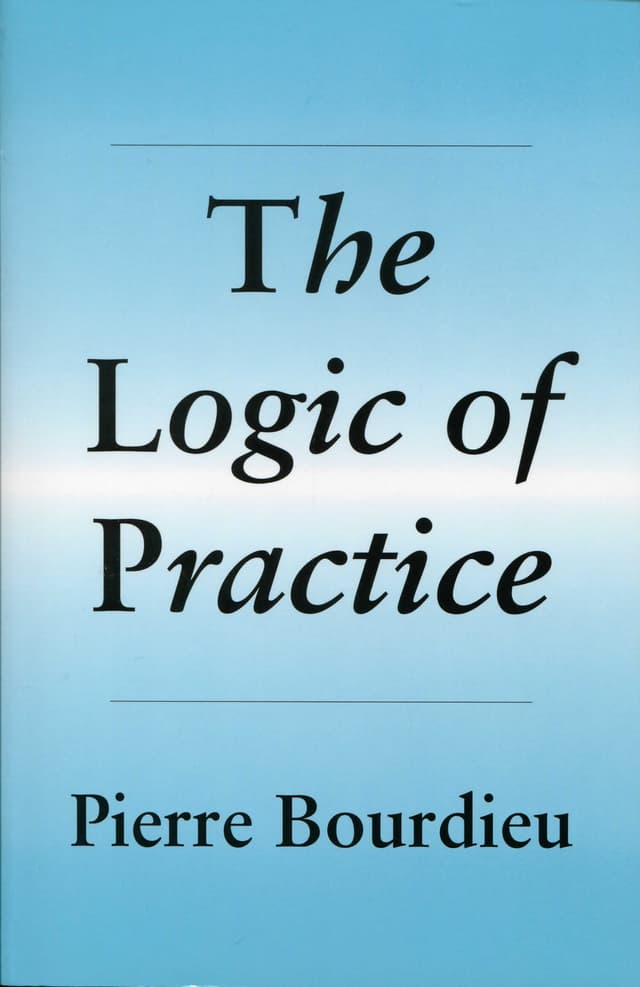
The Logic of Practice
'The logical [kinship] relations he constructs are to 'practical' relations - practical because continuously practised, kept up and cultivated - as the geometrical space of a map, a representation of all possible routes for all possible subjects, is to the network of pathways that are really maintained and used, 'beaten tracks' that are really practicable for a particular agent. The family tree, a spatial diagram that can be taken in at a glance, uno intuitu and scanned indifferently in any direction from any point, causes the complete network of kinship relations over several generations to exist in the mode of temporal existence which is that of theoretical objects, that is, tota simul, as a totality in simultaneity. It puts on the same footing official relationships, which, for lack of regular maintenance, tend to become what they are for the genealogist, that is, theoretical relationships, like abandoned roads on an old map; and practical relationships which really function because they fulfil practical functions.' p.35.


My source:
Bourdieu, P. (1990). The Logic of Practice. Stanford University Press. https://doi.org/10.1515/9781503621749 [and image source].

Bourdieu, Pierre, "The Logic of Practice (1990)" (1990). eTextbooks for Students. 875.
https://stars.library.ucf.edu/etextbooks/875

See also: https://hodges-model.blogspot.com/search?q=bourdieu

Wednesday, December 10, 2025

Problem solving, case formulation and policy formulation

On W2tQ this year, and possibly in a previous paper, or conference presentation, I've stated that the nursing process is basically a problem solving algorithm. Nothing profound there of course. 

'Problem solving' is a developmental threshold and an evolutionary skill obvious in humans, with learning passed on across generations. Evidence of problem solving in animals and nature is becoming increasingly apparent; with examples over recent decades of problems solved not witnessed before.

In healthcare, and psychotherapy more specifically, we shift to case formulation. Again a step-wise process to arise at a sufficiently complete rationale for therapy. Ideally, this extends beyond the individual. As an parent, grandparent, guardian, teacher, supervisor ... teaches a child so therapy is an opportunity for learning and, it must be added, unlearning.

Returning to (and passing on):

Hague, R., & Harrop, M. (2007). Comparative Government and Politics (7th ed.). New York, NY: Palgrave Macmillan.

Chapter 18 (pp.377-395) concerns 'Public Policy'. Clearly, here there is a shift from the individual to the collective, population and citizenry. The chapter's second page on 'Initiation and Formulation' quickly provides a flowchart 'Figure 18.1 Stages of the policy process'. Box 18.1 informs readers about 'Rational and incremental models and policy-making' (p.380):
'The key contrast between the two models is this. The rational model views policy formulation as emerging from a systematic search for the most efficient means of achieving defined goals. By contrast, the incremental model sees policy as emerging from a compromise between actors who have goals which are ill-defined or even contradictory. Where the rational model seeks the best policy in theory, an incremental framework seeks out a practical policy acceptable to all the interests involved.' p.380.
The book highlights Simon (1983) as a source for the rational or synoptic model:
 
Simon H.A. (1983) Reason in human affairs. Oxford: Basil Blackwell.

Plus, for the incremental model:

Lindblom, C.E. 1979. Still muddling, not yet through. Public Administration Review 39: 517–526.

If needed, online, you will find accounts and diagrams on problem solving, the nursing process, case formulation and policy formulation. That's quite a family is it not? 

While not referred to as explicitly today, the nursing process (now routinized) should address parity and integrate care across mental and physical health. The individual (person, patient) should be assessed and care planned with their social and community context taken into account. Collaboration in care should help assure that this is indeed the case. The nursing process in the sociological domain acknowledges the role of parents, guardians, and families as informal carers. The social care sector can also be represented and further the objectives of a more open and integrated care community as per the local situation. While not added to the sciences domain; case formulation should also factor in the physical and political. 

Politically, are all instances of problem solving, and formulation recognised for their importance and influence on outcomes and effectiveness, economy, efficiency (another 'box' p.357), plus efficacy? Are services politically afforded the resources, as defined across the domains of Hodges' model required to deliver, improve and change (achieve sustainability, educational, preventive)? 

The elephant here of course are the determinantS. Ultimately, all these forms of problem solving should be at 'home' in the political domain, but they are rarely there. It is not just the practitioner who can make the difference - be the difference.

Enough of l-implementation

Policy needs to be fit for 21st century purposes, and not hollowed-out but allowed out - beyond the legislative walls where it can make a real difference.

individual
|
INTERPERSONAL : SCIENCES
humanistic -------------------------------------------  mechanistic
SOCIOLOGY : POLITICAL
|
group-population

Nursing process

Case 
formulation

Nursing process

Nursing process

Case 
formulation


Policy
formulation


Monday, November 24, 2025

Working title: 'Can Hodges’ model provide a foundation for a mathematically informed ...

... epistemology and relational ontology? Part 1'

Abstract

Aims: To begin a process of examining a ‘model of care’ and conceptual framework known as Hodges’ model as a mathematical object. This paper examines the structural elements of this model, its axes and domains through a formal, logical and mathematical lens. To establish the extent to which a combined relational understanding and mathematical approaches can provide avenues for further research.

Design: This study adopts the design of a two-part exploratory and descriptive paper, using an inquiry-based approach throughout.

Methods: The method is interdisciplinary, descriptive, and involves conceptual analysis. Rather than Hodges’ Model acting as a model of, and for care, here the model is used to investigate how health and social care can be better conceptualised. The question is: What is the result when Hodges’ Model is treated as a mathematical object? Here, Hodges’ model is used as an inquiry-based model with reflection and critique.

Results: Readers will see the development of ideas, driven by the structure of a model of care, existing taxonomy defined by nursing theory, associated with foundational mathematical concepts.

Conclusion: The questions introduced and deliberated here will identify avenues for further study. And highlight Hodges’ model to other researchers; less familiar with Hodges’ model, and yet more skilled – adept mathematically.

What does this paper contribute to the wider global clinical community?

Re-assert the importance of theory development in nursing and health disciplines.

Draw attention to the relational (and reflexive) potential of Hodges’ model and in healthcare to abstract the collective dimensions of healthcare, especially those that are political.

Given the problems faced in the century to follow, e
ncourage researchers within and without healthcare to further develop these ideas.

Impact:

Extend the relevance and scope of mathematical abstraction, in healthcare disciplines and the humanities, beyond statistical analysis.

This paper confirms: the conceptual utility of Hodges’ model; the challenge of requisite mathematical skills; the need for interdisciplinary cooperation.

Theorists in health and social care, policy makers and researchers seeking to apply mathematical techniques, especially category theory in the social science may find this work helpful and encouraging.

Reporting Method: N/A

Patient or Public Involvement: This study did not include patient or public involvement in its design, conduct, or reporting.

Keywords: nursing, theory, relational ontology, health, Hodges’ model, 
mathematics

Friday, November 21, 2025

Hodges' model - Locus of Care & Control?

Draft notes:

There are obvious geometric features (Stewart, 1981) in Hodges’ model. Application of the model is a holistic affair. The centre of the model is its centre (as a template), but in application it is not fixed. There are several degrees of freedom, determined by the context of application. Consider figures 4a, 4b and 4c. Perhaps it can be argued there is what amounts to a care locus? As Persons (2025) notes:
‘Primary care is considered the first line of defense in health care, and it is the locus of the maintenance of both individual and population health.‘ p. 15.

 Emphasis can be placed on selected domains, as the situation dictates:


Stewart, I. (1981) Concepts of Modern Mathematics, Harmondsworth: Penguin Books.

Persons, G. A. (2025). Health Care Safety Nets: Vital Participant Roles and Varying Policy Contexts. Phylon (1960-), 62(1), 5–30. https://www.jstor.org/stable/27396595

Thursday, October 09, 2025

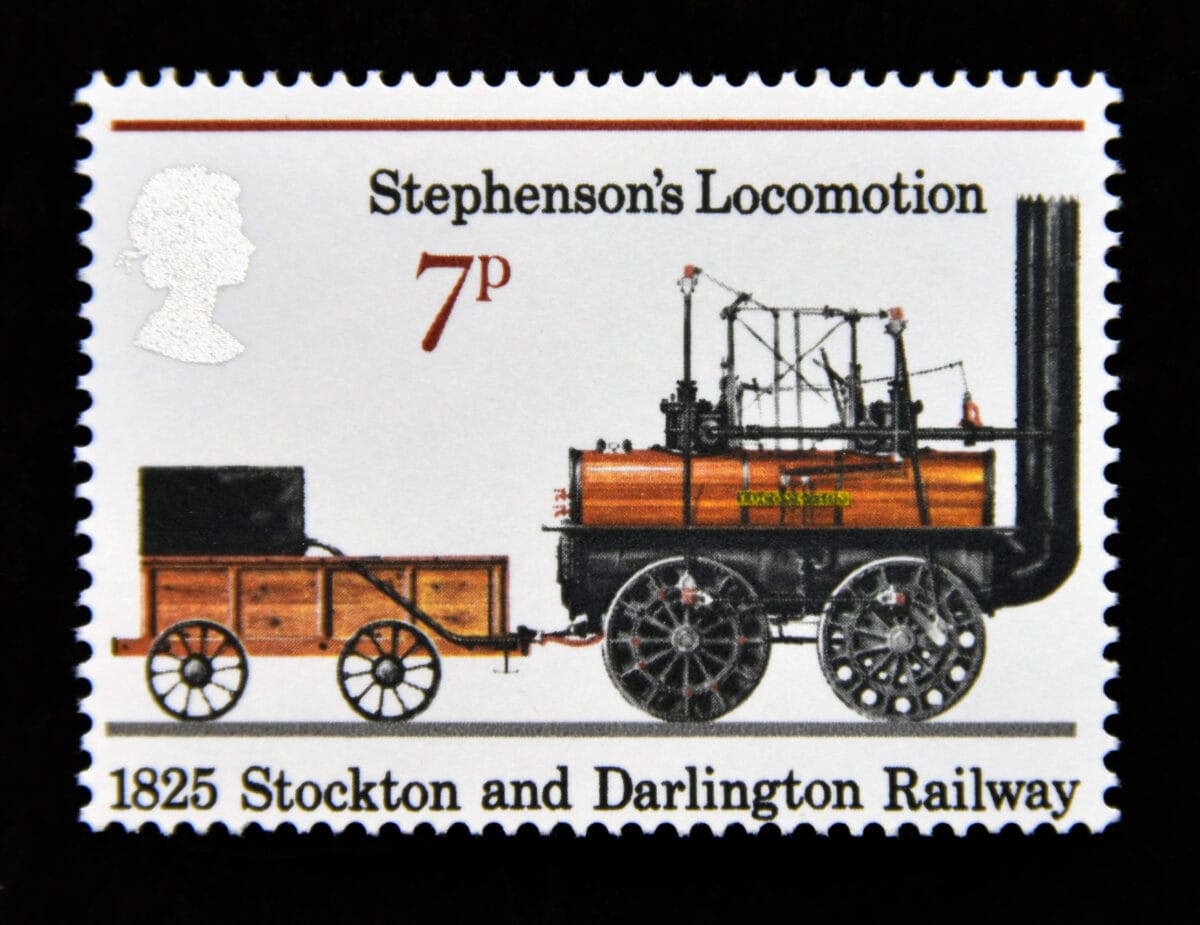
The creation of Hodges' model: "All aboard!" 200 years

28th May 1997
When I interviewed (Mr.) Brian Hodges in Manchester on 28th May 1997, I learned he had created the model in 1983, mainly while commuting to Manchester Polytechnical College by train from (Totley) Sheffield, and back. 

I wish I could have been sat by him, to strike up a conversation. Although (among other points) I'm not sure how much he relied upon, or was chasing down the visual side of the model, with some skethces and drawings. So would I have noticed him thinking, drawing, crossing-out, and labelling? This I would have noticed, not that I have a habit of 'spying' and being nosey. Although nowadays, with the repeated announcements on the trains: ‘See it. Say it. Sorted’; perhaps I should?

In 1983 I was a general student nurse (SRN), and still over a decade away from becoming a community psychiatric nurse in 1985, and being (well) taught by Brian and colleagues in 1987.

I also enjoy a (reliable!) train journey, and used to read a lot travelling from the NW England through the London underground (Euston-Waterloo) to Plymoth, and later to Portsmouth in the 1970s. Happy days, then and today; with the railways reasserting their relevance. A quality shared with a certain little-big model I know.

Individual
|
      INTERPERSONAL    :     SCIENCES               
HUMANISTIC =========================  MECHANISTIC      
 SOCIOLOGY  :    POLITICAL 
|
Group

Rail 200

Nationalised - Private
Private - Nationalised
Charity - CIC


Thursday, May 08, 2025

Sets in Hodges' model

INDIVIDUAL
  |
     INTERPERSONAL    :     SCIENCES               
HUMANISTIC --------------------------------------  MECHANISTIC      
SOCIOLOGY  :   POLITICAL 
|
GROUP

'The emotions that we want to infer are the seven basic emotion categories.
Concretely this set is E = {Anger,  Contempt, Disgust, Fear, Happy, Sadness, Surprise}.' p.111.*

Sets - Venn diagrams

Physical obs = { Temperature, Pulse, Respiration, Blood Pressure, Gait ... }
Social = { Friends, Family, Work colleagues, Neighbours ... }

Politics { [Freedom], - Elections, Law, Policy, Government, MPs, Ministers, PM-President ... }


David Sanchez-Mendoza, David Masip, Xavier Baro, and Agata Lapedriza. Emotion Detection Using Hybrid Structural and Appearance Descriptors. In. MDAI 2013: Proceedings of the 10th International Conference on Modeling Decisions for Artificial Intelligence - Volume 8234 November 2013. Pages 105–116 https://doi.org/10.1007/978-3-642-41550-0_10

*I am unable to double-check this reference and hope it is correct(?).

See also:
UNIVERSAL EMOTIONS: Paul Ekman Group

Tuesday, November 26, 2024

The naïve approach ii - Seeking / Avoiding a Catastrophe

In addition to Dodson's book I borrowed:

Zeeman, E.C. (1977) Catastrophe Theory-Selected Papers 1972–1977, Reading, MA: Addison-Wesley.

From the mid-1970s I remember catastrophe theory rather bursting on to the science scene. Articles in New Scientist (in a box somewhere?), Scientific American plus a BBC TV episode of Horizon (seeking details - originally aired July 28, 1975, 60 minutes 'Happy Catastrophe')*, that highlighted potential for new insights into the behaviour inside prisons. and other applications in the social sciences.

The CONTENTS reads:
GENERAL INTRODUCTORY PAPERS 

1. Catastrophe theory : Draft for a Scientific American article 1
2. Levels of structure in catastrophe theory 65

 BIOLOGICAL SCIENCES 80

3. Differential equations for the heartbeat and nerve impulse 81 
4. Primary and secondary waves in developmental biology 141 
5. A clock and wavefront model for the control of repeated structures during animal morphogenesis (with J.Cooke) 235
6. Gastrulation and formation of somites in amphibia and birds (Addendum by R. Bellairs.) 257 
7. Dialogue between a Biologist and a Mathematician 267 
8. Brain modelling 287 
9. Duffing's equation in brain modelling 293

 SOCIAL SCIENCES 302

10. Some models in the social sciences (with C.A.Isnard) 303 
11. On the unstable behaviour of stock exchanges 361 
12. Conflicting judgements caused by stress 373 
13. A model for institutional disturbances (with C.S.Hall, P.J.Harrison, G.H.Marriage, P.H.Shapland) 387
14. Prison disturbances 403 

PHYSICAL SCIENCES 408 

15. A catastrophe machine 409
16. Euler buckling 417 
17. Stability of ships 441

MATHEMATICS 496

18. The classification of elementary catastrophes of codimension <= 5 (with D.J.A.Trotman) 497
19. The umbilic bracelet and the double-cusp catastrophe 563 

DISCUSSION 604

20. Research ancient and modern 605 
21. Catastrophe theory : its present state and future perspectives (with R.Thom) 615
22. Afterthought 651 
As an area of contention the subject of catastrophe theory (CT) possibly presents(?) a dual-cusp of contention. Firstly, CT brought with it controversy within academia and mathematics. The book was reviewed by T. W. Barrett, Department of Physiology and Biophysics, University of Tennessee Center for the Health Sciences, Memphis, TN 38163: 
'Catastrophe theory (CT), as a new field in mathematics with many possible ramifications for both the physical and biological sciences, has recently been the subject of much controversy (see [1]-[5]). This controversy, in this reviewer's opinion, has served a valuable purpose insofar as it has stimulated the theory's proponents to refine and delineate their concepts more clearly. Catastrophe theory was developed by the Field prize winner, Rene Thom; but much work has been accomplished by E. C. Zeeman and his group, especially with respect to applications.' pp.609-610. IEEE TRANSACTIONS ON SYSTEMS, MAN, AND CYBERNETICS, VOL. SMC-9, NO. 9, SEPTEMBER 1979. https://ieeexplore.ieee.org/stamp/stamp.jsp?arnumber=4310286 
Stephen Smale also reviewed Zeeman's book; BULLETIN OF THE AMERICAN MATHEMATICAL SOCIETY Volume 84, Number 6, November 1978. 1360-1368. 
https://www.ams.org/journals/bull/1978-84-06/S0002-9904-1978-14580-7/S0002-9904-1978-14580-7.pdf
'To write a review in this environment has a very personal side for me. On one hand my own work on dynamical systems is closely connected to the origins of CT. I have had a long and close personal and professional relationship with both Thorn and Zeeman. More than 20 years ago I was discussing singularities of maps, transversality, and immersions with René Thom. Thom tried to interest me in an early draft of chapters of his book Structural stability and morphogenesis in 1966.

On the other hand I have remained skeptical and aloof from CT, perhaps due to my conservatism in science. While my colleagues and students were showing enthusiasm for CT, I gave critical lectures, one at the University of Chicago in 1974, one at the Aspen Institute of Physics in 1975. More recently I have been quoted negatively in the "Science" and New York Times references above. This is the first time I have written on the subject, and I should warn the reader of this negative bias, far from shared by many of my fellow mathematicians.' p.1360.

Some defenders of CT may accuse me of discussing very special examples not characteristic of the literature of the subject. I feel that the problem of lack of justification discussed above, is also found in Zeeman's other models. Furthermore Thorn's models are even less specific and less developed. On the other hand, Thorn's work in CT covers many subjects; in this connection Zeeman writes in his Scientific American article, April 1976, p. 65: "The method has the potential for describing the evolution of form in all aspects of nature, and hence it embodies a theory of great generality."' p.1366.
The book's introductory papers are somewhat confusing in content, as drawn to 'SOCIAL SCIENCES' it is the introductory section (and Part Two) that includes  'Anorexia nervosa', Example 9 pp.33-52. 

This is the second 'cusp' as the assessment, diagnosis, intervention, outcomes, skilled staff, access to specialised mental health services remains contentious to this day. As a charge nurse on a female acute admission mental health ward in the early 1980s, eating disorders have always presented a 'clinical' challenge. Often within a staff group and for individual staff members too.

Twitter/X is hardly an objective record but it appears today, that people and families affected by eating disorder continue to advocate for appropriate service provision, treatment and recognition. Recognition that can also develop evidence-based interventions. As discussed by Dr. Agnes Ayton, consultant psychiatrist and others in the video below:


A related paper:

Ibrahim, A., Ryan, S., Viljoen, D. et al. Integrated enhanced cognitive behavioural (I-CBTE) therapy significantly improves effectiveness of inpatient treatment of anorexia nervosa in real life settings. J Eat Disord 10, 98 (2022). https://doi.org/10.1186/s40337-022-00620-y [ My source: @AgnesAyton ]

The Zeeman chapter on anorexia nervosa is interesting graphically and conceptually ...

Page 42. Figure 20. The effect of the butterfly factor, d>0.
(Sorry for the image quality)

- but is of course 'from another time' and is clearly not person-centred. Eating disorders affect many people in the UK and are a cause of trauma, distress, disrupted life-chances and mortality. Referring to Hodges' model, such graphics, reinforce the idea that 'solutions' are to be found in the mechanistic and quantitative domains of the sciences and politics (choice, power, services, safety..). Here, maths and theories (seemingly) provide an explanation for people who are ill, and need treatment. As a teenager for most of the 1970s, Hodges' model was not yet a reality. As I have found since 1987-8 looking at the POLITICAL care/knowledge domain, the model's relevance has increased since the start of my nursing career in 1977. Consider for example, the politics of:
  • the global phenomena of famine
  • - whether or not associated with economic crisis, drought, other natural disaster, or conflict, political crisis
  • ultra-processed foods
  • obesity pandemic
  • weight loss drugs
  • appetite stimulants
  • appetite suppressants
  • eating disorder (anorexia and bulimia) across care sectors - primary, secondary, specialist
    • community / in-patient care
    • person-centred care
    • user involvement in service design
  • the availability of treatment modalities - psychotherapy (as in the video)
  • the impact on family relationships and peer group (estranged - loss of friends)
  • diagnostic blurring - psychosis, borderline personality disorder - the rise of 'anti-psychiatry'
Here then is the purpose of this post, what potential is there to look at nutrition from a situated individual and collective (global) perspective? This could be focussed on nutrition, or eating disorder; or alternately take a collective stance to encompass the global food supply and the industry. Discovering the diffeomorphism, I wonder if there are others, and their respective properties and character? 

INDIVIDUAL
|
INTERPERSONAL : SCIENCES              
humanistic ------------------------------- mechanistic
SOCIOLOGY : POLITICAL   
|
GROUP
COGNITIVE THERAPY
EMPATHY&RAPPORT
LISTENING - MUTUAL ENGAGEMENT
MENTAL HEALTH
DIAGNOSIS
TRAINED / SKILLED STAFF
EVIDENCE-BASED INTERVENTIONS*
MOTIVATION
MOOD
MULTIMORBIDITY

RESEARCH
EATING
DIET
NUTRITION
NUTRITIONAL VALUE
WEIGHT
BMI
IN-PATIENT UNIT
place of safety


PUBLIC HEALTH
SOCIETY
FAMILY
CARERS


Developed nations
are collectively and increasingly
'eating disordered'
and exporting this 'lifestyle'.


Before I return the book, I will revisit the discussion section.

See also:
Jones P, Wirnitzer K. Hodges’ model: the Sustainable Development Goals and public health – universal health coverage demands a universal framework. BMJ Nutrition, Prevention & Health 2022;5:doi: 10.1136/bmjnph-2021-000254

*I could not find on BBC website. I have contacted the Open University. I did find - 'In this Horizon episode, Rene Thom's mathematical discovery of the catastrophe theory is investigated.' at  https://thetvdb.com/series/horizon/episodes/1385431

Wednesday, September 11, 2024

THE GRID by Eli Payne Mandel

individual
|
INTERPERSONAL : SCIENCES
humanistic ------------------------------- mechanistic
SOCIOLOGY : POLITICAL
|
group

[125]
'Therefore, a mathematician babbles when he refers to cutting a given line in two. The actual line that he shows to us on the abacus has length and width. But the line he has in mind is a stroke with length and no width. What is drawn on the abacus cannot be such a stroke, and he who goes about cutting it cuts not the line that is but the line that is not.'

(Sextus Empiricus, Against the Mathematicians 9.282)
(n.b. The above is printed upside-down on the page.)

Scatter the trace of the vessel from the ash. Pythagoras here is riddling about confusion and mental cloudiness, for if one wants to do philosophy one must pass over physical and sensible demonstration in favor of abstract argumentation. The ash is analogous to the dust on the abacus in which diagrams are delimited and proofs brought to an end. 

(Iamblichus, Exhortation to Philosophy 34)' p.55


'[1] In ancient Greek, an abacus is a sand table. 'The abacist draws lines and maybe moves pebbles around the lines. When done, she wipes the sand blank. 


[2] A board or slab for drawing, computation, games; a cutting board. Technical term, likely to be a loanword, but conjectured origin in Hebrew abãq "dust" remains unproven. --  Pierre Chantraine, Dictionnaire etymologique de la langue greque.' p.10.

'[122] The abacus computes and it erases. It tells a life. Then gambles it away. Achilles and Ajax sit down to play a game of dice. They have hung up their shields. They lean on their spears. They are tired. The Anatolian air is cold off the water. Attendants wrap them each in wool cloaks thick with eight-pointed stars. The stars wander along eddies and meanders. The only straight lines are servants of error. Their fingers are on the abacus, but Achilles and Ajax do not play, do not speak, lost in the maze of their cloaks.

[124] The first reference in Western literature to written language is in the Iliad. An unsuspecting  man in a story is carrying semata lygra / grapsas en pinaki ptukto thymophthora polla: baleful signs written on a folded tablet, utterly soul-  destroying. The words, which some scholars conjecture to be Linear B, spell out the man's death, and the reader murders  the unreading man. After the murder, Death Wipes the tablet  blank and folds it back again.' p.54.

'[3] Because dust blows away and only the slab remains, an abacus is also the part of a column in immediate contact with what it supports. If that structure no longer survives, the abacus upholds the edifice of the sky.' p.10.


THE GRID by Eli Payne Mandel, Carcanet Press. 2023.

https://www.elipmandel.com/

Previously on W2tQ (with overlap):

arts :: drama :: poetry :: literature :: narrative

Wednesday, August 07, 2024

"How did you get that answer? Show your working out!"

As students of - math, maths, mathematics (pick one!) or arithmetic, algebra - know only too well: Learning, no doubt, through a series of prompts, especially if numerically challenged:

The way you derived your answer is an important - the most important part of the exercise. It is the exercise in most cases.

As may be apparent here on W2tQ, in addition to visual methods, mind-mapping, diagrams and computers, the professional basis for the study and the draw of Hodges' model was models of care and nursing theory. I've blogged previously about if we stress the theoretical, this variously invites yawns, and critique (always welcome), if not ridicule from outside.

In practice we seem struggle to do the ideal. This is one aspect of the theory-practice gap; bridging this gap was one reason for the creation of Hodges' model. What the student health professional learns in the  class/lecture theatre/online, may not be reflected and realised 100% in practice. 

On clinical placements the real-world intervenes, upsetting the academic comforts. Suddenly the armchair hypotheses do not sit so comfortably. Reality bites. Are there enough staff, is the skill-mix 'ideal'. Patients present their own variables. Which are also often at least binary (and invariably more), to include carers, family, with prior experiences. There are specific life experiences and situations of the patient; and yes, in plural.

Competence with paperwork, the electronic health record (EHR) is key to a student's progress:

From communication skills, establishing a therapeutic relationship (yes, so 'old school'?), enabling and concurrent with care assessment, care planning, intervention and evaluation. Plus, the 'writing' of the same including all the processes, messages received, clinical team meetings, allocations, supervision. All the while being mindful of ethics, professionalism and accountability.

Regarding theory: I do wonder; are we missing something? Something that artificial intelligence may (will) pick-up eventually (quite quickly in-fact!). With the legacy of largely abandoned nursing theories, models of care, health frameworks … do we need to look at theory in a more literal (yes, idealised) form? To have any chance of success do we need to leave behind what we have thus far? In addition to science, nursing, medicine are often described as an art. Even if this theoretical treatment is impressionistic surely it is worth trying - to be creative, innovative, to hypothesise and speculate on the edge?

Can we use Hodges' model, or another 'tool' you might care to propose even more suited to the purpose? 

Throwing caution to the wind: this is a theoretical exercise. It may be based upon sand? Then so be it! If there is a practical, pragmatic and practice-based application that would be marvellous. Why does this matter? The rationale here is driven by the fact that health has its feet, or draws every-other-breath in the humanities. Yes, evidence is grounded in science, anatomy, physiology, life sciences and the rest. The humanistic care - knowledge domains need, demand their own unique theoretical space. A sandpit to play with a theoretical language. And make no mistake, the sand is already hurting these eyes.

There are malign agents who would deny any practical benefits of such an effort, and yet this should be in prospect. This should be an outcome to follow in the near future (although delayed by COVID). In fact it is a necessity, a requirement even, given attention and prioritisation of the SDGs, and the determinants of health,. Add to this the politics of health, and health in politics and the world🌍🌎🌏🌐today; full implementation, achievement and ongoing development will costs billions (trillions of dollars) and once-and-for-all a long-term perspective. 

There is a now, a holistic need to show your working out. How you have arrived at your answer. 

Saturday, March 16, 2024

Hodges' model: An architectonic sense-making tool

"Translation by architectonic map is a sense-making tool inspired by Peirce's use of the term, architectonic, to describe the systematic form of a body of knowledge. Theorists create a structure around which their approach to understanding human conduct is built. Familiarity with the overall structure facilitates generalized discourse among those interested in the framework. An architectonic map identifies all the major components of a scientific text or canon, including its assumptions, concepts, propositions, and theories, and the paths connecting these components. Mapping architectonics is an intersemiotic (across two different types of sign systems) translation process when the translation product is a diagram, and an intralingual process when the product is a narrative." p.111. (My emphasis)

"Models employ symbols (terms and their meanings), but also have an iconic function (a design meant to represent a object or process in important ways) and an indexical function (notation indicating and pointing to persons, processes, relationships, organizations)." p.112. 


Individual
|
      INTERPERSONAL    :     SCIENCES               
HUMANISTIC  --------------------------------------  MECHANISTIC      
 SOCIOLOGY  :    POLITICAL 
|
Group
person

concepts

critical thinking

person

maps

framework


languages

dialogue - narrative

shared understanding

social worlds*

anthropology

organisations

communities of practice

professions, scope of practice

*translation here too:

policy, power, status ...


Forte, J. A. (2009). Interactionist Practice: A Signs, Symbols, and Social Worlds Approach. Humboldt Journal of Social Relations, 32(1), 86–122. http://www.jstor.org/stable/23263237


Thursday, December 14, 2023

Diagrams, Visualizations, Intuition and Critical Thinking QED

"The atom of Niels Bohr, a miniature solar system, had become a embarrassingly false image. ... Bohr himself had set the tone. In accepting the Nobel Prize for his atomic model, he said it was time to give up the hope of explanation in terms of analogies with everyday experience. 'We are therefore obliged to be modest in our demands and content ourselves with concepts that are formal in the sense that they do not provide a visual picture of the sort one is accustomed to require. . . .' This progress had not been altogether free of tension. 'The more I reflect on the physical portion of Schrödinger's theory, the more disgusting I find it,' was Heisenberg's 1926 comment to Pauli. 'Just imagine the rotating electron who charge is distributed over the entire space with axes in 4 or 5 dimensions. What Schrödinger writes on the visualizability of his theory . . . I consider trash.' As much as physicists valued the conceptualizing skill they called intuition, as much as they spoke of a difference between physical understanding and formal understanding, they had nevertheless learned to mistrust any picture of subatomic reality that resembled everyday experience. No more baseballs, artillery shells, or planetoids for the quantum theorists; no more idle wheels or wavy lines. Feynman's father had asked him, in the story he told many times: 'I understand that when an atom makes a transition from one state to another, it emits a particle of light called a photon. . . . Is the photon in the atom ahead of time? . . . Well, where does it come from, then? How does it come out?' No one had a mental image for this, the radiation of light, the interaction of matter with the electromagnetic field: the defining event of quantum electrodynamics." p.242.

 Individual
  |
     INTERPERSONAL    :     SCIENCES               
HUMANISTIC --------------------------------------  MECHANISTIC      
SOCIOLOGY  :   POLITICAL 
|
GROUP

reflection

critical thinking

intuition

physics

Bohr's atomic model

reflection


Gleick, J., (1992) GENIUS - Richard Feynman and modern physics, London: Little Brown and Company, p.242.

Saturday, October 07, 2023

Hodges' model: The Art & Science of Care Choreographies?

INDIVIDUAL
|
     INTERPERSONAL    :     SCIENCES               
HUMANISTIC --------------------------------------  MECHANISTIC      
SOCIOLOGY  :   POLITICAL 
|
GROUP

Introduction to Choreographies
Merce Cunningham:
Changes:
Notes on Choreography


Last month attending the UKSS conference in Portsmouth, I stopped in Oxford on the way South arriving 0800. Visiting Blackwell's bookshop - what bliss! I spotted Montesi's book and found a comfy armchair for more comfortable look. On the return journey, two days later, I used Park and Ride again and returned. It was worth it.

Over the years I've thought of Hodges' model as a theatre (in every sense), dance floor and the performance of health care practitioners. The wear of shoes bears testimony to the many steps about the hospital, clinic, nursing home, patient's home and community.

Choreography as a discipline naturally follows, and is more extensive than I thought.

UKSS is scheduled for Oxford in 2024, details - when I have them.

Cunningham cover: Amazon.

Saturday, August 19, 2023

Evidence-based care: The original Gordian Knot

or - Choose your audience carefully.

Within health and social care (and other - safety-critical - academic and professional fields) evidence-based care is pivotal as proof of safety, reproducibility, effectiveness, efficacy, professionalism, and benefits for the subjects of care and public. How best then to prove the scope, scale, relevance and safety of Hodges' model? How to demonstrate in theory and practice the utility and increasing relevance of Hodges' model? There are times I have to temper my belief, passion and enthusiasm for h2cm; am I too ardent, and at risk of coming across as preaching? There is a further tension. The one that is constant: language.

As a nurse, attention to language and terminology is vital to effective communication, establishing and sustaining rapport and empathy. This concern applies across situations, contexts and encounters; with patients, patient and carer (family), and colleagues. We are encouraged to avoid jargon, abbreviations  and technical terms. I use Hodges' model implicitly (aide-mémoire, assess, plan, evaluation, prioritise) and explicitly - sharing the model on some occasions but not all.

In the role of researcher / author, the audience, especially - editors, reviewers, and readers have expectations in how concepts, ideas, theories are expressed and explained. To a degree, the very title of a publication, preempts the language to follow. As I present, or write, sources must be declared and  referenced. Again, resort to jargon is discouraged. Clarity and brevity are strengths. And yet how likely is it that at least 1/3 reviewers will demand more technical rigour and explanation? If terms are used from other disciplines, the expectation follows that their cross-disciplinary application is explained and argued for, and meanings differentiated.

With potential theoretical underpinnings for Hodges' model to be found in Gärdenfors's Conceptual Spaces, and Meyer & Lands's Threshold Concepts and others (nursing and healthcare no-less); John D. Cook provides additional pause for thought - as I look even further afield:

"When I was in college, I sat in on a communication workshop for Latin American preachers. ...

Another lesson from that workshop, the one I want to focus on here, is that you don’t always need to convey how you arrived at an idea. Specifically, the leader of the workshop said that if you discover something interesting from reading the New Testament in Greek, you can usually present your point persuasively using the text in your audience’s language without appealing to Greek. This isn’t always possible—you may need to explore the meaning of a Greek word or two—but you can use Greek for your personal study without necessarily sharing it publicly. The point isn’t to hide anything, only to consider your audience. In a room full of Greek scholars, bring out the Greek.

This story came up in a recent conversation with Brent Yorgey about category theory. You might discover something via category theory but then share it without discussing category theory. If your audience is well velrsed in category theory, then go ahead and bring out your categories. But otherwise your audience might be bored or intimidated, as many people would be listening to an argument based on the finer points of Koine Greek grammar. ...

Some things may sound profound when expressed in esoteric language, such as category theory or Koine Greek, that don’t seem so profound in more down-to-earth language. Expressing yourself in a different language helps filter out pedantry from useful ideas. (On the other hand, some things that looked like pure pedantry have turned out to be very useful. Some hairs are worth splitting.) 

Sometimes you have to introduce a new terms because there isn’t a colloquial counterpart." ...

 Category theory and Koine Greek: John D. Cook. 

Category theory and Koine Greek: John D. Cook. 
https://www.johndcook.com/blog/2016/06/27/category-theory-and-homiletics/

See also: Applied category theory: John D. Cook

https://www.johndcook.com/blog/applied-category-theory/

Wednesday, June 14, 2023

[ Towards . . .] A Geometry of Care*

Context -
"Introduction: We present a new model of skilled performance in geometry proof problem solving called the Diagram Configuration model (DC)." p.577.

INDIVIDUAL
|
INTERPERSONAL    :     SCIENCES               
HUMANISTIC --------------------------------------  MECHANISTIC      
SOCIOLOGY  :   POLITICAL 
|
GROUP
"A safe abstraction only ignores irrelevant details, i.e., details which only discriminate between objects that are functionally equivalent with respect to the problem solving task." p.582.

So much to consider here, I may be overstretching analogies but then Hodges' model can act as both a conceptual rack and resolver.


"For instance, to use the side-angle-side rule for inferring triangle congruence a problem solver must locate three congruence relationships - two between corresponding sides of the triangles and one between corresponding angles. In searching for a list of statements for these three relationships, one might need to consider numerous possible combinations of three statements that exist in the list. However, if these relationships are marked on a diagram, one can quickly identify them since the side-angle-side configuration comes together in each triangle at a single vertex. In other words, related information is often easier to find in a diagram because it is typically in the same locality whereas the same information may be separated in a in a list of statements. This is the locality feature of diagrams." p.584.


not just 'local' -


- but intra- interdomain -
with constant stress on safety.


Koedinger, K.R. & Anderson, J.R. (1995) Abstract Planning and Perceptual Chunks. In  Diagrammatic Reasoning: Cognitive and Computational Perspectives. Janice Glasgow, N Hari Narayanan, B. Chandrasekaran (Eds.). Massachusetts: AAAI PRESS / MIT Press. pp.577-625.

Book cover: https://dl.acm.org/doi/book/10.5555/546459

*There may be several? But -
"One of the places where the Geometry tutor expert (GTE) gets bogged down while attempting difficult problems is in the fruitless application of algebra inferences. Algebra expressions can be combined and manipulated in infinite variety and as a result, algebra inferences often lead problem solvers into black holes in the search space from which they may never return." (17.4.3 Avoiding Algebra in the Diagram Configuration Space),  p.593.