Hodges' Model: Welcome to the QUAD: we

Hodges' model is a conceptual framework to support reflection and critical thinking. Situated, the model can help integrate all disciplines (academic and professional). Amid news items, are posts that illustrate the scope and application of the model. A bibliography and A4 template are provided in the sidebar. Welcome to the QUAD ...

Showing posts with label we. Show all posts

Sunday, December 14, 2025

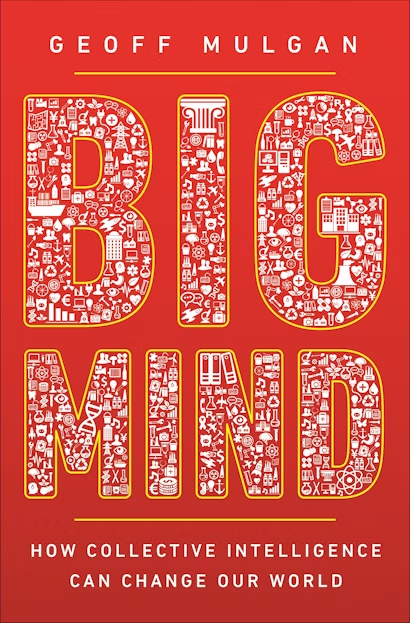
ii Big Mind: How Collective Intelligence Can Change Our World

'Everything we know is knowledge from the past, which may not apply in the future - the problem repeatedly stumbled on by models, algorithms, economic theories, and geopolitical dispositions, which made sense in one era, but then become dysfunctional in another. As social science has repeatedly discovered, the more you use a model, the less likely you are to question it. What starts as a pragmatic tool to answer a question becomes a truth in itself.

And so the models we use to think can also become traps. A model is held on to because it provides meaning and reassurance. Police forces notoriously cling to evidence they collect early in a case in the face of powerful contrary evidence that emerges later, and thus extraordinary miscarriages of justice result. The middle-aged cling to the theories they learned as undergraduates. Organizations become attached to models that become comfortable through use. I remember once meeting the planning team of a government that admitted that their forecasts had been no better than random guesses, but argued that the detailed forecasts were still needed to help with planning. The model became a comfort, even though it had no real use. 

Familiarity also breeds blindness. ...

Expertise can equally entrap. ...
 
The implication, as the Buddha pointed out, is that intelligence has to be at war with and suspicious of itself to be truly intelligent.' pp.120-121.

FIVE FUNDAMENTAL PRINCIPLES FOR EFFECTIVE COLLECTIVE INTELLIGENCE

'The first is the extent of what I call (1) autonomous commons of the intelligence in the system. By this I mean how much the elements of intelligence are allowed free rein, and not subordinated too easily to ego, hierachy, assumption, or ownership.' p.66. Chap. 5. Organizing Principles.
2. Balanced use of the capabilities of intelligence
3. Focus and the right granularity
4. Reflexivity and learning
5. Integration for action
 
'So a group is a we, but it is not just a scaling up of an I. How, then, should we think about the character of this we?' p.102. Chap. 9. The Collective.
 
Individual
|
      INTERPERSONAL    :     SCIENCES               
HUMANISTIC  --------------------------------------  MECHANISTIC      
 SOCIOLOGY  :    POLITICAL 
|
Group
 
EGO
 

 HIERARCHY


ASSUMPTION
 

OWNERSHIP


n.b. With my emphasis.

 
Geoff Mulgan (2017) Big Mind: How Collective Intelligence Can Change Our World, Princeton University Press.

Image: Princeton University Press.

See also: 'AI' : 'group' : 'axes' : 'individual'

 Previously:
Big Mind: How Collective Intelligence Can Change Our World


Sunday, February 02, 2025

Social Capital - related to Hodges' model: c/o Andy Haldane FT

'The world is more diverse and interwoven than ever before - economically, culturally, ethnically, generationally. This is largely the result of the postwar explosion in cross-border flows of:'
ME
|
      INTERPERSONAL    :     SCIENCES               
HUMANISTIC  --------------------------------------  MECHANISTIC      
 SOCIOLOGY  :    POLITICAL 
|
WE

INFORMATION*

GOODS

PEOPLE

MONEY

 *Here I am treating information as analog - attached to meaning and sense-making, human reasoning - thought; information is of course also digital and an economy in itself.

'There is no ecosystem on the planet that is not enriched by increased diversity. The complexity of rainforests and oceans explains their abundance. In social systems, the cross-pollination of ideas, cultures and practices in diverse communities has been a driver of innovation and dynamism for millennia.
Yet this is a double-edged sword. A rainforest or an ocean are vulnerable to antagonistic arrivals such as humans seeking timber or fish. If cultures clash rather than cohere, diverse communities exhibit similar fragility.
Every complex system faces this balancing act, but it can be improved by strengthening ties and trust - what Harvard political scientist Robert Putnam calls social capital. The depletion of social capital over the past half-century, documented by Putnam, has tilted the scales decisively towards fragility. Today's open, connected economies are nested in brittle, disconnected societies. Neither can flourish like this.
One policy response is to reverse economic course, tightening restrictions on cross-border flows of people, goods, technologies and information. While economists (like me) tell us that doing so would diminish economic dynamism, given these policies address the insecurities felt by many at source, it is no surprise they are gaining support - especially on immigration and trade.' 

ME
|
      INTERPERSONAL    :     SCIENCES               
HUMANISTIC  --------------------------------------  MECHANISTIC      
 SOCIOLOGY  :    POLITICAL 
|
Group

My - sense of security
My - trust

 (AFTER) -
FORETHOUGHT


... Rainforest : Ocean
Wetlands : Kelp forests ...^

Maps of Social Capital1

Spatial planning


Social capital
Social mobility
Sociable housing2
Social cohesion

Social -

Policy
Curricula
Governance, Citizen Trust
Nat. Strategy for social connection3

Capitalism

'An Office of the President or Prime Minister, charged with lacing social cohesion through policy, should be hard-wired into the machinery of governments.'

(Here, here!).

1. Raj Chetty - Social Capital Atlas: https://www.socialcapital.org/
2. Richard Sennett
3. Chris Murphy

^Sometimes perhaps the map is the territory? Discuss.

With thanks to:
Andy Haldane, How to get from the me to the we society. Opinion: FT Weekend, 14/15 December 2024, p.12.

Upswing image: 
https://www.allenandunwin.com/browse/book/Robert-D.-Putnam-and-Shaylyn-Romney-Garrett-Upswing-9781800750371