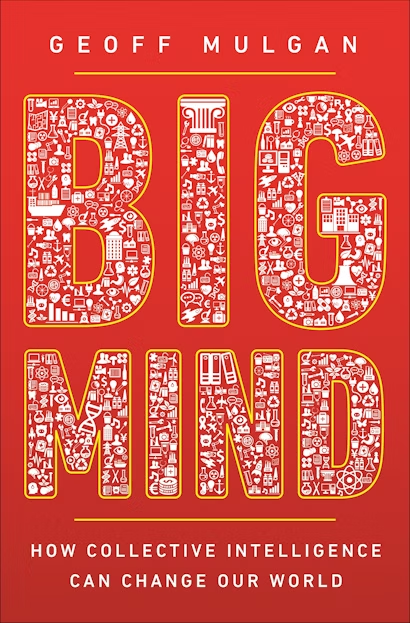
Big Mind: How Collective Intelligence Can Change Our World
Speech, gesture, behaviors, drawing, writing and other media all provide a way of recording and representing information, and knowledge. Digital technologies are the latest tools to extend our memories, and ability to analyse, synthesise and abstract from and to our experiences.
How we see the individual and collective (society) is a subject of much debate across many disciplinary fields, spanning the sciences and humanities; economics, healthcare, sociology, ethics, and philosophy. Mulgan considers as infrastructure, the measures that have emerged to support collective intelligence:
'They have evolved from physical objects (such as steel production) through aggregate concepts (like GDP and GNP) to intangibles (such as innovation indexes or measures of the value of creative industries). They have evolved from single measures of things like population to indexes (like the UN Human Development Index), and from activities to outputs and then outcomes (such as QALYs - quality adjustied life years - and DALYs - disability adjusted life years in relation to health). In all these ways, both states and societies watch themselves and recognize well-calibrated observation as the precondition for thought.' (p.52)
Using Hodges' model the focus is primarily upon individuals and teams application. Mulgan's chapter 12 (pp.145-160) on 'Problem Solving' is subtitled 'How Cities and Governments Think'. An excellent question, that was asked of me in February. How can a national government be informed of Hodges' model and its potential utility? Cities have repeatedly had to solve problems created by changes in transport, work, housing, population density, the movement of people, goods, materials, and links to rural and agricultural centers. The logistics of access to routes, ports, airports, and where to place industries efficiently (and safely)? 'City planning' is a key example of our cities thinking?
Perhaps, we need to think of mobility in a cognitive sense, and not just AI-mediated. So as we walk, run, seek access - we should take care we don't get stuck!
Individual
|
INTERPERSONAL : SCIENCES
HUMANISTIC -------------------------------------- MECHANISTIC
SOCIOLOGY : POLITICAL
|
Group
subjectivity models we use can be a trap (p.120) emotional intelligence quality | objectivity SYSTEMS energy, food, transport.. physical media & 'memory' quantity |
'Society Thinking as a System?' Chap. 16. Group - Collective | collective intelligence Patient Reported Outcome Measures (PROMs)? |
See also: 'literacy' : 'prevention' : 'service' : 'severe' : 'change'
Geoff Mulgan (2017) Big Mind: How Collective Intelligence Can Change Our World, Princeton University Press.
Image: Princeton University Press.


 orcid.org/0000-0002-0192-8965


