Hodges' Model: Welcome to the QUAD: web

Hodges' model is a conceptual framework to support reflection and critical thinking. Situated, the model can help integrate all disciplines (academic and professional). Amid news items, are posts that illustrate the scope and application of the model. A bibliography and A4 template are provided in the sidebar. Welcome to the QUAD ...

Showing posts with label web. Show all posts

Friday, August 15, 2025

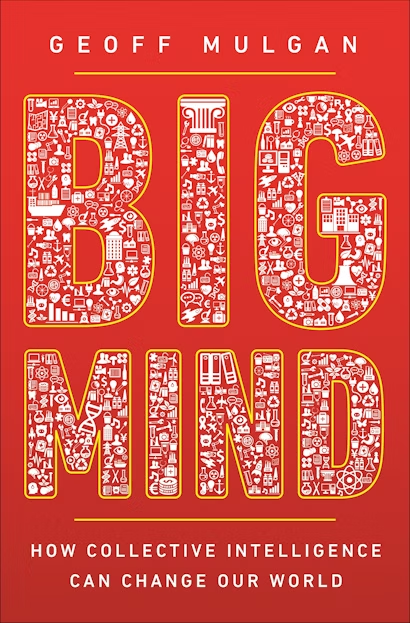
Big Mind: How Collective Intelligence Can Change Our World


It was COVID-19 that brought home to me the true significance of the 'collective' in the synonyms for group, population, polis, citizenry et al.. An integral part of Hodges' model, an individual, a person is clearly not an island.

Speech, gesture, behaviors, drawing, writing and other media all  provide a way of recording and representing information, and knowledge. Digital technologies are the latest tools to extend our memories, and ability to analyse, synthesise and abstract from and to our experiences.

How we see the individual and collective (society) is a subject of much debate across many disciplinary fields, spanning the sciences and humanities; economics, healthcare, sociology, ethics, and philosophy. Mulgan considers as infrastructure, the measures that have emerged to support collective intelligence:


'They have evolved from physical objects (such as steel production) through aggregate concepts (like GDP and GNP) to intangibles (such as innovation indexes or measures of the value of creative industries). They have evolved from single measures of things like population to indexes (like the UN Human Development Index), and from activities to outputs and then outcomes (such as QALYs - quality adjustied life years - and DALYs - disability adjusted life years in relation to health). In all these ways, both states and societies watch themselves and recognize well-calibrated observation as the precondition for thought.' (p.52)
Using Hodges' model the focus is primarily upon individuals and teams application. Mulgan's chapter 12 (pp.145-160) on 'Problem Solving' is subtitled 'How Cities and Governments Think'. An excellent question, that was asked of me in February. How can a national government be informed of Hodges' model and its potential utility? Cities have repeatedly had to solve problems created by changes in transport, work, housing, population density, the movement of people, goods, materials, and links to rural and agricultural centers. The logistics of access to routes, ports, airports, and where to place industries efficiently (and safely)? 'City planning' is a key example of our cities thinking?

Perhaps, we need to think of mobility in a cognitive sense, and not just AI-mediated. So as we walk, run, seek access - we should take care we don't get stuck!

Individual
|
      INTERPERSONAL    :     SCIENCES               
HUMANISTIC  --------------------------------------  MECHANISTIC      
 SOCIOLOGY  :    POLITICAL 
|
Group
subjectivity

models we use can be a trap (p.120)

emotional intelligence
quality
objectivity

SYSTEMS energy, food, transport..

physical media & 'memory'
quantity

'Society Thinking as a System?' Chap. 16.

Group - Collective

collective intelligence

Patient Reported Outcome Measures (PROMs)?

See also: 'literacy' : 'prevention' : 'service' : 'severe' : 'change'

Geoff Mulgan (2017) Big Mind: How Collective Intelligence Can Change Our World, Princeton University Press.

Image: Princeton University Press.

Thursday, April 24, 2025

Time to revisit Wikipedia?

Yesterday morning an email from a mail list -

https://groups.google.com/g/bytesforall_readers/about

- regards a Wikipedia entry, prompted me to look back at some personal - 'local' history. In 2006 having started this blog, I'd noticed 'models of care', and nursing theories' on Wikipedia.

I posted an entry on Wikipedia about Hodges' model.
This included the now defunct url/domain - p-jones.demon.co.uk (See below).

A request followed to remove it:

https://en.wikipedia.org/wiki/Wikipedia:Articles_for_deletion/Hodges_Health_Career_Model

I must admit there is a repetitive 'spam' quality to emails, contributions, activity on twitter and posts here. I do try to keep things relevant, in context and seek what is salient. 

Given the digital divide and ethos behind the web the 'complaints' now seem exclusive.
After a brief problem with Blogger I also wrote a blog post:

'Thanks Google ... Wiki ... oh for more time ....':

https://hodges-model.blogspot.com/2006/05/thanks-google-wiki-oh-for-more-time.html

At the time I wrote: 'I agreed the submission should be deleted - another time.' 

In writing - 'Another time...', perhaps, I should try again - or leave it to someone else?

Following up, I found that the now archived POLITICAL care/knowledge links page -

original static website 1998-2015
[ Which is itself a useful 'collection' of resources. ]

Since 2006 the bibliography for Hodges' model has grown, please see sidebar:

http://hodges-model.blogspot.com/

Created in NW England higher education in the mid 1980s Hodges' model was intended for use within post-registered nursing courses - psychiatric and learning disability nursing, health visiting and district nursing. Hodges' model, is however, universal in scope and potential application.

As no doubt occurs in other professions/disciplines, advocates for tools, resources, theories, model that may also be simple, free - open access, 'neutral', pragmatic, supportive of lifelong learning, curiosity, literacy and informatics forms can be met with internal resistance - never mind external responses:

Raskin, Jef. "Humbug: Nursing Theory". Archived from the original on July 10, 2001. Retrieved December 14, 2015. (Wikipedia).

More recently the phrase 'Nursing eats its own' has resonated. A phenomena not limited to nursing no doubt?

Friday, November 01, 2024

ERCIM News No. 139 Special Theme: "Software Security"

Dear ERCIM News reader,

A new ERCIM News issue (Number 139) is online with a special theme on Software Security. The articles in this special theme offer a comprehensive panorama of the current European research activities in software security and protection. They showcase a diverse range of research projects, highlighting the ongoing advancements and key developments of the field..

You can access the issue at https://ercim-news.ercim.eu/

This special theme was coordinated by our guest editors Sebastian Schrittwieser (University of Vienna) and Michele Ianni (University of Calabria).

Thank you for reading ERCIM News!

Please share this issue with anyone who might find it interesting. You can also support us on X (https://x.com/ercim_news) and LinkedIn. Let's keep the conversation going and share the latest updates together!

Next issue:

No. 140, January 2025
Special Theme: " Large-Scale Scientific Computing". Submissions are welcome! See call for contributions.

Announcements in this issue: Call for Proposals: Dagstuhl Seminars and Perspectives Workshops - Schloss Dagstuhl – Leibniz-Zentrum für Informatik is accepting proposals for scientific seminars/workshops in all areas of computer science.

Call for Papers: ACM Digital Threats: Research and Practice

ERCIM News is published quarterly by ERCIM, the European Research Consortium for Informatics and Mathematics. With the printed and online edition, ERCIM News reaches more than 10000 readers.
All issues published to date are available online.

About ERCIM

ERCIM - the European Research Consortium for Informatics and Mathematics - aims to foster collaborative work within the European research community and to increase cooperation with European industry. Leading European research institutes are members of ERCIM. ERCIM is the European host of W3C.

Peter Kunz                      	
ERCIM Office
+33 (0)7 68 16 50 47

2004, Route des Lucioles
BP93
F-06902 Sophia Antipolis Cedex

@ercim_news 

Saturday, February 03, 2024

Curation of posts on W2tQ

     Curation: Quote(s) to follow?
Several years ago I reviewed the blog's posts starting from post #1 in April 2006. Some posts, such as, journal calls for papers, conference announcements ... were clearly of time-limited value, even as to the degree they may document the history of ideas. The exercise also highlighted my adopted role of curator, which had not occurred to me before. 

Previously, tentatively, I tried to weigh the value of content. The value to scholarship of Hodges' model, and not wishing to sound grandiose - nursing theory (someone should - given the vacuum over the past 20-30 years?). There are person-centred items, with some that make me cringe (the personal ones, the ones premature and not quite 'fully-formed'), while others stand the test of time (I think). 

Eighteen years is not long and yet the change in several dynamic histories is very obvious, across society, politics, ecosystems, policy, education, nursing and of course technology. Many posts were deleted, others with:
  • too many links (for which you can be penalised?)
  • broken links;
  • missing images / videos;
  • typos ...

- where updated accordingly.

Revision #2 beckons in the near future, an effort to rationalise the wheat from the chaff.

It is - same old, same old regards the elephant in the room: that is, the missing new 'platform' - as it keeps reminding me.

W2tQ - "Welcome the the QUAD" - this blog.
Book image: Waterstones.

Monday, August 03, 2020

Call for papers - Rivista Italiana di Filosofia del Linguaggio - Rhetoric and Health

Call for papers - Rivista Italiana di Filosofia del Linguaggio www.rifl.unical.it

Vol. 15, N. 1/2021 Rhetoric and health

Edited by Maria Grazia Rossi

Deadline: 20.01.2021

Words can act as a pharmakon, becoming a remedy or a poison. Considering both theoretical tenets and empirical findings, we have convincing evidence on the power of language and words in changing minds and fostering behavioural change.

In the context of health, it has been underlined how the quality of communication affect (clinical) outcomes, at the individual level (on patients) and the collective or societal level (on citizens). During the current COVID-19 pandemic, it has become even more clear that such communication effect is indirect and mediated by factors such as understanding, motivation, social assistance, trust in the system, etc. Words that are well-spoken but also, obviously, well understood can have a strong impact on the quality of our lives, concerning the clinical, emotional and social spheres. This is why the proper and effective use of words should be considered as a common ethical responsibility: it is an ethical responsibility for healthcare providers that directly take care of patients, but it is also a responsibility of public and private institutions working to promote behaviours favouring the adoption of a healthier life and the building of healthier societies, respectful of other people and more environmentally friendly. What happened from a communicative point of view to justify the need to activate a state of emergency and maintain lockdown restrictions is exemplary in this respect, also to discuss the conflict between values that is pervasive in our complex and interconnected societies. Even beyond the pandemic, many examples can be mentioned to discuss the importance of both the effectiveness and quality of communication. Take as examples social campaigns and/or advertisements on health issues related to cases such as the public debate on vaccination or antibiotic resistance, the social campaigns to combat pollution or against smoking in public spaces.

However, it is not obvious to find a consensual framework to define what counts as communication of quality, even if rhetoricians investigated heavily on this issue. Not necessarily a successful communication is also desirable from an ethical perspective. Obtaining persuasion – to be able to change attitudes and/or behaviours, it is not necessarily equivalent to do it in an ethically way. For example, implicit persuasion strategies often (but not always) can be described in terms of manipulation tools attempting to manipulate people and to change their habits. Again, this applies at the individual level within the interactions between patients and healthcare providers, with therapeutic recommendations described as genuine persuasive acts. At the collective level, it also applies to public communication, including the communication made on social networks, where fake news and misinformation spread even more quickly.

The links between rhetoric and health can be therefore analysed from two different points of view. From a linguistic point of view, the main problem is to figure out which communicative strategies are effective to persuade patients (and citizens) in changing a given behaviour and/or accepting the treatment more appropriate to a specific medical condition. From an ethical point of view, the main problem is to figure out which effective communicative strategies are legitimate, meaning they respect values defining both the patient (citizen) agenda and the doctor (political/health system) agenda. The discussions concerning the frameworks of value-based medicine and patient-centered medicine fit in this context, as well as fall in this debate the current attention given to the frameworks of narrative medicine and persuasive technology (applied to telemedicine, mobile apps, social networks, etc.).

Vol. 15, N. 1/2021 of RIFL expects to explore the links between rhetoric and health, accepting papers aim at considering the role of communication in the context of health, and papers considering persuasion from an ethical point of view – at the individual level (between patients and providers) and the collective/societal one (between institutions and citizens, between media and citizens).

Papers should be theoretical or empirical. All fields will be considered (Philosophy of Language, Classic studies, Literary studies, Linguistics, Psychology, etc.) if they are relevant to discuss the persuasive and/or the ethical dimension of communication in the context of health. Papers exploring the following areas are very welcome:

  • Words and language as pharmakon
  • Communicating science, communicating the COVID-19 pandemic
  • Doctor-patient communication
  • Persuasion, argumentation and manipulation in the context of health
  • Ethic of the medical discourse and ethics for health
  • Ethical relevance and effectiveness of narrative medicine
  • Shared decision-making between patients and providers
  • Social campaigns and advertisement for health
  • Persuasive technology and health
  • Social networks and seeking information on the web
  • Value-based medicine
  • Patient-based medicine
  • Public opinion and health
  • Visual persuasion and the role of images in the context of health
  • Linguistic strategies developed for healthcare providers
  • Emotions and interpersonal relations in the context of health
  • Language and placebo effect

We call for articles in Italian, English and Portuguese. All manuscripts must be accompanied by an abstract (max 250 words), a title and 5 keywords in English.

The manuscript must be prepared using the journal template Download template. All submissions must be prepared by the author for anonymous evaluation. The name, affiliation to an institution and title of the contribution should be indicated in a file different from that which contains the text. The contribution must be sent in electronic format .doc or .rtf to segreteria.rifl AT gmail.com.

Instructions for authors:

Maximum contribution length:

40000 characters (including spaces) for articles (including bibliography and endnotes).

Deadline 20.01.2021

Publication: June 2021

CFP Full text: http://rifl.unical.it/index.php/rifl/announcement/view/23

My source:

Philos-L "The Liverpool List" is run by the Department of Philosophy, University of Liverpool https://www.liverpool.ac.uk/philosophy/philos-l/ Messages to the list are archived at http://listserv.liv.ac.uk/archives/philos-l.html. Recent posts can also be read in a Facebook group: https://www.facebook.com/PhilosL/ Follow the list on Twitter @PhilosL. Follow the Department of Philosophy @LiverpoolPhilos
Saturday, February 24, 2007

Apple Store: enter with Charles - leave with Charlie

Home from London 0030hrs. After posting that last message standing in the Apple Store I’d noticed someone standing next to me was looking at a Drupal site. We’d exchanged a few Q&As, like how to open the web browser and using the built-in camera on the iMac monitor. Me being me - I asked her about Drupal and how the h2cm site needs an update using a content or learning management system. It works out she was on the way to a Drupal meeting at the BTR internet café near Goodge St tube station. OK...!

Please believe me I don’t usually leave stores with women other than my wife (and daughter) I explained this to Charlie, whose work is on cause-based medicine; exchanging interests, names, jobs and activities we found the cafe.

I introduced myself to the organiser Robert, plus Ian, Peter and others as people arrived. Groups like this really help, just listening to what people were doing, the problems they were wrestling with and their successes proved a real inspiration. Some good advice too - what is the h2cm site about, what's it for?

Listening to Robert explain about CSS in Drupal and the Firebug plug-in for Firefox I noticed two other guys had arrived. Crikey, one was Roger who I met in October in Bath at the Ideas Factory. Four of us have kept in touch, and now Roger and I hope to meet up soon while I am working over at Leeds. In Bath there was a research proposal around bereaved relatives that needs more work, Roger as a Drupal developer is creating a site. Wish I could have stayed longer, but the last train was 2046. I've come away with some links to check up on and will definitely have a look at Drupal.

The final twist is that I only ended up in the Apple Store having gone along with Charles a colleague from the meeting. Plus my son Daniel has been talking about Apple kit. Thanks Charles, Charlie, Robert and the London Drupalers: the interconnectedness of all things…