Hodges' Model: Welcome to the QUAD: survival

Hodges' model is a conceptual framework to support reflection and critical thinking. Situated, the model can help integrate all disciplines (academic and professional). Amid news items, are posts that illustrate the scope and application of the model. A bibliography and A4 template are provided in the sidebar. Welcome to the QUAD ...

Showing posts with label survival. Show all posts

Monday, May 04, 2026

iii WCCS26: World Conference on Complex Systems 20-22nd April

Chaos
Making a New Science 
by James Gleick


When I first learned of WCCS26, I saw a connection, an affinity across the conference themes. This was reinforced when I read the final program for WCCS. Here was a home for the model, a way-point for Hodges' model. For an independent scholar, it was quite a trip to Ben Guerir, to the north of Marrakech; 13 hours (brief by global standards). It was a place to wave wildly, making use of the opportunity to present Hodges' model, to say - "Dear All, can you do anything with this?".


It is almost 40 years since I read James Gleik's, Chaos: Making a New Science. That was in Cornwall I think? Now, something more than book - a complexity conference.  

 After the first two keynotes - two panels: 

 Panel 1 - Complexity, Society & Global Challenges

▪ Carlos Álvarez Pereira - No Limits to Hope: Escaping from the unreasonable effectiveness of Modernity
▪ David Chavalarias - The Artificialization of Cultural Evolution: the Impact of Very Large Digital Infrastructures on Individuals and Society
▪ Louis Klein - Noospheric Singularity and the Mirror of Tamkeen
Panel Chair: Karima Kadaoui

These confirmed I was in the right place. Well, it was bit late if I wasn't! I was reminded of the slow movement, and how in healthcare, specifically client-nurse intereactions you had time to manage your time, that is your caseload to deliver person-centred care. I don't mean time-wasting, as in social chat, tea and custard creams either. This is what being professional is about, truly trying to make a difference - that lasts. So we worked through: What is; (science) what we understand; and (tech and law) what should be. Ecologically, we often refer to the size of our footprints. Panel one considered this individually and collectively - institutionally. Fascinating to reflect upon these themes and how modernity is stamping about in a rather chaotic way? We are seemingly power-less to stop this.

c/o Carlos Álvarez Pereira
No Limits to Hope: Escaping from the unreasonable effectiveness of Modernity

Three reports to the Club of Rome were displayed, spanning 'NO LIMITS TO LEARNING - Bridging the human gap' 1979; 'Limits and Beyond' 2022; 'NO LIMITS TO HOPE - Liberate the potential for Collective Learning' 2026. Should we be troubled, worried even, that the latest followed after a mere four years? There are of course, many reports as per the link above.

David Chavalarias - The Artificialization of Cultural Evolution: the Impact of Very Large Digital Infrastructures on Individuals and Society spoke about the beneficial and malign impacts of social media AI tools. Covid featured as might be expected. Within the sciences, what was worrying, was an innovation slowdown associated with AI, non-AI use, chartered around a central point (centroid). I believe the slide referred to:

Qianyue Hao & Fengli Xu & Yong Li & James Evans, 2026. "Artificial intelligence tools expand scientists’ impact but contract science’s focus," Nature, vol. 649(8099), pages 1237-1243, January. 

There was one slide:


Is this the demise of any efforts to achieve SOCIO-technical synergy? Even to the extent of realising benefits for the human in socio-technical systems? Did Covid not teach us anything about the informational difference technology can make? When so many technologies are muted by a virus? This is what we need: things to think about, question and critique. 

There used to be a series of A3 step-by-step oil painting magazines in the 1970s. One presented a desert campfire, clearly set in the east. I did try it, though not sure were the result is now. ... Such a scenario was presented by Louis Kleinand the Noospheric Singularity and the Tamkeen Process - Regenerative Hermeneutics, with the following reference provided:

Klein, L., & Kadaoui, K. (2024). Realising metamorphic transformation in the mirror of Tamkeen: Growing a shared understanding from co-reflected lived experiences. Systems Research and Behavioral Science, 41(5), 738–749. https://doi.org/10.1002/sres.3058 

There was much I could identify with. And, once again, I cannot continue at this pace. We have only covered (touched!) panel one. Hopefully you now have an idea of the depth of the conference programme. More however, will follow.

See also: thefifthelement.earth

Chaos - cover: https://www.goodreads.com/book/show/826080.Chaos
Saturday, January 24, 2026

Affordances


Affordance

An affordance is a perceptual pattern with survival significance. Affordances are relational, rather than objective or subjective properties. As Gibson, who coined the term, observes, 'An important fact about the affordances of the environment is that they are in a sense objective, real, and physical, unlike values and meanings, which are often supposed to be subjective, phenomenal and mental. But, actually, an affordance is neither an objective property nor a subjective property; or it is both if you like. An affordance cuts across the dichotomy of subjective-objective and helps us to understand its inadequacy' (Gibson 1979, 129). 
[Proust, Glossary, p.309.]


INDIVIDUAL
|
 INTERPERSONAL    :     SCIENCES               
HUMANISTIC --------------------------------------  MECHANISTIC      
SOCIOLOGY  :   POLITICAL 
|
GROUP

subjective

objective


Re. 'Survival significance' ...

Does this make affordances relevant in clinical education, and education more generally?

What of assisted dying in theory, policy, law and practice?

Are there any implications for the models employed by artificial intelligence - LLMs, neurosymbolic reasoning / AI (wave x)?

Source: Joëlle Proust (2013). The Philosophy of Metacognition: Mental Agency and Self-Awareness.  Oxford: Oxford University Press, Oxford. ISBN: 978-0-19-960216-2

Précis of The Philosophy of Metacognition:
https://joelleproust.org/wp-content/uploads/2012/09/pdf15.pdf 


See also: 'subject' : 'object' : 'affordance' : 'interface'

Thursday, September 04, 2025

Parity of Esteem: It's all smoke and mirrors ...

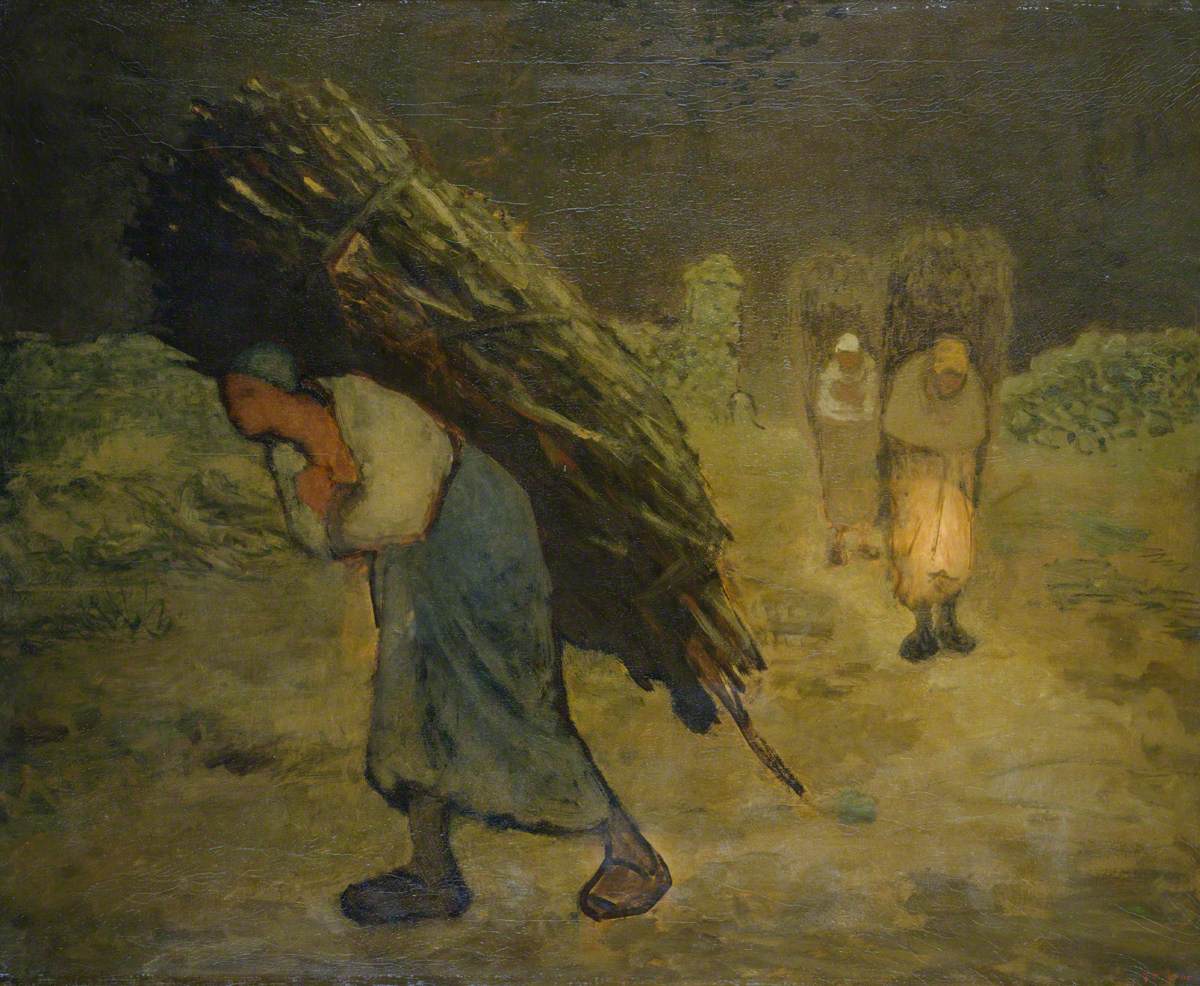
Having just visited the National Gallery and an exhibition on Millet:

https://www.nationalgallery.org.uk/exhibitions/millet-life-on-the-land

Dr Sanil Rege on twitter provided:


Seeing, and reading (again?) about 'The Faggot Gatherers' I couldn't help but see socio-economic history enacted:

'Two women are taking a short rest from gathering tree branches for sale as firewood. The older woman’s hunched back and clawed hands betray a lifetime of physical toil. The setting is the forest of Fontainebleau, south of Paris, close to the village of Barbizon. Millet was an exponent of Realism, a movement that rejected historical art and idealisation in favour of a truthful view of contemporary reality.'

Text: https://www.nationalgalleries.org/art-and-artists/232271
Winter, The Faggot Gatherers Jean-François Millet (1814–1875) National Museum Cardiff

The National Gallery's accompanying text reads:

'Three women are on their way home trom the forest of Fontainebleau. One of its entrances, the Porte aux Vaches, is visible at the back right. The staggering scale of their loads threatens to overwhelm them in their stumble homewards. The scene evokes Millet's 1851 letter to his biographer Alfred Sensier, in which he described how seeing 'a poor figure laden with a faggot reminded him of the constant fatigue of people's lives.
While the painting is unfinished, the elemental figures are typical of Millet's vork. The extreme simplification of their forms results in austere silhouettes.'

Mental illness has always been a facet of humanity, evidence of trephination from prehistoric times and across cultures and geographies bears testimony to the mind - body divide. Life was brutish physically too. What chance did the weakest stand? If, that is a broken bone: you could be left behind? But perhaps we underestimate the knowledge and experience of our ancient ancestors. Knowledge gained and passed orally, culturally, even before written history. Perhaps too, we struggle to understand how early humanity expressed itself beyond the big-stick of nature and the struggle for survival as the hominids that led to 'us' were winnowed down?

Even as recent as the 19th century life was hard. As the notes above attest, Millet's work seeks to record the sheer physicality of labour, even as the industrial age emerged. The advent of the industrial revolution brought its own pressures and privations, as pastoral life is replaced with change work at home (spinning cotton) to urban and factory growth. 

Severe mental illness would have been institutionalised in poor houses, religious and charitable organisations. Parity of esteem is grounded, to some extent in the questions: "What happened to you?", or "How are you feeling today?" In Millet's work the physical cost and strain stands out. While in the L'Angelus there is debate about prayer, or grief. What is visible usually speaks first, and stands for itself. This is why self-awareness, reflection, critical thinking, observational and interpersonal skills are important; and why mental health nursing calls for specific knowledge and skills. And, in psychiatry too, even when the same is contested.

Image source: Oil on carvas Lent by Amgueddfa Cymry - Museum Wales. Bequeathed by Gwendoline Davies in 1952.

Saturday, October 19, 2024

Nobel Peace Prize 2024


'The Norwegian Nobel Committee has decided to award the Nobel Peace Prize for 2024 to the Japanese organisation Nihon Hidankyo. This grassroots movement of atomic bomb survivors from Hiroshima and Nagasaki, also known as Hibakusha, is receiving the Peace Prize for its efforts to achieve a world free of nuclear weapons and for demonstrating through witness testimony that nuclear weapons must never be used again.

In response to the atomic bomb attacks of August 1945, a global movement arose whose members have worked tirelessly to raise awareness about the catastrophic humanitarian consequences of using nuclear weapons. Gradually, a powerful international norm developed, stigmatising the use of nuclear weapons as morally unacceptable. This norm has become known as “the nuclear taboo”.

The testimony of the Hibakusha – the survivors of Hiroshima and Nagasaki – is unique in this larger context. ...'


Press release. NobelPrize.org. Nobel Prize Outreach AB 2024. Sat. 19 Oct 2024. <https://www.nobelprize.org/prizes/peace/2024/press-release/>


Previously: Nobel Prize :: peace

1989 SHADES OF GREY, Computer Aided Learning program, BBC Micro. Simulation of nuclear weapons, Based on Fanchi, J. Local effects of nuclear weapons, BYTE, Volume 11. Issue 13. Dec., pp. 143–155. Computer Aided Learning program, BBC Micro, published by Open Software Limited.
https://hodges-model.blogspot.com/2024/03/jones-publications-list.html

Wednesday, October 11, 2023

'System 1 and 2 Modes of Thinking' in Hodges' model

 System 1 - 

"operates automatically and quickly,
with little or no effort and no sense of voluntary control. 

 System 2 - 

allocates attention to the effortful mental activities that demand it, including complex computations. The operations of System 2 are often associated with the subjective experience of agency, choice, and concentration." pp. 20-21.

"When we think of ourselves, we identify with System 2, the conscious, reasoning self that has beliefs, makes choices, and decides what to think about and what to do. Although System 2 believes itself to be where the action is, the automatic System 1 is the hero of the book. I describe System 1 as effortlessly originating impressions and feelings that are the main sources of the explicit beliefs and deliberate choices of System 2. The automatic operations of System 1 generate surprisingly complex patterns of ideas, but only the slower System 2 can construct thoughts in an orderly series of steps. I also describe circumstances in which System 2 takes over, overruling the freewheeling impulses and associations of System 1. You will be invited to think of the two systems as agents with their individual abilities, limitations and functions." p.21.


INDIVIDUAL
|
     INTERPERSONAL    :     SCIENCES               
HUMANISTIC --------------------------------------  MECHANISTIC      
SOCIOLOGY  :   POLITICAL 
|
GROUP

System 2:
  • Brace for the starter gun in a race.
  • Focus attention on the clowns in the circus.
  • Focus on the voice of a particular person in a crowded and noisy room.
  • Look for a woman with white hair.
  • Search memory to identify a surprising sound.
  • Maintain a faster walking speed than is natural for you.
  • Monitor the appropriateness of your behavior in a social situation.
  • Count the occurrences of the letter a in a page of text.
  • Tell someone your phone number.
  • Park in a narrow space (for most people except garage attendants).
  • Compare two washing machines for overall value.
  • Fill out a tax form.
  • Check the validity of a complex logical argument. p.22.

System 1:
  • Detect that one object is more distant than another.
  • Orientate to the source of a sudden sound.
  • Complete the phrase "bread and . . .".
  • Make a "disgust face" when shown a horrible picture.
  • Detect hostility in a voice.
  • Answer to 2 + 2 = ?
  • Read words on large billboards.
  • Drive a car on an empty road.
  • Find a strong move in chess (if you are a chess master).
  • Understand simple sentences.
  • Recognize that a "meek and tidy soul with a passion for detail" resembles an occupational stereotype. p.21.


Kahneman, D. (2011). Thinking, fast and slow. London: Penguin Books.

See also:
https://thedecisionlab.com/reference-guide/philosophy/system-1-and-system-2-thinking

Friday, July 21, 2023

Cognitive and Affective Empathy c/o Simon Baron-Cohen

   New Scientist 3311
"At the bottom, Nicholas Conard, archaeologist and director of the nearby museum in Blaubeuren, Germany, pointed to a layer of rock. 'Right here is 20,000 years ago,' he said. Then he pointed about a metre lower. 'Here, we are at 40,000 years ago.' 
I was in awe, suddenly aware that I was standing where our early human ancestors lived and breathed so long ago. But it was what they invented that inspired my trip. Hohle Fels is where, in 2008, Conard and his colleagues discovered the earliest known musical instrument, a flute carved from a vulture bone that is thought to be about 40,000 years old.

It is the product of what I argue are parallel revolutions in human cognition. In my career studying the human brain through the lens of understanding autism, I have devoted a lot of time to understanding empathy, its role in our evolution and how it still underpins human interaction today. But around the same time that the brain changes arose that enabled us to use empathy, another equally critical set of changes took place: the evolution of a pattern-seeking brain network, what I refer to as the systemising mechanism, that provides the foundation for human invention - including that of musical instruments." p.34.
INDIVIDUAL
|
     INTERPERSONAL    :     SCIENCES               
HUMANISTIC --------------------------------------  MECHANISTIC      
SOCIOLOGY  :   POLITICAL 
|
GROUP

"One of these circuits, the empathy circuit, enabled a raft of new behaviours, including the ability to deceive others, teaching, self-reflection, social "chess" and flexible communication that relied on shared reference, including storytelling. These explain why modern humans could make stealth weapons and jewellery: we were keeping track of what others might think, know, intend, feel, want and believe." p.36.

COGNITIVE EMPATHY
theory of mind

AFFECTIVE EMPATHY

"- the drive to respond to another person's mental state with an appropriate emotion." p.36.


Baron-Cohen, S. (2020) Our Restless Minds, New Scientist, 248: 3311, pp.34-39.

Autism Research Centre, Cambridge University

The Pattern Seekers, Simon Baron-Cohen.

Friday, December 30, 2022

C+nto

"The female body is a political space."

 INDIVIDUAL
|
 INTERPERSONAL    :     SCIENCES               
HUMANISTIC --------------------------------------  MECHANISTIC      
SOCIOLOGY  :   POLITICAL 
|
GROUP

My - MIND

C+nto
My - Body

& Othered Poems

Art / Arts :: [Counter] Culture

Othered Minds :: Othered Bodies

C+anto


Joelle Taylor. C+nto & Othered Poems. Saqi Books. April 2021 Paperback 128pp 9781908906489