Parity of Esteem: It's all smoke and mirrors ...
Having just visited the National Gallery and an exhibition on Millet:
Dr Sanil Rege on twitter provided:
🧵Psychiatry as a Scapegoat-And the Mirror We’d Rather Not Face 🚨1/11
— Dr Sanil Rege FRANZCP | MRCPsych (@sanilrege) September 2, 2025
‘Psychiatry isn’t real medicine.’
‘Psychiatry medicalises normal life.’
‘Psychiatry is pseudoscience.’
‘Psychiatry is dangerous.’
‘Psychiatry is built on lies’
⁰Psychiatry is the perfect object of… https://t.co/1XMdwtH5Nz pic.twitter.com/HQpkMvtxfm
Seeing, and reading (again?) about 'The Faggot Gatherers' I couldn't help but see socio-economic history enacted:
'Two women are taking a short rest from gathering tree branches for sale as firewood. The older woman’s hunched back and clawed hands betray a lifetime of physical toil. The setting is the forest of Fontainebleau, south of Paris, close to the village of Barbizon. Millet was an exponent of Realism, a movement that rejected historical art and idealisation in favour of a truthful view of contemporary reality.'
Text: https://www.nationalgalleries.org/art-and-artists/232271
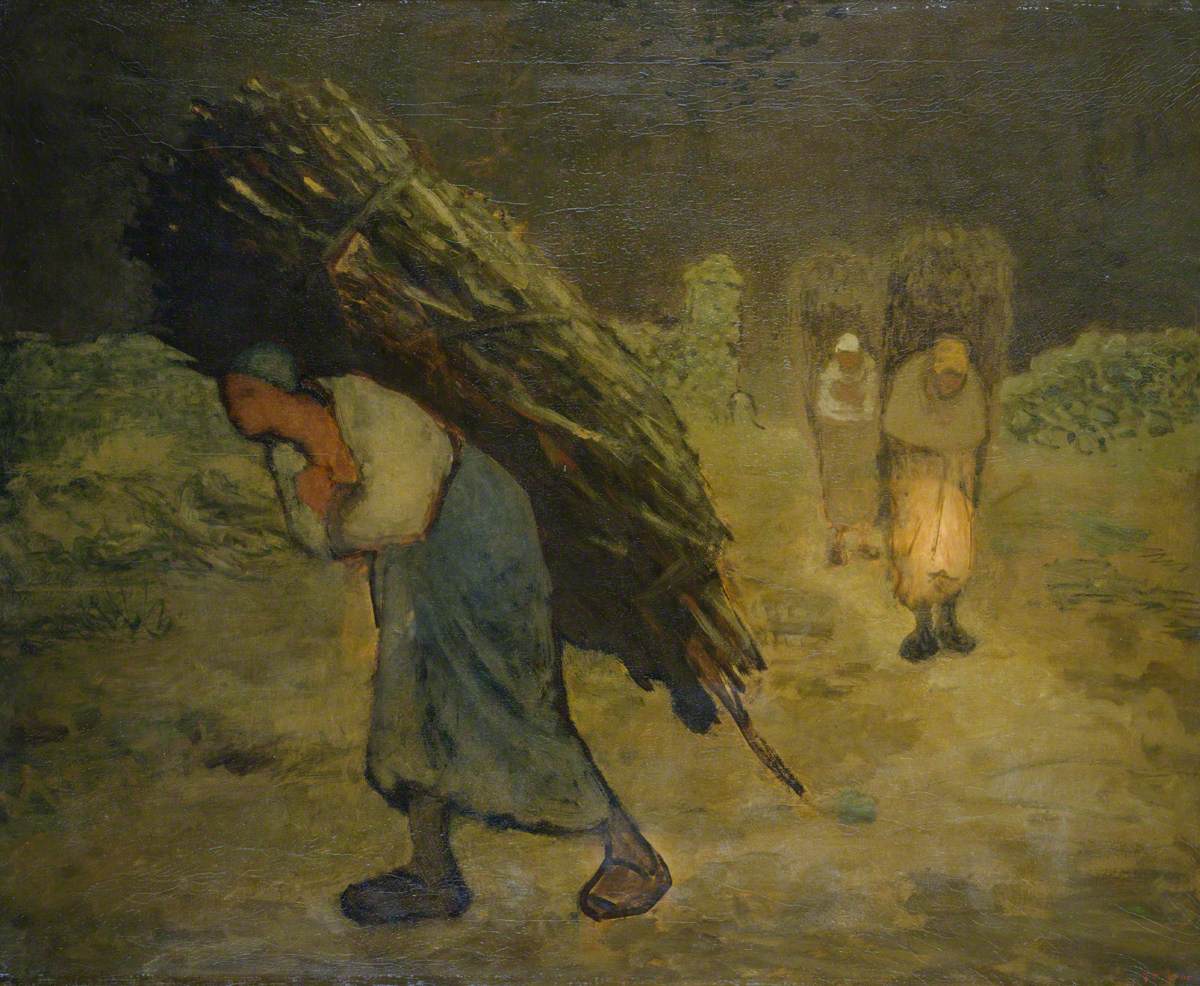 |
| Winter, The Faggot Gatherers Jean-François Millet (1814–1875) National Museum Cardiff |
The National Gallery's accompanying text reads:
'Three women are on their way home trom the forest of Fontainebleau. One of its entrances, the Porte aux Vaches, is visible at the back right. The staggering scale of their loads threatens to overwhelm them in their stumble homewards. The scene evokes Millet's 1851 letter to his biographer Alfred Sensier, in which he described how seeing 'a poor figure laden with a faggot reminded him of the constant fatigue of people's lives.
While the painting is unfinished, the elemental figures are typical of Millet's vork. The extreme simplification of their forms results in austere silhouettes.'
Mental illness has always been a facet of humanity, evidence of trephination from prehistoric times and across cultures and geographies bears testimony to the mind - body divide. Life was brutish physically too. What chance did the weakest stand? If, that is a broken bone: you could be left behind? But perhaps we underestimate the knowledge and experience of our ancient ancestors. Knowledge gained and passed orally, culturally, even before written history. Perhaps too, we struggle to understand how early humanity expressed itself beyond the big-stick of nature and the struggle for survival as the hominids that led to 'us' were winnowed down?
Even as recent as the 19th century life was hard. As the notes above attest, Millet's work seeks to record the sheer physicality of labour, even as the industrial age emerged. The advent of the industrial revolution brought its own pressures and privations, as pastoral life is replaced with change work at home (spinning cotton) to urban and factory growth.
Severe mental illness would have been institutionalised in poor houses, religious and charitable organisations. Parity of esteem is grounded, to some extent in the questions: "What happened to you?", or "How are you feeling today?" In Millet's work the physical cost and strain stands out. While in the L'Angelus there is debate about prayer, or grief. What is visible usually speaks first, and stands for itself. This is why self-awareness, reflection, critical thinking, observational and interpersonal skills are important; and why mental health nursing calls for specific knowledge and skills. And, in psychiatry too, even when the same is contested.
Image source: Oil on carvas Lent by Amgueddfa Cymry - Museum Wales. Bequeathed by Gwendoline Davies in 1952.


 orcid.org/0000-0002-0192-8965

