Hodges' Model: Welcome to the QUAD: uncertainty

Hodges' model is a conceptual framework to support reflection and critical thinking. Situated, the model can help integrate all disciplines (academic and professional). Amid news items, are posts that illustrate the scope and application of the model. A bibliography and A4 template are provided in the sidebar. Welcome to the QUAD ...

Showing posts with label uncertainty. Show all posts

Wednesday, August 05, 2026

"It's an equation Jim, but not as we know it!"

Silver (2013) in “The Signal and the Noise” refers to Drake’s equation, which has fascinated me since my teens. It is a formula that provides a framework for predicting the number of intelligent extraterrestrial species in the galaxy. Due to the high number of parameters and uncertainties that make up Drake's equation, Silver describes how the extreme range of results depend on the initial ‘inputs’. Given the variables presented they are estimates. I made a connection to Drake's work through BBC BASIC programming:

'The Nursing Process'
'Computer-Aided Patient Assessment'
'Blood Groups'
'Shades of Grey'

As time went on the simplicity of 'The NP' gave way to DIM arrays, which can provide data structures, and DEF PROC and DEF FN with parameters. 

The evidence for the elements of Drake's equation has made great strides since the 1990s. Despite the remaining uncertainties, Silver notes that Drake's equation has provided a useful lens for astronomers, plus - philosophers and the lay-person to think about life, the universe and everything.

Is there an implicit theory – an equation – in Hodges’ model?

See also: BBC BASIC

Previously: 'Sagan' : 'SETI' ; 'math' : 'Publication list (2024)'

Nate Silver (2013). “The Signal and the Noise”, Notes 89, London: Penguin. p.488.

Title Ack. the original is often misattributed: https://www.youtube.com/watch?v=FCARADb9asE

Thursday, January 29, 2026

Paper: 'Intra-Personal Compromises'

ARGUMENTA

Issue 21

November 2025

https://www.argumenta.org/issue/issue-21/

Intra-Personal Compromises  

Juha Räikkä

University of Turku 

Abstract

The most usual philosophical questions about compromises have been those related to inter-personal compromises, in which parties are compromising with each other, rather than intra-personal compromises, which are often psychologically demanding. This paper aims to fill the gap in the discussion and briefly analyze the nature of intra-personal compromises. The starting point here is the assumption that inter-personal compromises cannot be made without intra-personal compromises, although intra-personal compromises are common even when they are not linked to inter-personal compromises. The main question addressed in the paper is whether the intra-personal compromises that we accept in all kinds of contexts are similar to those intra-personal compromises that we make when we compromise with others. I argue that they are more or less similar, although there are also some distinctive features in intra-personal compromises that are involved in inter-personal compromises. When a person makes an intra-personal compromise in the context of an inter-personal compromise she is forced to act under uncertainty, as she cannot know beforehand what options are really available. The price of the compromise is known only after the negotiation process. This is a special feature, or so I will claim. 

Keywords: Inter-personal compromise, Intra-personal compromise, Bargaining, Uncertainty. 

Räikkä, R. 2025, “Intra-Personal Compromises”, Argumenta 11, 1, 149–162.
https://www.argumenta.org/wp-content/uploads/2026/01/Argumenta-11-1-Juha-Raikka-Intra-Personal-Compromises.pdf
 

For a long time I have viewed the INTERPERSONAL domain of Hodges' model as being concurrent, interchangable, working as the INTRAPERSONAL domain. This paper is a helpful discovery, c/o Philos-L "The Liverpool List" which is run by the Department of Philosophy, University of Liverpool https://www.liverpool.ac.uk/philosophy/philos-l/

There are several examples/cases discussed. While brief, a HOSPITAL CEO example is relevant to studies for Hodges' model, as with, a CRITICAL CITIZEN:

'The above examples are rather similar but have small differences. In the ‘Judge’ example, the overriding principle is based on the importance of institutional rules. In the ‘Hospital CEO’ example, the main concern and the strongest value is pragmatic. In the ‘Critical Citizen’ example, the question is about omission rather than action.' p.157. 

The observation about the CEO speaks volumes, across public and private health sectors (and social care?). There is no discussion of reflection, reflexivity, or critical thinking explicitly. But individual, and collective distinctions, and impacts are explored, especially responsibility and mutuality. Three arguments precede concluding remarks. Further progress might be made exploring and relating these to the concepts of bargaining, uncertainty and compromise through Hodges' model and identity: both person-al and organisational?

Thursday, September 04, 2025

Parity of Esteem: It's all smoke and mirrors ...

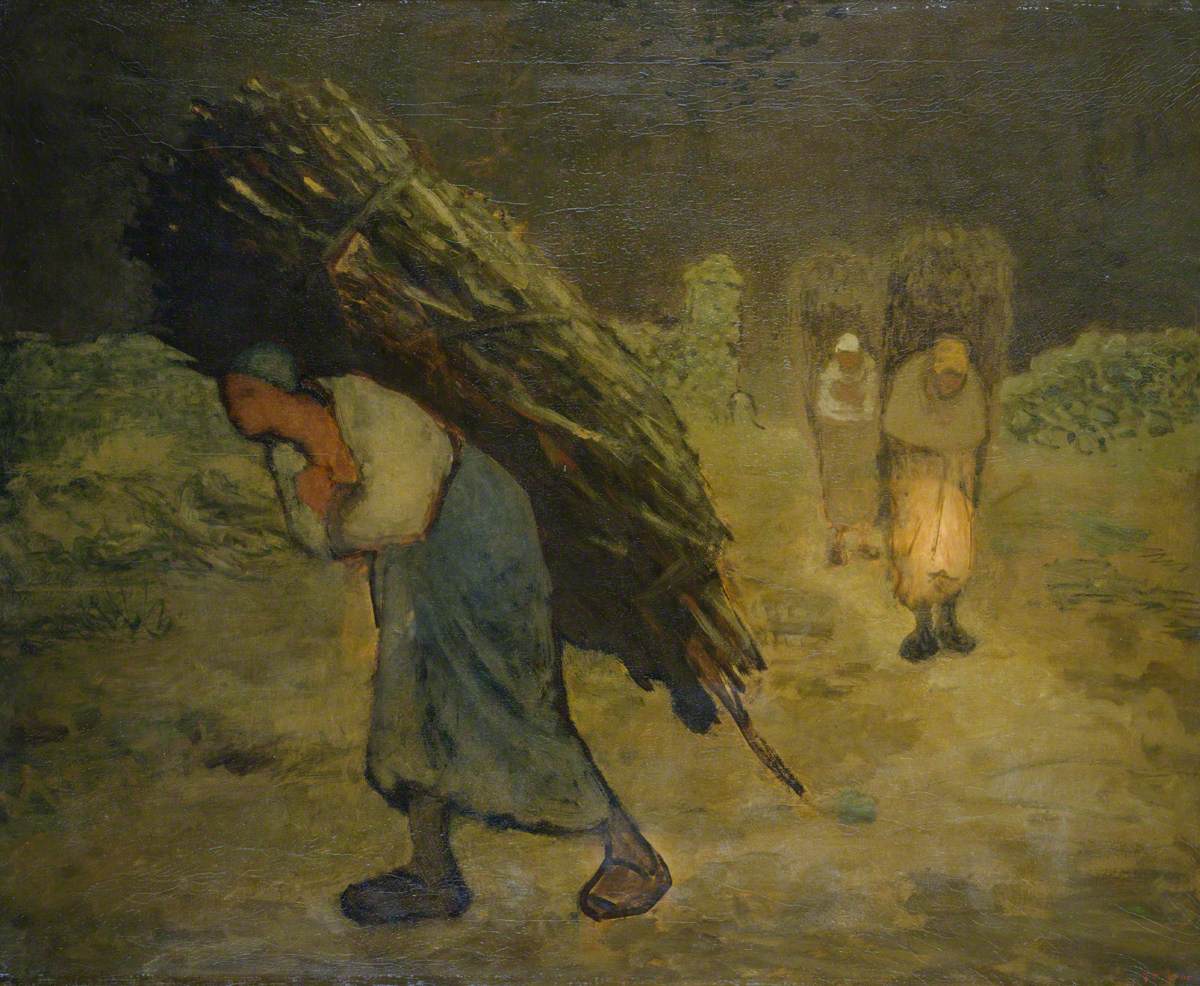
Having just visited the National Gallery and an exhibition on Millet:

https://www.nationalgallery.org.uk/exhibitions/millet-life-on-the-land

Dr Sanil Rege on twitter provided:


Seeing, and reading (again?) about 'The Faggot Gatherers' I couldn't help but see socio-economic history enacted:

'Two women are taking a short rest from gathering tree branches for sale as firewood. The older woman’s hunched back and clawed hands betray a lifetime of physical toil. The setting is the forest of Fontainebleau, south of Paris, close to the village of Barbizon. Millet was an exponent of Realism, a movement that rejected historical art and idealisation in favour of a truthful view of contemporary reality.'

Text: https://www.nationalgalleries.org/art-and-artists/232271
Winter, The Faggot Gatherers Jean-François Millet (1814–1875) National Museum Cardiff

The National Gallery's accompanying text reads:

'Three women are on their way home trom the forest of Fontainebleau. One of its entrances, the Porte aux Vaches, is visible at the back right. The staggering scale of their loads threatens to overwhelm them in their stumble homewards. The scene evokes Millet's 1851 letter to his biographer Alfred Sensier, in which he described how seeing 'a poor figure laden with a faggot reminded him of the constant fatigue of people's lives.
While the painting is unfinished, the elemental figures are typical of Millet's vork. The extreme simplification of their forms results in austere silhouettes.'

Mental illness has always been a facet of humanity, evidence of trephination from prehistoric times and across cultures and geographies bears testimony to the mind - body divide. Life was brutish physically too. What chance did the weakest stand? If, that is a broken bone: you could be left behind? But perhaps we underestimate the knowledge and experience of our ancient ancestors. Knowledge gained and passed orally, culturally, even before written history. Perhaps too, we struggle to understand how early humanity expressed itself beyond the big-stick of nature and the struggle for survival as the hominids that led to 'us' were winnowed down?

Even as recent as the 19th century life was hard. As the notes above attest, Millet's work seeks to record the sheer physicality of labour, even as the industrial age emerged. The advent of the industrial revolution brought its own pressures and privations, as pastoral life is replaced with change work at home (spinning cotton) to urban and factory growth. 

Severe mental illness would have been institutionalised in poor houses, religious and charitable organisations. Parity of esteem is grounded, to some extent in the questions: "What happened to you?", or "How are you feeling today?" In Millet's work the physical cost and strain stands out. While in the L'Angelus there is debate about prayer, or grief. What is visible usually speaks first, and stands for itself. This is why self-awareness, reflection, critical thinking, observational and interpersonal skills are important; and why mental health nursing calls for specific knowledge and skills. And, in psychiatry too, even when the same is contested.

Image source: Oil on carvas Lent by Amgueddfa Cymry - Museum Wales. Bequeathed by Gwendoline Davies in 1952.

Saturday, August 09, 2025

Richardson et al. 'The entities enabling scientific fraud at scale are large, resilient, and growing rapidly'

Abstract

'Science is characterized by collaboration and cooperation, but also by uncertainty, competition, and inequality. While there has always been some concern that these pressures may compel some to defect from the scientific research ethos—i.e., fail to make genuine contributions to the production of knowledge or to the training of an expert workforce—the focus has largely been on the actions of lone individuals. Recently, however, reports of coordinated scientific fraud activities have increased. Some suggest that the ease of communication provided by the internet and open-access publishing have created the conditions for the emergence of entities—paper mills (i.e., sellers of mass-produced low quality and fabricated research), brokers (i.e., conduits between producers and publishers of fraudulent research), predatory journals, who do not conduct any quality controls on submissions—that facilitate systematic scientific fraud. Here, we demonstrate through case studies that i) individuals have cooperated to publish papers that were eventually retracted in a number of journals, ii) brokers have enabled publication in targeted journals at scale, and iii), within a field of science, not all subfields are equally targeted for scientific fraud. Our results reveal some of the strategies that enable the entities promoting scientific fraud to evade interventions. Our final analysis suggests that this ability to evade interventions is enabling the number of fraudulent publications to grow at a rate far outpacing that of legitimate science.'


R.A.K. Richardson, S.S. Hong, J.A. Byrne, T. Stoeger, & L.A.N. Amaral, The entities enabling scientific fraud at scale are large, resilient, and growing rapidly, Proc. Natl. Acad. Sci. U.S.A. 122 (32) e2420092122, https://doi.org/10.1073/pnas.2420092122 (2025).
https://www.pnas.org/doi/10.1073/pnas.2420092122


My source: The Economist, 9th August 2025. 
https://www.economist.com/science-and-technology/2025/08/06/fraudulent-scientific-papers-are-booming

Friday, December 06, 2024

Int. Conference on Improving University Teaching 2025


Redefining Education:

Navigating Sustainability and Innovation in a VUCA World

In a world increasingly subject to volatility, uncertainty, complexity, and ambiguity (VUCA) the goal of sustainability is aspirational, yet elusive.  A UN report published in 2024 notes that “intensifying, interconnected challenges continue to endanger the realization” of the seventeen sustainable development goals identified by the UN Sustainability Conference twelve years ago in Rio de Janeiro.  This is especially true in education, which the report correctly terms “the bedrock of sustainable development.”   It notes the negative effects of the COVID epidemic, regional conflicts, climate shock, and economic turmoil and paints a picture of a planet struggling to make progress towards them. While the big picture may be less than perfect, there is still much cause for hope, as we strive towards a better future.

Against this backdrop, the International Conference on Improving University Teaching seeks to address the challenge of sustainability, equity, and innovation as they affect higher education. In particular, we are exploring how to prepare students for a “VUCA world” in which they will have to contend with multiple challenges, while at the same time ensuring their wellbeing—and that of all academic staff—in the present. By definition, a future subject to uncertainty and ambiguity will require flexibility and adaptability on the part of students. ..

Continued ...

Previously: IUT, VUCA

Thursday, December 21, 2023

'Freedom of belief' - really?

"We have seen that our beliefs are tightly coupled to the structure of language and to the apparent structure of the world. Our "freedom of belief," if it exists at all, is minimal. Is a person really to free to believe a proposition for which he has no evidence? No. Evidence (whether sensory or logical) is the only thing that suggests that a given belief is really about the world in the first place. We have names for people who have many beliefs for which there is no rational justification. When their beliefs are extremely common we call them "religious"; otherwise, they are likely to be called "mad," "psychotic," or "delusional." pp.71-72.

INDIVIDUAL
  |
     INTERPERSONAL    :     SCIENCES               
HUMANISTIC --------------------------------------  MECHANISTIC      
SOCIOLOGY  :   POLITICAL 
|
GROUP

my freedom of belief
senses - logic
my belief - beliefs
belief hygiene
my mental health state
continuum model -
 of mental health-illness

freedom of movement
senses logic
physical reality
personal hygiene

culture
organised religions
our beliefs


theocracy
secular states
Mental health law

Tuesday, September 19, 2023

Health information & 7th Global Alcohol Policy Conference

Politicians -
GIVE HEALTH LITERACY A CHANCE!


INDIVIDUAL
|
     INTERPERSONAL    :     SCIENCES               
HUMANISTIC --------------------------------------  MECHANISTIC      
SOCIOLOGY  :   POLITICAL 
|
GROUP
cognitive access, basic literacy
'legibility', digital access
PUBLIC - MENTAL - HEALTH

Society
Communities
Most vulnerable groups
Digital divide

"Why are alcohol companies pushing for QR codes on labels? Well, which of these two labelling methods actually shows the risk of alcohol consumption, 1 or 2? QR codes are a way for producers to say they are informing consumers, without doing so." @InstAlcStud

economic access
Health Information For All
POLICY
7th Global Alcohol Policy Conf.
Alcohol Taxes - False economy?


My source: https://x.com/InstAlcStud/status/1703658612109742578?s=20

Friday, October 01, 2021

Agnotology - (a) space for ignorance?

 Chapter 1 of Agnotology (Proctor, 2008) begins with two quotations:

“We are often unaware of the scope and structure of our ignorance. Ignorance
is not just a blank space on a person's mental map. It has contours and coher-
ence, and for all I know rules of operation as well. So as a corollary to writing
about what we know, maybe we should add getting familiar with our ignorance.”
Thomas Pynchon, 1984


“Doubt is our product.”
Brown & Williamson Tobacco Company, internal memo, 1969


The discovery of this book and its title, was quite an event.

Proctor, Robert N. and Schiebinger, Londa (Eds.). AGNOTOLOGY The Making And Unmaking Of Ignorance. (2008): Stanford University Press, Stanford, California.


Previously on W2tQ:

'ignorance'

'smoking'

Monday, August 26, 2019

"IV Square" by Sandra Blow RA.


Sandra Blow RA. IV Square (2004)


Screenprint on paper. The Golder - Thompson Gift (2010) (c) The Estate of Sandra Blow

A second print from this issue of Printmaking Today, in which I can see the need for the 'Public Understanding of Science' amid great uncertainty.


My source:
Simmons, R. A Collection of Collections, Printmaking Today, Spring 2019, Volume 28. pp.36-37.


Saturday, August 10, 2019

Threshold Concepts: Reflection on chaos, complexity and AI

Here are the reflections on the photograph posted in June following the Conference on Threshold Concepts:


Chaos can occur in any one ... or all of the four domains of Hodges' model. The same applies to order.

http://homepages.math.uic.edu/~kjerland/Lorenz/lorenz_attractor.html


This is a characteristic of chaos and chaotic systems.

Chaos can arise at any time: in the here and now, being sown now for the future (climate change?), or springing from the past, as in pleasurable, or traumatic memories.

While the Lorenz attractor and other graphical examples are grounded in mathematics and science, in #h2cm we need to imagine the butterfly diagram extended across and simultaneously at work across the models four domains.


individual - self
|
INTERPERSONAL : SCIENCES
humanistic ----------------------------------------------- mechanistic
SOCIOLOGY : POLITICAL
|
group- population


Even in instances of riot and anarchy there will be pockets of 'order', but would you would want to take your chance of finding one? Amid talk of being in the wrong place, at wrong time; to what extent is this dependent upon who we associate with socially? Or, what we believe is the political course we might, should, will, must follow?

The context of Prof. Land's slide is learning and decision making. As a 'political' matter when chaos occurs, how is it manifested in disintegration? Can we hear the 'gears grind'? What exactly goes awry? Is it the processes as in the timing, leadership and with it responsibility?

The slide is powerful in giving support, to clinical decision-making as a context in which complex decision making is very common and simultaneously encompasses political, rationale and judgemental (ethical) forms of decision making.

Hodges' model can also facilitate recognition of differentiation between relational chaos and the explicit state of decision-making. For example, a healthcare practitioner and client/patient/carer may have achieved empathy and rapport, but the complex demands of the clinical decision still presents a great deal of uncertainty. Alternately in instances when the relationship is being forged then the communications: verbal and non-verbal (and a function of the clinical team) can be a confounding factor if not negotiated professionally (and in socially acceptable terms by members of the public). Another useful perspective is Personal and Public Involvement (PPI) at what point is this achieved? What are the thresholds in the public's learning, as they engage and are engaged if they are not to label the initiative as a checkbox exercise? Again Hodges' model can help us to reflect upon the scope and complexity of such situations.


AI, artificial intelligence was mentioned (I'm sure?) in the presentation and the benefits of AI in healthcare are already being realised. This is tempered with the requirement for AI systems to be able to explain their 'reasoning', rather than this be taken at face value. As AI takes on tasks that include initial automated screening of job applications that include videos then another dimension of learning is presented to students.

Health and justice is by default complex. Consider, the task of being seen by society that justice is duly served and doing so with a duty of care and welfare of the prisoners. To this, we can add the aspiration of custody being rehabilitative. For a prisoner, even on remand, there will be times when health needs and patiency must be recognised. When a long-term prisoner becomes chronically ill, this can present a major challenge to law-makers, prisoners, their families, the healthcare team and society.

individual - self
|
INTERPERSONAL : SCIENCES
humanistic ----------------------------------------------- mechanistic
SOCIOLOGY : POLITICAL
|
group- population

Identity (use of name, touch ...)
(My) PURPOSE
Beliefs, Personal values
 Safety (personal) Thresholds
Trigger warning
Critical - critique 
not taking it personally


PROCESS
[Space] - physical &
degrees of freedom in decision making
constraints
Rationale*
Evidence
Theory
Quantitative Research


Qualitative Research


Patient : Healthcare practitioner
decision making
 PRACTICE
Critical - agreeing to disagree

Schism - 'distance'

Consensus (bridge building)
 Autonomy (in decision making)
Administration / Bureaucracy
Professionalism
Anti- 'X' movements
Riot and anarchy
safety (POLICY)
Critical - political


*While placed within the sciences domain, 'rationale' can be evidenced physically, psychologically,  politically and socially.  It is this that forces us to acknowledge the several edges of chaos.

See also:
Inaugural Scottish Threshold Concepts Conference: TCs in Action [i]


Images:
http://homepages.math.uic.edu/~kjerland/Lorenz/lorenz_attractor.html

https://www.thingiverse.com/thing:3774260/comments
(Original image)

Sunday, June 30, 2019

Inaugural Scottish Threshold Concepts Conference: TCs in Action [i]


Never having been to Dundee but being keen on Threshold Concepts for reasons to follow, I headed North stopping off at Glasgow the day before.

Some thought had clearly gone into the 'conference pack' which included a local comic , marmalade and a caramel biscuit (appreciatively consumed while writing this!).

[Earlier in the week, on twitter someone had pointed to the paper and pens laid on all the chairs in Manchester it appeared - questioning the sustainability. The organisers duly took note and a message for all.]

The first keynote was:

Threshold Concepts on the Edge by
Emeritus Professor Ray Land, Durham University and subtitled: 'Learning, risk and difficulty'.

As an initial co-author of the work on Threshold Concepts, Prof. Land is engaging and facilitating further research. The references flowed and were absorbed by a ready audience taking photos and notes. Next time, if there is one, I may rely on notes more. The presentations should be made available. The etymology of our language(s), liminality, complexity the experience of learning negotiated through variously safe and unsafe spaces were explored. As a concept itself threshold might indicate edge(s) and boundaries, referring also to knowl-edge. The presentation brought home the need for balance in education. Balance that in a way cannot be attained if learning is to occur? What should students be exposed to - in drama, literature as preparation for a [health] career, a life?

Through Timmermans (2010, Changing Our Minds) Prof. Land highlighted how even knowing something presents limits. I read this as the context internal or external calling into question this knowing. Complexity and chaos were inevitably added to this mix.

I thought of lacuna here. There are gaps in knowledge, but a nearby concept might just afford a stepping stone. This ability to 'step' begs a question. In what can become the domestic chaos of  unsupported care for people with dementia, I frequently have to empathise with the carers, relatives and close friends. These individuals will encounter 'gaps' appearing in their world. How they perceive, experience, interact and recall it. I temper this account depending on the situation. The changes to perception it is thought can be quite marked and disturbing, contributing to agitation. This is an edge fragmenting.

'Edges' are evident in Hodges' model:

Most obviously where the model's axes demarcate the care (knowledge) domains and additionally:

Sciences: Skin, touch, (surgical-knife) edge, cognitive map (home, locality), location - built environment, scientific thresholds as in blood tests, visual - auditory ... cues*
Intra- Interpersonally: identity, personal belief systems and schema, personal ethics, biases and prejudices (which may go 'unchallenged'), empathy - rapport, transference, *triggers perceived, incisive argument.
Sociology: Personal space, (Second...) language skills, breaking bad news, intimacy, nuclear - extended families.
Political: Negotiation, cross-party, consensus, debt, criminal activity, public disorder

I've some reflections on the image below to follow.


The citations of Waldrop (1992, p.12) and Zygmunt Bauman (2000) dissolving, turbulence and 'liquid modernity', prompts me to think of students [ and others ;-) ] getting stuck in minima and recall the work of Serres on Lucretius and non-linear dynamics. Prof. Land noted much more - supplantive and lost learning. We learn that the safety of education is unsurprisingly related to education (and its systems) becoming stronger. As it does there is a price, since learning involves weakness (Gert Biesta, 2013). The active debate on trigger-warnings, safe spaces and deplatforming gives me further reason to champion #h2cm. The model provides a blank, agnostic space, that can address all forms of truth, reality and if the situation requires disturbed experiences of reality.

I can clearly envision how student mental health nurses could find certain lectures challenging. Prof. Land weaves the point (Barnett, 2004) that we cannot reduce uncertainty for new students through a 'predictable' form of curriculum. For the MH students to learn they must be challenged personally. If not it is education that is failing them. Linking his themes it seems we can equate weakness with uncertainty but education must learn to appropriate and be comfortable with this. Contrasting uncertainty v. ambiguity I can see how Hodges' model can assist in understanding these relations and relationships from the lived - situated - experience - of a person, to the interpretation by several people, or the same person through time (frames of Hodges' model).

This was a marvellous start to the conference, about which more to follow.


See also:
http://nu2018.se/wp-content/uploads/2018/10/Keynote-abstract-Vasteras-October-2018.pdf

Pihl, O. V. (2015). Hidden realities inside PBL design processes: Is consensus design an impossible clash of interest between the individual and the collective, and is architecture its first victim? . Journal of Problem Based Learning in Higher Education, 3(1), 20-45. https://doi.org/10.5278/ojs.jpblhe.v3i1.1201

- and on W2tQ:

Tuesday, March 20, 2018

Steve Coleman And Five Elements, Functional Arrhythmias


individual
|
INTERPERSONAL : SCIENCES
humanistic --------------------------------------- mechanistic
SOCIOLOGY : POLITICAL
|
group


Steve Coleman And Five Elements, Functional Arrhythmias


Friday, February 16, 2018

Common Sense..? c/o Santayana

individual
|
INTERPERSONAL : SCIENCES
humanistic --------------------------------------- mechanistic
SOCIOLOGY : POLITICAL
|
group

"Santayana departs from the British school, however, in insisting that a common sense philosophy cannot itself be adequately defended by common sense." p.63.

common sense
?
common sense
?

common sense
?


O'Sullivan, N. (1992) Santayana. St Albans: The Claridge Press.

Tuesday, January 09, 2018

ERCIM News No. 112 Special Theme "Quantum Computation and Information"

https://ercim-news.ercim.eu/en112/special

Dear ERCIM News Reader,

ERCIM News No. 112 has just been published at https://ercim-news.ercim.eu/

The Special Theme "Quantum Computing" was coordinated by the guest editors:

Jop Briët (CWI) and Simon Perdrix (CNRS, LORIA)


This issue is also available for download in pdf and ePUB

Thank you for your interest in ERCIM News. Feel free to forward this message to others who might be interested.

Next issue:
No. 113, January 2018
    - Special Theme: "Smart Farming
    - Section Research and Society: "Research Evaluation"


My source: Peter Kunz  peter.kunz AT ercim.eu

Tuesday, September 17, 2013

Study on attitudes to epistemic uncertainty in safety - Call for participants

From: Eugenio Alberdi, e.alberdi AT CSR.CITY.AC.UK
To: SOCIOTECH AT JISCMAIL.AC.UK
Sent: Tuesday, 17 September 2013, 19:57
Subject: Study on attitudes to epistemic uncertainty in safety - Call for participants

The Centre of Software Reliability and the Department of Psychology at City University London are running a study on reactions to epistemic uncertainty in decision problems about safety.

Perceived errors in such decisions are often debated hotly after the fact, but there is still a need to study how the input to the decision maker can help or hinder correct decisions.

If you are involved in any capacity with probabilistic reasoning about safety and risk, we would be grateful if you take the survey at:

...

This study arises from research project UnCoDe -
(UNcertainty and COnfidence in safety arguments: effect on expert DEcision makers).

All participants will have the opportunity to read the final report from the study and the other project outputs.

Regards,

_eugenio

Dr. Eugenio Alberdi
Research Fellow, Centre for Software Reliability,
City University, London, Northampton Square, London EC1V 0HB