Hodges' Model: Welcome to the QUAD: Search results for icon

Hodges' model is a conceptual framework to support reflection and critical thinking. Situated, the model can help integrate all disciplines (academic and professional). Amid news items, are posts that illustrate the scope and application of the model. A bibliography and A4 template are provided in the sidebar. Welcome to the QUAD ...

Showing posts sorted by relevance for query icon. Sort by date Show all posts

Friday, March 13, 2026

'GlobalMinds' - NHS study severe mental health problems

Together we can change lives

Depression, bipolar, schizophrenia and related conditions affect millions of people around the world.

Yet mental health receives less than 1% of global research funding. 

This has left healthcare for these conditions stuck in the past:

Cross icon

Diagnosis can take years

Cross icon

Treatments target symptoms, not underlying causes

Cross icon

Half of the prescribed drugs cause severe side effects

GlobalMinds is a major research programme seeking to advance the understanding of mental health conditions and improve lives.


My source: 
News, NHS study to transform mental health treatment, The Times, 14 February, 2026, p.6

Monday, September 07, 2009

Evidence Hodges' model #1: Research in Nursing

Mind the gapWhen as a nurse (OT, physio, medic....) you are on a course, especially one about research you may be required to complete a study or more significant piece of research. Courses at graduate and post graduate level invariably include such demands and stress the hope that this course will spur you to continue the research effort in the work place. The ideal is of course to routinise research in clinical settings. Whatever the debate regarding the merits of evidence-based nursing, medicine and so on, this still needs to happen in part to help bridge the theory - practice gap.


In the same way all nurses have a professional responsibility to educate their student peers, (patients and carers...) there is an expectation that nurses are like embedded media commentators in a war zone. Part of your time in practice will be devoted to research, audit and governance.

While there are audit and governance teams there willing to help, many people multi-task in their work and nurses are seasoned practitioners. Many just want to do what they were trained for and nurse. They recognize this as they hear the expectations of the course leaders, lecturers and yet they are aware of the constraints. The scope for research is weighed against other commitments, notably:

  • direct(ing) patient care and safety
  • management and supervision
  • audit duties for management information
There are of course a host of psychosocial influences that come into play. What is my personal interest in research? Where do I prefer to be at work: office, ward, or home or retired? Cynical? No! Just being realistic. The information systems frequently in place can assist as a research tool, but their chief role is to provide management information through the collation of aggregated data. This is done by-and-large transparently in the background ('back-end'), and that is the problem. Nurses need to get their feet wet. The option must be there, and not just when on courses. Nurses need to immerse themselves in the data and information streams they help to create and source.

As the list above suggests nurses and not just senior nurses need direct access to the icon labelled 'reports'. There should be ways for nursing work to be captured in-situ, but how? Many clinical information system vendors have their solutions to this, but as regular readers know for a long time I've been wondering about -
  1. How can the balance between management data and intelligence needs and clinical needs be supported and bridged?*
  2. What is the evidence base to support Hodges' model in theory, practice, management and policy?
  3. What is the state, characteristics, access and usability of nursing terminology, taxonomy, classification systems in informatics - information and communication systems?
  4. If I am individually compelled (nuts!) to create a new website could I ally this aim with a course?
More to follow - including some of the sessions at Drupalcon Paris.....

*To this list we also need to add other stakeholders - members of the public.

Additional link:
https://www.icn.ch/what-we-do/projects/ehealth-icnp


Image sources:
Mind the gap: http://ci.coe.uni.edu/facstaff/zeitz/web/itag/mindthegap/
Report icon:
http://artistsvalley.deviantart.com/art/Free-Task-Icons-Reports-Icons-89509953

Thursday, February 28, 2008

Holistic Bandwidth [II] 16, 180, breadth, depth and thoughts initial

If we were able to put the care record into an appropriate text analysis program is there a measure of the conceptual span - the holistic bandwidth of care - somewhere in there? Could there be a disciplinary or task-based mesh, a tag cloud that could be superimposed on Hodges' model to represent care as holistic bandwidth?

Very early on in the web site's history a page was added on the multicontextual nature of health (and social care). This contexts page like the others has not been properly researched, which I recognise is a risk for readers in terms of 'evidence based sources' and a risk for me since of course the Web is a rather public arena to air initial thoughts.

Since the site and this blog are a call for research in this area, I'm sure a search would reveal a literature, but without recourse to said literature I'm not sure how explicitly - my incomplete - notion of holistic bandwidth has been studied in care contexts. On the context page I included several basic diagrams to indicate how Hodges' model might be used as a 'measure'. This page plus the others need revising with a bin (icon) close to hand, in the meantime how can we measure holistic bandwidth?

We could add the problems identified in each care domains, e.g.:

INTRA-interPERSONAL = 3
POLITICAL = 2
SOCIOLOGY = 5
SCIENCES = 6
= 16

Continuing in a fit of numerics we could throw in some multiplication - 3*2*5*6 = 180 ?
'180' is much more impressive than a paltry '16'.

What next...? Could the domain scores be weighted in some way? Is it valid to assign a primary domain? And while we are at it where does self-care fall (intra-interpersonal surely)? Wither the literary heavyweights of severity, chronicity, strengths, recovery and well-being. ...? Oops - how could I forget - dependency measures are nothing new; but the literature bearers are not the issue.

If we still frequently fail to deliver holistic care, then what is holistic bandwidth (actually measuring)? Is it -

  • The scope of care [in one or all of - assessment, planning, intervention, evaluation, outcome]?
  • Simplicity [breadth]?
  • Complexity [breadth and depth]?
  • (Rapid) care integration [time, connectedness]?
  • Concordance: clinical problems + patient (carer) problems + outcome set?
  • ....?

Sunday, March 19, 2017

Architects' social conscience - in Hodges' model

individual
|
INTERPERSONAL : SCIENCES
humanistic -------------------------------------------  mechanistic
SOCIOLOGY : POLITICAL
|
group-population
"Architects,
therefore, 
can never supply the 
whole answer 
without a 
complex and lengthy 
engagement 
with specific ...


"There is a sense that the age of the icon is now long dead, that architects need to take their eyes off the skylines and engage with the streets."

"... contemporary architectural culture, swings wildly between two poles. On one hand there is the urge to express (architecture as art)..."

"Aravena made his name with the "half-a-good-house" idea, an elegantly innovative design for a dwelling with a matching negative space beside it into which the inhabitants can expand as necessary when they have the means.


... social,

... and on the other the urge to confess
(social conscience)."

political and economic conditions."

"The current* refugee crisis perhaps
illustrates architects' powerlessness."


*From decades of 'news' experience we can take refugee crises, natural disasters and forced migration to be essentially ongoing and globally pernicious in population impact. Temporary and permanent architectural and housing solutions for people in these extreme situations are therefore critical to improving the lives of millions. PJ

Heathcote, E. (2016*). Architects' social conscience, FT Weekend, Venice Biennale of Architecture, 21-22 May, pp.1-3.

Wednesday, July 08, 2020

Book Review: iv Mathematics and Art: A Cultural History

Mathematics + Art
Mathematics + Art

As a reader fascinated by the connections between knowledge and the disciplines in which it is placed, it was encouraging to note reference to "Psychophysics" (p.136) the title of a book by Fechner. This is discussed under Suprematism with the development of tools for experimental psychology and evolving consciousness. The early 1900s was a time a search for higher consciousness and not just invention but new invention, made-up words for poetry, as art strove to shed light on the mind reaching for a "transrational" level of reasoning. It seems little has changed as many artists still seek the spiritual and Absolute in their work.

Reading of psychophysics is reinforcement for me of the many disciplinary bridges of which the book presents one. In Hodges' model you often find yourself traversing psychosocial, socioeconomic, physicopolitical, psychopolitical, psychosomatic and other bridges. This book demonstrates how in the four domains (plus spiritual) of Hodges' model, art and mathematics are interchangeable with respect to mind - body (reality), the objective and subjective. There are bound to be many writings that might follow on Malevich's Black Square, his icon to the secular age. I have wondered about Hodges' model as a culturally neutral, inert space, if there can ever be such a thing. Free will and probability provides a bridge of even greater span (for me 'here') in social physics (p.145). Using mathematics to understand human behaviour. What would Quetelet make of big data today and the often 'lively' debates between psychology and psychiatry?

Chapter 4 Formalism includes a definition:
"Today we use the word "formalism" to name both the mathematical and the artistic impulse to isolate form (abstract structure), but the term has a different origin in the two fields." (p.153).
Flatland is a marvellous book (plate 4-2, p.157) as is Gamwell's outline of the perception of space: Helmholtz's learned geometry. (p.156). Key mathematicians and their work feature here; Peano, Frege, Cantor and how consistency entails existence (p.161). Language introduces noise as much as when spoken it needs air as a medium. The focus on language, meaning and poetry with resort to made up words and pictograms to analyse rhythmic patterns is fascinating. There is this too:
"The task of artists who work with paint is to provide graphic symbols for the units of our mental processes. . . . The artist's task would be to provide a special sign for each type of space. Each sign must be simple and clearly distinguishable from all the rest. It might be possible to resort to the use of color, and to designate M with dark blue, B with green." (p.171). Khlebnikov.
The book prompts you to read further: Bohm and the interpretation of Hilbert's thought, "meaning-free" and "meaningless" begs further study.

In mathematics humanity has sought to understand not just the discipline but our place in the Cosmos. In chapter 5 (pp.196-223) we learn of Leibniz's project to invent the first artificial language.

More to follow ...

individual
|
INTERPERSONAL : SCIENCES
humanistic ----------------------------------------------- mechanistic
SOCIOLOGY : POLITICAL
|
group - population


Continuous phenomena:

24 hr air temperature


Discontinuous phenomena:

Bank deposit (p.134)


Lynn Gamwell (2016) Mathematics and Art: A Cultural History. Princeton, New Jersey: Princeton University Press. ISBN: 9780691165288. p.283.

(Thanks to PUP and John Wiley for the review copy.)

Saturday, September 13, 2014

In political hands person-centred care is a quantum phenomena (entanglement)

individual
INTERPERSONAL : SCIENCES
humanistic ------------------------------------------- mechanistic
SOCIOLOGY : POLITICAL
group
Acute mental health needs
RISK
Self-harm

Local care?
Empowering the individual?
Accessibility
Cognitive distance
Let therapy commence
Continuity
(dist-ress)
Remote policy touch
Organisational (distance) dementia?

threshold  
RISK
 Self-neglect
personal hygiene
domestic environment


local-regional-national? 

metrics: Km or Miles or time?
Gallons or Litres?
Cost?
Illusory savings?

threshold
RISK 
 Harm to others


to integrated care 
multidisciplinary care


     threshold
Beds

Lintern, S. (2014) Mental health patients sent hundreds of miles for a bed, HSJ, 14 August.

Beds shortage = Gathered Sobs
Mental Health = Lethal Anthem?
Mental health = Lean Halt Them

Bed image:
By kieran jones (http://www.clker.com/clipart-bed-icon.html) [Public domain], via Wikimedia Commons

Monday, November 11, 2024

ii "Nye" | Full Show [now ended] | National Theatre at Home

Watching yesterday on YouTube, I enjoyed NYE and was challenged by it personally and as a grandfather, son, nurse and tax-payer.

It wasn't all sweetness and light regards Aneurin "Nye" Bevin's character. Politically, he clearly pushed boundaries in response to the values he carried on his sleeve. As the family's of many health care professionals may recognise, needs outside the family can be prioritised at the family's cost. The theory-practice gap is expressed in so many ways. 

Whether by intent, or accident, the play points to the timeless challenge of social care and women's role in delivery of this care. This strikes home in the drama not just as care of the elderly, but being confronted (alone) with the slow, painful dying of a loved-one; and the reality of occupational diseases - 'black lung'. Women are exploited as carers, their hearts and feet may as well be bound; in the same way the mine owners exploited the workers. There was a stark reminder for me, of how continuity of care is often lacking today.

Nye becomes personal, as even up to 1970s working class parents would have worried, did worry about the prospect of their (invariably male - with some exceptions?) offspring going down the pit, especially in Lancashire and Yorkshire. Watching and listening to this you can appreciate how education was seen a passport to alternative white-collar work. My paternal grandfather worked in a slate quarry. I recall many invites to punch him in the 'stomach': a slate wall. He walked quite a few miles to work and wasn't that old when he died; although he (soon) followed grandma J.

For quite a while I've been drawn to the theatre. Aged 15 I was Francis Nurse - yes, the irony - in the school play, Arthur Miller's, The Crucible. It was Miss Smith, a drama teacher who first brought my attention to the idea of 'social awareness'. I recall Miss Clayton too who was a student teacher. On visits to London I've been struck by the relevance of Ibsen today. 

If there were to be a play in me, perhaps 'Axes and Crosses' must be-up-there as a working title? For  my father the 11+ exam was the icon to ward off the evil that was work down a mine; or lying under a an excavator / crane at 0400 to get the machine fixed for the shift due to start. The 11+ and need to pass this has provided its own anxiety, burden, and it must be said - motivation not just for me, but many more senior adults. I can see this now. So thank you Tim Price, National Theatre and Nye (2025!) for many further insights into stagecraft. 

See also:
https://www.bohs.org/media-resources/press-releases/detail/deadly-lung-disease-in-uk-kitchen-worktop-workers-is-avoidable/

September 2024: 'The Lightest Element'
https://www.hampsteadtheatre.com/whats-on/2024/the-lightest-element/

Previously:
What wright to care?

drama (theatre), arts

Friday, July 04, 2025

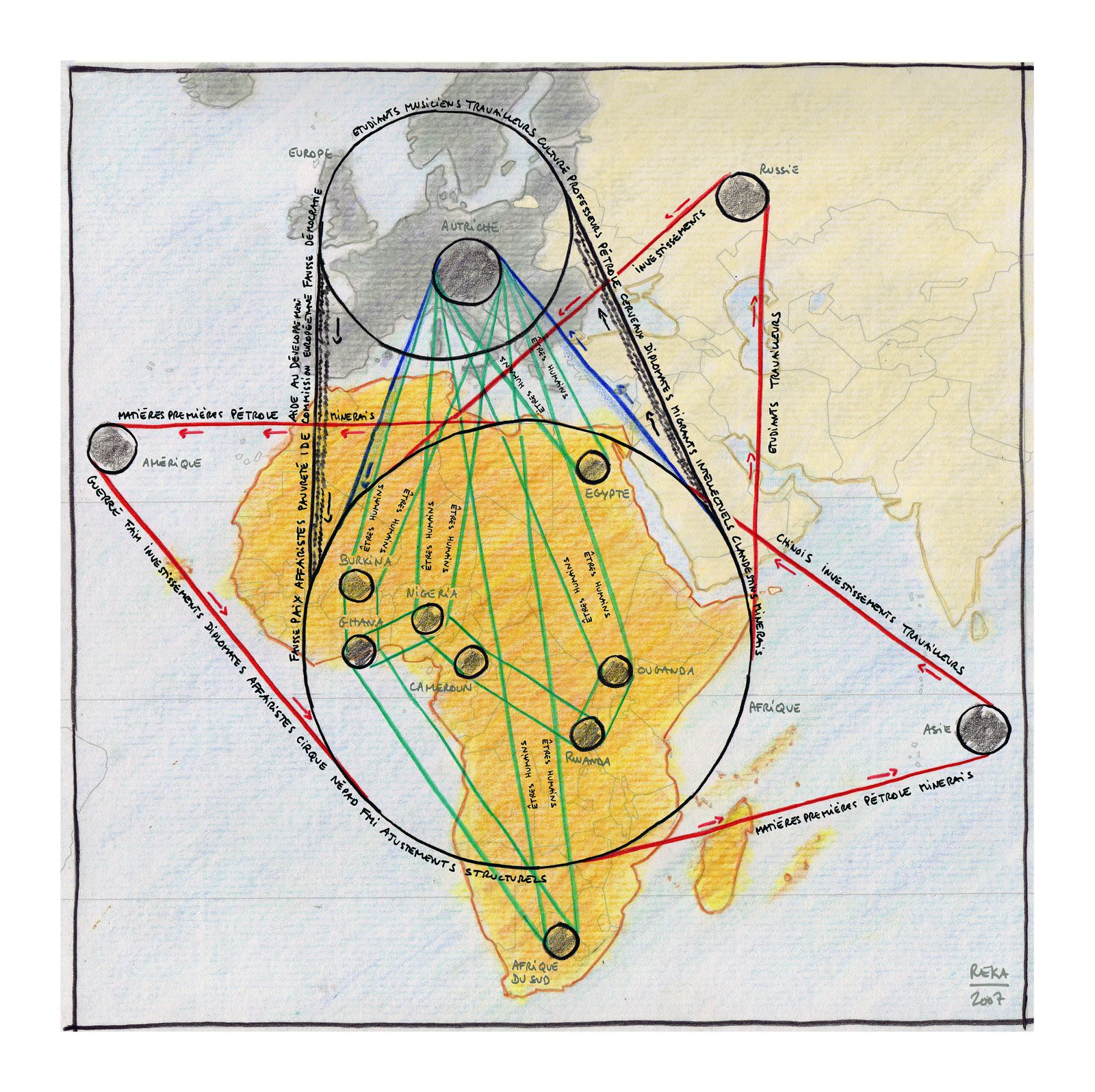
Diagrams - AMO/OMA at Prada Foundation Venice

"There is no such thing as an innocent map, observes Philippe Rekacewicz in his catalogue essay that accompanies Diagrams, a new exhibition at the Prada Foundation in Venice.

A renowned cartographer, the Paris-born Rekacewicz is well aware of his medium's capacity to transform narratives for good and ill. His own work includes maps that illustrate the deaths of migrants as they bid for new lives in Europe. "A map," Rekacewicz continues, "is above all a social and political act - and therefore inherently subjective."' p.5.

Individual
|
      INTERPERSONAL    :     SCIENCES               
HUMANISTIC  --------------------------------------  MECHANISTIC      
 SOCIOLOGY  :    POLITICAL 
|
Group
Am I Free?

My history ...
Philippe Rekacewicz / The African big wheel, 2007
The wheel symbolizes permanence and continuity in the context of a profoundly unequal exchange, drawing, color pencil and ink, exhibition copy.
Courtesy Philippe Rekacewicz
(Image credit: Philippe Rekacewicz)

SOCIETY

... is our history ...

Freedom

National & International Law

Justice


'Other pictures are equally revealing for what they conceal. Consider the diagram entitled "Universal commercial history", a visual analysis drawn up by the Scottish engineer William Playfair in 1805 which traces the rise and fall of global wealth since 1500 BC against what he terms "Remarkable Events Relative to Commerce". Playfair, who is said to have invented the pie chart, includes moments such as "Rome founded" "Mahomet's Flight" and "America discovered". He never mentions slavery.

With such a broad-brush approach, lacunae are inevitable. It is a shame that the work of Viennese social scientist Otto Neurath - who, along with his wife Marie and colleague Gerd Arntz, invented the Isotype (International System of Typographic Picture Education) - is not on show. Based on pictograms, Neurath's Isotypes are an lmportant forerunner to the digital vernacular (from emojis to icons) so familiar to us today. Nor does the exhibition include maps of the devastation of Gaza since October 2023, such as those made by investigative research agency Forensic Architecture, which are proving among the most critical diagrams of our time.' p.5.

Philippe Rekacewicz - https://www.grida.no/resources/10988

My source:
Rachel Spence. Hidden truths in the best laid plans. Diagrams | What charts, maps and graphics can - and can't - tell us. Collecting, FTWeekend. 26-27 April 2025. p.5. 
With many thanks acknowledging length of quotation.

Image source:
https://www.wallpaper.com/architecture/oma-amo-diagrams-prada-foundation-venice

See also: 'icon' : 'symbols' : 'diagram' : 'map' : 'Forensic Architecture'

Archived listing Links II Sciences - inc. 'Diagrams' & 'Visualization I' and 'II':