Hodges' Model: Welcome to the QUAD: Search results for forensic architecture

Hodges' model is a conceptual framework to support reflection and critical thinking. Situated, the model can help integrate all disciplines (academic and professional). Amid news items, are posts that illustrate the scope and application of the model. A bibliography and A4 template are provided in the sidebar. Welcome to the QUAD ...

Showing posts sorted by relevance for query forensic architecture. Sort by date Show all posts

Wednesday, March 07, 2018

Forensic Architecture (Care Forensics?)

individual
|
INTERPERSONAL : SCIENCES
humanistic --------------------------------------- mechanistic
SOCIOLOGY : POLITICAL
|
group


forensic
adjective: forensic
  1. relating to or denoting the application of scientific methods and techniques to the investigation of crime.
    "forensic evidence"
  2. relating to courts of law.
noun
plural noun: forensics; noun: forensic
1.
scientific tests or techniques used in connection with the detection of crime.


See also:
ICA London, 7 March - 6 May, Counter Investigations: Forensic Architecture.

My source:
Rowan Moore, Forensic Architecture: detail behind the devilry. The Observer Sun 25 Feb 2018

Friday, July 04, 2025

Diagrams - AMO/OMA at Prada Foundation Venice

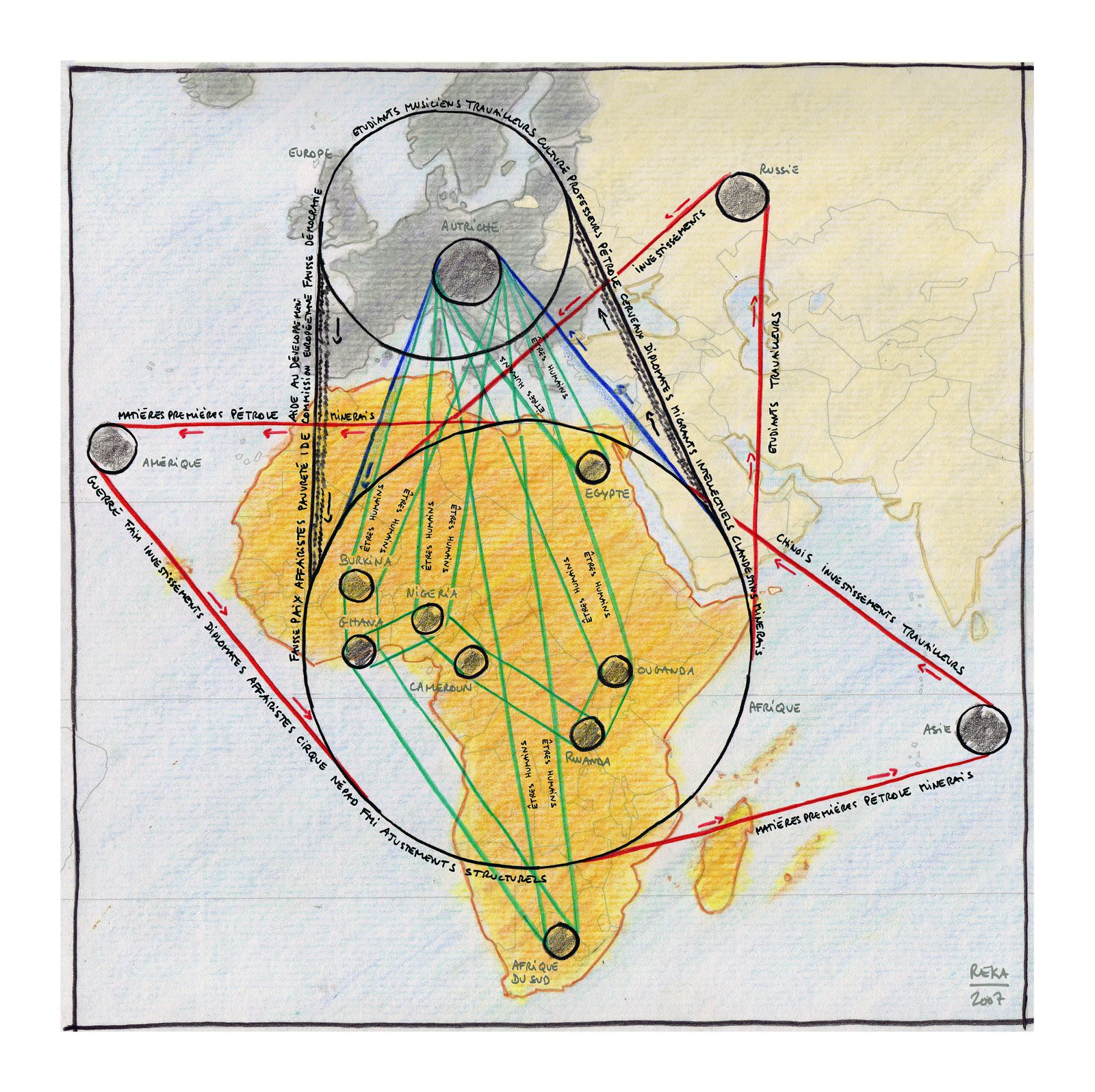
"There is no such thing as an innocent map, observes Philippe Rekacewicz in his catalogue essay that accompanies Diagrams, a new exhibition at the Prada Foundation in Venice.

A renowned cartographer, the Paris-born Rekacewicz is well aware of his medium's capacity to transform narratives for good and ill. His own work includes maps that illustrate the deaths of migrants as they bid for new lives in Europe. "A map," Rekacewicz continues, "is above all a social and political act - and therefore inherently subjective."' p.5.

Individual
|
      INTERPERSONAL    :     SCIENCES               
HUMANISTIC  --------------------------------------  MECHANISTIC      
 SOCIOLOGY  :    POLITICAL 
|
Group
Am I Free?

My history ...
Philippe Rekacewicz / The African big wheel, 2007
The wheel symbolizes permanence and continuity in the context of a profoundly unequal exchange, drawing, color pencil and ink, exhibition copy.
Courtesy Philippe Rekacewicz
(Image credit: Philippe Rekacewicz)

SOCIETY

... is our history ...

Freedom

National & International Law

Justice


'Other pictures are equally revealing for what they conceal. Consider the diagram entitled "Universal commercial history", a visual analysis drawn up by the Scottish engineer William Playfair in 1805 which traces the rise and fall of global wealth since 1500 BC against what he terms "Remarkable Events Relative to Commerce". Playfair, who is said to have invented the pie chart, includes moments such as "Rome founded" "Mahomet's Flight" and "America discovered". He never mentions slavery.

With such a broad-brush approach, lacunae are inevitable. It is a shame that the work of Viennese social scientist Otto Neurath - who, along with his wife Marie and colleague Gerd Arntz, invented the Isotype (International System of Typographic Picture Education) - is not on show. Based on pictograms, Neurath's Isotypes are an lmportant forerunner to the digital vernacular (from emojis to icons) so familiar to us today. Nor does the exhibition include maps of the devastation of Gaza since October 2023, such as those made by investigative research agency Forensic Architecture, which are proving among the most critical diagrams of our time.' p.5.

Philippe Rekacewicz - https://www.grida.no/resources/10988

My source:
Rachel Spence. Hidden truths in the best laid plans. Diagrams | What charts, maps and graphics can - and can't - tell us. Collecting, FTWeekend. 26-27 April 2025. p.5. 
With many thanks acknowledging length of quotation.

Image source:
https://www.wallpaper.com/architecture/oma-amo-diagrams-prada-foundation-venice

See also: 'icon' : 'symbols' : 'diagram' : 'map' : 'Forensic Architecture'

Archived listing Links II Sciences - inc. 'Diagrams' & 'Visualization I' and 'II': 

Thursday, February 20, 2025

Book review: #5 - Handbook on the Ethics of AI

Handbook on the Ethics of AI
If there is an overall theme to the book it is - rather inevitably -   anthropomorphism. Some argue it is consequential in nature due to the risks we are running. Sandry's chapter 10 Anthropomorphism and its Discontents begins by highlighting duality, dichotomies, and  oppositions that instantly come into effect in this emerging  theoretical, practical and policy field. If a term anthropomorphic can be 'loaded' this one carries extra baggage: history, religion, natural, aesthetic, philosophy, physical, existential. The dual issue of making a machine that looks human; versus, machines that could deceive humans (used remotely today and in situ in the future?) is considered. In our interacting with AI Tech, I found intention (and attention) of specific interest. Sandry seeks definitions, starting with dictionaries, the discussion is helpful across arts too. The reader is left well briefed and technically too: intrinsic and extrinsic forms, the role of the intentional stance, 3-factors. ...

Health is not a primary focus of the book. The index does not list healthmedicinenursing, at least not where they may be expected. The index is comprehensive but I wonder if it could be improved. Care is suggested through social robotics (p.147). Design figures again, anthropomorphically of course (p.147). Specific attention to ethics and Taking Care With Language are given (sections 6-7). I scribbled! again about care for tech - in the material, energy, and production 'costs' in an ecological sense. SUVs annoy me (sorry!) are they all necessary? On language, I thought back to McDermott D (1985) Artificial Intelligence Meets Natural Stupidity, In MIND DESIGN, Haugeland J (Ed), MIT Press, London, p.144-145:


Balance in subjectivity and objectivity of stances and resulting content / conclusions can be difficult to achieve and represent. The latter section prompts respond to frustration with the term anthropomorphism. I found myself in a couple's lounge, as a community mental health nurse, acutely aware of the role of proxies in dementia care; as Sandry described Paula Sweeney's 'fictional dualism' (8, 150). Hodges' model fits well here too, regards anxiety. To socialbots, I added carebots. There seems potential in sociomorphing.

As noted previously, reflection and relation-al points litter the text. In Jecker's chapter 11 A Relational Approach to Moral Standing for Robots and AI this is more explicit. Jecker refers to care of others - as animals too. In computer science and seeking to retain a socio-technical perspective, I've seen potential in capability and maturity frameworks. Section 2 provides some discussion of the former. One of the first words I looked up in the index was isomorphic. It wasn't listed but I found reference to it on page 157: '... a community of robots psychologically isomorphic to to human beings that share our psychology ...'. Maths is a focus here, even though I must try to utilise AI to aid my learning and understanding. This is - must be an outcome of reading HEoAI.

The section on (self-)counsciousness is engaging and not limited (again) to machine intelligence. Subjectivity arises again. I wrote a note re. the precautionary principle, my 'prompt' the ethical principle. A gift was dicovered in 3. A CONCEPTUAL REFLECTION and within 3.2 Relational Ethics, preceded by the potential of Kant, utilitarian and vurtue ethics. While not wishing to virtue signal I've long speculated on how other cultures could inform nursing theory and models of care. Jecker incorporates the African philosophy of ubuntu in relational ethics. Student's would enjoy this, especially as Jecker (Source: Author) provides tables laying out the ethical approaches and robot & AI capabilities. This can also encompass older adults and care contexts with social robots. Nussbaum's capabilities applied to human development is also adopted here - another useful reminder:

(And, once again I recall Nussbaum's talk on Aristotle.) In post #4 I wrote of the rubbish scene in the film A.I. Artificial Intelligence, but it's here (p.166) that I wrote the note. There is so much I'm skimming over - believe it not.

The conclusion in mentioning a hybrid future consisting of both humanistic and mechanistic agents appears to find an additional theoretical and practical ally in Hodges' model?


Chapter 12 by Navas is AI Ethics, Aesthetics, Art and Artistry visits the history and philosophy of this subject too, esp. from 1700s. With Žižek and Deleuze there is much prepatory reading for would-be undergrads - and general readers keen to have an awareness of contemporary issues. There is quite a triad here - disassembled - across several sections. I have quoted from the volume many times, but p.179 concerns empathy: 
'Empathy challenges the ongoing optimization of technology, because it takes time to exercise it. A person needs time to think about whatever issue, situation, thing, or person they may empathize with. In other words, empathy is essential for humans to understand and figure their relation to others and their surroundings. Empathy, if practiced reflexively, can lead to critical thinking. which may not lead to clear results but the activity may and often does end in "wasted" time if framed under the drive for efficiency, which is clearly something Al is designed to achieve. And lastly, empathy, because it has been foundational to art, is also part of art's long-term resistance against capitalism's exponential dependence on speed of production. At the core of AI ethics, then, we find speed of production and consumption coming in conflict with human existence itself. Humans are proving to be inefficient actors in the very system they built for their own benefit, which obsessively demands faster cultural activity from people, which (to be blunt) translates to an unapologetic and incessant desire for profit.' pp.179-180.
Section 6 on creativity AND speed is fascinating, especially as human-machine (brain) interfaces develop apace. Concerned as I am with what is a metacognitive tool, 8 Metacreativity formed the conclusion of chapter 12. The notes refer to generative coding which has come up in various webinars.

Silent Running: Film
Briefly, chapter 13 covers AI and the Environment. It is amazing (or not) how in a few sentences your mind can be changed? From "Really!" upon reading 'species culling', to this being explained in the crown-of-thorns starfish (hence COTSbot) and the toll on coral in Queensland. There are robots-for-ecology. I smiled returning to Silent Running's Dewey, Huey, and Louie becoming reality. Facinating point in: what is collective must be recognised in terms of causation. Appropriatly, PEAS is an acronym: probalistic weather event attribution studies are a reality in conjunction with remote sensing and tracking.

Drones are also developing apace, and applied robotics - tree-climbing. Less reassuring (adding to nature's precarity?) are artificial insects to undertake pollination; more positively reducing the impact of chemical and toxic spills. Simulation for training is well established in medicine and nursing; section 2.3 addresses this were PEAS form super-ensembles of data (I like that). PEAS can also have a role in determining an evidence-base and demonstrating it is hoped provenance for that evidence in the movement of populations, for example, climate refugees. In conflicts, human rights and justice, forensic architecture is of course well established: Forensic Architecture (Care Forensics?)

The summative nature in closing chapter 13 is a helpful approach which I will possibly try to duplicate.

Socio-technical approaches are found in chapter 14 Uses and Abuses of AI Ethics by Frank & Klincewicz. Understandably, boundaries play a large role, as you would expect in deliberating value and values, moral patients and agents. The Collingridge dilemma is discussed, regards putting in place controls for a technology while it is still in development, otherwise control may be lost (p.213). Diversity, a story of the moment - closes out this chapter. There is a 'nice' continuity across chapters to
15 The (Un)bearable Whiteness of AI Ethics by Syed Mustafa Ali et al. (the first note highlights the format is a dialogue). The (colonial) politics of north-SOUTH are duly noted and Africa (section 4). Section 8 points to technological (and health) colonialism. I take as a positive that the 'hyphen' also has a place (S.10).

The Savage Mind

Again related, as per the book's structured parts, chapter 16 Ethics beyond Ethics: AI, Power, and Colonialism by Kim prompts the reader to revisit the concepts of 'other', alterity even if 'understood'. I pencilled 'Savage Mind' here. Machines are posited as the colonial other. There will be a repeated argument as in response to humankind's going back to the moon (to stay) and on to Mars. We should sort Earth out first. So too for inclusion and the machines. What about the people who are excluded, disenfranchised and increasingly so? I wondered (previously) if (even) more could be made a transparency? Noting the word subaltern, it appears this has suddenly been attributed to Ukraine? On disability and ableism reminded also of radio history and 'Does He Take Sugar?'

The statement: 'Machines are perceived as distant - temporally, spatially, or socially - and different from human culture.' p.234. Is, so true.

INDIVIDUAL
|
      INTERPERSONAL    :     SCIENCES               
HUMANISTIC  --------------------------------------  MECHANISTIC      
 SOCIOLOGY  :    POLITICAL 
|
GROUP
cognitive - conceptual
'spaces'
distance:
time, space
human cultures
societies
difference


'Binary-opposition' and the need to think outside of this is acknowledged. And as if (perhaps) to stress both distance and proximity, I wrote 'mobius' in the margin (p.238). Hutchings (2015) sounds a valuable reference: 'Ethical Encounters - Encountering Ethics'. The books I've read contribute to evidence to revalidate my nurse registration. I realise I've sold-myself short in listing the book's titles. Although not discussed here the remaining chapters are excellent critical reading at a time when diversity, equality and inclusion policies are being rolled-back and undone. I will highlight these:

  • 17 Disabling AI: Biases and Values Embedded in Artificial Intelligence (quoted in 'Do you fit the description?')
  • 18 The AI Imaginary: AI, Ethics and Communication
  • 19 Feminist Ethics and AI: A Subfield of Feminist Philosophy of Technology
  • 20 Buddhism and the Ethics of Artificial Intelligence
  • 21 Queering the Ethics of AI

In chapter 16 'Ethics beyond Ethics...' just before the conclusion I will carry forward a sentence -
'Forming an identity requires that "I identify something or someone beyond me" - with one or more categories persons, non-human others, acts, ideals, values, or social systems' (p.243).
- and the points following, and end there.

Many thanks to David J. Gunkel (Editor), the many contributors, and Edward Elgar Publishing Ltd for my copy. I have greatly enjoyed and learned much from reading this book.

Handbook on the Ethics of Artificial Intelligence. David J. Gunkel (ed.). Cheltenham, UK: Edward Elgar Publishing Ltd. ISBN: 978 1 80392 671 1245
https://www.e-elgar.com/shop/gbp/handbook-on-the-ethics-of-artificial-intelligence-9781803926711.html


Images:
Silent Running 
https://cdna.artstation.com/p/assets/images/images/016/839/904/large/david-eagan-screenshot001.jpg?1553673214
The Savage Mind
https://en.wikipedia.org/wiki/File:The_Savage_Mind_(first_edition).jpg

Related previous posts: 'general + AI'

*That early streak of competitiveness was clearly educated out of me.

Tuesday, November 06, 2007

TEMSS - Therapeutically Enhanced Medium Secure Service for Women [II]

Dear Rachel (Ms Magee)

Delighted to help you and well done on picking out Hodges' model. It sounds like an exciting time for you personally being newly qualified and working on a new unit.

Apart from several occasions as a student (late 70s at Winwick Hospital) and more recent liaison through my Trust's NHS Care Record Service Project I have not worked in forensic/secure mental health services. So what follows is a very generic over view. That said Hodges' model is more than an out-liner - brainstormer tool. As your experience grows the model will grow with you and your clients if it is appropriate to share it with them. Anyway, here are some initial thoughts a real mish-mash running through the care (knowledge) domains in turn (with some repetition).

If you wish to develop and elaborate on what follows, casting a distinct TEMSS light on each care domain I'd be happy to place your prioritised version in a graphic (with you duly ack.)

intra-INTERPERSONAL
Screening on admission. Existing psychic 'injuries'.

An·a·gram: 'secure' = 'rescue' .....

Life history, experiences +ve/-ve (including hospital care), skills, strengths, beliefs, mood, expectations, RISK behaviour, personality, psychological reactions to situation (admission, secure environment, diagnosis, prognosis, treatment - psychotropics, locus of control, helplessness, motivation, family contact...), specific, individualised - person-centred care. Thought disorder? Attribution. Risk - self-harm, harm to others, self-neglect. Psychological dependence. Intelligence. Literacies: 3Rs, visual, social, information. Boredom, Mental capacity. Cognitive functioning. Religious beliefs. Personal skills, strengths, interests. Education - access to training. Response to stress - existing coping mechanisms. Sleep. Attitudes. Sexuality. Biopsychosocial influences PMT (sorry don't wish to seem sexist!)? Stress-vulnerability. Biases, prejudices. Orientation time, place, person (not just older adults).
(YOU as a nurse are also in this domain - your skills, control and restraint, anticipation of needs, observation, empathy, self-awareness, non-judgemental, bias etc....) Assessment tools. My care plan. 'personal' time. Quality - therapeutic time if used.

SOCIOLOGY
Family, pressure on existing - new relationships, spouse-boy/girlfriends, socialisation into the 'secure' environment, dependencies - children / pets. Observation. Group activities. Group therapies. Routine. Co-operation. Team work. Leadership. Status, stigma, respect. Communication. Social skills, Assertiveness. Media - papers, radio, TV. Qualitative research - client narratives. Demographic profiles - catchment areas - deprivation indices.

SCIENCES
Screening on admission. Existing injuries. Access to GP, emergency services if needed. Physical characteristics, height, weight - BP, temp, bloods, mobility. Evidence based care? NICE. Drugs, side-effects (+ substance misuse / alcohol), physical effects of addiction, physical environment - lighting (on-off [fade]), noise (acoustic) signature, colour, architecture (sharp corners vs curves), physical health problems, trauma. ADLs. Assessment toolkit - what's in yours? Nursing (care) process. Hygiene, Domestic services. Infection control. Physical space allocation. Multidisciplinary assessments - occupational therapy, physiotherapy, psychology, pharmacist. Unit viewed as a system - ecology. Complexity within TEMSS. Literature review. Site visits / conferences. Learners. Staff course study opportunities. Academic partnerships. Quantitative research. Triangulation. Statistics. Data gathering processes. Geographic profile of referrals.

POLITICAL
Human rights, policies, protocols, GP service provision, right of appeal as relevant, 'disciplinary constraints', compliance-concordance, 'offence' category. Client space - privacy / dignity. Access to therapies, rehabilitation, training opportunity, AUTONOMY, ability to exercise choice, institutional 'rules' make-up, clothing, bathing, kitchen, toilet facilities, dignity and privacy, 'unwritten' rules - bullying - vulnerable adults, abuse, financial, sexual, physical. Inspection - Commissioners - accountability. Referral process-pathway. Thresholds, waiting lists? Travel distance - regional resource. Transport links - visiting times. Cost of fares. Staff establishment. Health & safety rules. Disability. Care transitions. Learning disability. Early onset dementia. Ageism (other '-isms') RECORDS. CPA. Community Team. Qualified-unqualified staffing. Patient-relative groups. Service user representation on management. Academic links. Visiting. SAFETY - patients-staff. Serious untoward incident reporting. Translation. Advocacy - short-long term. Other agencies - Social Services, third sector voluntary partners? Philosophy of care, OUTPUTS vs OUTCOMES? 'contracts', Mental Health Act, appeals, hospital managers. Politics of care. Psychiatry in Dissent. Audit, data collection, IT systems. Access to REPORTS - INTELLIGENCE "How are we doing?" "Where are we going and is that the right way?" Your involvement - engagement - in these processes. Client - carer - public involvement. Finance budgets - (unit budget - resources), staff support / supervision. Energy use. Recycling. Client abilities with finances / debts. Homelessness. Re-housing. Existing tenancy. Opportunity for (regular) TEAM BUILDING ;-) Innovation and creativity. PDP - KSF. Targeted issues: Managed care. Personality disorder....? Professional associations, groups:
http://health.groups.yahoo.com/group/forensic-psychiatric-nursing/
No group for TEMSS for women? Over to you! .....

As you can see the model is high level. It does not DICTATE how your unit is run, what therapy is undertaken. It can help as an aide memoire prompting you and your colleagues to systematically consider all the care domains according to the context-situation and can help ASSURE an holistic assessment and evaluation.

The model can also be used to help explain problems, issues and their solution - or realistic outcomes to clients and their families. So the model doubles as an educational resource - very helpful to engage the INDIVIDUAL or a GROUP (family). You can do this EXPLICITLY using paper or flipchart for example, or implicitly with you using the model mentally as you go along...

By including a POLITICAL domain Hodges' model is ideally suited to your speciality - in fact POLITICALLY and SOCIALLY there are 'nested' issues within your 'secure care' context: gender, ethnicity, equality and equity, public attitudes, institutionalisation, citizenry, public involvement....

This blog includes many labels (on the right hand side) I will also add 'secure services'.

Rachel - I noticed on your organisation's website there are the names of the wards and address - there's a space to fill there...

Good luck, hope this helps and thanks again for your interest.

Best,
Peter
Sunday, April 03, 2022

MEMO TO: New College of Humanities and London Interdisciplinary School

Re. "Introduction to Lifelong Learning 101"

Since 1998, when I first went 'online' I've always been conscious of etiquette and note how this has changed - developed - over the years. The email associated with the former website domain p-jones.demon.co.uk saw a lot of emails to quite a diverse range of mail lists. Should I? Should I not? These questions remain a key consideration in trying to spread the thought and word on Hodges' model.

Stepping on toes a couple of times, someone also asked about links to blog posts on LinkedIn. Not had those queries recently so I think readers understand the 2x2 table is critical to the post in representing the model. Twitter presents its own challenges [ #WasteOfTime ]. So please pardon my shouting, but there's an important message here about an important resource.

I've lapsed again with no progress on the new site - maybe it is not just vapourware but a dream.

The creation of new education institutions: 

the New College of Humanities and London Interdisciplinary School

- is encouraging for the work here:

"The London Interdisciplinary School wants its students to be problem solvers with a wide range of academic interests."
(Nicola Woolcock, Polymaths plan to teach universities a thing or two. The Times, October 2, 2021. p.17.)

Does it, really - and by implication the NCH, plus New Model Institute for Technology and Engineering (NMITE) and others?

The Times Education Commission with proposals for reform due in June, adds further impetus and evidence ...

I read this evidence as supporting the argument that education and health are and always will be 'legacy issues', that is in need of change, investment, policy. All disciplines of study and knowledge are always dynamic and should be challenging, personally and collectively.

If institutions can distract themselves from fiscal incentive of the bums on seats for a few moments and policy makers look up from the dotting of  I's and crossing of T's then student's learning can be energised by Hodges' model: a generic bootstrap for lifelong learning.

Just to be clear. This model is NOT about boxes, it is about being aware of boundaries and being prepared to cross and use these journeys.

In the 21st century we are humbled by what now constitutes the pantology - the system of all knowledge. No individual can take in - apprehend and master it all, but we should have a means to at least conceptually touch this incredible gift.

INDIVIDUAL
|
 INTERPERSONAL    :     SCIENCES               
HUMANISTIC --------------------------------------  MECHANISTIC      
SOCIOLOGY  :   POLITICAL 
|
GROUP
Education
Philosophy (Ethics, Logic)
Psychology: (Applied, Child, Clinical,
Criminal - Forensic,
Occupational,
Artificial Intelligence ...
Cognitive Sciences
Theology
Arts
Creativity and Design
Eco-Anxiety
Happiness - Metrics
...

Sciences: Biology, Physics, Chemistry*
Health: (Medicine, Nursing ...)
Occupational Professions
Computer Science, Information
Mathematics
[macro - nano] Engineering
Architecture
Design and Creativity
Environmental Studies
Hydrology
Land use: Forestry ...

Arts (Music, Dance, Drama ...)
Literature
Anthropology, Archaelogy
Languages
Ancient-History, History
Future Studies
Social Work
Sociology (Culture, Ethnography ...)
Anthropology
Gender Studies
Philanthropy
...

Politics, Government
Security
Law & Crime - Fraud/Corruption
Policing - Law Enforcement
News and Media studies
Political Science - Citizenry
Economics
Socio-Economics
International Development
Peace Studies
Administration
Leadership and Management
War and Conflict ...


I am pleased to see that the post re. Nicholas Maxwell's work is popular here:

"How Universities Have Betrayed Reason and Humanity—And What's to Be Done About It" c/o Nicholas Maxwell 

*So many sub-disciplines: Climate studies, Epidemiology, Marine biology, Quantum Computing / Physics, Exobiology, Astronomy, Materials, Demographics, Geology, Genomics, Cybernetics, Systems, Epigenetics, Exobiology, Neuroscience, Public (Mental) Health, Allied Health Professions ...


Wednesday, June 05, 2024

'New' citation of Hodges' model - Kennedy (2019)


This morning an alert from ResearchGate brought news of a further not so new citation of Hodges' model:

Kennedy, Harry G. (2019). National Forensic Mental Health Service (NFMHS) Model of Care. 10.13140/RG.2.2.30103.59041.

I've extending thanks to Prof. Kennedy, and have added the details to the blog's bibliography (in the sidebar). It is not as if Hodges' model played a key role in service design (care architecture?), but it is nonetheless marvellous to achieve this visibility.

This does make me wonder if there are others?

Any further news welcome.