Hodges' Model: Welcome to the QUAD: Search results for ancient

Hodges' model is a conceptual framework to support reflection and critical thinking. Situated, the model can help integrate all disciplines (academic and professional). Amid news items, are posts that illustrate the scope and application of the model. A bibliography and A4 template are provided in the sidebar. Welcome to the QUAD ...

Showing posts sorted by relevance for query ancient. Sort by date Show all posts

Sunday, October 12, 2025

Paper: The spatiotemporal distribution of human pathogens in ancient Eurasia

 Abstract

Infectious diseases have had devastating effects on human populations throughout history, but important questions about their origins and past dynamics remain1. To create an archaeogenetic-based spatiotemporal map of human pathogens, we screened shotgun-sequencing data from 1,313 ancient humans covering 37,000 years of Eurasian history. We demonstrate the widespread presence of ancient bacterial, viral and parasite DNA, identifying 5,486 individual hits against 492 species from 136 genera. Among those hits, 3,384 involve known human pathogens2, many of which had not previously been identified in ancient human remains. Grouping the ancient microbial species according to their likely reservoir and type of transmission, we find that most groups are identified throughout the entire sampling period. Zoonotic pathogens are only detected from around 6,500 years ago, peaking roughly 5,000 years ago, coinciding with the widespread domestication of livestock3. Our findings provide direct evidence that this lifestyle change resulted in an increased infectious disease burden. They also indicate that the spread of these pathogens increased substantially during subsequent millennia, coinciding with the pastoralist migrations from the Eurasian Steppe4,5.

Sikora, M., Canteri, E., Fernandez-Guerra, A. et al. The spatiotemporal distribution of human pathogens in ancient Eurasia. Nature 643, 1011–1019 (2025). https://doi.org/10.1038/s41586-025-09192-8

My source: Carl Zimmer. What has ailed us over time, The New York Times International Edition, July 30th 2025. p.12.

Friday, October 25, 2019

Liminality in "How ancient rituals help us adapt to the digital age" c/o G. Tett

How ancient rituals help us adapt to the digital age

Ceremonies and symbols matter more than ever in a disorienting world

Context: "This week I made a pilgrimage to the east coast of Scotland to participate in that classic ritual of modern middle-class life: a university graduation".
"However, heritage marketing is not the only factor, given that such rituals also occur in places that do not have 600 years of history behind them. Another way to frame the issue is to ponder a concept first developed by the ethnographer and folklorist Arnold van Gennep, and later elaborated by the anthropologist Victor Turner and the psychologist Carl Jung – “liminality”.

This word comes from the Latin limen – doorway or threshold – and refers to the idea that whenever societies or people make a transition, they typically use rituals and symbols to mark this. 

These usually contain three parts: a ritual to show the end of the old life; a ritual to mark the entry into the new one; and a “liminal” stage between the two, when the transformation occurs. Moreover, in that liminal state the normal rules of life tend to break down. Liminality is the cultural equivalent of the pupation that insects undergo: patterns become untethered and fluid, to be remoulded".

Tett, Gillian. 2019, How ancient rituals help us adapt to the digital age. FT Weekend, Magazine, June 29-30, p.46.

Friday, March 03, 2023

Prof. Steven Clayman - The Rime of the Ancient Geometer


The Rime of the Ancient Geometer

by Steven Clayman

‘Squaring the circle’ is an ancient problem in geometry, of constructing a square with the same area as a given circle using only a compass and straightedge. The task is mathematically impossible, but nonetheless attracted many ardent cranks and charlatans over the centuries.


While some doth boast and many said it,
Verily I claim the credit.
For having lastly squared the circle,
I quaff thy praise lest some young Turk’ll.

Perchance that thou art not impressed,
Behold what I shall now attest:
It came to pass (this may seem pompous)
With naught but straightedge and a compass.

Unleash thy fettered lauds and laurels!
I fancy most the sweets and florals.
But giveth not thy full devotion:
I’ve well-nigh wrought perpetual motion.


© STEVEN CLAYMAN 2023
[With thanks.]

Steven Clayman is a Professor in the Department of Sociology at UCLA.

Philosophy Now, February/March 202. p.17.


There is a way to 'square the circle' :: the many circles of life and death in care - can be 'squared' - using Hodges' model.

#AnExerciseInCare

#CareIsASetOfValues

Thursday, May 29, 2025

Health Policy Watch: WHO’s Big Push to Integrate Traditional Medicine into Global Healthcare Framework

This is quite a development for the lived experience of all individuals, global health and for Hodges' model. Not only for Hodges' model as a universal framework (template) and model for / of care, but the capacity of Hodges' model to conceptually and culturally encompass all data, information, knowledge and wisdom.

c/o HIFA list:

Full text: https://healthpolicy-watch.news/whos-big-push-to-integrate-traditional-medicine-into-global-healthcare-framework/

'The World Health Assembly delivered a landmark victory for traditional medicine and indigenous cultures Monday evening, approving a strategy that calls for increased investment in research and integrating ancient healing practices into modern healthcare systems worldwide.
'The approval marks a breakthrough moment for advocates of traditional medicine, with nations across Asia, Africa, the Middle East and Latin America celebrating the decision. Iran called it “a visionary yet realistic roadmap” to integrate thousands of years of medical like its own.

'But the strategy text shows WHO walking a careful tightrope, embracing practices that represent “accumulated wisdom and healing practices passed down through generations” while demanding they meet modern scientific evidence standards that could take decades to satisfy...'
Best wishes, Neil

HIFA profile: Neil Pakenham-Walsh is coordinator of HIFA (Healthcare Information For All), a global health community that brings all stakeholders together around the shared goal of universal access to reliable healthcare information.

See also: 'Oceania' : 'indigenous' : 'ancient' : 'map' : 'nature'

Wednesday, April 01, 2020

Contextual and other forms of Collapse ...

individual
|
INTERPERSONAL : SCIENCES
humanistic ----------------------------------------------- mechanistic
SOCIOLOGY : POLITICAL
|
group - population

"I will get through this."

what is invisible


"Nowadays, digital technology is transforming our lives at an accelerating pace. This sometimes feels wildly liberating. But it is often terrifying too, because cyberspace is so disorientating. More specifically, in the cyberworld there is a constant problem of what anthropologists call "context collapse": it is hard to discern the contours of social interactions because the factors that used to frame our cultural lives are only half-present".


"We will get through this together."
my emphasis


At times such as this - the COVID19 pandemic - we are all trying to maintain the semblance of  "I will get through this." and "We will get through this together"; trying to self-care and in-so-doing care for friends, family, community and the population.

At times when our cultural and personal lives are not even 'half-present', there is an increased need for sense-making, for balance and orientation. While the tool we seek is a vaccine and preparedness for the next one, there are tools to reduce the impact of the several forms of collapse we are presently  experiencing.


Please see also initial post:

https://hodges-model.blogspot.com/2019/10/liminality-in-how-ancient-rituals-help.html

- sourced from and acknowledged Gillian Tett:

Tett, Gillian. 2019, How ancient rituals help us adapt to the digital age. FT Weekend, Magazine, June 29-30, p.46.

Monday, November 04, 2019

Ancient of Days: A Newtonian Compass [?]


INDIVIDUAL
|
INTRA- INTER-PERSONAL : SCIENCES
HUMANISTIC -------------------------------------------------- MECHANISTIC
SOCIOLOGY : POLITICAL
|
GROUP

William Blake Ancient of Days
Europe a Prophecy Copy B (Printed 1794)

William Blake, Newton
1795–c.1805

?

?


See also and image sources:

https://en.wikipedia.org/wiki/William_Blake

http://www.blakearchive.org/search/?search=GOD

https://www.tate.org.uk/whats-on/tate-britain/exhibition/william-blake-artist
[ Visited last month 1830-2200 ]

Monday, June 21, 2021

History: Ancient and Modern

individual
|
INTERPERSONAL : SCIENCES
humanistic ----------------------------------------------- mechanistic
SOCIOLOGY : POLITICAL
|
group


HISTORY


Artist:

Ian Hamilton Finlay

(British, 1925–2006)
Title:

For the temples of the Greek our homesickness lasts forever (collab. w/Michael Harvey)

Image: https://emuseum.aberdeencity.gov.uk/objects/118193/for-the-temples-of-the-greeks-our-homesickness-lasts-foreve

Lubbock, T. The conflict of ancient and modern, The Tuesday Review, The Independent, 26 March 2002. p.10.


Thursday, November 02, 2017

Humanistic + Mechanistic = Organicistic? c/o Vernon

"Holistic Biology ... 

Philosophy Now #122
In recent years biology has been moving beyond a biochemically reductive view of life. The days when we could regard ourselves as lumbering robots for our genes, to recall Richard Dawkins’ resonate phrase, are numbered, if not already over. Life for the biologist has become a lot more complex, and arguably, in its intricacy, more beautiful. ... 
I recently attended a conference on what is sometimes called ‘holistic biology’ or the ‘extended evolutionary synthesis’. ... 
These developments have led the philosopher Michael Ruse to pose a fundamental question. In biology, there has long been two ways of looking at life: as a mechanism, which can be broken down into parts; and as an organism, which can be explained only by considering the way the whole system works. Organicism is the more ancient approach, while the machine metaphor has come to dominate in modern times. Ruse suggests that perhaps it’s time for organicism to make a comeback. 
Its origins reach all the way back to Plato." p.7.
The links here provide access to one of four complimentary articles for non-subscribers.

Vernon, M. Rediscovering Plato's VisionPhilosophy Now. Issue 122. Oct/Nov 2017. pp.6-8.

Mark Vernon is the author of The Idler Guide to Ancient Philosophy (Idler Books, 2015).
For more, see www.markvernon.com.

Wednesday, July 25, 2012

Olympic Torches, History and Nostalgia for the Light


I never got to see the Olympic torch procession,  although I crossed its path on a couple of occasions.

This for me has much significance    +

In Euxton, Lancashire and more recently I found myself ahead of the relay in Oxford.


I saw a torch at the Disability Awareness Day in Warrington.


A prized possession: a keepsake of a lifetime.


Image source: http://www.warringtonguardian.co.uk/news/9825966.Disability_Awareness_Day_marks_21st_event_with_Olympic_glow/


Over the weekend I went to see the film - Nostalgia for the Light. A documentary that is simultaneously challenging, troubling, poetic and beautiful. A journey through history in its multiple forms; astronomy, and archaeology - ancient and modern. The setting is the Atacama desert. The astronomers using various telescopes explore celestial bodies, taking advantage of the elevation and transparency of the sky. The extremely low humidity that also supports such observations also preserves human bodies. Not just those thousands of years old, but human bodies from more recent times. Those of Chile's "disappeared" those who have been found and those still lost to their families.

Skeletons abounded. Ancient mummies, more recent explorers and miners. I noticed how these skeletons can give up their secrets from belongings, clothing, identified by relatives.

How telescopes themselves are skeletized in their design to save weight, cost. Today the affluent can purchase a skeletized watch - to make a statement. Mechanism. To mark their personal history. History.

What legacy? What cost? 

Around the world : dictatorship.

The search of the few for the many against the sun and the turn of stars.
Light seeking light, seeking peace and a final release.

Sunday, May 31, 2020

Book Review: ii Mathematics and Art: A Cultural History

Last time I suggested that philosophy is missing from the title. Architecture is another very welcome theme in the book, the significance of perspective to art being obvious, but not the only focus. As mentioned the preface is an invitation to dive in. The oldest star atlas (xi), Chinese, sets the scientific and global tone to follow. My interest in diagrams, was quickly awoken as there are many in this book. I recalled the lunar cycle depicted on cave walls and bone. The first diagrams from prehistory. The preface works brilliantly as an introduction, such that I couldn't wait for chapter 7: "Scientists describe such symmetries using the mathematics of group theory" (xv).

Mathematics + Art
Mathematics + Art
For young scholars the book plays the role of sign-posting schools and history of thoughts and ideas. [Paraphrasing..] Adorno and Horkheimer ... wrote the first in-depth analysis of the loss of confidence in enlightenment ideals, a condition that came to be called postmodernism (xviii). There's an observation of artists being inspired by mathematics, but not mathematicians drawing upon art - with some rare exceptions. When possible, Gamwell's approach to the personality and intellectual environment of mathematicians and artists is psychological (noting key traumas), at others the author adopts a more sociological and cultural stance. The prose throughout is clear and flows very well, even with some inevitable and necessary cross-referencing.

Chapter 1 Arithmetic and Geometry brings home the relationships and dependencies between maths, arts, belief and changes in our understanding of the Universe. When I learned in my teens of the destruction of the Library of Alexandria, which Ptolemy would have visited, (p.30) I was shocked and still am at this loss. Sadly a loss that is not just an ancient phenomenon.* Interested in astronomy, the loss of Hipparchus's globes and co-ordinate system is a further blow. A cross-cultural perspective is maintained throughout the book, with Islamic mathematics, South America and Asia. Do you know the difference between philosophy and mathematics? There is an opinion here. From the Greeks - Neoplatonism, early Christian and medieval thought and the 'liberal arts', I knew the modern book version of the 'Quad-rivium' on my shelf was of significance:
"In the late Roman and early Christian era, scholars continued to study the ancient texts based on a curriculum - arithmetic geometry, music, and astronomy (the quadrivium, Latin combination of quadri and via meaning "the place where four roads meet") - first described by the Pythagoreans and adopted by Plato for his Academy." (p.37)
An original purpose for Hodges' model, remains curriculum planning and development, the definition of the core disciplines of learning has always been a roll call of sorts. The book can serve all, but younger scholars especially, as it sets out the formulation of scholastic traditions which have a chapter each:
  1. logicism (chapter 5): Realism - St Augustine - Platonic realm
  2. intuitionism (chapter 6) - Conceptualism - Peter Abel - distinct objects only in the mind
  3. formalism - (chapter 4) Nominalism - William of Okham - mere signs or names (p.37)
Even today we must ponder on the status of the seven liberal arts, the quadrivium plus the trivium of grammar, rhetoric and logic. To classics scholars this will be introductory, but invaluable grounding for many learners - young and more senior.

There is an account of eastern and western cultures and the relative development of mathematics. The sciences and theology feature markedly as human reason made progress - increasing certainty only to suffer from doubt with new discoveries. The 'via negativa' (Latin for "negative way", p.47) reminded me of two books on ignorance I purchased in London. I arrived there March 12th and soon thought; "What on Earth (as a nurse too) am I doing here?" Especially, being in the basement for Jazz Live at Pizza Express, Soho. These are indeed uncertain and challenging times.

You may have noticed I have not mentioned the art thus far. Well there is plenty. By page 47 we are up to plate 1.52 'The Cloud of Unknowing' 1998 by Roman Verostko.

Post iii soon.

*In lockdown I followed a conversation on the destruction of libraries from the digital Hay Festival:

(This does require a subscription to Hay Player.)

Saturday, June 29, 2024

Book for review: iv "Philosophy of Care - New Approaches to Vulnerability, Otherness and Therapy"

Don't worry this is not a chapter-by-chapter review. Having cast the stone that is Hodges' model we will skip a few times.

The use of footnotes varies from chapter to chapter. They inform the text, in several instances being quite illuminating. Beside the footnote (1/3 of a page) I noted - 'baby, cacophony, perception - brain - not overwhelmed but can't ignore' (p.41). Stoicism is the focus in chapter 3; perception, fields, manifold, circles of care, self, time, situation! We have field, subfields, domains.
"Perception is always about a diagnosis of the situation in which the living being finds itself. ...

... perception is always about finding one's "whereabouts" or one's "location" in life's journey." p.42.

On the features of perception, 4/4: "might be termed the breadth or width of the perceptual field." p.42. 

"As pointed out above, all perception has the structure of a compact, continuous, and uninterrupted manifold. In other words, it forms what we have termed a field. But the perceptual field  could contain nothing but the "bare bones" of "inert" qualia, (a manifold of simple qualities impinging themselves upon the perceiver)." p.42. 

The author, Jorge de Carvalho continues another view of qualities that take place in "each given moment". This is the challenge of salience, what is significant? How to 'read' in care: the spoken, the unspoken? 

Developing notes on Hodges' model as a mathematical object, Hodges' model in its basic form as a template, I'm proposing as an empty set. The structure of Hodges' model, its two axes instantiate the "bare bones". In programming/instruction terms ... Hodges' model provides INITIALISATION. A reset. This can act as a prompt for learners to acknowledge the person - the other and consider 'unconditional positive regard'. There's polarity too (p.46) and each living being lives in its own global field, in its own global 'map' - in its own geography" (p.49). Physical geography and the change 'there' is giving rise to cogeographical (a neologism?) disruption - eco-anxiety and climate-angst. 

Psycho-geography: the polarity of our times?

Another note, amongst Hierocles' circles is 'reflex arc'. So many feedback loops, cascades to worry about. 

As Jorge de Carvalho writes: 'what we are talking about is a very complex field of fields. ... described both as a compass rose and as a framework of concentric circles" (p.51). [There's a relay race, a torch relay in ancient terms p.54. Care is the object that is passed on. I've a dual-shaped baton to pass on.]

Care is more than perception (p.52), care presupposes a degree of activity or action. I like the acknowledgement of 'vigilant waiting' too. For me this draws in the importance of communication; Watzlawick's Five Axioms of Communication. After all, what happens to all these perceptions? There's vulnerability, fragility and care for the sheer existence and the whole content of a given being (p.56). Jorge de Carvalho, deploys a series of numbered points which helps reading. Page 60's footnote had me drawing circles, unborn at the centre: as one. But the collective unborn in another rough circle. Eachtimeness: I like this Stoic formulation through circles. Fourthly, we arrive at pure care. I'm still pondering on ".. there is no absolute either/or dichotomy between care and its opposite" (p.61). Integration is also here, an issue for modern times, a legacy problem from ancient times?

Luis Mendes's chapter I must read again. The abstract includes:
"Three fundamental aspects will be identified: (a) the need to consider self-existence from a global point of view; (b) the need for an axis for that life-view; (c) the need for correspondence between self-existence and life-view. Apparently, this structure is formal and arbitrary. Secondly, I will analyse the structure of despair. Three fundamental aspects will be analysed: (α) the requirement for a life-view which can be applied to the totality of subjective existence; (β) the requirement for an unconditioned instance of meaning; (γ) the requirement for the exclusion of the possibility of failure." p.79.
I'm sure Kierkegaard has featured in Philosophy Now, and The Philosophers' Magazine. Mendes' focus is arbitrariness. The hypothesis is well explained (p.80) structure of care. There's much for me here: care, life-view (health career - life chances), "a global understanding maps the world" (p.81), existential map, fulfilment, meaning (of course!). Reading -
"So, a life-view needs to be stabilized, to have unity. It needs an instance that works as an axis and as a point of support. We need something to support our life" (p.83).
I could have jumped up, waved and shouted "OVER HERE!" Would Kierkegaard have been pleased? Perhaps I should have read Kierkegaard, not Michel Serres (please see bibliography in the sidebar)? Still time (fingers x'd); especially if there's any interest in the form of co-author(s)? Care is full of ideals. Mendes through Kierkegaard gives my  project encouragement: "Truth is to live for an idea." p.84. Not necessarily truth but the idealism in care, including identity. It is helpful in care to be reminded of the ideal as a calling, hence motivation (intrinsic and extrinsic) is still key. If you're intrinsically motivated, devoted to your chosen vocation, is your pay that important - to the government/organisation that employs you? A shame this is so often lost to political leaders; who, given their chosen vocation, exhibit a markedly short memory.

Braga, J. & Santiago de Carvalho, M. (Eds.), (2021) Philosophy of care: New approaches to vulnerability, otherness therapy. Springer. 

Many thanks again to Springer for my copy, especially given a follow-up request, well post-publication date.

Individual
|
      INTERPERSONAL    :     SCIENCES                   
HUMANISTIC  --------------------------------------  MECHANISTIC      
 SOCIOLOGY  :    POLITICAL 
|
Group

personal courage

relational - (emotional) care

despair - fulfilment

motivation

ideals

unity - stability

maps

compass - orientation

models - frameworks

geography

life as a whole

society - community of practice

external validation

extrnisic motivation


sustainable development goals

policy

accountability

failure (courage here - political convictions?)


See also:

body & soul - Book: Philosophy of care: New approaches to vulnerability, otherness therapy


Book for review: iii "Philosophy of Care - New Approaches to Vulnerability, Otherness and Therapy"

Friday, August 07, 2026

'From Tree to Sea [5] - The Bare Necessities' c/o BBC R4

My name is not Robinson Crusoe, but I feel privileged to live on an island. The sea has always been close. Liverpool (Scouser) has a history, to celebrate and seek forgiveness for. It was a surprise and yet wasn't from the map in the Bluecoat of the slave ships that plied the route to West Africa, to the West Indies and USA to see the same reflections in the dock area of Nantes in May 2025.

These reflections followed a BBC Radio 4 programme this afternoon (one of a series):

5. From Tree to Sea - The Bare Necessities

https://www.bbc.co.uk/sounds/play/m002ztzy

'We are living in turbulent times and it is easy to feel anxious about the state of the world. The pace of change is fast, and the future often seems uncertain and out of our control. Given our reliance on technology, any sort of outage could be catastrophic. Could you survive - and thrive - in a world without global supply chains, the internet and 24-hour energy?

In this series the writer Dan Richards seeks out the tradition bearers and carriers of ancient knowledge who actively choose to live in close connection with the natural world around them. A return to first principles of what it means to be human and the kind of people you would like to be around if things fell apart.

Dan heads to Whithorn in Dumfries and Galloway where he meets Traditional Boat Builder Gail McGarva who is putting the finishing touches to a skiff before its launch. Gail has gathered knowledge of the ancient craft of wooden boat building through her relationship with tradition bearers and mentors, without whom the knowledge would disappear completely. What Dan finds is that this small wooden boat represents not only an evolution of form and process, but soul. The souls of all who have gone before and how they might influence a sustainable future with community at the heart of it.'

In making the skiff there is a marvellous observation about:

 "when the boat hits the water it knows what to do ..".

For students entering a profession or trade (any) that strikes a chord.

Tuesday, June 13, 2017

Boxing 'II'

As young children we may encounter 'boxing' quite early on. This first experience, which we may or may not wholly remember is undoubtedly critical to our personality and subsequent psyche. Such early experiences influence our ability to 'look after ourselves', how we deal with bullies, anxiety, the potential for conflict and develop assertiveness skills. When a 'scrap' happens it can be quite sudden, that total impact of everything out of control, sheer danger and literal impacts. The environment might be nursery, playground, cloak room and the presence of peers as onlookers can be another key factor.

In the late 1960s early 70s I found some old boxing gloves under the stairs at my nan's. I had a handful of uncles on mum's side (just two now - Uncles Tom and Ken!) and the gloves had clearly been swung and jabbed down the line. I don't count myself as a fighter, unless someone tries to push their beliefs - without invitation - down my throat. Then it will be more a case of a reflex action. The 'arc' being comprised of vomit. In the school playground I learned to talk my way out of trouble, resorting to humour at times; as you learn to deploy whatever intellect you might have judiciously. Legs are essential to a boxer:

“First your legs go. Then you lose your reflexes. Then you lose your friends”
Willie Pep

My legs helped me a time or two.

Not too many years ago, so a new generation is in the frame and a nephew had boxing gloves of his very own. He trained with a local club and had some fights. I didn't go watching, but didn't make too big a big fuss either. He doesn't box now as it happens; he's married with family and busy earning a living. Over four decades I've cared for several gentleman, former boxers who developed dementia. Hence, my lack of enthusiasm. (Although the selective literature listed below does not reflect it, women's boxing is of course also well established.) The extent to which boxing caused their dementia is not the point here. It's trying to acknowledge the ongoing debate: the risks, the history (Ancient Greece 688BC), the discipline, sense of belonging and self-respect it can instill. Of course a great many sports can do this. Of course, I listened very attentively as one gent could still relate how perhaps he had been 'used' in terms of the fights and purses back in the 50s-60s. Vulnerable adults of today and yesteryear. Today American Football is concerned about head injuries, in football heading the ball repeatedly is in the news. Technology should be able to reduce the risks even more and protect individuals from injury that is obvious and more insidious in nature.

Some of these points I've considered in Hodges' model as follows:

individual
|
INTERPERSONAL : SCIENCES
humanistic ---------------------------------------  mechanistic
SOCIOLOGY : POLITICAL
|
group

SELF

self-awareness
Identity
self-belief

way-finding

dementia - cognitive damage

personality change

aggression

tactics  strategy

motivation training attitude

self-discipline

ethics

mental health - mental capacity
emotions

mood

Personal safety

boxing technique

reflexes speed movement balance

punching fitness

weight, reach, statistics

THE RING

stamina nutrition hydration

concussion
sub-concussive

exposure models

unconscious knockout

Head - Brain injuries

physics: force time (duration) momentum

technology - sensor equipped gloves

Sports Medicine Research
Headgear
Safety - Evidence

Medical risks

OTHER

Ethnographics
Coaches <-> Boxers
Mentors

Support network

THE STREET

personal history-family
History
sports history

trainer friends club

Sporting behaviour

family friends
Socio-
Rules (changes)

Conflict Power

promotion media finance

codification rules

Amateur Professional

Refereeing

Regulating bodies

Governance

Law

Contracts

Economics


Selective reading:

Sacha, J. (2017). Fighting Feelings. Sociological Perspectives, 60(1), 77-94.

Erlanger, D. (2015). Exposure to sub-concussive head injury in boxing and other sports. Brain Injury, 29(2), 171-4.

Falvey, &., & Mccrory, P. (2015). Because not all blows to the head are the same. British Journal of Sports Medicine, 49(17), 1091.

Mcintosh, A., & Patton, D. (2015). Boxing headguard performance in punch machine tests. British Journal of Sports Medicine, British Journal of Sports Medicine, 14 July 2015.

http://www.welshboxers.com/quotes/

See related post 2016: 'Boxing' I


Thursday, August 13, 2026

Call for Papers: Bioethics and Philosophical Health - JECP

Submission Deadline: Thursday, 31 December 2026

Contemporary bioethics has developed sophisticated tools for ethical decision-making. Yet it often operates within assumptions that reduce life to physiological viability. Ethical questions are frequently treated as matters of procedure and consent. Meanwhile, patients and clinicians face questions that exceed these frameworks. What makes a life worth living? How does illness disrupt or reveal meaning? What forms of care support not just survival but existential coherence? These questions call for a deeper engagement between bioethics and the philosophy of existence.

Despite growing interest in person-centred care, conceptual tools for clinical evaluation remain limited. Frameworks for assessing philosophical sense-making and existential orientation are underdeveloped. The Philosophical Health perspective addresses this gap by going beyond physical and psychological health. It asks how we cultivate meaningful lives through bodily experience, self-understanding, relational belonging, engagement with possibility, purposeful action, and philosophical reflection. The concept draws on the ancient tradition of bios philosophikos. It proposes that healthcare should attend not only to pathology but to the philosophical dimensions of human existence.

This special issue creates space for exploring how philosophical health can deepen bioethical inquiry as an embodied ethics of the good life. It challenges reductive assumptions and fosters practices that support purpose and meaning in lives, even when disrupted by health challenges. We welcome transdisciplinary contributions from philosophers, bioethicists, clinicians, medical humanists, and social scientists. Topics include how philosophical frameworks enrich clinical practice, how healthcare shapes existential experience, how the 4E cognitive approach may inform bioethical theory, and how dialogical methodologies can be integrated into institutional contexts. The issue aims to rediscover bioethics as a genuinely philosophical and existential enterprise, that is as bios ethikos.

Topics of interest for this call for papers include but are not restricted to:

  • Philosophical frameworks for enriching or transforming bioethical practice and clinical evaluation;
  • Philosophical dimensions of clinical encounters: embodiment, selfhood, temporality, and meaning-making;
  • Critiques of the reduction of ethical deliberation to procedure, regulation, or risk management;
  • How healthcare practices shape or constrain the philosophical dimensions of human existence;
  • The 4E cognitive approach (embodied, extended, enactive, embedded) applied to bioethical theory and practice;
  • Integration of philosophical inquiry and dialogical methods into clinical or institutional contexts;
  • Empirical and conceptual engagement with the Philosophical Health methodology, including SMILE_PH;
  • Cross-cultural and planetary perspectives on philosophical health and the good life;
  • Methodological innovations in clinical philosophy, philosophical counselling, and reflective practice.
More details here: https://onlinelibrary.wiley.com/page/journal/13652753/call-for-papers/si-2026-000772


_______

Dr Luis de Miranda
Associate Professor (Docent) in Bioethics, Uppsala University
Marie Skłodowska-Curie Fellow, Turku Institute for Advanced Studies
Associated Researcher, Centre for Research Ethics and Bioethics,
Department of Public Health and Caring Sciences, Uppsala University
https://www.luisdemiranda.com/

My source: Philos-L "The Liverpool List" is run by the Department of Philosophy, University of Liverpool https://www.liverpool.ac.uk/philosophy/philos-l/ Messages to the list are archived at http://listserv.liv.ac.uk/archives/philos-l.html. Follow the list on Twitter @PhilosL. Follow the Department of Philosophy @LiverpoolPhilos

Friday, October 24, 2025

Come on Healthcare: catch up will you!

Within philosophy it is recognised that Immanuel Kant provided a means by which the rationalists and empricists can be reconciled. Some background:

In philosophy, rationalism is the epistemological view that "regards reason as the chief source and test of knowledge"[1] or "the position that reason has precedence over other ways of acquiring knowledge",[2] often in contrast to other possible sources of knowledge such as faith, tradition, or sensory experience. More formally, rationalism is defined as a methodology or a theory "in which the criterion of truth is not sensory but intellectual and deductive".[3]  https://en.wikipedia.org/wiki/Rationalism
In philosophy, empiricism is an epistemological view which holds that true knowledge or justification comes only or primarily from sensory experience and empirical evidence.[1] It is one of several competing views within epistemology, along with rationalism and skepticism. Empiricists argue that empiricism is a more reliable method of finding the truth than purely using logical reasoning, because humans have cognitive biases and limitations which lead to errors of judgement.[2] Empiricism emphasizes the central role of empirical evidence in the formation of ideas, rather than innate ideas or traditions.[3] Empiricists may argue that traditions (or customs) arise due to relations of previous sensory experiences.[4]

Historically, empiricism was associated with the "blank slate" concept (tabula rasa), according to which the human mind is "blank" at birth and develops its thoughts only through later experience.[5] https://en.wikipedia.org/wiki/Empiricism

If health and social care, must be evidence-based, then as far as Hodges' model is concerned we are then duty-bound to use the most readily available 'evidence' to us, including (while taking liberties?):

  • The structure of national health and social care organisations (NHS, DHSS ...)
  • Physical infrastructure
  • Human Resources Organisation
  • Unions and Labour relations
  • Texbooks, journal papers, conferences
  • Organisational structures from the regional to the local
  • Professional bodies and governance of licensing/registration
  • Curricula that students follow^
  • Models, frameworks, teaching and learning tools and methods
  • Data, statistics, information and reporting (national, international)
  • Research projects ongoing (whatever scale, methods, methodology)
  • Accounts from lived experience of patients, carers and public (^and students)
  • Policy
  • Funding
  • Law relating to Health and Social Care
  • Public (Mental) Health? Discuss
  • Media (Social) Control, Advertising
  • . . .

Hodges' model: Structure and Content


Using this evidence, we still see the Cartesian divide, the mind-body distinction writ large in health and social care. The continuing impact is evident in theory, practice, (hence) lived experience, policy and managment. Since its creation in the 1980s, Hodges' model mirrors (literally) this philosophical, epistemological and ontological legacy, thereby acknowledging the ancient history of medicine, and 'modern' development of healthcare and nursing. Through this device, Hodges' model can facilitate debate, critique, reflection, and critical thinking; to encourage progress in our thought, motivations, action and subsequent evaluation.


This explains the structure of Hodges' model and predicts the range (contextual signature) of content when the model is applied.

Evidence permitting of course!

See also: BBC The Great Philosophers:

Series 1: 4. Descartes

Series 1: 5. Spinoza and Leibniz

Series 1: 8. Kant

n.b. I video taped this marvellous series when first screened. When studying for my BA(Hons), audio taped, they also provided a great learning resource in the car. The programmes are on BBC 4 (UK) once again, but are readily accessible.

Thursday, September 04, 2025

Parity of Esteem: It's all smoke and mirrors ...

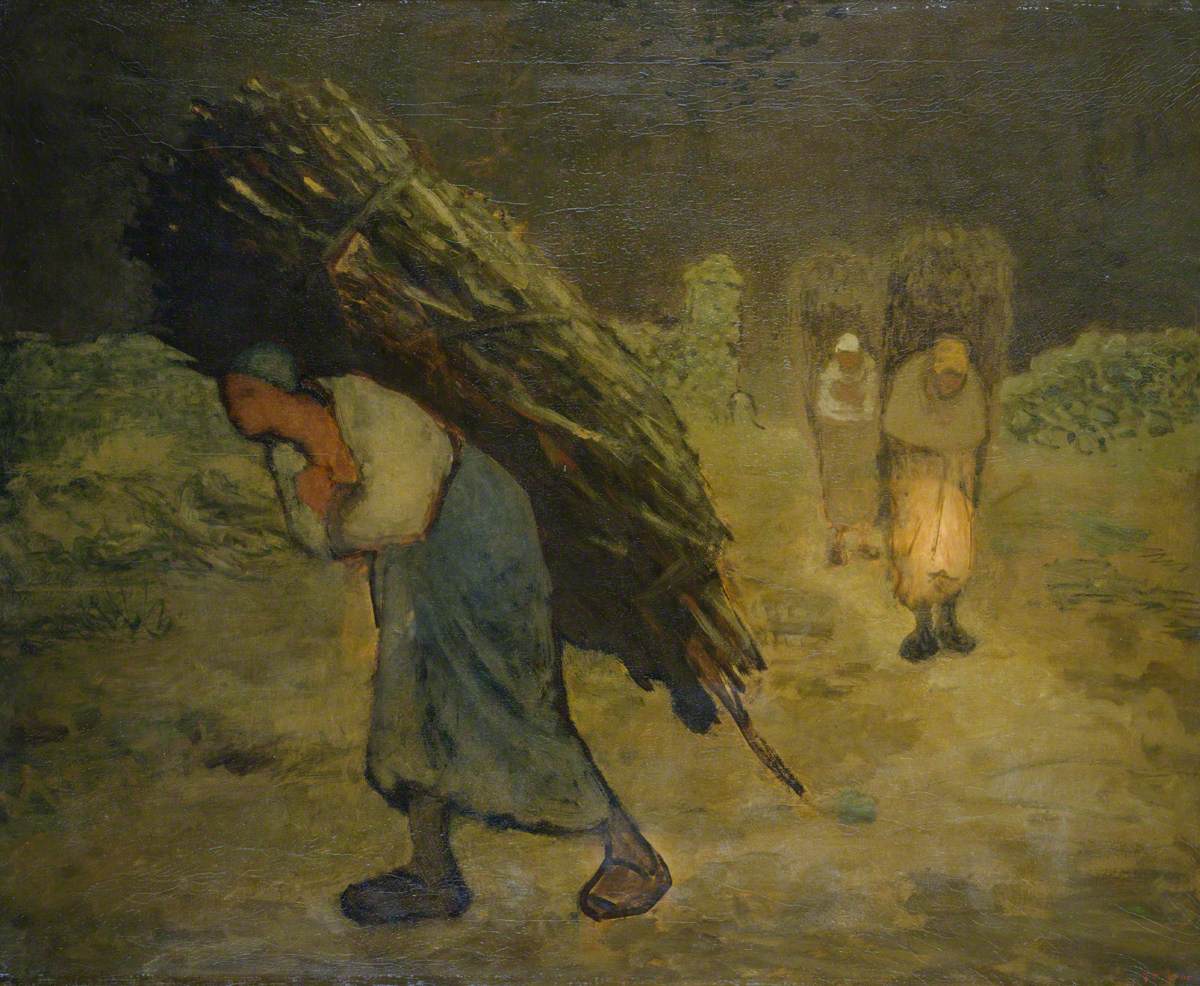
Having just visited the National Gallery and an exhibition on Millet:

https://www.nationalgallery.org.uk/exhibitions/millet-life-on-the-land

Dr Sanil Rege on twitter provided:


Seeing, and reading (again?) about 'The Faggot Gatherers' I couldn't help but see socio-economic history enacted:

'Two women are taking a short rest from gathering tree branches for sale as firewood. The older woman’s hunched back and clawed hands betray a lifetime of physical toil. The setting is the forest of Fontainebleau, south of Paris, close to the village of Barbizon. Millet was an exponent of Realism, a movement that rejected historical art and idealisation in favour of a truthful view of contemporary reality.'

Text: https://www.nationalgalleries.org/art-and-artists/232271
Winter, The Faggot Gatherers Jean-François Millet (1814–1875) National Museum Cardiff

The National Gallery's accompanying text reads:

'Three women are on their way home trom the forest of Fontainebleau. One of its entrances, the Porte aux Vaches, is visible at the back right. The staggering scale of their loads threatens to overwhelm them in their stumble homewards. The scene evokes Millet's 1851 letter to his biographer Alfred Sensier, in which he described how seeing 'a poor figure laden with a faggot reminded him of the constant fatigue of people's lives.
While the painting is unfinished, the elemental figures are typical of Millet's vork. The extreme simplification of their forms results in austere silhouettes.'

Mental illness has always been a facet of humanity, evidence of trephination from prehistoric times and across cultures and geographies bears testimony to the mind - body divide. Life was brutish physically too. What chance did the weakest stand? If, that is a broken bone: you could be left behind? But perhaps we underestimate the knowledge and experience of our ancient ancestors. Knowledge gained and passed orally, culturally, even before written history. Perhaps too, we struggle to understand how early humanity expressed itself beyond the big-stick of nature and the struggle for survival as the hominids that led to 'us' were winnowed down?

Even as recent as the 19th century life was hard. As the notes above attest, Millet's work seeks to record the sheer physicality of labour, even as the industrial age emerged. The advent of the industrial revolution brought its own pressures and privations, as pastoral life is replaced with change work at home (spinning cotton) to urban and factory growth. 

Severe mental illness would have been institutionalised in poor houses, religious and charitable organisations. Parity of esteem is grounded, to some extent in the questions: "What happened to you?", or "How are you feeling today?" In Millet's work the physical cost and strain stands out. While in the L'Angelus there is debate about prayer, or grief. What is visible usually speaks first, and stands for itself. This is why self-awareness, reflection, critical thinking, observational and interpersonal skills are important; and why mental health nursing calls for specific knowledge and skills. And, in psychiatry too, even when the same is contested.

Image source: Oil on carvas Lent by Amgueddfa Cymry - Museum Wales. Bequeathed by Gwendoline Davies in 1952.

Sunday, April 03, 2022

MEMO TO: New College of Humanities and London Interdisciplinary School

Re. "Introduction to Lifelong Learning 101"

Since 1998, when I first went 'online' I've always been conscious of etiquette and note how this has changed - developed - over the years. The email associated with the former website domain p-jones.demon.co.uk saw a lot of emails to quite a diverse range of mail lists. Should I? Should I not? These questions remain a key consideration in trying to spread the thought and word on Hodges' model.

Stepping on toes a couple of times, someone also asked about links to blog posts on LinkedIn. Not had those queries recently so I think readers understand the 2x2 table is critical to the post in representing the model. Twitter presents its own challenges [ #WasteOfTime ]. So please pardon my shouting, but there's an important message here about an important resource.

I've lapsed again with no progress on the new site - maybe it is not just vapourware but a dream.

The creation of new education institutions: 

the New College of Humanities and London Interdisciplinary School

- is encouraging for the work here:

"The London Interdisciplinary School wants its students to be problem solvers with a wide range of academic interests."
(Nicola Woolcock, Polymaths plan to teach universities a thing or two. The Times, October 2, 2021. p.17.)

Does it, really - and by implication the NCH, plus New Model Institute for Technology and Engineering (NMITE) and others?

The Times Education Commission with proposals for reform due in June, adds further impetus and evidence ...

I read this evidence as supporting the argument that education and health are and always will be 'legacy issues', that is in need of change, investment, policy. All disciplines of study and knowledge are always dynamic and should be challenging, personally and collectively.

If institutions can distract themselves from fiscal incentive of the bums on seats for a few moments and policy makers look up from the dotting of  I's and crossing of T's then student's learning can be energised by Hodges' model: a generic bootstrap for lifelong learning.

Just to be clear. This model is NOT about boxes, it is about being aware of boundaries and being prepared to cross and use these journeys.

In the 21st century we are humbled by what now constitutes the pantology - the system of all knowledge. No individual can take in - apprehend and master it all, but we should have a means to at least conceptually touch this incredible gift.

INDIVIDUAL
|
 INTERPERSONAL    :     SCIENCES               
HUMANISTIC --------------------------------------  MECHANISTIC      
SOCIOLOGY  :   POLITICAL 
|
GROUP
Education
Philosophy (Ethics, Logic)
Psychology: (Applied, Child, Clinical,
Criminal - Forensic,
Occupational,
Artificial Intelligence ...
Cognitive Sciences
Theology
Arts
Creativity and Design
Eco-Anxiety
Happiness - Metrics
...

Sciences: Biology, Physics, Chemistry*
Health: (Medicine, Nursing ...)
Occupational Professions
Computer Science, Information
Mathematics
[macro - nano] Engineering
Architecture
Design and Creativity
Environmental Studies
Hydrology
Land use: Forestry ...

Arts (Music, Dance, Drama ...)
Literature
Anthropology, Archaelogy
Languages
Ancient-History, History
Future Studies
Social Work
Sociology (Culture, Ethnography ...)
Anthropology
Gender Studies
Philanthropy
...

Politics, Government
Security
Law & Crime - Fraud/Corruption
Policing - Law Enforcement
News and Media studies
Political Science - Citizenry
Economics
Socio-Economics
International Development
Peace Studies
Administration
Leadership and Management
War and Conflict ...


I am pleased to see that the post re. Nicholas Maxwell's work is popular here:

"How Universities Have Betrayed Reason and Humanity—And What's to Be Done About It" c/o Nicholas Maxwell 

*So many sub-disciplines: Climate studies, Epidemiology, Marine biology, Quantum Computing / Physics, Exobiology, Astronomy, Materials, Demographics, Geology, Genomics, Cybernetics, Systems, Epigenetics, Exobiology, Neuroscience, Public (Mental) Health, Allied Health Professions ...


Thursday, January 21, 2021

Book review: iii "Leave No One Behind" #LNOB

Arriving at chapter 4 "No Smallholder Farmer Left Behind" by Jane Nelson,I was acutely aware of the news from India in the (N) autumn. Smallholders and family farmers protested about newly enacted farm laws. The government claimed the changes would protect the farmers from bullying middlemen, while the farmers were afraid of price instability and the rise of corporations*. Even in today's news I note this issue is ongoing. Very quickly any romantic notions of smallholder farmers are challenged reading this book and must be set aside. How can being a farmer (and agricultural laborers) equate with being among the world's poorest and most vulnerable and yet they number an estimated 500 million? There are 200 million smallholders producing food as part of formal supply chains and yet they are in extreme poverty and were circumstances are improved, there is a risk of relapse. 

Leave No One Behind
The talk of public-private partnerships, even if 'new' is disconcerting. This is the 21st C. though as  'inclusive business models' are defined. I was (slightly) shocked at the proximity of businesses and corporations, what choices do 'small-players' have? This is the value of the book, correcting parochial notions from Wigan Pier.

With an eye on the Green agenda though, and reading of the role for technology it still unsettles me thinking about bio-genetics, digital colonialisation when reading of the role of digital technology. With low and high Earth orbits filling up, there should be improved broadband access in remote locations, but I do wonder about choice. This is were the authors and organisations will no doubt push an advocacy role (p.68).

  As I mention orbits and digital technology, mapping is key and to smallholder farmers too:

It is good to hear of development work that is also climate-smart. Leapfrogging is a important idea in the book (to follow) but I hope that as mobile technology has jumped the communications infrastructure of some developed nations that small-holders here can also leapfrog. The book's footnotes do not leapfrog, they are fairly constant and a very rich thread of learning and sources. A key and literal platform for leapfrog is big data and AI (p.70) [ https://www.brookings.edu/research/using-big-data-and-artificial-intelligence-to-accelerate-global-development/ ]. Hopefully, this blog demonstrates my enthusiasm and interest in STEM, again with these influences I can't help recalling my review of Friel's LITTLE-big book on climate change and the people's health in which attention to the nutritional value of food is stressed. When Nelson asks of the poorest farmers "What are they eating?" (p.76) yes, you do have to ask. 

Give me a page of text and certain words standout a kilometer. 'Holistic' is one. So, holistic investment in infrastructure is needed (p.77) and a holistic approach to on- and off-farm interventions. The expertise, experience and political awareness of the development community is evident here in accounts of measures and evaluation. Rurbanomics (p.77) concerns the linkages between rural and urban economies and in policy terms there could be specific mention of the rural phenomena of 'empty villages' (in the EU too?) and the need to better manage the movement of people from rural to urban environments.

The chapter organisation is almost logical moving to refugees and migrants [Chap. 5]. I've posted before on geopsychiatry and it will be interesting to see in coming years if non-refoulement (p.79) routinely enters the news lexicon. At this time, how the majority of us wish we could travel, and p.82 had me wondering about ancient history before 'countries': no nations. Discussion of the definition and its limitations of 'refugee' 1951 is very informative, especially as it relates to the SDGs, which includes migrants. You can see how much crossover there is (and must be - sustainable determinants of health ...) between the SDGs and hence the need for all governments to address this in policy and law. 

Working in healthcare and c/o Brexit and the COVID crisis you are aware of the global nursing and social care workforce.  This is described here in terms of training (p.96) To state the obvious, politically, refugees and migration remain a charged matter. Quite rightly the gains from international refugee and migration flows have a section of their own. Since the 1990s you become ever more aware of remittances sent abroad (and until recently the cost of the same). Talk of seasonal work has an analogue in the seasonal routes that people at great risk whatever their reasons, make from Africa and Asia. I've mapped some content from chapter 5 to Hodges' model:

INDIVIDUAL
|
INTERPERSONAL : SCIENCES
humanistic ----------------------------------------------- mechanistic
SOCIOLOGY : POLITICAL
|
GROUP - COMMUNITY - POPULATION
mental health
post-traumatic stress
knowledge diffusion

access to shelter, water,
health care and sanitation
rural - urban
border regions
cities
social media
social attitudes in receiving nations
sexual and gender-based violence
formal labor market access
informal camp employment?
remittance flows
'mechanism design theory' p.93
land registration
having an 'address'

I learned of What3Words quite a while ago** and the addition of 'having an address' in the POLITICAL domain is an addition. I knew an article in May (FT Magazine, 16-17 May 2020, pp.32-35.) would come in handy:

"Where the streets have no name" by Deirdre Mask - The Address Book. 

An illustration by Andy Robert Davies says it all:

Mask's book points out the obvious that if you are Stateless you are address-less too. The health - political implications here are serious and this problem is not restricted to 'developing' nations. So much is tied to this: track and trace, having a bank account, being able to vote all can depend on this specific information. Without an address, a default - whether acknowledged or not - of 'data missing' in census data gathering follows. For many nations the 'census year' has been disrupted by the pandemic. 

Referring back to migrants, refugees and the recent politicization and nationalistic rhetoric, reading made me wonder about government's ability to envision the positive potential of migration flows and refugees. The statistics are revealing in the impressions provided by social media and news reporting. The problem for (some) policy makers and resident populations given the bias and misinformation of reporting seems to me, extracting individual and family narratives from the collective.

The reader is very well served with the index, if needed, while reading and my writing here. Unless I've missed it, there is a missing reference to 'tax' on page 312, which we'll reach next time. It is an important one.

Homi Kharas, John W. McArthur and Izumi Ohno, (Eds.) 2020. Leave No One Behind: Time for Specifics on the Sustainable Development Goals, Washington D.C.: Brookings Institution Press.  

*https://www.aljazeera.com/economy/2020/12/1/why-are-thousands-of-indian-farmers-protesting

**https://hodges-model.blogspot.com/2016/04/what3words-mapping-globe-hodges-model.html