Ryle's 'logical geography'
I like the way Ryle apparently analogised philosophy to cartography.*
'Similarly, Ryle advocated that philosophy should chart the 'logical geography' of our concepts. In The Concept of Mind he argued that the Cartesian dualism of mind and body results from 'category-mistakes': it treats mental concepts which signify behavioural dispositions as if they referred to processes that are just like physical ones, only more ethereal. Ryle rejected Wittgenstein's therapeutic image according to which 'the philosopher treats a question like a disease' (1953: §255). Yet he accepted that philosophy is a meta-discipline which does not 'talk sense with concepts' but tries to 'talk sense about concepts' (1949: 9-10). The paradox of analysis disappears since the task is not to provide novel information about a realm extrinsic to us. According to Wittgenstein, philosophy reminds us of rules that we have mastered in practice but which mislead us in the course of philosophical reflections. According to Ryle, it takes us from the knowledge how to use words to an explicit knowledge that they are used according to certain rules. Either way, analysis is not a trivial pursuit, because the explanation of philosophically interesting concepts is complex and rich, especially when it places these concepts in their diverse contexts (everyday, scientific, philosophical).' p.43.
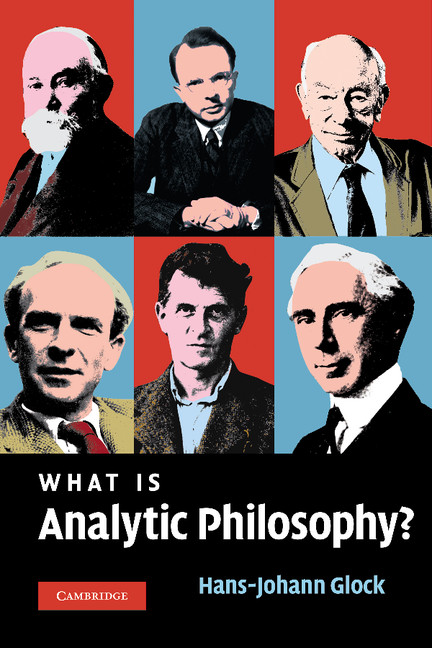
Hans-Johann Glock. 2008. What is analytic philosophy? Chapter 2. Historical survey. pp.21-60. CUP. Pb.
https://www.cambridge.org/us/universitypress/subjects/philosophy/philosophy-general-interest/what-analytic-philosophy
https://www.cambridge.org/us/universitypress/subjects/philosophy/philosophy-general-interest/what-analytic-philosophy
* 'Ryle analogises philosophy to cartography. Competent speakers of a language, Ryle believes, are to a philosopher what ordinary villagers are to a mapmaker: the ordinary villager has a competent grasp of his village, and is familiar with its inhabitants and geography. But when asked to interpret a map of that knowledge, the villager will have difficulty until he is able to translate his practical knowledge into universal cartographic terms. The villager thinks of the village in personal and practical terms, while the mapmaker thinks of the village in neutral, public, cartographic terms.[20]: 440–2 '. https://en.wikipedia.org/wiki/Gilbert_Ryle
I've wondered about 'cogeography' - combining cognition and geography, even care cartography. There is also of course psycho-politics, geo-psychiatry and psycho-geography ...
Hopefully a more current text would be more diverse.^


 orcid.org/0000-0002-0192-8965


