Good luck Suns & Daughters . . .
Individual
|
INTERPERSONAL : SCIENCES
HUMANISTIC -------------------------------------- MECHANISTIC
SOCIOLOGY : POLITICAL
|
Group
'The sun may be on its lonesome now - its closest neighbour is 4.2 light years away - but that wasn't always the case. Once upon a time it had close family. After their birth in the same cloud of dust and gas that formed our solar system, these solar siblings scattered hundreds of light years apart in the MilkyWay. In May, astronomers reported the first one: a star called HD 162826. "It looks like the sun, but a little-bit bluer," says Ivan Ramirez at the University of Texas at Austin, who led the study. It's also warmer than the sun and 15 per cent more massive. The star is about 110 light years away, and you can see it with the aid of a pair of binoculars in the left arm of the constellation Hercules.' | 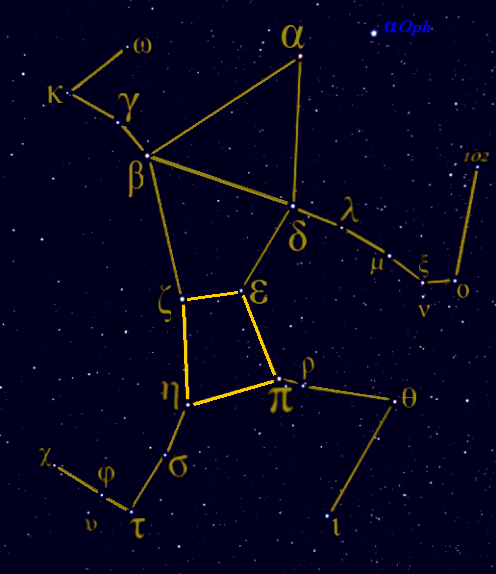 |
'To find its family ties, Ramirez's team combed through galactic archaeology studies, which model the motions of the Milky Way. These predictions laid out where sibling stars would be now if they had formed in the same place as the sun. Though they spread out in different directions, their positions still give away their birthplace, Ramirez says. He narrowed down the search area to 30 stars, and then looked at them closely to find a family resemblance. Only HD 162826 had a similar chemical make-up to the sun. A separate team led by Eric Mamajek at the University of Rochester in New York also studied the star and found it is the same age as the sun, as would be expected for two stars born together. Even more tantalising, HD 162826 is already in a catalogue of stars that might harbour planets.' | Science funding |
Rebecca Boyle. Strangest star. New Scientist. 20 September 2014: 223, 2987, pp.38-41.
Image: Sadalsuud, CC BY-SA 3.0, via Wikimedia Commons.


 orcid.org/0000-0002-0192-8965



