Theatre in TI:ME
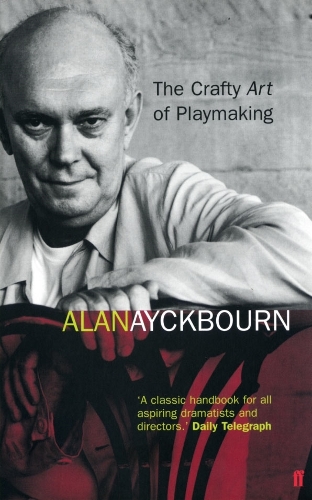 |
| The Crafty Art of Playmaking |
Since the publication of TCAoP in 2004 people seem to quite ready to dispense, disregard, downplay, demote the humanistic with the rise of AI and assisted dying for the terminally ill (of course).
Time recurs - as a frame. (p.25) with a touch of elective surgery. 'Think of your story as a piece of thread. Where you cut in is the point at which the lights come on in Act One. Where you cut out will be your final curtain. (There may be a knot or two in the middle to denote the intervals, too.)' p.25.
In the first post re. TCAoP I stressed the complexity, plethora of ideas that Hodges' model can create. Sir Alan provides a potential 'get of jail free card' (or as near as?) in his original rule no. 9.
'If a play can be too simple, it can also be too complicated. If one element is particularly complicated, keep the rest of it simple.' (p.25).
Very useful advice! But achieving it when having and applying an idea is another matter.
What's this though? Step back to original rule no. 6:
'There is no hard and fast rule as to which constructional element comes first.' (p.20).
 |
| Butrint National Park Albania |
In the guided discovery exercise in students (audiences..) creating the model, there are two constructional elements, that also contribute to the one big idea.
It gets better! Original rule no. 14:
At least fifty per cent of your play is going to be visual. (p.33).
I must make sure I don't confuse concept/ual with visual/imagery.
More to follow.
The Crafty Art of Playmaking by Alan Ayckbourn. Faber, 2004, softcover, ISBN 0571215106.
https://www.concordtheatricals.co.uk/s/45898/the-crafty-art-of-playmaking


 orcid.org/0000-0002-0192-8965


