Hodges' Model: Welcome to the QUAD: hate

Hodges' model is a conceptual framework to support reflection and critical thinking. Situated, the model can help integrate all disciplines (academic and professional). Amid news items, are posts that illustrate the scope and application of the model. A bibliography and A4 template are provided in the sidebar. Welcome to the QUAD ...

Showing posts with label hate. Show all posts

Thursday, March 19, 2026

'Loud' noises and silences - Martin Luther King

INDIVIDUAL
|
    INTERPERSONAL    :     SCIENCES               
HUMANISTIC --------------------------------------  MECHANISTIC      
SOCIOLOGY  :   POLITICAL 
|
GROUP


... We are confronted with the fierce urgency of now. In this unfolding conundrum of life and history, there is such a thing as being too late. Procrastination is still the thief of time. Life often leaves us standing bare, naked, and dejected with a lost opportunity. ... We may cry out desperately for time to pause in her passage, but time is adamant to every plea and rushes on. Over the bleached bones and jumbled residues of numerous civilizations are written the words, "Too late." There is an invisible book of life that faithfully records our vigilance or our neglect. Omar Khayyam is right: "The moving finger writes, and having writ moves on."
    -DR. MARTIN LUTHER KING, J.,
    Beyond Vietnam - A Time to Break Silence


Saturday, March 07, 2026

A definition of the 'Psycho-Political'

Clearing books, magazines and journals (to make space for a few new acquisitions) on a trip to Hay-on-Wye, I bought a secondhand copy of:

Weizsacker, Carl Friedrich von. (1980). The Unity of Nature.

I noticed chapters on the definition of health and illness, and information.

Models of Health and Illness, Good and Evil, Truth and Falseness

Chapter  Jun 2014 
https://doi.org/10.1007/978-3-319-03671-7
In book: Carl Friedrich von Weizsäcker: Major Texts in Philosophy (pp.74-89)

Abstract

This essay is the core of our reflections on cybernetics. It is the only essay in this Part that tries to describe concretely what cybernetics can achieve. Written in the fall of 1967 but unpublished until now, it was inspired by a lecture on “Peacelessness as Mental Illness” delivered in Bethel in 1967 (published in Der ungesicherte Friede; Göttingen: Vandenhoeck & Ruprecht, 1969). On that occasion the question arose whether it is medically justifiable, or merely metaphoric, to call the inability to maintain peace an illness. As far as I can see, contemporary medicine lacks a sufficiently clear concept of illness to decide this question. Since I had no desire to merely skirt the issue, I was faced with the task of outlining a scientifically justifiable definition of illness. The result is presented in Sect. 6.2 of this essay; its social application is very briefly sketched in Sect. 6.4.

(My emphasis)
Unfortunately, I cannot find a copy of the lecture. In my softback copy the title is "Lack of Peace as Psychic Illness".

We don't tend to think of mental illness in the collective, but history provides many examples within and extended across communities - 'mass psychogenic illness'. More recently there is a literature on the mental health, competency of global leaders, also known as 'hubris syndrome' previously. Even the history of Carl Friedrich von Weizsäcker is controversial, his World War II record and knowledge of nuclear physics.

We have a veritable storm across all the domains of Hodges' model (including the spiritual) that point to the model's ongoing  relevance, consider:

  • climate crisis;
  • pollution (air, water ...)
  • geopolitics;
  • disruption of the international rules-based order;
  • the status and reputation of global organisations (were they ever 'international'?);
  • the record of current global political leadership;
  • the need to protect Political titles (not just Professional titles, Dr, Nurse, ...)?;
  • the rise of artificial intelligence.


Link: 
https://www.researchgate.net/publication/300477492_Models_of_Health_and_Illness_Good_and_Evil_Truth_and_Falseness?
Monday, October 13, 2025

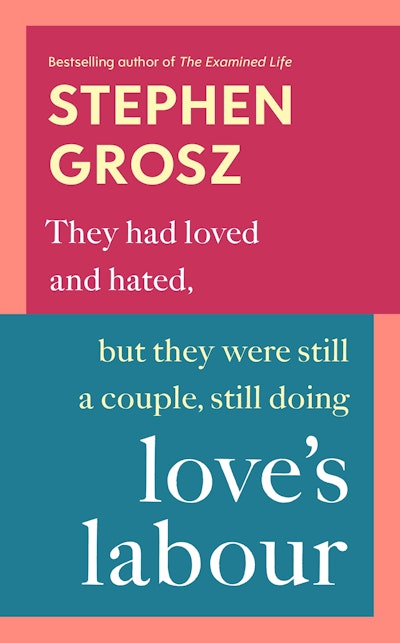
Book: Love's Labour by Stephen Grosz

They had loved and hated,
but they were still a couple, 
still doing love's labour ...

Luminous and necessary stories from the psychoanalyst's consulting room; on desire, heartbreak and learning how to love.

When it comes to love why do we find things so difficult? Drawing on over forty years of candid and surprising conversations with his patients, Stephen Grosz asks, what gets in the way of our falling in love? And what must we do to stay there? Penguin UK.
<>
'Ravi, a maths lecturer, is tormented by his wife Sonal's supposed infidelity, but won't look at the CCTV - even though that might reveal her to be innocent. This chapter has a sting in its tail when 19 years later Grosz is contacted by Sonal. She is dying of cancer and Ravi is cruelly neglecting her. Grosz feels that he missed a vital clue all those years ago, concerning Ravi's ingratitude and envy.

This moment of "failure" on Grosz's part forms an aspect of this small book's power. It shows that the psychoanalyst is not a machine, and the process is fallible. But it is also a testament to human complexity. When he hasn't understood the patient sufficiently, Grosz brings the case to his supervisor, and we, the reader, are witness to their exchange.' Life&Arts, FTWeekend.
Individual
|
      INTERPERSONAL    :     SCIENCES               
HUMANISTIC =========================  MECHANISTIC      
 SOCIOLOGY  :    POLITICAL 
|
My source: Kathy O'Shaughnessy. The hard work of seeing ourselves. Books, Life&Arts, FTWeekend, 27-28 September 2025, p.11.


Iamge: https://cdn2.penguin.com.au/covers/400/9780701188979.jpg

Monday, March 17, 2025

1st Seminar Series: "Violence, Memory, Networks" - Interdisciplinary Connections

Dear colleagues,

The first session of the seminar "Violence, Memory, Networks" will take place on 19th March, 2025, at 2.30 pm (GMT), exclusively online.

In this session, Caroline Elkins (Harvard University, USA) will speak about "Legalized Lawlessness: Violence and the End of the British Empire" and Max Silverman (University of Leeds, UK) will bring us a communication on "Concentrationary violence and the everyday: the Zone of Interest (Jonathan Glazer, 2023)".

Registration is free but mandatory: https://forms.gle/brgNcR6hk6dxf7gu7

Event website: https://www.uc.pt/fluc/seminarvmn/

We would be very grateful if you could publicise the event through your channels.

Looking forward to see you soon,

The organising committee.

My source: https://www.uc.pt/fluc/ief/

Monday, January 22, 2024

When you 'give no quarter'^


When the only thing
on the table is your history,
there is no space, even as corners multiply.
No longer is there space for a future,
no longer space for hope,
no space for a peace to be thought of -
let-alone shared.


When you give - absolutely! - no quarter
and act to prove the same,
Yes, you stand.
But how do you stand?
You stand to lose insight,
and so much more - 
you stand to lose
humanity


 Individual
   |
      INTERPERSONAL    :     SCIENCES               
 HUMANISTIC  --------------------------------------  MECHANISTIC      
 SOCIOLOGY  :   POLITICAL 
|
Group
CON-SCIENCE

SCIENCE

geo-

Time & Land

politics

PEACE?


^Easy for me - many of us - to say?

Listen also:

BBC Radio 4 Start the Week War crimes justice
https://www.bbc.co.uk/sounds/play/m001vktw

Where do you/we find peace? Discuss.
