Hodges' Model: Welcome to the QUAD: Search results for bunge

Hodges' model is a conceptual framework to support reflection and critical thinking. Situated, the model can help integrate all disciplines (academic and professional). Amid news items, are posts that illustrate the scope and application of the model. A bibliography and A4 template are provided in the sidebar. Welcome to the QUAD ...

Showing posts sorted by relevance for query bunge. Sort by date Show all posts

Wednesday, February 14, 2024

Distance: Shoulders and ships that pass ...

James Lovelock, 2005 (cropped).jpg
Lovelock in 2005: Wikipedia

Over the past 10-20 years I've become more aware of the distance from scholars and people whose work is relevant to Hodges' model. Distance in the sense of their concomitant 'celebrity', hence the issue of how to make contact; and the stage of their career and my discovery of their relevance. Three people come to mind ... 

I've long admired the work of James Lovelock, and when writing on ecological themes in -

Jones, P. (2008) Exploring Serres’ Atlas, Hodges’ Knowledge Domains and the Fusion of Informatics and Cultural Horizons, IN Kidd, T., Chen, I. (Eds.) Social Information Technology Connecting Society and Cultural Issues, Idea Group Publishing, Inc. Chap. 7, pp.96-109.
- I wondered about trying to contact Dr Lovelock. As the majority of people are aware his thought and books, especially the Gaia hypothesis with Lynn Margulis caught the public's imagination from first publication and through the 1970s. Was there a Horizon TV programme? James Lovelock's influence was not just in ecology, but also earth (planetary) sciences through work for NASA. In early 2021 I thought I would reach out, through his most recent book and publisher/agent. I passed a message, which was forwarded but I never heard anything more.

As a nurse - with experience in older adult community mental health, I was acutely aware that this senior gentleman - in every sense of the word - may not want to be mithered by a scouser*, now living near Wigan Pier. I stressed not wanting to disturb the Dr. I also thought, given Dr Lovelock being of independent mind - a maverick, he might on the contrary love to be disturbed. 

Sadly, I was too late, hearing the news of Dr Lovelock's death in 2022. Of course, I was seeking validation (and still am) for the project here. I can't help thinking though, that Dr Lovelock really would have 'got' Hodges' model.

James Lovelock: BBC Radio 4 The Life Scientific

<>

Philosophy has long been an interest B.A.(Joint Hons.) Comp./Phil.. In a way you have no choice as a nurse, especially trained in mental health and general nursing: the theory and practice invariably touch reality, consciousness, perception, subjectivity, objectivity, knowledge, being, perception, data, information, time and so on.

Once acquainted with Hodges' model, scale is the dimension that asserts itself. I wrote about this and referenced Mario Bunge in about 1998, on the old, now archived website:

https://web.archive.org/web/20100329050839/http://www.p-jones.demon.co.uk/infintro.htm

Scale is a constant and multicontextual focus, but interest was piqued once again as I try to look at Hodges' model mathematically (yes, who am I trying to kid!) - as an object and relationally. I was reminded of Prof. Bunge's work noting a paper that included 'isomorphic-ism':

Bunge, M. (1969). Corrections to “Foundations of Physics”: Correct and Incorrect. Synthese, 19(3/4), 443–452. http://www.jstor.org/stable/20114653

https://link.springer.com/article/10.1007/s10838-021-09553-7

Mahner, M. Mario Bunge (1919–2020): Conjoining Philosophy of Science and Scientific Philosophy. J Gen Philos Sci 52, 3–23 (2021). https://doi.org/10.1007/s10838-021-09553-7

There may be a brief email exchange with Prof. Bunge, a request for a paper or two. Any emails are now stored (CD-ROM and portable drive) in a Turnpike folder, an old email client. Last year I was disappointed again, to learn of Dr Bunge's passing in 2020. His focus on science, philosophy, and systems - hard / soft is also very informative.

<>

More recently, I came across the fascinating work of David Sallach, one paper (a conference from 2012) includes:
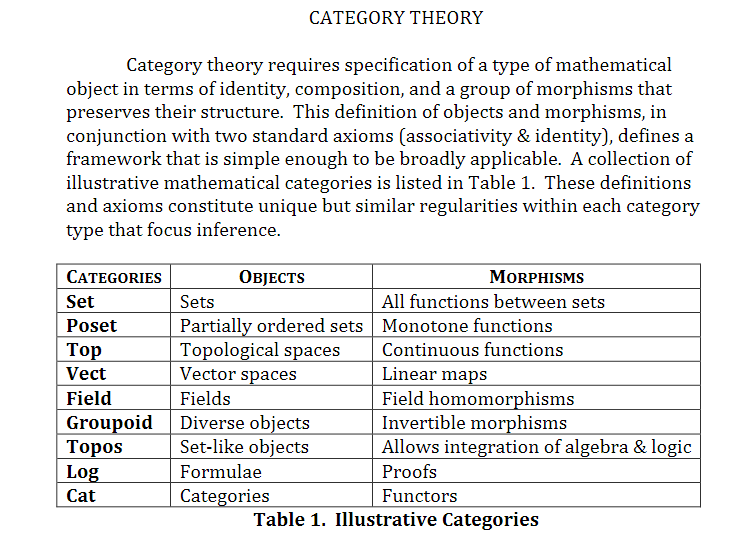

Sallach, D.L. Categorical Social Science: Theory, Methodology and Design. September 2012
Conference: Fourth World Congress on Social Simulation. Taipei, Taiwan.
https://www2.econ.iastate.edu/tesfatsi/Sallach2012CategoricalSoSci4.WCSS-SS.pdf

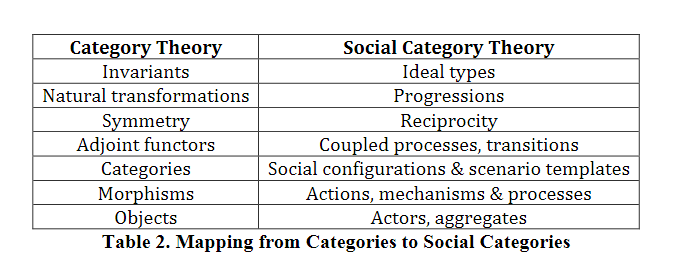
Plus, developed further in table 2:

If time permits as an exercise, please consider Sallach's table 3 below. It may be interesting to map this to the domains of Hodges' model(?) [template]:
:
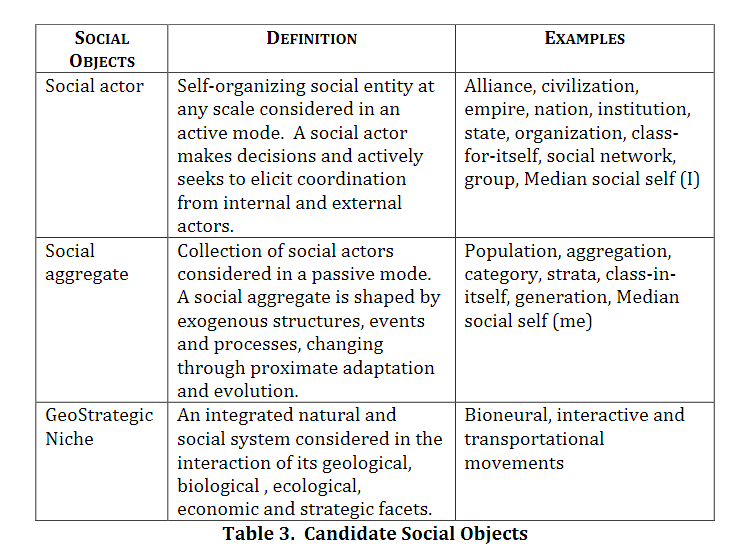
If you can see the potential utility of Hodges' model, you may also appreciate why Sallach's paper  resonates. Having emailed Dr Sallach, without reply, I did some checking. More sad news followed.

I, and no doubt many people will continue to discover and appreciate the legacy left behind by the above and many other pioneers. 

<>

I must acknowledge - Enid Mumford - whose work on socio-technical systems continues to inform my study and application of Hodges' model. This includes recognition of the many x-disciplinary bridges (or, barricades?) that can be found within Hodges' model. 

Clearly, much reading still to do.
<>

Returning to Hodges' model as a mathematical object, the 'distance' above is suddenly interstellar (and yes, sudden, as in faster than light!). I'm following videos, papers, and specific work-streams by  universities (I won't mention presently...) seeking to apply category theory to the social sciences. This suggests, at least, I'm not (completely!) wasting my time. If you have thoughts yourself on Hodges' model, the journey from Sallach's tables 1 - 2 not just 3, I'd be delighted to hear from you. 

There is another approach I will share this (N) spring. This author - researcher I have been able to contact.

*Scouser - https://en.wikipedia.org/wiki/Scouse
(Re. Liverpool - further post to follow).

James Lovelock image:  Bruno Comby, CC BY-SA 1.0, via Wikimedia Commons.

Saturday, November 29, 2025

If "mechanism-based approach to theorizing offers an encompassing way ...

... to think about social and ecological phenomena":

What if there was a model that could encompass 
mechanism-based and humanistic-based theorising?

'A core challenge of studying ecosystems and societies as one system is integrating social and ecological theorizing. Although the social and the ecological intertwine in multiple ways, much traditional theory focuses on one or the other (Schlüter et al. 2022). Despite good intentions, attempts for integration are often only partially successful. One reason for this is the apparent incommensurability of methodological and theoretical approaches. However, the mechanism-based approach to theorizing offers an encompassing way to think about social and ecological phenomena by framing them in terms of entities and their interactions. Mechanism-based theorizing has been gaining popularity in science philosophy (Machamer et al. 2000, Craver 2007, Glennan and Illari 2017), including social sciences philosophy (Elster 1989, Hedström and Swedberg 1998, Hedström and Ylikoski 2010) and philosophy of ecology (Pâslaru 2017, González del Solar et al. 2019). It has helped to resolve many traditional problems related to scientific explanation and it is consistent with the way in which social and natural scientists talk about theorizing, causation, and explanation.'


Fig. 1. The social-ecological expansion of Coleman’s diagram.


Martínez-Peña, R., & Ylikoski, P. (2024). Coupling social and ecological mechanisms with the Coleman boat. Ecology and Society, 29(4). https://doi.org/10.5751/ES-15209-290406

See also: 'micro' : 'macro' : 'Bunge'

Thursday, April 30, 2026

ii WCCS26: World Conference on Complex Systems 20-22nd April

Day 1

Plenary Talk: Reda Benkirane - Lost in Complexity: Welcome to the Real World

A first slide considered Abraham Maslow's book The Psychology of Science and his thought on the "law of the instrument". Maslow's hierarchy of needs is a key primer for new students to many disciplines, including nursing, and psychology. The purpose of Benikrane's focus on instruments concerns the emergence of civilisation and roles of agriculture, and war in the rise of community at several scales from village, to cities, states and nations. In terms of flow the slides highlighted the next speaker Peter Turchin's END TIMES, and two books by Johann Chapoutot, LES IRRESPONSABLES, and FREE TO OBEY.

In response to the slide with Einstein's -

"We cannot solve our problems with the same thinking we used when we created them":

- may I please class 'health - care' as a world? The thought that the medical, bio-medical, and bio-psycho-social encourages, sees enacted, and sustained a : is this fit for the problems of the 21st century. I like the slide's heading 'Beyond Complexity'. Such is the pace of change, which is labelled 'progress' that each one of us wakes up momentarily stupified and lost in complexity.

Keynote Speaker: Peter Turchin - The Great Holocene
Transformation: What Complexity Science Tells Us About The Evolution of Complex Societies

Turchin's keynote reminded me of Jared Diamond's book Guns, Germs and Steel. Reading GGS I realised there is more to 'axes' than I thought, especially from the individual to collective scales. It appears that whichever label - academia, research or education - you would like to apply, they all need a conceptual framework. Just as, individually, we all need a model of self, others and the world. This was a marvellous journey, through millennia of humanities' evolution, social, and political development, all realised through complexity. While attractors are to the fore, architecture and archaeology are regular distractors for me. Reading Holocene then had me hooked. 

A fellow delegate and speaker I dined with a few times encouraged me to read 'END TIMES'. I will seek it out later this year, (the next Hay-on-Wye visit?). Turchin is seeking to account for how human societies have reached their current state of organisation. The role of self-protection, seeking food, shelter, co-operation are all factors, with the emergence of religions, and agriculture. Several theories to date were covered [including, cultural multilevel selection, see Wilson et al. (2023)], plus a major project on cultural evolution: The Seshat: Global History Databank. For all the current loss and misery, conflict has paid a major role in cultural and political development. The prefix 'macro' features here. There was a social scale (people): FROM 10s - in foraging bands through TO 100,000,000s large nation-states. Mention of levels of scale, took me back to the work of Mario Bunge. The application of the Hertzsprung-Russell 'main sequence' (H-R) diagram is a great idea. I think Olaf Stapleton, author of Star Maker would have approved. 

This itself, for me, is reason enough to read Turchin. There is evolutionary biochemistry too, which is required in terms of a systems account. Is there a reflection of a main sequence construct between the SOCIOLOGICAL and SCIENCES domain of Hodges' model? 

 It is incredible the way new findings are regularly pushing even further the dates of human milestones stepping-stones. Perhaps we should always view progress in this way, and enjoy the 'moment'. There is still the puzzle of ultrasociality, and how to explain it? Turchin is seeking a mathematical history, with a journal Cliodynamics. There is another SF reference here, in Asimov's psychohistory in the Foundation books, but with less emphasis upon maths. This is encouraging for Hodges' model, and the inevitable transdisciplinary approach these questions demand.

More to follow ...

D.S. Wilson, G. Madhavan, M.J. Gelfand, S.C. Hayes, P.W.B. Atkins, & R.R. Colwell, Multilevel cultural evolution: From new theory to practical applications, Proc. Natl. Acad. Sci. U.S.A. 120 (16) e2218222120, https://doi.org/10.1073/pnas.2218222120 (2023).