Hodges' Model: Welcome to the QUAD: paediatric

Hodges' model is a conceptual framework to support reflection and critical thinking. Situated, the model can help integrate all disciplines (academic and professional). Amid news items, are posts that illustrate the scope and application of the model. A bibliography and A4 template are provided in the sidebar. Welcome to the QUAD ...

Showing posts with label paediatric. Show all posts

Thursday, November 20, 2025

South Sudan Medical Journal - November 2025
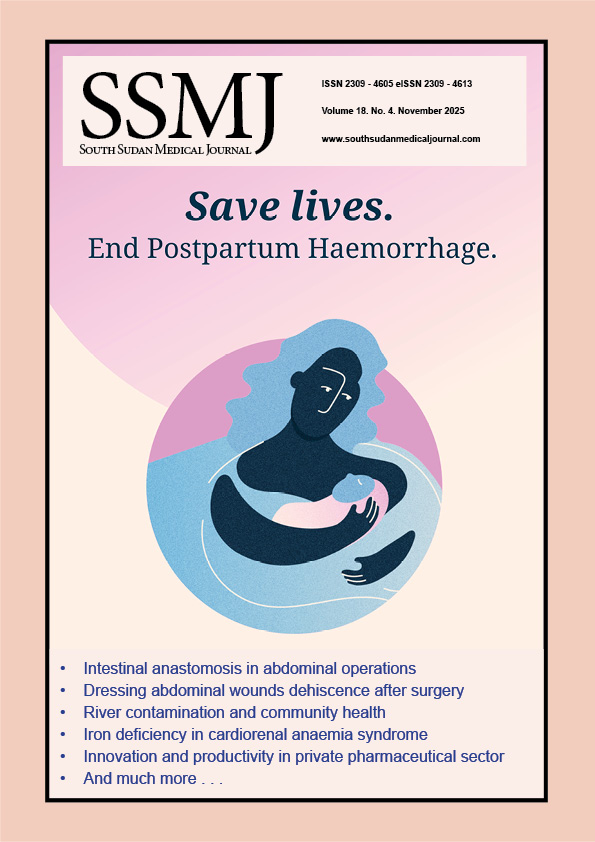
SSMJ Vol 18 No 4 November 2025

 Dear reader,

The full issue of our November 2025 issue is now online; this is a bumper issue featuring 14 full articles and other news items, listed below. We thank the copyeditors and reviewers who helped prepare these papers. Let us know if you would like to join the Editorial team. We need you if you have time and editing skills.
 
Editorial

Research Articles

  • Comparative study between classical two-layer and one-layer extra-mucosal intestinal anastomosis in elective and emergency abdominal operations. John Chol Ajack, Galal Abouelnagah, Haytham Fayed
  • Comparison of improvised negative pressure wound therapy and conventional wound dressing in abdominal wounds dehiscence after surgery. Nasra Lichika, Edward Ketson Msokwa, Alphonce Chandika
  • River contamination and community health: mining impacts in rural central Kalimantan, Indonesia. Nawan, Septi Handayani, Agnes I. Toemon, Hepryandi L. D. Usup, Seth Miko, Joni Rusmanto
  • Iron deficiency in cardiorenal anaemia syndrome in Dodoma, Tanzania Gidion Edwin
  • Guerrilla investors: Firm-level innovation and productivity in South Sudan’s private pharmaceutical sector Garang M. Dut
  • Paediatric deaths at Al-Sabbah Children’s Hospital, Juba, South Sudan – an audit Zechariah J. Malel, Garang Dakjur Lueth, Mary Poni Jackson, Nicolas Kazimiro Sasa
  • Prevalence of anaemia among pregnant women attending the antenatal clinic at Bor State Referral Hospital. Mark Kuoi Jongkuch Kuoi and Shalini Ninan Cherian
  • The impact of dietary compliance on diabetic foot ulcer healing: A cross-sectional study. Dadi Santoso, Rajesh Kumar Muniandy, Putra Agina Widyaswara Suwaryo

Review Articles

  • Personal determinants of gender-based violence: a review of intimate partner violence in South Sudan. Nyinypiu Adong
  • Misdiagnosing Muslims: The hidden risk of using the CAGE questionnaire in some Islamic contexts. Anas Ibn Auf and Sayed Halaly
  • Impact of healthcare worker training on paediatric tuberculosis detection and reporting: A systematic review. Suryanti Chan, Hamzah Hamzah, Miftahul Falah

Case Reports

  • Lupus nephritis overlap syndrome in a male with albinism: A case report. Adam Gidion Edwin, Baraka Alphonce, Sabina Mmbali, Alfred Meremo
  • Rare isolation of Pseudomonas mendocina from a postoperative wound in a diabetic patient: A case report. Vimal Kumar Karnaker, Asem Ali Ashraf, Bhadra Jyothikumar

Short Communications

  • News: Physicians Association of South Sudan and Association of Gynecologists and Obstetricians of South Sudan. Sudan

Back Page: Supporting Wet Nursing During Emergencies
 
Articles in SSMJ are indexed by Scopus, African Journals Online (AJOL), and the Directory of Open Access Journals (DOAJ), and as well as being on our website. SSMJ is included in the EBSCO scientific research collection.
 
Thanks to everyone who supports SSMJ. Tell your colleagues they can join our mailing list here.
 
The SSMJ team
Email: southsudanmedicaljournal AT gmail.com
Website: http://www.southsudanmedicaljournal.com

Saturday, June 20, 2020

30 Years of Progress: Nursing informatics and Nursing theory

Going through some papers I found some notes written in the 90s:

Allan Curtis a clinical services manager described the experience of setting up a 24 hour information service to a hospital paediatric hospital service.

Creating a system using Sensible Solution (a database package), Curtis noted how:
"The intricacies of programming were more difficult than I imagined."
Problems occurred when the school of nursing changed its adopted model of nursing, some information was then either redundant or incompatible.
"Although it would be nice to redesign the program to take account of such changes, it would take too much time - and money."
  <>

I do not have the article and a search failed to locate the full reference. I am assuming the link above is the 1980s-90s database package in question. When able to visit a university library I will update accordingly. It would be interesting to see if the model of nursing and the change was noted and any reasons. I'm sure they were? The point for me are the divides in skills, academic - service settings, finance and the status of 'models of nursing' (care). There is also the extent of change in programming and information systems. What is now referred to as 'the development stack' is far more powerful and yet more complex and complicated.

Curtis, A. (1990) Nursing Times, February 28, 86, 9, pp.69-70.

Thursday, April 19, 2018

Journal: Learning Health Systems - April 2018

https://onlinelibrary.wiley.com/toc/23796146/current

Learning Health Systems is an open access peer-reviewed journal dedicated to the science, engineering and design of continuous improvement of health and health care.

The new April 2018 issue is now available. Click here to read the latest articles. All articles are freely available to read, download and share.

My source:
Email: Kathleen Young
Editorial Assistant, Learning Health Systems
Room 210 Victor Vaughan
1111 East Catherine Street
Ann Arbor, MI 48109
734-763-1400

Wednesday, November 28, 2012

RFID Tags Track Possible Outbreak Pathways in the Hospital

There is no substitute for providing evidence that confirms many common-sense assumptions about what happens in the clinical environment that is the ward - in this case paediatrics.

See the links below for details and explanation.


My source: John Matson. Graphic Science. Scientific American, November 2012, page 76.
See also the original PLoS ONE paper.

Monday, October 06, 2008

Death in Birth By Vivienne Walt/Freetown Thursday, Sep. 18, 2008

An excerpt from an article in TIME magazine is posted below by Patti Abbott, Co-Director of the PAHO/WHO Collaborating Center for Nursing Knowledge, Information Management and Sharing (KIMS), Johns Hopkins University School of Nursing.

The entire article can be found at: http://content.time.com/time/magazine/article/0,9171,1842278,00.html

“In a hospital ward in Freetown, the capital of Sierra Leone, Fatmata Conteh, 26, lay on a bed, having just given birth to her second child. She had started bleeding from a tear in her cervix, the blood forming a pool on the floor below. Two doctors ran in and stitched her up, relatives found blood supplies, and nurses struggled to connect a generator to the oxygen tank. One nurse jammed an intravenous needle into Conteh's arm, while another hooked a bag of blood to a rusted stand, and a third slapped an oxygen mask over her face. In the corner of the room, a tiny baby--3 hours old--lay on a bed, wailing, swaddled in bright-colored African fabric. "Listen! You must feel happy to hear your baby cry," said a nurse, pleading with Conteh to find strength. Three visiting members of a neighborhood church began chanting over Conteh: "Jesus, put blood into this woman! Thank you, Lord!" But as their chants grew louder, the nurses stepped back from the bed. Conteh was dead.
Some version of that scene is repeated around the world about once a minute. Death in childbirth is not just something you find in a Victorian novel. Every year, about 536,000 women die giving birth. In some poor nations, dying in childbirth is so common that almost everyone has known a victim. Take Sierra Leone, a West African nation with just 6.3 million people: women there have a 1 in 8 chance of dying in childbirth during their lifetime. The same miserable odds apply in Afghanistan. In the U.S., by contrast, the lifetime chance that a woman will die in childbirth is about 1 in 4,800; in Britain, 1 in 8,200; and in Sweden, 1 in 17,400. Deaths are heavily weighted to the poorest and most isolated in each country, which means that many politicians remain largely ignorant of the scale of the tragedy. "Often the people in the cities do not know what is happening in their own rural areas," says Sarah Brown, wife of British Prime Minister Gordon Brown and patron of the White Ribbon Alliance, a global advocacy organization that works with governments to lower maternal mortality rates. Brown--who lost a baby 10 days after giving birth in 2001--says that when she tells heads of state and their spouses how many women die in childbirth, "they are aghast."

The Gains Not Made
They have reason to be. For here is the truly ghastly reality of maternal mortality: in 20 years--two decades that have seen spectacular medical breakthroughs--the ratio of maternal deaths to babies born has barely budged in poor countries. To be sure, maternal health has seen advances, with new drugs to treat deadly postpartum bleeding and pregnancy-related anemia. But in many places, such gains are dwarfed by a multitude of problems: scattershot care, low pay for health workers and a scarcity of midwives and doctors. In Mozambique, where women have a 1 in 45 lifetime chance of dying in childbirth, there are just 3 doctors per 100,000 people; in all of Sierra Leone, there are 64 government doctors, only five of whom are gynecologists. Millions of families have never seen a doctor or nurse and give birth at home with traditional birthing helpers, while those who make it to a clinic--some being carried on bicycles or in hammocks--often find patchy electricity, dirty water and few drugs or nurses. Explaining the task of reducing maternal deaths, Sierra Leone's Minister of Health, Saccoh Alex Kabia, who returned home last year after decades of working as a surgeon in Atlanta, says, "The whole health sector is in a shambles."

The article goes on to say:
“When world leaders gather in New York City this month to take stock of the MDGS, their speeches are likely to tout the many achievements since 2000: millions more African children now attend school and sleep under mosquito nets; thousands of new water wells have been dug. Yet though maternal health care underpins many other development goals (healthy mothers are more likely to ensure that their children are well fed and educated), the total number of women dying in childbirth has remained virtually unchanged in eight years. Why? Health officials are clear in their answers. Aside from lack of money and political will, they also face entrenched traditions and fatalistic attitudes to maternal mortality, especially in very poor communities. "People think that dying in childbirth is not preventable," says Nadira Hayat, Afghanistan's Deputy Minister of Health. "They say it is up to God."
~~~~~~~~~~~~~~~~~~~~~~~~~~~~~~~~~~

I think they need knowledge, a nurse, a midwife.

Patti
Patricia A. Abbott, PhD, RN, FAAN
Co-Director of the PAHO/WHO Collaborating Center for Nursing Knowledge, Information Management and Sharing (KIMS), Johns Hopkins University School of Nursing
___________________
Visit web site:
http://my.ibpinitiative.org/GANM/NMmakingpregnancysafer/

My source: posted by Jody Lori: [Nursing and Midwifery for Making Pregnancy Safer: Discussion] link to article in Time Magazine.

Additional links:

http://www.unicef.org/infobycountry/sierraleone.html

http://www.unicef.org/infobycountry/sierraleone_statistics.html

Wednesday, October 25, 2006

Student Query: Paediatric Burns Unit - Change from Hodges to Casey's Model

Rachael Baron contacted me from Salford University about her assignment on:

Change management relating to a problem identified in practise.

Mine is about changing from Hodges' model to Casey's in a paediatric burns setting (one of the reasons being that there is little evidence supporting Hodges) to achieve family centred care and better partnership with parents. Before my placement on the burns unit I had never come across Hodges' model so it has been interesting reading about it.
In response I acknowledged Rachael's observation about the evidence base and provided the reference bundle.

I also explained how Hodges can co-exist with another model (although the proof is in the testing). Brian Hodges has never been prescriptive in terms of a particular approach to how care is delivered, the model is higher level - an aide memoire. Noting Rachael's objective I wonder if Hodges' model could provide a test of the extent and quality of parent-guardian/care professional partnerships?

In addition Rachael informed me that they use the Health Career Model on the Burns Unit at Booth Hall Children's Hospital. I must follow this up and think Rachael was happy with the reply...
Once again, many thanks for your rapid response and suggestions for reading - it was a huge help!!
Cheers Rachael and best of luck with 6 months of your course remaining!
