Hodges' Model: Welcome to the QUAD: investment

Hodges' model is a conceptual framework to support reflection and critical thinking. Situated, the model can help integrate all disciplines (academic and professional). Amid news items, are posts that illustrate the scope and application of the model. A bibliography and A4 template are provided in the sidebar. Welcome to the QUAD ...

Showing posts with label investment. Show all posts

Thursday, November 20, 2025

South Sudan Medical Journal - November 2025
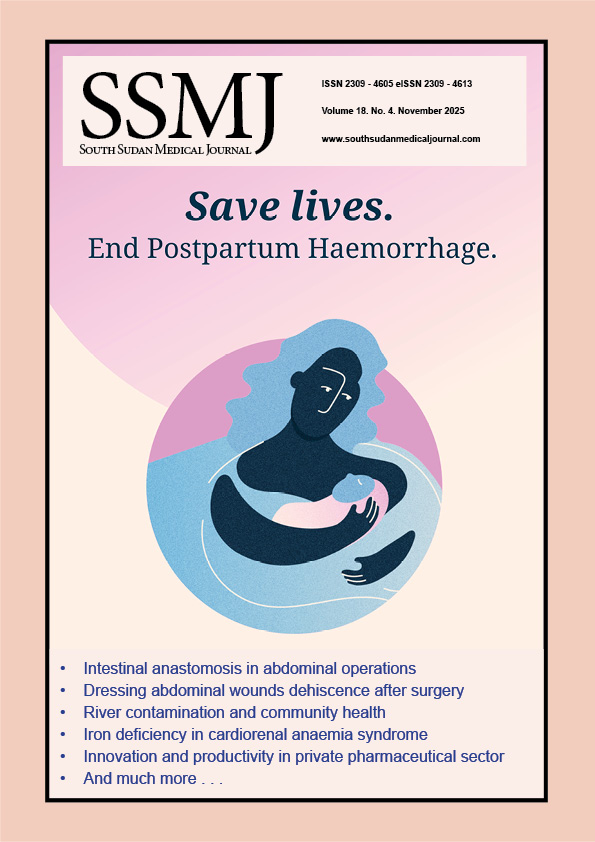
SSMJ Vol 18 No 4 November 2025

 Dear reader,

The full issue of our November 2025 issue is now online; this is a bumper issue featuring 14 full articles and other news items, listed below. We thank the copyeditors and reviewers who helped prepare these papers. Let us know if you would like to join the Editorial team. We need you if you have time and editing skills.
 
Editorial

Research Articles

  • Comparative study between classical two-layer and one-layer extra-mucosal intestinal anastomosis in elective and emergency abdominal operations. John Chol Ajack, Galal Abouelnagah, Haytham Fayed
  • Comparison of improvised negative pressure wound therapy and conventional wound dressing in abdominal wounds dehiscence after surgery. Nasra Lichika, Edward Ketson Msokwa, Alphonce Chandika
  • River contamination and community health: mining impacts in rural central Kalimantan, Indonesia. Nawan, Septi Handayani, Agnes I. Toemon, Hepryandi L. D. Usup, Seth Miko, Joni Rusmanto
  • Iron deficiency in cardiorenal anaemia syndrome in Dodoma, Tanzania Gidion Edwin
  • Guerrilla investors: Firm-level innovation and productivity in South Sudan’s private pharmaceutical sector Garang M. Dut
  • Paediatric deaths at Al-Sabbah Children’s Hospital, Juba, South Sudan – an audit Zechariah J. Malel, Garang Dakjur Lueth, Mary Poni Jackson, Nicolas Kazimiro Sasa
  • Prevalence of anaemia among pregnant women attending the antenatal clinic at Bor State Referral Hospital. Mark Kuoi Jongkuch Kuoi and Shalini Ninan Cherian
  • The impact of dietary compliance on diabetic foot ulcer healing: A cross-sectional study. Dadi Santoso, Rajesh Kumar Muniandy, Putra Agina Widyaswara Suwaryo

Review Articles

  • Personal determinants of gender-based violence: a review of intimate partner violence in South Sudan. Nyinypiu Adong
  • Misdiagnosing Muslims: The hidden risk of using the CAGE questionnaire in some Islamic contexts. Anas Ibn Auf and Sayed Halaly
  • Impact of healthcare worker training on paediatric tuberculosis detection and reporting: A systematic review. Suryanti Chan, Hamzah Hamzah, Miftahul Falah

Case Reports

  • Lupus nephritis overlap syndrome in a male with albinism: A case report. Adam Gidion Edwin, Baraka Alphonce, Sabina Mmbali, Alfred Meremo
  • Rare isolation of Pseudomonas mendocina from a postoperative wound in a diabetic patient: A case report. Vimal Kumar Karnaker, Asem Ali Ashraf, Bhadra Jyothikumar

Short Communications

  • News: Physicians Association of South Sudan and Association of Gynecologists and Obstetricians of South Sudan. Sudan

Back Page: Supporting Wet Nursing During Emergencies
 
Articles in SSMJ are indexed by Scopus, African Journals Online (AJOL), and the Directory of Open Access Journals (DOAJ), and as well as being on our website. SSMJ is included in the EBSCO scientific research collection.
 
Thanks to everyone who supports SSMJ. Tell your colleagues they can join our mailing list here.
 
The SSMJ team
Email: southsudanmedicaljournal AT gmail.com
Website: http://www.southsudanmedicaljournal.com

Friday, May 16, 2025

RCN Congress 2025 Liverpool i

... the twists and folds of debates

Repeating myself (again) but worthwhile I think(?), the past week brought my second RCN Congress. If you are new student nurse, international (Std) nurse, or nursing support worker and not engaged with a professional body, or union; do try to get involved. Don't leave it as long as I have (I joined a union as a nursing assistant). By way of a small excuse, listening this week it seems I am not the only one to leave it 'late'. Based in Liverpool (again after 2019) means there's a torrent of potential content. So where am I/We? By their nature all the debates are worthy. I have picked a few:

Discussion - Celebrating a nursing career

You can read above the main focus for the discussion. For me it prompted the following (no doubt - familiar)  reflections ...

The number of potential careers in health and social care is amazing:

Not only what the NHS (for training, education) can 'offer', but within that the number of nursing roles and specialities. The discussion inevitably drew the 'longevity' card. Students do pick on the temperature of their chosen community of practice. They recognise when they are surrounded (not literally!) by colleagues who have careers numbered in the several decades. But like a card the side that presents the occupational safe harbour from the threat posed by artificial intelligence, is countered by the seemingly relentless pressures imposed on nursing staff. The debates also revealed the pressure and negative impact of 'lived' work experiences for students and newly qualified nurses. I remember in the late 1970s early 1980s student nurses being counted as 'staff'. Have we really not progressed? I wrote 'offer' above because many students cannot get jobs once they have qualified. Not the best start to a shiny career. Having to fold, as they qualify.

Speaking of "career", can we please twist that? There is a great deal of talk - soul searching - about how on earth the (so-called) health service truly transforms itself to be health promoting and preventive. In the NHS's history perhaps there was a window of opportunity to begin in the late 1960s. Not so much a 'moonshot' as a healthshot. Now with the demographics that potential is being lost, unless this is positive way that AI can make up the shortfall? Alternately, nursing can utilise the health career, as in Hodges' model which are invariably impacted by an individual's life chances. As such there may be signs and signatures in the person's familial background? We can imagine a timeline composed of Hodges' model as 2x2 frames through a person's life, even prior to their conception and their legacy. 

More to follow . . .

Previously: 'RCN' : 'nursing' : 'power'

Please pardon the 'gambling' analogies, but we are literally asking students to gamble with their careers, financial status and well-being (life chances - no less). Should they be lost to the service, you can't blame young people. They know the logic of care, also known as demographics. They can do the maths? So who is it who can't do basic arithmetic?

Monday, May 12, 2025

'International Nurse's Day' 2025 #2 - c/o ICN & WHO

State of the World’s Nursing Report 2025


State of the World’s Nursing
Report 2025

'As the world’s nurses celebrate International Nurses Day (IND), ICN issues a rallying cry to governments around the globe for urgent nursing support, following the launch of the second World Health Organization (WHO) State of the World’s Nursing (SOWN) report.

The SOWN report is a vital assessment of the global nursing workforce in the aftermath of the COVID-19 pandemic and underscores the urgent need for bold investments in nursing to address shortages, strengthen health systems, and promote global resilience and economic stability.

The SOWN report reflects ICN’s IND 2025 report, Caring for nurses strengthens economies, and related Survey of National Nurses' Association (NNA) Presidents, reinforcing the central role of nurses in achieving global health, including Universal Health Coverage (UHC), and calling for immediate action to address long-standing challenges. The SOWN data presents a mixed picture. It highlights progress in areas such as advanced practice and nursing leadership, but indicates gravely concerning continued workforce shortages, inadequate compensation and working conditions, poor mental health support, inequities in the distribution and employment of nurses, and failures to fully enable nurses as practitioners and health care leaders.'

Continued ...

Caring for nurses strengthens economies


Caring for nurses
strengthens economies


'As we face growing health care challenges, from ageing populations and rising chronic diseases to climate-related emergencies and deepening global inequalities, the need for a strong, sustainable nursing workforce has never been greater. We cannot meet these challenges without sufficient nurses who are themselves well-cared for and supported. ICN’s International Nurses Day report reveals the severity of our current nursing shortage and well-being crisis – and the path forward. ICN’s “Caring for Nurses Agenda” provides a comprehensive roadmap for creating environments where nurses, patients, and entire health care systems can flourish.'

Thursday, May 02, 2024

Natural asset companies - 'Small is Beautiful'

Individual
|
      INTERPERSONAL    :     SCIENCES               
HUMANISTIC  --------------------------------------  MECHANISTIC      
 SOCIOLOGY  :    POLITICAL 
|
Group

What I value and the values I hold.

Philosophy

Nature - Nature has Intrinsic Value


What we value and the values we hold.


Natural Asset Companies

The continuity of capitalism, or new approaches?


 My prompt - following and commenting in chat:
'Part II of the Small is Beautiful Celebration' The Schumacher Institute

Apparently nature has intrinsic value and 'natural asset companies' are a thing (for good or ill is another Q. -  continuity of capitalism? Is this one way where (literally) SMALL comes in? As nature locally has value, citizens are stakeholders (in the country by proxy)? But then how as societies do we compensate urban environments and those who clamour for - see the future in 'smart' cities? https://www.nytimes.com/2024/02/18/business/economy/natural-assets.html
See also:
https://www.nature.com/scitable/knowledge/library/intrinsic-value-ecology-and-conservation-25815400/
Sandler, R. (2012) Intrinsic Value, Ecology, and Conservation. Nature Education Knowledge 3(10):4.

Lydia DePillis, Nature Has Value. Could We Literally Invest in It? The New York Times. “Natural asset companies” would put a market price on improving ecosystems, rather than on destroying them. 18th February 2024. https://www.nytimes.com/2024/02/18/business/economy/natural-assets.html

Sunday, December 13, 2020

Two Triangles: Fire and Bubbles

individual
|
INTERPERSONAL : SCIENCES
humanistic ----------------------------------------------- mechanistic
SOCIOLOGY : POLITICAL
|
group
O2

Fuel

Heat

Marketability of Assets

Expansionary money and credit

Intense speculation

My source:

Plender, J. (2020) Bubble, bubble, toil and trouble, Life & Arts, FT Weekend, 7-8 November. p.7.

Review of -

Levenson, T. (2020) Money for Nothing: The South Sea Bubble and the Invention of Modern Capitalism, London: Head of Zeus.

Quinn, W. Turner, J.D. (2020) Boom and Bust: A Global History of Financial Bubbles, Cambridge: Cambridge University Press. (This post draws upon a triangle in this book explained by Plender).

Monday, July 22, 2019

PRIMEtime CE: a multistate life table model for estimating the cost-effectiveness of interventions affecting diet and physical activity

When I saw Adam Brigg's tweet and thread the figure below stood out.

I have modelled some of the concepts using Hodges' model. I have added some additions, flagging gender* to highlight way this and other factors (often) need to be considered in a multicontextual manner.

There is a lot more of course, including the reference list; for example Squires, et al. which pose some interesting questions.

81. Squires H, Chilcott J, Akehurst R, Burr J, Kelly MP. A framework for developing the structure of public health economic models. Value Health. 2016;19:588–601.

Fig. 1 The PRIMEtime CE conceptual model


individual - self
|
INTERPERSONAL : SCIENCES
humanistic ----------------------------------------------- mechanistic
SOCIOLOGY : POLITICAL
|
group- population
Interventions
over time

individual behaviours
motivation

model: outputs
AGE, GENDER*
Active People Survey

DIET - PHYSICAL ACTIVITY

cardio-vascular disease - heart disease,
 stroke, diabetes,
 liver disease, cancers, raised blood pressure, cholesterol, and body weight

TIME: chronological-pathological
PROCESS
 PRACTICE

behaviours - social
over time

social care


socio -

population health

POLICY
health economics
health care costs
social care costs
return on investment
- economics


My source (and do follow Adam's full-thread):

Wednesday, August 29, 2018

Books: [ Gold Fever ]

individual
|
INTERPERSONAL : SCIENCES
humanistic ----------------------------------------------- mechanistic
SOCIOLOGY : POLITICAL
|
group
http://www.simonandschuster.co.uk/books/The-Drugs-That-Changed-Our-Minds/Lauren-Slater/9781471136887
The Drugs That Changed Our Minds

https://www.bookdepository.com/Natural-Causes-Barbara-Ehrenreich/9781783782413
Natural Causes
https://books.telegraph.co.uk/Product/James-Le-Fanu/Too-Many-Pills--How-Too-Much-Medicine-is-Endangering-Our-/22185615
Too Many Pills
GOLD
FEVER


...
Cured of what we suffered from
And sufferin' from the cure ...


My sources:
The Drugs that Changed Our Minds and Natural Causes, Sunday Times, 25 March & 1 April 2018
Too Many Pills, FT Weekend, 26-27 May 2018

Sunday, December 10, 2017

EHR Individual - Group: Aggregator

People probably look at Hodges' model and see something that is simplistic. There is a great power, however, in the scenarios that the structure of Hodges' model can readily encompass. Not just in the hospital, but across all care contexts.

"Where is the great value promised by the transition to EHR [Electronic Health Record]? Where is the huge surplus from all those lives saved? Without an actor who can find it, and deploy it to shift the doctors into surplus, nothing will happen. 
If the ecosystem* includes just the five traditional players, EHR will remain an academic dream. The answer, then, requires introducing a new player - an aggregator. Because the odds of mistakes are so low, the benefits of EHR are invisible to the individual patient. They become material only when we aggregate outcomes over a large enough number of patients. We need to find an actor whose surplus is affected by patients not as individuals but as a group, and who is able to both capture and distribute this benefit; insurers, health-care systems, and governments all fit the bill. And the larger the group, the larger the surplus." p.130.

*The ecosystem illustrated by Adner is simplified and includes:
Payer/ Insurer, IT Provider, Hospital Administration, Hospital Department, Doctor, Nurse, Patient
(I have added Nurse)

Adner, R. (2012). The Wide Lens: A New Strategy for Innovation. London: Portfolio/Penguin.

Tuesday, January 31, 2017

Plug & Play and IT Arms Races ... wither Patients, Persons...

On the internet, in journals and the conference circuit judging from various calls for papers and other announcements, you cannot move for innovation, creativity, biotech and change that is inevitably transformative. This is good don't get me wrong but in the push for plug and play ecosystems or calls for an IT arms race something(s) are repeatedly lost.

In the former its about consumers with a single diagrammatic mention of 'patient'. I looked for the person as in person-centered. I looked for the client. In the latter the arms race will be a mechanistic affair: a circuit that runs from finance to technology. I realise the agenda and audience for the articles is specific: IT is Healthcare IT News and a Consultancy Co. As previously noted here on W2tQ it's not just that I may be talking out of turn: I'm out of Continent too.

Reading these articles just convinces even more of the need for a conceptual grounding. We really should read:

 'plug and play' as mechanistic AND humanistic.

As for the IT arms race. Let's race by all means, that is what innovation and (rapid) progress is all about. But lets exercise our legs too and ensure that the data is not only stored holistically and distributed, but that this is the nature of its inclusive purpose and source.

Here and across the water they just don't get IT.

individual
|
INTERPERSONAL : SCIENCES
humanistic --------------------------------  mechanistic
SOCIOLOGY : POLITICAL
|
group-population

Prompted by:

PwC Health Research Institute December 2015

HIMSS Time for a health IT arms race

Thursday, June 25, 2015

Capital 'p': Patient, Person, Person-centred, Personhood

individual
|
INTERPERSONAL : SCIENCES
humanistic --------------------------------------- mechanistic
SOCIOLOGY : POLITICAL
|
group


capital Patient


Patient capital


Whenever financial markets get hyperactive - the norm rather than exception over the past three decades - we hear calls for "patient capital" that can fund long-term investment in the productive capabilities that are essential for a prosperous economy. ...
The problem is not just "short-termism" but more fundamentally value extraction that far outstrips contributions to value creation, with financial interests, including top executives, reaping gains that should go to taxpayers and workers.
For the sake of stable and equitable growth, it is time that these real patient capitalists lose their political patience, and demand fundamental economic reform. p.24.

Source:
Lazonick, W. Why patient capital is running thin, Armchair Alphaville, FTMoney. July 26/July 27 2014: p.24

Wednesday, June 04, 2014

Would you let a robot take your blood?

A Robot With A Hypodermic Needle 

Written by Lucy Black
27 July 2013

Would you let a robot take your blood? The answer to this question illuminates our real relationship to machines that aspire to rise above the robot vac. Is there another sort of uncanny valley?

Veebot is a very clever use of some basic image processing plus some very accurate positioning mechanisms. It first locates a good vein using infrared. Once it has a target it switches to ultrasound to make sure that there is enough blood flow to make it worth inserting the needle.

More...


My source:
International Society for Presence Research: June
http://ispr.info/


individual
INTERPERSONAL : SCIENCES
humanistic ------------------------------------------- mechanistic
SOCIOLOGY : POLITICAL
group
trust, confidence, anxiety, expectations, 'needles' - phobia, previous experiences, model of the 'other', intelligence, physical tests to differentiate mental health problems, subjective feelings - 'creepiness'
human
pa
safety, measurement, imaging, mechanics, technology, electromagnetic spectrum, infra red, ultrasound, motion, accuracy, research, trials, evidence, logic, blood sample,  appearance, (surgical robots R-here)
factors
in             RFT - 'right first time'
public awareness, interaction, relationships, community of practice - acceptance, publicity, media, dissemination
investment, policy, certification, law, standards, testing, supervision, labour relations

Tuesday, May 13, 2014

International Nurses Week: If I live I'll see you Tuesday...


Richard Prince (b. 1949)
Nurse of Greenmeadow 
Price Realized
$8,565,000

http://www.Christies.com/IfILive

My source:
FT Weekend May 10 - 11 2014. Life&Arts, Style p.5
Image:
http://www.pinterest.com/pin/560487116097991129/

Friday, September 14, 2007

Bottom line: The parts informatics does not reach

I really must get on board the bus: there are many assumptions that people make, what a nurse does, the role of a social worker and such like. I'd assumed that the private health sector - in this case a provider of residential nursing care would automatically invest in administration and clinical information systems. Silly me.

I don't know if the home I visited is an exception or typical of this particular group, but the staff are not only struggling to provide the best quality care for their residents, they are struggling with paper. Where's the I.T.?

2007 heading fast towards 2008 why I.T.'s in plastic folders, pinned on the office walls, on the office desks, semi-scrunched into pockets.

There is nothing wrong with paper and after all these staff are expert in handling several types.

What I was told, is that when a home (or two) is acquired and there are examples of good practices in documentation these will be adopted by the new parent. That is good; nothing wrong with that, surely this is a key part of what acquisition is all about.

The problem is that amid these additions the whole documentation system is not reviewed and rationalised; so the paper-burden grows literally with the organisation. Conclusions:

  1. There is a records management consultancy opportunity there for someone (race you!).
  2. I did not have to wait to see and discuss my client. There were no clinical information system vendors cueing up to demonstrate their wares. So good news for clinical informatics suppliers: you have of course not yet covered the (w)hole market!
  3. If this particular organisation is successful financially, how much more successful could it be if it embraced clinical and organisational informatics?
  4. Does the Commission for Social Care Inspection (and other regulatory agencies) take informatics capability into account in their assessments? If the benefits of effective informatics are real then they must be represented in inspection reports: shouldn't they?
  5. 'Success' what does this mean in a nursing home? Well, let's try marks out of ten -
  • the bottom line in the Financial Times;
  • the bottom line in the nursing home main office;
  • the bottom line on that top floor with its residents, staff and relatives/visitors.
So, what is the real bottom line?

Out of sight....
