Hodges' Model: Welcome to the QUAD: icons

Hodges' model is a conceptual framework to support reflection and critical thinking. Situated, the model can help integrate all disciplines (academic and professional). Amid news items, are posts that illustrate the scope and application of the model. A bibliography and A4 template are provided in the sidebar. Welcome to the QUAD ...

Showing posts with label icons. Show all posts

Monday, September 29, 2025

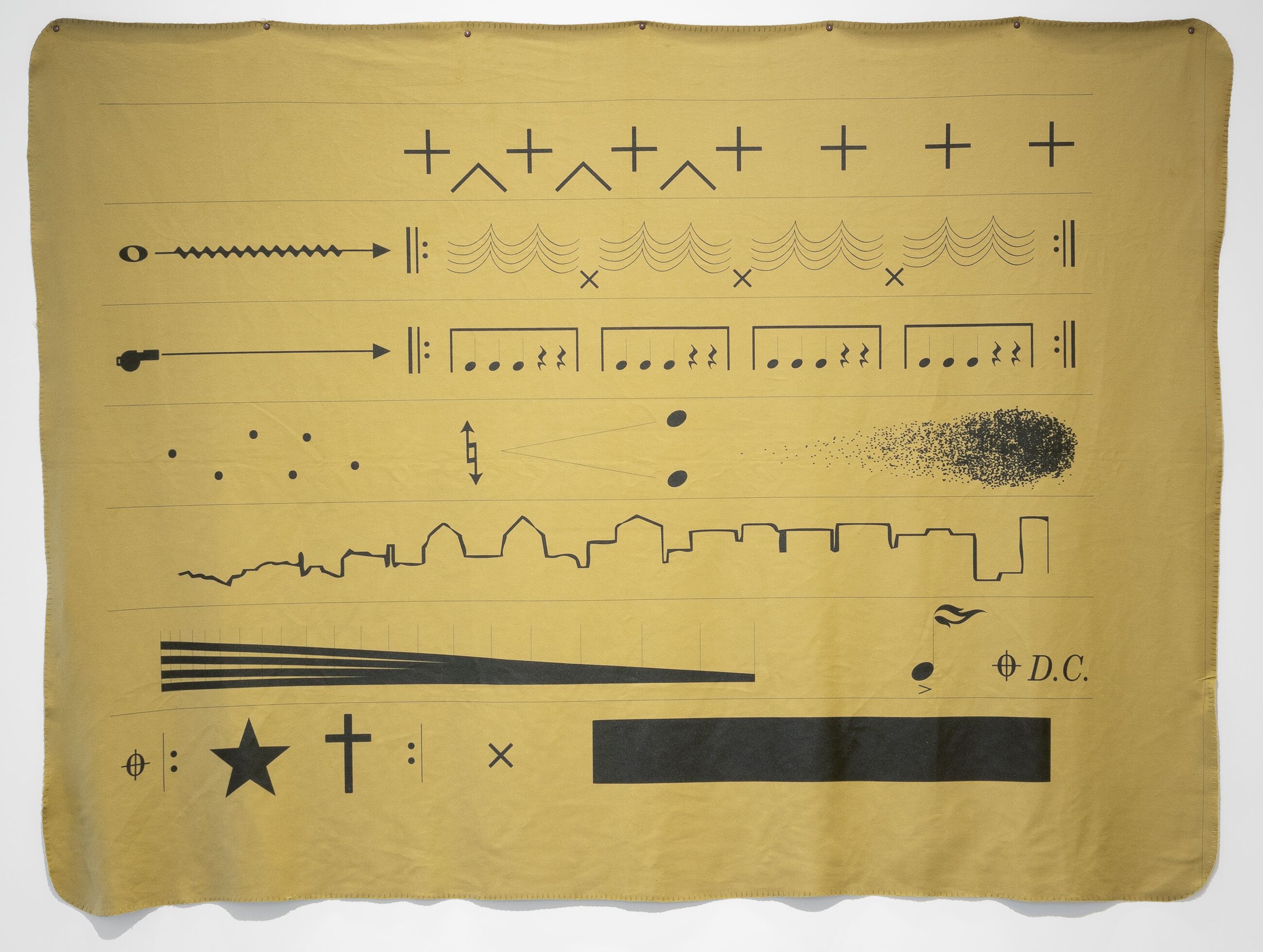
Raven Chacon - graphical musical scores

Individual
|
      INTERPERSONAL    :     SCIENCES               
HUMANISTIC  --------------------------------------  MECHANISTIC      
 SOCIOLOGY  :    POLITICAL 
|
Group
'The artist and composer Raven Chacon, 46, who grew up in Albuquerque and now divides his time between the city and upstate New York, used to explore these lava fields as a youngster, ingesting psychoactive plants such as jimson weed and searching for petroglyphs on the sides of rocks. Some - spirals, zigzags and dotted lines, for example - have found their way into the graphic musical scores for which he is now known. When I visited him in Albuquerque, he drove me out to see them.'
Raven Chacon, American Ledger No. 1 (Army Blanket), 2020. Graphic score


My source: Griffin, J. Sound of a different music. Life&Arts. FT Weekend. 24/25 February 2024. p.17.

Image: ECHOES OF A PLACE - Raven Chacon on transforming land, memory and political resistance into sound: https://www.hauserwirth.com/ursula/echoes-of-a-place-raven-chacon/

See also: RAVEN CHACON - https://spiderwebsinthesky.com/

https://en.wikipedia.org/wiki/Raven_Chacon

Previously: 'music'

Thursday, February 24, 2022

Book: "In Search of Mary Seacole"

 INTERPERSONAL    :     SCIENCES               
HUMANISTIC -----------------------------------  MECHANISTIC      
SOCIOLOGY  :   POLITICAL 
|
Community - GROUP - Population   


Mary
In Search of Mary Seacole
Seacole


"Known by the British Troops in Crimea as 'Mother Seacole', she was a nurse, pharmacist, humanitarian, businesswoman and patriot."


The Turkish Order of the Medjidie
French Legion of Honour
British Crimea Medal


Photo taken in Richard Booth's Bookshop, Hay-on-Wye, 19th February 2022.

Owolade, T. (2022) The myth of Mother Seacole, Culture, The Sunday Times, 13 February, p.22.


Saturday, July 22, 2017

Bliss + Symbols = Language for Care?

As I have written before on W2tQ the initial attraction of Hodges' model was its relation to brainstorming, mind-mapping, diagrams and the possibility of iconic languages. In addition, in the 1980s graphical user interfaces GUIs were introduced on microcomputers and PCs. There followed a rapidly expanding literature on icons, visual languages and interfaces. I had also heard of a Charles Bliss [ Charles K. Bliss (1897-1985) ] and Bliss Symbolics. So, to brainstorming ... we can add ideographs and pictographs.

This past week BBC Radio 4 explored the life and work of Charles Bliss and the application of Bliss in literacy, care and special needs education. The programme presented by Michael Symmons Roberts is available for 4 weeks. For its 30 minutes length the programme introduces Bliss himself, his life, aims, the challenges he and his wife faced and the ongoing legacy of his work. It could be argued - and has been - that this is a step backwards to hieroglyphs; but the programme is broader in its reference to 'care'...

individual
|
INTERPERSONAL : SCIENCES
humanistic --------------------------------------- mechanistic
SOCIOLOGY : POLITICAL
|
group

'bliss'


Wikipedia - Portal:Constructed languages


BBC Radio 4
The Symbols of Bliss

Ideal of
Universal - International
Languages


In the 1990s I received some copies of a journal devoted to 'Unish' a constructed language. The link to unish.net does not seem to work, but the Wikipedia site below includes some details.

Monday, June 01, 2015

Rich Pictures - rich pickings?

Seeking conceptual anchors I've often thought of Hodges' model as a rich picture. Reading to complete my latest module and add to the threshold concepts draft I came across:

Berg, T., Pooley, R. (2013) Contemporary Iconography for Rich Picture Construction. Systems Research and Behavioral Science 30, 31–42. doi:10.1002/sres.2121

There are several points with implications for h2cm and future work. From the abstract:

The RP is a diagrammatic means of identifying differing world views with the aim of creating shared understanding of the organization. The RP has predominately been used as a freeform, unstructured tool with no commonly agreed syntax.
Our research suggests that the RP requires structure to become a contemporary knowledge elicitation device. p.31.
The application of rich picture is quite specific within soft systems methodology [SSM], but there is much to learn here. Let's use the abstract as a template:

Hodges' model could be a diagrammatic means of identifying differing personal care needs, with the aim of creating shared understanding of person-centred care aims and co-created health literacy which whenever possible includes the patient and carer.

Hodges' model provides a structure but one that is nonetheless freeform. You could say the coastline is mapped, but only to a degree. I have already likened Hodges' model to a cognitive periplus. A coastline is clearly definable: initially (it is also fractal). For a ship as in years of yore where can it go? Can it turn inland, to new discoveries (and disciplines)? Is this an estuary with a navigable river? Can the ship find a way out to a new sea through this strait? Even if the ship hugs the coast navigating potentially treacherous waters when newly found? Does this flexibility in Hodges' model arise because it is in effect templatized (axialised)? I have often wondered about my concluding that the user of Hodges' model wants to have their cake and eat it too. By this I mean h2cm is simplistic and so it is dismissed by many, but it can serve complex purposes once populated. By deriving the care domains from the structure, h2cm provides conceptual spaces within which users can orchestrate the concepts pertaining to a particular situation, or context.

Back to paper: there is no syntax as yet since there are no designated icons for Hodges' model. There are many sources and libraries including possibly a subset of RPs, the Noun Project too.

Berg and Pooley write that: RP requires structure to become a contemporary knowledge elicitation device. There is a problem here in what we mean by contemporary, given how long RPs have been around. Of course the same applies to h2cm, hence my efforts. Can we, dare we be more ambitious?

From the paper itself:
This holistic methodology [SSM] uses the rich picture (RP)... p.31
Hodges' model is a holistic methodology that combines threshold concepts, conceptual spaces...!?

More specifically Berg and Pooley write:
Avison and Fitzgerald propose that there is an unwillingness to engage in the rather lengthy requirement gathering process of the RPs and further suggest that management want to avoid political issues that could arise. In certain hierarchal organizations, it is suggested that the RP does not appear ‘business like’, and there is a lack of credibility with the approach (Daellenbach, 1994). p.32.
Judging from the graphics in the paper much of the 'political' may be interpersonal-relationships, but this will inevitably also refer to interdepartmental and interdisciplinary wrangling. Hodges' model gets# politics. H2CM includes into its structure a POLITICAL domain. If we expand Berg and Pooley's observation could this account in part for the failure of so many IT projects and the need for socio-technical approaches? Computers feature quite highly as one of the most repeated icons in RPs (graph on p.35). There is also a striking similarity between Hodges' model and RP in the simplicity I referred to previously. Within the 'organization' and the hierarchy (even if levelled to pubescent bumps) there remains a need for efficiency (accounting for time), formality and being 'business-like'.

I suspect that for some people, depictions of RPs and Hodges' model are fine on the training room flipchart paper. Once the turn-is-given and the evidence is there to see on the A1 page then to expect more: time for drawing, reflecting, concept mapping, meeting of hearts and minds, problem solving... is a stretch of credibility for some. It may be that as Berg and Pooley do not refer to vocabulary, so often this is the stumbling block as there is no shared vocabulary. It may be close, but differences remain and technology waits for no organization.

Hodges' model attests that meaning comes from several sources and we need to listen in quadrophonic at least, and all before any pencil is licked.

<>


# Gets is used here in two senses: The model (I mean of course the user) gets politics  in terms of access to the political ramifications of whatever... This bare structure may not be doing anything but it has potential. Concepts, such as, consent, capacity, deprivation of liberty, 7-day follow-up, safeguarding, information sharing... can then be encountered in practice, learned and eventually integrated.
Students (and others) can get political as an activist
; be that as a critical thinker, advocating for healthcare, or within union and professional bodies.

See also (a dated paper and still an excellent read):
Shaw, Mildred L.G., & Gaines, Brian R. (1989) Comparing conceptual structures: Consensus, conflict, correspondence and contrast. Knowledge Acquisition, 1(4), 341-363.

The SSM - RPs community should look f/w with relish to the advent of VR. This can surely overcome many of the difficulties highlighted in Berg and Pooley (2013) and address the point above about contemporaneity. Icons will be ready-to-hand (gesture, look, thought!...): the challenge then becomes shared VR, but then this is central to its purpose.
Sunday, January 20, 2008

The symbol '+'

Apart from a multitude of symbolic meanings the figure below also provides the structural foundation for Hodges' model and as symbols .com notes:
Cross from symbols.com

The cross with arms of equal length is an extremely old ideogram used in most cultures. It is also one of the basic gestalts in Western ideography (as opposed to the basic elements, which are derived entities). The cross is found in every part of the world, in prehistoric caves and engraved on rocks.


In my interview with Brian Hodges' over 10 years ago in May 1997, Brian provided an account for how he arrived at this structure (summarised below). As mentioned elsewhere on this blog, the website, symbols.com and other sources - the cross, or 2x2 matrix is a common device to explain and structure. The four elements, the four humours (or humors) yellow bile, black bile, phlegm and blood, the seasons; there are so many things that can be characterised in this way.

With '+' as a starting point for me to reflect on Hodges' model I see each line as an individual. This agent or subject could include patient (person) and health care worker; lecturer and student and many other examples.

The act of cros-sing, the intersection of the axes represents two human beings being in a situation.

Space and time brings people together:

and also forces us apart - physically and temporally.

Adding an arrow to one end of these axes creates the dynamic of communication.

The angular distance in the alignment of those arrows offers hope -
  • in our common humanity we are never in 180 degree opposition;
and yet acknowledges:
  • the isolation of the individual -
  • and the challenge.
The work that must done. Hence the primacy of communication skills and values; in order to bridge individual being, ti:me and space.

Perspective is helpful here as an extension:

While we may get close to another person, through relationships that entwine the lines - be they spun by professional obligations, friendship, family ties, or intimate sexual relationships - the two lines are always distinct: part of an elaborated knot.

Is it just the special ties that must forever seek to be one+


The best way to explain h2cm is to review the questions Brian Hodges originally posed.

To begin, who are the recipients of care? Well, first and foremost individuals of all ages, races and creed, but also groups of people, families, communities and populations. Then Hodges asked: what types of activities - tasks, duties, and treatments - do nurses carry out? They must always act professionally, but frequently according to strict rules and policies, their actions often dictated by specific treatments including drugs, investigations, and minor surgery. Nurses do many things by routine according to precise procedures, rather like the stereotypical matron with machine-like efficiency? If these actions are classed as mechanistic, they contrast with times when healthcare workers give of themselves to reassure, comfort, develop rapport and engage therapeutically.

This is opposite to mechanistic tasks and is described as humanistic; what the public usually think of as the caring nurse. In use this framework prompts the user to consider four major subject headings or care domains of knowledge. Namely, what knowledge is needed to care for individuals - groups and undertake humanistic - mechanistic activities? Through these questions Hodges’ derived the model axial structure.