Hodges' Model: Welcome to the QUAD: Search results for needs

Hodges' model is a conceptual framework to support reflection and critical thinking. Situated, the model can help integrate all disciplines (academic and professional). Amid news items, are posts that illustrate the scope and application of the model. A bibliography and A4 template are provided in the sidebar. Welcome to the QUAD ...

Showing posts sorted by relevance for query needs. Sort by date Show all posts

Wednesday, August 03, 2022

Call for Papers - Basic Needs: Normative Perspectives

for a special issue on
Basic Needs: Normative Perspectives
(Editors: Lukas Meyer – Daniel Petz – Alessandro Pinzani)

Lessico di Etica Pubblica
http://www.eticapubblica.it/
 
In recent years the debate on basic needs and their place in normative theories of ethics and politics has been rekindled. This controversial concept has finally been openly adopted by authors who adopt different approaches to discuss issues of social justice. There are good reasons for this.

As a currency of justice, needs have several advantages. First, in contrast to preferences, desires, and some other currencies, basic needs are fully objective, i.e., whether a person has a basic need for a certain thing is independent of her own or anybody else’s mental attitudes towards that thing. A second important reason for preferring basic needs as the currency of justice is that they are also universal, although their definition might be culturally influenced. Thirdly, basic needs are intrinsically morally demanding: that P has a basic need for O by itself entails that P ought to be able to have, be, realize, etc. O. Finally, basic needs also have an important advantage in the particular context of sufficientarianism. One of the main objections against sufficientarianism is that it is unable to provide a plausible substantive specification of its threshold of sufficiency. The concept of basic needs, in contrast, essentially entails the idea of a qualitative difference. Being able to fulfill such needs takes precedence over being able to fulfill non-basic needs and desires. Moreover, it distinguishes a life that has a certain minimum quality from a life that lacks this quality.

We invite authors to explore these and other aspects of the concept of basic needs and its use for normative theories of social justice, including intergenerational justice.

Contributions can be in English, Italian, German, and French. The deadline is September 30, 2022

For inquiries please contact: Alessandro Pinzani <alepinzani AT gmail.com>
 
*currently.

Saturday, April 18, 2009

Nursing as reverse engineering...

At Scotland on Rails last month one of the sessions included an example of Ruby code outlining a 'morning routine'. It comprised a series of tasks and sub-tasks all of which led to getting to work.

Much of the vital essentials of the code I cannot understand beyond some tentative inklings, but in the hope of learning I've re-hashed the accessible bits and turned it into a NursingRoutine. The output looks like this....

Nursing....
"Non-judgmental attitude"
"Universal positive regard"
"Basic counselling skills"
"Open mind"
"Meet person"
"Receive referral"
"assess person utilizing Hodges model"
"Create care plan"
"Meet physical needs"
"Meet interpersonal needs"
"Meet political care needs"
"Meet social care needs"
"Holistic care"
"Evaluate physical needs"
"Evaluate interpersonal needs"
"Evaluate social care needs"
"Evaluate political care needs"
"Evaluate care"
"caring..."

Something like nursing is obviously a much more complex routine than that implied above - that is because:

  • nursing is not [some - 'thing'];
  • nursing can be represented as a routine BUT;
  • nursing seeks to transcend the routine: emphasizing the personal, unique, the humanistic;
  • nursing is parallel and sequential;
In addition now we are about collaborative, multidisciplinary care that must factor in agreement (the care plan...), and patient reported outcome measures (PROMS). ...

In the meantime I need to exercise care trying to understand the program that produced the output (that could also be easily printed as a list). While this is not an example there is such a thing as obfuscated code, but surely not obfuscated nursing care?

Friday, October 01, 2010

Older People with High Support Needs want more Choice and Control in How they Live their Lives

A new paper has been published today (to coincide with International Older Person's Day) by the National Development team for Inclusion (NDTi) to share findings from a two year project which is aiming to increase the voice, choice and control of older people with high support needs. This includes older people living in care homes and those living at home with a lot of support.

Around 1 million older people live in residential care and sheltered / supported housing. Older people want to have a broad range of options for their care and support, yet there seems to be widespread reluctance to develop and adopt new ways of thinking about and working with older people with high support needs. Traditional forms of service provision still dominate. As our society ages, the way we think about ageing, older people and disability needs to change to reflect with this demographic reality and the expressed wishes and desires of older people themselves.

The paper is from a 2 year project taking place in 3 local authorities in the South East Region of England. Local organisations and communities are working together to ensure options and opportunities are developed which support independent living and increase voice, choice and control for older people with high support needs. (See notes to editors for more information on the project and NDTi). The project is supported by ODI as one of the commitments in the Independent Living Strategy, which states:

Older disabled people must have the same options and opportunities for independent living as anyone else and the Strategy contains a number of commitments which will help achieve this goal.

The paper is :

- 'South East Regional Initiative on Increasing the Voice, 
Choice and Control of Older People with High Support Needs - Emerging Lessons'.

It summarises the findings to date from this project and has been written particularly to inform local authorities and partners about the work, to help them to achieve better outcomes for older people as well as best value in the use of public services and resources.

The paper highlights findings and messages about the priorities for ensuring older people can exercise greater choice and control over their support, including where and how they live. It also identifies some of the issues and barriers which get in the way of this happening.

A summary of the paper has been produced as an 'NDTi Insight' - part of a series of 2 page highlights of the most important learning from pieces of work carried out by NDTi.

...

Helen Bowers, Head of the Older People and Ageing Programme at NDTi and author of the paper said:
"The same level of commitment given to transforming health and social care is now required to transform expectations and experiences of older people with high support needs across all public services, including in residential care. Current debate in this area tends to focus on funding pressures and extending traditional services, rather than how we conceptualise, design and deliver support that promotes citizenship and transfers power from professionals and organisations to individuals, their families and friends."
To find out more, contact:- Helen Bowers, Head of Older People & Ageing Programme, National Development Team for Inclusion Magnolia House, 21a Stour Road, Christchurch, BH23 1PL Tel. 01220 471423 helen.bowers at ndti.org.uk
or
Rob Greig, Chief Executive, National Development Team for Inclusion - Head Office, Montreux House, 18a James Street, West Bath, BA1 2BT Tel: 01225 789135 rob.greig at ndti.org.uk

My source:
The Choice Forum

Thursday, June 10, 2010

Carer's support evidence / measures and end of life care

The following e-mail was received this week from (Prof.) George Kernohan and includes correspondence with Mary A. Waldron, Research Assistant, University of Ulster (thanks to Mary for confirming the reference).

My responses to George's points are right justified, italicised.

<->
Peter,

I am beginning to find examples of Hodges’ model every day now.

Once you adopt the model as a framework George it does tend to frame everything,
so I am not surprised at your finding. Maybe there is a paper there too...

Today we had a second research meeting to consider a (more) rigorous attempt to evaluate the provision of ‘support’ to carers of people undergoing palliative or End-of-Life Care (EOLC). An area of care with a dearth of evidence. So we looked at one review from Grande et al. (2009). They say that:

There has already been considerable research identifying carers’ needs in EOLC. These include psychological support, information, help with personal, nursing and medical care of the patient, out of hours and night support, respite, domestic and financial help.9,10,16–21 There is also a large body of research into adverse effects of care-giving, such as anxiety, depression, stress, strain, fatigue and mortality.22–24
Given this strong evidence base, any further investigation into the prevalence of needs and adverse effects should mainly focus on under-researched groups to ensure that future interventions are sensitive to their specific concerns. This includes carers of patients with conditions other than cancer, including neurodegenerative disorders,25 respiratory26 and cardiovascular diseases,27 to help us understand how differences in disease trajectories, awareness of the terminal nature of the disease and available support28 translate into different carer experiences. Although carers of patients with dementia have been extensively researched, little is known about their needs during patients’ final phase of life.9 p.340.
(The numbers refer to references by Grande et al., I have extended the quote used here).

Thanks for this paper George (and Mary) which I will read in full.
I extended your quote to encompass some additional interesting ideas.

To move toward a plan for a more rigorous evaluation, I would like to use a simple framework: here we go!

I think I will be suggesting Hodges’ Health Career as a possible model.

:-) ! If I can support you in this George I am pleased to help.

This could provide a framework for all carer-focused interventions in a broad way. As always, it would imply that carers need to have their needs addressed in terms of science, sociology, politics and interpersonal needs. As I see it, the first step would be to ‘map’ the carers’ needs onto that framework (from publications, if necessary from carers themselves). The basic idea (I think) is that care should address the four quadrants:
  • Science: (carer’s physical needs, information, instruction)
  • Political: (policy that enables care for carer, finance, allowance)
  • Sociology: (recognising that people need people, networks and “sharing” groups, story telling/hearing)
  • Interpersonal: (psychological support, prevention of anxiety & depression)
Have you any thoughts or guidance on this “mapping exercise”?

Goodness, that's quite a question!

Plenty of thoughts George but not sure how meaningful ....
Basically, since a community mental health project in 1990s
I have always considered (as per standard approach of course) that a toolkit of measures are needed. Even when we start from that most basic of distinctions between demand and supply.

As per your approach if h2cm is considered as a circle, a spectrum -
(sometimes we must circle the square)
then (if holstic) the adopted measures should cover all the domains:

Political: (outcomes, carer, patient satisfaction, financial assessment (means testing), respite care frequencies, reviews)
Interpersonal: (mood, coping ability, anxiety, depression, sleep, HoNOS)
Sciences: (pain, general health scales, care complexity (measures?))
Sociology: (dedicated carer assessment tools, sociability - social network size, psychosocial measures... there are many out there)

George, I realise the above is a ragbag collection but - like yours - these are dimensions which can (must) be reduced. Now there is also emphasis on this area post Darzi and the 'new' quality agenda.

This will serve (and is serving) to emphasize the distinctions between measures:

Objective - Subjective
Quantity - Quality
Staff administered - Self (Patient, Carer) administered
Global/general - condition specific
Service centered: Primary care - Secondary care

While it is easy to spin dichotomies,
the NHS must (constantly) focus on this area whatever the policy emphasis:

NHS Information Centre: Measuring for Quality Improvement

NHS Information Center: What is happening on indicators for...?

NHS Inst. for Innovation and Improvement: Quality and Service Improvement Tools

Earlier this year I contacted the NHS-IC [enquiries at ic.nhs.uk] regards additional measures of quality suggesting that the health career model bears due consideration (research).

Mental health services (and others?) have recognised how the measures they use can be a chaotic, personally selected, preferred, legacy-mix of assessment tools. Dictated by Senior Nurses, Consultants, Senior Management and not the evidence base. Now these are assured (are they?) with purposed selection (a task worthy of an 'away day') and then supported with regular in-house training.

Last month Anne-Marie Osbourne-Fitzgerald, Clinical Development Nurse, with (her) Clinical Manager, Denise Banks (Cygnet Hospitals), met Michael Doyle (Univ. of Manchester & Edenfield Unit, Prestwich Hospital) and I one evening at the Trafford Center in Manchester. Our two hour+ discussion covered the health career model, documentation, approaches to formal assessment and future plans (aspirations!). In the time available we obviously only scratched the surface, but Mike and Anne-Marie brought along examples of their paperwork.

Mike demonstrated how the health career model can be used implicitly or explicitly. At the Edenfield Unit the domains are being used individually to make up what is a standard A4 portrait form. The model informs their existing documentation; rather than the explicit form of the h2cm with the 2 x 2 matrix.
(I have a MS Word version of the latter and must update this to other formats).
Legally, as we know if it is not written down, recorded then it did not happen.
Educationally however, the objective is also to get students - practitioners - to think - before they do.

Anne Marie's documentation example at Cygnet Hospital included The Recovery Star:

http://www.mhpf.org.uk/recoveryStarApproach.asp

As you consider the star's points against the domains of the health career model - where in the model are you?

Can this provide another means to define 'care pathway'? A way that is not masked, hiding behind political, policy rhetoric (and really service-centered)? There are without question some excellent tools available, so care needs to be taken not to re-invent the wheel - hence your literature search. In some tools the effort and engagement of patients, carers and the public is exemplary. It seems what is needed is a hybrid solution. There is no single measure.

It may not sound scientific, but the complexities of care mean that academics, clinicians and managers must resort to a pick'n'mix approach. There is a battery of evidenced tools each with their history, application context and issues log (Why not? Lack of the latter might denote that such tools are no longer in development / review). As a clinician also involved in training, managers need to listen and make some tough operational decisions. The comms 'traffic' between clinicians, their managers, and senior managers needs to improve even more. Since, just using the above as an example, the STAR approach may find us on a ramble in the humanistic domains, the constraints of the mechanistic domain prompts the clinician's to ask:

"If you want me to use this assessment tool, what other thing do you want me to put down?"

As we are all aware: There is only so much time in a day, week, month, quarter. ...

In follow up emails I directed Anne-Marie to -

http://www.p-jones.demon.co.uk/contexts.htm

If you scroll down there is some discussion and graphics I did quite a while ago. This deserves revision as per the rest of the website, but the ideas are there I believe which can inform your project George?

Back then - and here on W2tQ I have been trying to demonstrate the wide range of contexts to which the health career model can be applied. In our meeting that evening the well established Tidal Model was also noted. This has of course benefitted from specific development, as per research that has produced audit and evaluation tools (Stevenson, et al. 2002).

It might make a useful reflective article – or at least a conference presentation. Ideally it would lead us to a measurement or observation approach ...

I would relish the prospect of a paper George, or a conference presentation. Not just contributing as a co-author/presenter, but supporting and enthusing new authors. The 21st century belongs to our students. Hodges' model can act as 'stellar' nursery not just here in the UK and EU, but globally. And not just in our respective disciplines (mental health, palliative - end of life care, forensic nursing care), but in informatics - conjoining and championing the need for socio-technical perspectives.

In addition to the above and thinking before they do, all health and social care practitioners must be able to reflect after.

As one of the original purposes for the model in my initial interviews with Brian Hodges (1997-98), research work addressing these are much needed.

This conceptual framework can offer much in case formulation, evaluation, clinical supervision, patient, carer and public (health) engagement.

[In short -] Can we measure Hodges' model?

George K. (Prof.)

You started with a big question George and similarly here at the end.
We have to be able to do this. In the first instance taking apart your question - there are clearly several questions here:

PRACTICE:

Above you noted that:

This could provide a framework for all carer-focused interventions in a broad way. As always, it would imply that carers need to have their needs addressed in terms of science, sociology, politics and interpersonal needs. As I see it, the first step would be to ‘map’ the carers’ needs onto that framework (from publications, if necessary from carers themselves).

It would be interesting to consider the formal process and practice of dementia care mapping against Hodges' model. Perhaps the approach you seek is something similar? If carer's make use of self-assessments these e-documents might act as an input for text analysis tools? If appropriate you could also weight certain items according to the priorities of carers? This would build on other carer research adding validity to your 'final' objectives.

Carers and clients (patients, service users) can with due explanation, appreciate the health career model. The model has a role to play in health education. I can well imagine a proforma similar to the Recovery Star example above, but purposed for carers and underpinned with the health career model. We also need to remember the spiritual domain, which is collective.

Ultimately George, your question concerns our ability to measure holistic, integrated, person-centred, multidisciplinary care and to state the obvious: there is no single measure to do this. Several tools and approaches gathered within a conceptual framework might however provide an environment favourable for a hybrid measure to emerge - literally a cycle?

THEORY:

In the paper you referred to George - Grande. et al. (2009) state:

In parallel with the lack of empirical evidence, there has been a lack of theoretical and conceptual models for when and how support provision in EOLC should improve carer outcomes. To guide further research, palliative care may here benefit from drawing on models within other fields, such as gerontology, sociology or psychology. p.341.

I am biased, but reading the paper the potential of the health career model as a high level tool is convincing just from a 'disciplinary cross-match'. Intra-, interdisciplinary, metadisciplinary and transdisciplinary perspectives could be a focus. This in addition to the specific knowledge and practical domains of sociology and psychology and as the authors note models therein. I forget the reference at the moment (and will check), but I recall carers / family units being framed in terms of strengths and weaknesses. That is, events, characteristics and relationships impact on a family with either additive, subtractive or neutral effects. This would seem applicable here?

While Grande et al. (2009) note that the (informal) carer's role is hidden (and is routinely described in this way) I wonder if in palliative care there are other dimensions that accentuate this 'hidden, covert' role?

The politics of potential death and actual dying may be another factor the health career model can help illuminate in a constructive, enabling way? Health care, patiency, sick roles, caring are always mediated by 'politics'. Hence the need for a political domain in any conceptual framework that Grande, et al. may consider. On a negative front, the model might also illustrate alienation and related concepts?

In conclusion!

Thank you so much George and Mary for my being able to share your initial thoughts here and respond with some of my own. I hope this helps you take your work further? There may be a few points to follow, which I will add and as you have noted above there is much that could be done to take this further.
Peter J.

From: Waldron Mary [mailto:MA.Waldron at ulster.ac.uk]
Sent: 06 June 2010 17:49
To: wg.kernohan at ulster.ac.uk
Subject: Carers Support Evidence

George,

Jury's still out on the effectiveness of support interventions and programmes which support carers in palliative care. Not enough research. Lack of evaluation, lack of rigour, no conclusive research, but lots of policy advocacy of carers support and addressing of needs. Sample of lit attached.

Mary A Waldron,
Research Assistant,
School of Nursing,
University of Ulster.

Many thanks George and Mary for your ongoing interest, and to Anne-Marie, Denise and Mike.

Reference:

Grande, G. et al. (2009) Supporting lay carers in end of life care: current gaps and future priorities
, Palliative Medicine, 23: pp. 339-344. DOI: 10.1177/0269216309104875

Stevenson C, Barker P and Fletcher E (2002) Judgement days: developing an evaluation for an innovative nursing model. J Psychiatric and Mental Health Nursing, 9(3), 271-276.

Stellar nursery image
My source: http://media-2.web.britannica.com/eb-media/60/21260-004-3C62CA58.jpg

Saturday, January 13, 2018

Person-centred care [PCC]: is it really happening? c/o National Voices

https://www.nationalvoices.org.uk/publications/our-publications/person-centred-care-2017

individual
|
INTERPERSONAL : SCIENCES
humanistic --------------------------------------- mechanistic
SOCIOLOGY : POLITICAL
|
group

PCC =
what’s important to the individual,
is co-ordinated around their needs
and involves them in decisions.

"To be person-centred, that care needs to work together to wrap around all the needs of the individual in a holistic way. Sadly, our report found that neither the NHS nor adult social care can demonstrate co-ordination of care, despite ‘integrated care’ being a key goal of all national and local leaders over the past five to 10 years.
The way health and care services work must change to reflect the needs of the population. It would be a start to recognise that co-ordination of care is an important factor, and that we need to be measuring whether it is happening."
(many) Definitions = 5 key indicators of pcc: 
good information,
good communication,
involvement in decisions, 
care co-ordination
 and care planning.

Service user reported data from 19 nat. surveys
NHS:  in primary care, only 39% of patients said their GP was ‘very good’ at involving them in decisions. What’s more, personalised care planning doesn’t really happen. Only 3% of GP patients with one or more long-term conditions reported having a written care plan, suggesting that opportunities to deliver personalised care in the NHS are being missed.

"Personalisation of care is more advanced in adult social care than in the NHS, with 89% of adult social care users reporting that the care and support they received helped them to have control over their daily life.

Similarly, 63% of people using a social care personal budget said that this had improved their ability to make everyday decisions.
Participation and control of decisions is well-established in adult social care, with just over 90% of those using community adult social care saying they were involved in decisions about their care and support needs."

(See original post - report for important additions)


 20+ years policy
 England
Care Act 2014

National Voices
coalition of health and care charities  report
‘Person-centred care in 2017'

No National data on this...

"It is clear from our report that a strategic overhaul of how care is measured is needed. Rather than single-service, single-setting, activity measures, more credence needs to be given to the experiences of the people who rely on services. Only then can we help local systems succeed in offering personalised, integrated and holistic care.
Whilst there have been some advances in the delivery of person-centred care, there is still a long way to go before the policy rhetoric matches the reality experienced by people."


Monday, September 16, 2024

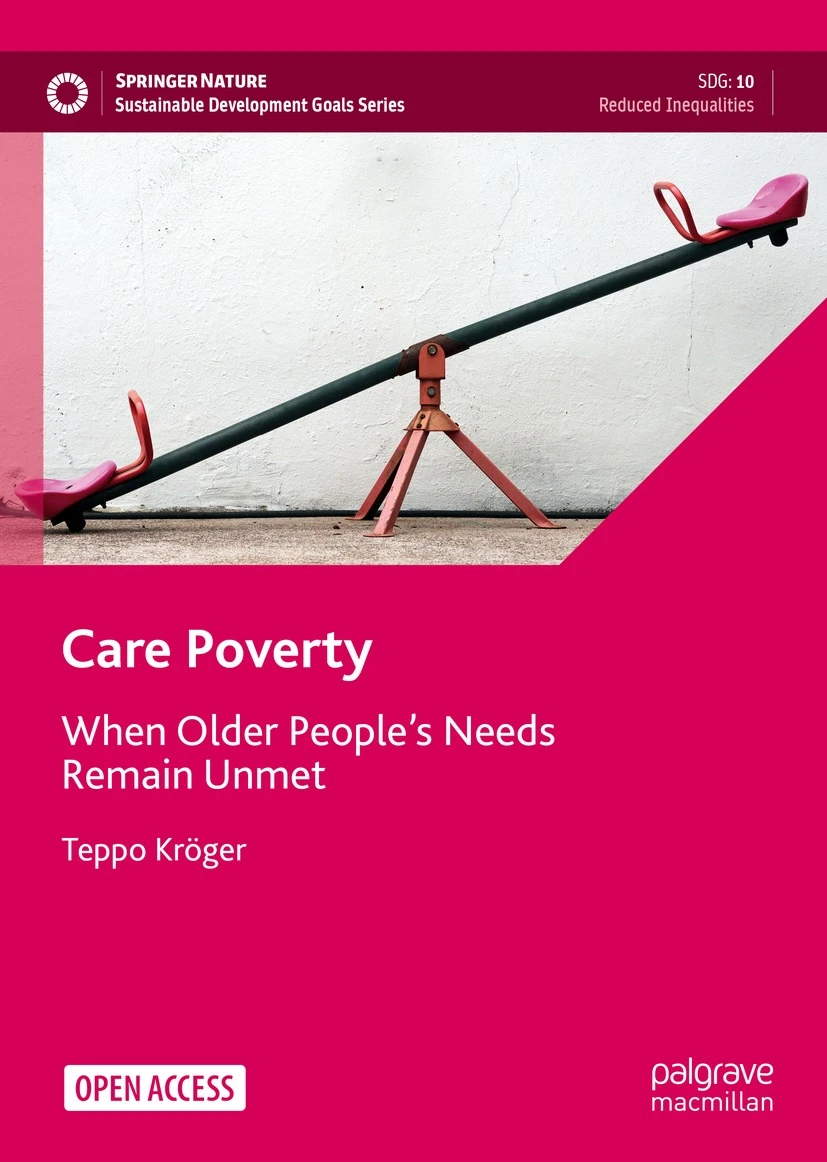
Book: Care Poverty - When Older People’s Needs Remain Unmet

CARE POVERTY
'This open access book turns the research attention of social policy scholars and long-term care researchers from comparative descriptions of care systems, focusing mostly on expenditures and volumes of long-term care services, to outcomes, and in particular to the question whether older people really receive the support that they need. Without knowledge about which needs and which social groups are currently inadequately covered, it is impossible to guide policy development.

The book puts forward a novel theoretical framework to guide future research work and public discussion on the issue of unmet long-term care needs, by broadening the current discussion so that inadequate care is seen in its societal and policy contexts, taking structural issues and policy designs into account. Kröger outlines three different domains of care poverty (personal care poverty, practical care poverty and socio-emotional care poverty) and differentiates between main methods how unmet needs are measured.' [my emphasis]

In psychiatry and psychiatric nursing, a person may be assessed to display poverty of thought, ideas or speech. As an exercise it may be useful to invert the rendering below in Hodges' model, and  consider Kröger's forms of poverty and possibly others that arise from your critique, reflections and life experience to date. Clearly, another book to add to the list!
 
individual
|
INTERPERSONAL : SCIENCES
humanistic ------------------------------- mechanistic
SOCIOLOGY : POLITICAL
|
group

CARE


CARE

CARE

POVERTY


Previously on W2tQ - (unmet) 'needs'

Kröger, T. (2022) Care Poverty - When Older People’s Needs Remain Unmet. Cham: Palgrave Macmillanhttps://link.springer.com/book/10.1007/978-3-030-97243-1#about-this-book

Will check on a related title too.

Thursday, September 18, 2025

Nurses - Ask 5 complimentary questions

I received an email from RCNi subject heading - 'Q. What questions are nurses asking?'

An invitation to sign-up and ask five free questions: https://rcni.com/ask 

Question 1

Is there a model of care, or nursing that encompasses the sciences, mental health, sociology and political domains of care?

Several models of care and nursing frameworks integrate diverse domains beyond purely biological aspects, encompassing scientific, mental health, sociological, and even political dimensions. These models emphasise a holistic approach to patient well-being, recognising the complex interplay of various factors in health outcomes.

  • Social Model of Health: This model focuses on salutogenesis, examining what contributes to health rather than just illness, by considering broad social, economic, environmental, and cultural influences on an individual's well-being .
  • Person-Centred Nursing Framework: This framework extends beyond individual biological health to include the person's intricate cultural context, family, spirituality, and life experiences, defining health as encompassing intellectual, social, and spiritual dimensions .
  • Biopsychosocial Model of Care: This approach integrates biological, psychological, and social factors to address a patient's holistic needs, moving beyond the biomedical model's sole focus on physical illness .
  • Dual Registration Degrees: Educational programmes for nurses and social workers combine life sciences with social work principles, law, and policy, preparing professionals to understand factors influencing health, social justice, structural inequalities, and anti-discriminatory practises .
  • Multidisciplinary Team (MDT) Care Model: While not a nursing model itself, the MDT approach enhances patient care by integrating expertise from various professionals, including specialist doctors, nurses, psychology counsellors, dietitians, and pharmacists, to deliver individualised treatment plans and coordinate care .
Modern healthcare increasingly recognises the necessity of comprehensive care models that extend beyond traditional medical approaches. These integrated frameworks, including the social model of health, person-centred nursing, and the biopsychosocial model, provide a foundation for understanding and addressing the multifaceted nature of health, incorporating scientific, mental health, sociological, and policy-related aspects to improve patient outcomes. [Five references provided - hence poor formatting in transfer.]

Question 2

What model of care has the conceptual scope to critique parity of esteem in mental health nursing?

Critiquing the concept of parity of esteem in mental health nursing requires models that move beyond a purely biomedical focus to embrace holistic, person-centred, and culturally sensitive approaches. These models emphasise equality, social justice, and comprehensive care, addressing the historical imbalance between physical and mental health provision.

  • Biopsychosocial Model: This model offers a conceptual framework to critique parity of esteem by considering biological, psychological, and social factors in a patient's health, aiming for holistic needs rather than just biological ones . It contrasts with the biomedical model, which has historically led to paternalistic decision-making in healthcare .
  • Culturally Sensitive and Competent Care: Essential for critiquing parity of esteem, culturally sensitive care requires nurses to appreciate diverse cultures and adopt personalised, flexible approaches to mental health support . Culturally competent care, underpinned by equality and diversity principles, involves behaviours and attitudes that value patients' diverse backgrounds, improving satisfaction and outcomes .
  • Person Centred Care: This approach is crucial for addressing the historical paternalism in healthcare, ensuring patients participate in decisions about their care and re viewed as individuals with unique experiences rather than just labels or symptoms . Recent mental health reforms, such as the Mental Health Bill 2025, aim to embed person-centred and equitable care further .
  • Holistic Care: The Nursing and Midwifery Council (2024) emphasises assessing spiritual needs to provide effective holistic care, recognising that "seeing the whole person supports better care" . This aligns with the biopsychosocial model's aim to meet holistic needs and challenges the organisational and practice divisions between mental and physical healthcare .
Effective critique of parity of esteem in mental health nursing necessitates a shift towards models that integrate biopsychosocial, culturally sensitive, and person-centred approaches. These frameworks are vital for fostering equality, social justice, and comprehensive care, moving beyond traditional biomedical limitations to address the full spectrum of patient needs. [Eight references.]

I'll leave it there. I think. PJ
<>

My emphasis: In the spring I tried to engage and see if I could write a short article about Hodges' model for RCNi. After an online chat and following up by email, Hodges' model isn't for them apparently. It was kindly suggested that I try another journal.

I must improve my prompt writing.
Nurse, you must improve your prompt writing ...

Wednesday, October 29, 2008

Transcultural health & Hodges model

Text by Larson et al. (2001) is presented below with a suggested placement of
Bradshaw's (1972) typology of social need on to the four care domains of Hodges' model:
Felt need:
The needs as perceived by members of the group.
Normative need:
The group fails to meet an objective, universalistic standard. Technical definitions of need such as the Australian National Mental Health Standards are examples of normative need.
Expressed need:
Through their behaviour, group members have demonstrated a need, often by lengthy queues for services or failure to attend a service.

Comparative need:

The group is demonstratively worse off than another group. Comparative need is usually demonstrated through routinely collected statistics, which is problematic for small ethnic groups whose identities are rarely recorded (p.336).
Bradshaw’s framework is still widely used. The important distinction is one between the ‘top-down’, professional-derived definitions of normative and comparative needs, on the one hand, and the felt and expressed needs, interpreted as the ‘bottom-up’ expression of experiences and attitudes, on the other (p.336).
See also Larson et al. discussion of 'thin' and 'thick' needs.

(The fact that this typology can be described in terms of 'top-down' - 'bottom-up' also highlights the socio-technical potential of Hodges' model.)

References:
Bradshaw, J. (1972). The concept of social need. New Society, 19(496), 640–643.
Larson, A., Frkovic, I., van Kooten-Prasad, M., Manderson, L. (2001). Mental Health Needs Assessment in Australia’s Culturally Diverse Society, Transcultural Psychiatry, 33(3), 333-347. Abstract

Saturday, May 31, 2014

At a glance 65: Better Life for older people with high support needs: the role of social care


Published: May 2014

Key messages

The Joseph Rowntree Foundation has identified seven key challenges to be addressed for older people with high support needs to achieve a better quality of life. Social care has a key role to play in meeting these challenges.
  1. Old age is not about 'them': it is about all of us
  2. Older people are individuals and they are, as a group, becoming more diverse
  3. Relationships matter to us whatever our age; we have a fundamental human need to connect with others meaningfully
  4. Older people with high support needs have many assets, strengths and resources that they can also bring to the development and provision of services
  5. Whatever our age or support needs, we should all be treated as citizens: equal stakeholders with both rights and responsibilities
  6. The individual and collective voices of older people with high support needs should be heard and given power
  7. We need both to innovate and improve existing models
SCIE's role is to share knowledge about what works and use this to produce practical resources. Many of these resources will support people working in all aspects of social care to address these challenges.

Thursday, June 23, 2022

New WHO Quality Toolkit


"On Monday 20 June WHO launched the Quality Toolkit - a new interactive, online resource for anyone at any level of the health system interested in improving the quality of health services.

The Quality Toolkit provides users with tools to facilitate specific actions to enhance the quality of health services. It is a companion resource to WHO Quality Health Services: a planning guide which provides an outline of key actions to be taken across the health system. The Toolkit then supports these actions with numerous tools. It also enhances understanding of the key interlinkages across the health system when implementing any tool.

The Toolkit incorporates key WHO-published tools and other materials related to quality of health services. It will be updated periodically to reflect new and emerging information relevant to improving quality of health services, including WHO technical products currently under development.

The Quality Toolkit is available at: https://qualityhealthservices.who.int/quality-toolkit

HIFA members are invited to navigate the Toolkit and consider how they might use the tools as part of their improvement efforts. WHO welcomes feedback on the Toolkit qualitytoolkit AT who.int "

Via - HIFA - https://www.hifa.org/

I - IDENTIFY tools and resources relevant to quality of care
M - MAP those tools against improvement needs or identify gaps
P - PLAN implementation of activities for improving quality of care
R - RECOGNIZE interlinkages between technical areas and the process of change
O - OPTIMIZE multi-level action
V - VISUALIZE journeys for improving quality of care
E - ENGAGE stakeholders across the health system


INDIVIDUAL
|
 INTERPERSONAL    :     SCIENCES               
HUMANISTIC --------------------------------------  MECHANISTIC      
SOCIOLOGY  :   POLITICAL 
|
GROUP

IDENTIFY (context)

PLAN^ (mental health)

RECOGNIZE*

needs

gaps


IDENTIFY (context)

MAP / VISUALIZE

PLAN^ (physical health)

OPTIMIZE

technical areas
gaps
needs


IDENTIFY (context)

ENGAGE

needs
gaps


IDENTIFY (context)

RECOGNIZE*

needs
gaps


Above rendering idealised and all embedded within spiritual and ethnocultural context.

*Recognition required politically to avoid individual frustration and facilitate (policy ...) coherence.

^Planning should (must) take into account need for parity of esteem between mental and physical health (with triage situations acknowledged).


Source: Jules Storr, Independent Consultant, S3 Global & working with WHO as part of the Quality Toolkit development team - via HIFA

Tuesday, January 30, 2024

"Maslow's hierarchy of needs hides housing horror" c/o Gary Backler in FTWeekend

"John Burn-Murdoch sets out graphically the intergenerational horror story of housing in Britain since 1980 (Opinion, January 13). ...
Abraham Maslow, the American psychologist, placed the need for "shelter" at the very bottom of his famous hierarchy of needs. 
We used to know this. I have a photo of my newly married parents' first rentbook for the council house into which they moved in 1953. It is clear on the cover that after the "accountant to the council", the next most responsible officer is the "medical officer of health". ...
Individual
   |
      INTERPERSONAL    :     SCIENCES               
HUMANISTIC  --------------------------------------  MECHANISTIC      
 SOCIOLOGY  :   POLITICAL 
|
Group

mental health

emotional needs

physical health

shelter/physical security

social needs - belonging

social care

society
Rentbook for council house in 1953 © Gary Backler


Backler, Gary, Maslow's hierarchy of needs hides housing horror, Letters. FT Weekend, 20-21 January 2024, p.8.
Ack. Financial Times. https://www.ft.com/content/3b8719f6-d8e9-4997-b9b5-7dd7ba96fc08

Previously: Maslow.

Monday, September 09, 2019

Paper: "Comprehensive Geriatric Assessment (CGA) in Healthcare of older people in UK care homes"

When something is described as 'comprehensive' this might suggest the need for an aide-mémoire?

"Rubenstein et al defined CGA as a ’multidisciplinary diagnostic process intended to determine a frail older person’s medical, psychosocial and functional capabilities and limitations in order to develop an overall plan for treatment and long-term follow-up’. CGA has been shown to improve outcomes for older people in hospital and community settings. It encompasses health and social care needs and facilitates multidisciplinary working. However, evidence regarding its effectiveness in care homes is limited, and there are limited data describing what needs to be in place for uptake and sustained implementation in this setting."

individual
|
INTERPERSONAL : SCIENCES
humanistic ----------------------------------------------- mechanistic
SOCIOLOGY : POLITICAL
|
group - population
Care home
(Lived experience?)
PURPOSEs
 (synergy across the multidisciplinary team,
consistency - communication)
Resident access to expertise

Ethics - PEACH project

Individual reasoning

[ What about the "Health Career" of residents?
FROM: date of admission TO: date now.
Residents who can perceive 'continuity of care' more likely to be assessed as having mental capacity. What of others? ]

Care home
425 000 people live in care homes
Comprehensive assessment
Realism, The situation, Context as it is
(and across all the domains; e.g. all health care currently conducted amid Brexit uncertainty).
Context-Mechanism-Outcome (CMO) configurations
Coding NVIVO - reasoning & resource components
Health-related Quality of Life (HRQoL)
Programme theory (development)
Frail
Basic and personal care needs
PROCESS
Causes, Synthesis
.Physical access

Care Homes
PRACTICE
Patient Public Involvement
Proxy, Next of Kin

Care plan
Group reasoning

"Mechanism reasoning developing a unified view and shared aims and goals for the resident."

Care Homes

"Mechanism reasoning: delegation from the multidisciplinary team to care home staff provides authority to deliver care according to the care plan."

POLICY
Outcomes: Quality, Safety
(Do see Conclusion of Paper)


The review sought papers on "multi-domain assessment".

"The practices and processes of assessment inform the whole CGA ... . Assessment of many domains of health status and impairments was represented as crucial in building a picture of an individual’s complex needs and views about their personal priorities and goals. Unlike discipline-specific needs assessment that may focus on a particular syndrome or care pathway, structured comprehensive assessment requires an overview of all domains."

Figure 2: Nested arrangement of  Context-Mechanism-Outcome (CMO) configurations


Ref.
Chadborn NH, Goodman C, Zubair M, et al Role of comprehensive geriatric assessment in healthcare of older people in UK care homes: realist review BMJ Open 2019;9:e026921. doi: 10.1136/bmjopen-2018-026921