Hodges' Model: Welcome to the QUAD: Search results for logic

Hodges' model is a conceptual framework to support reflection and critical thinking. Situated, the model can help integrate all disciplines (academic and professional). Amid news items, are posts that illustrate the scope and application of the model. A bibliography and A4 template are provided in the sidebar. Welcome to the QUAD ...

Showing posts sorted by relevance for query logic. Sort by date Show all posts

Saturday, October 23, 2021

COVID: Logic is the patient - again...

Hodges' model is evidence seeking, what logic might apply? 
 
Logic was once the 'patient':
“Yet, by 1530, formal logic was a dying branch of studies, and by the seventeenth century it had been completely forgotten. Why? No one to my knowledge has provided a satisfactory answer. Prantl, one of the earliest scholars to take notice of medieval logic, merely relied on the prejudice of four hundred years in depicting the universities as nursing; the sick but obstinate patient (dialectics), until 'the healthy spirit of antiquity conquered the scholastic pedantry'. Bochenski is not concerned with the mechanics of historical change. Ong gives the cause of death as an inherent weakness in medieval logic itself: 'Scholastic logic was dying of the frustration attendant upon its failure to develop a symbolic system adequate to its ambition and the promise of its initial development.' Even if medieval logic could not overcome this weakness, it had nevertheless hobbled along for three hundred fifty years with the malady! Even if the universities artificially prolonged its life, how exactly did the 'healthy spirit of antiquity' do away with the old warrior?” (Heath, 1971, p.47).
 
Individual
|

INTERPERSONAL : SCIENCES
humanistic ------------------------------------------ mechanistic
SOCIOLOGY : POLITICAL
|
Group

logic


LOGIC

logic

logic

Heath, Terrence. “Logical Grammar, Grammatical Logic, and Humanism in Three German Universities.” Studies in the Renaissance 18 (1971): 9–64. https://doi.org/10.2307/2857078.

Saturday, October 04, 2025

Argumentation - Journal: Informal Logic

Early evening (UK) yesterday, I joined a further webinar on argumentation. Through the speaker, and discussion, I was led to a journal

INFORMAL LOGIC

It is in informal logic that I see a role for Hodges' model. The model's structure providing a universal foundation of knowledge domains to be applied in practice. The bonus of this journal, is its being open access, a search revealed the following paper:

Mark Weinstein. Towards a Research Agenda for Informal Logic and Critical Thinking. XII.3, Fall 1990.
https://ojs.uwindsor.ca/index.php/informal_logic/article/view/2609

'This paper recommends that the recent concern with informal logic and critical thinking be redirected from its general philosophical focus and towards a greater appreciation of the particulars of practice in the various domains of human understanding. The redirection recommended is prompted by the central role that critical thinking and informal logic can be seen to play in meaningful educational reform, especially at the undergraduate level.' 

'Critical thinking, similarly, should be redirected from concerns typical of philosophers and towards issues and approaches more representative of critical thinking both within and across the wide range of disciplines represented by the course of undergraduate studies.' p.121.

'The sense that there is an internal relationship between arguments, argumentation and domains of knowledge persists despite attempts to show relevant and useful notions of critical thinking that are generally available for instruction and neutral in respect of the disciplines. The resolution of the issues generated by these competing views, requires that reflective practitioners of the disciplines, students of the history of ideas, methodologists and specialists in teaching increasingly engage in the task of generating and organizing the data upon which an informed and adequate notion of critical thinking across the disciplines must be based.' p.125.

I believe that the structure of Hodges' model provides a basis for Weinstein's ordinary argumentation and stylized argumentation.

For me (at present) ordinary argumentation, is 'open' argumentation. That is, without differentiation in (using) Hodges' model. I might (well, I would) have Hodges' model in mind, but choose not to apply it. As per the paper, stylized argumentation is using Hodges' model and doing so in a multidisciplinary manner - within my discipline. 

The problem and challenge for nurses and other health professionals is the need, if:

  • person/patient-centred;
  • integrated;
  • and holistic - having regard for parity of esteem (mind - body)

- not to stray, extend the disciplinary scope, while working within one's professional scope.

In highly effective multidiscioplinary teams that touch on being transdisciplinary (hybrid?), can experienced team members have insight into the stylized argumentation of their colleagues?

Ack. ​Argumentation network of the AMERICAS - https://www.argnet.org/ethics-of-arg.html

Previously: 'critical thinking'

Tuesday, December 09, 2025

In search of socio-political logics

'The logic of appropriateness refers to actions which members of an institution take to conform to its norms. For example, a head of state will perform ceremonial duties because it is an official obligation. By contrast, the logic of consequences denotes behaviour directed at achieving an individual goal such as promotion or re-election.' p.87.

individual
|
INTERPERSONAL : SCIENCES
humanistic -------------------------------------------  mechanistic
SOCIOLOGY : POLITICAL
|
group-population


'Institutions are far more than the theatre within which the political drama unfolds; they also shape the script (Peters, 1999). This emphasis within the institutional framework on the symbolic or ritual aspect of political behaviour contrasts with the view of politicians and bureaucrats as rational, instrumental actors who define their own goals independently of the organization they represent.' p.87.


'Further, institutions bring forth activity which takes place simply because it is expected, not because it has any deeper political motive. When a legislative committee holds hearings on a topic, it may be more concerned to be seen to be doing its job than to probe the topic itself. Much political action is best understood by reference to this 
logic of appropriateness rather than a logic of consequences. For instance, when a president visits an area devastated by floods, he is not necessarily seeking to direct relief operations or to achieve any purpose other than to be seen to be performing his duty of showing concern. In itself, the tour achieves the goal of meeting expectations arising from the actor's institutional position. "Don't just do something, stand there", said Ronald Reagan, a president with a fine grasp of the logic of appropriateness.' pp.86-87.


See also: 'drama' : 'bridges'

Hague, R., & Harrop, M. (2007). Comparative Government and Politics (7th ed.). New York, NY: Palgrave Macmillan.

Peters, B. Guy. (1999). Institutional theory in political science: the new institutionalism. London: Pinter.

Wednesday, April 15, 2026

Book: 'Logic on the Track of Social Change'

When I walked into Lancaster Univ. library in February, I had no idea I was being followed.

From the maths shelves, the lights switching on as you progress, I decided to walk across to the more familiar realm of sociology. Looking for something, it was nice to see the parity in lighting, even as my struggle for mathematical enlightenment continues.

Logic on the Track of Social Change    

I do use the e-library, and other e-resources, but sometimes real shelves and varying levels of mustiness (remember the 'new acquisitions' - fewer these days?) invite a bit of serendipity. Suddenly, over my shoulders, the stranger,  pointed (with four arms of course). Was it my shadow? Or, was it my unconscious that 'read': LOGIC and TRACK and SOCIAL CHANGE, on the spine of -

David Braybrooke, Bryson Brown & Peter K. Schotch (eds.), Logic on the Track of Social Change, Oxford University Press. 1995?

In the early decades of health informatics, there was much talk - and still is(?) - of  'languages for health', even languages for nursing. Coding and classification systems were constantly developing, as posted here, but while physical diagnoses were the driver, the psychosocial dimensions of person - patienthood proved more nebulous. DSM is still subject much debate.

 Chapter 8 in Braybrook et al. is brilliant: A Rules-Analysis, Following Foucault, of the Birth of Clinical Medicine.

I've been in situations when surgery is suggested for an older person, and family, friends wonder is this really necessary? This chapter literally brings the history home, and not only that, but the emergence of the hospital system, versus care at home, in the community. The social determinants of health have been ever-present. This is essential reading for students, with the history of ICD, and the history of medicine. There are insights too into public attitudes and expectations to health services and provision here in the UK and in France.

For me, and Hodges' model, the significance of Braybrook, Brown, Schotch and Byrne is that it precedes:

Sallach, D.L. Categorical Social Science: Theory, Methodology and Design. September 2012
Conference: Fourth World Congress on Social Simulation. Taipei, Taiwan.
https://www2.econ.iastate.edu/tesfatsi/Sallach2012CategoricalSoSci4.WCSS-SS.pdf

And so, I do need my own secondhand copy of  Logic on the Track of Social Change. More to follow (indeed)! ... and help still welcome and needed.
 

Sunday, May 17, 2026

Wittgenstein's - Tractatus

Apparently, Wittgenstein walked away from philosophy after publication of the Tractatus. He thought he had solved the problems of philosophy, logic and reality.

In trying to ‘see’ Hodges’ model, in mathematical terms, there may be lessons in Wittegenstein’s approach, both in content and style. Of course, as a non-mathematician, I probably should leave well-alone; and stick to nursing. But that is the problem: from 1987-88 there is a need for a different perspective, even if this is a personal challenge. As with many ‘reviews’ here, we can look at Wittengenstein’s work, reflect upon it, and consider how it relates to the purposes, structures and content of Hodges’ model.

The Tractatus’s first line then, offers a warm welcome.

‘The world is everything that is the case.’ [I]

Making the decision to become a nurse and enrolling as a student makes you an educational and workforce demographic case.

Once a student in the university lecture theatre, you hopefully whether consciously, or not are exposed to the theory – practice gap; as you yearn to be on your first placement. Now it you who is seeking ‘cases’. As we live, and statistics roll and tally, the question of caseness (and categories) is key, one that is carried around even if not always active, recognised as such.

As noted in the previous post, we can for Hodges’ model (and other models, frameworks it must be said) think of ‘case’ as a, or the situation. 

A mathematical approach to Hodges’ model involves looking at things, concepts, people as objects. This includes patients and carers. In terms of a project worthy of pursuing in nursing and other disciplines involved in healthcare, this mathematization presents a non-trivial challenge. A fully-deserved response would be: 'What have you done to the aptitude for care and caring attitude? You've cancelled - subtracted it!' Humour aside:

'In order to know an object, I must know not its external but all its internal qualities.' [2.01231] 

Is this equivalent to us getting to know our patient / client and their socio-political context? 

‘The way in which objects hang together in the atomic fact is the structure of the atomic fact.’ [2.032] 

It is a help that Wittgenstein points to structure (crumbs of understanding are welcome here, as incremental steps). In formulating Hodges’ model we first identify the axes. It is the axes that then provide a space, four domains in total, to frame the objects that we decide; or, as the situation dictates, what concepts are placed in the domains of Hodges' model.

There is a successive series that follows, combining place, space and logic: ‘The proposition determines a place in logical space: the existence of this logical place is guaranteed by the existence of the constituent parts alone, by the existence of the significant proposition.’ [3.4]

‘The propositional sign and the logical coordinates : that is the logical place.’ [3.41]

‘The geometrical and the logical place agree in that each is the possibility of an existence.’ [3.411]

‘Although a proposition may only determine one place in logical space, the whole logical space must already be given by it.
(Otherwise denial, the logical sum, the logical product. etc., would always introduce new elements -in co-ordination.) 
(The logical scaffolding round the picture determines the logical space. The proposition reaches through the whole logical space.)' [3.42]

While Wittgenstein came to view ‘the picture theory of meaning’ as incorrect, as a conceptual framework and diagrammatic resource Hodges’ model is closely tied to this form of representation.

Of course, the logic at work here, is far from mathematical, but there is surely a logic.

'Formal concepts cannot, like proper concepts, be presented by a function.' [4.126]

'There is therefore really a sense in which in philosophy we can talk of a non-psychological I.
The I occurs in philosophy through the fact that the "world is my world'".
The philosophical I is not the man, not the human body or the human soul of which psychology treats, but the metaphysical subject, the limit - not a part of the world.' [5.641] 

'Although the spots in our picture are geometrical figures, geometry can obviously say nothing about their actual form and position. But the network is purely geometrical, and all its properties can be given a priori.

Laws, like the law of causation, etc., treat of the network and not of what the network describes.' [6.35]

There is much more in this work, and much that remains a challenge. Many commentators have written and said in interviews that the Tractatus rewards re-reading and some sentences stay with you for life (The Great Philosophers BBC TV). 

I'm still seeking mine.

https://www.gutenberg.org/files/5740/5740-pdf.pdf

Tuesday, August 25, 2026

Medicine - Mathematics & History

'We now come to the input of mathematics into medical history, and to the related questions of arithmetic and quantification, ratio and proportion, geometrical argument and diagrams, and probability. Mathematics (consisting in arithmetic, geometry, astrology and music) had an established place in the quadrivium of the medieval arts course; its application to medicine is demonstrated in such textbooks as the Articella, which include treatises on weights and measures, and in studies of proportion and ratio such as those of the medieval Oxford calculators which Italian doctors among others caused to be revived at the beginning of our period. In the sixteenth century, it was a vigorously debated subject; there is a well-documented discussion of the certainty of mathematics, concerning its status in respect to the logical adequacy of its proofs, in which some natural philosophers and doctors (notably Cardano) take part. It will come therefore as no surprise that it was prescribed for doctors by most Renaissance pedagogical writers;  this prescription is often specifically linked to Galen's geometrical (axiomatic) method whose operations are the constitution of objects from elements, the comparison of existing objects and their reduction into their constitutive elements.

Associated with mathematics are diagrams, that is, abstract quantified spatial representations. There is a modern debate about the contribution of technical innovations in illustration in the Renaissance (most notably perspective) to the scientific revolution: this is only relevant here insofar as some participants in this debate argue for the importance of diagrammatic symbolisation of mental abstractions above those, like perspective, which are still representations of the real world, and see the former as a step on the path to full algebraic notation of geometry. Not all Renaissance thinkers were persuaded of their usefulness: Argenterio describes the diagrams of Manardo and Akakia reproduced below as 'vain and false tables and figures'; but I shall argue here that they were related to the uptake of doctors from the arts course insofar as well-known logical diagrams reproduced above (4.3:3) were adapted by them for their own purposes.' pp.171-172.

Maclean, Ian. 2002. Chapter 5, Beyond logic: geometry, proportion, quantity. In Logic, Signs, and Nature in the Renaissance: The Case of Learned Medicine. Cambridge/New York: Cambridge University Press.

Related to ongoing reading, Maclean provides two (among several) historical illustrations (with apologies for the quality) on pp.174-175, the first is from the Wellcome Collection:

Dubois, Jacques, 1478-1555 (Boe͏̈, Jacques, Bois, J. d., Boë, J., del, Boë, J., Del Boë, J., DelBoe͏̈, J., . . . Sylvius/de Bois). (1548). Methodus sex librorum galeni in differentiis et causis morborum et symptomatum in tabellas sex ordine suo conjecta paulo fusius ne brevitas obscura lectorem remoretur & fallat. de signis omnibus medicis, hoc est salubribus, insalubribus, & neutris, commentarius / ... per jacobum sylvium ..Paris: Retrieved from https://www.proquest.com/books/methodus-sex-librorum-galeni-differentiis-et/docview/2090356749/se-2

Jacobus Sylvius, 1539

Which Maclean then translates / interprets (p.174):

Maclean. Figure 5.1, p.174.

'Manardo goes further, and causes and symptoms adapts the square of contraries to represent not only all the possible combinations of temperaments (combinations of cold and hot and wet and dry are cleverly excluded) but also inserts a mediate point to represent the absolutely temperate body: see fig. 5.2.
This adaptation of the square of contraries (which has precedents in the medieval period) shows the appropriation for their own use by doctors of the logical instruments at their disposal.

As we have seen, it is a feature of medical thinking to take into account many circumstantiae or variables, and, over time, the numbers of variables taken into consideration increases.' p.174-175.

Figure 5.2 Giovanni Manardo, p.175.

individual
|
INTERPERSONAL
: SCIENCES             
humanistic ------------------------------- mechanistic
SOCIOLOGY : POLITICAL   
|
group

quality

logic

quantity
past - present - future
diagrams

symptoms - signs


subjective

objective

Previously: 'medicine' : 'history' : 'diagram'

Thursday, December 11, 2025

Bourdieu: systems, axes, maps, practical logics

I have checked these quotes and am fairly sure they are accurate. The first, I feel, improves with re-reading, and presents a clearing at the end? 

The clearing could be a template, and as per the second it may be old; but retains its practical function.

'Intellectualism is inscribed in the fact of introducing into the object the intellectual relation to the object, of substituting the observer's relation to practice for the practical relation to practice. Anthropologists would be able to escape from all their metaphysical questioning about the ontological status or even the 'site' of culture only if they were to objectify their relation to the object, that of the outsider who has to procure a substitute for practical mastery in the form of an objectified model. Genealogies and other models are to the social orientation which makes possible the relation of immediate immanence to the familiar world, as a map, an abstract mode of all possible routes, is to the practical sense of space, a "system of axes linked unalterably to our bodies, which we carry about with us wherever we go", as Poincaré put it.' p.34.
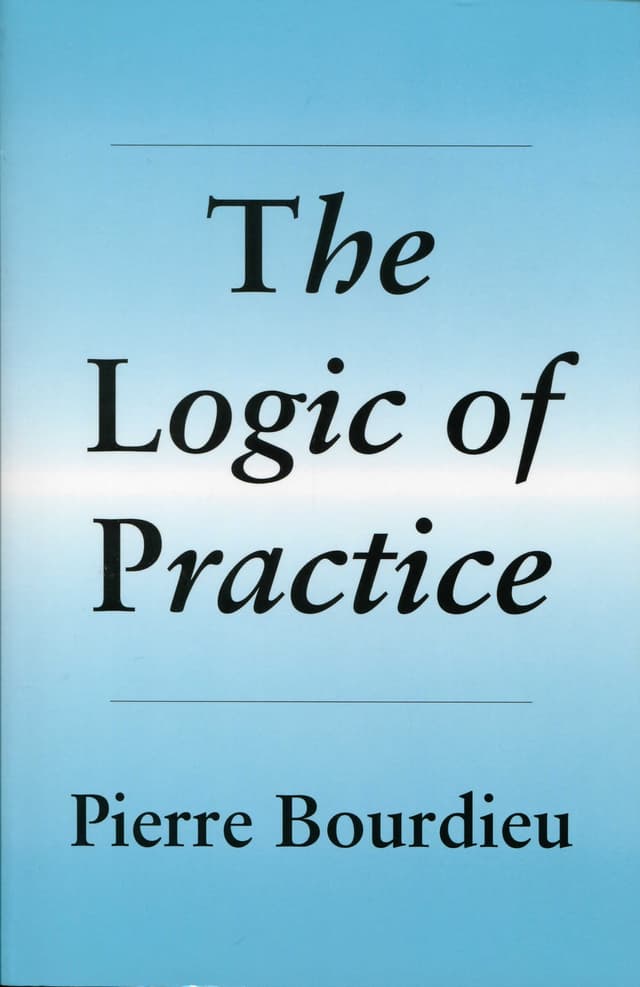
The Logic of Practice
'The logical [kinship] relations he constructs are to 'practical' relations - practical because continuously practised, kept up and cultivated - as the geometrical space of a map, a representation of all possible routes for all possible subjects, is to the network of pathways that are really maintained and used, 'beaten tracks' that are really practicable for a particular agent. The family tree, a spatial diagram that can be taken in at a glance, uno intuitu and scanned indifferently in any direction from any point, causes the complete network of kinship relations over several generations to exist in the mode of temporal existence which is that of theoretical objects, that is, tota simul, as a totality in simultaneity. It puts on the same footing official relationships, which, for lack of regular maintenance, tend to become what they are for the genealogist, that is, theoretical relationships, like abandoned roads on an old map; and practical relationships which really function because they fulfil practical functions.' p.35.


My source:
Bourdieu, P. (1990). The Logic of Practice. Stanford University Press. https://doi.org/10.1515/9781503621749 [and image source].

Bourdieu, Pierre, "The Logic of Practice (1990)" (1990). eTextbooks for Students. 875.
https://stars.library.ucf.edu/etextbooks/875

See also: https://hodges-model.blogspot.com/search?q=bourdieu

Saturday, April 25, 2020

Grant: Helmut Veith Stipend for Female Master’s Students in Computer Science

The Helmut Veith Stipend is awarded annually to motivated female students in the field of computer science who pursue (or plan to pursue) one of the master’s programs in Computer Science at TU Wien taught in English.

Helmut Veith Stipend

The Helmut Veith Stipend is dedicated to the memory of an outstanding computer scientist who worked in the fields of logic in computer science, computer-aided verification, software engineering, and computer security. Helmut Veith, who tragically passed away in March 2016, was a strong advocate and mentor for women in computer science. More on Helmut Veith´s research on the pages of his research group FORSYTE (to follow).


Award

Students who are awarded the Helmut Veith Stipend, receive:
  • EUR 6000 annually for a duration of up to two years.
  • Waiver of all tuition fees at TU Wien.


Eligibility

1. Applicants must be eligible for admission to one of the master’s programs in computer science at TU Wien that are taught in English. In 2019/2020 and 2020/2021 those are:

• Master in Logic and Computation
• Master in Business Informatics
• European Master in Computational Logic
• Master in Computer Engineering (Technische Informatik)
• Master in Data Science
• Master in Media and Human-Centered Computing


Continued... Helmut Veith Stipend ...


My source:
Rozman, Mihaela - mihaela.rozman AT tuwien.ac.at

Tuesday, March 03, 2026

Thoughts ii re. 2026 Lancaster Philosophy of Psychiatry Work in Progress Workshop

For me, applying Hodges' model I tend to place philosophy and psychiatry (mind, thought, belief, truth, intention ...) within the humanistic part of the model. So, Ewa Grzeszczak and - Philosophy of psychiatry and the methodology of social ontology - stood out. This is helpful as Homeostatic Property Clusters (HPC) are a useful structure, spanning bio-mathematics. As suggested previously with 'equality', we can place the philosophical non-trivial question of kinds at the centre of Hodges' model and proceed (if possible?) from there.

The requirement for a holistic, integrative and pluralistic framework is there in literature. A statement supported by Alessandra Civani's talk: 'What kind of concept is ‘incongruence’? I located a paper:

Enactive psychiatry - A pragmatic and pluralistic approach to mental health and disease

- (and now have a copy c/o and thanks to Alessandra) and am grateful to being pointed to de Haan:

An Enactive Approach to Psychiatry

 I will (must) return to these papers. Earlier on Hodges' model, I'd opined (as on 'X') how the -

  • medical
  • biomedical
  • bio-psycho-social models - are insufficient in the 21st century.

There was a thematic feel to the presentations with Anna Golova - Self-illness ambiguity without a self-illness distinction - following nicely. The styling on the slides was an added bonus. I located an informative (co-authored) paper by Golova:

‘Is it me or my illness?’: self-illness ambiguity as a useful conceptual lens for psychiatry'

Part of the power of Hodges' model derives not so much from its duality; as its dual axes. The two axes can encompass and handle the relatedness between/within reductionism, holist perspectives, the self and otherness, illness and health (well-being).

An hours break brought us to an event which was very well attended, clearly open to the public:

6-7pm Prof Miriam Solomon – Royal Institute of Philosophy talk ‘Stigma as an actant in the history of psychiatry’

In setting out the talk's structure I liked Prof. Solomon's reference to the common, implicit "grime" theory of the dynamic of stigma, and "punching down" as a strategy for managing stigma. 'Grime' made me think of sense of smell, the grime in my father's work van, a diesel. Now so many memories are evoked with the merest whiff. More positively, the patina of physical and mental life also came to mind. You would - might think stigma has been dealt with by now, but of course we are socio-politically far from it.

There is a related podcast from 2025, which also covers Prof. Solomon's early studies. A previous paper was also noted in the slides:

Solomon, M. (2025). The Elusiveness of Hermeneutic Injustice in Psychiatric Categorizations. Social Epistemology, 39(2), 166–177. https://doi.org/10.1080/02691728.2024.2400068
 
Discussion of the DSM inevitably followed (and in the above podcast). In questions the 'reality' of severe mental illness, and suggestion of the acute challenge of managing the negative symptoms of psychoses.
 
Prof. Solomon's conclusion was well worth waiting for, including:
Stigma as an "actant" (cf. Bruno Latour's concept of an agent: causal role without intention)... DSM - ICD...
 
If stigma disappeared tomorrow, the DSM would not have the same categories. 
 
Stigma (more specifically, its management) is shaping the conceptual space, with both scientific and moral consequences.

[Added 4th March...] On Friday - Sam Fellowes, took on, or has taken on - the non-trivial issue of - Modelling psychiatric diagnoses when self-diagnosing - how does this work? Complexity was acknowledged on the first slide, with self-diagnosis, and modelling, set against the Duhem-Quine thesis. 

This technical aspect is welcome and no doubt essential given the socio-technical nature of diagnosis, touching as it does the public (society), primary care, psychiatry, service user groups, policymakers, informatics, and HM Treasury, amongst several 'stakeholders'. With the impact of the internet and social media, much (if not all?) of the vocabulary of mental health professionals has been co-opted and re-framed(?) by patient / service-user groups? It does not, for example, appear that the agency behind the DSM will be able to claim it back. Autism and ADHD were also discussed and debated. I located a previous chapter by Sam (pay-wall):

Fellowes S. Self-Diagnosis in Psychiatry and the Distribution of Social Resources. Royal Institute of Philosophy Supplement. 2023;94:55-76. doi:10.1017/S1358246123000218
 
This really is a thicket of thorns, it spreads as and wherever you go.
 
The welfare bill is such that there should have been government Ministers in attendance. I have responded on behalf of clients to PIP assessments. Agencies have invited me to interview for 'Disability Assessor' roles. Not only is this a complex web, but several logics obtain: a perverse temporal logic operates, binary logic and a fixed mindset can develop so that some (vulnerable!?) individuals can get stuck. Perhaps, a social imperative steps in and disrupts, life chances: their being a NEET ('a young person who is no longer in the education system and who is not working or being trained for work'. Ecosia) is better for someone else? 
 
To unpick, make sense of this, you need a foundational universal model.
 
There is a (co-authored) paper from Giulia Russo, who presented - Epistemic and political role of experience: https://philpapers.org/rec/RUSTPO-112 from which:
'As it is widely known, epistemic injustice was introduced by Fricker (2007) to unveil power relations that have negative consequences on people as epistemic agents. She distinguished in particular two different kinds of epistemic injustice: testimonial and hermeneutical. The first kind occurs when a person (usually in a disadvantaged and oppressed role within the epistemic relation) is damaged as a knower because, as the name suggests, their testimony is overlooked, dismissed or invalidated. The second kind of epistemic injustice occurs when a person is deprived of the epistemic resources to even explain or articulate their experience of distress, or of systemic oppression. In connection to this, the concepts of neurodivergence and neurodiversity come from the political and social arena, and are born explicitly to contrast dominant pathologizing narratives in psychiatry.'
In seeking some 'test' cases to try to model relationally, Hodges' model suggests at least four - without letting the care / knowledge domains wag-the-dog. Giulia's talk was very helpful, ranging across forms of epistemic injustice (addressed by others too), identity, neurodivergence, lived experience, self-, counter- and collective narratives with references. A great resource.
 
Frank Denning, reminded me of an important phenomena, in Using Stebbing’s Directional Analysis to Evaluate ‘Mentalizing’. Talking therapies, or more properly referral to talking therapies often presents several criteria that would-be subjects must 'pass'. An ability to mentalize, can represent one. This is understanable, for effectiveness, efficiency, efficacy ... it is to be found in the manual. But, in terms of power relations, gate keeping in various forms is a literal (virtual) key to service access. Hodges' model is no different (sigh!). At what age can people start to use Hodges' model? What mentalization is involved to cognitively engage in use of Hodges' model? 
 
I struggled to obtain a copy of Stebbing's original work from 1930, but see how closely tied the work is to physics. An Internet Archive copy is poor quality. The search will continue, as I suspect there are links to Bill Ross's text on Deleuzian cosmology. It is marvellous that work from 1930 resonates today. There is: 

Janssen-Lauret, F. (Accepted/In press). Directional Analysis in Susan Stebbing’s Philosophy of Physics. In S. Chapman (Ed.), Susan Stebbing on Logic and Analysis Springer Nature. 
https://pure.manchester.ac.uk/ws/portalfiles/portal/338653274/Directional_Analysis_in_Susan_Stebbing_s_Philosophy_of_Physics_Final_.pdf

Gloria Ayob - Flourishing as mental health - was encouraging. 'TASK 1:EQUATION' a slide was titled, including emotional disorder is meta-evaluative; there are negative and positive poles, plus isomorphism between unpleasantness-pleasantness and disorder-health. I think my stomach was protesting I should have paid more attention. There is a blog post by Gloria: https://blog.oup.com/2024/12/the-concept-of-emotional-disorder/

After lunch Richard Hassall - Hermeneutical Injustice and Damaged Intellectual Self-Trust in Psychiatric Service Users, a reminder of the time and effort that needs to be put into public and patient involvement and engagement in mental health service (when this is desired). References included J.L. Austin and J.S. Bruner. A paper:

Hassall R. Sense-making and hermeneutical injustice following a psychiatric diagnosis. J Eval Clin Pract. 2024 Aug;30(5):848-854. doi: 10.1111/jep.13971. Epub 2024 Feb 20. PMID: 38375925.
https://onlinelibrary.wiley.com/doi/10.1111/jep.13971 

Scoping reviews are more common it seems: Lara Calabrese - Exploring epistemic injustice in dementia care: a scoping review and a qualitative study, plus paper [with QR code on the slide]:

Calabrese L, Brigiano M, Quartarone M, Chirico I, Trolese S, Lambiase F, Forte L, Annini A, Bortolotti L, Chattat R. I'm still here and my opinion matters: a scoping review on the experience of epistemic injustice among people living with dementia. Curr Psychol. 2025 Dec 17;45(1):s12144-025-08519-y. doi: 10.1007/s12144-025-08519-y. PMID: 41445984; PMCID: PMC7618523.
 
The paper's title here brought to mind the radio programme "Does He Take Sugar?" Questions followed regards the studies methods. Since leaving I wondered if there has been an evaluation of Dementia Friendly Communities? Are there dots to usefully joined there?
 
The final talk was delivered (with gusto - pepped me up anyway) by Jacob Barlow - Epistemic borders: experts, communities, communication. Jacob's interest in pragmatism was apparent. I look forward to reading future work, and note Liverpool 2025: ‘Problems with Pragmatism in the Philosophy of Psychiatry’.

All in all, a stimulating and enjoyable event.

Friday, May 10, 2024

Towards isomorphisms in Hodges' model

"The concept that best captures the process of homogenization is isomorphism. In Hawley's (1968) description, isomorphism is a constraining process that forces one unit in a population to resemble other units that face the same set of environmental conditions. At the population level, such an approach suggests that organizational characteristics are modified in the direction of increasing comparability with environmental characteristics; the number of organizations in a population is a function of environmental carrying capacity; and the diversity of organizational forms is isomorphic to environmental diversity." p.149.

"We identify three mechanisms through which institutional isomorphic change occurs, each with its own antecedents: 1) coercive isomorphism that stems from political influence and the problem of legitimacy; 2) mimetic isomorphism resulting from standard responses to uncertainty; and 3) normative isomorphism, associated with professionalization. This typology is an analytic one: the types are not always empirically distinct." p.150.

DiMaggio, P. J., & Powell, W. W. (1983). The Iron Cage Revisited: Institutional Isomorphism and Collective Rationality in Organizational Fields. American Sociological Review, 48(2), 147–160. https://doi.org/10.2307/2095101

"Some of them went further, using approaches based in political economy, world systems theory, and theories of neocolonialism and underdevelopment to show that economic imperatives on a global scale were a major force in shaping education worldwide. Others interpreted such change through an institutional lens, arguing that the convergence toward accepted models of modernity has resulted in a process of educational isomorphism within and across countries." p.1.

Carnoy, M., & Rhoten, D. (2002). What Does Globalization Mean for Educational Change? A Comparative Approach. Comparative Education Review, 46(1), 1–9. https://doi.org/10.1086/324053

"The movement is inspired by Rudolf Virchow (1821-1902), who coined the term zoonosis, arguing that there should be no dividing lines between animal and human medicine. This position has been gathering momentum in the last fifteen years. The One Health Initiative is a rather daring interdisciplinary alliance that unites physicians, osteopaths, veterinarians, dentists, nurses, and other scientific-health and environmentally related disciplines, on the basis of a simple hypothesis, which is the isomorphism of structures between humans and animals in immunology, bacteriology, and vaccine developments. This means that humans are both exposed and vulnerable to new diseases, like bird flu and other epidemics, which they share with animal species." p.16.

Rosi Braidotti. (2015). Yes, There Is No Crisis. Working Towards the Posthumanities. DiGeSt. Journal of Diversity and Gender Studies, 2(1–2), 9–20. https://doi.org/10.11116/jdivegendstud.2.1-2.0009

"The chapter begins by developing the logic of strategic voting in a single- member district system, thus won by whichever party or candidate gets the most votes (first past the post, or FPTP). This represents the simplest and easiest case for the logic of strategic voting, and similarities (and sometimes theoretical isomorphism) exist between strategic voting— sometimes called instrumental voting (or voting as an investment)— and expected- utility maximization." p.3.

Aldrich, J. H., Blais, A., & Stephenson, L. B. (2018). Strategic Voting and Political Institutions. In J. H. Aldrich, A. Blais, & L. B. Stephenson (Eds.), The Many Faces of Strategic Voting: Tactical Behavior in Electoral Systems Around the World (pp. 1–27). University of Michigan Press. http://www.jstor.org/stable/j.ctvh4zhzr.4 

"Let us take a closer look at this important topic: what might be termed the isomorphism between the realm of care and the realm of perception/oikeiôsis-allotriôsis." p.57.

Joaquim Braga & Mário Santiago de Carvalho (eds.) (2021). Philosophy of Care - New Approaches to Vulnerability, Otherness and Therapy. Cham: Springer Verlag.
https://link.springer.com/book/10.1007/978-3-030-75478-5

- will add here ... suggestions welcome h2cmng AT yahoo.co.uk

Sunday, July 16, 2023

UK Higher Education Research Excellence Framework - Disciplines

The Research Excellence Framework (REF) is a national assessment of the quality of UK higher education research in all disciplines.

34 subject-based Units of Assessment (UOAs)


INDIVIDUAL
|
     INTERPERSONAL    :     SCIENCES               
HUMANISTIC --------------------------------------  MECHANISTIC      
SOCIOLOGY  :   POLITICAL 
|
GROUP

Psychology, Psychiatry and Neuroscience

Archaeology

Theology and Religious Studies

Philosophy

[Mathematics & Logic]

^Communication 
as Intra- Interpersonal (Skills) Neurodiversity
hence an individual's
sense-making

Clinical Medicine (Neuroscience)
Public Health, Health Services and Primary Care
Allied Health Professions, Dentistry, Nursing and Pharmacy
Biological sciences 
Agriculture, Food and Veterinary Sciences

Earth Systems and Environmental Sciences
Chemistry
Physics
Mathematical Sciences
Computer Science and Informatics
Engineering
Architecture, Built Environment and Planning
Geography and Environmental Studies
Archaeology
Area Studies
Sport and Exercise Sciences, 
Archaeology
Social Work and Social Policy
Sociology
Anthropology and Development Studies
area studies
Education
Modern Languages and Linguistics
English Language and Literature
History
Classics
Communication^, Cultural and Media Studies, Library and Information Management
Art and Design: History, Practice and Theory
Music, Drama, Dance, Performing Arts, Film and Screen Studies
Leisure and Tourism


Archaeology

Economics and Econometrics

Business and Management Studies

Law

area studies

Politics and International Studies


As ever, you see the idealised nature of conceptual (and other) models. I have repeated archaeology, and area studies, added mathematics and logic to the intra- interpersonal (our reasoning, imaginative ability) which increasingly is being challenged and debated as computer-based proofs 'take-over'. I'm not sure where future studies might sit (or pace anxiously!)?

The REF was mentioned at the Improving University Teaching Conference [IUT] in the past week. I'd been meaning to look at the scope of the framework which is often raised across the media, hence this post. IUT, was well worth the effort of a presentation and attending. A global event spanning Australia-Asia, Europe, and North America - one to follow in the future.

Thursday, February 16, 2017

A Spin on Logic, Belief, Facts & Truth

individual
|
INTERPERSONAL : SCIENCES
humanistic -------------------------------------------  mechanistic
SOCIOLOGY : POLITICAL
|
group-population

Doxastic Logic
Individual Belief


Post-truth (time)
Short : Long term
Statistics
Facts
Proton Spin Mystery

The public
The crowd
The people
The public - the politicians deserve

Post-truth (politics)
Alternative-Facts
Fake news
False promises
True Spin
The politicians - the public deserve


My original source:
Simon Kuper, (2017). The age of broken promises, FT, Magazine, 28/29 January, p.5.

Thursday, February 15, 2024

Questions in eclipse

 Last Friday 9th I had a Zoom chat for 30 mins, regards Hodges' model with faculty in the USA.

We touched upon:

  • background to Hodges' model
  • courses taught across the water and interests
  • overlaps, inc. person-centered care - socio-technical
  • informatics & literacies
  • maths/logic

As an outcome it was suggested I forward some questions I'm currently of Hodges' model. Questions that for me, are challenging, put me in the dark, and may not even be valid?

Going through my draft notes I picked out 20, beginning with the working title:

Hodges’ Model as a mathematical object and relational ontology:
category theory or category mistake?

  1. Can it be argued there is what amounts to a care locus - that can 'locate' person-centredness?

  2. Can the model's domains be seen as functions?

  3. Are the domains placeholders?

  4. Is there a case to test, and if logical implement co-domains (e.g. parity of esteem)?

  5. Are there other 'structures' in Hodges' model,  for example L-shaped forms, that is relations that involve three domains and (seemingly) omit one?

  6. Are there practical - case studies - that can be associated with such structures?

  7. Can Hodges' model be considered as a single conceptual space (Gärdenfors), or a series of four? (blog posts)

  8. Can Hodges' model be used to identify and apply threshold concepts (Meyer & Land)? (blog posts)

  9. Can we argue that the structure of Hodges’ model as defined by the axes extent, provides and invites inverse relations?

  10. Is Hodges' model as a structure only (a template) equivalent to an empty set (empty set as an initial object)?
  11. Is this a mathematical analogue (being neutral) to a practitioner's unconditional positive regard?

  12. Taking its axes and four (care/knowledge) domains can Hodges' model be reduced to a graph?

  13. If Hodges' model acknowledges/incorporates Cartesian duality, are there Cartesian products?

  14. In these Cartesian products are critical operations, e.g. relating to psychotropics - physical health; eating disorder - physical/mental health; complex emotional needs - policy (evidence-based care)?

  15. If the model is inverted, mirrored ... what follows: is the structure - function - consistency retained?

  16. Is Hodges' model 'closed' in comparison with Buzan's (open?) approach to mind-mapping?

  17. There is an 'equation of time': is there an 'equation of care'?

  18. Thought experiments: (semantic distance... cognitive linguistics)

    Which concept (INTERPERSONAL :: SCIENCES) is closer to the ‘INDIVIDUAL’ axes; which is closest to the ‘GROUP’ (SOCIOLOGY :: POLITICAL)?

    Which concept (SOCIOLOGY :: INTERPERSONAL) is closer to the HUMANISTIC axes; which is closest to the MECHANISTIC (SCIENCES :: POLITICAL)?

  19. Role of 'types' in Hodges' model - that is, patient / model as a whole as objects (with identity)?

  20. What significance can be gleaned given commonality between several mathematical terms, e.g. group, object, (co-)domain and Hodges' model?

I can no doubt structure - group these questions, and I've not picked out many concerned with Hodges' model as a set, or, as yet, those venturing into category theory. I am wondering, what the commutative law might tell us about holistic, integrated care, and parity of esteem when applied through Hodges' model? Also refining 3-4 case examples to explore and illustrate the same?

While it is maths that prompts this diversion, perhaps ultimately health care disciplines can determine its own formal approach that can produce its own context-sensitive rules, that straddle mathematics/logic and the humanities?

In initial emails, I'd noted the forthcoming eclipse across the USA. Checking, my interlocutor is just N of the path of totality (I wish!) for April's total eclipse. I'm enjoying the darkness here too.

https://science.nasa.gov/eclipses/future-eclipses/eclipse-2024/where-when/

#TotalEclipse2024 #SolarEclipse2024

Friday, November 02, 2018

1959 - 60 years and still all to do ...

individual
|
INTERPERSONAL : SCIENCES
humanistic ----------------------------------------------- mechanistic
SOCIOLOGY : POLITICAL
|
group

'Computers' have not always been a matter of mechanism. Depending on your definition, what we describe as medical informatics, clinical informatics and nursing informatics could be said to originate in the data-gathering, recording and graphic work of John Bell, Florence Nightingale and many other pioneers. If John Bell and Florence Nightingale introduced the arrival of modern public health and nursing respectively, there is still a need to 'fix' the history of medical informatics.

"Pinpointing the beginning of the field of medical informatics is challenging, but it is perhaps best to begin any discussion of the field with the 1959 paper “Reasoning foundations of medical diagnosis; symbolic logic, probability, and value theory aid our understanding of how physicians reason” by Ledley and Lusted [19]. Ledley went on to invent the whole-body CT scanner [20], and Lusted became a leader in the field of medical decision-making. Their 1959 paper, however, laid out a probabilistic model for medical diagnosis, with grounds in set-theory and Bayesian inference." p.642.
[19] R.S. Ledley, L.B. Lusted, Reasoning foundations of medical diagnosis; symbolic logic, probability, and value theory aid our understanding of how physicians reason, Science 130 (3366) (1959) 9–21.
[20] D.F. Sittig, J.S. Ash, R.S. Ledley, The story behind the development of the first whole-body computerized tomography scanner as told by Robert S. Ledley, J. Am. Med. Inform. Assoc. 13 (5) (2006) 465–469.

Wright, A., Sittig, D.F. (2008) A four-phase model of the evolution of clinical decision support architectures, International Journal of Medical Informatics. 77: 641–649.

Tuesday, September 06, 2022

Book review iii "Human Landscapes: Contributions to a pragmatist anthropology"

 
Human Landscapes

As per previous 'reviews', this reader can get lost in the Introduction.

Discussing - "interactions, and loop effects within the organic-environmental system" - there is emergentism, causality, teleology, and supervenience with argument about definitions and word-use through the historical development of pragmatism and understanding of human behaviour individually, collectively and as a culture.

 A close reading can help, is called for here ...


What is of interest to me at present is the non-surprising mention of logic, Dreon points to the many problems that Dewey and pragmatic and other philosophers encountered from the introduction of subjective-objective dichotomies. 

For a mental health nurse the intra- interpersonal is your 'bread and butter' so to speak. Dreon has you reflecting on your professional field, by raising the dichotomy of feelings and cognition, the psychical and the physical aspects of emotions, language and experience. (Interesting, does a pragmatic approach foster identification of dichotomy or continuity?)

For a moment on page 66 I thought we were still on the introduction: 

"The final chapter of this volume will be devoted to the development of a qualitatively richer conception of human linguistic experience conceived as continuous, rather than as opposed to sensibility."
But this is fine and is a statement of Dreon's argument, its depth in dealing with the thought of Dewey, James and others (e.g. Mead). This is dense, and yet detailed, when it is not your field, but you can - begin, at least - to see how the historical development of pragmatism (schools of philosophy), psychology and sociology create so many dilemmas and debates:

"In my opinion, some of the Classical Pragmatists’ insights should
be brought to a coherent conclusion by basically working on two sides,
in order to avoid a foundational conception of language, while at the
same time gaining a more rounded view on sensibility, as it unfolds in
our ordinary lives. As already hinted at in response to Dreyfus, I endorse
a more complex conception of language as primarily consisting in fully
embodied and socially shared linguistic practices that have a variety
of different ends in view and are largely regulated by an affectively or
qualitatively oriented mutual sensibility." p.66.

The book is also 'developmental' too:

"Those practices—from so-called motherese to lullabies, nursery rhymes, and storytelling—are often specifically directed at eliciting responses from the baby and catching attention. The baby’s behaviors—shaking the arms, keeping the eyes wide open,
squealing—are strongly embodied, even when they are vocal; but they are also affectively based and oriented responses to cultural-linguistic stimulations on the part of its caregivers." p.67.
All this shouted emergence to me (and as above), and Dreon rewards this reading. 

Thinking about the 'logic' (if any) in Hodges' model, this stood out:

"The point is to change our approach and to adopt the point of view of the
shared social context in which an individual’s first perceptions occur,
rather than the still monological perspective of an isolated individual
as the primary starting point of experience." p.67.
With more to follow ... I know now why I saved this:

embodied nature

an interactive installation to nurture
our sensibility to the living world


Dreon R. (2022) Human landscapes. Contributions to a pragmatist anthropology. Suny Press, Albany.

https://sunypress.edu/Books/H/Human-Landscapes

Video: Roux, Caroline, Design Miami: Tangled up in the natural world. FT Weekend, Collecting, 27-28 November 2021, p.3.

https://mischertraxler.com/projects/embodied-nature/

Friday, March 22, 2013

BBC Horizon II: Processes - step this way ... safely

Following the BBC TV Horizon programme last night "How to Avoid Mistakes in Surgery" I came across the following list concerned with processes:

Sequential steps. Where one step follows another.

Alternative steps. Where conditional logic specifies which of several paths should be traversed.

Iterative steps. Where a single step is repeated multiple times.

Composite steps. Where steps are nested within other steps.

Optional steps. Where any one of a set of steps may be traversed, depending on the results of a boolean operation.

Checklist. Where all of a number of steps must be traversed, but in any order. p.126.
The list is related to software development and manufacturing as per the reference source below. Within informatics and project management I've noticed and written here about the emphasis placed on processes. Process, process and yet more - in one form or other. As A&E doctor Kevin Fong revealed people can get lost in a process (intubation), especially experts within organisational hierarchies - complex teams in urgent circumstances. In information system projects the need for a socio-technical perspective is essential, and is synonymous with due consideration of human factors. Processes are an essential ingredient to understanding the world and there's a huge literature on events, co-ordination, timing, logistics, value ... but as the Horizon programme pointed out there's also a need for reflection, stepping back, taking in or trying to grasp the big picture. Maintaining situation awareness is vital to assure safety and as the program showed in a crisis hindsight makes a blind spot visible. This is why process is one of four P's in Hodges model (the others - purpose, practice and policy). Processes count, but they are only part of the bigger picture.

The steps above are intended for software developers, but the descriptions throw up some points when subject to a more literal - human - interpretation (which might be a problem?).

The 'alternative' steps: could that mean skipping one in turn as in 'alternate'?

And crucially for the checklist are there any risks associated with its being completed in any order?

There is a world of difference between programming methods and logic on the one hand; and human language and dialogue on the other.

Fayad, M.E., Johnson, R.E. Domain-Specific Application Frameworks: Frameworks Experience by Industry.

Saturday, March 12, 2011

Reading: From A to <A> Keywords of Markup

On the way to Colombia I started to read this book in order to review it - more on that to follow. I've only read four chapters so far and it is a fascinating read. A collection of essays each deals with a particular HTML tag and each so far provides new insights for me and resources.

When I came across the invitation for reviewers I read through the index. HTML 5 was not there so I thought the book might suffer from the rate of change in the interval from original conception to publication. Well HTML 5 is not in the index (just HTML), but it is in the text. Drupal and Ruby on Rails also get a mention.

Of particular interest is chapter 4 'alt' by Colleen A. Reilly which combines accessibility and definitions of disability.

I'll start writing the review soon for the Journal of Community Informatics trying to be more concise than previous efforts (I volunteered to learn too). As for W2tQ I've already found several interesting quotes too, such as the example below. This struck me because it's possible to describe h2cm as a keyword collage ...

Book cover
<A> evokes collagist writings, "interesting networks that open up a conceptual map" McLuhan (258).
Indeed, collage often is the focus of this type of educational/digital education or writing that asks students to merge texts and ideas. <A>, as a social space, though, is not a collage. As a network, <A> builds relationships while also becoming relationships. To enact a pedagogy of <A>, I have to imagine a social software logic as opposed to connection or merging among things. That logic is not bound to a specific platform, such as the Web, but instead informs institutional practices through the generation of large-scale spaces.p.61.

Thursday, December 21, 2023

'Freedom of belief' - really?

"We have seen that our beliefs are tightly coupled to the structure of language and to the apparent structure of the world. Our "freedom of belief," if it exists at all, is minimal. Is a person really to free to believe a proposition for which he has no evidence? No. Evidence (whether sensory or logical) is the only thing that suggests that a given belief is really about the world in the first place. We have names for people who have many beliefs for which there is no rational justification. When their beliefs are extremely common we call them "religious"; otherwise, they are likely to be called "mad," "psychotic," or "delusional." pp.71-72.

INDIVIDUAL
  |
     INTERPERSONAL    :     SCIENCES               
HUMANISTIC --------------------------------------  MECHANISTIC      
SOCIOLOGY  :   POLITICAL 
|
GROUP

my freedom of belief
senses - logic
my belief - beliefs
belief hygiene
my mental health state
continuum model -
 of mental health-illness

freedom of movement
senses logic
physical reality
personal hygiene

culture
organised religions
our beliefs


theocracy
secular states
Mental health law

Wednesday, June 10, 2026

v Book: 'Complexity in Health Care - A Paradigm Shift for Clinical Practice'

Chapter 11 held promise in the title 'Formalising the Clinical Field'.

If anyone is interested, formalisation is what I would like to focus upon - using Hodges' model - over the next several years (taking nothing for granted). If truth be told, I'd be stressed as if (true) formalisation was discovered here, I may find this is beyond me, but this is the course I have chosen.

There was nothing new, the 'clinical illustrations' continued. The reading is worthwhile, in trying to define complexity, or what constitutes a 'complex case', hence 'Each new entry expands the complexity and gravity of the case, moving it beyond "plain vanilla" of a single medical or socially based condition'. I was reminded here of the user personas used in developing online communities. And in health the way personalised detail gets lost as personal details - emotional content gets lost (necessarily) as data is aggregated. The chapter revists the definition of clinical complexity.

'So, how does this information fit with our tentative understanding of clinical complexity as "the potential for progress toward health recovery in the context of a particular set of diagnoses and available treatments" (Kathol et al. 2018)? The phrase "particular set of diagnoses" could be replaced by "clinical challenges?" After all, where do you fit cultural considerations or family disjunctions here? Neither are diagnoses per se. Both have typically been relegated to the periphery of diagnostic considerations. Instead, they are elements in a loose matrix of clinical influencers.' p.76. [My emphasis].
Well, Hodges' model provides an ideal place for cultural considerations and family disjunctions. But replacing 'particular set of diagnoses' with 'clinical challenges' will be met with a challenge itself. This serves my purpose in advocating for Hodges' model, if challenges across the model's four care/knowledge domains can be seen as 'clinical'.

Identity morphism

Part VI on Subjectivity and Intersubjectivity is an important lesson to look; then look again - beyond the (basic!) subjective-objective dichotomy. You want patients - clients to recover quickly. The clinical illustrations are helpfully carried forward, as per the longevity their being 'complex' portends. The fact that in a clinical conference, social aspects are barely mentioned is one rationale for use of Hodges' model in practice. What has not been discussed? For 'Seth' a case formulation is raised, (I sketched a 'simple'  triangle) and the limited conceptual scope acknowledged above (p.80). Reading, I did wonder what a new edition might look like given developments in the USA? Would it make a difference? There a question about to categorise one client. And I scribbled 'identity' in the summary for the subjectivity between client and clinician.

I've always liked archaic terms^ and here cussedness springs to mind as the authors seem compelled to return to the issue of a definition for complexity. You could say - they can't put it to bed! 'Lifestyle' is not indexed. But it is clear that the adopted lifestyle of many clients also compounds, contributes to the clinically complex presentation. Case, condition, set of sign/symptoms, state of affairs, situation - all may be simple or complex. On page 87 regards Mark: 'The management challenge of this situation is evident. The situation itself is not medically complex. However, managing it is.'

When I read the aforementioned formalisation (chapter 11), I thought logic might follow, a specific illustration? Abduction is a teaser introducing chapter 14. It is chapter 15 that inference including abduction is usefully discussed:

'Abduction goes further than obtaining general and specific logical conclusions. Abduction seeks explanations beyond logic. The clinician listens to the utterances of a patient and integrates word meanings and word referents with other gathered data. The clinician abductively decodes information and concocts potential explanations for the words of the patient that fit with aggregated clinical findings. This rational processing results in what the clinician considers the best explanation for the information at hand. However, other explanations remain as viable until and unless eliminated by subsequent data. The clinician using abductive reasoning always maintains an openness to changing explanations and an intention to expunge unsatisfactory conclusions as accumulating data dictate [1].' p.96.

The author's empirical-collaborative (E-C) approach spans the book. They might find that Hodges' model as a conceptual framework can seamlessly fit with E-C. A reference on Bayesian Statistics. Lee PM (2013), plus further reading is listed.

There is a spelling mistake p.73; 'contacted a disease'?

One more post to follow ... may add here also.

Thanks again to Daniela and colleagues at SpringerNature for the review copy. 

Steven A. Frankel, Steven D. Thurber, James A. Bourgeois (2023) Complexity in Health Care: A Paradigm Shift for Clinical Practice. Cham. Switzerland: Springer. ISBN: 978303114948. 

Image:
https://krossovochkin.com/posts/2020_04_26_category_theory/ 
 
^Which is ok, I'm a grandad now.