Hodges' Model: Welcome to the QUAD: Search results for nasa

Hodges' model is a conceptual framework to support reflection and critical thinking. Situated, the model can help integrate all disciplines (academic and professional). Amid news items, are posts that illustrate the scope and application of the model. A bibliography and A4 template are provided in the sidebar. Welcome to the QUAD ...

Showing posts sorted by relevance for query nasa. Sort by date Show all posts

Friday, January 09, 2026

Space for Medicine - ISS


Individual
|
     INTERPERSONAL    :     SCIENCES               
HUMANISTIC  --------------------------------------  MECHANISTIC      
 SOCIOLOGY  :    POLITICAL 
|
Group
 
ETHICS
CONFIDENTIALITY
CONFIDENCE
 
'COMMS' 
 
MENTAL HEALTH
 
BEHAVIOURAL HEALTH &
PERFOIRMANCE
 
PRIVATE PSYCHOLOGICAL
COMMUNICATION 
 
CIRCADIAN HEALTH

PERSON-CENTRED HEALTH/DISABILITY


INTERNATIONAL SPACE STATION 
distance - remoteness
EARTH orbit

 LAUNCHES - RE-ENTRY WINDOWS  

TRAINING
MEDICAL EMERGENCY in SPACE

HEALTH - EMERGENCY
CONSTRAINTS - CONTIGENCIES
PLANNING - TIME - PROBABILITY
'MONTE CARLO' MODELS/SIMULATIONS

DIAGNOSIS: INJURY, RADIATION, MUSCULOSKELETAL, NEUROLOGICAL, VISION, microGRAVITY


CREWS
WELFARE - PRIORITY 
SOCIAL - WELL-BEING


NASA
POLICY - PREPAREDNESS
MEDIA RELATIONS


NASA Spaceflight Human System Standard Volume 1: 
Crew Health

'NASA-STD-3001 Volume 1 covers the requirements needed to support astronaut health and provide medical care while Volume 2 covers human-related vehicle system design and operations requirements that will maintain astronaut safety and promote performance.'

Additional reading:
Farrell, R.M., Fogarty, J.A., Covington, M. et al. A moonshot for female astronaut health, a win for all astronauts and space exploration. npj Microgravity 11, 38 (2025). https://doi.org/10.1038/s41526-025-00495-8
 
Marshall Porterfield, D., Tulodziecki, D., Wheeler, R. et al. Critical investments in bioregenerative life support systems for bioastronautics and sustainable lunar exploration. npj Microgravity 11, 57 (2025). https://doi.org/10.1038/s41526-025-00518-4
  
Rizzo, A., Borra, E.M., Ciciani, L. et al. Foundations of radiological protection in space: the integrated multidisciplinary approach for next manned missions in deep space. Eur. Phys. J. Plus 138, 1001 (2023). https://doi.org/10.1140/epjp/s13360-023-04572-3


The National Space Institute -  
https://nss.org/the-national-space-institute/

During the 1990s I was a member of the 
Space Nursing Society -
https://nss.org/space-nursing-society-chapter/ 

London Institute of Space Policy and Law - 
https://www.space-institute.org


See also: 'NASA' : 'astronautics'


Sunday, August 30, 2026

A Scope with the Big Picture in Mind

Coverage plans are ready for NASA’s Nancy Grace Roman Space Telescope prelaunch and launch activities. Roman is NASA’s next-generation observatory designed to explore some of the universe’s biggest mysteries, including dark energy. NASA and SpaceX are targeting Roman’s liftoff for no earlier than 7:26 a.m. EDT Sunday, Aug. 30, aboard a SpaceX Falcon Heavy rocket from Launch Complex 39A at the agency’s Kennedy Space Center in Florida. Launch coverage begins at 6:20 a.m. Live coverage of these events will stream through a variety of platforms. Learn where to watch online: 


individual
|
INTERPERSONAL
: SCIENCES             
humanistic ------------------------------- mechanistic
SOCIOLOGY : POLITICAL   
|
group
education for ALL
life chances

Nancy Grace

STEMM
Observation
Scale

ROMAN

Girls - Women in Science

Political investment in Science for Public and Planetary Good

See also:

Nancy Grace Roman

https://science.nasa.gov/mission/roman-space-telescope/

Previously: 'women' : 'astronomy' : 'big picture'

Saturday, April 04, 2026

Apollo - Artemis II and the Joy of Earth

Since Artemis II was launched, several more-senior people in the media have been interviewed, with their reflections on certain lunar events in 1969 with the Apollo programme.
 
I too remember being woken up, taking several giant steps down the stairs and huddling around the black & white TV set in the early hours. I'm so glad I did that.
 
Thanks mum and dad. X
 
Following the livestream from Artemis, it's brilliant to see Christina Koch and Victor Glover onboard too.
 
INDIVIDUAL
|
    INTERPERSONAL    :     SCIENCES               
HUMANISTIC --------------------------------------  MECHANISTIC      
SOCIOLOGY  :   POLITICAL 
|
GROUP
 

art002e008487 (April 4, 2026) - NASA astronaut and Artemis II mission specialist Christina Koch peers out of one of the Orion spacecraft's main cabin windows, looking back at Earth, as the crew travels towards the Moon.


"I have not complained about the weather one single time. I'm glad there is weather. I've not complained about traffic. I'm glad there are people around. One of the things that I did when I got home - I went down to shopping centers, and I'd just go around there, get an ice cream cone or something, just watch the people go by, and think: "Boy, we're lucky to be here. Why do people complain about the Earth? We are living in the garden of Eden."

                    Alan Bean. Apollo 12


Tuesday, November 14, 2023

'Humanistic geography' - goes full circle

INDIVIDUAL
|
     INTERPERSONAL    :     SCIENCES               
HUMANISTIC --------------------------------------  MECHANISTIC      
SOCIOLOGY  :   POLITICAL 
|
GROUP

"Alongside Euclidean geometry non-Euclidean geometries were invented. Alongside the old Aristotelian logic and the law of the excluded middle, new forms of logic with, for example, multiple values were developed. This type of work, far from remaining purely speculative, proved indispensable to the progress of physical theories. Consequently epistemological research was no longer seen as fundamentally inductive. It was no longer content to follow the movement of science: it undertook to precede science by indicating which tools should be used to make the best progress. This was the atmosphere which characterised neo-positivism: some concern was already apparent, therefore, but epistemology was still only partially critical. Its role was still more prescriptive." p.227.


"Tuan states that 'humanistic geography' is 'not an earth science' and that with its purpose as the better understanding of man and his condition, humanistic geography properly belongs to the humanities. (Tuan, 1976, 266). For Tuan humanistic geography is 'event-centred'; it is the study of articulated geographical ideas such as 'place', 'territory', 'crowding', 'privacy' and religion and it is particularly concerned with describing the quality of the emotion experienced in specific settings, e.g. the study of place as a centre of meaning for an individual rather than place as described by its geographical coordinates." pp.116-7.


Now we need to think of 'biospheric geography' within which humanity plays a pivotal and critical part.

https://science.nasa.gov/resource/the-story-behind-apollo-8s-famous-earthrise-photo/

https://www.nasa.gov/news-release/nasa-administrator-honors-life-of-apollo-astronaut-frank-borman/

Rose, C., Wilhelm Dilthey's Philosophy of Historical Understanding: a Neglected Heritage of Contemporary Humanistic Geography, p.99-131; Claval, P., Epistemology and the History of Geographical Thought, p.227-239. In. Stoddart, D.R., editor (1981) Geography, Ideology & Social Concern. Oxford: Basil Blackwell Publisher Ltd.

More books - gone; btw I'm not finding a post in each one - honest!

Monday, December 16, 2024

Fragile: This way up - Frozen goods!

Apollo 17 'Blue Marble' Photograph
 
Apollo 17 1972 NASA Original Blue Marble Photograph

Or, some water 'heading your way' ...
'NASA’s archival designation for it is AS17-148-22727, and the original image was taken upside down with the South Pole at the top. In its myriad reproductions, it’s flipped up to match what we would normally expect to see.'

Text: https://www.thephoblographer.com/2013/12/09/behind-blue-marble/


Does the model still 'work' -

Group
|
 POLITICAL        :     SOCIOLOGY  
MECHANISTIC --------------------------------------  HUMANISTIC
            SCIENCES       :    INTERPERSONAL
|
Individual
POLITICAL

SOCIOLOGY

SCIENCES

INTERPERSONAL


- this way ...?

Image source: https://www.forum-conquete-spatiale.fr/t15428-apollo-17-1972

Prompt for 'Blue Marble' - Plate 1 in Brotton, J. (2024) The Four Points of the Compass: The Unexpected History of Direction, London: Allen Lane.

Previously: 'compass'

A planet is not just for Christmas.

Tuesday, December 13, 2022

Essay Competition: On the Principles of Intelligence c/o AI-SGES list

On December 17, 1903, two brothers from Dayton,
Ohio, named Wilbur and Orville Wright,
were successful in flying an airplane they built.

Dear all,

Around 1500, Leonardo da Vinci published his sketches of an aircraft with rounded wings, and in 1783 the first manned hot-air balloon took off. It wasn't until 1905 – over 4'000 years after the oldest known depiction of human flight was carved in clay – that the Wright Brothers took off for the first sustained, controlled, and heavier-than-air crewed flight. From today's point of view, the principles of aerodynamics necessary to build operational aircraft seem relatively trivial.

But only in retrospect are the results of such breakthroughs considered part of the 'obvious'. In 1957, psychologist Frank Rosenblatt published the first paper on trainable neural networks. Since then, humans have walked on the moon, the internet has been invented, and smart devices have been built to fit in our pockets – but neural networks have still not led to human-level artificial intelligence. Neural networks appear like wings that fly for a short time but then drop like a stone when confronted with unknown tasks. Therefore, we'd like to propose moving away from the current hype around neural networks and ask you more fundamentally:

Which fundamental principles of intelligence must be considered in the successful design of artificial intelligence?

The appropriate example from aviation would be: "What are the core aspects of flight that must be considered in the successful design of aircraft?" (One possible answer: As a curved airfoil wing flies through the sky, it deflects air and alters the air pressure above and below it. When moving forward, the curved upper part of the wing lowers the air pressure directly above it, so it moves upward.)

With that in mind, we challenge you to write an essay of 2'000 to 3'000 words and become the Wright Brothers in the field of AI! Whether you answer the question from a philosophical, biological, computational, mathematical, neuroscientific, psychological, social, or any other perspective is up to you. We value novel and insightful arguments that are useful in the field of AI.

Go to https://lab42.global/essay/ and hand in your essay by 23:59 GMT on December 31, 2022. The best essays are rewarded with 3'500 USD in total.

Best regards

Oliver Schmid
oliver.schmid AT lab42.global

https://lab42.global/essay

[Do read the guidance on the website. PJ]

Image use here: https://www.nasa.gov/multimedia/imagegallery/image_feature_976.html
original credit - inc. Library of Congress

AI-SGES list

Sunday, October 30, 2022

An observational record and learning from 30,000 years ago

"A fascinating example is the shoulder blade of an ox unearthed in the 1980s (Figure 1) by archaeologists investigating a stone age encampment in the south of France. Carbon dating showed this to be approximately 30,000 years old. The bone was marked with inscriptions that the archaeologist couldn't decipher. It was clear they were neither a tally, nor a pattern, nor any recognisable form of writing. Late one night one of the archaeologists noticed the moon, and something in its shape caught his curiosity.

Aurignacian Lunar Calendar / diagram, drawing after Marshack, A. 1970; Notation dans les Gravures du Paléolithique Supérieur, Bordeaux, Delmas / Don’s Maps
Figure 1 my source: https://sservi.nasa.gov/articles/oldest-lunar-calendars/

Then it struck him. Here, on this fragment of bone, was a lunar calendar complete with 72 observations ... something like 1,600 generations ago. One of our common ancestors (statistically, all of us can claim a relationship to this thoughtful person) 30,000 years ago had the intellectual curiosity to watch the moon, night after night, and then transcribe these movements, at scale, onto the stone age equivalent of the back of an envelope, as he (or she) attempted to "think it through". What makes us human is our ability to think, learn and adapt to our changing environment. The story of the stone age learner gets even better when you imagine a small community of people (adults, adolescents, children on their laps) sitting around a campfire every night working out the meaning of the lunar phases together." pp.72-73.

Abbott, J. & Ryan, T. (2000). Chapter 4, How mass education eclipsed apprenticeship, The Unfinished Revolution: Learning, Human Behavior, Community, and Political Paradox, Stafford, UK: Network Educational Press. (The figure in the book does not include the bone.)

Previously: 'diagrams' , 'archaeology'

[I am also still trying to clear papers and books, as some posts will suggest.]

Sunday, November 10, 2019

Psyche: Amid the Mind and Stars

INDIVIDUAL
|
INTRA- INTER-PERSONAL : SCIENCES
HUMANISTIC -------------------------------------------------- MECHANISTIC
SOCIOLOGY : POLITICAL
|
GROUP
"The Greek origin of the word psyche (breath) is well known but psyche also referred to life as action or as soul, some special force or spirit which entered living creatures. ... It was natural that when psychology and and medical psychology became established with institutions, they would wish for armorial bearings and it was logical that some representation of psyche should be incorporated. ... Some psychiatrists would consider mind to be an epiphenomenon of brain function, many of whose mysteries will eventually yield to scientific and clinical investigation and most would consider the emergent subjective experiences as important in determining behaviour. The current motto "Let Wisdom Guide" is certainly suitable whatever interpretation or meaning is given to Psyche and whatever direction psychiatry may take in the future." p.429,431.

James, F.E. (July 1991). "Psyche". Psychiatric Bulletin. 15 (7): 429–31. doi:10.1192/pb.15.7.429


Artist's concept of the asteroid 16 Psyche
which is thought to be a stripped planetary core.
Image credit: Maxar/ASU/P. Rubin/NASA/JPL-Caltech


Psyche Revived by Cupid’s Kiss
 Antonio CANOVA (1757 – 1822)
Marble - H. 1.55 m; L. 1.68 m; D. 1.01 mMR 1777
Paris, Musée du Louvre

© 2010 Musée du Louvre / Raphaël Chipault
Political mythology:
Government pronouncements on psyche?

Tuesday, October 30, 2007

Northern Skies: Comet Holmes in outburst

If you've dark skies (and even if you are under urban skies) look out for Comet Holmes, which has brightened suddenly:

http://antwrp.gsfc.nasa.gov/apod/ap071026.html

See also an animated Astronomy Picture of the Day

More to follow in 2008!

Wednesday, January 23, 2013

In orbit*: Where a model of global health care should be


What platform are you using 
to monitor and positively impact 
the minutiae of care 
and the whole picture?

* and in mind.

On 25 May, NASA's Phoenix lander was 10 kilometres above the surface of Mars and less than three minutes from landing when it was captured passing in front of Heimdall crater by the HiRISE camera on the Mars Reconnaissance Orbiter (MRO).

http://www.nature.com/news/2008/080604/full/453712a/box/1.html
Published online 4 June 2008 | Nature 453, 712-713 (2008) Eric Hand

Additional link:
Phoenix: A tribute

Friday, December 07, 2007

Thermo, Long Way Down, Aether and Atlantis

Here's a video on a forthcoming new Adobe development tool - 'Thermo'.

Thanks Ewan and Charley - great TV.

Another journal - Aether : The Journal of Media Geography -

Aether offers a forum that examines the geography of media, including cinema, television, the Internet, music, art, advertising, newspapers and magazines, video and animation. It is our goal to provide a space for contributions to current issues surrounding these media, beginning with constructions of space & place, cultural landscapes, society, and identity.
Atlantis takes flight tomorrow (fingers x'd). For a different media mix try NASA EDGE.

In the Northern hemisphere whether you're walking the dog or E.T. is walking you, keep your eyes open for the Shuttle and ISS. In the Southern hemisphere too with those mid-summer nights - enjoy!

Thursday, February 15, 2024

Questions in eclipse

 Last Friday 9th I had a Zoom chat for 30 mins, regards Hodges' model with faculty in the USA.

We touched upon:

  • background to Hodges' model
  • courses taught across the water and interests
  • overlaps, inc. person-centered care - socio-technical
  • informatics & literacies
  • maths/logic

As an outcome it was suggested I forward some questions I'm currently of Hodges' model. Questions that for me, are challenging, put me in the dark, and may not even be valid?

Going through my draft notes I picked out 20, beginning with the working title:

Hodges’ Model as a mathematical object and relational ontology:
category theory or category mistake?

  1. Can it be argued there is what amounts to a care locus - that can 'locate' person-centredness?

  2. Can the model's domains be seen as functions?

  3. Are the domains placeholders?

  4. Is there a case to test, and if logical implement co-domains (e.g. parity of esteem)?

  5. Are there other 'structures' in Hodges' model,  for example L-shaped forms, that is relations that involve three domains and (seemingly) omit one?

  6. Are there practical - case studies - that can be associated with such structures?

  7. Can Hodges' model be considered as a single conceptual space (Gärdenfors), or a series of four? (blog posts)

  8. Can Hodges' model be used to identify and apply threshold concepts (Meyer & Land)? (blog posts)

  9. Can we argue that the structure of Hodges’ model as defined by the axes extent, provides and invites inverse relations?

  10. Is Hodges' model as a structure only (a template) equivalent to an empty set (empty set as an initial object)?
  11. Is this a mathematical analogue (being neutral) to a practitioner's unconditional positive regard?

  12. Taking its axes and four (care/knowledge) domains can Hodges' model be reduced to a graph?

  13. If Hodges' model acknowledges/incorporates Cartesian duality, are there Cartesian products?

  14. In these Cartesian products are critical operations, e.g. relating to psychotropics - physical health; eating disorder - physical/mental health; complex emotional needs - policy (evidence-based care)?

  15. If the model is inverted, mirrored ... what follows: is the structure - function - consistency retained?

  16. Is Hodges' model 'closed' in comparison with Buzan's (open?) approach to mind-mapping?

  17. There is an 'equation of time': is there an 'equation of care'?

  18. Thought experiments: (semantic distance... cognitive linguistics)

    Which concept (INTERPERSONAL :: SCIENCES) is closer to the ‘INDIVIDUAL’ axes; which is closest to the ‘GROUP’ (SOCIOLOGY :: POLITICAL)?

    Which concept (SOCIOLOGY :: INTERPERSONAL) is closer to the HUMANISTIC axes; which is closest to the MECHANISTIC (SCIENCES :: POLITICAL)?

  19. Role of 'types' in Hodges' model - that is, patient / model as a whole as objects (with identity)?

  20. What significance can be gleaned given commonality between several mathematical terms, e.g. group, object, (co-)domain and Hodges' model?

I can no doubt structure - group these questions, and I've not picked out many concerned with Hodges' model as a set, or, as yet, those venturing into category theory. I am wondering, what the commutative law might tell us about holistic, integrated care, and parity of esteem when applied through Hodges' model? Also refining 3-4 case examples to explore and illustrate the same?

While it is maths that prompts this diversion, perhaps ultimately health care disciplines can determine its own formal approach that can produce its own context-sensitive rules, that straddle mathematics/logic and the humanities?

In initial emails, I'd noted the forthcoming eclipse across the USA. Checking, my interlocutor is just N of the path of totality (I wish!) for April's total eclipse. I'm enjoying the darkness here too.

https://science.nasa.gov/eclipses/future-eclipses/eclipse-2024/where-when/

#TotalEclipse2024 #SolarEclipse2024

Monday, November 05, 2007

J'accuse Apollo

Earth from space: NASA

'I don't know what you could say
about a day in which you have seen four beautiful sunsets.'
John Glenn


I blame Apollo and Gerry Anderson too

for wanting to be an astronaut.

What must it be like

To have the right stuff?

To have the courage

To do the things that must be done

To go to the places that test

Mind, heart, soul: moments - case of stress

Potential spent - kinetic venerability

Cast adrift, burdened wait lifted: sweet release -

Flotsam, jetsam :object: back to Space

The world is suddenly lighter and older

To remind us of who we are and once were

To look after the where, when, who and see the whole

Trying to keep the stars alight at home

The world is full of astronauts

Call them Carers

Above All - they travail alone


Thanks Apollo and Gerry A. wouldn't want it any other way...

Wednesday, February 14, 2024

Distance: Shoulders and ships that pass ...

James Lovelock, 2005 (cropped).jpg
Lovelock in 2005: Wikipedia

Over the past 10-20 years I've become more aware of the distance from scholars and people whose work is relevant to Hodges' model. Distance in the sense of their concomitant 'celebrity', hence the issue of how to make contact; and the stage of their career and my discovery of their relevance. Three people come to mind ... 

I've long admired the work of James Lovelock, and when writing on ecological themes in -

Jones, P. (2008) Exploring Serres’ Atlas, Hodges’ Knowledge Domains and the Fusion of Informatics and Cultural Horizons, IN Kidd, T., Chen, I. (Eds.) Social Information Technology Connecting Society and Cultural Issues, Idea Group Publishing, Inc. Chap. 7, pp.96-109.
- I wondered about trying to contact Dr Lovelock. As the majority of people are aware his thought and books, especially the Gaia hypothesis with Lynn Margulis caught the public's imagination from first publication and through the 1970s. Was there a Horizon TV programme? James Lovelock's influence was not just in ecology, but also earth (planetary) sciences through work for NASA. In early 2021 I thought I would reach out, through his most recent book and publisher/agent. I passed a message, which was forwarded but I never heard anything more.

As a nurse - with experience in older adult community mental health, I was acutely aware that this senior gentleman - in every sense of the word - may not want to be mithered by a scouser*, now living near Wigan Pier. I stressed not wanting to disturb the Dr. I also thought, given Dr Lovelock being of independent mind - a maverick, he might on the contrary love to be disturbed. 

Sadly, I was too late, hearing the news of Dr Lovelock's death in 2022. Of course, I was seeking validation (and still am) for the project here. I can't help thinking though, that Dr Lovelock really would have 'got' Hodges' model.

James Lovelock: BBC Radio 4 The Life Scientific

<>

Philosophy has long been an interest B.A.(Joint Hons.) Comp./Phil.. In a way you have no choice as a nurse, especially trained in mental health and general nursing: the theory and practice invariably touch reality, consciousness, perception, subjectivity, objectivity, knowledge, being, perception, data, information, time and so on.

Once acquainted with Hodges' model, scale is the dimension that asserts itself. I wrote about this and referenced Mario Bunge in about 1998, on the old, now archived website:

https://web.archive.org/web/20100329050839/http://www.p-jones.demon.co.uk/infintro.htm

Scale is a constant and multicontextual focus, but interest was piqued once again as I try to look at Hodges' model mathematically (yes, who am I trying to kid!) - as an object and relationally. I was reminded of Prof. Bunge's work noting a paper that included 'isomorphic-ism':

Bunge, M. (1969). Corrections to “Foundations of Physics”: Correct and Incorrect. Synthese, 19(3/4), 443–452. http://www.jstor.org/stable/20114653

https://link.springer.com/article/10.1007/s10838-021-09553-7

Mahner, M. Mario Bunge (1919–2020): Conjoining Philosophy of Science and Scientific Philosophy. J Gen Philos Sci 52, 3–23 (2021). https://doi.org/10.1007/s10838-021-09553-7

There may be a brief email exchange with Prof. Bunge, a request for a paper or two. Any emails are now stored (CD-ROM and portable drive) in a Turnpike folder, an old email client. Last year I was disappointed again, to learn of Dr Bunge's passing in 2020. His focus on science, philosophy, and systems - hard / soft is also very informative.

<>

More recently, I came across the fascinating work of David Sallach, one paper (a conference from 2012) includes:


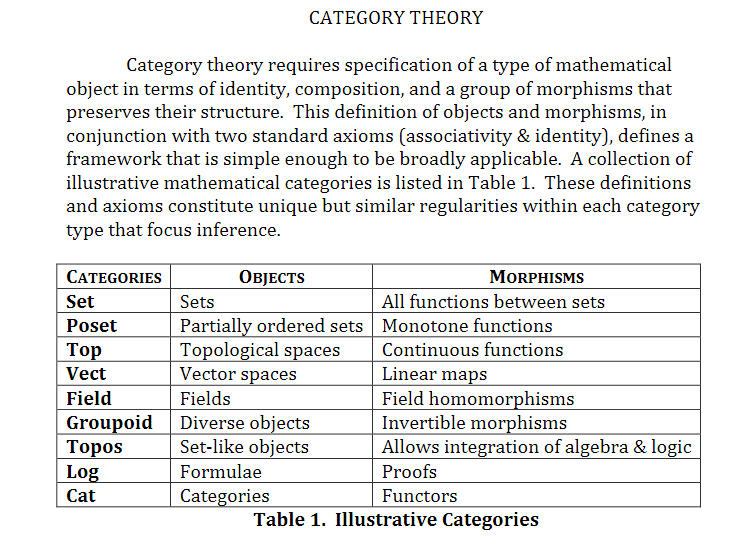
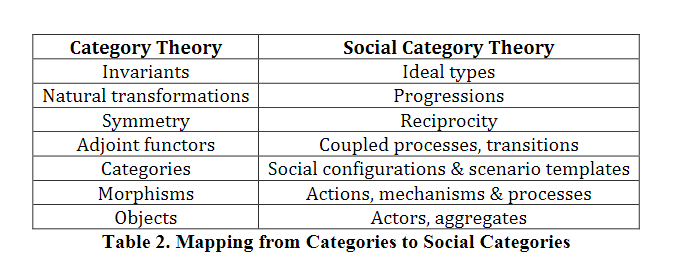
Sallach, D.L. Categorical Social Science: Theory, Methodology and Design. September 2012
Conference: Fourth World Congress on Social Simulation. Taipei, Taiwan.
https://www2.econ.iastate.edu/tesfatsi/Sallach2012CategoricalSoSci4.WCSS-SS.pdf

Plus, developed further in table 2:

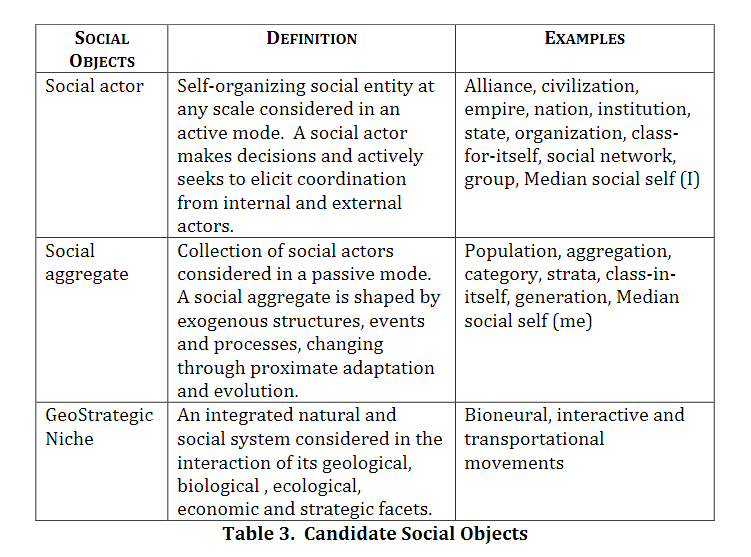
If time permits as an exercise, please consider Sallach's table 3 below. It may be interesting to map this to the domains of Hodges' model(?) [template]:
:

If you can see the potential utility of Hodges' model, you may also appreciate why Sallach's paper  resonates. Having emailed Dr Sallach, without reply, I did some checking. More sad news followed.

I, and no doubt many people will continue to discover and appreciate the legacy left behind by the above and many other pioneers. 

<>

I must acknowledge - Enid Mumford - whose work on socio-technical systems continues to inform my study and application of Hodges' model. This includes recognition of the many x-disciplinary bridges (or, barricades?) that can be found within Hodges' model. 

Clearly, much reading still to do.
<>

Returning to Hodges' model as a mathematical object, the 'distance' above is suddenly interstellar (and yes, sudden, as in faster than light!). I'm following videos, papers, and specific work-streams by  universities (I won't mention presently...) seeking to apply category theory to the social sciences. This suggests, at least, I'm not (completely!) wasting my time. If you have thoughts yourself on Hodges' model, the journey from Sallach's tables 1 - 2 not just 3, I'd be delighted to hear from you. 

There is another approach I will share this (N) spring. This author - researcher I have been able to contact.

*Scouser - https://en.wikipedia.org/wiki/Scouse
(Re. Liverpool - further post to follow).

James Lovelock image:  Bruno Comby, CC BY-SA 1.0, via Wikimedia Commons.

Sunday, March 10, 2013

Space to reflect

2013 could be quite a year for comets, at least in the northern hemisphere.

As we reflect in our studies and at work it is vital to take a breathe and reflect when we can on things otherwordly - Comet PanSTARRS:


Weather permitting after work  I will visit Parbold Hill to get a good view of the western horizon.

I've tried on two evenings - 12th - 13th - to spot PanSTARRS without success. There's still time as it moves north. The new moon was quite a sight last evening. Through the binoculars a jet very low down looked like a rocket - the shuttle taking off. Between the low clouds I watched the sun set: cue reflection

APOD archive southern appearance: comets Lemmon & PanSTARRS

Image source: NASA.

Sunday, February 15, 2009

Good things come to those who wait...:

Being interested in astronomy I've used this theme in quite a few blog posts. Hodges' model cannot only act as a repository for a constellation of ideas - the model is up there in the constellations - in several forms including - The Southern Cross, Crux.

I thought about the Milky Way, but was disappointed about the scope for finding Hodges' model there on two counts:

  1. we (and more especially our children) can hardly see the Milky Way such is the light pollution;
  2. the Milky Way does not reflect Hodges' model - which axis would it be?
Then I realised:
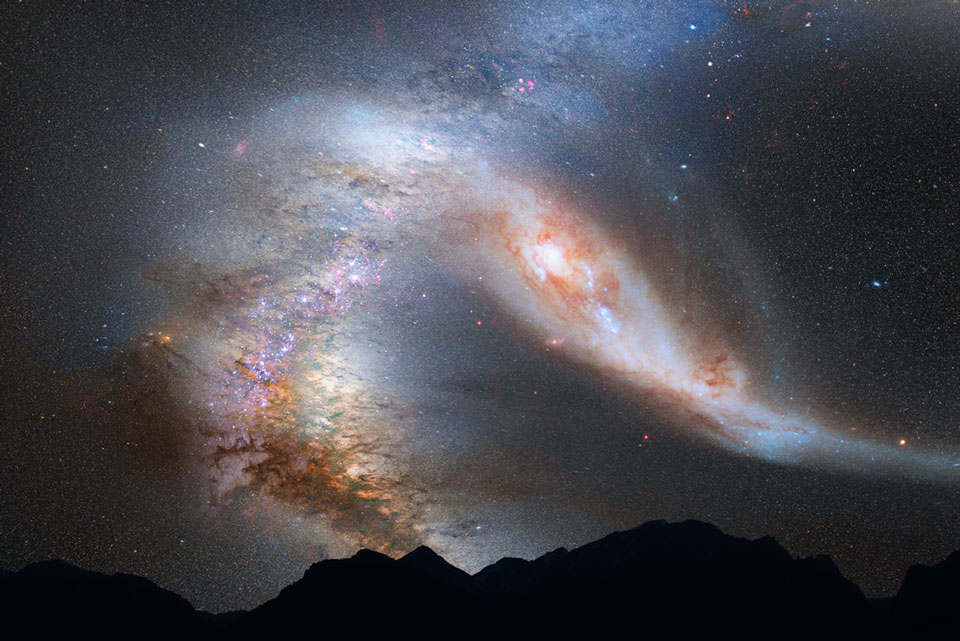
One day, there will be two bands of star dust across the night sky (c/o APOD):
Milky Way Galaxy Doomed: Collision with Andromeda Pending
Illustration Credit: NASA, ESA, Z. Levay and R. van der Marel (STScI), and A. Mellinger
It just goes to show you... good things come to those who wait...
 
Image source: The Southern Cross  

Additional links: International Year of Astronomy Kepler Star Wheel

Wednesday, January 08, 2025

Hodges' model: A person - Everyone else [x2!]

INDIVIDUAL
|
   INTERPERSONAL : SCIENCES              
humanistic ------------------------------- mechanistic
 SOCIOLOGY : POLITICAL   
|
GROUP


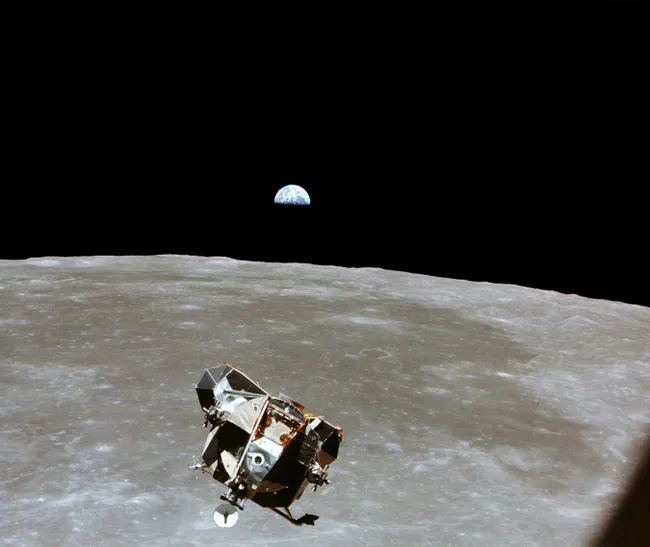
'Michael Collins, the astronaut who took this photo in 1969, is the only human, dead or alive, that isn't in the frame of this picture.' 

 (Image credit: NASA/Getty Images) 


“If the universe is meaningless, so is the statement that it is so… The meaning and purpose of dancing is the dance.”

'Alan Watts on our search for meaning and the antidote to our existential loneliness'


Image: https://www.digitalcameraworld.com/news/spaceman-who-photographed-every-living-being-but-himself-rip-michael-collins

Text: https://x.com/themarginalian/status/1876298178326069285

https://www.themarginalian.org/2016/11/01/alan-watts-wisdom-of-insecurity-3/

So good I'm repeating myself ... https://hodges-model.blogspot.com/2019/07/2-everyone-else-1-thank-you-michael.html

'dance' :: 'meaning'

Saturday, January 11, 2014

moon, resources and Materialism


INTERPERSONAL : SCIENCES
humanistic ------------------------------------------- mechanistic
SOCIOLOGY : POLITICAL

individual
http://southbanklondon.com/republic-of-the-moon


group - population

Republic of the Moon
http://southbanklondon.com/republic-of-the-moon
(I missed this when it was in Liverpool!)

Additional links:

NASA Releases New Earthrise Simulation Video

UNOOSA: 34/68. Agreement Governing the Activities of States on the Moon and Other Celestial Bodies
http://www.oosa.unvienna.org/oosa/SpaceLaw/gares/html/gares_34_0068.html

Images:
Leonid Tishkov, Personal Moon - Republic of the Moon
http://www.artscatalyst.org/projects/detail/republic_of_the_moon_Liverpool/

Omega Speedmaster Moonwatch -
https://www.omegawatches.com/en-gb/?search=speedmaster+apollo