Hodges' Model: Welcome to the QUAD: data sharing

Hodges' model is a conceptual framework to support reflection and critical thinking. Situated, the model can help integrate all disciplines (academic and professional). Amid news items, are posts that illustrate the scope and application of the model. A bibliography and A4 template are provided in the sidebar. Welcome to the QUAD ...

Showing posts with label data sharing. Show all posts

Monday, September 01, 2025

BCS - AI Health 2025 - Artificial Intelligence SG (reminder)

Date and time: Friday 7 November, 9:30am - 4:30pm

Location: BCS, The Chartered Institute for IT, Ground Floor, 25 Copthall Avenue, London, EC2R 7BP

Price: 42 - 108 GBP

Synopsis

BCS-SGAI, the BCS, The Chartered Institute for IT's Specialist Group on Artificial Intelligence, was founded in June 1980. Its mission is: "To foster achievement, capability and awareness in both business and research in Artificial Intelligence, and to promote the interests of the related community". It is one of Europe's longest-established groups working to support the community of artificial intelligence developers and users and is the organiser of one of the longest-running annual series of AI conferences in Europe: the AI-20xx series.

In England, 189 out of 208 (91%) hospital trusts are using electronic health records (EHRs) bringing opportunities and challenges and for Artificial Intelligence (AI). In the morning, there will be a session about EHRs with speakers from UK (animal health records), France (European Health Data Space infrastructure for the use and exchange of EHRs), and Spain (personal health records). Before lunch break, there will be a brief 101 hands-on tutorial about Neuro-Symbolic AI with short exercises. In the afternoon, there will be a session about clinical decision, exemplifying the use of AI-based healthcare technologies. Come along if you are interested in AI and its potential in healthcare.
  • A comparison between open-source biomedical LLMs and general-domain LLMs (e.g. DeepSeek, Gemini, Claude, and ChatGPT-4)
  • How to lower the technical skills overhead (understanding of AI and programming code) needed to use open-source LLMs for content generation and content analysis of text, images and audio
  • Exploring the plausible benefits of neuro-symbolic AI, combining neural AI (to process and extract patterns for health issues from unstructured data) with symbolic AI (explicit representations of background knowledge)
There will be Certificates of Attendance for those who register and attend the event.

We hope that you will come and join us, and that you enjoy this new offering from the BCS SGAI.

Speakers

Programme

More details and registration ...

(I look forward to attending.)

My source: BCS SGAI mail list.

Thursday, July 03, 2025

AI Health 2025 Friday November 7th 2025

AI Health 2025

Friday November 7th 2025

At the BCS London Office
Ground Floor, 25 Copthall Avenue, London, EC2R 7BP (near Moorgate underground)

Organised by BCS-SGAI

BCS-SGAI, the British Computer Society Specialist Group on Artificial Intelligence was founded in June 1980. Its mission is: "To foster achievement, capability and awareness in both business and research in Artificial Intelligence, and to promote the interests of the related community". It is one of Europe's longest established groups working to support the community of artificial intelligence developers and users and is the organiser of one of the longest running annual series of AI conferences in Europe: the AI-20xx series.

In England, 189 out of 208 (91%) hospital trusts are using electronic health records (EHRs) bringing opportunities and challenges and for Artificial Intelligence (AI). In the morning, there will be a session about EHRs with speakers from UK (animal health records), France (European Health Data Space infrastructure for the use and exchange of EHRs), and Spain (personal health records). Before lunch break, there will be a brief 101 hands-on tutorial about Neuro-Symbolic AI with short exercises. In the afternoon, there will be a session about clinical decision support, exemplifying the use of AI-based healthcare technologies. Come along if you are interested in AI and its potential in healthcare.

There will be Certificates of Attendance for those who register and attend the event.

We hope that you will come and join us, and that you enjoy this new offering from the BCS SGAI.

Dr. Mercedes Arguello Casteleiro (BCS SGAI)*

Please see link above for programme and speaker details.
*.. And my source - BCS SGAI.

Sunday, January 06, 2019

The Art & Science of Health: [conceptual scraps ii]

The contrast here within health care is quite stark, we can distinguish between scraps of paper in two ways ...

  1. Whatever we do with care needs; confirm them from the referral and possibly (usually) identify additional care needs (and educational opportunities also..?), assess, plan, intervene, and evaluate - that scrap of paper (or its digital analogue) should initially be blank, untainted by judgements, bias and assumptions.
  2. As soon as the scrap of paper is populated - scribed-upon then its value and the responsibility of those who access it subsequently is suddenly weighed and measured by law and accountability.
In the first case, ownership is not relevant, in that there is nothing, as yet, to 'own'. Values however can still be represented, if the staff's attitude towards the new patient, client, service user or administration terms referral, contact, triage case is similarly 'neutral'.*

In the second case, when the print hits the page by whatever means the stakes are suddenly raised. The law has a say in what is expected, permissible and reasonable conduct by those gathering data, creating a record, holding, copying and transferring the record in part, or whole and its accuracy, destruction and disposal.

*Of course, even when blank, forms - templates can have proprietary value and may well be protected, copyrighted and trademarked.

to be continued ...

Related post - Part 1:
The Art & Science of Health: [conceptual scraps i]

Tuesday, January 26, 2016

Tuesday, August 25, 2015

Ethics and Best Practices in Sharing Individual-level Research Data

"Welcome to the Resource Centre for ethics and sharing individual-level research data. This Centre brings together resources about ethical best practices for data sharing, policies and processes for data curation and data sharing, and links to repositories for data sharing. Please participate in this online community by posting links to your resources, and questions and comments in the discussion group or a blog. ...
A new, open-access toolkit for researchers and data managers is released today, providing guidance, resources and an eLearning course about ethics and best practices of sharing individual-level health research data in LMICs." ...

My source: Alexis Segrt, The Global Health Network 2015 list

Friday, June 12, 2015

Sharing of Knowledge: Culture, Community, Conceptual Spaces and Economics (Gärdenfors)

"Culture, in the form of interaction between people, may in itself generate constraints on conceptual spaces. For example, Freyd (1983) puts forward the intriguing proposal that conceptual spaces may evolve as a representational form in a community just because people have to share knowledge (Freyd 1983, pp. 193–194):

There have been a number of different approaches towards analyzing the structures in semantic domains, but what these approaches have in common is the goal of discovering constraints on knowledge representation. I argue that the structures the different semantic analyses uncover may stem from shareability constraints on knowledge representation. [. . . ] So, if a set of terms can be shown to behave as if they are represented in a three-dimensional space, one inference that is often made is that there is both some psychological reality to the spatial reality (or some formally equivalent formulation) and some innate necessity to it. But it might be that the structural properties of the knowledge domain came about because such structural properties provide for the most efficient sharing of concepts. That is, we cannot be sure that the regularities tell us anything about how the brain can represent things, or even “prefer” to, if it didn’t have to share concepts with other brains.
Here Freyd hints at an economic explanation of why we have conceptual spaces: they facilitate the sharing of knowledge." p.17.

From: Gärdenfors, P. (2004) Conceptual Spaces as a Framework for Knowledge Representation. Mind and Matter. Vol. 2(2), pp. 9–27.


Thursday, January 08, 2015

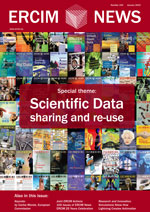
ERCIM News No. 100 Special theme: "Scientific Data Sharing and Reuse"

Dear ERCIM News Reader,

ERCIM News No. 100 has just been published at http://ercim-news.ercim.eu/en100
Join us in celebrating the 100th issue and post a message at http://ercim-news.ercim.eu/guestbook

http://ercim-news.ercim.eu/en100/special/
ERCIM NEWS 100
Special Theme: "Scientific Data Sharing and Reuse"
http://ercim-news.ercim.eu/en100/special/

Keynote by Carlos Morais, European Commission: "e-Infrastructures Enabling Trust in the Era of Data-Intensive Science"

This issue is also available for download in:
pdf:  http://ercim-news.ercim.eu/images/stories/EN100/EN100-web.pdf
epub: http://ercim-news.ercim.eu/images/stories/EN100/EN100.epub

Next issue: No. 101, April 2015 - Special Theme: "The Internet of Things & the Web of Things"
(see Call for articles at http://ercim-news.ercim.eu/call)

Thank you for your interest in ERCIM News. Feel free to forward this message to others who might be interested.

Best regards,
Peter Kunz
ERCIM News central editor