Hodges' Model: Welcome to the QUAD: open data

Hodges' model is a conceptual framework to support reflection and critical thinking. Situated, the model can help integrate all disciplines (academic and professional). Amid news items, are posts that illustrate the scope and application of the model. A bibliography and A4 template are provided in the sidebar. Welcome to the QUAD ...

Showing posts with label open data. Show all posts

Sunday, October 28, 2018

PayWALL

individual
|
INTERPERSONAL : SCIENCES
humanistic ----------------------------------------------- mechanistic
SOCIOLOGY : POLITICAL
|
group
'Who' profits?

The Sciences
Qualitative - RESEARCH - Quantitative


The Public
[Locus of the 'public purse']


My source:
https://www.newscientist.com/article/2181744-paywall-the-business-of-scholarship-review-analysis-of-a-scandal/

Friday, February 26, 2016

Open Data as Open Educational Resources: 4th March 1400-1700 UCL

 
Next Thursday evening I'm heading to London for Drupalcamp Saturday and Sunday. On the Friday afternoon I'm attending:

Open Data can be understood as “universally participatory data”, which is openly shared by government agencies, NGOs, academic institutions or international organisations.

Open Data can be used in Higher Education using real life scenarios, bringing together students, academics and researchers working towards overcoming local and global real problems.
In this way students can develop transversal, research and citizenship skills, by working with the same raw materials researchers and policy makers use, contributing with the society in new and yet-unimagined ways.
The event will be featuring
  • Santiago Martín: University College London
  • Mor Rubistein: Open Knowledge International>
  • Leo Havemann: Birkbeck, University of London
  • Dr Carla Bonina: University of Surrey
  • William Hammonds: Universites UK
  • Dr Fabrizio Scrollini: Latin American Open Data Initiative
  • Dr Tim Coughlan: Open University 
WHEN Friday, 4 March 2016 from 14:00 to 17:00 (GMT) 
WHERE Medawar G01 Lankester Lecture Theatre: UCL, Gower Street, London, United Kingdom.

Sunday, January 03, 2016

Autonomy Cube(d)

OBSERVATION
|
INTERPERSONAL : SCIENCES
OBSERVATION  ---------------------------------------  OBSERVATION
SOCIOLOGY : POLITICAL
|
OBSERVATION


Rosa Menkman from amsterdam, Netherlands, CC BY 2.0 <https://creativecommons.org/licenses/by/2.0>, via Wikimedia Commons

"When installed in a gallery, the cube creates an open Wifi hotspot that uses the alternative Tor network to anonymise internet use."
Jobey, L., (2016)  Trevor Paglen What Lies Beneath, FT Magazine, 2-3 January. p.20.

Trevor Paglen: Autonomy Cube (2014)

Whitechapel Gallery, London, January 29 to May 15.

Photo source: e-flux - Edith-Russ-Haus for Media Art


                             Autonomy-Advocacy Cubed?
     Late 1970s                      1980s-1990s                         2000s...
   Nurse Advocate                 Nurse as Advocate?             Independent Advocacy
                           
             Ongoing nurse advocacy role amid the politics of healthcare...

Thursday, January 08, 2015

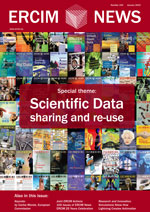
ERCIM News No. 100 Special theme: "Scientific Data Sharing and Reuse"

Dear ERCIM News Reader,

ERCIM News No. 100 has just been published at http://ercim-news.ercim.eu/en100
Join us in celebrating the 100th issue and post a message at http://ercim-news.ercim.eu/guestbook

http://ercim-news.ercim.eu/en100/special/
ERCIM NEWS 100
Special Theme: "Scientific Data Sharing and Reuse"
http://ercim-news.ercim.eu/en100/special/

Keynote by Carlos Morais, European Commission: "e-Infrastructures Enabling Trust in the Era of Data-Intensive Science"

This issue is also available for download in:
pdf:  http://ercim-news.ercim.eu/images/stories/EN100/EN100-web.pdf
epub: http://ercim-news.ercim.eu/images/stories/EN100/EN100.epub

Next issue: No. 101, April 2015 - Special Theme: "The Internet of Things & the Web of Things"
(see Call for articles at http://ercim-news.ercim.eu/call)

Thank you for your interest in ERCIM News. Feel free to forward this message to others who might be interested.

Best regards,
Peter Kunz
ERCIM News central editor


Thursday, October 09, 2014

Privacy: Open Data, Individual and Group

The vertical axis of Hodges' model is the individual - group, or self through to collective. Health and social care constantly negotiates this from the ideals and delivery of person-centred care to public mental health. So often for health professionals the emphasis is on the individual, the person's care needs, their strengths, their rights, outcomes and feedback on care received. The same individual focus is also ascribed to records and information. Protection of data, maintaining confidentiality is an essential duty of health care  professionals.  

Earlier this year the government's care.data scheme was placed on hold. 'Open' is the way of the world: open access, open source, open data and open government. Increasingly the group as an entity needs to considered in what may be a new way, as Floridi writes:

The idea that groups may have a right to privacy is not new, and it is open to debate, but it has not yet received all the attention it deserves, although it is becoming increasingly important.
 ...
Open data is more likely to treat types (of customers, users, citizens, demographics population, etc.) rather than tokens (you, Alice, me), and hence groups rather than individuals. But re-identifiable groups are ipso facto targetable groups.It is therefore a very dangerous fallacy to think that, if we protect personal data that identify individuals, the protection of the groups will take care of itself. p.23.

Luciano Floridi. Group Privacy. The Philosophers' Magazine. Issue 65, 2nd Quarter 2014. pp. 22-23.


http://grantabooks.com/The-Private-Life

Here is a related book (on my list) a BMJ award winner:

The Private Life, Josh Cohen:
https://granta.com/products/the-private-life/

The war over private life spreads inexorably. Some seek to expose, invade and steal it, others to protect, conceal and withhold it. Either way, the assumption is that privacy is a possession to be won or lost.

But what if what we call private life is the one element in us that we can't possess? Could it be that we're so intent on taking hold of the privacy of others, or keeping hold of our own only because we're powerless to do either? ...


Tuesday, July 29, 2014

Stanford offers new open access MOOC - Open Knowledge: Changing the Global Course of Learning

Open source, open science, open data, open access, open education, open learning -- This fall Stanford faculty and librarians are working with international partners to offer the innovative free (no-cost) course Open Knowledge: Changing the Global Course of Learning on [updated] http://online.stanford.edu.


The course provides an introduction to the important concept of openness from a variety of perspectives, including library and information studies, education, publishing, economics, politics, and more. Open Knowledge is international and multi-institutional, bringing together instructors and students from Stanford University (USA), Fordham University (USA), University of British Columbia (Canada), Simon Frasier University (Canada), the Kwame Nkrumah University of Science and Technology (Ghana), the Universidad Autónoma del Estado de México (Mexico), and the rest of the world.

Learn more about the concept of "open", develop your digital literacy skills, and connect with peers from around the world.

For more information and to register: ...

Lauren A Maggio, MS (LIS), MA
Lecturer, Department of Medicine
Director of Research and Instruction
Lane Medical Library & Knowledge Management Center
Stanford University Medical Center
300 Pasteur Drive, L109, Stanford, CA 94305-5123

My source: HIFA2015

Monday, January 20, 2014

ERCIM News No. 96 Special theme: "Linked Open Data"

Dear ERCIM News Reader,

ERCIM News No. 96 has just been published at
http://ercim-news.ercim.eu/en96

Special Theme: "Linked Open Data"
http://ercim-news.ercim.eu/en96/special/
Guest editors
: Irini Fundulaki (Institute of Computer Science, FORTH) and Sören Auer (University of Bonn and Fraunhofer IAIS)

http://ercim-news.ercim.eu/en96
Keynote: "Linked Data: The Quiet Revolution" by Wendy Hall

This issue for download
pdf
: http://ercim-news.ercim.eu/images/stories/EN96/EN96-web.pdf
epub: http://ercim-news.ercim.eu/images/stories/EN96/EN96.epub

Next issue: No. 97, April 2014 - Special Theme: "Cyber-Physical Systems"
(see the call at http://ercim-news.ercim.eu/call)

Thank you for your interest in ERCIM News.
Feel free to forward this message to others who might be interested.

Best regards,
Peter Kunz
ERCIM News central editor

--------------------------------------------------
An initiative for the ERCIM members: Call for Participation - identifying the emerging grand challenges in ICST http://kwz.me/74

Sunday, December 22, 2013

mEDucator 3.0 | Open Linked Education - Melina+ (Drupal)


http://www.meducator3.net/melinaplus/

Checking through links yesterday I came across the mEDucator initiative and Melina+ [no longer available] which is part and noticed it is built using Drupal.

There is a thread on Drupal.org on science applications:


I posted in 2009 about the Science Collaboration Framework - SCF (for creating biomedical resources).

The link to SCF no longer works; there is an archive of this and other work that was part of Harvard's Initiative in Innovative Computing (IIC) (also now archived - 2026).

So it's important to consider these initiatives at least in terms of their longevity, their scale and number of participants, as examples of funded research and as Drupal projects.

Tuesday, June 17, 2008

2009 March Manchester, UK: 4th Oekonux Conference - Free Software and Beyond...

Call for Contribution - to the 4th Oekonux Conference in collaboration with P2P Foundation

During the past decade the phenomenon of Free Software has become successful and well-known. It is still amazing how in the realm of software the creativity of so many volunteers leads to products which are useful for the whole mankind. In 1999 the Oekonux Project [http://www.oekonux.org/] started with analyzing this phenomenon and trying to understand the special features of Free Software as a social and political enterprise.

Today, beyond the Free Software world, projects based on a similar approach of peer production are rapidly emerging, including Wikipedia and many more. It is time to look at peer production from a broader perspective.

This is the goal of the 4th Oekonux conference [http://www.oekonux-conference.org/] which is done in collaboration with the P2P Foundation [http://p2pfoundation.net/]. Under the title

Free Software and Beyond The World of Peer Production - we are planning a conference where

o researchers and activists meet
o intensive discussions are possible
o experiences can be shared and learned.


We are calling for contributions about the big world of peer production.
Possible themes include (but not limited to):

o Reports from peer production projects such as -

o Wikipedia
o Blogosphere
o Design communities
o OpenAccess movement
o Open Music
o Free Culture
o Sharing platforms like Flickr and YouTube
o Free Software


o Peer production and capitalism

o Theoretical approaches on their relationship
o Peer production and commercial interests
o Peer production and the state
o Peer production and political approaches of the past


o Peer governance

o Theoretical approaches to governance in peer production
o Peer ownership
o Maintainership and conflict resolution


o Material peer production

o Existing projects
o Theoretical approaches


If you want to - give a talk - prepare a workshop - moderate a round table discussion

Please submit a short outline of your idea (~300 words) together with a short bio to projekt AT oekonux DOT de. (Mails to this address are archived on the web. Please ask there if this is a problem for you.) If you want to add some other kind of contribution or have other questions please also don't hesitate to contact this address.

About Project Oekonux: In Project Oekonux different people with different opinions and different methods study the economic and political forms of Free Software and other peer production phenomenons. An important question is, whether the principles of peer production may be the foundation of a new economy which may be the base for a new society.

About P2P Foundation: The Foundation for Peer to Peer Alternatives researches, documents and promotes P2P practices in every domain of social life. It's a global cyber-collective and aims to be a knowledge and internetworking platform for open/free, participatory, and commons-oriented initiatives on a global scale.