Hodges' Model: Welcome to the QUAD: Search results for care architecture

Hodges' model is a conceptual framework to support reflection and critical thinking. Situated, the model can help integrate all disciplines (academic and professional). Amid news items, are posts that illustrate the scope and application of the model. A bibliography and A4 template are provided in the sidebar. Welcome to the QUAD ...

Showing posts sorted by relevance for query care architecture. Sort by date Show all posts

Friday, June 14, 2024

Book for review: i "Philosophy of Care - New Approaches to Vulnerability, Otherness and Therapy"


Among the questions that research might answer regards Hodges' model I have in mind:
  • At what age can Hodges' model be introduced in the general curriculum?
  • Is there consistency in how people view/interpret and apply Hodges' model?
  • How simple is it (or complex)?
  • Is it a meta-model?
  • How can Hodges' model relate to the spiritual?
My B.A.(Joint Hons) is in Philosophy and Computer Science, so the 'Philosophy of Nursing' is a preoccupation. In January 2022 I discovered:

J. Braga & M. Santiago de Carvalho (Eds.), Philosophy of care: New approaches to vulnerability, otherness therapy. Springer.

I requested a copy but ever distracted did not register any further action beyond acknowledgement and being forwarded. Discovering I'd missed this, I picked it up again. I must admit two years ago I was expecting a book with 'care' in the nursing, medicine, health context. Revisiting the 'blurb' I saw that this is not the full picture. Last year and this however drawn to conferences that combine the environment and religion this book really did fit the bill. Requesting a 'review copy' so late in the publishing cycle presents a challenge. 

Hodges' model provides a long-tail, surely a defining property of a lifelong learning resource? This plus a history of cataract surgery brought a print copy and many thanks to Daniela Rohrmann and team. I've now reached Part V, chapter 19 and 'medical care'.

The book's physical quality (printed hardcopy) is up to Springer's usual high quality standard. The fact that much of the contents have, I believe, been translated appears to show at times, in one chapter especially, with missing, or additional words. Perhaps this also reflects proof reading, an important part of production I would have thought (and still best not left to AI)? The font and print size is very readable and the format and design - architecture - of headings and layout are inviting and engage the reader. There are Any problems with grammar, flow were readily overcome. 

In meeting this text I oscillated in expectation - philosopher of care, as in the clinical context; and then the spiritual, pastoral. Which is it? The emphasis is on the latter with the final part focussed more on medicine. The book has extended my appreciation of 'care' in the wider sense, it is rewarding and well-worth reading.
"Finally, the fifth part – Care and Therapy – examines issues relevant to medical
care. This volume would be remiss if it did not take therapeutic care into account.
Practical and theoretical knowledge mutually influence each other. This highly specialized
domain imparts a significant amount of the status that care is given in our
daily lives. Thus, in this last part, the previous themes of otherness and ipseity converge
systematically. Through the theoretical emphasis that is placed on the issue of
suffering – whether it concerns physical illnesses or those of the psychological and
psychiatric realm – the authors of these chapters show us the urgency of thinking
about therapeutic care practices in the light of a theory of intersubjectivity, where
the disease itself and its cure are understood within the communication processes
and not only as exclusively technical-scientific processes." p.vii. (Introduction).
Don't worry I'm not going through each chapter, but Chapter 1 is a fascinating read, the title 'Care: A New Arrival in the History of Philosophy?' https://link.springer.com/chapter/10.1007/978-3-030-75478-5_1 presented an immediate challenge. For me, love, compassion, philosophy - as the love of wisdom, knowledge, what it is be, think, exist, the human condition and more all imply 'care' including care of thought and argument. I'm probably begging the question and I realise the Peirron's purpose is more specific, nuanced. I'm reassured though as care is defined by three criteria:
"(a) care is contextual and anti-essentialist... The characterization of care requires a great deal of attention to the precise details of each situation (Tronto, 2012: 35)."

"(b) care is relational and accepts that human beings , other beings, and the environment are interdependent  (Tronto, 2012: 32)."

"(c) In human societies which would like to assume the equal value of all human life, care needs to be democratic and inclusive  (Tronto, 2012: 36)." p.6.
I must read Tronto - who work has elevated vulnerability as flagship concept of her politics of care (Tronto, 2009) (p.8); 'dialectical' too (p.10). The book is full of many leads, the writing scholarly and authoritative.

With some studies in education and philosophy the pragmatic school of thought quickly surfaces. I see Hodges' model as a pragmatic solution. In addition to the 'pragmatics of care', Peirron opens the door even further in respect of 'care':
"Giving through care involves much more than what is described in the interactional framework of exchanges characteristic of homo economicus (economical animal) paradigm. Giving is not exchanging because care involves so much more than just the provision of a service. Care, as understood as a politically relevant anthropological position, is thus very different from a Hobbes-inspired anthropology which supposes a social epistemology based on a an atomistic approach to individuals. It provides a fundamental interpretation of our social intelligence by thinking it, starting from a relational anthropology within which the concept of vulnerability plays, as we will see, a strategic role. A pathetics of care rethinks the balance between reason and feeling, argument and emotion in the spirit of the tradition of Scottish philosophy, in order to allow a "different voice" to be heard in the analysis, the description, and the support of the human world." p.7. 
The pathetic view of care requires a language, methods, aesthetics that can manage 'the singularity of an enduring life history' (p.10). This equates for me with the health career in Hodges' model.

As usual below I've mapped some concepts to the domains of Hodges' model. I will add to this post too.

Individual
|
      INTERPERSONAL    :     SCIENCES                   
HUMANISTIC  --------------------------------------  MECHANISTIC      
 SOCIOLOGY  :    POLITICAL 
|
Group

contextual

anti-essentialist

relational

situated


context

human being, other being 

and environment -

interdependent


context

interdependence

care in human societies 

equality within human societies

context

situated

human societies are democratic

and inclusive


See also:
body & soul - Book: Philosophy of care: New approaches to vulnerability, otherness therapy

Saturday, June 18, 2022

Seeds in 'architecture' i

For many years I've held a copy of:

Younés, Samir. “Constructing Architectural Theory.” Philosophy 78, no. 304 (2003): 233–53. http://www.jstor.org/stable/3752046.

Previously, missing a few (photocopied) pages, the paper is now complete as I continue to sort and clear 'stuff'.

There is something dynamic, literally world-defining* in architecture, a view that has influenced my thoughts about Hodges' model, and it appears other disciplines.

The source lost, I recall reading somewhere about a trend of  'architecture' being added to titles and disciplines. It may have been in an information technology, programming source, but I'm not sure. The point made, was that when this is the case the result is NOT architecture. If you have a source for such ideas I would love to hear from you.

This statement probably stood out, because I'm guilty too:

'architect-ure' - care architecture, care design ...

Buildings are fascinating, sometimes as important as the art inside, getting from side A to B and so on. If properly curated though the building shouldn't overwhelm the work inside? While I love the arts, drawing and painting, Leonardo's technical work is awesome, as witnessed in Oxford and London, I was never keen on 'technical drawing' at school. It's not in my nature to blame the teacher, but - for once - I was a runner not a footballer. In hindsight, the time was almost up on technical drawing as we were taught in the 1970s and Leonardo, well he is in another class.

In health and social care, we plan and plan again; and resort to design (case formulation) too.

So, models and frameworks - anyone..?

The axes of the model are like a mast.

The care (knowledge) domains - with their nebulous edges - are like sails.

The concepts (data, information, disinformation, uncertainty, null! ...)
caught in the domains are the wind that drives, disrupts, or in its absence bestills us.

The direction of travel the context, the situation - always adjusting.

And often subject to change, misdirection and correction.

ii Seeds in 'architecture'.

*A potential for good or ill.

Monday, November 16, 2009

Dementia, Drugs, Nursing by Degr[EE]s and Care Transitions

Of all the policy issues that government faces the care of an ageing population is irresistible in demanding attention. This one will keep tapping MPs, policy makers and families ... on the shoulder. It will constantly cycle through the government's gamut of official papers. In the UK this past week people suffering with dementia and the prescribing of anti-psychotic medication and deaths arising from the same has been highlighted and not for the first time.

Whilst my spare time web attention is also given to nursing IT and socio-technical matters, as an NHS community mental health nurse these vulnerable individuals are the primary focus of my work and that of my colleagues. There are three strands to the current role - in brief:

  • Nursing home liaison - dedicated to specific homes;
  • assessment, intervention and subsequent review;
  • working with social services integration project duty desk.
Drugs are of course a day-to-night constant for all nurses, with the addition of debate across all the knowledge domains of Hodges' model - that is interpersonal, sciences, sociology and political domains of knowledge. We have witnessed this in the scientific evidence of substance misuse and the government misuse of drugs advisory group 'difficulties' and now this issue which is professionally closer to home: right on the doorstep in fact.

'Home' is the operative word as many of the people concerned reside in residential care and nursing home facilities. Let's scratch the surface of what we already know:
  • These people can be very confused, vulnerable, they may be agitated and not easily reassured and placated without repeated skilled intervention.
  • Facilities are subject to inspection and care standards.
  • Many do not have an advocate in the sense of a family member who visits at least weekly and will challenge and question care and prescribing.
  • Older people may already be on several drugs (polypharmacology) due to other chronic health problems.
  • There is still a disconnect (holistic gap!) between the interdependence between mental - physical health problems.
  • These facilities are that individual's home - they continue to live and hence age there.
  • Homes get attached to their residents; in the best homes they (and their relatives and friends) become part of a greatly extended family.
  • For confused people there is a potential community (albeit a closed one) that people can participate in or choose to stay in their room. This space, the freedom of movement it affords - toing-and-froing - should itself be subject to history taking and ongoing assessment.
  • The quality of this community depends on the core staff and additional skills seen as essential by the organisation and care standards, e.g. activities coordinators, residents committees that also engage family, friends.
  • NVQs and mandatory training in the sector is making a positive difference.
  • There remains a high level of staff turnover.
  • Some homes are dual-registered catering for nursing care with another floor for dementia care (does a 1st or 2nd floor provide secure access to a garden in the summer?).
  • Homes rely greatly on the specialist services of local community mental health service, also given the placement of people in homes 'out of area' this involvement may be more remote and subject to varying degrees of engagement and hence quality.
  • Homes are businesses and the movement of clients incurs changes in income.
  • The quality and standards of architecture and design for residential accommodation has seen great strides in the past decade.
The bottom line (no pun intended) is the need for macro-management in terms of multidisciplinary team input; that is, primary care, modern matron, mental health and micro-management in terms of personalised care with regular review of physical and mental well-being and medication.

As government's of all persuasion utter the mantra of education! education! education! - this must be heard in the residential and nursing home care sector. The good news is that standards, competencies and the quality of care in the sector are improving; but to education we must add environment! environment! environment! As someone who appreciates aesthetics in design we should all be aware of the seductive properties of newly designed and furnished nursing homes (new carpets plus brand new flat screen LCD TVs does not automatically mean multi-dimensional care).

The counterpoint to this are the long stay, geriatric wards of old (c. 1977-1984) and the reaction of family friends when they first walked through the (three) doors.

They were distraught.

In time they came to appreciate the efforts of the staff and the importance of the knowledge, skills and attitude of the ward team. They could understand and see what staff were trying to achieve regards individualised care. Many responded to the open invitation to be part of the team, to get involved. Yes, the environment was far from 'right' (it was terrible), but it's the people on all sides of the care equation that count. It is the same today, but if the care environment is no longer appropriate then people should be moved to a place were their care needs can be met without recourse to anti-psychotic medication. That is why initial and ongoing person-centred assessment is very important.

It is very difficult to predict future needs and yet trying to anticipate them is the primary nursing challenge. If life is a book, then the turning of the page that ends one chapter and starts a-new is a non-trivial transition. That said and make no mistake, it is not for dramatic effect that we describe the behaviour of some individuals as challenging. Drugs are a tool and like all tools it is how they are used in assuring the highest standards of care, retaining personal dignity and maximising whatever quality of life an individual can achieve. Accounting for care interventions including medication is critical. If due diligence cannot be effectively applied in the financial sector then perhaps there is scope for due diligence in the care of older adults*?

*Some clients are under 65 years of age.

Monday, October 26, 2026

'Maggie’s: Architecture That Cares' exhibition

Learning of this exhibition in February, c/o the FT; I wished I'd been able to visit. Now it ends on the 1st November:

'Maggie’s: Architecture That Cares' exhibition at the V&A Dundee.

Hodges' model is a latent 'care architecture' brought to life when applied to person, or community-centred care. Architecture in care, is a theme that keep recurring which is encouraging in its own right.


Edwin Heathcote, The healing power of a hospitable hospital, Life&Arts, FTWeekend, 21-22 February 2026, p.15.

Previously: 'Maggie's'

Friday, July 17, 2020

Ecovisionaries: The Royal Academy - Nov 23 - Feb 23 2020

Late autumn I received news of an exhibition that sounded right-up my street - down in London.

Eco-Visionaries at The Royal Academy.

Without wishing to sound grandiose, I see myself as an 'eco-visionary' in several respects:

  • yes, as a white, middle-class male and would-be environmental do-gooder;
  • yes, as this is the perspective that Hodges' model fosters;
  • yes, because now we all need to be eco-visionaries.

As this post's title shows, the exhibition had a short run. Probably a norm in London, but from the NW of England not straightforward but then there was great news and a golden opportunity.

The RA was organising a symposium:

Confronting a Planet in a State of Emergency: Eco-Visionaries Symposium

Sat 22 Feb, 10am-6pm
From futuristic visualisations of a world without humans, to innovative ways of measuring toxicity in cities, creative research into the climate crisis is proving essential for imagining solutions. Join us for a full day of presentations and discussions looking at how we can protect and understand our environment now and in the future. 

And! There was a call for abstracts. Just the thought of a symposium makes me go wobbly, so could I imagine this: actually being an eco-visionary and presenting at the RA! Goodness me.


On twitter I read of many people's efforts to present and publish. I've tried for the Planetary Health event and been unsuccessful but will try again. To those people who try, I say: If you've a message, a resource - keep trying.

Previously on W2tQ [ Waste not, want not ... ], I recycled an 'Item for discussion' that was not accepted last year for RCN Congress, so once again:

Abstract:

In healthcare we are and must be in permanent readiness for emergency situations. Education, continuing professional development, theory and practice are all predicated on lifelong learning and safety. Triage is applied in a practised, reflex manner. This paper will explain how we can better critique the climate emergency and debate solutions using a resource created in healthcare. Healthcare must not only respond to extreme levels of demand, but it is itself demanding. Practitioners and learners must provide safe, high quality care; which must be holistic to achieve a person-centred focus, a positive lived-experienced and integrated outcome. Health is a dedicated Social Development Goal (3), this paper reveals a map of all seventeen.

Despite the proclamations of technophiles, technology alone cannot deliver solutions, a socio-technical perspective is essential. Health and health care systems achieve this by being situated. The climate change emergency highlights not just the interdependency of people to the-ir environment, but the biosphere as a whole. We take health for granted until something goes 'wrong' and now the weather is 'wrong'. This paper addresses: “Creative approaches to conveying information on climate change, air pollution or other environmental issues” but can potentially represent all the symposium's themes. Does this matter? It does in terms of finding not only solutions, but reconciling socio-economic, political groups, global dependencies, issues and vested interests.

The environment needs nursing now.

Health professions will not take kindly to the 'system' placing the climate crisis at their feet and proclaiming “triage this!” Ironically, (bar mass-extinction events) since life emerged the 'system' that really matters is self-regulating. The first example of self-care is vested in Gaia. Eco-vision calls for vision of scale. This paper will share a care architecture worthy of eco-vision and the visionaries we must all aspire to be ...

Title:

A Unique Space: a Care Architecture for Person, Population and a Planet

I'm sure the above can be re-purposed, since alas, it was also unsuccessful. I knew the chances were slim. Hearing the speakers and panel discussions, this is clearly their forte and all very well qualified as Eco-Visionaries. The organisers were very gracious and encouraging, which helped to temper the disappointment. I was offered a complimentary place at the symposium and and was informed there would be Q&A, so I would have chance to highlight the model behind the abstract.

I arrived in London on the Thursday before and visited the exhibition Friday 21st - the last day. It was stimulating, challenging, thought-provoking and upsetting - a video of a giraffe being shot. If shock was the intention: it worked.

With a white rhino in the exhibition and an elephant in the lecture theatre called 'COVID' the symposium appeared full the day after.

I will defer to The Guardian's Oliver Wainwright's review of the exhibition:

Eco-Visionaries review – the salt flats will die and the jellyfish shall rise

I asked several questions / raised points at the symposium, but I suspect for many of us the weeks and months of disruption since disrupted the positive momentum that I at least left with - which is a pity.

I hope the RA Architecture team re-visit this theme. Not so much that I can try to submit again, but more to perfect the technique of framing Hodges' model within a question.

The exhibition and symposium were very good for learning and I really appreciate the opportunity to attend.

Thursday, April 21, 2022

Adapting Gärdenfors' - 'event boards' figure

Further to the post:

c/o Gärdenfors: "Events and Causal Mappings Modeled in Conceptual Spaces" 

[ re. Gärdenfors (2020) ]

A related work (Gärdenfors et al., 2019) includes 'figure 1' copied here:


Fig. 1. The components of the holistic AI architecture
Gärdenfors et al., 2019


I've never been diagnosed with ADHD, but am left to wonder. I say this in all seriousness, having come across individuals who need formal assessment (autism too) and hence referral. Listening to others, it seems many people have 'unfinished' writing projects. One here (>40k words) still proves helpful, with notes on Gärdenfors' work and trying to relate this to the Health Career Model.

With some notes, I have copied the tables below from Gärdenfors (2000) and you can see the development in figure 1 above.

Cognitive Science

Goals

explanation and construction

constraint

problem of representation

Solution

SYMBOLIC

ASSOCIATIVISM

CONCEPTUAL

Table 6 Cognitive Science as explanation and construction 


These solutions to the problem of representation have been applied and their respective strengths identified in the construction of ANNs as per table 4.


Levels of Representation p.253

SYMBOLIC:

Searching, matching and rule following

CONCEPTUAL:

Vector calculations, coordinate transformations and other geometrical operations

SUBCONCEPTUAL:

Pattern recognition, pattern transformation and dynamic adaptation of values

Table 7 Levels of Representation

When presented with evidence in support of my project, I must utilise it. So, quoting Gärdenfors again:

"In this way, simulations can provide the robotic system the power
to imagine events that is needed to understand the physical, social
and, eventually, the emotional world we live in." Gärdenfors (2020)

Here, Gärdenfors' reference to: physical, social, and emotional I read as:

physical - SCIENCES domain

social - SOCIOLOGY domain

emotional - INTRA- INTERPERSONAL domain

Of course, Gärdenfors defines domain* and other terms (quality dimensions), and domain differs within Hodges' Health Career Model.

Students and artificial intelligence [AI] have something in common in that we want to enroll student nurses who have an aptitude and attitude that equips them with basic nursing skills and knowledge. This knowledge is nuanced, and would draw upon the plethora of proposed literacies, emotional, social and spiritual in this instance. Even before lectures begin, and the curriculum begins its march, the point is the need for common sense, general intelligence and ability to problem solve and reason.

Englemore, Robert; Morgan, Tony (1988).
Blackboard Systems. Addison-Wesley.
ISBN 978-0-201-17431-1.


In Englemore and Morgan's Blackboard Systems, Chapter 12, AGE: (Attempt to GEneralize) A Knowledge-Based Program for Building Knowledge-Based Programs (Nii and Aiello), there are two levels of irony.

H2cm is a long-term project and the journey here covers aspects of knowledge engineering, information processing to arrive at a care architecture and care assurance.


Below I've re-created figure 1, retaining 'symbolic' and 'conceptual' capabilities. The conceptual capability extends beyond conceptual spaces, to include threshold concepts, a concept-based curricula, semantic networks and more. The 'symbolic capability' is retained as I still maintain that h2cm can be represented within a computer program. The 'sub-conceptual level' has in a way been reversed - 'exploded' to take-in the primary focus and purposes for h2cm: the student, the patient, the public. 

H2CM: The components of a holistic care architecture -
See also: Gärdenfors et al., 2019

Our 'event board' is Nursing, Health and Social care situated using h2cm. Simulation is retained, its central location does not imply importance - quite the contrary. Theory combines lectures, research, the evidence-base, self-study, models and theories of nursing. Placements brings in clinical encounters with patients, carers and the public; plus mentors and the scope of learning opportunities. I have kept peers separate with the process of professional socialisation - which (should) span all.

*I will revisit this and my notes (definitions) at some point.


Gärdenfors P (2020) Events and Causal Mappings Modeled in Conceptual Spaces. Front. Psychol. 11:630. doi: 10.3389/fpsyg.2020.00630

Gärdenfors, P., Williams, M.-A., Johnston, B., Billingsley, R., Vitale, J., Peppas, P., et al. (2019). “Event boards as tools for holistic AI,” in Proceedings of the 6th International Workshop on Artificial Intelligence and Cognition, CEUR Workshop Proceedings, Vol. 2418, eds A. Chella, I. Infantino, and A. Lieto (Palermo: University of Technology Sydney), 1–10.

Gärdenfors, P. (2000). Conceptual Spaces, MIT Press, Cambridge.

Saturday, February 16, 2008

Care Architects in an Era of Care Ecology

Not everyone is an Architect. And yet we are all architects at certain times when a proposal with its accompanying design, construction and commissioning challenges comes along. The difference is formality (the law) and scale: ultimately we the 'architect' may defer to the professional.

Similarly, we are not all Doctors, Nurses, Social Worker, or Occupational Therapists... although we may have played these roles in imagination and in taking on day-to-day diagnosis and problem solving: Do I(we) need to consult? Like a bandage there is a twist here -

You see, we are all Care Architects.

The duty of care is quite an extensive concept. The call to reach for the T-square and drawing desk will hopefully be infrequent, rare even, when we do the starting point is the problem at hand, whether that hand is injured, tonsils are swollen, belly aches or our mood is low.

There are set points in our lives where personal administration is a necessity. The tax return, dental checks, the renewal of insurance policies, eye-sight check-up. It is nice when these things look after themselves, these days we even have e-prompts to jog us into action.

Looking at Care Architecture as a whole - as a Care Ecology - this ecology has another starting point; one to which the individual / patient does not usually have ready access. The medical record. If this is not our starting point, it is for the health and social care workers (although there are many constraints that operate for these Care Architects). More and more is being expected of us as individuals and members of groups - be that as 'patients' or 'citizens'. A primary example is Health Space:
HealthSpace is a secure online personal health organiser. Anyone over the age of 16 and living in England can open a HealthSpace account.
HealthSpace is an initiative that is designed to acknowledge how we are all Care Architects at heart and part of a much wider care ecology.

As of Feb 2008 - once subscribed and depending on geography HealthSpace may provide the account holder with access to their Summary Care Record.

It would be very interesting to see the (h2cm) profiles of HealthSpace subscribers thus far. There's a marvellous MSc. - Ph.d dissertation there for someone. People with long term medical conditions or extended acute episodes may recognise the benefits of being actively engaged in contributing - writing to and viewing - their (own) medical record.

This engagement must be
a vital perspective
not a vanishing
point
.

What about the rest of us? How can we get over the personal admin-hump?

How can people be engaged in their health record? Health is the operative word here.

Thursday, July 28, 2022

Seeds in 'architecture' iii

Prof. Younés describes 'three essential dualities': 

  • IMAGE and WORD 
  • TYPE and MODEL
  • IMITATION and INVENTION

IMAGE and WORD 

Nursing has its historical images, that are continually presented, the lamp, hands imbued with care and support and others. The attraction to Hodges' model was through its similarity to mind-mapping, but with offering an foundational structure for reflection and critique (learning). So image has been there from the start.

Younés writes: "Within the dialectic of the visible (objects apprehended by the senses) and the invisible (ideas or forms apprehended by the mind), the image acts as a symbol when it supports the visibility of an idea." ... "Forms can be seen as structural potentials ..." p.238.

Younés classifies images (p.241), or the artistically factual through three divisions:

  1. visual images (that would include icons and interface features)
  2. mental images
  3. verbal images (including metaphors and descriptions).

 "... the mind constructs a world within a world, and then reflects upon its own activity, as well as its own aesthetic appreciation of such activity."
I must stress the Younés context is architecture (and philosophy), but here extending to meaning I'm reminded of the way Hodges' model can span the arts and sciences, and original influences on why this model stood out for me through its facility for mind-mapping.

TYPE and MODEL 

 Here (p.242) Younés returns, not just to the origin, but the concept of origin through Form, the word and the type. Searching for universally shared purposes, within the permanences of human experience  this is health and social care too.

Taking in data, information, knowledge from assessment and other activities, this is usually contextualised - associated with a care domain. A return to the origin (nexus) of Hodges' model, the center is vital to retain balance and provide assurance in what we are doing, or not, and why.

"The architect imitates things as they have essential significance, but he or she does not copy any particular thing. This enables the layered transformation of natural models, without which the column would have always remained a tree. The form of the imitation is always different from that of the model. The roof is different from the forest's canopy. It is here that the pleasure of invention and the evaluation of the new enter, for it is within the recognized distance between the forest's canopy and the roof, that much of art occurs." p.244.
How times change in two decades. So many seek a roof, with architects having a recognized role in providing solutions post-natural disaster and political displacement of people. Not just homelessness, but homes that can cope, adjust to climate change. COVID has reminded us of the rejuvenating properties of nature, of the forest canopy, even that afforded by city centre gardens. 

We now see a roof not merely in physical terms, but social. As the night skies brighten we try to secure the canopy of the stars.

IMITATION and INVENTION 

Have we forgotten the contribution of positive role-models in learning? Imitation is the sincerest form of flattery and this throws up the constant educational dilemma of the theory - practice gap. Should we be exposed to practice without the guiding mentor represented in theory - that is also evidence-based?

There is an interesting exploration of SCOPE, DISCOURSE and NATURE: On Scope

"Thus a theory that is systemic aims at a certain level of completeness for it establishes the internal organization of architecture as a discipline, and it explains its external relations to other arts, to techniques, to social factors. Put differently, the interior individual realm concerns the intellectual freedom, the inner reflection of the architect-maker. The exterior individual pertains to the thoughts resulting from one architect reflecting upon another architect's work, as well as the individual architect's reflections on the suitability of her or his building to a context. The interior collective bears upon the conscious or unconscious content of culture which thrive within the images of of operative myths that inform architectural production. The exterior collective designates that commonly built sense regarding the suitability of architecture (decorum) within its milieu par excellence: the city. The above concerns the scope of an architectural theoretical system, on the urban, architectural, aesthetic, social, and practical levels." p.245-246.

INDIVIDUAL
|
 INTERPERSONAL    :     SCIENCES               
HUMANISTIC --------------------------------------  MECHANISTIC      
SOCIOLOGY  :   POLITICAL 
|
GROUP
interior individualexterior individual
interior collective
exterior collective


I started these three posts noting the addition of 'architecture' to titles, concepts, and 'stretching' disciplines. Also guilty here; in mitigation, I'm aware of how in the mid-late 1970s technical drawing as taught was to change radically in the digital wave.

Hodges' model provides a drawing board, with analogue and digital potential.

I will continue to draw upon the (inspirational) discipline of architecture, it informs and sustains thought, construction, meanings, language use, and effort here.

There is much more to glean from this paper, so I hope to revisit it in the future - with further annotations on my copy.

Over the years I have noted related items in the press (yes, I saved the following):

Designs for life: architecture in the disaster zone, FT Weekend.

and read - A Bed for the Night: Humanitarianism in Crisis

See also: 

Seeds in 'architecture' i 

Seeds in 'architecture' ii

Younés, Samir. “Constructing Architectural Theory.” Philosophy 78, no. 304 (2003): 233–53. http://www.jstor.org/stable/3752046.


Tuesday, November 06, 2007

TEMSS - Therapeutically Enhanced Medium Secure Service for Women [II]

Dear Rachel (Ms Magee)

Delighted to help you and well done on picking out Hodges' model. It sounds like an exciting time for you personally being newly qualified and working on a new unit.

Apart from several occasions as a student (late 70s at Winwick Hospital) and more recent liaison through my Trust's NHS Care Record Service Project I have not worked in forensic/secure mental health services. So what follows is a very generic over view. That said Hodges' model is more than an out-liner - brainstormer tool. As your experience grows the model will grow with you and your clients if it is appropriate to share it with them. Anyway, here are some initial thoughts a real mish-mash running through the care (knowledge) domains in turn (with some repetition).

If you wish to develop and elaborate on what follows, casting a distinct TEMSS light on each care domain I'd be happy to place your prioritised version in a graphic (with you duly ack.)

intra-INTERPERSONAL
Screening on admission. Existing psychic 'injuries'.

An·a·gram: 'secure' = 'rescue' .....

Life history, experiences +ve/-ve (including hospital care), skills, strengths, beliefs, mood, expectations, RISK behaviour, personality, psychological reactions to situation (admission, secure environment, diagnosis, prognosis, treatment - psychotropics, locus of control, helplessness, motivation, family contact...), specific, individualised - person-centred care. Thought disorder? Attribution. Risk - self-harm, harm to others, self-neglect. Psychological dependence. Intelligence. Literacies: 3Rs, visual, social, information. Boredom, Mental capacity. Cognitive functioning. Religious beliefs. Personal skills, strengths, interests. Education - access to training. Response to stress - existing coping mechanisms. Sleep. Attitudes. Sexuality. Biopsychosocial influences PMT (sorry don't wish to seem sexist!)? Stress-vulnerability. Biases, prejudices. Orientation time, place, person (not just older adults).
(YOU as a nurse are also in this domain - your skills, control and restraint, anticipation of needs, observation, empathy, self-awareness, non-judgemental, bias etc....) Assessment tools. My care plan. 'personal' time. Quality - therapeutic time if used.

SOCIOLOGY
Family, pressure on existing - new relationships, spouse-boy/girlfriends, socialisation into the 'secure' environment, dependencies - children / pets. Observation. Group activities. Group therapies. Routine. Co-operation. Team work. Leadership. Status, stigma, respect. Communication. Social skills, Assertiveness. Media - papers, radio, TV. Qualitative research - client narratives. Demographic profiles - catchment areas - deprivation indices.

SCIENCES
Screening on admission. Existing injuries. Access to GP, emergency services if needed. Physical characteristics, height, weight - BP, temp, bloods, mobility. Evidence based care? NICE. Drugs, side-effects (+ substance misuse / alcohol), physical effects of addiction, physical environment - lighting (on-off [fade]), noise (acoustic) signature, colour, architecture (sharp corners vs curves), physical health problems, trauma. ADLs. Assessment toolkit - what's in yours? Nursing (care) process. Hygiene, Domestic services. Infection control. Physical space allocation. Multidisciplinary assessments - occupational therapy, physiotherapy, psychology, pharmacist. Unit viewed as a system - ecology. Complexity within TEMSS. Literature review. Site visits / conferences. Learners. Staff course study opportunities. Academic partnerships. Quantitative research. Triangulation. Statistics. Data gathering processes. Geographic profile of referrals.

POLITICAL
Human rights, policies, protocols, GP service provision, right of appeal as relevant, 'disciplinary constraints', compliance-concordance, 'offence' category. Client space - privacy / dignity. Access to therapies, rehabilitation, training opportunity, AUTONOMY, ability to exercise choice, institutional 'rules' make-up, clothing, bathing, kitchen, toilet facilities, dignity and privacy, 'unwritten' rules - bullying - vulnerable adults, abuse, financial, sexual, physical. Inspection - Commissioners - accountability. Referral process-pathway. Thresholds, waiting lists? Travel distance - regional resource. Transport links - visiting times. Cost of fares. Staff establishment. Health & safety rules. Disability. Care transitions. Learning disability. Early onset dementia. Ageism (other '-isms') RECORDS. CPA. Community Team. Qualified-unqualified staffing. Patient-relative groups. Service user representation on management. Academic links. Visiting. SAFETY - patients-staff. Serious untoward incident reporting. Translation. Advocacy - short-long term. Other agencies - Social Services, third sector voluntary partners? Philosophy of care, OUTPUTS vs OUTCOMES? 'contracts', Mental Health Act, appeals, hospital managers. Politics of care. Psychiatry in Dissent. Audit, data collection, IT systems. Access to REPORTS - INTELLIGENCE "How are we doing?" "Where are we going and is that the right way?" Your involvement - engagement - in these processes. Client - carer - public involvement. Finance budgets - (unit budget - resources), staff support / supervision. Energy use. Recycling. Client abilities with finances / debts. Homelessness. Re-housing. Existing tenancy. Opportunity for (regular) TEAM BUILDING ;-) Innovation and creativity. PDP - KSF. Targeted issues: Managed care. Personality disorder....? Professional associations, groups:
http://health.groups.yahoo.com/group/forensic-psychiatric-nursing/
No group for TEMSS for women? Over to you! .....

As you can see the model is high level. It does not DICTATE how your unit is run, what therapy is undertaken. It can help as an aide memoire prompting you and your colleagues to systematically consider all the care domains according to the context-situation and can help ASSURE an holistic assessment and evaluation.

The model can also be used to help explain problems, issues and their solution - or realistic outcomes to clients and their families. So the model doubles as an educational resource - very helpful to engage the INDIVIDUAL or a GROUP (family). You can do this EXPLICITLY using paper or flipchart for example, or implicitly with you using the model mentally as you go along...

By including a POLITICAL domain Hodges' model is ideally suited to your speciality - in fact POLITICALLY and SOCIALLY there are 'nested' issues within your 'secure care' context: gender, ethnicity, equality and equity, public attitudes, institutionalisation, citizenry, public involvement....

This blog includes many labels (on the right hand side) I will also add 'secure services'.

Rachel - I noticed on your organisation's website there are the names of the wards and address - there's a space to fill there...

Good luck, hope this helps and thanks again for your interest.

Best,
Peter

Tuesday, November 10, 2020

Book review: "The Power of the 2 x 2 Matrix" iv

Yes, it is a literal reading but if I didn't 'see' Lowy and Hood's discussion of "The team goes to work" (p.74) with symptoms identification and "Listen, listen, listen" (p.75) I'd miss a trick.

In healthcare the team really matters; in mental health care (especially) it is a professional and therapeutic* ... duty to listen; symptoms are not enough, we must seek signs too; what goes unspoken? A 2x2 matrix once created and agreed can also help identify positive and negative symptoms, in healthcare we differentiate this in several ways. The individual whether psychosis or cancer; and the group (socially and politically) through the impact of constraints and opportunities. There's a 'Health Magazine Marketplace Matrix' (p.76).

Strategy is central with tactical and operational factors in business and commerce and chapter 6 deals with strategic frameworks. The chapter starts: 

"Strategy is the art and science of competing more effectively than one's competitors." (p.91).

Below are two of the matrices described which I've placed within Hodges' model. Nursing is all about seeking, testing, trying, accepting, parking and respecting unexploited opportunities, not only 'in' the intra- interpersonal domain, but the other domains too. I will let you reflect upon the commodification of health and 'end of life'. 

individual
|
INTERPERSONAL : SCIENCES
humanistic ----------------------------------------------- mechanistic
SOCIOLOGY : POLITICAL
|
group - population
Beyond Customer Led Matrix p.96.
Discontinuity and Life Cycle Matrix p.101


The social and political domains are obviously well represented throughout the book: value, customer, prosumer, civics and much more. An example is the Librarian Scenario Matrix which comprises of the dimensions - Locus of Concern  and Social Contract (p.119).

There's mention of architecture in the book which in a business context is understandable. I can not find where I read it but recently the addition of 'architecture' as in 'care architecture' represents a misuse? This is not architecture. This book and Hodges' model makes concepts the bricks, mortar, spans and splines of architecture. 
 
There is much more I could draw out. The Johari Window, individual frameworks - in which the quadrant's significance (size) varies, Myers-Briggs. In addition to a couple of references with the chapters, a notes section provides a full-list. The index is thorough and there are copyright notices for the many tables and figures.

A great book - just lacking one-other model, but I would say that!

Here are the previous posts:

Q. What is Hodges' model? A. It is NOT a 2x2 matrix


'Proof' of the Four Quadrants

Alex Lowy, Phil Hood (2004) The Power of the 2 x 2 Matrix: Using 2 x 2 Thinking to Solve Business Problems and Make Better Decisions, San Francisco, CA: Jossey-Bass. ISBN: 978-1-118-00879-9

With many thanks to the publisher for my review copy.

 *All effective carers (formal and informal) are 'good listeners' and not just 'good listeners' they respect what is said and if presented with it: a silence.


Wednesday, September 02, 2009

Care & Information Architecture in Drupal 7 and h2cm

At Drupalcon Paris this morning webchick provided an overview of Drupal 7. Amongst the feature laden slides was the way an information architecture emerged and was used to review the usability of version 6 and the soon to be released 7th version of Drupal. The list - comprising several contexts:

  • appearance
  • configuration
  • content
  • people
  • structure
- had me reaching for Hodges' model and the care (knowledge) domains. This is a very informal rendering of an information architecture and yet very useful. As explained elsewhere h2cm is a very high level tool and resource and I have often viewed Hodges' model as a care architecture. Placing the above list on to Hodges' model then -

content
appearance
structure


people

configuration

The rationale for this is fairly straight forward:

CONTENT: in creating content we are - as Dries stressed with Drupal - reaching out to a global audience, but content needs to fire in the mind of individual users. The site must have meaning for that person.

APPEARANCE: Style and design are physical in the sense that properties abound, even though appearance is subjective at the end of the day. Despite this there are guide lines and rules that help us avoid "what sucks".

STRUCTURE
: Again even if conceptual on paper, in menus, or database tables; our models and frameworks span the divide between physical and abstract or virtual as representations. They enable communication and interaction.

CONFIGURATION
: Well here the decisions are political. They may vary in the degree of left - right and centre, but they are nonetheless political.

PEOPLE
: Last, but not least is people - COMMUNITIES! Built around users and the practical implementation of things they want to do - their purposes.

When we think of people it reminds me of the way people sometimes confuse social inclusion and exclusion and in placing 'people' here we cannot ignore the constant interplay between the interpersonal and political domains with roles, permissions, policy, security and other related issues.

Hearing about Drupal 7 on the first full day of Drupalcon means that the winter and indeed 2010. ... sounds a busy and lucky time here! The plans for code freeze and move towards the final release were also outlined this morning. With the announcement of Drupalcon 2010 in San Francisco more to follow: including three days in Paris....

Sunday, March 23, 2014

Sensing Spaces: Care architecture - memories of choice

Good architecture is often invisible,
but it allows whatever is happening in that space to
be the best experience possible.

Pezo von Ellrichshausen


Good architecture may have something in common with good health; it is something that can be taken for granted. When things go awry and are wrong then architecture and health suddenly impose upon us, a major intrusion.

As I may have mentioned before, in the past I've been asked how I've managed entering such and such care facility for so long. Within health there is recognition of heartsink patients. There are still heartsink buildings too. Not purpose built, seemingly either all narrow dark corridors, interrupted when doors let in shafts of light and assault dignity and privacy; or large 'lounges' that still invite armchairs to be flung against walls.

Architecture like this is not invisible. Walls are walls, blanc, flat and solid. Pictures removed due to safety concerns. Two holes and exposed plaster testify to what? Now, after six months....?

Even for the confused there are few potential found spaces, spaces to sit, stand, be; spaces towards which some personal impetus might have a person gravitate. A space of relative quite, looking out on some-thing relaxing even if not a small garden feature.

"Where's Joan, her friend's here to see her?"
"It's OK, I know where she'll be."

Royal Academy: Sensing Spaces
Education guide


Saturday, November 08, 2025

COP30: Seeking change shopping in the far North & SOUTH

individual
|
INTERPERSONAL : SCIENCES
humanistic -------------------------------------------  mechanistic
SOCIOLOGY : POLITICAL
|
group-population


'John Kørner (born 1967, Danish): Understanding the Impact of Architecture, 12, 2020

Lithograph

Kørner pursues his artistic practice through various media, including painting, printmaking, ceramics, installations, sculpture, videos and theatre work. Throughout his career he has tackled contemporary global issues such as migration, war, and systems of production and consumption. He refers to these as 'Problems' that form an ongoing process of enquiry in his work. In his series of paintings and prints Understanding the Impact of Architecture (begun in 2014) he explores the way architecture influences, impacts and interacts with people and their environment. This print from the series addresses blind consumerism and its effect on the fragile Nordic landscape. It was made at Edition Copenhagen which along with Borch Editions is the other major print workshop in Denmark.

Acquisition supported by AKO Foundation, 2023,7056.2'

Text and my source: British Museum Room 90

Nordic noir
works on paper from Edvard Munch to Mamma Andersson


Exhibition
 / 09 October 2025 – 22 March 2026

See previously: 'care architecture' : 'architecture'

Thursday, September 19, 2013

H2CM new website - A short-form project brief


In Dani Nordin’s Drupal for Designers, chapter 4 is includes a short-form project brief.

As I pack for Prague and another Drupalcon (my 6th!) and with PHPNW conference fast approaching it's time I re-visited my project brief:

1 Identify the Project Goals


According to Nordin a good list of project goals should be no more than about three bullet points.
  1. To provide a new archive for Brian Hodges’ lecture notes and make these accessible and multilingual
  2. To share / signpost papers to date and invite others to collaborate and share work
  3. To highlight why Hodges’ model matters
Then Dani moved to personas and here I'll extend the above goals.

2 Identify the Audience

I am looking for student nurses, that is under graduates and post grad, indeed life-long learners within the field of health and social care. In seeking students the natural progression of this is to connect if possible with lecturers and faculty. Nordin lists several ways to characterise the personas through common aspects:
  • Who they are
  • What will win them
  • What I need them to know
  • Content focus
So immediately I can broadly identify and develop two personas:

Learners

Who they are: Student nurses, social work students including medicine and other health and social care disciplines. They will be seeking evidence in theory and practice, with sources and resources to apply to assigned work. They will also be open to ideas and techniques that can help them to structure and recall their learning.
What will win them: Make it easy for them to see what is offered, find what they seek, Brian Hodges' lecture notes, provide feedback on learning if students are willing to register and invest their time. Provide a responsive contact form to answer questions promptly. Link the content to evidence if, or as soon as possible. Make content relevant by allowing users to contribute to website's development and direction.
What I need them to know: I want to convey to them an understanding of Hodges’ model its purposes, structure, content and how the model might be applied in theory and practice.
Content focus: Lecture notes text and video; Quiz; Test; Certificate; h2cm grid; Case study template; Presentations; FAQ; Registration; Contact form; Polls; Bibliography; Biographies; Timeline; Photos.

Lecturers

Who are they: Health and social care related faculty, teaching on nursing, social work, learning disability and other programmes. A diverse range of subjects and disciplines could be included from mental health, acute care, community and across the life course.
What will win them: Illustrate the ways h2cm can facilitate learning the aspects of (for example) nursing, not only reinforcing the key concepts of nursing (care) but why they care.
What I need them to know: Understanding how h2cm fits within their respective curriculum. Gaining awareness of how can the model can potentially stimulate and challenge their students and complement assignments. Why Hodges' model is relevant at this particular time.
Content focus: Brian Hodges' lecture notes; Outstanding questions; Research directions; Blog; Contact form; Registration; h2cm examples.

On the old website I possibly over-egged the pudding in terms of 'audiences'. There is an introductory page for -
  • students and lecturer; 
  • patients and carers;
  • the public (citizens);
  • and managers with policy makers.
Nordin has a persona for The Sharer. There are people for whom this is their forte. Here though I would try to include sharing tools that might be utilised by specific audiences. So for lecturers ways sharing might be Academia.edu, ResearchGate and LinkedIn. Likewise there are student (social media oriented) communities.The content of the old was fixed - by me. This needs to change, so polls and discussion may help define what the students / lecturers would like to see, hear ...

3 Focus on Information Architecture and Content Strategy

Nordin is describing a website re-design and so am I with some simplifications. Taking step 3 literally and from reading having an information architecture is very important to me. Its importance is not just in earning a scout badge, but it may need to vary slightly across the site. Nordin's step three seems to emphasize content. I'm wondering about headings, subtitles and other structural and aesthetic points. How might these work and hopefully cohere across the archive and rest of the site? It is also the case of separating (in my head) information architecture and styling.

As to content strategy I've played and doodled with this on several occasions. There's even an A, B, C, ... about it if you check above.

4 Identify New Features or Technologies You Want to Include

Responsive design is as Nordin also indicates a must have for me. In successive Drupalcon keynotes Dries Buytaert has stressed the rise of mobile devices. It would be a major gain to have the archive readable by mobile and tablet users.

Thus far I've not made full use of video, Skype and even audio for delivering content. At Drupalcon Prague there's a session media management and the Scald module. I'm hardly a radio or TV station but as people say DO consider those things that you are not skilled at, or naturally drawn to. Slides and presentations both existing and contributions (or links) would also be a key content feature.

If a community can emerge this might also be that as Nordin suggests users can share internally within the site using (unconsciously) specific structures within Drupal. The latest means of classifying and searching a site will also be essential. Seeking to share h2cm with the world I've scheduled some sessions on leveraging the multilingual capabilities of Drupal 8.

Accessibility is another essential feature.

5 Upgrade, or Start from Scratch

This, thankfully, is not an upgrade. To the list in #4 I could have added database - a dynamic website because this is the primary need, the enabler. With that though comes complexity and responsibility. Website management then demands data be protected, secure, backed up, and this involves migration and upgrades. So, starting from scratch - yes, but with an eye to upgrading.

The NW Drupal meetings in Manchester and Drupalcon Prague program bring the news of the many new tools and changes in Drupal 8:
  • Views in core;
  • New configurable fields e.g. entity reference, date, e-mail and others;
  • Multilingual changes;
  • Blocks & Layouts;
  • Responsive images and breakpoints.

    From Drupalcon Prague "Drupal 8 for Site Builders" session
In addition there is Symfony, the loss of some hooks, Twig a templating engine.

6 Figure Out Theming and CSS Issues

If .Net and Web Designer magazines inform us of two things it's the pace of change in tools and the range of tools. It's helpful then when those choices are reduced. This may be the case with CSS within Drupal and adopting a grid system, a point made by Todd Nienkerk (p.79).

There are some excellent themes and sub-themes within Drupal 7. Drupal 8 extends this potential. I posted previously about Omega.

To conclude:
I think there is an interesting project here, but thinking alone isn't going to get this done!

Saturday, June 20, 2026

ii Thoughts re. Ecosia's AI Chat 'answer'

The previous post has been updated, to the prompt is added:

 'Please provide sources and references.

[If you are new here, and too Hodges' model please see the bibliography in the sidebar.] 

A 'human' reading (still) makes me wonder if the 'answer' is what I want to hear (as a user)? Is it worrying that the first provides a 'Conclusion' the latest does not. The table is helpful as I believe that Hodges' model has a role across research (and political!) -isms through methodologies and methods. The model can also encompass ('eat'!) aspects of scale, or level.

The reply still gives me quadraphonic joy (if read out-loud). Not only are the domains recognised, but the LLM/agent ai takes the intrapersonal / interpersonal in its stride (from the blog?). Subjects related to each of the domains are given in brackets. 

There is of course a bias (several) in the prompt, as the care domains were never intended to be comparable. It is positive that each domain is seen as having its own specific scope and function. Over twenty years notes were started on a paper on Hodges' model and its role/function in helping to define 'scope of practice'. Significantly, in the UK the rise of associate positions across disciplines has provoked much debate, vitriol (on X and union and lobbying) and soul searching in certain professional groups. Given the increasing importance of the global health and social care workforce this trend is reflected globally. A situation set to be extended with uncertainties and tensions exacerbated by artificial intelligence in practice.

Before 'explaining' the asymmetries (in points 1-4) it seems the domains are complementary (for all their differences), and provide a holistic underpinning for the model as a whole (my reading).

1. Scope and Focus 

Interesting, how the science and sociology domains are described as broad. Perhaps I am underestimating the depth/density of sociology, after all folk theory is found there? Unfortunately, we can also add a myriad of conspiracy theories? Sociology can also lay claim to quite a few constructions of its own. Including aesthetics as a bridge to architecture and design(?).

On 'X', Hodges' model has been described negatively as inviting / fostering generalism. So, this is a bad thing? Is it not strange then that your Advanced Nurse Practitioner, Consultant doctors (all specialities) and students cross-curricula can all use Hodges' model? The fact that my own responses were never engaged has helped train my thought. Here the relevance of the model to students and continued professional development is made through generalizable knowledge.

The response to the political domain is supportive, acknowledging resource allocation and the distinction between individual and collective (see for example):

S. Bettiol, P. Jones, H. A. Onyedikachi, and W. G. Kernohan, (2026) Bridging Gaps in Oral Health Frameworks: Mapping With Hodges' Health Career - Care Domains - Model, Journal of Public Health Dentistry. 1–14, https://doi.org/10.1111/jphd.70034.  

I've seen tweets today regards IQ reductions in younger people. This is one reason for support of the top-left mental domain being designated as 'Intrapersonal – Interpersonal'. Our interpersonal skills and awareness are surely dependent upon our achieving a given level of inner mental life? Encouraging to see how subjectivity and objectivity is assigned too. Although, I think I'm in an echo chamber!

2. Epistemological Differences

In arguing for a model of health and social care that goes beyond:

  • medical model;
  • bio-medical model;
  • bio-psycho-social model.

Reading 1-2 from the perspective of the Intrapersonal – Interpersonal domain you see how limiting this is, if an individual in a mental health/illness/mental capacity context can only point to sciences and sociological domains. Indeed, they may be relying guardians and advocates as they are unable to does this and raise the political matter of their rights. Without the POLITICAL domain (or as a result of it - neglect, structural racism) there is no law enshrining independent advocacy...

3. Practical Application in Care

To care is to act. Think about triage and emergency response.

Now in the 21st century 'care' must include self-care, health and social care, and (delayed or not you decide?) planetary care.

This necessitates a change of mindset at an individual and collective level. Consider the literacies that (again) young people must master to be effective, productive and happy citizens tomorrow?

So the following is a gift (in my eyes): 

"This means the intrapersonal-interpersonal domain is not just another 'content area' but a lens through which all other domains are experienced and integrated."

4. Hierarchy of Integration

'While the domains are conceptually equal in Hodges’ model' ..

This is interesting in itself.

[There does seem a emphasis upon the Intrapersonal – Interpersonal domain in this answer?]

This is quite a step, as the idea of a nexus and integration are picked up; and pointing to what are the determinants of health:

'For example:

  • A scientific understanding of depression (e.g., serotonin levels) must be interpreted through the intrapersonal experience of the individual.
  • A sociological analysis of healthcare disparities must be understood through the political structures that enable or inhibit change.
  • A political decision about resource allocation must be filtered through intrapersonal values and priorities.'

I'm pleased I did this, as long as I'm not being trapped in an epistemological cocoon: otherwise known as a circle. Apart from a few occasions, I have not used AI/LLMs, perhaps it is time to explore more? I'd like to preserve my naivety, especially were maths is concerned. I'm not sure of what baggage I may pick up and lack the knowledge to interpret?

Previous post:  https://hodges-model.blogspot.com/2026/06/h2cm-domains-symmetry.html

Thursday, February 20, 2025

Book review: #5 - Handbook on the Ethics of AI

If there is an overall theme to the book it is - rather inevitably -   anthropomorphism. Some argue it is consequential in nature due to the risks we are running. Sandry's chapter 10 Anthropomorphism and its Discontents begins by highlighting duality, dichotomies, and  oppositions that instantly come into effect in this emerging  theoretical, practical and policy field. If a term anthropomorphic can be 'loaded' this one carries extra baggage: history, religion, natural, aesthetic, philosophy, physical, existential. The dual issue of making a machine that looks human; versus, machines that could deceive humans (used remotely today and in situ in the future?) is considered. In our interacting with AI Tech, I found intention (and attention) of specific interest. Sandry seeks definitions, starting with dictionaries, the discussion is helpful across arts too. The reader is left well briefed and technically too: intrinsic and extrinsic forms, the role of the intentional stance, 3-factors. ...

Health is not a primary focus of the book. The index does not list health, medicine, nursing, at least not where they may be expected. The index is comprehensive but I wonder if it could be improved. Care is suggested through social robotics (p.147). Design figures again, anthropomorphically of course (p.147). Specific attention to ethics and Taking Care With Language are given (sections 6-7). I scribbled! again about care for tech - in the material, energy, and production 'costs' in an ecological sense. SUVs annoy me (sorry!) are they all necessary? On language, I thought back to McDermott D (1985) Artificial Intelligence Meets Natural Stupidity, In MIND DESIGN, Haugeland J (Ed), MIT Press, London, p.144-145:


Balance in subjectivity and objectivity of stances and resulting content / conclusions can be difficult to achieve and represent. The latter section prompts respond to frustration with the term anthropomorphism. I found myself in a couple's lounge, as a community mental health nurse, acutely aware of the role of proxies in dementia care; as Sandry described Paula Sweeney's 'fictional dualism' (8, 150). Hodges' model fits well here too, regards anxiety. To socialbots, I added carebots. There seems potential in sociomorphing.

As noted previously, reflection and relation-al points litter the text. In Jecker's chapter 11 A Relational Approach to Moral Standing for Robots and AI this is more explicit. Jecker refers to care of others - as animals too. In computer science and seeking to retain a socio-technical perspective, I've seen potential in capability and maturity frameworks. Section 2 provides some discussion of the former. One of the first words I looked up in the index was isomorphic. It wasn't listed but I found reference to it on page 157: '... a community of robots psychologically isomorphic to to human beings that share our psychology ...'. Maths is a focus here, even though I must try to utilise AI to aid my learning and understanding. This is - must be an outcome of reading HEoAI.

The section on (self-)counsciousness is engaging and not limited (again) to machine intelligence. Subjectivity arises again. I wrote a note re. the precautionary principle, my 'prompt' the ethical principle. A gift was dicovered in 3. A CONCEPTUAL REFLECTION and within 3.2 Relational Ethics, preceded by the potential of Kant, utilitarian and vurtue ethics. While not wishing to virtue signal I've long speculated on how other cultures could inform nursing theory and models of care. Jecker incorporates the African philosophy of ubuntu in relational ethics. Student's would enjoy this, especially as Jecker (Source: Author) provides tables laying out the ethical approaches and robot & AI capabilities. This can also encompass older adults and care contexts with social robots. Nussbaum's capabilities applied to human development is also adopted here - another useful reminder:

(And, once again I recall Nussbaum's talk on Aristotle.) In post #4 I wrote of the rubbish scene in the film A.I. Artificial Intelligence, but it's here (p.166) that I wrote the note. There is so much I'm skimming over - believe it not.

The conclusion in mentioning a hybrid future consisting of both humanistic and mechanistic agents appears to find an additional theoretical and practical ally in Hodges' model?


Chapter 12 by Navas is AI Ethics, Aesthetics, Art and Artistry visits the history and philosophy of this subject too, esp. from 1700s. With Žižek and Deleuze there is much prepatory reading for would-be undergrads - and general readers keen to have an awareness of contemporary issues. There is quite a triad here - disassembled - across several sections. I have quoted from the volume many times, but p.179 concerns empathy: 
'Empathy challenges the ongoing optimization of technology, because it takes time to exercise it. A person needs time to think about whatever issue, situation, thing, or person they may empathize with. In other words, empathy is essential for humans to understand and figure their relation to others and their surroundings. Empathy, if practiced reflexively, can lead to critical thinking. which may not lead to clear results but the activity may and often does end in "wasted" time if framed under the drive for efficiency, which is clearly something Al is designed to achieve. And lastly, empathy, because it has been foundational to art, is also part of art's long-term resistance against capitalism's exponential dependence on speed of production. At the core of AI ethics, then, we find speed of production and consumption coming in conflict with human existence itself. Humans are proving to be inefficient actors in the very system they built for their own benefit, which obsessively demands faster cultural activity from people, which (to be blunt) translates to an unapologetic and incessant desire for profit.' pp.179-180.
Section 6 on creativity AND speed is fascinating, especially as human-machine (brain) interfaces develop apace. Concerned as I am with what is a metacognitive tool, 8 Metacreativity formed the conclusion of chapter 12. The notes refer to generative coding which has come up in various webinars.

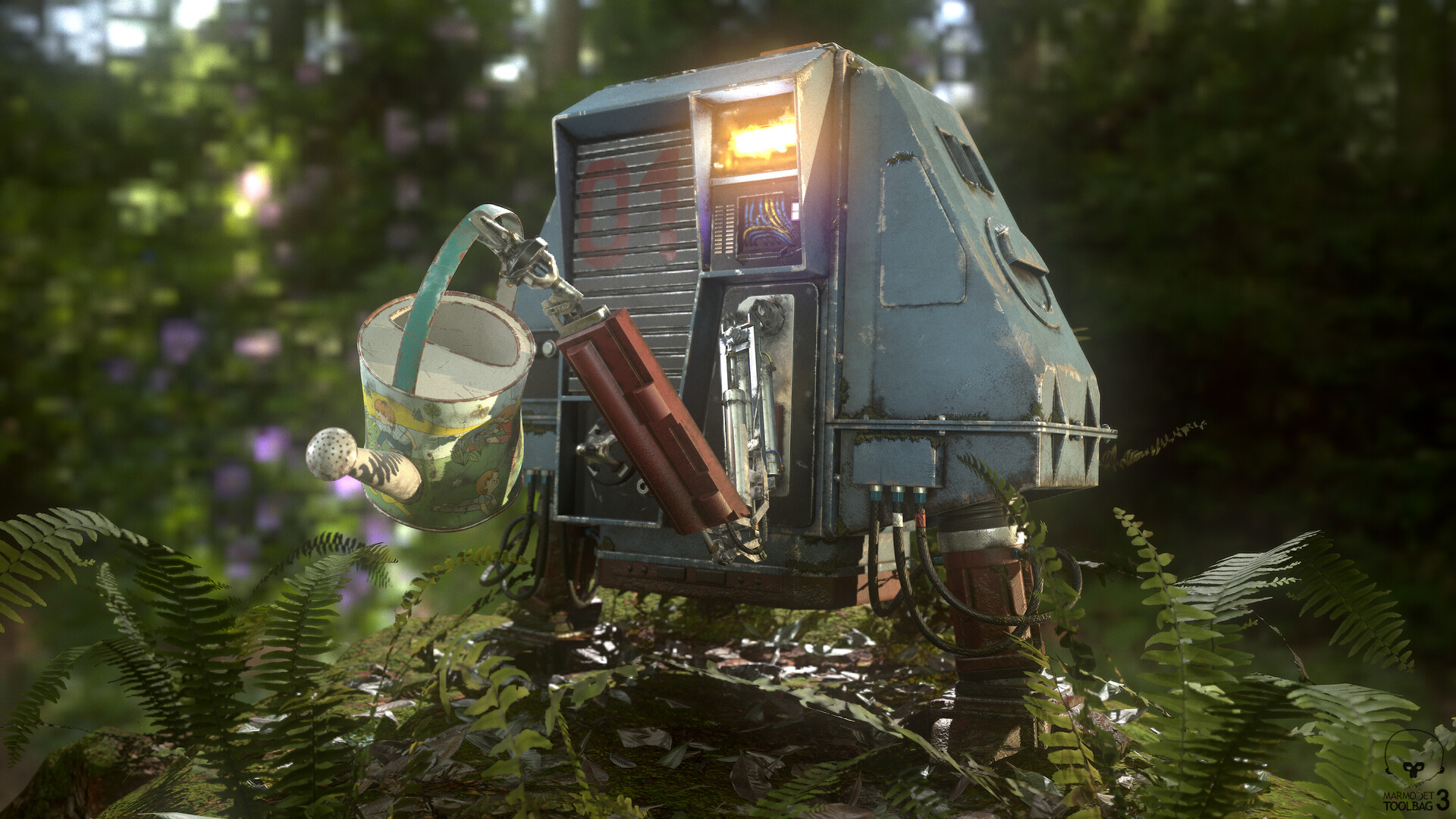
Silent Running: Film
Briefly, chapter 13 covers AI and the Environment. It is amazing (or not) how in a few sentences your mind can be changed? From "Really!" upon reading 'species culling', to this being explained in the crown-of-thorns starfish (hence COTSbot) and the toll on coral in Queensland. There are robots-for-ecology. I smiled returning to Silent Running's Dewey, Huey, and Louie becoming reality. Facinating point in: what is collective must be recognised in terms of causation. Appropriatly, PEAS is an acronym: probalistic weather event attribution studies are a reality in conjunction with remote sensing and tracking.

Drones are also developing apace, and applied robotics - tree-climbing. Less reassuring (adding to nature's precarity?) are artificial insects to undertake pollination; more positively reducing the impact of chemical and toxic spills. Simulation for training is well established in medicine and nursing; section 2.3 addresses this were PEAS form super-ensembles of data (I like that). PEAS can also have a role in determining an evidence-base and demonstrating it is hoped provenance for that evidence in the movement of populations, for example, climate refugees. In conflicts, human rights and justice, forensic architecture is of course well established: Forensic Architecture (Care Forensics?)

The summative nature in closing chapter 13 is a helpful approach which I will possibly try to duplicate.

Socio-technical approaches are found in chapter 14 Uses and Abuses of AI Ethics by Frank & Klincewicz. Understandably, boundaries play a large role, as you would expect in deliberating value and values, moral patients and agents. The Collingridge dilemma is discussed, regards putting in place controls for a technology while it is still in development, otherwise control may be lost (p.213). Diversity, a story of the moment - closes out this chapter. There is a 'nice' continuity across chapters to
15 The (Un)bearable Whiteness of AI Ethics by Syed Mustafa Ali et al. (the first note highlights the format is a dialogue). The (colonial) politics of north-SOUTH are duly noted and Africa (section 4). Section 8 points to technological (and health) colonialism. I take as a positive that the 'hyphen' also has a place (S.10).

The Savage Mind

Again related, as per the book's structured parts, chapter 16 Ethics beyond Ethics: AI, Power, and Colonialism by Kim prompts the reader to revisit the concepts of 'other', alterity even if 'understood'. I pencilled 'Savage Mind' here. Machines are posited as the colonial other. There will be a repeated argument as in response to humankind's going back to the moon (to stay) and on to Mars. We should sort Earth out first. So too for inclusion and the machines. What about the people who are excluded, disenfranchised and increasingly so? I wondered (previously) if (even) more could be made a transparency? Noting the word subaltern, it appears this has suddenly been attributed to Ukraine? On disability and ableism reminded also of radio history and 'Does He Take Sugar?'

The statement: 'Machines are perceived as distant - temporally, spatially, or socially - and different from human culture.' p.234. Is, so true.

INDIVIDUAL
|
      INTERPERSONAL    :     SCIENCES               
HUMANISTIC  --------------------------------------  MECHANISTIC      
 SOCIOLOGY  :    POLITICAL 
|
GROUP
cognitive - conceptual
'spaces'
distance:
time, space
human cultures
societies
difference


'Binary-opposition' and the need to think outside of this is acknowledged. And as if (perhaps) to stress both distance and proximity, I wrote 'mobius' in the margin (p.238). Hutchings (2015) sounds a valuable reference: 'Ethical Encounters - Encountering Ethics'. The books I've read contribute to evidence to revalidate my nurse registration. I realise I've sold-myself short in listing the book's titles. Although not discussed here the remaining chapters are excellent critical reading at a time when diversity, equality and inclusion policies are being rolled-back and undone. I will highlight these:

  • 17 Disabling AI: Biases and Values Embedded in Artificial Intelligence (quoted in 'Do you fit the description?')
  • 18 The AI Imaginary: AI, Ethics and Communication
  • 19 Feminist Ethics and AI: A Subfield of Feminist Philosophy of Technology
  • 20 Buddhism and the Ethics of Artificial Intelligence
  • 21 Queering the Ethics of AI

In chapter 16 'Ethics beyond Ethics...' just before the conclusion I will carry forward a sentence -
'Forming an identity requires that "I identify something or someone beyond me" - with one or more categories persons, non-human others, acts, ideals, values, or social systems' (p.243).
- and the points following, and end there.

Many thanks to David J. Gunkel (Editor), the many contributors, and Edward Elgar Publishing Ltd for my copy. I have greatly enjoyed and learned much from reading this book.

Handbook on the Ethics of Artificial Intelligence. David J. Gunkel (ed.). Cheltenham, UK: Edward Elgar Publishing Ltd. ISBN: 978 1 80392 671 1245


Images:
Silent Running 
https://cdna.artstation.com/p/assets/images/images/016/839/904/large/david-eagan-screenshot001.jpg?1553673214
The Savage Mind
https://en.wikipedia.org/wiki/File:The_Savage_Mind_(first_edition).jpg

Related previous posts: 'general + AI'

*That early streak of competitiveness was clearly educated out of me.