Hodges' Model: Welcome to the QUAD: Search results for hospital

Hodges' model is a conceptual framework to support reflection and critical thinking. Situated, the model can help integrate all disciplines (academic and professional). Amid news items, are posts that illustrate the scope and application of the model. A bibliography and A4 template are provided in the sidebar. Welcome to the QUAD ...

Showing posts sorted by relevance for query hospital. Sort by date Show all posts

Friday, September 12, 2025

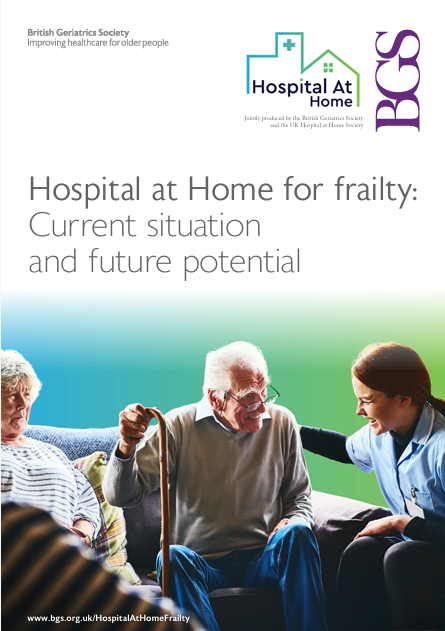
Report: Hospital at Home for frailty ...

 .... Current situation and future potential

Report: Hospital at Home for frailty
The BGS has produced report on Hospital at Home services for older people. This explains how they are currently provided and how they might develop in the future as a key part of community-based healthcare. The report is endorsed by the UK Hospital at Home Society.

Hospital at Home is a safe and effective alternative to acute hospital bedded care for people who are sick enough to be in hospital.

Hospital-level care provided at home means people living with frailty are not exposed to some of the risks arising from long stays in hospital, such as infections and deconditioning.

There is mounting evidence for the effectiveness of Hospital at Home services, which are greatly valued by those who use them. With 35,000 people a year benefiting from this alternative to hospital in England, further development of Hospital at Home should be encouraged as a key part of the Government’s ‘left shift’ from hospital to community.

continued ...

My source:
https://x.com/GeriSoc/status/1965676874111037547

Wednesday, May 01, 2013

Jordan: hospital, hospitality and the global research nurses network

The Jordan conference and experience prompted me to reflect upon 'hospitality' and 'hospital'. Also hospital as a physical environment and the way this contrasts with community care; and those without access to either.

At the research workshop on Monday with Nicola McHugh Project Coordinator for the Global Research Nurses' network, we were asked to consider and record how our respective job had changed. I jotted down the following also expanded here:

Winwick Hospital - Institutional care.
Issued with a (grey) suit and waistcoat.
White coats. Union lapel badges.
Witnessed (not overnight and still ongoing ...?) the transition to community care.
Development of primary care mental health.
The emergence of information technology.
From frontplate - nursing process and models, theories of nursing.
Nurses as advocates - now the addition of independent advocates.
Revisions to the Mental Health Act.
Changes in organizational hierarchies.
Changes in nurse education.
The increase in significance of the POLITICAL care domain:
informed consent, mental capacity, public engagement, litigation.
The cycle of re-organisations - NHS and Social Services.
Community Mental Health Nurses as therapists to assessors.
The development of the care programme approach (CPA).
The reduction in the number of injections / use of electroconvulsive therapy.
New drugs, evidence, specialist teams.
From in-house system to Körner to National Programme for IT to ..........
Less stigma for some conditions: epilepsy, psychosis but much remains
Diseases - Recovery - Self-care

Here are hospital and hospitality:

INTERPERSONAL : SCIENCES
SOCIOLOGY : POLITICAL

individual

During the Middle Ages hospitals served different functions to modern institutions, being almshouses for the poor, hostels for pilgrims, or hospital schools. The word hospital comes from the Latin hospes, signifying a stranger or foreigner, hence a guest. Another noun derived from this, hospitium came to signify hospitality, that is the relation between guest and shelterer, hospitality, friendliness, hospitable reception. 
The word hospitality derives from the Latin hospes, meaning 'host', 'guest', or 'stranger'. Hospes is formed from hostis, which means 'stranger' or 'enemy' (the latter being where terms like 'hostile' derive).
group - population

Sources:
http://en.wikipedia.org/wiki/Hospitality
https://en.wikipedia.org/wiki/Hospital

Saturday, March 08, 2025

AI, Nursing, Safety and presentation - 1st Aug 2-3pm

Hodges' model was not created primarily as a safety tool. It cannot claim to achieve or adhere to an ISO standard. ISO 45001 - health and safety management standard, for example. There is however a relation to clinical risk across healthcare professions, disciplines and clinical fields, including community and public (mental) health. To which of course we must now add planetary health. That said, the question of ISO safety and quality standards for Hodges' model has not been assessed. What exactly would certification entail? Would this process be appropriate for what is a generic - foundational tool?

What this means, however, is that as a situated model for reflection, reflective practice and critical thinking Hodges' model constitutes a deliberative step in the right (formal) direction. As noted previously, in template form, Hodges' model acknowledges the initial personal, professional and organisational standards that (must) shape our clinical encounters. That is, if assessed (as students - and our peers clearly are, and you would expect to be), unconditional positive regard would be observed, supported by the required standards of professional behaviour. 

There is another step here. The ethical and legal edict of 'do no harm' must also be central to care delivery, outcomes and evaluation. So from the outset, implicit in Hodges' model is the (NON-LEGAL) statement:

You, the practitioner - agent (student - and your mentor/supervisor) will not knowingly, or through professional ignorance, or neglect  cause physical, psychological, social (cultural), political (power), or spiritual harm to the patient - subject (or their carer - guardian/proxy).

There is no escape from AI and Large Language Models as I noticed in FTWeekend:

'Jilin University Hospital in the eastern city of Changchun has rolled out a diagnostic tool it claims can produce treatment plans through DeepSeek consulting the hospital's database, medical guidelines and drug efficacy results. Jinxin Women and Children's Hospital in south-western China said it had a tool for patients to track their ovulation cycles, with test results combined with the hospital's patient data to produce personalised fertility plans.

One doctor at public hospital in Hubei province in central China said the institution's leadership had issued a directive that DeepSeek should be used as a third-party arbiter if two doctors have differing views on treatment.
 
There have been rollouts in public hospitals in Chengdu, Hangzhou and Wuhan for less complex applications, such as digital nurses directing patients to the right consulting room or explaining complicated medical reports.
 
Several industry insiders warned against taking all the announcements at face value, as some companies were trying to capture investor enthusiasm around DeepSeek without meaningfully deploying its models. Meanwhile, government bodies are also under political pressure to be seen as aligned with China's AI darling.
 
The SOE tech supplier said "much work still needs to be done to make these models useful" for more complex work such as medical diagnosis. "It must be trained on enough medical data to produce good results. This will take time and needs collaboration from leading AI companies. It is not something hospitals can buld on their own."

Another doctor described a move to deploy DeepSeek last week at a hospital in eastern Zhejiang as a "publicity stunt".

Even if some announcements should be treated with scepticism, experts say the willingness to test out its models still marks a step change.'
Edited for formatting, some text is emphasised. A vast array of conditions can be substituted (parametrised) for 'fertility'. While nursing is mentioned there is little on testing, but for 'plans' we can read nursing assessment, plans, and evaluations. 

Returning to safety. Following an online chat yesterday, I've an online presentation to the Patient Safety Management Network [Patient Safety Hub] pencilled in for 1st August 2-3pm. Comprised of 40 minutes with questions following - I will, as discussed - focus upon:
  • Introduction to the model
  • How it can be applied in different situations – safety/risk/improvement
  • Examples of its use
This is progress - a step to develop Hodges' model and reveal the limits of the bio-psycho-social model.

^soe - state-owned enterprises.

Olcott, E., Ding, W. AI challenger DeepSeek spreads rapidly across China with the blessing of Beijing, FTWeekend, 1-2 March, 2025. p.13.

Monday, July 20, 2009

NHS data breaches: the 'cogeography' of who and where?

Computing this past week featured an item (extract below with link) -

Five more NHS trusts involved in serious data breaches
Written by Tom Young
Computing, 17 Jul 2009

Privacy watchdog the Information Commissioner's Office (ICO) has found five more NHS organisations in breach of the Data Protection Act.
The Royal Free Hampstead NHS Trust reported the loss of an unencrypted CD initially thought to contain medical treatment details of 20,000 patients from the hospital’s cardiology department.
Chelsea and Westminster Hospital Foundation Trust reported the theft of an unencrypted memory stick containing 143 patient details including sensitive medical information.
And Epsom and St Helier University Hospital NHS Foundation Trust has been storing hospital records insecurely for nearly two years following data being transferred between hospitals. ...

Straight away reading this I thought of my previous post about cogeography and commented accordingly (which registered twice - oops!). In light of the previous post here's that comment with some additions....
Such events merely (without trivializing) highlight the human capacity to ERR big(gish) time. Is it not possible for tech to help? If info systems through to mobile devices had a sense of where they are and their status as carrying sensitive data recognised through digital IDs - plus additional meta-dynamic data, then 'cogeographic awareness' might result?

I blogged about this with ref to conceptual spaces.

This would be an artificial example and would make it possible for data previously designated as confidential, sensitive, - HOT data if you will - to self-destruct, 'e-vaporate' if it found itself beyond a given combined virtual or physical environment be that hospital, Trust boundary, SHA, or National border...? This capability already exists no doubt in the security services (although sometimes you wonder) or as suggested in the realms of 'MI' and '007'.

Cogeographic or (cogneographic) may be a neologism and seeks to conjoin the cognitive (cognition) involved in defining, representing and using concepts in conceptual spaces; AND the finding that knowledge is invariably situated - that is knowledge has a geography.

Copies of NHS and social care
data could - should - MUST
have a geography too...?

Another comment rightly questioned the ability to put personal data on
CDs and other media in the first place. Amid the emergence
of renewed debate about the future of e-health
records, clinicians may have a professional
duty to demand cogeographic
properties no
less ...?

Image source: http://www.tapintoquality.com/facts/glossary-d.html

Happy Anniversary 20th July!

Monday, December 02, 2024

'Un Caso Clinico' BUZZATI (I906-I972)

Reading The Theatre of the Absurd earlier this year was a very enjoyable and disconcerting experience. In acknowledgement: I have quoted from the book at length below. I do so to better convey the context, and in the hope other people may similarly obtain and enjoy this classic theatrical text.

Reading, I was reminded of starting my career as a nursing assistant and student nurse, and the 'lock-up' wards: male and female. Listening now to the current Reith Lectures I will post regards: 

Gwen Adshead - Four Questions about Violence

https://www.bbc.co.uk/sounds/play/m0025cmg

As a community mental health nurse in community mental health teams and nursing home liaison, residents on the ground floor (of two or three floors - with 'general') 'knew' there were very poorly people on the top floor. In summer, windows open, they could often be heard shouting and in the night. Inside, for staff, family members, friends became advocates expressing concern for a lack of access to fresh air and sunshine. Something, of course, we can all benefit from. For some residents there was an in-house understanding of NOT wanting to be moved 'upstairs'. At times I gather, if a resident 'played up' such re-location (displacement) was used as a threat: a cue for education.^

DINO BUZZATI (I906-I972)
'In Les Bátisseurs d'Empire the flight from death takes the form of trying to escape upwards. The same image appears in the opposite direction in a remarkable play by Dino Buzzati, the eminent Italian novelist and journalist on the staff of the Corriere della Sera in Milan. This play, first performed by the Piccolo Teatro, Milan, in 1953, and in Paris in an adaptation by Camus in 1955, is Un Caso Clinico. In two parts (thirteen scenes), it shows the death of a middle-aged businessman, Giovanni Corte. Busy, overworked, tyrannized but pampered as the family's breadwinner, whose health must be preserved, he is disturbed by hallucinations of a female voice calling him from the distance and by the spectre of a woman that seems to haunt his house. He is persuaded to consult a famous specialist, and goes to see him at his ultra-modern hospital. Before he knows what has happened, he is an inmate of the hospital, about to be operated on. Everybody reassures him - this hospital is organized in the most efficient modern manner; the people who are not really ill, or merely under observation, are on the top floor, the seventh. Those who are slightly less well are on the sixth; those who are ill, but not really badly, are on the fifth; and so on downwards in a descending order to the first floor, which is the antechamber of death.

In a terrifying sequence of scenes, Buzzati shows his hero's descent. At first he is moved to the sixth floor, merely to make room for someone who needs his private ward more than does. Further down, he still hopes that he is merely going down to be near some specialized medical facilities he needs, and before he has fully realized what has happened, he is so far down that there is no hope of escape. He is buried among the outcasts who have already been given up, the lowest class of human beings - the dying. Corte's mother comes to take him home, but it is too late.

Un Caso Clinico is a remarkable and highly original work, a modern miracle play in the tradition of Everyman. It dramatizes the death of a rich man - his delusion that somehow he is in a special class, exempt from the ravages of illness; his gradual loss of contact with reality; and, above all, the imperceptible manner of his descent and its sudden revelation to him. And in the hospital, with its rigid stratification, Buzzati has found a terrifying image of society itself - an impersonal organization that hustles the individual on his way to death, caring for him, providing services, but at the same time distant, rule-ridden, incomprehensible, and cruel.' 
Esslin, Martin. Parallels and Proselytes, The Theatre of the Absurd. London: Pelican, 1982. (3rd Ed.).pp.277-279.

The Bewitched Bourgeois
^Rest assured, there were and are excellent centers of care too.


Update: 11th January 2025: c/o John Self. Meet the forgotten maestro of the ultra-short story. Saturday Review, The Times, p.15.
'One of his most widely published stories, Seven Floors, is set in a hospital where they put the "mildest cases" on the seventh floor, and so on in increasing order of sickness down to the first floor, which is occupied by those who are "beyond hope"'.

Lawrence Venuti. (2025) The Bewitched Bourgeois, New York: NYRB Classics ISBN: 9781681378671.

Cover image: NYRB.

Thursday, December 31, 2009

Goodbye to David McKendrick an 'old' friend and personal reflections

The past three years have been quite challenging both personally and professionally.

Professionally as an IT secondment came to an end in 2007 and brought with it positive and negative changes. The positive of moving back to clinical practice, the negative the vagaries of clinical banding and the Knowledge and Skills Framework which many health sector organisations are still attempting to fully implement. On a personal level, I am now also divorced. Working on the community for so many years - just over the border of my clinical patch - was a gift of convenience in terms of the children's schooling and playing taxi driver.

While there was a very objective interview panel I feel I owe having my current job to my friend David McKendrick. This fact now scares me witless that this was back in 1985 when my eldest son was born. I was so wrapped up in this life-changing event that the secretary phoned to ask if I did want the job. The organisation I still work for has changed its title and status umpteenth times it seems and I have had several roles over the years, including research and service development projects. The truth is though that when it comes to work, this journey began at Chorley with David and that is essentially where I am still at.

David McKendrickI was really shocked then when Sue, David's wife phoned with the news that David had died earlier this month. I'd kept in touch with David through the years. Due to my new domestic circumstances I moved back to Ashton-in-Makerfield - living not far from David and Sue - in July last year. David was so helpful, patient and supportive as I have progressed through the divorce.

We both worked at Winwick Hospital, Warrington, UK and I am pleased I went along this summer to a reunion and saw David in his element with friends, Sue and a pint. I also managed to take quite a few photos which will now be extra memorable for so many of us. Although I didn't work with David at Winwick, as already suggested he was my boss on the community mental health team at Chorley, Lancashire from October 1985 through to his early retirement due to illness.

We shared a love of IT and coding as enthusiasts. In the early 80s David called to my parents home when I'd bought a BBC micro, an upgrade from a Sinclair ZX81. David contributed so much to health IT, through his work with Open Software Library, computer aided learning and his pioneering bulletin board. David was also a co-organiser of a computer based training conference at Keele University 1987-88. Open Software Library distributed several computer programs I wrote on the BBC micro. One thing that makes me smile is the way in the late 80s early 90s I got my underpants into a bit of a twist over the copyright. Now reflecting back, David was a real Gent in how he handled that, my concerns to which he listened, accepted and explained. There was a lesson there also in terms of Hodges' model and Brian Hodges' worries over the same. Where might the model be now, we often pondered, if it had been driven hard from the outset!

When David retired it wasn't the same. Of course you know the job changes constantly, but there was a real loss of impetus: from warp to impulse drive. David was much liked and respected as a boss and colleague. If you were professional in your approach put the clients, carers and families first then he left you to get on with the job. That said his recognition for accountability and governance was communicated and shared by the team. He used an Amstrad micro to produce statistics on the number of home visits, injections and many other details. David was ahead of the informatics game in recognising the value of information for service planning, development and improvement. When David was off a while I kept this effort going for a short while until duties dragged me elsewhere. David's early IT work was published in the Community Psychiatric Nursing Association journal, an association (now the MHNA) which he helped established initially.

I can see us all walking from the team office at Eaves Lane hospital (long gone now), up through the tunnel to the main hospital for the regular team meeting. That was a golden age of sorts, when all the community nurses came together. David was always keen on that. You were a member of a team and everyone was valued and had a role to play.

David recognised my interest (and yes skill -- thanks David!) in computing and sent me on a health care computing conference held in Manchester 1986. I wrote a report and have attended and presented at the HC-XXXX series on several occasions since. We often shared books, papers and plans around technology developments and when to build or buy that next PC.

I really, really can't believe David has gone. He was (very) widely read and we loved knocking ideas around always wondering about what sort of clinical / nursing application might have a future. I only learned since his passing of his excellence as a student nurse. When he qualified as a Registered Mental Nurse (RMN) he was awarded the Gold Medal. He was always keen to read my writing efforts and discuss the same. I remain really impressed with his website on Winwick Hospital - Winwick Remembered. While there is much in the old institutions to say good riddance to and never again this IS social history and as BBC R4's In the Mind featured there is much to record and document. In 2006 David got in touch with a query regarding relatives of patients from Winwick trying to trace details of their family members. I posted his inquiry on the psychiatric nursing list (since closed).

Over the past year or so, we met a few times at Tom & Gerry's the local pub with David riding there on his bike: magic!! Sitting at that usual table (near the plug) sad, but lots of smiles too.

I arrived late to politics and I much admire his involvement in community work, the Three Sisters Recreation area project in Ashton. While I enthused over 'community informatics' David was practicing it, engaging with others. I'm sure I don't appreciate the extent of his efforts, the youth club - helping make IT available to youngsters, environmental projects, and the community forum.

I am truly thankful for having met David, for his friendship, support and guidance over the past 18 months and the years before. If I've three regrets:

  1. I never did take my guitar around; as I realise now how good David was - McKendrick's Moonshiners no less - I clearly missed a lick there!
  2. Also never did find and show David the old photos from Winwick hospital - the show we put on as students.
  3. Being able to explore Ashton Heath, the types of heather and the bees there.
Regular readers here know of the hyperbole over the new website, well now if I ever do create the new website - maybe we'll know why...

David - I'll miss you pal and miss you already!
As the new decade begins bless you, Sue and your family and friends...

Peter

===================================
From: Richard Lakeman, richard.lakeman at dcu.ie
To: Peter Jones h2cmng at yahoo.co.uk
Sent: Mon, 14 December, 2009 14:40:27
RE: [PSYCHIATRIC-NURSING] David McKendrick - CPN - CPN Manager, Winwick & Chorley, UK

I’m sorry to hear about David, Peter. Thanks for letting us know. I never met David, but he marketed some software I wrote for some years and He was a pleasure to deal with.

Regards
Richard

Monday, September 07, 2026

Host|Guest by Hospital Rooms

To mark its 10-year anniversary, arts and mental health charity Hospital Rooms presents a major exhibition at Victoria Miro this September.

Bringing together leading contemporary artists from across the Hospital Rooms programme, the exhibition features re-creations of monumental new artworks created for hospitals this year, alongside artists the organisation has collaborated with over the past decade. It reflects on the impact of transforming NHS mental health environments through art, while looking ahead to expanding access to creative programmes nationwide.

Host|Guest


My source: Ellee Su, Gallery, HOSPITAL ROOMS, FT Weekend Magazine, Number 1,192. 5 September 2026, pp.10-11.

Sunday, July 07, 2013

Part II: Pensioners, 'Health students' and Children

For decades the reactive health care system has been founded, loved and sustained through the primary care - secondary care hospital system, together with its complex range of referral systems and processes.

Now demographic trends and economic pressures have seen the emergence and ongoing development of the virtual hospital. Call centers and teams that deliver nursing and medical care in the home to prevent admission and facilitating early discharge are still basically reactive.

What is needed is a cognitive hospital.

A form of hospital that acknowledges the health care system but can finally progress the preventive agenda on an individual, educational basis, fostering self-efficacy, health literacy and if necessary self-care.

Saturday, September 13, 2025

On Care, Papers, Distance, Pressure, Academia and Falls

In my student nursing days late 1970s there was a big-stick of motivation. It wasn't management, and yet it was. There was a stigma attached to a patient developing a pressure sore - decubitus ulcers. The NHS then had many psychogeriatric wards, but that care is now with nursing homes. Despite the best efforts some patients did, especially on the mental health infirmary, which was staffed by 'general'  trained nurses too. Using aseptic technique wounds had to be packed (stage 3-4?). Some of the treatments, were not exactly 'evidence-based'. There is a historical account of previous treatments provided on 'Asylum Years'.

In the 1990s I was working on a 'book' about health, nursing and informatics (it was simpler then?). Submitting the project as a book proposal, a letter from one publisher reads: 'thanks but no thanks'. Although unsuccessful, that exercise accounts for the range of interests I still maintain today, and the scope of posts here on W2tQ. Continuing to clear and sort notes, one is for the 'book':

Abbott, P., & Payne, G. (Eds.). (1990). New Directions in the Sociology of Health (1st ed.). Routledge. https://doi.org/10.4324/9781351141727

From the above book, I've a page of notes headed "For chapter 2" drawing on a brilliant chapter 4:

Distance Decay and Information Deprivation: Health Implications for People in Rural Isolation

By George G. Giarchi

Abstract

Deprivation is frequently associated with the lives of inner city dwellers in old densely packed terraced housing, or with the residents in high-rise city slums and concrete council houses. In substantive socio-economic terms the deprivation of both the urban and the rural setting are the effects of the same structural dysfunctions, as aptly demonstrated by Townsend's 1968 classic study of poverty. On the basis of empirical studies rural deprivation affects the standards of health of many people in the countrysides of the UK particularly the most vulnerable dependent populations, such as younger children and older adults at the lower end of the social scale. The houses which are 'unfit' are damp, poorly lit, badly ventilated or lack healthy sanitation: clothes are rotten with mildew. Leschinsky's nationwide survey of rural health services indicates that centralization of health provision is a major reason for health disparities in rural areas.


I looked up the author, guessing that they were possibly still in academia, emeritus, or more likely (then, a decade or more in their career) retired by now. The search did not take long, but filled me with sadness and anger:

'A coroner has said there were "missed opportunities" to prevent the death of a hospital patient who died after developing a bedsore.

George Giacinto Giarchi, 86, died in November 2017 at Plymouth's Mount Gould Hospital after being treated for weeks at Derriford Hospital after a fall.

At Plymouth Crown Court coroner Ian Arrow said Mr Giarchi died of multi-organ failure from the pressure ulcer.

His family urged ministers to ensure hospitals had adequate staffing levels.

The former Plymouth University professor was admitted to Derriford Hospital after falling and fracturing his arm at home on 25 September 2017.

He was later transferred to Mount Gould where the lesion was first noticed.'

Pressure ulcers, known as bed sores, are injuries caused by pressure on the skin often seen in bedridden patients.'

https://www.bbc.co.uk/news/uk-england-devon-48798285

 Thank you and bless you Prof. George G. Giarchi RIP.

Jones, P. (2012). Exploring several dimensions of local, global and glocal using the generic conceptual framework Hodges's model. The Journal Of Community Informatics. 8(3). Retrieved from https://www.academia.edu/3794699/Reflecting_on_the_glocal_through_the_conceptual_framework_of_Hodges_s_model

Thursday, January 15, 2015

Architecture and Design: 4 beds in 4 domains

'Privileged' is definitely the wrong word. Perhaps it is the advantage of experience and the passing of almost four decades and more....

Times have changed since arriving at Winwick Hospital on a bike as a student nurse for an early shift at 0655. I would  leave my bike just down a small corridor to the right of the main entrance. I don't think I locked it. Then depending on the ward allocation I walked through the red carpeted front of the hospital to the increasingly rough and seemingly lost corridors beyond.

Hospitals have changed markedly. Winwick and other asylums have gone - thank goodness.

Cockroaches, leaking roofs, two-storey blocks where when necessary the patients would carry the meals up the stairs. A charge nurse set about ensuring that the patient's were provided with proper safety equipment if there were no lifts. The dormitories were large: 40+ bedded and more. There were lockers of some description I think, but personalised clothing was still to follow in 1977.

Despite the emphasis on community care, a project that in reality is still a work in process, the need for hospital beds remains. I have worked to keep people out of hospital, to help provide crisis support at home. When beds are needed the experience for members of the public and their families is radically different today. As taxpayers we recognise the need for efficiency in design, procurement, commissioning and managing new buildings. So it is within the NHS. Visiting new modern facilities, and this includes private nursing homes, you really appreciate the benefits good design can bring for patients-residents, staff, students and visitors.

individual
INTERPERSONAL : SCIENCES
humanistic ------------------------------------------- mechanistic
SOCIOLOGY : POLITICAL
group
My space
Private space - observations permitting/negotiated
Space to wander
Space for wheelchairs
Colour
Personalisation
Temperature

Why is Joe staying in bed?
Why is Mary not going in the lounge?
...?
4 Bed Multi Bed Bay c/o ProCure21+


Public space
Quiet spaces (who says?)
'Community'
Lounge
Dining areas
Activities room
Noise levels
Meeting rooms
Interview rooms
...?


Public Engagement
Staffing
Volunteers
Project Management
Value for Money
Savings
Security
Policies
Safety
Services
ProCure21+
...?

Image source: http://www.procure21plus.nhs.uk/standardshare/

Tuesday, November 19, 2019

South Sudan Medical Journal - November 2019

http://www.southsudanmedicaljournal.com/assets/files/Journals/vol_12_iss_4_nov_19/Full%20Draft%20Final.pdf
South Sudan Medical Journal


The November 2019 issue is now online here and includes items on Diabetes management, FGM and perineal injuries, Nutrition surveys, Gestational choriocarcinoma, Laryngeal trauma, Tympanic membrane perforation, Acute malnutrition and Overuse of antibiotics.  See details below.


Please send us your feedback on this issue, submit your manuscripts (which we can help you prepare), encourage colleagues to join the mailing list here, follow us on twitter @SSMedJournal and our Facebook Group, and find previous SSMJ articles at African Journals Online (AJOL) and the Directory of Open Access Journals (DOAJ).


EDITORIAL
  • Bringing diabetes mellitus into focus on World Diabetes Day Edward Eremugo Kenyi
ORIGINAL RESEARCH
  • The effect of Female Genital Mutilation on perineal injuries among women in labour in Dodoma Region, Tanzania Janeth Dickson Sichone, Athanase Lilungulu, Secilia K. Ngwashemi and Agatha Ngowi
  • Analysis of trends in SMART Nutrition Survey data from South Sudan between 2004 and 2016 Ciara Hogan, Kate Golden, Regine Kopplow and Elaine Ferguson
  • Pattern and causes of tympanic membrane perforation at a private hospital in Dar es Salaam, Tanzania Zephania Saitabau Abraham, Aveline Aloyce Kahinga, Kassim Babu Mapondella, Enica Richard Massawe, Emmanuel Ole Lengine and Daudi Ntunaguzi
  • Nurses’ knowledge of the management of diabetic patients at Juba Teaching Hospital Abuk Mayen Deng, Lucia Buyanza and Fekadu M. Alemu
  • Abstracts from the Juba College of Nursing and Midwifery: Management of 3rd stage of labour Deborah Akon Akech; Danger signs of obstetric complications Kiden Harriet Oliver
CASE REPORTS
  • Gestational choriocarcinoma at Juba Medical Complex and Juba Teaching Hospital: five case reports Kizza Paul, Kuma Chuol Biel, Anthony Lupai, Changkel Banak, Mirghany Abdallah and Paula Nuer
  • Laryngeal trauma at Juba Teaching Hospital, South Sudan Justin Rubena Lumaya, Jino David and Natali Tong
NEWS
  • South Sudanese recipients of grants from the Gordon Memorial College Trust Fund (GMCTF) in 2019
  • Continuum of care for acute malnutrition in South Sudan
  • Public health resources
BACK COVER

Kind regards
The SSMJ team

Copyright © 2019 Southern Sudan Medical Journal, All rights reserved.

Sunday, December 13, 2009

(many) Care Transitions and The Little '-' That Could

Some people looking at Hodges' model may believe that the model perpetuates the dichotomies of old:

Human --- Machine
Individual --- Group
Sick --- Healthy
Supply --- Demand
Home --- Hospital
Self care --- Nursing care

In the 1990s as a community mental health nurse I was involved with a group of general nurses looking at ways of improving:
  • discharge planning
  • continuity of care
These issues remain and with the dichotomies of care above we can see how Hodges' model can assist our thinking and planning about transition. Not just one transition, but several.

This past week I was fortunate to attend one of a series of workshops -
Delivering High Quality Health Care for All: Bringing the social and technical together for a joined-up approach to deliver supporting systems and technologies
10th/11th December 2009, Leeds, UK

Organised by the UK Faculty of Health Informatics and the BCS Socio-Technical Group

The event was very good, stimulating and challenging. In the closing debate the appeal of 'socio-technical' and how to market a much needed joined-up approach in health IT came down at one point to the difference between:

'socio-technical' and 'sociotechnical'

In trying to find an alternative title, the hyphen was lost, and whilst it is not a crucial issue - for me that hyphen represents the axes of Hodges' model. Hodges' model acts as a high level aide-mémoire and that little hyphen can perform the same trick. The hyphen reminds us of the differences. The dichotomies that need to be navigated and negotiated in our dialogues about care AND caring. These are most evident in transfers and transitions (after all - "getting out of bed is a risk").

There are mini and macro transitions. Care pathways are not yellow-bricked unbroken splines from cottage to cottage hospital. They should be tortured if they do reflect person-centered experiences and needs.

Some transitions are process laden and repetitive, such as drug administration and must be protected - free from interruption. Although grounded in a social exchange of (correct) identities: a registered nurse, the right patient, right drug, right dose, right duration and right time these can be framed within the SCIENCE domain. That is where (for me) the conventional 'drug round' can be found. Counselling is another transition (if effective it also moves people on). 'Counselling' can be found in the INTRAPERSONAL domain - close to the border with SOCIOLOGY.

Other transitions and transfers are more involved:
  • person's home to attend day care (for the first time!)
  • person's home to residential home
  • hospital ward to home
  • home encounter with the crisis team
  • telecare consultation
  • ...
Care is constantly passed hence the need to write and record. Passed from -

person-to-person
team-to-team
team-to-carer
time-to-time
discipline-to-discipline
self-care

This is the outcome that is sought. Ultimately passing responsibility back to the individual and when applicable their family. Having formal integrated care pathways is one thing, but they are never truly continuous, clear and true. And as they say crossing bridges you may have to break step and surely different disciplines march to different tunes? Today though the most audible tune must be socio-technical. ...

Additional link: The Little Engine That Could
Image source:
Drug round tabard
http://internet-workwear.co.uk/acatalog/Drug_Round_Tabard.html

Tuesday, June 21, 2022

'Pad culture' ...

INDIVIDUAL
|
 INTERPERSONAL    :     SCIENCES               
HUMANISTIC --------------------------------------  MECHANISTIC      
SOCIOLOGY  :   POLITICAL 
|
GROUP
DEMENTIA

SELF
ORIENTATION - INSIGHT
Listened to .. 'Hear me'?
dignity and respect
Mental capacity (awareness?)
emotional distress

Appears confused -
Physical cause: dehydration, delirium..?


[A shared convenience?:
How many persons are assumed
to be diagnosed with a dementia?]


in-CONTINENCE

Place:
[Home,
Community Hospital,
Residential care, Nursing Home]
IT/Record systems

'Parity of Esteem' i
Mental Health and Physical health

'Parity of Esteem' ii
[Mental Health and Physical Health] AND Social Care

Time:
ASSESSMENT, Care Plan, Evaluation ...

'Pad Culture'


'My Pad' Culture -
buy/sell
£££ $$$


Standards of Care
Nursing - Social Care
policy - funding


File on 4 BBC Radio 4 21 June 2022 - 20:00hrs

Dementia: The Final Indignity

"Around 800,000 people have dementia in the UK. For those suffering from the illness, incontinence can often be seen an inevitable consequence - but that’s not always the case. Deemed as too embarrassing or taboo, it’s a topic that rarely hits the spotlight. Experts say preserving someone’s ability to go to the toilet is crucial to maintaining their dignity and quality of life and should be a priority in care settings. But is that always happening? A new report shown exclusively to File on 4 has looked at how continence care is being managed in hospitals – and how, in some cases, those who are continent are actively encouraged to soil themselves. Datshiane Navanayagam speaks to families who say their loved ones were ignored when it came to their continence needs in hospital and that the consequences have left them with health issues and requiring additional support. Nurses and medical staff say that continence training is often seen as a ‘Cinderella subject’. We also hear from dementia patients themselves about why maintaining your own dignity and independence is so crucial with this disease. With the government set to reveal a new dementia strategy this year, will continence care be placed higher up the agenda?"


Featherstone K, Northcott A, Boddington P, Edwards D, Vougioukalou S, Bale S, et al.
Understanding approaches to continence care for people living with dementia in acute hospital settings: an ethnographic study. Health Soc Care Deliv Res 2022;10(14). https://doi.org/10.3310/
QUVV2680
 
Source: Today BBC Radio 4, 21st June, 2022.

Saturday, November 10, 2018

South Sudan Medical Journal - November 2018

 http://www.southsudanmedicaljournal.com/

Dear SSMJ Reader,

The November 2018 issue of the South Sudan Medical Journal is now on online and includes articles on Ebola, Caesarean Section and Obstetric fistula. You can download the complete issue as a pdf here or the individual articles listed below.

Please share this notice with your colleagues.

EDITORIAL
Keeping an eye on Ebola Virus Disease Edward Eremugo Kenyi
Between June and November 1976, the medical world was baffled by an outbreak of a ferocious haemorrhagic disease in Nzara, South Sudan (then part of Sudan). This became known as Ebola Virus Disease (EVD). The West African outbreak in Guinea, Liberia and Sierra Leone in 2014 was devastating.  A new outbreak in DR Congo in 2018 is a warning to South Sudan to be on high alert.

ORIGINAL RESEARCH
Knowledge of type 2 diabetes mellitus and adherence to management guidelines: a cross-sectional study in Juba, South Sudan Alexandre Ali M. Bili and Longying Zha
Inadequate education and the lack of efficient diabetes care centres compounded by high costs are common barriers for diabetes care. This study assesses the level of knowledge and adherence to guidelines for management of type 2 diabetes in South Sudan.

Knowledge, attitude and willingness to accept Caesarean Section among women in Ogbomoso, southwest Nigeria Olumuyiwa A Ogunlaja, Idowu P Ogunlaja, Samuel E Akinola, Olufemi O Aworinde
Caesarean Section (CS) is a common procedure in obstetrics and has contributed immensely to improving maternal and foetal outcome. The study which seeks to assess the level of knowledge, attitude and acceptance of women about CS in Ogbomoso, Nigeria, concludes that mothers should be educated on the process involved in Caesarean delivery.

Obstetric fistulae, birth outcomes, and surgical repair outcomes: a retrospective analysis of hospital-based data in Dodoma, Tanzania Athanase Lilungulua, Balthazar Gumodokab, Mzee Nassoroc, Patrice Sokac and Kibusi Stephen
Obstetric Fistula (OF) among pregnant women remains a widespread condition with devastating consequences and poses a significant challenge in a community as well as globally. The study concludes that timely fistula repair by experienced fistula surgeons will improve outcomes and limit the clinical insult and distress that OF invariably causes.

CLINICAL GUIDANCE
How to repair a vesico-vaginal fistula Brian Hancock
Most fistulae are caused by ischaemic necrosis of the genital tract and adjacent organs through prolonged obstructed labour. This article provides a brief overview and refers the reader to resources that cover the practical aspects of the surgery and holistic care of the patient.

MAIN ARTICLES
Ebola Virus Disease: epidemiology, management, prevention and control Gasim Abd-Elfarag
Ebola Virus Disease (EVD) is part of the group of illnesses known as viral haemorrhagic fevers, and was previously known as Ebola haemorrhagic fever. Infection with EVD is acute, severe and often fatal in humans. The paper provides an outline of what is known about EVD.

Ebola on our doorstep: Ebola Virus Disease preparedness in South Sudan Richard Lako and Otim Patrick Cossy Ramadan
South Sudan has previously experienced three EVD outbreaks in 1976, 1979 and 2004. With recent outbreaks in DR Congo, it is possible that a sporadic outbreak can happen in South Sudan, and so the country is always at risk. Preparedness is key.

COMMENTARIES
Internship training in South Sudan: the challenges and way forward Jessry Pasquali Oboya
The House Officer is the professional whom the patient meets most often when entering hospital and will remember for a long time. The extraordinary commitment and work load of the House Officers at Juba Teaching Hospital has received little recognition by the authorities despite the challenges they face in the course of their training.

The current crisis of human resource for health in Africa Brian Madison
Brain drain has been a source of despair for developing countries, and the healthcare sector arguably bears the biggest brunt imposed by this growing problem. The author argues that if Africa is to counter the healthcare human resources crisis, member states may need to adopt radical reforms in the healthcare sector.

SHORT ITEMS
Caesarean Section acceptability and rate in South Sudan
Call for submissions
Obituaries

BACK COVER
Neonatal resuscitation chart
This chart is designed with the ‘Helping Babies Breath’ training in mind. However, it incorporates external cardiac massage, which can be effective in some cases.

All previous issues of the journal are in the Archive section, and you can ‘search’ for particular articles.

Please support the journal by submitting items for future issues. We are interested in articles on your research, case reports, and clinical guidance, as well as news of projects, and relevant photographs. We can help you prepare these for publication (see our ‘Authors’ Guidelines’). We welcome letters to the editor and questions. Send your contributions to the Editor-in-Chief, Dr Edward Luka admin@southernsudanmedicaljournal.com. 

If you are not already a member, join our Facebook Group and share your news and experiences and ideas.

You can follow us on twitter: @SSMedJournal. Other people can be added to our mailing list by clicking here.

SSMJ is a member of African Journals Online – see who is downloading SSMJ abstracts and articles here. We are listed in the Directory of Open Access Journals (DOAJ), you can find and search DOAJ for SSMJ articles here.

Kind regards
The SSMJ team
Friday, June 08, 2018

Hospital Passports or Traffic Light documents


Hospital Passport / Traffic Light Poster

I hope this helps a little John-Marc and colleagues...?

The health career - life chances - model was developed with the care and positive life experiences of people with learning disability very much in mind. Consider the model's intra- interpersonal care (knowledge) domain and the political. We are prompted to simultaneously factor in individual and collective autonomy.

As a possible learning exercise (CPD!) sketch out the model and use the poster to reflect on the concepts and aspects of individual and person-centred care that are highlighted.

Identity and care in recognising that identity is paramount whatever 'condition' places members of the public in our hands (and hearts).

Saturday, November 25, 2023

South Sudan Medical Journal - November 2023 Gender-Based Violence

Dear reader,

Our November issue on gender-based violence (GBV) is online here. See details below; we thank the many people who contributed to this important topic.
 
Please share this issue with your colleagues and promote it through your social platforms.


For example: “The South Sudan Medical Journal’s November issue tackles gender-based violence @SSMedJournal #SouthSudan #SSOT” or retweet from @SSMedJournal
 

EDITORIAL


RESEARCH ARTICLES
  • Maternal socio-economic and neonatal medical characteristics associated with survival of preterm neonates in Torit State Hospital, South Sudan: a descriptive cross-sectional study Beatrice Doki, Pontius Bayo and Ronald Jada
  • Factors associated with maternal deaths in Bongor Provincial Hospital, Chad Gabkika Bray Madoué, Allarehene Noudjalbaye, Saleh Abdelsalam, Kainba Passoret, and Diguisna Kadam

FOCUS ON GENDER-BASED VIOLENCE
  • Gender-Based Violence: How South Sudan is fighting back Nyakomi Adwok
  • Clinical management of rape survivors Koma Akim
  • One Stop Centre for the survivors of sexual and gender-based violence at Juba Teaching Hospital Busiri Julius Korsuk
  • SSMJ talks to Data Gordon about Men4Women Ann Burgess and Data Gordon
  • Ask the GBV experts Koma Akim and Nyakomi Adwok
  • The reality of GBV: The story of a South Sudanese girl child in Kenya Nyajuok Tongyik
  • 16 Days of Activism Against GBV Rita Martin Lopidia  
  • Resources on gender-based violence/violence against women and girls related to South Sudan
  • GBV Educational/Training Resources

SHORT COMMUNICATIONS
  • Applications for postgraduate Training Gordon Memorial College Trust Fund (GMCTF)
  • Letter to the Editor
  • Obituary: Dr Bashir Aggrey Abbas Meseka 
  • Obituary: Dr Peter Lado Aggrey Jaden


FRONT AND BACK COVERS IMAGES: From Tales of Lala, No to GBV (Credit: Crown the Woman, South Sudan)
 
Our articles are listed by African Journals Online (AJOL) and the Directory of Open Access Journals (DOAJ) as well as being on our website. SSMJ is included in the EBSCO scientific research collection.

The SSMJ team
Email: southsudanmedicaljournal AT gmail.com
Website: http://www.southsudanmedicaljournal.com
Follow us on Twitter/X @SSMedJournal and our Facebook Group

Sunday, December 10, 2017

EHR Individual - Group: Aggregator

People probably look at Hodges' model and see something that is simplistic. There is a great power, however, in the scenarios that the structure of Hodges' model can readily encompass. Not just in the hospital, but across all care contexts.

"Where is the great value promised by the transition to EHR [Electronic Health Record]? Where is the huge surplus from all those lives saved? Without an actor who can find it, and deploy it to shift the doctors into surplus, nothing will happen. 
If the ecosystem* includes just the five traditional players, EHR will remain an academic dream. The answer, then, requires introducing a new player - an aggregator. Because the odds of mistakes are so low, the benefits of EHR are invisible to the individual patient. They become material only when we aggregate outcomes over a large enough number of patients. We need to find an actor whose surplus is affected by patients not as individuals but as a group, and who is able to both capture and distribute this benefit; insurers, health-care systems, and governments all fit the bill. And the larger the group, the larger the surplus." p.130.

*The ecosystem illustrated by Adner is simplified and includes:
Payer/ Insurer, IT Provider, Hospital Administration, Hospital Department, Doctor, Nurse, Patient
(I have added Nurse)

Adner, R. (2012). The Wide Lens: A New Strategy for Innovation. London: Portfolio/Penguin.

Wednesday, July 15, 2026

Project 2000: The Judge Report 1985

Somehow, or perhaps that is being kind, I have a feeling that sources on the history of 'recent' nurse education may come to the fore. It is interesting that the guest editorial below reflects itself on the preceding 25 years. Not just several cohorts of students, careers, but a whole life-time. 

We must hope today, that British nurse educators can find more security, if not the contentedness described by Rye in 1985 ...

'The main principles for policy change contained in the commission's report are as follows.

1 The uncoupling of education from service. Students should no longer be employees of the National Health Service. Nursing education should now be part of the main-stream of higher education, students being financed through a suggested bursary system.

2 A single level of basic nurse qualification leading to registration.

3 Curriculum development (as discussed in chapter 4 of the report) must take into account the need to retain certain speciality options, and prepare students for practice both in hospital and community settings. It creates the possibility of direct entry into district nursing, health visiting and midwifery. 

This 3-year course would have educational credibility as it will be at diploma level, the first year being a foundation programme, furnishing a basis for informed choice later. The second year would contain practical placements (in the community, adult nursing and mental health). It would consist of three modules, the first to be based in a community setting, the second (focused upon the nursing of adults) in a hospital setting, and the third in a variety of environments related to mental health. Roughly 30% of the time will be dedicated to carefully supervised practice in clinical settings. The final year will be characterized by increased specialization. The opportunity to make a selection from a number of available modules will equip each successful student to become registered and to take up work either in an institutional or non-institutional setting. The academic award will be that of Diploma in Nursing Studies. 
...
This new approach to nursing education will not create a 'generic' nurse, but will prepare students to work in their chosen speciality in hospital or in the community. If nurses are to respond to the changing patterns of health care, it is critical for future development that preparation for working in the community takes place in the basic diploma programmes. This may be seen as one of the more controversial implications of the report, but the profession must address itself now to these matters, as nursing education must become more flexible and capable of change to meet the needs of clients.'

See also: #RCN26 RCN Congress - Nurse Education 

Rye, D.H. (1985), THE EDUCATION OF NURSES: A NEW DISPENSATION. THE REPORT OF THE RCN COMMISSION ON NURSING EDUCATION. Journal of Advanced Nursing, 10: 505-506. 
https://doi.org/10.1111/j.1365-2648.1985.tb00540.x

Royal College of Nursing (Great Britain)., & Judge, H. G. (1985). The education of nurses : a new dispensation. Royal College of Nursing. (Classed as a Book.)

See also: https://wellcomecollection.org/works/p889dx97

https://eprints.hud.ac.uk/id/eprint/10084/1/ouseycontent_9838.pdf

Saturday, March 30, 2024

"Jason and the adventure of 254" c/o Wellcome Collection

"A work by artist Jason Wilsher-Mills is displayed at the Wellcome Collection ahead of the opening of a solo exhibition at the London museum. "Jason and the adventure of 254" reimagines the gallery space as a hospital ward and features huge sculptures, illustrations and interactive dioramas that draw on the artist's experience of becoming disabled at the age of 11.

The exhibition's title alludes to 2.54pm at Pinderfields Hospital, Wakefield, on August 1 1980, when Wilsher-Mills watched from his hospital bed as his parents were told he was suffering from an autoimmune condition brought on by a bout of chicken pox.

The free exhibition opens tomorrow (21st March) and runs until January." p.2.

INDIVIDUAL
|
      INTERPERSONAL    :     SCIENCES               
HUMANISTIC  --------------------------------------  MECHANISTIC      
 SOCIOLOGY  :    POLITICAL 
|
GROUP


'Figure in the bed', 2024, part of Jason and the Adventure of 254, an exhibition by Jason Wilsher-Mills at Wellcome Collection. Gallery Photo: Benjamin Gilbert. Attribution-NonCommercial 4.0 International (CC BY-NC 4.0).


Body of work, Artist relives diagnosis, Financial Times, 20 March 2024, p.2. 

Previously - 'beds'

Friday, January 28, 2011

Proximity: Relationships, Records, e-Health - Person-centredness near and far

When data protection and confidentiality is debated "the need to know" is often wheeled out as a rationale for access to personal identifiable data.

See the following:
NHS Confidentiality Consultation - FIPR Response (esp. #18).
DoH, Confidentiality, UK

In addition, if I need to access the record of patient held at hospital 'x' from hospital 'y' what is the health care relationship that prompts and justifies this need?

At present visiting nursing and care homes, you go knowing that data capture and recording (care assessment) is a fundamental requirement. Having a secure laptop for community has long been promised. While tech solutions are available and implemented elsewhere, my lack of such technology prompts me to imagine a future visit. ...

Pulling up at the nursing home I walk up the drive, ring the bell. While I wait the new tablet device in its bag has already introduced itself to the home. As I am allowed in - my identity assured - the tablet continues its dialogue, it:

  1. Downloads and updates existing active client data.
  2. Downloads additional data as per the agreed dataset on the new referral.
  3. Checks on items 1-2 with a review of recent prescribing for key psychotropic medicines.
  4. It checks the most recent NICE, Cochrane evidence and reconciling the local care knowledge. (This may seem excessive at present, but come personalised medicine this will be crucial).
  5. Will check on most recent clinical reviews and due dates.
  6. The h2cm template is there ;-) ready to present the care domain summary for the general physician ... and possibly (roles?) the next care professional to visit this home and this resident.
The significance of relationships is usually denoted by distance. Personal space is rather obviously spatial. This is how we recognise (well one of the ways!) the meaning and significance of an intimate relationship. In care situations with individuals who are confused and potentially aggressive we are conscious of the need to have due regard and respect for that person's personal space. Spaces and boundaries have to be negotiated in a variety of ways and means. 

Health information technology has already made effective use of role-based access to systems. If we take person-centred care to the nth degree, proximity can also count as it does in mobile health (m-health). Whilst to effect a role is to be in a certain location and context (sat at the office PC in the hospital) roles are organisationally and politically defined. Proximity is also contextual and situated in other ways, my proximity to:
  • the nursing home;
  • the individual's room;
  • the individual themselves.
  • (and their relatives)
While telecare / informatics can deliver a dividend in remote care, it is essential that it can also demonstrably support person-centred care. The best way (clinically assured) to do that for many activities is person-to-person contact. Just because one-side of the relationship may not recall the encounter as little as five minutes after, does not mean that there is no value in sustaining the ring of the bell, the exchange of s-miles, the record that results and other background conversations.

Image source:
Gestalt - proximity
http://graphicdesign.spokanefalls.edu/tutorials/process/gestaltprinciples/gestaltprinc.htm