Hodges' Model: Welcome to the QUAD: metadata

Hodges' model is a conceptual framework to support reflection and critical thinking. Situated, the model can help integrate all disciplines (academic and professional). Amid news items, are posts that illustrate the scope and application of the model. A bibliography and A4 template are provided in the sidebar. Welcome to the QUAD ...

Showing posts with label metadata. Show all posts

Wednesday, June 29, 2022

meta- meta- meta- +!

 
INDIVIDUAL
|
 INTERPERSONAL    :     SCIENCES               
HUMANISTIC --------------------------------------  MECHANISTIC      
SOCIOLOGY  :   POLITICAL 
|
GROUP

META-COGNITIVE

META-GENOMICS

META-SOCIOLOGICAL

META-POLITICAL


meta-conceptual - anyone?


+! all the other 'meta-'s you wish to consider ...


Source: Reference to 'metagenomics' in -

Mancini, D.P., 'Monkeypox mutating faster than expected, study finds', FT Weekend. 25-26th June 2022.  p.6.

See also: Previous posts 'meta'


Thursday, April 19, 2018

Workshop on Research Objects (RO2018)

2018-10-29 at IEEE eScience 2018, Amsterdam, The Netherlands
http://www.researchobject.org/ro2018/

## Timeline
...

## Research Objects

Scholarly Communication has evolved significantly in recent years, with an
increasing focus on Open Research, FAIR data sharing and community-developed
open source methods. A question remains on how to publish, archive and explore
digital research outputs.

A number of initiatives have begun to explore how to package and describe
research outputs, data, methods, workflows, provenance and structured metadata,
reusing existing Web standards and formats.

Such efforts aim to address the challenges of structuring multi-part research
outcomes with their context, handling distributed and living content and
porting and safely exchange what we collectively can call “Research Objects”
between platforms and between researchers.

## Call for Papers

In the workshop RO2018 we will explore recent advancements in Research Objects
and publishing of research data with peer-reviewed presentations, invited
talks, short demos, lightning talks and break-out sessions to further build
relationships across scientific domains and RO practitioners.

RO2018 welcomes submissions of academic abstracts (1-2 pages), data/software
articles (3-6 pages) and short research articles (4-8 pages) on cross-cutting
case studies or specific research on topics including, but not limited to:

  FAIR metrics; platforms, infrastructure and tools; lifecycles; access control
  and secure exchange; examples of exploitation and application; executable
  containers; metadata, packaging and formats; credit, attribution and peer
  review; dealing with scale and distribution; driving adoption within current
  scholarly communications and alignments with community efforts; and
  domain-specific and cross-domain Research Objects.

## Submitting

Submitted abstracts and articles can be in a range of open formats (e.g. HTML,
ePub) and are particularly encouraged to be submitted in a FAIR research data
packing format.

Accepted abstracts and articles will be included in the IEEE eScience 2018
proceedings. Submitted preprints will, upon acceptance, be made available as
Green Open Access on the RO2018 website with DOI links to the Zenodo record and
(eventually) the published IEEE proceeding article.

It is a requirement that at least one author of each accepted submission
attends the RO2018 workshop and at the IEEE eScience 2018 conference, where
registration fees applies.

Further details on submitting ...
...

Stian Soiland-Reyes (my source: by email)
The University of Manchester
http://www.esciencelab.org.uk/
http://orcid.org/0000-0001-9842-9718

Thursday, March 08, 2018

Drupalcamp London: And all that jazz

Drupalcamp London was a bootcamp literally in light of the weather. This affected the schedule a bit but it was well worth attending.

The first session on my list was not the intended module development but:

Flexible content editing with paragraphs and Drupal 8 - with Baddý Sonja Breidert who stepped in at short notice. We were encouraged to look at Open Doors as an example of Paragraphs being deployed. The fact that there were 25 types of paragraphs prompts the thought - not so much how many would I would need but the users? Apparently, paragraphs are not that user friendly to edit. Navigation was indicated 'Manage Display' - 'Preview' - 'Paragraph'. The 'environment indicator' flagged whether the site in use was live or dev: a reminder. A future tip included not using entities, but media for anything reusable. Reusable paragraphs were applied to banner and images, using simple entities. There were some special functions (and specific modules) in the table of contents, entity embed, entity browser, insert view and add map.

In considering when to use paragraphs this connects with choosing content types - another key question for me. There was a lot more in what was a 'changed session'. I'll check the slides / videos were available and for those below. The three keynotes were excellent too:

Let’s take the best route - Exploring Drupal 8 Routing System

Drupal in the era of microservices

"Hi user, I am Drupal. How can I help you?"

Accelerating Drupal projects with Thunder: a case study

In 'Make your site findable' dutchyoda Dick Rensema pulled me up short. So, I will check out the metatags module and use this from the outset. As for being findable - it's also best to have separate text and images not have both within a WYSIWYG editor. Another point is to 'make it long'. That sits well for the archive pages for Hodges' model.

Lunchtime on Sunday was preceded with gambry on Plugin API, a key idea being:

ENTITY - Same model different data
PLUGIN - Same "thing" type different ways

This was a captivating, dense, rich session and one to revisit.

Finally, the 0930 start in London helped as I'd been up late. Ronnie Scott's is an amazing experience, the second house from 1030 doors open through to 0300: I left at 3 thanks also to Resolution 88.


Monday, January 18, 2016

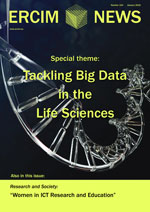
ERCIM News No. 104 Special theme: "Tackling Big Data in the Life Sciences"

Dear ERCIM News Reader,

ERCIM News No. 104 has just been published at http://ercim-news.ercim.eu/en104

This issue features a special theme on "Tackling Big Data in the Life Sciences"
coordinated by the guest editors Roeland Merks (CWI) and Marie-France Sagot (Inria) and a section "research and society" about "Women in ICT Research and Education", coordinated by Lynda Hardman (CWI)

This issue is also available for download in pdf and EPUB.

Thank you for your interest in ERCIM News. Feel free to forward this message to others who might be interested.

Next issue: No. 105, April 2016 - Special Theme: "Planning and Logistics" (see Call for contributions)

Best regards,
Peter Kunz
ERCIM News central editor

Thursday, January 08, 2015

ERCIM News No. 100 Special theme: "Scientific Data Sharing and Reuse"

Dear ERCIM News Reader,

ERCIM News No. 100 has just been published at http://ercim-news.ercim.eu/en100
Join us in celebrating the 100th issue and post a message at http://ercim-news.ercim.eu/guestbook

http://ercim-news.ercim.eu/en100/special/
ERCIM NEWS 100
Special Theme: "Scientific Data Sharing and Reuse"
http://ercim-news.ercim.eu/en100/special/

Keynote by Carlos Morais, European Commission: "e-Infrastructures Enabling Trust in the Era of Data-Intensive Science"

This issue is also available for download in:
pdf:  http://ercim-news.ercim.eu/images/stories/EN100/EN100-web.pdf
epub: http://ercim-news.ercim.eu/images/stories/EN100/EN100.epub

Next issue: No. 101, April 2015 - Special Theme: "The Internet of Things & the Web of Things"
(see Call for articles at http://ercim-news.ercim.eu/call)

Thank you for your interest in ERCIM News. Feel free to forward this message to others who might be interested.

Best regards,
Peter Kunz
ERCIM News central editor
