Hodges' Model: Welcome to the QUAD: organisations

Hodges' model is a conceptual framework to support reflection and critical thinking. Situated, the model can help integrate all disciplines (academic and professional). Amid news items, are posts that illustrate the scope and application of the model. A bibliography and A4 template are provided in the sidebar. Welcome to the QUAD ...

Showing posts with label organisations. Show all posts

Saturday, September 05, 2026

UN votes to adopt new world map to reflect Africa's true size | BBC News

UN tells the world: Stop making Africa look small

'By 164 votes to one, Member States on Friday endorsed a resolution promoting map projections that more accurately reflect the true size of continents – the culmination of an African-led campaign against the 16th-century Mercator projection, still the most widely used map in the world. 

The United States cast the sole vote against, dismissing the initiative as part of a “radical ideological project.” 

Six countries – Estonia, Georgia, Lithuania, Moldova, Serbia and Ukraine – abstained. 

The resolution does not ban the Mercator projection or impose a replacement. Instead, it encourages governments, schools, international organizations and technology companies to use the Equal Earth projection and other so-called equal-area maps when relative size matters, and to teach the limitations of any flat map in representing a spherical planet.'

Continued ... UN


Previously: 'cartography'

Sunday, December 14, 2025

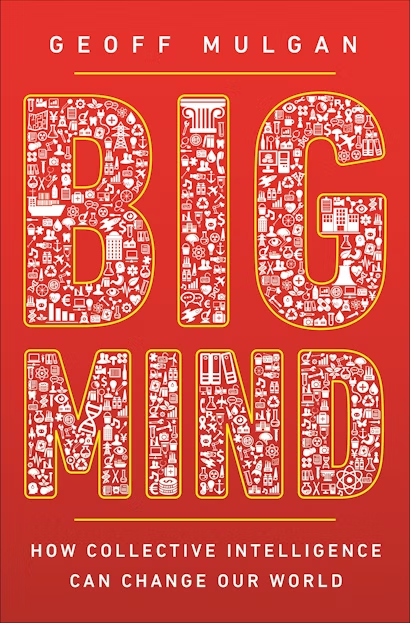
ii Big Mind: How Collective Intelligence Can Change Our World

'Everything we know is knowledge from the past, which may not apply in the future - the problem repeatedly stumbled on by models, algorithms, economic theories, and geopolitical dispositions, which made sense in one era, but then become dysfunctional in another. As social science has repeatedly discovered, the more you use a model, the less likely you are to question it. What starts as a pragmatic tool to answer a question becomes a truth in itself.

And so the models we use to think can also become traps. A model is held on to because it provides meaning and reassurance. Police forces notoriously cling to evidence they collect early in a case in the face of powerful contrary evidence that emerges later, and thus extraordinary miscarriages of justice result. The middle-aged cling to the theories they learned as undergraduates. Organizations become attached to models that become comfortable through use. I remember once meeting the planning team of a government that admitted that their forecasts had been no better than random guesses, but argued that the detailed forecasts were still needed to help with planning. The model became a comfort, even though it had no real use. 

Familiarity also breeds blindness. ...

Expertise can equally entrap. ...
 
The implication, as the Buddha pointed out, is that intelligence has to be at war with and suspicious of itself to be truly intelligent.' pp.120-121.

FIVE FUNDAMENTAL PRINCIPLES FOR EFFECTIVE COLLECTIVE INTELLIGENCE

'The first is the extent of what I call (1) autonomous commons of the intelligence in the system. By this I mean how much the elements of intelligence are allowed free rein, and not subordinated too easily to ego, hierachy, assumption, or ownership.' p.66. Chap. 5. Organizing Principles.
2. Balanced use of the capabilities of intelligence
3. Focus and the right granularity
4. Reflexivity and learning
5. Integration for action
 
'So a group is a we, but it is not just a scaling up of an I. How, then, should we think about the character of this we?' p.102. Chap. 9. The Collective.
 
Individual
|
      INTERPERSONAL    :     SCIENCES               
HUMANISTIC  --------------------------------------  MECHANISTIC      
 SOCIOLOGY  :    POLITICAL 
|
Group
 
EGO
 

 HIERARCHY


ASSUMPTION
 

OWNERSHIP


n.b. With my emphasis.

 
Geoff Mulgan (2017) Big Mind: How Collective Intelligence Can Change Our World, Princeton University Press.

Image: Princeton University Press.

See also: 'AI' : 'group' : 'axes' : 'individual'

 Previously:
Big Mind: How Collective Intelligence Can Change Our World


Sunday, October 26, 2025

'Politics as a science' ...

'The science of politics is the oldest of the social sciences but still perhaps the most dependent: it derives much of its methodology from statistics (the science of the state turned into the science of numerical data), from economics and from sociology and it steals much of its substance from anthropology, from history and from law. Yet there is little doubt about the core of the subject: it focuses on the ways in which decisions are taken by men acting within territorially or functionally defined networks and constellations of organizations. And the hallmark of the discipline is 'its systematic analysis', whether couched in verbal and literary terms or in the formalized language of statistics or of mathematical logic.' Preface vii
Hayward R. Alker, Karl W. Deutsch, Antoine H. Stoetzel (eds.), Mathematical Approaches to Politics, Amsterdam, Elsevier, 1973, pp. 475.

Tuesday, September 09, 2025

Hollowed out - aka 'No science here' ... 'Limited vision' ...

Individual
|
      INTERPERSONAL    :     SCIENCES               
HUMANISTIC  --------------------------------------  MECHANISTIC      
 SOCIOLOGY  :    POLITICAL 
|
Group


Policy. Public Protection. Vigilance. Monitoring:
Public (mental) health
is being (has been) hollowed out?
Discuss.


Image: https://sotamedialab.wordpress.com/2014/12/15/adjusting-perspective/

Tuesday, August 12, 2025

Revisiting the G7 ... G20

'Under the Trump administration, the US is retreating from the global leadership role it has played since the end of the second world war. The world is bedevilled with challenges and there is a desperate need for stability and co-ordinated solutions to global problems. Where will the leadership to solve them come from? 

Some have argued that we are now in a "G zero" world in which no one is in charge. There is great uncertainty and the powerful dictate solutions to smaller players. Others say we are moving to a regional carve up - a G3 where the US. Russia and China have spheres of influence in a modern day version of the Three Emperors League. 
Some version of a new multi-polar order may yet take shape. But it also seems clear that a G minus one world is starting to fill the vacuum in some domains — with countries coming together to find solutions to global problems without the US.' p.11.
 
Individual
|
      INTERPERSONAL    :     SCIENCES               
HUMANISTIC  --------------------------------------  MECHANISTIC      
 SOCIOLOGY  :    POLITICAL 
|
Group
imaginary -

*You cast your vote and get the 
global leadership we all deserve. ...

- numbers


... Discuss.

G20
G7
G-0?
Goto*


My source: 
Minouche Shafik, How to live in a G minus one world, Opinion, FTWeekend. 26-27 July 2025, p.11.
https://www.ft.com/content/7b884f20-e44e-4afe-9c0c-0c602f76b3f6

Previously: 'G7'

Saturday, December 07, 2024

Multicultural Group (NWMG) NW Region - RCN


There is a group that that may be of interest, even if you are not located in the NW of England. If located elsewhere, perhaps you can help start a group in your respective region, and together mobilise and liaise with groups internationally. The group is also on WhatsApp, and Facebook; the website's introduction begins ...


The RCN North West Multicultural Group (NWMG) creates a community for members across the region from multicultural ethnic backgrounds to connect with each other, share their lived experience, knowledge and diverse ideas that help drive change around racism to ensure that their various organisations is the best place to work.

Membership is open to RCN members of Royal College of Nursing from multicultural backgrounds and their allies.

Mission statement: 

The aim of the North West Multicultural Group is to stand against racism and discrimination by using members lived experiences, encouraging organisations to be anti-racist and with the support of allies.  ...


Source and continued... https://www.rcn.org.uk/northwest/Get-Involved/NW-Multicultural-Group

Tuesday, September 10, 2024

Suicide Postvention in the Workplace - new SOM resource

https://www.som.org.uk/suicide-postvention-workplace-new-som-resource

Posted by Ann Caluori | Mon, 09/09/2024 - 08:52

The term 'suicide postvention' refers to the actions taken by an organisation to provide effective support in a sensitive manner after a death by suicide. It aims to promote recovery and prevent further adverse outcomes.

This new SOM resource, authored by Professor Gail Kinman and Professor Neil Greenberg, provides evidence-informed guidance and recommendations for organisations to respond to the death by suicide of a colleague, or the unexpected death of a colleague from other causes. The guidance draws on high-quality sources from research and practice and was developed through consultation with experts from various fields. It aims to help organisations navigate the complexities and sensitivities involved in such tragic events, ensuring they provide the support required to maintain a healthy and compassionate workplace.

The resource should be useful for occupational health practitioners, wellbeing leads, HR professionals, managers, and policy makers. It addresses several important issues in the aftermath of a workplace death by suicide, such as immediate response approaches, communication protocols, support mechanisms for affected individuals, and long-term considerations for fostering a supportive work environment.

Download the guidance here.

This resource has been launched ahead of World Suicide Prevention Day 2024.

My source: TwiX @somceo

See also: 
World Suicide Prevention Day 2024 #WorldSuicidePreventionDay

Monday, May 06, 2024

Book: "The Unaccountability Machine: Why Big Systems Make Terrible Decisions - and How The World Lost its Mind"

Individual
|
      INTERPERSONAL    :     SCIENCES               
HUMANISTIC  --------------------------------------  MECHANISTIC      
 SOCIOLOGY  :    POLITICAL 
|
Group
mind . . .

- and there was I ...

I always thought heat rises?

'heat sinks'

minima - maxima

'accountability ...
... 
...
...
... sinks'


Felix Martin (2024) Computer says no, Life&Arts, FTWeekend, 6-7 April 2024, p.9.

Tuesday, April 23, 2024

Call for participation in a Doctoral Research Study

ARE YOU WORKING IN THE NHS? IF SO, HELP NEEDED URGENTLY! 

Please read this email. 

Glasgow Caledonian University is inviting NHS Staff across the UK to participate in this doctoral research survey to analyse the impact of responsible leadership on improving well-being and organisational trust among NHS Staff members. 


To be eligible, you must be an NHS staff member from any area of the UK in any job role. The survey collects no recognisable information and is wholly anonymised to protect participant privacy and confidentiality. It has received full ethical approval, will take around 10 minutes and will help provide an improved understanding of the area of well-being in the profession.


Please forward this survey link to everyone in your contacts working for NHS. This will help gain more responses, increasing the study's reach and validity. Your help is highly appreciated, and we thank you in advance.


Here's the link for the participant information sheet and survey: 

https://app.onlinesurveys.jisc.ac.uk/s/caledonian/impact-of-responsible-leadership-on-employee-well-being-and-org


Warm wishes

Ummey Tariq (Chief Investigator)


Umm E Habiba Tariq (she/her) | PhD Candidate, MSc, BBA (Hons)

Occasional Lecturer | Department of HRM | Glasgow School for Business and Society (GSBS)

Glasgow Caledonian University is a registered Scottish charity, number SC021474


My source: NURSE-PHILOSOPHY list
https://www.jiscmail.ac.uk/cgi-bin/webadmin?A0=NURSE-PHILOSOPHY

Saturday, January 14, 2023

Report: "Developing learning health systems in the UK: Priorities for action"

Developing learning health
systems in the UK:
Priorities for action

"Importantly, many of the issues discussed above highlight how successful learning communities – and successful LHSs – require effective leadership. In particular, effective leadership is a critical facilitator for:

  • aligning the activities of the LHS with wider operational and strategic priorities
  • securing resources and organisational support
  • gaining the buy-in of staff and teams across an organisation
  • creating a healthy improvement culture.144
In this context, effective leadership includes behaviours such as being ‘problem framers’ rather than ‘problem solvers’, listening and observing, and stimulating reflection and critical thinking within teams.145 (While a detailed exploration of leadership is beyond the scope of this report, it is worth emphasising that this includes clinical leadership, which can have a significant impact on organisational performance.146)" pp.49-50.

 INDIVIDUAL
|
 INTERPERSONAL    :     SCIENCES               
HUMANISTIC --------------------------------------  MECHANISTIC   
SOCIOLOGY  :   POLITICAL 
|
GROUP


See also: Thiscovery

Being situated, Hodges' model can also 'frame' - strengths, staying well, relapse prevention, weaknesses, opportunities, threats, recovery, prevention...

Thursday, August 04, 2022

[The CINet] Individual-Level Solutions Have Led Policy Astray

"So, what do you think?

In their journal paper "The I-Frame and the S-Frame: How Focusing on the Individual-Level Solutions Has Led Behavioral Public Policy Astray" (summary here with links to abstract and full paper), two previously self-described members of the behavioural science academic community change their view.

'An influential line of thinking in behavioral science, to which the two authors have long subscribed, is that many of society’s most pressing problems can be addressed cheaply and effectively at the level of the individual, without modifying the system in which individuals operate. Along with, we suspect, many colleagues in both academic and policy communities, we now believe this was a mistake..'

The reasons for this about-face are based around the following:

'Results from [i-frame: individual-focused] interventions have been disappointingly modest.'

'The fact that corporations have spent billions of dollars promoting i-frame interventions in the belief that such interventions will fail should make behavioral scientists uneasy.'"

...

https://www.comminit.com/global/content/cinet-individual-level-solutions-have-led-policy-astray 


I don't want this to sound like "Told you so!" but I'm not surprised, even as the literature and media often wax lyrical about 'synergy', constantly about 'integration' and more recently 'population health'.

I appreciate too that having a (cognitive) model is just the beginning. I really admire the practitioners in The Communication Initiative Network and other groups who grapple with funding, policy, recruitment, communication, change and outcomes around the globe.

As efforts continue across health, social care and education ... never under-estimate the relevance of conceptual tools, especially the power of not just one lever - but at least two:

Hodges' Health Career - Care Domains - Model


See also: I-dentity: How the Individual-Group runs...

Monday, April 11, 2022

Into the looking glass: A collective self-assessment of health literacy

Dear friend ....

I am hoping to take a quick snapshot of health literacy around the world - and I need your help to accomplish this task.

Below is a link to 10 short and easy-to-answer questions - a very short survey - on SurveyMonkey. Responding shouldn't take more than a few minutes of your time but in the aggregate I believe will produce an actionable and meaningful understanding.

These questions are intended for people/organizations actively working on health literacy issues in communities or clinics or hospitals or states and nations and/or actively conducting health literacy research with people in any context.

I will be in your debt if you could help me by doing just two things that should not take up your time.
1. Respond to the questions - anonymously - yourself.
2. Share this email and the link with your entire network of health literacy professionals.

Here is the link:
https://www.surveymonkey.com/r/VXPZJPL

If you have any questions or concerns about this effort, please contact me directly.

Best wishes as always,
Andrew Pleasant, Ph.D.

HIFA profile: Andrew Pleasant is Director of Health Literacy and Research at Canyon Ranch Institute, United States. Professional interests: Health literacy, Prevention of disease, Integrative medicine, Health system reform. andrew AT canyonranchinstitute.org

My source: HIFA.

[ Completed. PJ ]

Tuesday, February 22, 2022

Book: "A Theory of Legal Personhood"


     Self - INDIVIDUAL - Person

|
 INTERPERSONAL    :     SCIENCES               
HUMANISTIC -----------------------------------  MECHANISTIC      
SOCIOLOGY  :   POLITICAL 
|
Community - GROUP - Population   

person
personhood (clinical / legal)

Reflective Equilibrium
extensional beliefs
definitions


interest [theory]
will [theory]


responsibility
[mental] capacity


objects
nature / natural

'West' - 'East' legal systems


[ More to follow FROM here
Re. BIOSPHERE
ECOCIDE
... ]


Whanganui River -
newborn children
adults of sound mind
slaves
corporations

foetuses
nonhuman animals

Orthodox View

west - culture - east

Social contract
agreement

Legal personhood

Jurist

Hohfeldian understanding of rights
(non-Hohfeldian?)

non-incorporated organizations

Corporation as artificial person


See also:

Law 'in' Hodges' model (Discuss?)

My source: @OUPAcademic


Tuesday, June 01, 2021

Book: Noise

individual
|
 
 INTERPERSONAL : SCIENCES
humanistic ----------------------------------------------- mechanistic
SOCIOLOGY : POLITICAL
|
group
noise?

noise? noise?

Daniel Kahneman, Olivier Sibony, Cass R. Sunstein, Noise: Exclusive Edition (Hardback), HarperCollins Publishers.

Wednesday, May 26, 2021

The Filing Cabinet: A Vertical History of Information

individual
|

INTERPERSONAL : SCIENCES
humanistic ----------------------------------------------- mechanistic
SOCIOLOGY : POLITICAL
|
group

The Filing Cabinet: A Vertical History of Information

-TECHNICAL
SOCIO-


Don't forget the horizontal history and better prepare for the future too?
 

The Filing Cabinet: A Vertical History of Information. Craig Robertson. University of Minnesota Press. 2021.

My source: Peter Kurilecz, RECORDS-MANAGEMENT-UK mail list

https://www.jiscmail.ac.uk/cgi-bin/webadmin?A0=RECORDS-MANAGEMENT-UK 

Jones, P. (1996) Humans, Information, and Science, Journal of Advanced Nursing, 24(3),591-598.

Wednesday, May 12, 2021

HSJ: Human centred systems - the case for [disintegrated] integration

individual
|
 INTERPERSONAL : SCIENCES 
 humanistic ----------------------------------------------- mechanistic  
SOCIOLOGY : POLITICAL 
|
group
Listening, communication slip ups

YOU! are a -
“bed blocker” “frequent flyer”

My purpose

Valuable or Vulnerable person?

“PROTECT the Person”
Services, Teams, Silos

Repeated doubling up, duplication
Threshold raising
simplify the steps

1940s style factory production line model

? 5-year cycle, interventions, (budget) ?

Place-based
Neighbourhoods

Anthropology of Communities

PUBLIC - 'shared purpose'

lived experience - develop a more flexible multidisciplinary workforce


coproduction :: purchaser provider led model of commissioning

social scaffolding in neighbourhoods -  
initiatives

Organisation
'INTEGRATE'

Sovereignty, governance structures, pooled budgets

“PROTECT the NHS”

Public Service reform: 
local government, dept of work and pensions,  police, housing and community and voluntary organisations.

 - joint investment models
 
Human centred systems - the case for integration, By Donna Hall, 15 February 2021. HSJ. https://www.hsj.co.uk/service-design/human-centred-systems-the-case-for-integration/7029472.article 
 
My source: https://twitter.com/antlerboy/status/1392547724201971716?s=20

Friday, January 08, 2021

Textbook of Patient Safety and Clinical Risk Management

Textbook of Patient Safety
and Clinical Risk Management
About this (open access) book

Implementing safety practices in healthcare saves lives and improves the quality of care: it is therefore vital to apply good clinical practices, such as the WHO surgical checklist, to adopt the most appropriate measures for the prevention of assistance-related risks, and to identify the potential ones using tools such as reporting & learning systems.

The culture of safety in the care environment and of human factors influencing it should be developed from the beginning of medical studies and in the first years of professional practice, in order to have the maximum impact on clinicians' and nurses' behavior. Medical errors tend to vary with the level of proficiency and experience, and this must be taken into account in adverse events prevention. Human factors assume a decisive importance in resilient organizations, and an understanding of risk control and containment is fundamental for all medical and surgical specialties. 

This open access book offers recommendations and examples of how to improve patient safety by changing practices, introducing organizational and technological innovations, and creating effective, patient-centered, timely, efficient, and equitable care systems, in order to spread the quality and patient safety culture among the new generation of healthcare professionals, and is intended for residents and young professionals in different clinical specialties.

https://link.springer.com/book/10.1007%2F978-3-030-59403-9#about 

My source: HIFA - https://www.hifa.org/

"The complexity of many safety-critical systems makes an a priori analysis of possible system failures and human errors impossible and unreliable. Despite this, it is considered useful to apply this type of healthcare technique to promote reflection among frontline operators before introducing technical or organizational innovation. For example, before introducing a new procedure, it is useful to reflect on the possible, critical aspects of the different phases of the procedure, or, in the case of technological innovation, back-up solutions can be prepared to deal with any malfunctions of the instrument." p.139.

"The role of non-technical skills for patient safety has progressively become more evident through the years and, on this topic, one of the most striking moments of reflection for the healthcare community was Martin Bromiley’s report [10] on the death of his wife in 2005. Fixation errors, absence of  planification, teamwork breakdown, poor communication, unclear leadership, lack of situational awareness, and other non-technical aspects of performance in anesthesiology and critical care medicine can negatively impact patient outcome." p.161.

"In other words, HFE [Human Factors and Eronomics] takes a systems approach that acknowledges the importance of context, emergence and holism in elucidating interactions between various system elements and developing this understanding requires being embedded in the system." p.151.

 W2tQ: safety


Friday, November 20, 2020

Two heads are better than one, but ...

beware ...
 
 individual 
|
INTERPERSONAL : SCIENCES
humanistic ----------------------------------------------- mechanistic
SOCIOLOGY : POLITICAL
|
... team - group - department - organisation - Party ...


group think


My source: Various


Tuesday, December 10, 2019

Global Health Literacy Summit 2020

SAVE THE DATE: 26 - 28 October 2020

Where: Kaohsiung Taiwan
Why: To unite people all over the world, foster knowledge exchange, and promote action to advance health literacy
How:  IHLA Interest Group call for abstracts open now.  General call for abstracts opens soon.

Dear HIFA,

The International Health Literacy Association (IHLA) is a non-profit, member-based organization dedicated to the professional development of its members and the continued growth and development of the health literacy field. IHLA was formed in 2016, incorporated in 2017, launched a website and published its first member newsletter in 2018. IHLA now has more than 1,000 members in 80+ countries. Membership is FREE!

To become a member go to http://www.i-hla.org

In spring 2019, the IHLA Executive Board issued a call for proposals to co-host the first
 IHLA Global Health Literacy Summit 2020
http://www.i-hla.org/summit-2020

After a careful review of five EXCELLENT proposals, E-DA Healthcare Group, I-Shou University in Kaohsiung Taiwan earned the honor to host the meeting. In 10 months, IHLA members from around the world will meet in person, share their work, and learn from others locally and globally.

An immediate way to tailor the association to meet your needs is to join an IHLA Interest Group. Interest groups are run by and for members; they emerge and dissolve as health literacy topics and pursuits become relevant. In this way, IHLA Interest Groups keep the organization enduring and relevant. Interest groups (as described in IHLA's Constitution and Bylaw) have programming rights at the Global Health Literacy Summit and play a vital role in shaping the organization at large.

Here are the next steps for IHLA Interest Groups and the Global Health Literacy Summit 2020.
  • Encourage Interest Group members to plan and submit research, practice, policy-oriented panels or workshop proposals for the 2020 Global Health Literacy Summit
  • Interest Group Chairs and Co-chairs create a peer review process/subcommittee to screen proposals
  • Interest Groups select proposals to forward to the Global Health Literacy Summit 2020 Program Committee by February 27, 2020
  • Starting in March, the Summit Program Committee conducts a peer review process and either accepts proposals as submitted, or suggests changes
  • The IHLA Program Committee has an open call for other proposals, which may lead to an opportunity to supplement interest group sessions - if needed.
For more information, please view this video:  https://youtu.be/RLKlkGPdhHo
Or contact Interest Group Chairs directly via email:  See list of Interest Groups, Chairs/Co-chairs, and email addresses<http://www.i-hla.org/about/interest-groups/

Also, please see below the Global Health Literacy Summit 2020 Principles of Participation, which apply to all IHLA Interest Groups and Members.
  1. Interest group proposals must be peer reviewed by a subcommittee of 2-4 interest group members appointed by interest group chairs.
  2. All interest group members should have an opportunity to be considered as a reviewer.
  3. Reviewer names must be disclosed to interest group members.
  4. Presenters in selected sessions must commit to attend the IHLA Global Health Literacy Summit 2020 prior to submission to the Summit Program Committee.
  5. Each interest group is encouraged to use a template developed by the IHLA Summit Program Committee to review submission abstracts.
  6. It is unethical to charge or receive money as well as in-kind contributions for abstract submissions and peer review.
  7. It is unethical to lobby or influence the members of peer review subcommittees regarding the status of any abstract submission.
  8. Research submissions must be original research. In addition, accepted submissions will be retracted if found to be plagiarized.
  9. Discrimination is prohibited based on national origin, religion, ethnicity, gender, or any other socio-demographic variable.
  10. Interest group sessions are open to all attendees.  As such, interest group sessions should be as welcoming as possible to all IHLA Global Health Literacy Summit 2020 attendees.
Sincerely,

Teresa Wagner  Teresa.wagner AT unthc.edu
Rob Logan  logrob AT gmail.com
Sabrina Kurtz-Rossi  sabrina.kurtz_rossi AT tufts.edu
Thursday, September 05, 2019

Reflection on the Political (Domain) in Hodges' model

individual
|
INTERPERSONAL : SCIENCES
humanistic ----------------------------------------------- mechanistic
SOCIOLOGY : POLITICAL
|
group - population

Individual
Person

(Emotional Intelligence)

Process
Planning
Demand, Supply - Logistics
Just-in Time Delivery
"Shelf-Life"
Use by Date?
Best Before End?


Reputation

Social Epidemiology
Population Health
Public Mental Health
Public Health

(Scope of 'Practice'?
[See the domain to the right for guidance?])

Social Capital
LIFE
Social Life
Social Care

Letter: Chief Medical Officer Prof Dame Sally Davies to Rt Hon Jacob Rees-Mogg MP


My source:

Update:
https://twitter.com/BBCJayneMcC/status/1169727346481520641?s=20


Accessibility issue acknowledged.