Hodges' Model: Welcome to the QUAD: intelligence

Hodges' model is a conceptual framework to support reflection and critical thinking. Situated, the model can help integrate all disciplines (academic and professional). Amid news items, are posts that illustrate the scope and application of the model. A bibliography and A4 template are provided in the sidebar. Welcome to the QUAD ...

Showing posts with label intelligence. Show all posts

Saturday, June 13, 2026

Hodges' model: An antidote to "Cognitive Surrender"*

'The pope's counterpoint that humanity flourishes "not despite limitations but often through them" is one that many people are becoming more aware of in the case of "cognitive surrender": the realisation that making things easier through AI can diminish rather than enhance our abilities. It is in a similar vein that the FT commits to always keeping human judgement at the centre of our journalism.'

* - and burnout?

The FT View, The ethical dilemmas of artificial intelligence. FTWeekend, 6-7 June 2026, p.12.
https://www.ft.com/content/d2c90246-11d7-4169-ac35-988de7fdb2af?syn-25a6b1a6=1

See also: https://www.futureofbeinghuman.com/p/magnifica-humanitas-and-being-human
Previously: 'ai' : 'language'

Sunday, December 14, 2025

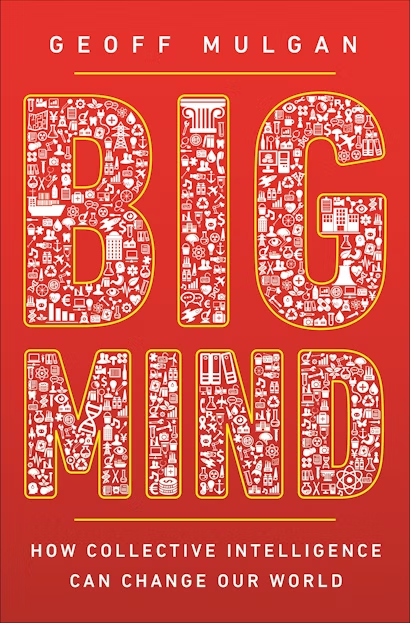
ii Big Mind: How Collective Intelligence Can Change Our World

'Everything we know is knowledge from the past, which may not apply in the future - the problem repeatedly stumbled on by models, algorithms, economic theories, and geopolitical dispositions, which made sense in one era, but then become dysfunctional in another. As social science has repeatedly discovered, the more you use a model, the less likely you are to question it. What starts as a pragmatic tool to answer a question becomes a truth in itself.

And so the models we use to think can also become traps. A model is held on to because it provides meaning and reassurance. Police forces notoriously cling to evidence they collect early in a case in the face of powerful contrary evidence that emerges later, and thus extraordinary miscarriages of justice result. The middle-aged cling to the theories they learned as undergraduates. Organizations become attached to models that become comfortable through use. I remember once meeting the planning team of a government that admitted that their forecasts had been no better than random guesses, but argued that the detailed forecasts were still needed to help with planning. The model became a comfort, even though it had no real use. 

Familiarity also breeds blindness. ...

Expertise can equally entrap. ...
 
The implication, as the Buddha pointed out, is that intelligence has to be at war with and suspicious of itself to be truly intelligent.' pp.120-121.

FIVE FUNDAMENTAL PRINCIPLES FOR EFFECTIVE COLLECTIVE INTELLIGENCE

'The first is the extent of what I call (1) autonomous commons of the intelligence in the system. By this I mean how much the elements of intelligence are allowed free rein, and not subordinated too easily to ego, hierachy, assumption, or ownership.' p.66. Chap. 5. Organizing Principles.
2. Balanced use of the capabilities of intelligence
3. Focus and the right granularity
4. Reflexivity and learning
5. Integration for action
 
'So a group is a we, but it is not just a scaling up of an I. How, then, should we think about the character of this we?' p.102. Chap. 9. The Collective.
 
Individual
|
      INTERPERSONAL    :     SCIENCES               
HUMANISTIC  --------------------------------------  MECHANISTIC      
 SOCIOLOGY  :    POLITICAL 
|
Group
 
EGO
 

 HIERARCHY


ASSUMPTION
 

OWNERSHIP


n.b. With my emphasis.

 
Geoff Mulgan (2017) Big Mind: How Collective Intelligence Can Change Our World, Princeton University Press.

Image: Princeton University Press.

See also: 'AI' : 'group' : 'axes' : 'individual'

 Previously:
Big Mind: How Collective Intelligence Can Change Our World


Friday, August 15, 2025

Big Mind: How Collective Intelligence Can Change Our World


It was COVID-19 that brought home to me the true significance of the 'collective' in the synonyms for group, population, polis, citizenry et al.. An integral part of Hodges' model, an individual, a person is clearly not an island.

Speech, gesture, behaviors, drawing, writing and other media all  provide a way of recording and representing information, and knowledge. Digital technologies are the latest tools to extend our memories, and ability to analyse, synthesise and abstract from and to our experiences.

How we see the individual and collective (society) is a subject of much debate across many disciplinary fields, spanning the sciences and humanities; economics, healthcare, sociology, ethics, and philosophy. Mulgan considers as infrastructure, the measures that have emerged to support collective intelligence:


'They have evolved from physical objects (such as steel production) through aggregate concepts (like GDP and GNP) to intangibles (such as innovation indexes or measures of the value of creative industries). They have evolved from single measures of things like population to indexes (like the UN Human Development Index), and from activities to outputs and then outcomes (such as QALYs - quality adjustied life years - and DALYs - disability adjusted life years in relation to health). In all these ways, both states and societies watch themselves and recognize well-calibrated observation as the precondition for thought.' (p.52)
Using Hodges' model the focus is primarily upon individuals and teams application. Mulgan's chapter 12 (pp.145-160) on 'Problem Solving' is subtitled 'How Cities and Governments Think'. An excellent question, that was asked of me in February. How can a national government be informed of Hodges' model and its potential utility? Cities have repeatedly had to solve problems created by changes in transport, work, housing, population density, the movement of people, goods, materials, and links to rural and agricultural centers. The logistics of access to routes, ports, airports, and where to place industries efficiently (and safely)? 'City planning' is a key example of our cities thinking?

Perhaps, we need to think of mobility in a cognitive sense, and not just AI-mediated. So as we walk, run, seek access - we should take care we don't get stuck!

Individual
|
      INTERPERSONAL    :     SCIENCES               
HUMANISTIC  --------------------------------------  MECHANISTIC      
 SOCIOLOGY  :    POLITICAL 
|
Group
subjectivity

models we use can be a trap (p.120)

emotional intelligence
quality
objectivity

SYSTEMS energy, food, transport..

physical media & 'memory'
quantity

'Society Thinking as a System?' Chap. 16.

Group - Collective

collective intelligence

Patient Reported Outcome Measures (PROMs)?

See also: 'literacy' : 'prevention' : 'service' : 'severe' : 'change'

Geoff Mulgan (2017) Big Mind: How Collective Intelligence Can Change Our World, Princeton University Press.

Image: Princeton University Press.

Thursday, February 06, 2025

Last Word by Ann Williams

LAST WORD

In Africa, one word for now,

Another word for tomorrow,

But forty words for the past.

The elephants do not forget.

They stand close in a circle,

Turn the heaped pile of bones

This way and that, stroke

Leg-bone, thigh and skull,

Rub dust into their faces.


Sighing, they understand

The weight of grief,

How memory is carried.

by Ann Williams

Poetry, edited by Peter Abbs (RIP 2020), Small Epiphanies, Resurgence & Ecologist, Sept/Oct 2013, Issue 280: p.52-53. I cannot locate a web presence for Ann Williams, if anyone can assist please get in touch. Resurgence & Ecologist is a marvellous read. I do not subscribe but enjoy a copy when visiting a city.

P.S. I feel bad not subscribing, but you have to 'cut your cloth'. That's not the only pain factor. An online subscription may be greener, and cheaper? As with book reviews (Ethics and AI - to follow), I need a physical copy, spending enough time on-screen already. The publication is much more than a magazine. The magazine represents a change of mindset and ironically reflects former and for many 'new' ways of life.

Wednesday, October 23, 2024

Book received: 'Handbook on the Ethics of Artificial Intelligence'

Many thanks to Edward Elgar Publishing for a review copy of this book which arrived today:

Edited by David J. Gunkel, Professor of Communication, Northern Illinois University, US, and Professor of Applied Ethics, Łazarski University, Poland

Publication Date: 2024 ISBN: 978 1 80392 671 1 Extent: 336 pp
This engaging Handbook identifies and critically examines the moral opportunities and challenges typically attributed to artificial intelligence. It provides a comprehensive overview and examination of the most pressing and urgent problems with this technology by drawing on a wide range of analytical methods, traditions, and approaches.

This is timely, prior to next month's event on AI and Planetary Health, about which news to follow shortly, especially if you are based near London and southern England.

I also can't believe it is 34 years since publication of the following case study:

Davies, M. and Owen, K. ‘Complex uncertain decisions: medical diagnosis’, Case Study 10 in Expert System Opportunities from the DTI’s Research Technology Initiative, HMSO 1990.

Ethics in AI 2024 :: Expert Systems 1990

Tuesday, December 13, 2022

Essay Competition: On the Principles of Intelligence c/o AI-SGES list

On December 17, 1903, two brothers from Dayton,
Ohio, named Wilbur and Orville Wright,
were successful in flying an airplane they built.

Dear all,

Around 1500, Leonardo da Vinci published his sketches of an aircraft with rounded wings, and in 1783 the first manned hot-air balloon took off. It wasn't until 1905 – over 4'000 years after the oldest known depiction of human flight was carved in clay – that the Wright Brothers took off for the first sustained, controlled, and heavier-than-air crewed flight. From today's point of view, the principles of aerodynamics necessary to build operational aircraft seem relatively trivial.

But only in retrospect are the results of such breakthroughs considered part of the 'obvious'. In 1957, psychologist Frank Rosenblatt published the first paper on trainable neural networks. Since then, humans have walked on the moon, the internet has been invented, and smart devices have been built to fit in our pockets – but neural networks have still not led to human-level artificial intelligence. Neural networks appear like wings that fly for a short time but then drop like a stone when confronted with unknown tasks. Therefore, we'd like to propose moving away from the current hype around neural networks and ask you more fundamentally:

Which fundamental principles of intelligence must be considered in the successful design of artificial intelligence?

The appropriate example from aviation would be: "What are the core aspects of flight that must be considered in the successful design of aircraft?" (One possible answer: As a curved airfoil wing flies through the sky, it deflects air and alters the air pressure above and below it. When moving forward, the curved upper part of the wing lowers the air pressure directly above it, so it moves upward.)

With that in mind, we challenge you to write an essay of 2'000 to 3'000 words and become the Wright Brothers in the field of AI! Whether you answer the question from a philosophical, biological, computational, mathematical, neuroscientific, psychological, social, or any other perspective is up to you. We value novel and insightful arguments that are useful in the field of AI.

Go to https://lab42.global/essay/ and hand in your essay by 23:59 GMT on December 31, 2022. The best essays are rewarded with 3'500 USD in total.

Best regards

Oliver Schmid
oliver.schmid AT lab42.global

https://lab42.global/essay

[Do read the guidance on the website. PJ]

Image use here: https://www.nasa.gov/multimedia/imagegallery/image_feature_976.html
original credit - inc. Library of Congress

AI-SGES list

Friday, August 06, 2021

Management evolution: Book "Global Teams"

 self - PERSON - individual
|

INTERPERSONAL : SCIENCES
humanistic ------------------------------------- mechanistic  
SOCIOLOGY : POLITICAL
|
team - group - organisation

Intelligence QUOTIENT
19TH c.
Emotional QUOTIENT
20th c.

Integrative* QUOTIENT
21st c. ...


Emotional QUOTIENT

Cultural QUOTIENT

Political QUOTIENT
21st c.


The book, may be aimed at global businesses, teams and leaders, Hodges' model is applicable to these groups and the individual employee.

*Main challenges: 

Climate change, Energy transition, Global governance, AI, Bio- and Geo-engineering, Political efficacy/stability, Health and Education for all and First Contact. ;-)

Ack. Wilber and many others.

Owen, J. (2016) Global Teams: How the Best Teams Achieve High Performance, FT Publishing.

https://www.pearson.com/store/p/global-teams-how-the-best-teams-achieve-high-performance/P100000256990/9781292171913?tab=overview

My source: Book extract, Business, Sunday Times, 20 November 2016.


Tuesday, January 19, 2021

Do you have the intell? ... [Sure?]

PERSON
|
INTERPERSONAL : SCIENCES
humanistic ----------------------------------------------- mechanistic
SOCIOLOGY : POLITICAL
|
GROUP - COMMUNITY - POPULATION
emotional intelligence
physical intelligence
Social & Cultural
Intelligence
Political
Intelligence?
[What the State provides ...]


My reminder: Book Reviews, "Physical Intelligence", What Investment, October 2020, p.51.

If you have 'reflective literacy' what is its scope?

Monday, February 03, 2020

Deradicalisation: Sheep dips and holistic approaches


"Need to treat these people as individuals, not as generic sheep-dip things ..."

"Approach needs to be holistic, all encompassing ..."

individual
|
INTERPERSONAL : SCIENCES
humanistic ----------------------------------------------- mechanistic
SOCIOLOGY : POLITICAL
|
group - population

Individual beliefs
Personality, Character
Mindsets
Vulnerability
Religion - subverted
Need for Theological interventions
'Truth'
Motivation
Rehabilitation
Purpose

Assessment
Intervention
Evaluation
Process
Subjective - Objective
Resource intensive
Surveillance

Culture
Social values, social media
Community leadership
Community response
Reintegration of Terrorist Offenders
Practice
Public Awareness - Preparedness

ACT Awareness E-Learning

(Counter) Terrorism
Prison (aptitude?)
Sentence served
Prison early  release
Deradicalisation programmes -
 (Globally none are 100% success)
Martyn's Law
Policy
Funding


My source:
BBC Radio 4 Today 3 February 2020.

Saturday, January 25, 2020

h2cm = 'GI - General Intelligence'?


"In 1990 a paper curiously- titled "Elephants don't play chess", published by Australian roboticist Rodney Brooks, ushered in the idea that artificial intelligence could become smarter by learning as the human brain does. Building simple connections that gradually become more complex could help AI emulate the way we think."


"AGI [artificial general intelligence] is a really tough problem, making something that is as flexible and efficient across a wide range of domains as a mammalian brain is a tough challenge.."


"In a new paper published in Nature yesterday, DeepMind unveiled how an area of AI , known as reinforcement learning, has shed new light on the way the brain learns. ... At the heart of the paper is a new idea of how dopamine works. Known as the "motivation molecule" or "surprise signal", dopamine has come to be of significant interest." Chowdhury, 2020.

AI or G(A)I ? Specific and General ...
... depending on the situation ...

individual
|
INTERPERSONAL : SCIENCES
humanistic ----------------------------------------------- mechanistic
SOCIOLOGY : POLITICAL
|
group - population

cognitive
decision making

intellect
motivation

learning
science
neuroscience

dopamine

data  information


Brooks, Rodney (1990), "Elephants Don't Play Chess" (PDF), Robotics and Autonomous Systems, 6 (1–2): 3–15, CiteSeerX 10.1.1.588.7539, doi:10.1016/S0921-8890(05)80025-9

Dabney, W., Kurth-Nelson, Z., Uchida, N. et al. A distributional code for value in dopamine-based reinforcement learning. Nature (2020). https://doi.org/10.1038/s41586-019-1924-6

My source:
Chowdhury, H. Why scientists just had a brainwave in quest for artificial intelligence, Business, The Daily Telegraph, 16 January, 2020, p.5.

Friday, November 01, 2019

Here is the News: another "Brilliant Map"

Or, to be more precise -

"Brilliant Maps"

An Atlas for Curious Minds – 100 New Ways to See the World

A new book released 5 November 2019:
Brilliant Maps - Book
"Which nations have North Korean embassies? How many countries have bigger economies than California? Who drives on the “wrong” side of the road? And where can you find lions in the wild?
In Brilliant Maps for Curious Minds, you’ll learn all this and much more. One hundred visually arresting maps strike a balance between sobering analysis (number of executions by state) and whimsical insight (the countries of the world where there aren’t any McDonald’s).
Thought-provoking and flat-out fun, this one-of-a-kind atlas—compiled by the editor of the popular Brilliant Maps website—makes surprising connections that illuminate the contours of culture, history, and politics. Brilliant Maps for Curious Minds will change the way you see the world—and your place in it".

See also:

https://www.infographic.ly/


My source:
Wright, I. The World as you've Never Seen It, The Sunday Times Magazine, 27 October 2019, pp.26-31.
 

Tuesday, August 13, 2019

Individual & Group process - Collective Intelligence [CI] c/o Radcliffe, et al. (2019)

No explanation is needed as to why this paper caught my attention in a tweet that featured the figure [2] below? The context is medical, not nursing and the extended multidisciplinary team, but as per the threshold concepts post the focus is decision making.

From a nursing perspective and using Hodges' model the 'individual processes' would include data gathering, patient assessment, liaison with relatives and colleagues and reflection to integrate information. Evidence-based sources will also be involved depending on the reason for referral, the patients (relatives) account, and the status of the diagnosis. Information technology input will be through the electronic health record that should also provide a history of previous episodes of care and the conclusions reached.

Within Hodges' model below I have added socio-technical and governance. Perhaps, as a systematic scoping review and applied to a specific healthcare profession there is less emphasis on the 'political' dimensions of decision making (management, policy, rules, reporting, targets). Equally from a nursing perspective there is the 'data cleaning' within the research process but then also nurses, and students in particular not being negatively impacted by comments about a forthcoming clinical placement, or a patient / client who has been referred (or referred) to the service / team.


individual - self
|
INTERPERSONAL : SCIENCES
humanistic ----------------------------------------------- mechanistic
SOCIOLOGY : POLITICAL
|
group- population

individual as subject of mental health Dx

Individual knowledge and experience
Reflection
Learning and decision-making styles and bias
(positive and negative?)
Feedback from Collective Intelligence?


individual as subject of physical Dx


Analysis
Individual Input
Group Input
Synthesis

Information Technology

Collaborative working
Clinical Teams

Level of SOCIO-technical
integration
outcomes
Studies were:
 individual or group process
several a combination.

governance


My source:

Radcliffe, K., Lyson, H. C., Barr-Walker, J., & Sarkar, U. (2019). Collective intelligence in medical decision-making: A systematic scoping review. BMC Medical Informatics and Decision Making, 19(1), 158. https://doi.org/10.1186/s12911-019-0882-0

Monday, June 24, 2019

Book: The AI Does Not Hate You

You don't need to deploy AI strategies...

"Indeed, there are already glimpses of dangerous, unpredictable thinking in our AI. One AI learnt to win noughts and crosses tournaments against other computers by creating impossible moves billions of squares away from the board. This forced all the other computers to try to represent a board billions of squares across in their memory - but they didn't have the capacity and crashed. The cheating algorithm won by default.". James Marriot. Saturday Review, The Times, 1 June, 2019, p.13.

https://www.bbc.co.uk/programmes/b01cj1s1


- to be a healthcare professional...*

individual
|
INTERPERSONAL : SCIENCES
humanistic ----------------------------------------------- mechanistic
SOCIOLOGY : POLITICAL
|
group


*for the moment at least... 


You don't even need 3x3!


Marriott, J., Why the nerds are nervous, Saturday Review, The Times, 1 June, 2019, p.13.
[Book cover - The Times.]

Saturday, September 10, 2016

8 Digital Skills to Teach our Children* - related to Hodges' model


individual
|
INTERPERSONAL : SCIENCES
humanistic -------------------------------------------  mechanistic
SOCIOLOGY : POLITICAL
|
group-population
digital literacy  

digital emotional intelligence

  digital identity

digital security


digital communication

digital use  


digital safety

  digital rights


* ... and many adults too.

My source: Original tweet by Dorlee Michaeli, @SWcareer

Image source and original article:
https://www.weforum.org/agenda/2016/06/8-digital-skills-we-must-teach-our-children

Sunday, January 03, 2016

Autonomy Cube(d)

OBSERVATION
|
INTERPERSONAL : SCIENCES
OBSERVATION  ---------------------------------------  OBSERVATION
SOCIOLOGY : POLITICAL
|
OBSERVATION


Rosa Menkman from amsterdam, Netherlands, CC BY 2.0 <https://creativecommons.org/licenses/by/2.0>, via Wikimedia Commons

"When installed in a gallery, the cube creates an open Wifi hotspot that uses the alternative Tor network to anonymise internet use."
Jobey, L., (2016)  Trevor Paglen What Lies Beneath, FT Magazine, 2-3 January. p.20.

Trevor Paglen: Autonomy Cube (2014)

Whitechapel Gallery, London, January 29 to May 15.

Photo source: e-flux - Edith-Russ-Haus for Media Art


                             Autonomy-Advocacy Cubed?
     Late 1970s                      1980s-1990s                         2000s...
   Nurse Advocate                 Nurse as Advocate?             Independent Advocacy
                           
             Ongoing nurse advocacy role amid the politics of healthcare...

Friday, January 14, 2011

ERCIM News No. 84 Special theme "Intelligent and Cognitive Systems"

Dear ERCIM News Reader,

ERCIM News No. 84 has just been published at http://ercim-news.ercim.eu/

Special Theme:
"Intelligent and Cognitive Systems"
- coordinated by: Rüdiger Dillmann and Tamim Asfour, Institute for Anthropomatics, Institute of Technology Karlsruhe, and Antonis Argyros, FORTH-ICS

https://ercim-news.ercim.eu/en84
- featuring the keynote "Cognitive Systems and Robotics" in the ICT Programme of the European Commission, by Hans-Georg Stork, European Commission, Information Society and Media Directorate General, Unit E5 “Cognitive Systems,Interaction, Robotics.

Includes on p.20
Long-term Evaluation of a Mobile Remote Presence Robot for the Elderly
by Amedeo Cesta, Gabriella Cortellessa, Lorenza Tiberio

Next issue: April 2011 - Special Theme: "Unconventional Computing Paradigms"

Thank you for your interest in ERCIM News.

Feel free to forward this message to others who might be interested.
Best regards,
Peter Kunz
ERCIM News central editor

Thursday, September 09, 2010

Gardner's 5 Minds for the Future (and the Question)

In order to pursue post graduate study you need a project, which demands a question. Formulating a research question is central. I wonder however whether there remains a bias - hard sciences vs humanities (and triangulation) - towards a class of questions that are closed and so can be answered in X-words : Y-time : with Z-funding? Thereby passing through the necessary academic hoops. Of course I realise that if there are no constraints then chaos would ensue. I just wonder if the journey (creativity, discovery ...) might be lost for the sake of assuring the end product?

My questions (apart from 'beware reflex moves') tend to be framed in broad terms. You could say that as yet I am not disciplined (specific) enough to come up with a question that passes "GO!"

In Howard Gardner's Five Minds for the Future the issue of educational programmes is raised and I read the following:

The second antidote entails the creation of educational programs directed specifically at certain individuals of promise - for example, leaders of tomorrow. Chief executives and general managers are expected to be able to see the big picture - to look beyond their own background and specialization; to understand the various components in their organization or constituency; to think systematically about what is working, what is not working, and how goals can be more effectively achieved. ...

Other individuals - for example, those exhibiting a "searchlight" or "bricoleur" intelligence - might be attracted to such programs as well. They would make use of their enhanced skills even if they do not occupy explicit leadership roles. Perhaps, as educator Vartan Gregorian has suggested, we need a specialization in becoming a generalist. p.75.

Gardner, H. (2008) Five Minds for the Future, Harvard University Press.

Tuesday, December 11, 2007

To all 'average scholars'...

Michel Serres:

"Intelligence is not about knowing axiomatically how to reason... The French 16th Century philosopher Montaigne already had dismissed the concept of a 'well-stuffed head'. The advent of the printing press made the memorization of Ulysses' travels and of folk tales - the support of knowledge at that time - redundant. Montaigne saw no longer use in memorizing a library that was potentially infinite. But does not the Internet ask for a 'well-endowed head'? Won't the best surfer be a 'Jack of all trades'? The fastest surfer is not going to be your typical Ivy-league super-titled philosopher: That guy's head will be simply too loaded to sort it out on the Net. So, there will be fresh opportunities for those who were viewed by society as laggards. It is a clean start with equal opportunities for all."
Source:
Join-Lambert, L., Klein, P., & Serres, M. (1997). Interview. Superhighways for All: Knowledge’s Redemption. Revue Quart Monde. http://www.nettime.org/Lists-Archives/nettime-l-9810/msg00137.html
