Violence is a . . .
INTERPERSONAL : SCIENCES
violence is a STATE of mind: and ...? | |||
|
My source: Financial Times. 9 September, 2026, p.1.
Hodges' model is a conceptual framework to support reflection and critical thinking. Situated, the model can help integrate all disciplines (academic and professional). Amid news items, are posts that illustrate the scope and application of the model. A bibliography and A4 template are provided in the sidebar. Welcome to the QUAD ...
violence is a STATE of mind: and ...? | |||
|
My source: Financial Times. 9 September, 2026, p.1.
The Whitworth is proud to present Yuki Kihara’s acclaimed installation Paradise Camp (2022), first presented at the Aotearoa New Zealand Pavilion in the 59th Venice Biennale in 2022, and a new video work, Darwin Drag (2025).
Kihara delves into art histories and archives to unpick the effects of colonialism on the peoples and ecologies of the Pacific. Her visually compelling projects centre and empower the Fa’afafine and Fa’atama in Sāmoa, traditional yet marginalised third gender communities to which the artist belongs. In this exhibition, Kihara focuses on two celebrated Western figures – French modernist artist Paul Gauguin and evolutionary biologist Charles Darwin (1809-1882) – who each shaped Western understandings of the Pacific.
Paradise Camp responds to famous paintings of Tahiti and its people by French modernist artist Paul Gauguin (1848-1903). Through archival research, Kihara links Gauguin’s paintings to colonial photographs taken in Sāmoa. Described by Kihara as an act of 'upcycling', she recreates Gauguin’s compositions in a series of 12 resplendent high definition photographs, shot on location in Upolu Island. Collaborating with Fa’afafine models and production crew, Kihara repurposes these cultural artefacts to speak to, and from, queer Indigenous worlds in a profound gesture of reclamation.'
My source:
Josh Lustig. Yuki Kihara, Gallery, FT Magazine, November 22, 2025, #1152. pp.12-13.
Posted by Peter Jones at 1:55 pm | PERMALINK
Labels: art , colonialism , Darwin , exhibition , Gauguin , gender , history , Indigenous , Manchester , marginalised , Oceania , Pacific , paintings , peoples , photos , queer , reclamation , South , upcycling , video
DIAMOND, Dr Hugh Welch (1808–1886)
| Asylum patient by Hugh Welch Diamond, c1850-58 Hugh Welch Diamond (English, 1808-1886) Public domain, via Wikimedia Commons |
'The women Iook out at us across 170 years of history with a variety of expressions - bold and shy, serene and distressed. Yet all of them were regarded at the time as "lunatics". These faces were the subjects of a pioneering project by the 19th-century psychiatrist Hugh Welch Diamond, superintendent of the female division of an asylum in London and the world's first photographer to take pictures of patients for the purpose of diagnosis and therapy.Twenty-two of Diamond's asylum portraits - the largest surviving group - will be put up for auction on December 10 at Christie's in London, as part of a sale of books, manuscripts and photographs from the library of The Royal Society of Medicine. If they achieve their estimated prices, RSM, a membership charity, will raise more than £2mn to invest in physical and digital infrastructure.' ...
'Diamond was working at a time when society's views of people suffering from mental illness were changing. The earlier practice of shutting patients away in secure "madhouses" was giving way to more humane treatment. Diamond seems to have believed that photography would help doctors both to diagnose and to treat patients. His diagnoses were based partly on the idea, popular in Victorian medical circles, that an individual's physiognomy - their physical features, particularly the face - could reveal their mental state.
"He wanted to make people better and put them back into the world," says Sharrona Pearl, a medical historian at Texas Christian University who has studied Diamond's work. "He also enjoyed experimenting and liked the idea of bridging his expertise in medicine and photography.' p.32.
Mental Illness PERSON - SUBJECT Patient's names not recorded Portrait - Consent? | Diagnosis and Treatment person - DATA - SUBJECT Photography as records Eagerness to classify - label |
Social history Change in social attitudes Stigma and fear of mental illness Current relatives? | Confidentiality Institutional change Power imbalance Shift from 'custodial' to health care |
My source:
Clive Cookson, Mind Hunter, FT Magazine, November 15, 2025, 1151, pp.30-34.
I have noticed Prof. Brendan Kelly is a regular FT respondent, as with this article:
'These photographs were likely to have been taken without meaningful consent and in the context of power imbalance. Yet publication can reclaim their individuality, address historical injustice and underscore our common humanity. Compassion, respect and humility should guide decisions.Proceeds should support medical, educational, or justice-oriented programmes. Most importantly honouring forgotten patients of the past demands better care for people with mental illness today, who often languish, neglected, in homeless hostels or prisons. We can do better.'
Posted by Peter Jones at 9:01 am | PERMALINK
Labels: archive , art , asylums , attitudes , auction , change , diagnosis , England , history , institutions , medical sociology , medicine , mental illness , patients , photos , portraits , psychiatry , records , society , treatment
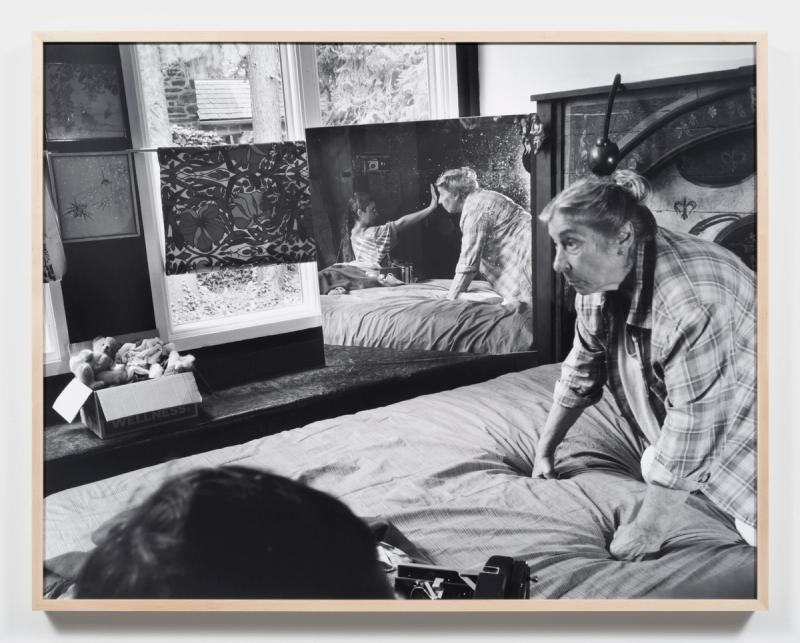
"The American interdisciplinary artist Katherine Hubbard has spent the past five years documenting her relationship with her ageing mother, Antonette Berger, who in 2020 began exhibiting the first signs of memory loss. Her book The Great Room, set between the four walls of Berger's home in Philadelphia, is a culmination of grief and intimacy, as Hubbard steps into her role as caregiver. Using two large- format 4x5 cameras (which she is both behind and in front of) and drawing on her background n performance art, Hubbard transforms the once safe, domestic space into a psychological playground as the pair navigate their new reality. ...
In this portrait, Hubbard sits with her mother on her bed. Their bodies are reflected in a square nirror offset by a series of other square and rectangular objects (picture frames, windows, the headboard) which fragment the viewer's gaze. "This photograph was taken before she had a diagnosis,' Hubbard tells me. "It was a very confusing time, with a lot of uncertainty and frustration between us. ...
"І am using the camera as а means of creating time with my mom apart from the brutal task of managing her," Hubbard writes. And to the woman who gave her life: "You might like to know that, when І think of you and see you, it's as a whole person."
Inès Cross. FTMagazine.
'The Great Room' | |
Collaboration Care in the Community | Direction Gaze |
Posted by Peter Jones at 10:27 am | PERMALINK
Labels: art , body , carer , dementia , empty , exposure , grief , intimacy , loneliness , memory , mind , objects , personhood , photos , possessions , reflection , relationship , rooms , space , vulnerability
My maternal grandfather was a man of few words (WWI). He did recount tales of when as a lad, he and his friends would knock the policeman's (and it was a 'man' back then) helmet off and leg it. It was, another time in several senses. Given his war experiences, I now wonder how easy it was to end up working at a gas works? Passive, re-traumatisation? Or, just grateful to have a job in the 1920-30s?
Posted by Peter Jones at 7:37 pm | PERMALINK
Labels: arts , children , community , diversity , engagement , history , Hodges' model , justice , law , media , photos , police , relationships , society
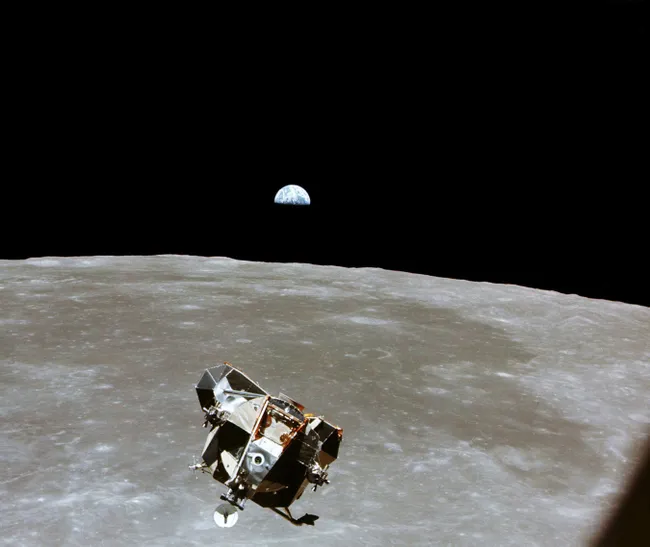
'Michael Collins, the astronaut who took this photo in 1969, is the only human, dead or alive, that isn't in the frame of this picture.'
| |||
“If the universe is meaningless, so is the statement that it is so… The meaning and purpose of dancing is the dance.” 'Alan Watts on our search for meaning and the antidote to our existential loneliness' |
Posted by Peter Jones at 5:07 pm | PERMALINK
Labels: Apollo , astronautics , dyad , Earth , Gaia , global health framework , group , history , Hodges' model , humanity , identity , loneliness , meaning , perspective , photos , population , reality , self , social , space
![]() |
| Apollo 17 1972 NASA Original Blue Marble Photograph |
'NASA’s archival designation for it is AS17-148-22727, and the original image was taken upside down with the South Pole at the top. In its myriad reproductions, it’s flipped up to match what we would normally expect to see.'
Text: https://www.thephoblographer.com/2013/12/09/behind-blue-marble/
POLITICAL | SOCIOLOGY |
SCIENCES | INTERPERSONAL |
Posted by Peter Jones at 1:15 pm | PERMALINK
Labels: Antarctica , Apollo , astronautics , climate , colonial , Earth , expectations , future , global South , history , ice , observation , Oceania , oceans , orientation , perspective , photos , space , water , weather
"Stephen Willats aimed to explore the realities of living in a British tower block. The work centres on Mrs Moran, an elderly woman who lived at Skeffington Court in Hayes, West London. Willats photographed and interviewed Mrs Moran over the course of six months. The text in the work is based on these interviews. In his composition, Willats highlights the physical, social and economic constraints that she faced. Each panel also features a question. These invite the viewer to participate directly in Mrs Moran’s lived experiences."
Gallery label, September 2023
Tower blocks are an integral, defining structure in urban and city life. Governance, effective policy, accountability, high standards, public safety and duty of care must not be an after-thought.
| |||
| Grenfell Tower Inquiry Housing policy Housing provision Housing market 'Mobility' Ownership Private, rented Housing Assoc. ... Tower Blocks Life chances - 'Health career' |
Posted by Peter Jones at 4:57 pm | PERMALINK
Labels: accessibility , artist , arts , choices , community , company , friends , Hodges' model , housing , loneliness , mobility , museum , older adults , photos , policy , quality of life , social care , Tate , Tower blocks , transports
![]() |
| Visual Methodologies |
"It is as if the Photograph always carries its referent with itself, both affected by the same amorous or funereal immobility, at the very heart of the moving world; they are glued together, limb by limb, like the condemned man and the corpse in certain tortures." [Barthes 1982: 5-6] p.121."The referent is there in photographic images in ways it is not in other sorts of visual imagery, Barthes argues. And a result, he suggests that photographs can be interpreted in two ways. First, there is a level of the studium, which is a culturally informed reading of the image, one that interprets the signs of the photographs. But he says that some photographs produce a different response, which is a second kind of reading, by containing what he called a punctum. A punctum is unintentional and ungeneralisable; it is a sensitive point in an image which pricks, bruises, disturbs a particular viewer out of their usual viewing habits. And he went so far as to suggest that 'while the studium is ultimately always coded, the punctum is not [Barthes 1982: 51]. That is, there are points in some photographs that escape signifiers and shock the viewer with their 'intractable reality' [Barthes 1982: 119]. And while shock is something that most adverts aim to achieve, it is the case that recent advertising is relying more and more, not only on the transfer of meaning between signs, but on the evocation of a feeling or a mood attached to a brand that is difficult to analyse using semiological terminology." p.122.
On twitter* @h2cm over the years I've noted a certain stance, an aversion even, to generalist approaches in nursing (as suggested apparently by Hodges' model). The simplicity of Hodges' model in its template (basic) form belies how the model can address both generalist and specialist practice and theory. Bluntly: choose your domain; slice, dice and drill as you wish.
Rose's reference to Barthes, in-particular studium and punctum stands out. We can equate the former with the situation as found, the clues provided in the referral details, the initial cues, data and information gleaned upon assessment. What might be expected, so to speak, including assumptions.
But the punctum, may be described - interpreted in person-centred (yet professionally balanced) terms. Especially in assessment, planning, intervention and evaluation. The punctum signifies salience: what is important to this person. If the academic emphasis is upon ‘reflection in action’, ‘reflection on action’, ‘single loop learning’ and ‘double loop learning’ (Schön, 1987), can the punctum represent empathy, rapport, the sustenance of dignity and respect, an individual's sense-making?Our photograph, taken through Hodges' model is comprised of four frames. The photograph is compound, and with several exposures it can be animated.^ When played, it reveals a hint, a fraction, an interval in an individual's (potential) health career. A light upon the several-fold determinants of health and their influence and impact upon life chances experienced and exercised to date - and to follow (climate change).
Rose, G. (2012). Visual Methodologies: An Introduction to Researching with Visual Materials (3rd ed.). London: Sage. PB. [Now in 5th edition.] Image - Amazon.
Schön , D. (1987). Educating the reflective practitioner. San Francisco, CA: Jossy Bass.
*Yes, I know.
^The Producer - Director depends on your Spiritual stance.
Rose (2012) now with student nurses [on placement from Chester University].
SOCIETY PUBLIC SERVICES |
Posted by Peter Jones at 6:15 pm | PERMALINK
Labels: accessibility , art , arts , emotion , emotional intelligence , geology , history , I , identity , memory , nature , NHS , parity , photos , physical , policy , public services , remembering , storage , trauma
Posted by Peter Jones at 2:38 pm | PERMALINK
Labels: art , dementia , emotion , emotional intelligence , health career , I , identity , literacy , memory , parity , photos , physical , psychology , remembering , resilience , self , self-esteem , storage , trauma , witness
|
"In traditional Bolivian dress, on the outskirts of El Alto, the Flying Cholitas launch themselves at each other. At first, I was fascinated by the skill of these indigenous women flying through the air, reclaiming the clothing their community was forced to wear as servants for Spanish occupiers. But then I saw it went beyond the ring. They are fighting for their rights, for recognition, for equality. They're fighting for their lives." Luisa Dörr
Posted by Peter Jones at 5:19 pm | PERMALINK
Labels: activism , arts , Bolivia , colonial , culture , equality , ethnicity , history , human rights , Indigenous , inequality , inequity , media , occupiers , photos , political , recognition , South America , women
Submissions are OFFICIALLY open for our Liminal Issue.
Φ Magazine is a quarterly publication aimed at showcasing the creative talents of Philosophy students across the globe outside the academic realm. Be it photography, painting, poetry, prose, or anything in between then it can find a place in the pages of Φ.
My source:
Philos-L "The Liverpool List" https://www.liverpool.ac.uk/philosophy/philos-l/
@PhilosL @LiverpoolPhilos
Thanks to Chiara at PHI Magazine for the cover image by Taudalpoi.
n.b. I will add a further post to relate the above call to threshold concepts and Hodges' model.
Posted by Peter Jones at 5:50 pm | PERMALINK
Labels: ambiguous , art , arts , film , journey , learning , liminality , magazine , music , opinion , orientation , painting , philosophy , photos , poetry , process , ritual , status , students , thresholds
My source:
Honigmann, D. Critic's Choice, World, Blk Jks, Abantu/Before Humans, Life&Arts, FTWeekend, 15-16 May, 2021, p.14.
Image:
https://www.ft.com/content/cf3b9aaf-a8e4-437a-8ac6-e39b45131f0f
Posted by Peter Jones at 3:41 pm | PERMALINK
Labels: arts , belief , care domains , FT , group , Hodges' model , image , interpretation , music , photos , reflection , South Africa , spiritual
"MOTHER" - model theory emergency - COP26
Marsel Van Oosten, NOW YOU SEE THEM... The Sunday Times Magazine, May 30, 2021. pp.34-39.
Posted by Peter Jones at 7:07 pm | PERMALINK
Labels: animals , arts , book , dependency , Earth , ecology , ecosystem , environment , fauna , flora , habitats , Hodges' model , humanity , mother , nature , photos , relationships , sustainability , whole
individual
|
Posted by Peter Jones at 10:34 pm | PERMALINK
Labels: art , biosphere , Earth , environment , Hodges' model , identity , inner space , inverse , journey , life , meaning , nature , oceans , photos , reflection , reflexive , space , water , whales
Ask a child to draw a house ..? |
Light Air* |
||
|
HUMAN RIGHTS |
Source:
A row of coal miners' houses with no windows to the street, Halifax, 1937 by Bill Brandt. Nostalgia is a seductive liar. pic.twitter.com/zrpzQySRjt
— Davenant 📸 (@MarcDavenant) March 29, 2021
https://www.billbrandt.com/bill-brandt-archive-print-shop/sp03-coal-miners-houses-with-no-windows-to-the-street-c1937
*and its quality
Posted by Peter Jones at 11:23 pm | PERMALINK
Labels: buildings , class , England , health , history , Hodges' model , home , housing , human rights , industry , mining , photos , poverty , quality of life , SDGs , social determinants , social justice , standards , UK
Photograph: Toya Sarno Jordan / Reuters - Seeing red A member of a feminist collective paints the helmet of a riot police officer during a protest against gender and police violence in Mexico City. More than 1,000 Mexican women were murdered because of their gender last year, and there was also a rise in sexual harassment and assault by police.
World News, The Daily Telegraph [UK], 13 November 2020, p.17.
http://www.toyasarnojordan.com/
Photo: https://uk.reuters.com/news/picture/top-photos-of-the-day-idUKRTX898PP
Posted by Peter Jones at 5:56 pm | PERMALINK
Labels: activism , arts , awareness , change , feminism , gender violence , Hodges' model , image , journalism , media , Mexico , murder , photos , police , protest , society , violence , women
Born in Liverpool, NW England, UK.
Community Mental Health Nurse NHS, Part-time Lecturer,
Researcher Nursing & Technology Enhanced Learning
Registered Nurse - Mental Health & General
Community Psychiatric Nursing (Cert.) MMU
PG Cert. Ed.
BA(Joint Hons.) Computing and Philosophy - BIHE - Bolton
PG(Dip.) Collaboration on Psychosocial Education [COPE] Univ. Man.
MRES. e-Research and Technology Enhanced Learning, Lancaster Univ.
Live and work in NW England - seeking a global perspective.
The views expressed on W2tQ are entirely my own, unless stated otherwise.
Comments are disabled.
If you would like to get in touch please e-mail me at
h2cmng AT yahoo.co.uk
orcid.org/0000-0002-0192-8965-=<>=-