Hodges' Model: Welcome to the QUAD: interpretation

Hodges' model is a conceptual framework to support reflection and critical thinking. Situated, the model can help integrate all disciplines (academic and professional). Amid news items, are posts that illustrate the scope and application of the model. A bibliography and A4 template are provided in the sidebar. Welcome to the QUAD ...

Showing posts with label interpretation. Show all posts

Saturday, July 18, 2026

Hodges' conceptual framework: A model for Narrative Medicine ...

Abstract

The effective practice of medicine requires narrative competence, that is, the ability to acknowledge, absorb, interpret, and act on the stories and plights of others. Medicine practiced with narrative competence, called narrative medicine, is proposed as a model for humane and effective medical practice. Adopting methods such as close reading of literature and reflective writing allows narrative medicine to examine and illuminate 4 of medicine's central narrative situations: physician and patient, physician and self, physician and colleagues, and physicians and society. With narrative competence, physicians can reach and join their patients in illness, recognize their own personal journeys through medicine, acknowledge kinship with and duties toward other health care professionals, and inaugurate consequential discourse with the public about health care. By bridging the divides that separate physicians from patients, themselves, colleagues, and society, narrative medicine offers fresh opportunities for respectful, empathic, and nourishing medical care. ...


Charon R. Narrative Medicine: A Model for Empathy, Reflection, Profession, and Trust. JAMA. 2001;286(15):1897–1902. doi:10.1001/jama.286.15.1897 

With my emphasis.

#Identity #Group #Individual #Collective #Mind #Body #TheOdysseyHasBegun

Saturday, April 18, 2026

'Our broken sticks' c/o Roger Lewin "Complexity: life at the edge of chaos"

Chapter 4 Explosions and Extinctions

  'Is Stu being led astray? I asked. "There's something called the broken stick model in statistics," said Dave. In this trick, a random number generator "breaks'' a stick a hundred inches long at twenty-five points, and produces twenty-six short sticks. Measure them, count the number that are one inch long, the number two inches long, and so on, and draw a histogram. You get a skewed distribution, toward the short end, just like many natural phenomena, including the distribution of sizes of U.S. cities, for instance. "One thing you have to remember about extinctions is that some species are more likely than others to die out, just because they exist as small, isolated populations,'' explained Dave. "This sort of statistical quirk can skew your results, easily." So, you would be suspicious of anything that looks like a power law? "I would, because it's common, just in the nature of statistics. It may tell you that a system is poised at a critical point, whatever that means, but it may not. In any case, when Stu says that the curve he gets from my data is close to a power law, he knows that there are many other mathematical models that could fit equally well."
  Clearly, there were many reasons to be cautious about drawing the conclusion that global ecosystems are poised at the edge of chaos, using just the extinction data.' p.80.
 
Hodges' model: Axes (structure) and Domains (content)

If we take the axes of Hodges' model, and break them at twenty-five points, I wonder what we end-up (or start) with?
 
Lewin, Roger. (1993) Complexity: life at the edge of chaos. London : Phoenix [Dent, 1993] ISBN: 1857990285.

Previously: 'complexity' : 'system'

Friday, April 10, 2026

'Healing grid' - the penultimate?

Healing grid by Ryota Kanai

Hodges' model is surely a clear winner 'healing grid'? Acting not only in healing, but in recovery, rehabilitation, reablement, palliative, illness and well-being too.

Quite a grid all-in-all (which also fascinate grandchildren).

My source: 

Previously: 'grids' : 'perception' : 'vision' : 'lines' : 'geometry'

#ArtemisSafeReturn #PrecisionGridManoeuvres

Monday, June 23, 2025

Entry to the Theatre of Nursing & Space

I do understand that reading theatre related texts, joining a theatre group, my writing a play is still pi in the sky. It's the journey, that's all. In Hodges' model I've differentiated between structure and content. This is the center of the stage about which Hodges' model turns. In the guided discovery by which students and audiences can discover the model,  these are the bases to touch in turn.


Sir Alan's focus on construction in writing: is narrative, time, location, characters (p.12). The overall message for me is, the frequently uttered - less is more. I must take heed and listen. During Ayckbourn's career, he has encountered the full retinue of writers and directors young and 'experienced'. Reading this, it is nice to be both 'new old-er' -
'Then there is the new old playwright. Far more difficult to deal with. They have probably nursed this script for twenty-five years and they're damned if you're going to mess it up for them when they've waited so long. Especially someone your age who wasn't even born when their harrowing play about World War Two was still raging, dammit.' p.110. (My emphasis in bold.)
Thinking about 1959 and the start of Sir Alan's career, his reference to WWII, made me recall nursing assistant and student nurse studies and placements at Winwick Hospital in 1977. On the geriatric wards for entertainment it was WWI songs were often sung, or records played. Long players, indeed.

In health we are usually accustomed to stopping before the 'true' end, with the exception of palliative care, although even then the ending should be 'better' than what it would otherwise have been.

If I am nursing Hodges' model, I've been doing so ever since 1987-88. As Sir Alan also observes of writers, while passionate about the utility of the model - my project - not my model; I am filled with self-doubt. Is this an over-valued idea - in my hands (and mind!)?

In other reading - Stagecraft. The Complete Guide To Theatrical Practice, by Griffiths Trevor R. 1982, I came across the word 'proscenium'.

'Incidentally, when we came to stage [the play in question is 'Woman in Mind' PJ] the London proscenium version this was far more difficult to achieve. Proscenium theatres generally make scenic statements whether they want to or not; the round makes none unless called upon to do so.' p.32. 

There are many insights into sets, design, and the various pros and cons. In May and earlier this month, with three other cast members I performed a role 8-9mins in a Living Newspaper (40-50 mins in total). It was fascinating to watch the various aspects developing from the initial reading in January. With Hodges' model an idea, the question of set design is not straight forward. But as with over-valued ideas, I am probably over-thinking (as usual) making things more complicated than necessary.

One golden nugget of advice, is if you are the writer and write well, well you don't have to think the set design. That is a problem for someone else to solve. Hopefully you will be impressed by the interpretation and realisation (often in film credits) of your work.

That is, unless you're unlucky and find yourself on the receiving end of Obvious Rule No. 13:

Beware of competitive set designers, particularly those with a 'concept'.

The name Ayckbourn is synonomous with The Stephen Joseph Theatre, which is in the round:

'The Round provides a truly unique experience as the audience is seated all around the stage. Not only does the audience see the performance from every angle, it also brings the actor into the same space as the audience.'

"Let’s have the actors in the same room as the audience, let’s have four front rows, let’s get really excited about this acting business!"

Stephen Joseph, 1959 - https://sjt.uk.com/about-us

From the mid-1980s and 90s I used to visit Bolton's Octagon quite regularly. Performances were frequently in the round. Last month, Abigail's Party was too (the last night).

Whatever, the staging, set, I'd be interested to see the 'concept'. On directing:

'As regards interpretation. you may need to tread more warily. As I said earlier, many playwrights are not naturally theatre creatures - certainly they are rarely visual theatre creatures, I have seen them sit there and watch their play physically anfold with a look of total amazement. pordering sometimes on delight, sometimes on dismay. What was in their head has been made three-dimensional flesh.' p.111.

Space has been and remains fundamental to my thinking about Hodges' model. Even pushing the envelope to topology, this is well beyond my ken. But not other gifted researchers. Hodges' model provides inter- multi- transdisciplinary bridges: we need to Before the time of schools becoming fenced and patrolled sites, we used to play cricket, tennis and football. There was a large wall at front of a former school, great for tennis, but not return of serve. Now a projection shared in the round - so everyone sees the same thing (yes, another rule!) might hold potential. There's acknowledgement that technology moves on too (p.123). And room for comedy, Ayckbourn's starting point. 

'Designers, it has been said, even the best of them, sometimes get hold of the wrong end of the stick. ... Always get to look at drawings, ground plans and, most helpfully, scale models of what they intend.' p.120.

The Crafty Art of Playmaking by Alan Ayckbourn. Faber, 2004, softcover, ISBN 0571215106.

https://www.concordtheatricals.co.uk/s/45898/the-crafty-art-of-playmaking

Thursday, June 12, 2025

Rain, Library, and a Poem on a Neon Line

'It is raining in the library,
and leaking between theory and practice.'

Rain by Faroese poet and novelist Carl Jóhan Jensen


My source: BBC Radio 4 The Verb. Poetry and performance with Ian McMillan.

8th June 2025. 1710-1750. https://www.bbc.co.uk/sounds/play/m002d88g

Previously: 'theory' : 'practice' : 'library' : 'poetry'

Thursday, March 20, 2025

Book 'Your Life Is Manufactured: How We Make Things, Why It Matters and How We Can Do It Better'

Individual
|
      INTERPERSONAL    :     SCIENCES               
HUMANISTIC  --------------------------------------  MECHANISTIC      
 SOCIOLOGY  :    POLITICAL 
|
Group

My choices
  My vote

Your Life Is Manufactured

freedom
citizenry

lawful government
legitimate government

elections
Yes, you can vote -
does it 'count'?


My source: Book
Crabtree, J. Chain reactions, Books, Life&Arts, FTWeekend, 22-23 February 2025, p.11.

Video: Choreographic painting "Labor Day". Igor Moiseyev Ballet
 https://www.youtube.com/watch?v=ogLGpMH3u1w

Monday, November 18, 2024

The mask ...

'I will speak from my experience with Balinese masks, but I have to go back one step before that. One of the first, knockout exercises that you can do with actors, which is used in lots of theatre schools where they use masks, is putting a plain, blank, white mask on someone. The moment you take someone's face away in that way, it's the most electrifying impression: suddenly to find oneself knowing that that thing one lives with, and which one knows is transmitting something all the time, is no longer there. It's the most extraordinary sense of liberation.

This is one of those great exercises that whoever does it for the first time counts as a great moment: suddenly to find oneself immediately for a certain time liberated from one's own subjectivity. And the awakening of a body awareness is immediately there with it, irresistibly; so that if you want to make an actor aware of his body, instead of explaining it to him and saying, "You have a body and you need to be aware of it," just put bit of white paper on his face and say, "Now look around." He can't fail to be instantly aware of everything he normally forgets, because all the attention has been released from this great magnet up top.' p.219
self
|
INTERPERSONAL : SCIENCES              
humanistic ------------------------------- mechanistic
SOCIOLOGY : POLITICAL   
|
other


Brook, P. (1989). The Shifting Point. London, UK: Methuen. pb.

Secondhand from Reid's, Mount Pleasant, Liverpool, this book was already 'musty'. On October 18th it got 'wet' in a downpour from Sorrento to Capri and back. It smelt even more historic afterwards. It still provided great reading though! I noticed in a new pb edition the images were not included.  https://reidofliverpool.co.uk/

Wednesday, October 02, 2024

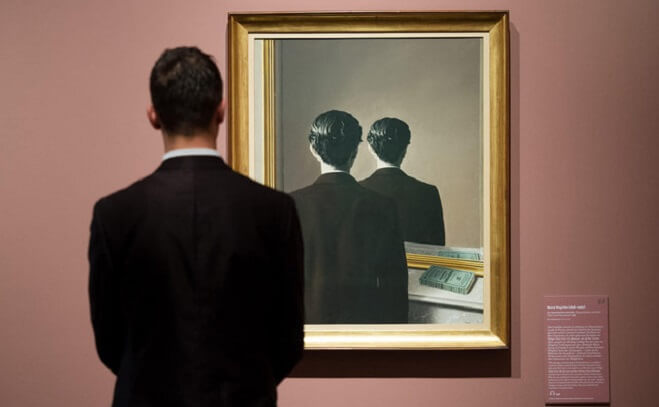
It's not that I want a copy ...

... I just want to know what it means to you?

individual
|
INTERPERSONAL : SCIENCES
humanistic ------------------------------- mechanistic
SOCIOLOGY : POLITICAL
|
group
Not to Be Reproduced, 1937 by Rene Magritte


Image: https://www.renemagritte.org/not-to-be-reproduced.jsp

Saturday, June 24, 2023

Being Reflective and Reflexive


INDIVIDUAL
|
     INTERPERSONAL    :     SCIENCES               
HUMANISTIC --------------------------------------  MECHANISTIC      
SOCIOLOGY  :   POLITICAL 
|
GROUP

"Benner suggested five levels of practice, from the rule-bound novice or beginner who nurses literally 'by the book', following non-contextualised rule-governed procedures, to the expert who:

'with an enormous background of experience, now has an intuitive grasp of each situation and zeroes in on the accurate region of the problem without wasteful consideration of a large range of unfruitful, alternative diagnoses and solutions.'" (Benner 1984) p.22.

"A moral agent is any being who is capable of thinking, deciding, and acting in accordance with moral standards and rules. A moral agent may not always fulfill the requirements of a moral standard or rule; that is, he need not be morally perfect. But he must have the capacity to judge himself on the basis of such criterion and to use it as a guide to his choice and conduct." (Taylor 1975, p.6).

"When the practitioner reflects in action in  a case he perceives as unique, paying attention to the phenomena and surfacing his intuitive understanding of them, his experience is at once exploratory, move testing, and hypothesis testing. The three functions are fulfilled by the very same actions. And from this fact follows the distinctive character of experimenting in practice." (Schon 1987). p.27.

"When someone reflects-in-action, he becomes a researcher in the practice context. He is not dependent on the categories of established theory and technique, but constructs a new theory of the unique case . . . because his experimenting is a kind of action, implementation is built into his inquiry."  (Schon 1983) p.28.

Transforming Nursing Through
Reflective Practice


"This approach approach represents a new call for the:
'.. integration of reason and emotion, the personal and the political, the public and the private. In moral theory ... this is part of a general effort to reverse the segregation of intellectual inquiry from personal experience in moral deliberation.'" (Lauritzen 1996,p.6) p.37.

"Greene (1998) noted:
'To become [different] is not simply to will oneself to change. There is the question of being able to accomplish what one chooses to do. It is not only a matter of the capacity to choose; it is a matter of the power to act to attain one's purposes. We shall be concerned with intelligent choosing and, yes, humane choosing, as we shall be with the kinds of conditions necessary for empowering persons to act on what they choose." (p.3) p.52.


Johns, C. and Freshwater, D. (eds). (1998). Transforming Nursing Through Reflective Practice. London: Blackwell Science. [1st edition.]

Chapter 2 Rolfe. Reflective and Reflexive Nursing Practice. pp.21-31.
Chapter 3 Ferrell. Customary vs Reflective Morality. pp.32-42.
Chapter 5 Johns and Hardy. Voice as a Metaphor for Transformation. pp.51-61.

Wednesday, November 23, 2022

Communication - "See what I mean?"

"Lasswell (1948) claimed that an act of communication was adequately explained only when every aspect of his famous question had been answered:

who - says what - in which channel - to whom - with what effect?"

Lasswell, H.D. (1948) The Structure and Function of Communication in Society. In Bryson, (ed.), The Communication of Ideas, Harper & Brs.


 INDIVIDUAL
|

INTERPERSONAL
   :     SCIENCES             

HUMANISTIC --------------------------------------  MECHANISTIC     

SOCIOLOGY
  :   POLITICAL
|
GROUP


who

says what
in which channel

to whom

with what effect?


My source: 

Morgan, John. & Welton, Peter.  (1992).  See what I mean? An introduction to visual communication. London :  Edward Arnold. pp.2-3.  http://www.loc.gov/catdir/enhancements/fy0638/92229403-t.html


See also - the concept of information remains an interest here:

Jones, P. (1996) Humans, Information, and Science, Journal of Advanced Nursing, 24(3),591-598.

Jones, P. (1996) An overarching theory of health communication? Health Informatics Journal,2,1,28-34.

Saturday, August 13, 2022

"Suffering in Silence" c/o David Robertson

 INDIVIDUAL
|

   INTERPERSONAL    :     SCIENCES               
HUMANISTIC --------------------------------------  MECHANISTIC      
SOCIOLOGY  :   POLITICAL 
|
GROUP
David Robertson www.davidrobertsonprintmaker.com QEST Scholar Instagram.com/multiple_of_one
Suffering in Silence, 2018. Woodcut, each 2000 x 910 mm.
Installation: 2400 x 5500 x 5500 mm


"David Robertson’s immersive print installation explores the stigma around mental health and the difficulties men have in reaching out for help. Consisting of 25 life-sized men, the figure is a self-portrait but is representative of any man. Formed of tally marks, each mark representing an individual." ...
[my emphasis].

The Holburne Museum:
https://www.holburne.org/events/holburne-open-david-robertson/

Image: With thanks to David Robertson

David Robertson
www.davidrobertsonprintmaker.com
QEST Scholar
Instagram.com/multiple_of_one 

My source: Printmaking Today Summer 2022, 31:122, p.7.
https://www.cellopress.co.uk/page/printmaking-today

Sunday, June 13, 2021

Four Care Domains +Spiritual: c/o Blk Jks

individual
|
 
 INTERPERSONAL : SCIENCES
humanistic ----------------------------------------------- mechanistic
SOCIOLOGY : POLITICAL
|
group


Photo: Brett Rubin


My source:

Honigmann, D. Critic's Choice, World, Blk Jks, Abantu/Before Humans, Life&Arts, FTWeekend, 15-16 May, 2021, p.14.

Image:

https://www.ft.com/content/cf3b9aaf-a8e4-437a-8ac6-e39b45131f0f


Thursday, February 25, 2021

The mechanics of Empire (or Not) c/o Yinka Shonibare

INDIVIDUAL
|
INTERPERSONAL : SCIENCES
HUMANISTIC----------------------------------------------- MECHANISTIC
SOCIOLOGY : POLITICAL
|
  GROUP


Yinka Shonibare MBE – End of Empire, 2016, Turner Contemporary


"The Salzberg show, at the Museum der Moderne in Monchsberg, will show works going back to the mid-1990s, and though still in development, its title - End of Empire - is secured. This refers to a work Shonibare created for the 14-18 Now project, which commemorated the 100 years since the end of the first world war: two figures with globes for heads sit either end of a moving see-saw, their precarious balance representing the fragile conditions of conflict. 'It's this idea that the arguments are shifting constantly; I didn't want it to be didactic or simplistic,' he says."


Yinka Shonibare

Image: https://publicdelivery.org/yinka-shonibare-end-of-empire/

My source: Roux, C. All a question of power, Life&Arts, FTWeekend. 20-21 February, 2021. p.13.


Monday, February 22, 2021

Call for Papers: Diagrams 2021


The organization of Diagrams 2021 is making rapid progress. Five outstanding Keynote speakers have now been announced. Also, the free, online conference has adopted a novel approach to the program structure that is expected to provide fair access to the conference across multiple time zones.

 Find more details in the 2nd call for papers attached below or on the webpage www.diagrams-conference.org/2021 - and do pass on the information if you know researchers or students for whom it may be relevant.

Best,

Mikkel Willum Johansen 

Publicity Chair

Diagrams 2021


*** Call for Papers: Diagrams 2021 ***

12th International Conference on the Theory and Application of Diagrams

September 28 – 30, 2021

Virtual Event

www.diagrams-conference.org/2021


*** Highlights ***


- FREE REGISTRATION

- Proceedings published by Springer

- Three Tracks: Main, Philosophy, and Psychology and Education.

- Graduate Symposium

- Best Paper and Best Student Paper awards

- Submission dates in April 2021.


***************** Keynote Speakers Announced *******************

Shaaron Ainsworth, University of Nottingham

Daniel Rosenberg, University of Oregon

Katarina Scheiter, University of Tubingen

Atsushi Shimojima, Doshisha University

Frederik Stjernfelt, Aalborg University of Copenhagen


Francesco Bellucci, University of Bologna, is the Inspirational ECR Speaker for Diagrams 2021

******************* Novel Program Schedule *********************

Diagrams 2021 will adopt a novel approach to scheduling talks, to accommodate different time zones across the globe. See

http://www.diagrams-conference.org/2021/index.php/program/

for more details.

*************************************************************

Diagrams is the only conference series that provides a united forum for all areas that are concerned with the study of diagrams and has a multidisciplinary emphasis.

For 2021, *MAIN TRACK* conference topics include, but are not limited to:

– applications of diagrams,
– computational models of reasoning with, and interpretation of, diagrams,
– design of diagrammatic notations,
– diagram understanding by humans or machines,
– diagram aesthetics and layout,– evaluation of diagrammatic notations,
– graphical communication and literacy,
– heterogeneous notations involving diagrams,
– history of diagrammatic notations,
– information visualization using diagrams,
– nature of diagrams and diagramming,
– novel technologies for diagram use,
– reasoning with diagrams,
– semiotics of diagrams,
– software to support the use of diagrams, and
– usability and human-computer interaction issues concerning diagrams.

In addition to the main track, Diagrams 2021 will have two further tracks: Philosophy, and Psychology and Education; for their topics of interest, see

http://www.diagrams-conference.org/2021/index.php/calls/main-track/

http://www.diagrams-conference.org/2021/index.php/calls/philosophy/

http://www.diagrams-conference.org/2021/index.php/calls/psychology-of-diagrams/.


If the main research contribution of your submission is considered to fit either of the other tracks then you are strongly encouraged to submit to the respective special track, each of which has a dedicated program committee.

Authors of accepted submissions will be expected to be in attendance at the virtual conference to present their research and respond to questions presented by delegates. All presenters must accept that it is not within the power of the organisers to prevent delegates from recording  talks. However, when registering, delegates will be asked to confirm that they will not record any part of the conference.

*****************************************************************

Submission Categories

The conference will include presentations of refereed Papers, Abstracts, and Posters, alongside a graduate symposium.

We invite submissions for peer review that focus on any aspect of diagrams research, as follows:

- Long Papers (16 pages),

- Abstracts (3 pages),

- Short Papers (8 pages),

- Posters (4 pages – this is both a maximum and minimum requirement).

More details and all important dates can be found on at www.diagrams-conference.org/2021.

*****************************************************************

________________________________

Mikkel Willum Johansen

Associate professor

Department of Science Education

University of Copenhagen

Saturday, August 29, 2020

Reflecting in the Garden: c/o Anish Kapoor

individual
|
INTERPERSONAL : SCIENCES
humanistic ----------------------------------------------- mechanistic
SOCIOLOGY : POLITICAL
|
group - population
Anish Kapoor, Installation view, 2020
Houghton Hall, Norfolk, UK


See also: https://hodges-model.blogspot.com/search?q=kapoor

 My sources:

Campbell-Johnston, R. (2020) As maddening as it is mesmerising, The Times, Visual Art, Friday, July 10, p.10. 

Revely-Calder, C. (2020) The pomposity's still there, but so are the moments of magic, The Daily Telegraph, Friday, July 10, p.25.


Wednesday, April 29, 2020

"Field of Vision" from an excellent book

If 2020 confirms anything for humankind,
it is the need to assure our field of view
- beyond '2020' vision.


individual
|
INTERPERSONAL : SCIENCES
humanistic ----------------------------------------------- mechanistic
SOCIOLOGY : POLITICAL
|
group - population
Ernst Mach, Visual Field; looking through Mach’s left eye at his own body stretched out in his studio; limited by the curvature of the eye socket, 
one sees his nose and beard.
Mathematics and Art: A Cultural History


Lynn Gamwell (2016) Mathematics and Art: A Cultural History. Princeton, New Jersey: Princeton University Press. ISBN: 9780691165288. p.283.

(Thank you to PUP for the review copy - more to follow.)

Image source:
http://earwaveevent.org/article/cezanne-and-music/

Tuesday, December 31, 2019

Happy New Year: Nostradamus c/o Al Stewart

"A Man for All Seasons" ...
"A Woman ... and other gender identities ..."
"A Child ..."
"A model ..."

"A model for Past, Present, Future"

A series of Frames - Janus-like view:

Pre-morbid, Diagnosis, Prognosis ...

Clinical and Case -
Assessment
Planning
Formulation
Evaluation
Engagement

individual
|
INTERPERSONAL : SCIENCES
humanistic ----------------------------------------------- mechanistic
SOCIOLOGY : POLITICAL
|
group - population


Nostradamus - Al Stewart
From the Album: Past, Present, Future

Thursday, October 31, 2019

Lucian identity i

INDIVIDUAL
|
INTERPERSONAL : SCIENCES
HUMANISTIC ----------------------------------------------- MECHANISTIC
SOCIOLOGY : POLITICAL
|
GROUP
Lucian Freud, Self Portrait, c.1956 (oil on canvas)
Painting

Process

peer (painting)

peer supervision

"... [Lucian Freud's] most precious works are perhaps his unfinished portraits. ... The two painters [Francis Bacon] often used each other as models preferring to depict each other’s psychological states rather than physical. ...

Then there is the unfinished self-portrait from around 1956. (Image #4 in the slideshow) These paintings should be looked at as precious gifts that offer an unprecedented access to Freud’s very personal process. Notice how his loose pencil marks, more like broad guidelines for the final portrait gain volume and become imbued with emotion at the hand of the master. You can see that Freud started each portrait with the most expressive feature of the human face – the eyes, and moved radially outwards from there."
 With my emphasis and image source:
 http://www.galleryintell.com/lucian-freud-portraits-kunsthistorisches-museum/
See also:

Lucian Freud Archive
http://lucianfreud.com/index.html

Royal Academy Lucian Freud: The Self-portraits
https://www.royalacademy.org.uk/exhibition/lucian-freud-self-portraits


My source:
Campbell-Johnston, R. The secrets that still lie in the paint-strewn lair of Lucian Freud, The Times, Saturday Review, October 19 2019, pp.4-5.

Sunday, September 08, 2019

"Cloud Reservoirs in Finite Glitch Space" by Jacob Hashimoto

individual
|
INTERPERSONAL : SCIENCES
humanistic ----------------------------------------------- mechanistic
SOCIOLOGY : POLITICAL
|
group - population


Jacob Hashimoto

Cloud Reservoirs in Finite Glitch Space (Reservoir III), 2018.
Woodblock monoprint, 65 x 60 inches


My source: The New York Review of Books, August 15 - September 25, 2019, Volume LXVI, Number 13, p.19.