Hodges' Model: Welcome to the QUAD: spiritual

Hodges' model is a conceptual framework to support reflection and critical thinking. Situated, the model can help integrate all disciplines (academic and professional). Amid news items, are posts that illustrate the scope and application of the model. A bibliography and A4 template are provided in the sidebar. Welcome to the QUAD ...

Showing posts with label spiritual. Show all posts

Monday, August 03, 2026

The Sciences: Points, lines, angles and perspectives on Domains

In Hodges' model the axes are presented - by convention - as perpendicular. From this it follows that the resulting four domains, or quadrants appear as equivalent in terms of the space they each occupy. There are many posts on the blog that present a 2x2 table. When in template form Hodges' model is also a potential corpus, empty apart from its structure, then there must surely be a gross asymmetry in the SCIENCES domain compared with the others, including the SPIRITUAL. Discuss?

#simplicity #complexity #folktheory #humanities #arts #humanistic #emotion #balance

See also: https://hodges-model.blogspot.com/2026/06/h2cm-domains-symmetry.html

Saturday, June 20, 2026

ii Thoughts re. Ecosia's AI Chat 'answer'

The previous post has been updated, to the prompt is added:

 'Please provide sources and references.

[If you are new here, and too Hodges' model please see the bibliography in the sidebar.] 

A 'human' reading (still) makes me wonder if the 'answer' is what I want to hear (as a user)? Is it worrying that the first provides a 'Conclusion' the latest does not. The table is helpful as I believe that Hodges' model has a role across research (and political!) -isms through methodologies and methods. The model can also encompass ('eat'!) aspects of scale, or level.

The reply still gives me quadraphonic joy (if read out-loud). Not only are the domains recognised, but the LLM/agent ai takes the intrapersonal / interpersonal in its stride (from the blog?). Subjects related to each of the domains are given in brackets. 

There is of course a bias (several) in the prompt, as the care domains were never intended to be comparable. It is positive that each domain is seen as having its own specific scope and function. Over twenty years notes were started on a paper on Hodges' model and its role/function in helping to define 'scope of practice'. Significantly, in the UK the rise of associate positions across disciplines has provoked much debate, vitriol (on X and union and lobbying) and soul searching in certain professional groups. Given the increasing importance of the global health and social care workforce this trend is reflected globally. A situation set to be extended with uncertainties and tensions exacerbated by artificial intelligence in practice.

Before 'explaining' the asymmetries (in points 1-4) it seems the domains are complementary (for all their differences), and provide a holistic underpinning for the model as a whole (my reading).

1. Scope and Focus 

Interesting, how the science and sociology domains are described as broad. Perhaps I am underestimating the depth/density of sociology, after all folk theory is found there? Unfortunately, we can also add a myriad of conspiracy theories? Sociology can also lay claim to quite a few constructions of its own. Including aesthetics as a bridge to architecture and design(?).

On 'X', Hodges' model has been described negatively as inviting / fostering generalism. So, this is a bad thing? Is it not strange then that your Advanced Nurse Practitioner, Consultant doctors (all specialities) and students cross-curricula can all use Hodges' model? The fact that my own responses were never engaged has helped train my thought. Here the relevance of the model to students and continued professional development is made through generalizable knowledge.

The response to the political domain is supportive, acknowledging resource allocation and the distinction between individual and collective (see for example):

S. Bettiol, P. Jones, H. A. Onyedikachi, and W. G. Kernohan, (2026) Bridging Gaps in Oral Health Frameworks: Mapping With Hodges' Health Career - Care Domains - Model, Journal of Public Health Dentistry. 1–14, https://doi.org/10.1111/jphd.70034.  

I've seen tweets today regards IQ reductions in younger people. This is one reason for support of the top-left mental domain being designated as 'Intrapersonal – Interpersonal'. Our interpersonal skills and awareness are surely dependent upon our achieving a given level of inner mental life? Encouraging to see how subjectivity and objectivity is assigned too. Although, I think I'm in an echo chamber!

2. Epistemological Differences

In arguing for a model of health and social care that goes beyond:

  • medical model;
  • bio-medical model;
  • bio-psycho-social model.

Reading 1-2 from the perspective of the Intrapersonal – Interpersonal domain you see how limiting this is, if an individual in a mental health/illness/mental capacity context can only point to sciences and sociological domains. Indeed, they may be relying guardians and advocates as they are unable to does this and raise the political matter of their rights. Without the POLITICAL domain (or as a result of it - neglect, structural racism) there is no law enshrining independent advocacy...

3. Practical Application in Care

To care is to act. Think about triage and emergency response.

Now in the 21st century 'care' must include self-care, health and social care, and (delayed or not you decide?) planetary care.

This necessitates a change of mindset at an individual and collective level. Consider the literacies that (again) young people must master to be effective, productive and happy citizens tomorrow?

So the following is a gift (in my eyes): 

"This means the intrapersonal-interpersonal domain is not just another 'content area' but a lens through which all other domains are experienced and integrated."

4. Hierarchy of Integration

'While the domains are conceptually equal in Hodges’ model' ..

This is interesting in itself.

[There does seem a emphasis upon the Intrapersonal – Interpersonal domain in this answer?]

This is quite a step, as the idea of a nexus and integration are picked up; and pointing to what are the determinants of health:

'For example:

  • A scientific understanding of depression (e.g., serotonin levels) must be interpreted through the intrapersonal experience of the individual.
  • A sociological analysis of healthcare disparities must be understood through the political structures that enable or inhibit change.
  • A political decision about resource allocation must be filtered through intrapersonal values and priorities.'

I'm pleased I did this, as long as I'm not being trapped in an epistemological cocoon: otherwise known as a circle. Apart from a few occasions, I have not used AI/LLMs, perhaps it is time to explore more? I'd like to preserve my naivety, especially were maths is concerned. I'm not sure of what baggage I may pick up and lack the knowledge to interpret?

Previous post:  https://hodges-model.blogspot.com/2026/06/h2cm-domains-symmetry.html

Friday, June 19, 2026

[Updated] AI Chat: Are the domains of Hodges' model comparable?

In drafting a future post: 'The Sciences: points, lines, angles and perspectives on domains', I thought I would ask Ecosia's AI Chat a related question, here is the (quick) prompt and reply:

PROMPT: 
In Hodges' model there are four care, or knowledge domains. The four domains are the sciences, sociology, political, and intrapersonal – interpersonal domain. In terms of potential content are these domains comparable, or is there an essential asymmetry? Please provide sources and references.

(I have saved the prompt for future reference and refinement.)

RESPONSE: [updated 21st June 2026]


Hodges’ model (also known as the Health Career Model or h2cm) is a conceptual framework that organizes knowledge and care into four quadrants, each representing a distinct domain of human experience and knowledge. These domains are:

  1. Sciences (empirical, biological, and physical sciences)
  2. Sociology (social structures, relationships, and community)
  3. Political (power, policy, governance, and resource allocation)
  4. Intrapersonal – Interpersonal (psychological, emotional, and relational aspects of the self and others)

Are the Four Domains Comparable or Asymmetrical?

The four domains in Hodges’ model are not strictly symmetrical in terms of their content, scope, or application. While they are presented as equal in structure (each occupying one quadrant of the model), their potential content, theoretical foundations, and practical implications can vary significantly. Here’s why:

1. Differences in Scope and Focus

  • Sciences (Quadrant 1):
    This quadrant focuses on empirical, measurable, and biological aspects of health and care, such as anatomy, physiology, and pathophysiology. Its content is often highly specialized, technical, and evidence-based, rooted in natural sciences like biology and chemistry.

    • Example: The role of hormones in stress response or the pathophysiology of diabetes.
  • Sociology (Quadrant 2):
    This quadrant addresses social structures, culture, and community dynamics. Its content is broader and more interpretive, drawing from sociology, anthropology, and social psychology.

    • Example: The impact of socioeconomic status on health outcomes or the role of family support in recovery.
  • Political (Quadrant 3):
    This quadrant examines power, policy, governance, and resource distribution. Its content is highly contextual and often contested, influenced by political science, economics, and public policy.

    • Example: The effect of healthcare policies on access to services or the role of advocacy in shaping health priorities.
  • Intrapersonal – Interpersonal (Quadrant 4):
    This quadrant focuses on individual psychology, emotions, and relationships. Its content is highly subjective and variable, drawing from psychology, psychotherapy, and ethics.

    • Example: A patient’s personal beliefs about illness or the dynamics of a therapeutic relationship.

2. Differences in Methodology

  • Sciences and Political domains often rely on quantitative methods (e.g., experiments, statistical analysis, policy evaluations).
  • Sociology and Intrapersonal domains frequently use qualitative methods (e.g., interviews, case studies, ethnography).
  • This methodological diversity can create asymmetry in how knowledge is generated, validated, and applied.

3. Differences in Practical Application

  • Sciences and Political domains  are often system-level and influence macro-level decisions (e.g., clinical guidelines, healthcare policies).
  • Sociology and Intrapersonal domains are more individual- or community-level, focusing on personalized care, cultural competence, and therapeutic relationships.
  • This can lead to asymmetry in impact, where some domains (e.g., Political) shape broad systems, while others (e.g., Intrapersonal) focus on direct human experience.

4. Theoretical Foundations

  • The Sciences and Political domains are grounded in positivist and structuralist theories, emphasizing objectivity and external reality.
  • The Sociology and Intrapersonal domains are influenced by interpretivist and constructivist theories, emphasizing subjectivity and lived experience.
  • This theoretical diversity can create asymmetry in how knowledge is perceived and valued in different contexts.

Is There an Essential Asymmetry?

Yes, there is an essential asymmetry in the potential content of the four domains. While the model presents them as equal in structure, their content, methods, applications, and theoretical foundations are not interchangeable. The domains complement each other but serve different purposes in understanding and delivering care.

Sources and References

  1. Conceptual Overview of Hodges’ Model:

  2. Theoretical Foundations:

  3. Discussions on Asymmetry and Complementarity:

Summary Table: Asymmetry in Hodges’ Model Domains

DomainContent FocusMethodologyTheoretical FoundationLevel of Application
SciencesBiological, empirical dataQuantitativePositivistMacro (systems, clinical)
SociologySocial structures, communityQualitative/QuantitativeInterpretivist, StructuralistMeso (groups, communities)
PoliticalPower, policy, governanceQuantitative/QualitativeStructuralist, Critical TheoryMacro (systems, policy)
Intrapersonal-InterpersonalPsychology, emotions, relationshipsQualitativeConstructivist, HumanisticMicro (individual, relational)

PROMPT: 
In Hodges' model there are four care, or knowledge domains. The four domains are the sciences, sociology, political, and intrapersonal – interpersonal domain. In terms of potential content are these domains comparable, or is there an essential asymmetry?


In Hodges’ model, the four care (or knowledge) domains are:

  1. Sciences (biological, physiological)
  2. Sociology (social, cultural, environmental)
  3. Political (legal, policy, organizational)
  4. Intrapersonal – Interpersonal (psychological, emotional, relational)

These domains are not strictly comparable in terms of content, scope, or function. Instead, they represent complementary perspectives that together form a holistic framework for understanding human health, well-being, and care. Here’s why there is an essential asymmetry between them:

1. Scope and Focus

  • Sciences and Sociology are broad, well-established academic disciplines with extensive theoretical and empirical foundations. They provide generalizable knowledge about biological processes and social systems.
  • Political is more narrowly focused on power structures, governance, and resource allocation. While critical for systemic change, it is less about individual experience and more about collective frameworks.
  • Intrapersonal – Interpersonal is deeply personal and subjective, focusing on individual psychology, emotions, and relationships. It is less about universal laws and more about unique, context-dependent experiences.

This makes the intrapersonal-interpersonal domain inherently asymmetrical compared to the others, as it deals with subjectivity and variability rather than objective or structural phenomena.

2. Epistemological Differences

  • Sciences, Sociology, and Political domains rely on external observation, measurement, and analysis. They are rooted in positivist or structuralist traditions, where knowledge is often generalized.
  • Intrapersonal – Interpersonal is rooted in interpretivist and phenomenological traditions, where knowledge is co-created through subjective experience and dialogue. It resists universal generalization.

This creates a fundamental asymmetry in how knowledge is produced and validated across the domains.

3. Practical Application in Care

  • The Sciences, Sociology, and Political domains provide frameworks for action (e.g., medical treatments, social policies, legal rights). They are instrumental in shaping systems and interventions.
  • The Intrapersonal – Interpersonal domain is transformative—it shapes how individuals perceive, interpret, and respond to care. It is the domain where meaning is made and agency is exercised.

This means the intrapersonal-interpersonal domain is not just another “content area” but a lens through which all other domains are experienced and integrated.

4. Hierarchy of Integration

While the domains are conceptually equal in Hodges’ model, in practice, the intrapersonal-interpersonal domain often acts as the nexus where the other domains intersect. For example:

  • A scientific understanding of depression (e.g., serotonin levels) must be interpreted through the intrapersonal experience of the individual.
  • A sociological analysis of healthcare disparities must be understood through the political structures that enable or inhibit change.
  • A political decision about resource allocation must be filtered through intrapersonal values and priorities.

This integrative role makes the intrapersonal-interpersonal domain asymmetrical in function, even if not in formal status.

Conclusion: Essential Asymmetry

The four domains are not comparable in content or function. Instead:

  • The Sciences, Sociology, and Political domains provide structural and systemic knowledge.
  • The Intrapersonal – Interpersonal domain provides subjective and relational knowledge, which is essential for meaning-making and agency.

The asymmetry arises from the epistemological and practical differences between objective/systemic knowledge and subjective/experiential knowledge. Hodges’ model emphasizes that all domains are necessary, but they operate in fundamentally different ways.

Sunday, May 31, 2026

iv Book: 'Complexity in Health Care - A Paradigm Shift for Clinical Practice'

After a first mention on page 23, it is chapter 6 that discusses "awe" - the chapter's title. I wrote (in light pencil!) 'It keeps you going'. This is deeper than job satisfaction, but in healthcare is a contributing factor. And different again to (clinical) intution (with many mentions), which recurs, despite (or due to) its subjective nature.

Within its 3.5 pages you will find 'interpersonal awe', Piaget's 'accomodation', the neuroscience of awe, and humility. From a physiological and experiences with short-sightedness and vision, I have applied the concept of accommodation over the years. All this, quite rightly, places emphasis upon the therapeutic relationship. Even since the book's publication in 2023, this relationship has grown in importance.

'The sense of awe is an emotional reaction to events characterized as "vast" or to experienced stimuli outside the domain of the usual and prototypical. A sense of "awe" is often described by scientists who peer through telescopes (immensity) or who observe the uniqueness and expansiveness of the microscopic world. A similar emotional reaction can ocur with respect to the overwhelming experience of the clinician processing the complexity of intertwined variables experienced with a patient. When interpersonal awe occurs, it potentially opens the mind of the clinician to enhanced information gathering, cognitive processing, and empathic understanding.' p.49.

I often feel obliged to apologise that the spiritual does not have a concrete home in Hodges' model. Personally, it is INTRA- and interpersonal. Our religious beliefs, and committments were they apply. Unfortunately, the spiritual is often expressed politically: 'shock and awe'(?). Socially, the spiritual is manifest in the world's religions, our cultures and upbringing, recognition of others - in our communities, the media, ability to 'see' beauty, experience empathy, rapport and shared emotions. On twitter I've often written -

(SPIRITUAL [Intra- Interpersonal; Sciences; Political; Sociology] )

So, Hodges' model is embedded within - should be viewed as surrounded by the spiritual. 

Chapter 7, 'Clinical Decision-Making' utilises the thought of Daniel Kahneman. I like the use of ratiocinations here. I do try to bear in mind the 'traps' afforded by Hodges' model. To be clear, it is not the only clinical cognitive tool I have used. For some reason, against ratiocinations I scribbled 'running the axes, or the corridors of care'. Formal training brought to mind training to assure the marking of student's work (if still needed!), and mentoring student nurses. Case-based learning features here, and in the conclusion: CBL 'will be the central element of this book and will involve actual patients with pronounced biopsychosocial complexities.' p.56. How I wish there was an extra reference (a #16) here: clinical decision-making is fundamentally political; both reflectively and reflexively.

Part V then begins (p.59) on further technical considerations with chapter 8 Introduction to Clinical Complexity. A shift is flagged from a linear, logical-based approach to mix of logic and clinical content. At two pages I did hope for more: biological complexity and resolution left me hungry for more. There is however a key learning point on p.62, re. resolution; that of suffering. Connected to this and a well made point is priorities and what is clinically important and any contrast for the clinical team and the patient.

In a BASIC program from the 1980s on the 'Nursing Process' (essentially p.11 in the book, and somewhere on W2tQ?) I'd included a woman, medical ward with chest pain, who was agitated and couldn't explain herself that well. It wasn't delerium, but we eventually found out she was alone at home and worried about a cat. Attention and listening are not in the index, but should be in all clinical texts. An essential ingredient in the aforementioned reflective/reflexive aspect of interpersonal exchange. In the summary for C8 it was good to read of constellations. Our forebears joined the stars to provide meaning and explanation for what was life, being and experience for them, who had passed, and who was to follow. Without that political domain, the meaning is incomplete, may be repeatedly mistaken. How impoverished [we are / are we] as a result?

 Chapter 9 starts to present the clinical model, with clinical illustrations - case examples. The focus here is underrepresented factors. There is always an issue about granularity in how much data/information is needed for a comprehensive assessment/evaluation. A paragraph considers The problem of simplication. A question is raised:

'How can a clinician think of all the contributing factors on the spur of the moment, the point at which many if not most clinical decisions are made? Our guess is that your response, as a reader, may be to wipe your brow and decide to return to "treatment as usual." reverting to comfortable algorithms.' p.67.

This 'treatment as usual' is surely institutional in origin? Back to the 'political' again. Well I can think of a way to frame, apprehend all the contributing factors and on the spur of the moment. Healthcare is inherently situated. Healthcare professionals need to proceed with care, especially with constant reference to statistics and algorithms. Hodges' model can provide an anchorage, a safe harbour even if the visit is fleeting. These harbour fees, or dues, service charges are negligible.

 In Chapter 10 brings the complexcity of the clinical "field", once more through a case illustration, a woman with chronic schizophrenia, complexity based on clinical diagnosis. The process of diagnosis (and a medical matter) is largely a matter of data reduction, a means to simplify, and provide an avenue to aggregate and group. There is a history lesson in the development of hospitals, even as in the UK bed numbers have seen whole scale reductions. Interestingly (for further study), of course, diagnosis is also a way to abstract away details. The problem is that although this makes the unknown a known, it is binding when it comes to complexity. It ties down a flux, a dynamic that doesn't just want to be free it is constantly changing and may also achieve a more ordered state. The authors try to get to grips with this, they highlight housing, employment, comorbidity and how these may prevent recovery. All this as they seek to define complexity in clinical terms. No easy task: itself part of the problem.

In the summary for chapter 10 it was encouraging to see the cultural aspects for the person and group emphasised, plus how identical demographic factors can still result in disimilar prognoses, hence the importance to 'see' the person and their respective 'self-management'. 

More to follow ...

^Jones P. (2014) Using a conceptual framework to explore the dimensions of recovery and their relationship to service user choice and self-determination. International Journal of Person Centered Medicine. Vol 3, No 4, (2013) pp.305-311. 

Steven A. Frankel, Steven D. Thurber, James A. Bourgeois (2023) Complexity in Health Care: A Paradigm Shift for Clinical Practice. Cham. Switzerland: Springer. ISBN: 978303114948.

Saturday, March 21, 2026

'Health - Illness': Status - presence - absence - Being

A pre-charity shop revisit: 

'So long as we are healthy, we do not notice that we are healthy. Health is one of those phenomena that we do not perceive as anything special because they are a part of everyday life. We discover them by their absence. Only illness enables us to see health as health. That I am healthy, and in what way I am healthy, is something I experience when, and to the extent that, I am or was not healthy, or when I perceive (but this it is difficult to do) that, and to what extent, someone else is or was not healthy. Being healthy is not the only 'being' that escapes our gaze precisely by being, and that appears to us by its absence. One could say the same of being as such.' p.257.

von Weizsäcker, Carl Friedrich (1971 [1980 trans.]). Einheit der Natur [The Unity of Nature] New York: Farrar Straus Giroux.

If we are to demonstrate ('prove') that Hodges' model can be applied, is relevant in:

  • illness, disease, trauma (physical and mental);
  • health and well-being; 
  • human development, ageing, pregnancy;
  • social care; 
  • preventive medicine, health promotion, health education;
  • life sciences, bioengineering; 
  • public (community and mental) health;
  • self care;
  • spiritual health;
  • and global - planetary (political) health ...

Then these observations by Friedrich, allied with definitions of health, as per the WHO's Constitution:

'Health is a state of complete physical, mental and social well-being and not merely the absence of disease or infirmity.'
https://www.who.int/about/governance/constitution

The oft cited (when I was a student nurse) definition of nursing by Virginia Henderson:

“Assisting the individual, sick or well, in the performance of those activities contributing to health or its recovery (or to peaceful death) that an individual would perform unaided if he had the necessary strength, will or knowledge”.
https://libguides.twu.edu/c.php?g=270174&p=1803121

We need to 'see' beyond these sources, to take in the global situation. But, being situated this is something Hodges' model is ideally equipped to achieve.

Tuesday, January 21, 2025

A Voyage in Cosmic Health ... loneliness

Individual
|
     INTERPERSONAL    :     SCIENCES               
HUMANISTIC --------------------------------------  MECHANISTIC      
SOCIOLOGY  :   POLITICAL 
|
Group
[2] 'Most pressingly, Voyager 1 has severe memory loss It stopped speaking clearly on November 14. All they received at JPL was a carrier signal. This was described to me in many ways: flatlining, an interstellar dial tone, useless ones and zeros, gibberish, no data. Imagine your friend is on a long journey and sends you a detailed letter every day, then, one day, empty envelopes start arriving. What happened to your friend? How do you help?' p.21.
[1] 'VOYAGER 1 SUFFERS MANY AILMENTS OF AGE. It has arthritis. During its planetary encounters, the team excitedly swung the camera and other instruments this way and that; this squeezed the lubricant out of the bearings of its articulated platform. Only painstakingly slow movements could loosen its joints. It also has heart disease, as Todd Barber, its propulsion engineer, explained. The arteries that deliver its propellant, which keeps it perfectly pointed at Earth, are partially clogged. Barber calls himself a space plumber and wore a shirt with flying saucers on it as we spoke in the Voyager office. He had considered all the usual cardiological remedies. 
Diet: unfortunately, Voyager eats only the propellant hydrazine, total junk food. 
Exercise: they haven't thought of a way to fire the thrusters to clear the blockage. 
Medication: so they've relaxed its alignment a bit and fire its thrusters less often; in other words, Voyager is on beta blockers.' p.21.

The Sounds of Earth Record Cover - GPN-2000-001978


My source - with thanks - brilliant writing! 

Roeder O. TERMINATION SHOCK. Last Days of a Lonely Interstellar Spacecraft. FT Magazine, August 3/4 2024. pp.18-27. https://www.ft.com/content/0f2dce04-ec78-4aeb-808c-cff5b5135699

https://www.ft.com/content/90b6aaaa-b192-48d9-bd43-e6f41978ad1c

Wednesday, November 13, 2024

Simplifying universal health coverage to achieve political action

'The narrative on universal health coverage should be centred around four core elements: universality, equity, adequate financing, and preparedness in public health emergencies, write Katri Bertram and Justin Koonin'.
Bertram K, Koonin J. Simplifying the universal health coverage narrative can help to achieve political action BMJ 2024; 387 :q2441 doi:10.1136/bmj.q2441

A RESPONSE* 

Can this be true? Why, this is absolutely marvellous! I?
Yes! Me. 

I do count! I'm seen, heard and included in the health care system and can have a voice in the service's development (1.). 

Not only that, but everyone in my - our community - has access - too (2.) ...

client - person - individual - self - patient - citizen
|
INTERPERSONAL : SCIENCES              
humanistic ------------------------------- mechanistic
SOCIOLOGY : POLITICAL   
|
couple - family - group - community - village/town - city
1. UNIVERSALITY

4. PREPAREDNESS


2. EQUITY

3. ADEQUATE FINANCING

... Now that health and social care are properly funded, they've finally done it! They've taken the key step to include education. This is crucial, critical to preventing poor health. Whenever possible we want people to self-care. The mother of all us has always whispered of the safety net. Now she shouts and rages. We all must listen to the stories of old.  Children should be brought up to be health and media... literate and recognise for them as an individual, the merit, the joy of health and well-being.

At last - the power's-that-be are addressing policy. Not just policy on paper, but implementing it, to assure the quality and cost of food, baby-formula, the air and water (3.).

What does this mean?^ It means health budgets can be better managed. Being prepared does not mean we reach immediately for the technical solution, write the prescription (for antibiotics). No. Being prepared means wising-up too. Together, we are ready to face each other, and right across the world: S-N and E-W. Now we can look to the future, climate change and Gaia: as ONE (4-5).


^O’Connell T, Rasanathan K, Chopra M. What does universal health coverage mean? Lancet 2014;383:277-9. doi:10.1016/S0140-6736(13)60955-1 pmid:23953765

(Cited by Bertram & Koonin)

5. Spiritual.

*A response, that is both too simple and too complex. Discuss.

Saturday, September 21, 2024

Hybrid: Seminar & Tetralogic Model


individual
|
INTERPERSONAL : SCIENCES
humanistic ------------------------------- mechanistic
SOCIOLOGY : POLITICAL
|
group
my corner 'I'

The person - self
The person's -
mental state, mental capacity
orientation (time, place, person) continuity - 
mental illness
identity
(advanced?) choice ...
my decisions?
PSYCHO-

physical environment
place, time
embodiment - sense of self
deprivation of liberty
anticipated future developments
probability
silk
my body?!
next of kin
family
friends
carers
Social Housing
Community Care
Residential care sector
personal welfare decisions
-POLITICAL

UK - EU Politics
European Convention on Human Rights
Law - Case Law
Solicitors Barristers Silk Judge
Court of Protection
Decisions of the Court
Mental Capacity
Mental Health Law
🌍

My source: https://x.com/hfp91/status/1837526633235833079

Monday, September 16, 2024

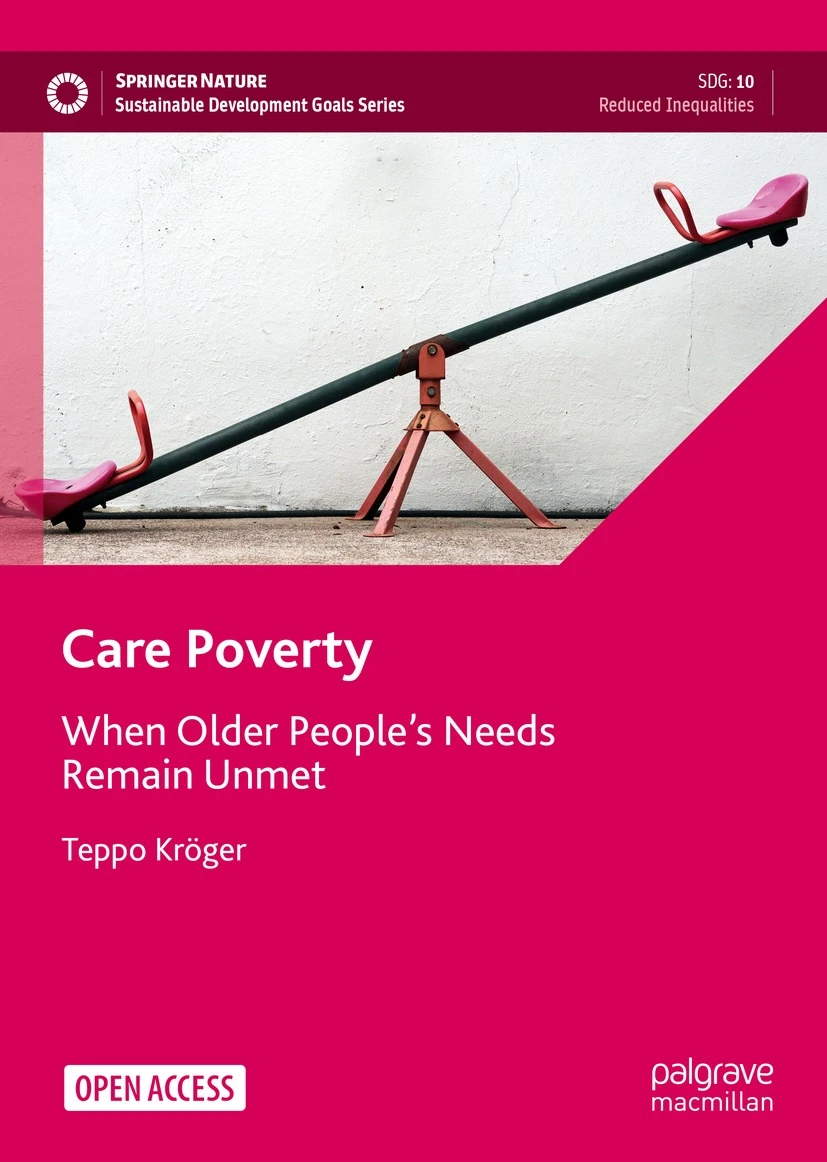
Book: Care Poverty - When Older People’s Needs Remain Unmet

CARE POVERTY
'This open access book turns the research attention of social policy scholars and long-term care researchers from comparative descriptions of care systems, focusing mostly on expenditures and volumes of long-term care services, to outcomes, and in particular to the question whether older people really receive the support that they need. Without knowledge about which needs and which social groups are currently inadequately covered, it is impossible to guide policy development.

The book puts forward a novel theoretical framework to guide future research work and public discussion on the issue of unmet long-term care needs, by broadening the current discussion so that inadequate care is seen in its societal and policy contexts, taking structural issues and policy designs into account. Kröger outlines three different domains of care poverty (personal care poverty, practical care poverty and socio-emotional care poverty) and differentiates between main methods how unmet needs are measured.' [my emphasis]

In psychiatry and psychiatric nursing, a person may be assessed to display poverty of thought, ideas or speech. As an exercise it may be useful to invert the rendering below in Hodges' model, and  consider Kröger's forms of poverty and possibly others that arise from your critique, reflections and life experience to date. Clearly, another book to add to the list!
 
individual
|
INTERPERSONAL : SCIENCES
humanistic ------------------------------- mechanistic
SOCIOLOGY : POLITICAL
|
group

CARE


CARE

CARE

POVERTY


Previously on W2tQ - (unmet) 'needs'

Kröger, T. (2022) Care Poverty - When Older People’s Needs Remain Unmet. Cham: Palgrave Macmillan. https://link.springer.com/book/10.1007/978-3-030-97243-1#about-this-book

Will check on a related title too.

Friday, August 30, 2024

Still sorting books: "The holographic paradigm and other paradoxes"

There has been overlap in my subscription to the Laws of Form mail list and a (David) Bohm list. With the difference, I unsubscribed from the latter, in an effort to focus. The work of Bohm is still very much on the radar and book shelves (well, boxes currently). Continuing to clear books, I've been reading through some relevant sections and quote here at length from:

Wilber, K. (Ed.), (1982) The holographic paradigm and other paradoxes. Boulder, CO: Shambhala.

The Enfolding-Unfolding Universe: A conversation with David Bohm (pp.44-104)

"WEBER: You've spoken of clarity often today and in the past: therefore, isn't it necessary at this point to consider consciousness and the knower, the one who is or isn't clear?

BOHM: Yes, we could come to that. The point is that consciousness is confused. Confusion is nonclarity. And if you say, a person is not clear, you mean he's confused, although it is more polite to say he's not clear. And confusion means "melting together." Things that are different are seen as one and things that are one are seen as broken up into many. So confusion clearly causes chaos." p.61.

"BOHM: Well, yes, we can consider that maybe that is what is, but, at the same time we have to be very  careful to say that thought cannot grasp it, so at some stage thought has to put this question aside as to what is, you see. Thought cannot grasp that which is. And any attempt to grasp that which is engages us in serious self-deception which confuses everything. So that thought has to learn or somehow come to a state of discipline, or whatever you want to call it, spontaneous discipline, its own discipline. 

WEBER: Order?  

BOHM: Yes, order, in which it does not attempt to grasp the questions which are beyond it, such as the question of that which is. It can grasp any relative question which is conditioned, or in some way, conditional. So even the nonmanifest consciousness of the  nonmanifest matter, which is highly subtle, is still within the possible area of thought."  p.64.


"WEBER: Deeply. So you're saying that prior to this current awareness of the centrality of consciousness, what we've been trying to do is hopeless because we've addressed small social problems all in the wrong domain, so to speak. 

BOHM: Yes. Well, really not going to their source at all." p.80.


"WEBER: Which was the old Cartesian or dualistic model.  

BOHM: Right. It also leads to infinite regress, unless you end it by  God or somewhere.
Now I think we come to a point where we're raising a question which was similar to what was raised in  yesterday's discussion.  How long can we go on trying to talk about what is beyond thought by making an intellectual construction? You see, because when we  make such an intellectual construction we  have a content and we have implied that the one who is constructing it is also supposed to be beyond that content. So he evades the very thing we attempt to include him in and in that very attempt he gets out. And so it seems that there is some limit to how far you can go in that  process, in that approach. Therefore it's best to say that in this approach in which we attempt to make a map, or a sketch of some  kind of what reality is, that we are really dealing with something limited. Korzybski used to say: "Whatever we say it is, it isn't."

WEBER: The map is not the territory. . . .

BOHM: That's right. Yes. And therefore what we are doing is making maps, making sketches, making concepts. And see, that's why I said the other night that science, for example, theoretical  science, is not primarily concerned with observing things but with observing ideas. ..."  p.84


The Tao of Physics Revisited  (pp.215-248)

"CAPRA: Yes, they would look at genetics, individual parts and so on. 

WEBER: They have the Cartesian view, whereas you're saying that this is the new vision, emphasizing interdependence, interconnectedness, the dynamics of the whole. 

CAPRA: But I should say that both reductionism and holism are necessary. 

WEBER: I understand. You are not suggesting that we abolish the other. You are saying we should supplement one with the other. 

CAPRA: If you want to get the full story, then you need both views. Because either one gives you only half of the story. This is what I see as the future of science, and I see a future science as no longer distinguishing between disciplines. 

WEBER: That's a very radical view. 

CAPRA: Yes, and by the way Heinsenberg already said that years ago. In one of his books, The Part and the Whole, he ends with his view of future science, and I agree very much with that. I have come to believe that in the future we will apply a network of models, and we will use different languages to describe different phenomena at different levels. We will not worry any longer whether we are doing biology or psychology or physics or anthropology or whatever; we won't be worried about these classifications." p.241.

Reading of The Systems View of Life - A Unifying Vision is also ongoing (p.240 ... and a joy) with posts to follow.

See also:
https://kfoundation.org/krishnamurti-and-david-bohm/

Sunday, June 23, 2024

Book for review: ii "Philosophy of Care - New Approaches to Vulnerability, Otherness and Therapy"

What I like here is being drawn (rescued then!) from the torrent that is the near reaches of the 

    bit, byte ... data, information, knowledge, wisdom

continuum, to its latter realm. The forever incomplete project of wisdom in 'care':
"Care, which is prior to all curing, identifies a fundamental availableness that has not yet been appropriated in the expert and technical discourses of care specialists." p.9.
This goes back to Pierron's 1st chapter focus upon 'Care: A New Arrival in the History of Philosophy'?

J. Braga & M. Santiago de Carvalho (Eds.), Philosophy of care: New approaches to vulnerability, otherness therapy. Springer.

A real gift for me (Hodges' model) is:
"Narration .. In opposition to the mathematization of the world, which reduces human problems to theoretical questions and to a universalized and rational formulation of moral dilemmas, the philosophies of care present a conflict of interpretations which deconstructs official and stereotyped narratives. Amy (or the voice of care) does not conceive a dilemma as a mathematical problem but rather as a narration of human relations, whose effects extends over time. (Gilligan 2008: 53)." p.13.
In addition to Tronto "Care is <<a species of activity that includes everything we do to maintain, contain, and repair our 'world' so that we can live in it as well as possible. That world includes our bodies, ourselves, and our environment>> (Tronto 2009: 143)." p.15. (see i) - I must add Gilligan to the list. 

In this weekend's FT, there's an item about the sorry state of the UK's statistical infrastructure (a post will follow, and mention of another book). I remember* Derek Hoy (RIP) doing a presentation about using data, and nursing informatics to make nursing visible. I wonder how he would make sense of the contrast between nursing whilst in COVID and post?
"Gilligan puts forward a distinction between a feminine ethics of care, which makes use of the idea of the natural solicitude of women by associating self-sacrifice and concern for others, and a feminist ethic of care, thought of as a critical approach that brings to light the mechanisms which favour the "invisibilisation" of care. The latter makes it possible to analyse the ways in which we lose the capacity to care for the other when relations of mutual caring are damaged." p.14. 

As usual below I've mapped some concepts to the domains of Hodges' model. 
Many thanks again to Springer for my copy.

Please note, also - as usual I am trapped in chapter 1! :-)

Individual
|
      INTERPERSONAL    :     SCIENCES                   
HUMANISTIC  --------------------------------------  MECHANISTIC      
 SOCIOLOGY  :    POLITICAL 
|
Group

"Amy - voice of care"

relational

situated


data, information, informatics

visibility

statistical infrastructure


context

equity - equality

social justice

context

feminism

data - reporting

accountability of government(s)


See also:
body & soul - Book: Philosophy of care: New approaches to vulnerability, otherness therapy

*https://hodges-model.blogspot.com/2010/08/drupal-musings-12-semantic-web-icnp.html

Saturday, June 15, 2024

Hodges' model: A tool to watch the complications of Care

Individual
|
      INTERPERSONAL    :     SCIENCES               
HUMANISTIC  --------------------------------------  MECHANISTIC      
 SOCIOLOGY  :    POLITICAL 
|
Group
How many
complications
here?
... here?

"Despite its achievement, Vacheron Constantin has not filed a patent, on the Chinese perpetual calendar, saying it doesn't want to reveal details." p.S9.

... and here too?


Foulkes, N. Inside Vacheron's exclusive cabinet of complications, Watches & Jewellery, Financial Times, 9 April 2024, p.4.

Image and text: https://www.hodinkee.com/articles/introducing-vacheron-constantin-berkley-grand-complication

The Complications, 1 Through 63

"There's likely some part of you that's curious about each of the 63 functions that have totaled a record-breaking level of complication. I'll list the functions below, broken down by type, to simplify things.

Time measurement (9 Total): 1. Regulator-type hours, minutes, and seconds for mean solar time 2. Retrograde second for mean solar time 3. Day and night indication for reference city 4. Visible spherical armillary tourbillon regulator with spherical balance spring 5. Armillary sphere tourbillon 6. World time indication for 24 cities 7. Second time zone hours and minutes (on 12 hours display) 8. Second time zone day and night indication 9. System to display the second time zone for the Northern or Southern hemispheres

Gregorian Perpetual Calendar (7 Total): 10. Gregorian perpetual calendar 11. Gregorian days of the week 12. Gregorian months 13. Gregorian retrograde date 14. Leap-year indication and four-year cycle 15. Number of the day of the week (ISO 8601 calendar) 16. Indication for the number of the week within the year (ISO 8601 calendar).

Chinese Perpetual Calendar (11 Total): 17. Chinese perpetual calendar 18. Chinese number of the day. 19. Chinese name of the month 20. Chinese date indication 21. Chinese zodiac signs 22. 5 elements and 10 celestial stems 23. 6 energies and 12 earthly branches 24. Chinese year state (common or embolismic) 25. Month state (small or large) 26. Indication for the Golden number within the 19-year Metonic cycle 27. Indication for the date of the Chinese New Year in the Gregorian calendar.
Chinese Agricultural Perpetual Calendar (2 Total): 28. Chinese agricultural perpetual calendar. 29. Indications of seasons, equinoxes, and solstices with solar hand.

Astronomic Calendar (9 Total): 30. Sky chart (calibrated for Shanghai) 31. Sidereal hours 32. Sidereal minutes 33. Sunrise time (calibrated for Shanghai) 34. Sunset time (calibrated for Shanghai) 35. Equation of time 36. Length of the day (calibrated for Shanghai) 37. Length of the night (calibrated for Shanghai) 38. Phases and age of the moon, one correction every 1027 years.

Split-seconds Chronograph (4 Total): 39. Fifths of a second chronograph (1 column wheel) 40. Fifths of a second split-second chronograph (1 column wheel) 41. 12-hour counter (1 column wheel) 42. 60-minute counter.

Alarm (7 Total): 43. Progressive alarm with single gong and hammer striking 44. Alarm strike/silence indicator 45. Choice of normal alarm or carillon striking alarm indicator 46. Alarm mechanism coupled to the carillon striking mechanism 47. Alarm striking with choice of grande or petite sonnerie 48. Alarm power-reserve indication 49. System to disengage the alarm barrel when fully wound.

Westminster Carillon (8 Total): 50. Carillon Westminster chiming with 5 gongs and 5 hammers 51. Grande sonnerie passing strike 52. Petite sonnerie passing strike 53. Minute repeating 54. Night silence feature (between 22.00 and 08.00 hours – hours chosen by the owner) 55. System to disengage the striking barrel when fully wound 56. Indication for grande or petite sonnerie modes 57. Indication for silence / striking / night modes.

Additional features (6) 58. Power-reserve indication for the going train 59. Power-reserve indication for the striking train 60. Winding crown position indicator 61. Winding system for the double barrels 62. Hand-setting system with two positions and two directions 63. Concealed flush-fit winding crown for the alarm mechanism."

Also: Naas, R. New and extremely complicated. Watches. The New York Times International Edition, April 9, 2024, p.S9

Craftsmanship. "It took a watchmaker a year to assemble the Complication's 2,877 parts, including 31 hands, nine discs and 245 jewels." p.S9. Plus, quote regards the question of a patent.

Vacheron Constantin


(Just to be clear - this post, as with all others is not paid/sponsored.)