Hodges' Model: Welcome to the QUAD: needs

Hodges' model is a conceptual framework to support reflection and critical thinking. Situated, the model can help integrate all disciplines (academic and professional). Amid news items, are posts that illustrate the scope and application of the model. A bibliography and A4 template are provided in the sidebar. Welcome to the QUAD ...

Showing posts with label needs. Show all posts

Thursday, January 22, 2026

NANDA-I Newsletter - theme of clinical reasoning


'This month at NANDA-I, we have been exploring the theme of clinical reasoning.


Clinical reasoning is at the heart of nursing; it’s how nurses make sense of complex patient information and choose the best path forward. While many nurses think of diagnosis as the centerpiece, it’s really the thinking that leads up to it, gathering cues, interpreting what matters most, and then safely determining goals and actions, that makes all the difference in outcomes. Strong reasoning helps nurses notice subtle changes and act with confidence.


As healthcare grows more complex, understanding how nurses think, not just what tools they use, helps elevate care for every patient. We’ll be sharing insights throughout the year to help you stay connected to nursing knowledge and its impact on care delivery and education.'


Teaching Tip: Clinical Reasoning in Practice

Start With Assessment to Improve Reasoning

When nurses work with standardized languages and clinical judgment tools, it’s tempting to dive right into diagnosis. But the most accurate and useful nursing judgments always come from strong, systematic assessment first. Quality assessment supports better interpretation of patient needs and more precise identification of nursing responses.


Quick Tip: Use a flexible assessment framework, whether it’s a conceptual model or a tool like functional health patterns, to make sure you’re capturing the data that matters most first. When you build a solid foundation with assessment, everything that follows (including diagnostic thinking) becomes clearer and more grounded.  


My source: 'Friends of NANDA®-I Newsletter' subscription (with my emphasis).

See also:
https://nanda.org/2025/12/nanda-360-for-educators-and-researchers-strengthening-nursing-knowledge-through-diagnosis-centered-reasoning/

Assessment, plus planning, implementation - action, evaluation (plus, formulation).

Functional and cognitive [Health, Illness, Climate, Poverty, Political, Security, Prevention, Self-care, ...] patterns.

'... make sure you’re capturing the data that matters most first' - Situated, Context, Salience.

For a competent practitioner an assessment can also be 'therapeutic' for the patient.

Previously: 'classification' : 'diagnosis' : 'NANDA' : 'ICD'
Wednesday, October 01, 2025

Julian Tudor-Hart 'The Inverse Care Law' - c/o The Lancet

On the bottom of my notes re. Giarchi and 'distance decay' I'd written:

'Inverse Care law - p.60. - Giarchi. "those who suffer more ill health are less likely to be assisted."

It made me wonder about the origin of this law having posted about it in 2020.

The Lancet has an editorial and an associated podcast:

50 years of the inverse care law. The Lancet, Volume 397, Issue 10276, 767. February 27, 2021.

'“The availability of good medical care tends to vary with the need for it in the population served. This inverse care law operates more completely where medical care is most exposed to market forces, and less so where such exposure is reduced.”

These understated opening lines of Julian Tudor Hart's paper, The Inverse Care Law, are as relevant now (50 years to the day since publication) as in 1971. The paper is one of the landmark publications in The Lancet's near 200-year history, and the resonance of Tudor Hart's definition of the inverse care law has global and timeless importance. Simply expressed, Tudor Hart observed that disadvantaged populations need more health care than advantaged populations, but receive less.
Tudor Hart's life and career took him from highly privileged beginnings in London and Cambridge to decades spent in the deprived and deeply socialist Welsh valleys. His experience and work has inspired a generation of influential health-care leaders including Andrew Haines, Allyson Pollock, Cesar Victora, and Graham Watt. Today's anniversary issue of The Lancet explores both the global reach of the inverse care law and primary care initiatives in deprived areas around the UK.
Although inequality in health and its many causes are widely understood, inequity in health-care service provision is enduring and fundamental: an intractable concept that lies at the heart of the inverse care law. The inverse care law is primarily about inequity (injustice) in health care that results in unfair social inequalities (imbalances) in health. Since the inverse care law was published, the UK's National Health Service (NHS) has strived to reduce inequity with mixed success. Notably, long-lasting progress was achieved through the 1970s resource allocation formula, which reduced geographical inequality in hospital and institutional expenditure. In the early 2000s, the NHS strengthened primary care provision in disadvantaged areas, leading to a temporary reduction in social inequality, although this progress has reversed following shifts in funding, a slowing of spending, and years of living with austerity.'

See also: 

https://en.wikipedia.org/wiki/Julian_Tudor-Hart

https://www.chpi.org.uk/blog/julian-tudor-hart-and-the-essence-of-primary-care/

Tuesday, September 16, 2025

Chatbot therapists c/o The Sunday Times

It wasn't that long along ago, I tweeted about the prospect of our clinical information systems 'listening' and autotranscribing one-to-one clinical contacts and even formal psychotherapy sessions. How time flies!


Individual
|
      INTERPERSONAL    :     SCIENCES               
HUMANISTIC  --------------------------------------  MECHANISTIC      
 SOCIOLOGY  :    POLITICAL 
|
Group

AI therapy chatbots

'Conventional' 
Counselling / Psychotherapies

Mental health - illness

Issue of: 'Titles'
I can call myself ...
therapist, nurse ...


(New) Evidence-based

Workflow:
intake, assesses needs,
booking into care,
offers CBT based on guidelines.

Uses a person's details,
asks questions to identify
the likely problem ...

clinical
Empathy: Human - Machine

Public safety

DEMAND <-> supply

Access to Therapy: Untreated?

Other AI solutions -

validation

Regulatory approval


unvalidated 'solutions'

risk of a huge industry setback


My source: Danny Fortson, Chatbot therapists are here. But who's keeping them in line? The Sunday Times, August 17, 2025, p.4.

The online article is behind a paywall, but there is a related podcast (with advertising):


See also: 'AI' : 'ethics' : 'expert system, language'

Monday, September 16, 2024

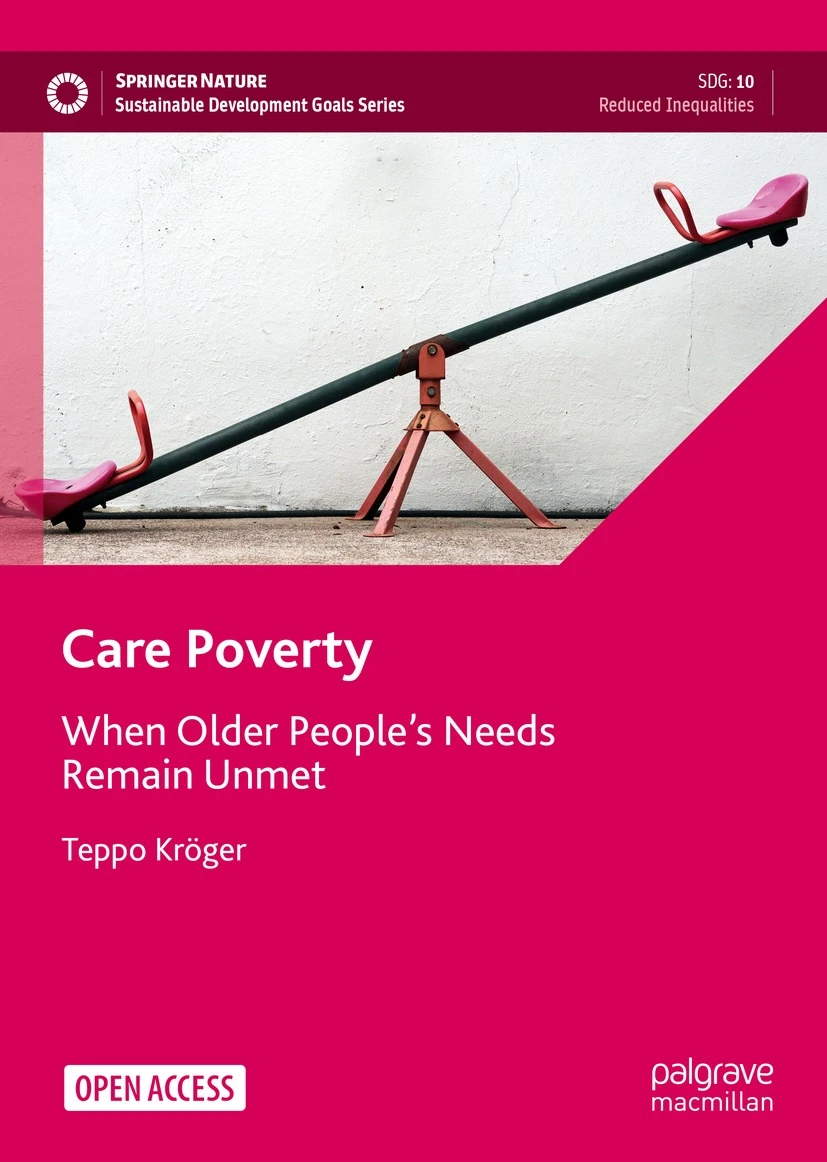
Book: Care Poverty - When Older People’s Needs Remain Unmet

CARE POVERTY
'This open access book turns the research attention of social policy scholars and long-term care researchers from comparative descriptions of care systems, focusing mostly on expenditures and volumes of long-term care services, to outcomes, and in particular to the question whether older people really receive the support that they need. Without knowledge about which needs and which social groups are currently inadequately covered, it is impossible to guide policy development.

The book puts forward a novel theoretical framework to guide future research work and public discussion on the issue of unmet long-term care needs, by broadening the current discussion so that inadequate care is seen in its societal and policy contexts, taking structural issues and policy designs into account. Kröger outlines three different domains of care poverty (personal care poverty, practical care poverty and socio-emotional care poverty) and differentiates between main methods how unmet needs are measured.' [my emphasis]

In psychiatry and psychiatric nursing, a person may be assessed to display poverty of thought, ideas or speech. As an exercise it may be useful to invert the rendering below in Hodges' model, and  consider Kröger's forms of poverty and possibly others that arise from your critique, reflections and life experience to date. Clearly, another book to add to the list!
 
individual
|
INTERPERSONAL : SCIENCES
humanistic ------------------------------- mechanistic
SOCIOLOGY : POLITICAL
|
group

CARE


CARE

CARE

POVERTY


Previously on W2tQ - (unmet) 'needs'

Kröger, T. (2022) Care Poverty - When Older People’s Needs Remain Unmet. Cham: Palgrave Macmillan. https://link.springer.com/book/10.1007/978-3-030-97243-1#about-this-book

Will check on a related title too.

Tuesday, January 30, 2024

"Maslow's hierarchy of needs hides housing horror" c/o Gary Backler in FTWeekend

"John Burn-Murdoch sets out graphically the intergenerational horror story of housing in Britain since 1980 (Opinion, January 13). ...
Abraham Maslow, the American psychologist, placed the need for "shelter" at the very bottom of his famous hierarchy of needs. 
We used to know this. I have a photo of my newly married parents' first rentbook for the council house into which they moved in 1953. It is clear on the cover that after the "accountant to the council", the next most responsible officer is the "medical officer of health". ...
Individual
   |
      INTERPERSONAL    :     SCIENCES               
HUMANISTIC  --------------------------------------  MECHANISTIC      
 SOCIOLOGY  :   POLITICAL 
|
Group

mental health

emotional needs

physical health

shelter/physical security

social needs - belonging

social care

society
Rentbook for council house in 1953 © Gary Backler


Backler, Gary, Maslow's hierarchy of needs hides housing horror, Letters. FT Weekend, 20-21 January 2024, p.8.
Ack. Financial Times. https://www.ft.com/content/3b8719f6-d8e9-4997-b9b5-7dd7ba96fc08

Previously: Maslow.

Saturday, December 09, 2023

Processing people ... in Nursing and Social Services

 When the nursing process was introduced in the UK in the late 1970s - early 1980s, the change was resisted to a degree with concern that patients were at risk of being  'processed': assessed, care planned, interventions delivered then evaluated, discharged or re-assessed. ...

 Individual
  |
     INTERPERSONAL    :     SCIENCES               
HUMANISTIC --------------------------------------  MECHANISTIC      
SOCIOLOGY  :   POLITICAL 
|
GROUP
play 
my quality of life
my quality of care

Emotional, Health and Care Plans

Teaching Assistant provision

continuity of care 

'demand'

time
my quality of life
my quality of care

self-care - feeding
23% rise in demand 
for school transport

Human geography
'supply'

families

'informal carers'

needs that can (supposedly) be met at home

Government funding crisis

social inclusion

social capital

Care in the community

'demand'

£4bn overall funding gap in
children's services

Children and Families Act
Index of Multiple Deprivation
Needs-based funding?
Children with special educational needs and disabilites (SEND)

Parental resort to specialist tribunal courts: 96% legal challenges successful (2022)
National / local taxation
'supply'

'broken' social care market - "dysfunctional"


"The costs are rising inexorably," he said. "Children are very often being processed rather than looked after."

Williams, J. Children at sharp end of council funding crisis, FTWeekend, 2-3 December 2023, p.3.

🤔Just a thought - every supply has a supply' every demand a demand' potentially duplicated across the care domains.

Wednesday, September 06, 2023

Ability Today's Accessible Online Dip. in Journalism - Launches Next Course


Hello 

Ability Today's ADJ Launches Next Diploma Course

I hope this email finds you well.

We're really excited to announce the doors for our Academy for Disabled Journalists (ADJ) Diploma Course in partnership with the National Council for the Training of Journalists (NCTJ) are now open for disabled individuals for the third year.

This initiative aims to break down barriers in the media industry and make journalism more inclusive. We are offering accessible online classes, featuring a wide range of topics such as reporting, writing, editing, and multimedia journalism, all while accommodating the unique needs and challenges faced by disabled students.

WE NEED YOUR HELP TO SPREAD OUR MESSAGE TO AS MANY DISABLED INDIVIDUALS AS POSSIBLE.

Please access our press release by clicking the button below 👇🏼

Get the press release here

Would you please share this with your network to help us reach as many potential students who we can support on their journey into journalism?

We also welcome any further involvement you may wish to have in this program, such as offering mentorship, resources, or scholarships.

Should you have any questions or require additional information, please don't hesitate to contact me directly at grant AT abilitytoday.com.

Here is a link to our academy page with a short promotional video and further details:

abilitytoday.com/diploma-in-journalism/

twitter.com/ADJnews/status/

Best

Grant


Monday, September 04, 2023

"Models, Theories and Concepts" c/o Smith (1994). Plus ça change ...

"Whilst the impracticality of unified approaches has been noted for some time (McFarlane, 1976), it is still considered that many theories, in their efforts to explain everything, succeed only in explaining nothing (Draper, 1990). Therefore, as Kenny (1992) points out, the use of theories and models in nursing has resulted in sweeping generalizations which 'are not always personally, culturally or contextually appropriate'.

In overcoming this difficulty many authors advocate that theories of lesser scope and abstraction are considered (McFarlane, 1976; Clarke, 1986; Draper, 1990; Moore, 1990; Ingram, 1991; Reid & Bond, 1991). Such theories have been termed 'mid-range' and address a more limited number of variables in particular situations (scope), whilst being empirically grounded and focusing on practical problems (abstraction) (Rogers & Shoemaker, 1971; Walker & Avant, 1983; Fawcett, 1984; Lowenberg, 1984). According to Clarke (1986), mid-range theories should appeal to practitioners as being more directly accessible conceptually and linguistically. Reed & Robinson (1991) contend that, given the diversity of nursing practice, the search for grand theory is inappropriate and nursing would be better served by developing mid-range theories that are 'more precisely stated, more easily treated and produce more specific indications for practice'." pp. 59-60.


Smith, J.P. (1994) Advanced Nursing Series - Models, Theories and Concepts. Oxford: Blackwell Scientific Publications.


While the structure of Hodges' model is global - 'grand' in scope, the model, as a template is blank and open to whatever conceptual content follows in the practice situation, or context. 'Precision' can be assured using Hodges' model as it can facilitate person-centred care, integrated care, reflection, critical thinking and conceptual development. 

Delivery of high-quality health care is not a given. 

Safe, effective and equitable care is variously dependent upon staffing, the skills and attitudes of individual nurses, staff numbers, skill-mix, team effectiveness and resource allocation. Hodges' model can also assist users to recognise and call-out unmet needs, deficits in the quality of care, and risks to the safety of patients, the public, staff and the profession.


At risk of sounding grand if not grandiose ...
Change will and must follow - in respect of models and theories, not just of and for nursing but health and care at scale.

Wednesday, August 03, 2022

Call for Papers - Basic Needs: Normative Perspectives

for a special issue on
Basic Needs: Normative Perspectives
(Editors: Lukas Meyer – Daniel Petz – Alessandro Pinzani)

Lessico di Etica Pubblica
http://www.eticapubblica.it/
 
In recent years the debate on basic needs and their place in normative theories of ethics and politics has been rekindled. This controversial concept has finally been openly adopted by authors who adopt different approaches to discuss issues of social justice. There are good reasons for this.

As a currency of justice, needs have several advantages. First, in contrast to preferences, desires, and some other currencies, basic needs are fully objective, i.e., whether a person has a basic need for a certain thing is independent of her own or anybody else’s mental attitudes towards that thing. A second important reason for preferring basic needs as the currency of justice is that they are also universal, although their definition might be culturally influenced. Thirdly, basic needs are intrinsically morally demanding: that P has a basic need for O by itself entails that P ought to be able to have, be, realize, etc. O. Finally, basic needs also have an important advantage in the particular context of sufficientarianism. One of the main objections against sufficientarianism is that it is unable to provide a plausible substantive specification of its threshold of sufficiency. The concept of basic needs, in contrast, essentially entails the idea of a qualitative difference. Being able to fulfill such needs takes precedence over being able to fulfill non-basic needs and desires. Moreover, it distinguishes a life that has a certain minimum quality from a life that lacks this quality.

We invite authors to explore these and other aspects of the concept of basic needs and its use for normative theories of social justice, including intergenerational justice.

Contributions can be in English, Italian, German, and French. The deadline is September 30, 2022

For inquiries please contact: Alessandro Pinzani <alepinzani AT gmail.com>
 
*currently.

Sunday, July 03, 2022

New WHO Quality Toolkit - 'Take ii"


Further to last months post, I've worried at times about the axes of Hodges' model and their status and function. Can I let the axis stand for itself?

INDIVIDUAL
|
|
|
GROUP

Do I expand (explode) the conceptual labels?

self - INDIVIDUAL - person
|
|
|
relationship - family - GROUP - community - population

There seems to be an asymmetry, when you traverse the axis - and its horizontal counterpart; from wherever you start. Perhaps, I worry too much as if the axis was regular then the generic property of the model overall would be diminished. Is this an axis at all?

The website for the Quality Toolkit at: https://qualityhealthservices.who.int/quality-toolkit

- explains the toolkit's scope that includes:

"This new online resource is a user-friendly toolkit to support action on improving the quality of health services at every level of the health system, from national and district to facility and community levels."

I have only scratched the surface here and hope to revisit again - in more detail. Please see below for reflections on the levels by which the toolkit can support action to improve the quality of health services. I have tried to suggest proximity and distance between the SOCIOLOGICAL and POLITICAL (policy). Perhaps, what is a 'clinic' has a name, that it is known by - a key part of the community. The community is closer to the people - to the would-be users of the facility. You can appreciate(?) here the challenge of getting the local community involved in their services. What is 'NATIONAL' should not be remote. Can people compare and contrast with what they are offered? 
 
On the website I note there are video presentations also. The prospect of regular updates for the toolkit is also welcome.

INDIVIDUAL
|
 INTERPERSONAL    :     SCIENCES               
HUMANISTIC --------------------------------------  MECHANISTIC      
SOCIOLOGY  :   POLITICAL 
|
GROUP

psychological access

'My' clinic

Trust, I feel safe)

(feeling safe)

Tell others - my experience..


physical access

clinic

(appearance, facilities, safety)

controlled environment

(cleanliness, sterile..,
or more social)


'the centre'

COMMUNITY

DISTRICT

national


facility
(policy translation / coherence?)

community

district

NATIONAL


Original source: Jules Storr, Independent Consultant, S3 Global & working with WHO as part of the Quality Toolkit development team - via HIFA

Previously: New WHO Quality Toolkit

'Take II'? Quality means getting it right first time (even as you persist in what you are doing - your aspirations and quality improvement). Vitally, this means you, the team make a positive impression for the person, the individual, client .. carer, group. 

If they need to - they will recognise their own ability, knowledge, follow advice, they will come back, they leave not to return soon as they can now self-care and care for others in their home, community ...

 Please note: This post and that previous is not intended to denote endorsement of Hodges' model.


Thursday, June 23, 2022

New WHO Quality Toolkit


"On Monday 20 June WHO launched the Quality Toolkit - a new interactive, online resource for anyone at any level of the health system interested in improving the quality of health services.

The Quality Toolkit provides users with tools to facilitate specific actions to enhance the quality of health services. It is a companion resource to WHO Quality Health Services: a planning guide which provides an outline of key actions to be taken across the health system. The Toolkit then supports these actions with numerous tools. It also enhances understanding of the key interlinkages across the health system when implementing any tool.

The Toolkit incorporates key WHO-published tools and other materials related to quality of health services. It will be updated periodically to reflect new and emerging information relevant to improving quality of health services, including WHO technical products currently under development.

The Quality Toolkit is available at: https://qualityhealthservices.who.int/quality-toolkit

HIFA members are invited to navigate the Toolkit and consider how they might use the tools as part of their improvement efforts. WHO welcomes feedback on the Toolkit qualitytoolkit AT who.int "

Via - HIFA - https://www.hifa.org/

I - IDENTIFY tools and resources relevant to quality of care
M - MAP those tools against improvement needs or identify gaps
P - PLAN implementation of activities for improving quality of care
R - RECOGNIZE interlinkages between technical areas and the process of change
O - OPTIMIZE multi-level action
V - VISUALIZE journeys for improving quality of care
E - ENGAGE stakeholders across the health system


INDIVIDUAL
|
 INTERPERSONAL    :     SCIENCES               
HUMANISTIC --------------------------------------  MECHANISTIC      
SOCIOLOGY  :   POLITICAL 
|
GROUP

IDENTIFY (context)

PLAN^ (mental health)

RECOGNIZE*

needs

gaps


IDENTIFY (context)

MAP / VISUALIZE

PLAN^ (physical health)

OPTIMIZE

technical areas
gaps
needs


IDENTIFY (context)

ENGAGE

needs
gaps


IDENTIFY (context)

RECOGNIZE*

needs
gaps


Above rendering idealised and all embedded within spiritual and ethnocultural context.

*Recognition required politically to avoid individual frustration and facilitate (policy ...) coherence.

^Planning should (must) take into account need for parity of esteem between mental and physical health (with triage situations acknowledged).


Source: Jules Storr, Independent Consultant, S3 Global & working with WHO as part of the Quality Toolkit development team - via HIFA

Friday, January 21, 2022

Webinar: WHO Classification of Self-Care Interventions for Health - Feb 14th

Webinar to present the WHO Classification of self-care interventions 

 09:00 Washington / 15:00 Geneva

This classification aligns with a people-centred approach to health and well-being outlined in the WHO global Guideline on Self-Care Interventions for Health and Well-being. This classification has a health system focus and aims to promote an accessible and bridging language for researchers, policymakers, donors and health programme managers working on self-care. 

Please register here:

https://attendee.gotowebinar.com/register/7796921047088796688

WHO resources on self-care interventions: 

 https://www.who.int/health-topics/self-care#tab=tab_1

WHO Classification of self-care interventions: 

https://www.who.int/publications/i/item/9789240039469

We look forward to your participation! 

Ados V. May, MPA | WHO/IBP Network

Senior Technical Advisor

email: ados.may AT phi.org


  Self - Individual - Person
|

INTERPERSONAL : SCIENCES
humanistic ------------------------------------------ mechanistic
SOCIOLOGY : POLITICAL
|
Community - Group - Population
 Classification of Self-Care
Interventions for Health
Classification of Self-Care
Interventions for Health

Service planning and development
Public engagement
Informal carers
Social care
Care Givers
Accountability
Value for Money
Population Health
Users

Patient - Self - Citizen Research?


Health For All
Human Rights
Health Services
Reporting, Statistics and
Planning, Standards
Information Systems Infrastructure
Governance, Regulation

Population Health
Finance, Value for Money
Outcomes - Policy:
National - International
Sustainability


My source: IBP Network


Wednesday, June 03, 2020

RA of Eng - Healthcare challenges needing engineering expertise


individual
|
INTERPERSONAL : SCIENCES
humanistic ----------------------------------------------- mechanistic
SOCIOLOGY : POLITICAL
|
group - population


The Royal Academy of Engineering is keen to help identify potential solutions and facilitate useful contacts across its national and international engineering networks that could help our governments address problems and assist the public health response.

https://www.raeng.org.uk/policy/engineering-response-covid-19-coronavirus/healthcare

We would like to hear from frontline medics and policymakers who are encountering critical issues, so that we can convene expert teams of engineers to help solve these problems.
