Hodges' Model: Welcome to the QUAD: FT

Hodges' model is a conceptual framework to support reflection and critical thinking. Situated, the model can help integrate all disciplines (academic and professional). Amid news items, are posts that illustrate the scope and application of the model. A bibliography and A4 template are provided in the sidebar. Welcome to the QUAD ...

Showing posts with label FT. Show all posts

Wednesday, February 25, 2026

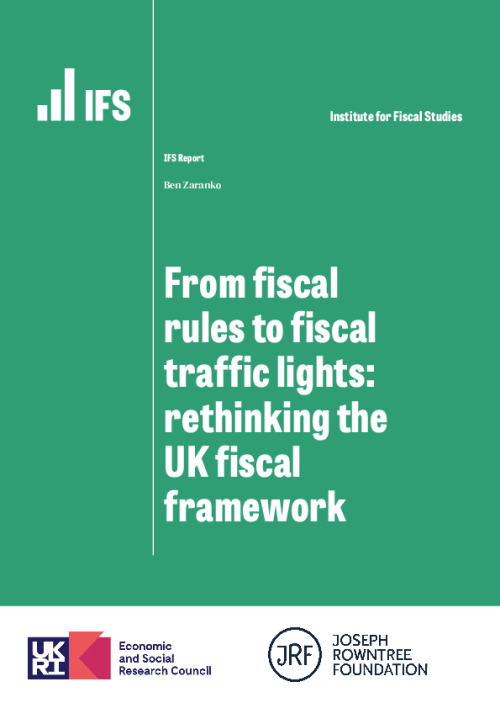
IFS Report: 'From fiscal rules to fiscal traffic lights: rethinking the UK fiscal framework'

'In other words, the current framework means that macroeconomic volatility is mainlined into policy volatility, which adds unnecessarily to economic uncertainty and makes good policymaking less likely. There is also a problem of asymmetry: when the forecast improves, any additional ‘headroom’ is typically treated as free money and happily spent. Yet when the forecast worsens, the rules tend to get changed or ‘gamed’: Chancellors of all political stripes have proved adept at promising future tax rises or spending cuts which are unlikely to be delivered, but which allow them to meet the letter of their rolling fiscal targets. 

All this is to say, the current framework is not delivering good outcomes. It is not achieving sustainable public finances, it has limited credibility with financial markets, and it is not creating the conditions for good policymaking or for a high-quality public debate about the important issues at play. It seems likely that any framework, left in place for long enough, will start to create problems in practice, as unhelpful norms emerge and actors find ways to game the system. Just as the tendency of HM Treasury to fudge its forecasts in the 2000s was one reason for the creation of the OBR as a corrective mechanism, the dysfunction around the current framework necessitates a change in thinking and approach.'

INDIVIDUAL
|
    INTERPERSONAL    :     SCIENCES               
HUMANISTIC --------------------------------------  MECHANISTIC      
SOCIOLOGY  :   POLITICAL 
|
GROUP
'Fixation upon -

lived
[ equilibrium ]
experience


'RAG'
assessment of patients in mental health services - caseload management


 fiscal headroom'
GOOD - BAD
PASS - FAIL
Equilibrium
Outcomes 
Public Policy
 
Interviews
 
sustainable public finances
 
good policymaking
(here)

high-quality public debate

Cost of Living


Report: IFS

Policy
Office for Budget Responsibility


My source: Valentina Romei, IFS urges end to fixation on fiscal 'headroom', Financial Times, 19 February, 2026, p.3.

Images: IFS

Friday, January 23, 2026

Optimism - Pessimism c/o Baggini & Macaro

INDIVIDUAL
|
 INTERPERSONAL    :     SCIENCES               
HUMANISTIC --------------------------------------  MECHANISTIC      
SOCIOLOGY  :   POLITICAL 
|
GROUP

Cognitive flaws,
or psychological adaptations?

'Van der Lugt: "reality confound"

... Optimists believe they have more control over what happens than they actually do.'
 
Dunning-Kruger Effect: 
people tend to overestimate their own expertise.

Baumeister: 
"The negativity effect"
 
Norem:
"defensive pessimism"

Optimism and Pessimism are independent scales.

'Age also makes a difference, for the simple reason that life and its potential future vary accordingly.'

'Designated Cassandra'^
Rotation of role.

'When your prospects are bleak, a gloomy outlook is realism, not pessimism.'
'... how optimistic we feel depends not just on us, but on our life circumstances. 

Think about how race, class and social inequality have real impacts on life chances.'

'In western culture, optimism is valorised more than pessimism.'

'To suggest that people struggling in an unequal system should simply adopt a more positive attitude is to turn social and economic problems into psychological ones.'


^With apologies.

Source: J. Baggini, A. Macaro. In defence of pessimism. Or. why optimism is not quite a prerequisite for achieving a valued goal. FT Weekend Magazine, 1131: June 28, 2025, pp.18-20.
https://www.julianbaggini.com/in-defence-of-pessimism/

Books noted in the above article:

Sharot, T. (2011). The optimism bias: A tour of the irrationally positive brain. Pantheon/Random House.

Tierney, J., & Baumeister, R.F. (2019). The power of bad: How the negativity effect rules us — and how we can rule it. New York: Penguin.

Van der Lugt, M. (2025). Hopeful Pessimism. Princeton University Press. https://doi.org/10.2307/jj.17707125

See also:

Baumeister, R. F., Bratslavsky, E., Finkenauer, C., & Vohs, K. D. (2001). Bad is stronger than good. Review of General Psychology, 5(4), 323–370. https://doi.org/10.1037/1089-2680.5.4.323

Saturday, January 03, 2026

Universal Basic [Income and Capital] c/o N. Berggruen

Individual
|
     INTERPERSONAL    :     SCIENCES               
HUMANISTIC  --------------------------------------  MECHANISTIC      
 SOCIOLOGY  :    POLITICAL 
|
Group
AI ..

Pope Leo XIV - 'Distributional justice'
Pope Leo XIII "Rerum Novarum" 1891?^
 
 *Ethics - see below.

Baby bond schemes -
Australia Superannuation programme
USA MAGA accounts
Proposed European Sovereignty Fund?
UK?

Globally? "We're in this together, remember"


UNIVERSAL BASIC INCOME
UNIVERSAL BASIC CAPITAL 
 
PREDISTRIBUTION not
REDISTRIBUTION

^History: Impact of the industrial revolution
 

.. ECONOMY

  Diminishing value of labour
 Global wealth inequality
 US: top 10% own 93% of all equities
Europe: .. nearly 60% of all wealth.
Bottom 50% owns just 5%
 

*The ecological and ethical impacts from the energy demands of AI still need to be addressed. Financial 'rewards' for the masses, must not become the 'cake' - the bribe for the public to enter into a conspiratorial dyad with technology. PJ

Source: N. Berggruen, Universal basic capital would create a fair AI economy, Opinion, FTWeekend, 1-2 November. 2025, p.13. https://berggruen.org/eu

https://www.ft.com/content/9b93e02a-c693-4070-9094-a2f532dfa929

See also: 'economics' : 'poverty' : 'AI' : 'inequality' : 'universal'

Monday, December 08, 2025

Remember (if you can) in each care domain ...

... there is an elephant in the 'room'!


individual
|
INTERPERSONAL : SCIENCES
humanistic -------------------------------------------  mechanistic
SOCIOLOGY : POLITICAL
|
group-population
'If there is one product that symbolises the absurdities of the EU's single market in goods, it might be a cuddly elephant. The Djungelskog toy from Ikea may only be 12cm tall and cost less than €2, but it has a 20cm-long label protruding from its behind.

Environmental rules from France and EU textile legislation account for much of the length. But the elongated label reflects a strategic even a philosophical, problem for Europe as its companies battle to compete globally.

The single market in goods should be the EU's crowning achievement. Compared with free movement of people, services or capital, it is the area that has come furthest in more than 30 years since the common market was established.

Yet there remain small, often invisible barriers to trade that, taken together, amount to what the IMF estimates is a drag on Europe's economy equivalent to a tariff of 44 per cent.'


RICHARD MILNE - OSLO and SAM JOINER - LONDON, Elephant in the room hampers frictionless EU trade, FTWeekend, 6-7 December 2025, p.6.

Related?

Jones, P. (1996) Nursing Technology and Elephants - Part 1: Technology as a beast of burden. IT in Nursing. 8,1,4-6.

Jones, P. (1996) Nursing Technology and Elephants - Part 2: Technology as a serpent. IT in Nursing. 8,2,5-7.

Jones, P. (1996) Nursing Technology and Elephants - Part 3: Technology rope to save humanity and health care, IT in Nursing. 8,3,5-7.

Sunday, November 16, 2025

'Realization' in Training and Simulation

'Some time in the late 1800s, the body of a young woman was pulled from the River Seine. Lacking any signs of struggle or foul play, her death was ruled a suicide. She was displayed on a slab of marble in the window of the Paris morgue - standard procedure for corpses awaiting identification. At the time, the morgue was a popular, albeit gruesome, attraction which drew more daily visitors than the Louvre. ... Apparently, the forensic scientist assigned to the drowned girl's cadaver became so captivated by her that he paid a moulder to make a plaster cast of her face.' p.16.
individual
|
INTERPERSONAL : SCIENCES
humanistic -------------------------------------------  mechanistic
SOCIOLOGY : POLITICAL
|
group-population


'The face is important. The face: pleasant, delicate features, all languid curves, a relaxed, even blissful expression. Her long, matted eyelashes stuck, as if still wet, to plump cheeks. Her mouth curved into an enigmatic smile. The face, gone unclaimed, triggered an intense, cultish frenzy across Europe. She was dubbed the L'Inconnue de la Seine (the Unknown Woman of the Seine). 
...

The advent of mechanical reproduction allowed the mask to be copied and sold on a massive scale. ... Widely replicated in plaster, wax and then plastic, L'Inconnue's dead face was used as a model for artists at the Ecole des Beaux-Arts, and apprentices at beautician training schools.' p.16.


'You may have seen her face yourself. In fact, odds are you've kissed it - indeed, 300 million people have. In 1955, tasked with the job of creating a life-size doll for teaching mouth-to-mouth resuscitation, Norwegian toymaker Åsmund Lærdal thought back to a death mask he'd noticed years ago, hung in his wife's family home. Lærdal wanted the face to be inviting, not dead-looking. It had to be female, of course, the kind of face men undergoing CPR training would be inclined to kiss. L`Inconnue was, perhaps, the obvious choice for Resuscì Anne, the doll that is still used in schools and swimming pools across the UK and US. Lærdal's website nods to the mask's origins, writing that "the face of death became the face of life".' p.16.


Ack. Sarah Haque, https://www.sarahhaque.co.uk/ 

The strange allure of L'Inconnue de la Seine, FT Magazine, 1,149, November 1, 2025. p.16-17. https://www.ft.com/content/64c930ac-b2b7-4314-b915-eb93c87a451f

See also: Wikipedia - L'Inconnue de la Seine

Wednesday, October 29, 2025

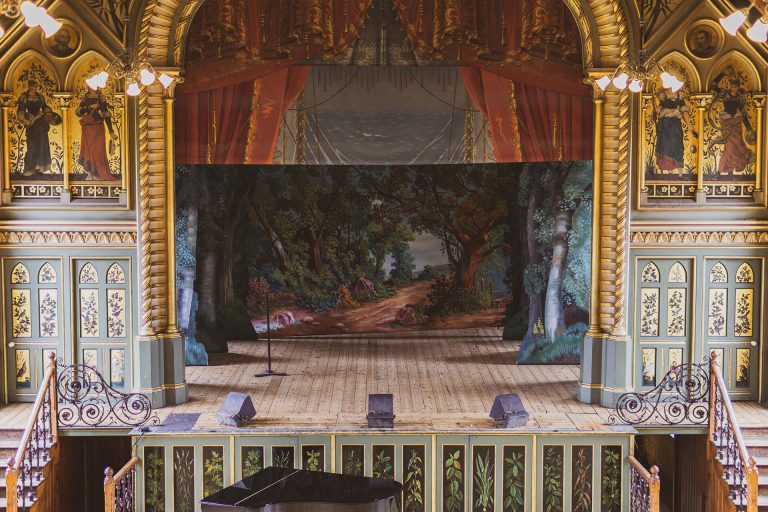
Normansfield Theatre in Teddington

Normansfield Theatre in Teddington

'My favourite building is the amazing Normansfield Theatre in Teddington that John Langdon Down (1828-1896) built to provide positive and stimulating education for learning disabled people (Down syndrome is named after him). At a time when most disabled people would have been shut away in horrific asylums, Down adapted his own house as a residential home, and built a beautiful theatre for creative rehabilitation. It's one of the few surviving private theatres from the period, with original painted scenery and other ornate fixtures, recently remodelled. For me, it's also a reminder of how the wealthy often used their money for good causes, which feels less common now. Jos Boys, guest curator and co-director of The DisOrdinary Architecture Project'


My source: The pick of London Open House. House&Home, FTWeekend. 6/7 September 2025. p.8.

Image: Langdon Down Centre

Previously: 'learning disability' : 'theatre' : 'architecture'

Friday, September 26, 2025

Book: Atlas of Finance

Individual
|
      INTERPERSONAL    :     SCIENCES               
HUMANISTIC  --------------------------------------  MECHANISTIC      
 SOCIOLOGY  :    POLITICAL 
|


Dariusz Wójcik, James Cheshire, Oliver Uberti. (2024). Atlas of Finance: Mapping the Global Story of Money. Yale University Press. https://atlasoffinance.com/

Previously: 'atlas' : 'finance' : 'visualization'

My source:Guthrie, J. Tresure maps. Life& Arts. FT Weekend. 26/27 October 2024. p.12.

Friday, September 19, 2025

'Recall Me Maybe' | FT Drama

Stephen Fry and Gemma Whelan star in a new FT drama written by David Baddiel, exploring AI, memory and truth. Fry plays a grandfather with dementia who uses AI to fill in gaps in his memory. While reviewing the archive of his life his family makes a shocking discovery. Which memories are really true? And how AI is defining who we are?

See also: FT Standpoint unveils David Baddiel digital-first drama about AI and dementia -https://www.dropmedia.co.uk/ft-standpoint-unveils-david-baddiel-digital-first-drama-about-ai-and-dementia/

My source: Times Radio. Dom Joly in for Ayesha Hazarika. 1300-1600 BST From 1405-21.
https://www.thetimes.com/radio/show/20250919-32052/2025-09-19

I still need to catch up with last weekend's FT.
https://www.ft.com/video/a4d2ba19-051e-47c5-98ae-c27c59f1b3f0

Tuesday, August 12, 2025

Revisiting the G7 ... G20

'Under the Trump administration, the US is retreating from the global leadership role it has played since the end of the second world war. The world is bedevilled with challenges and there is a desperate need for stability and co-ordinated solutions to global problems. Where will the leadership to solve them come from? 

Some have argued that we are now in a "G zero" world in which no one is in charge. There is great uncertainty and the powerful dictate solutions to smaller players. Others say we are moving to a regional carve up - a G3 where the US. Russia and China have spheres of influence in a modern day version of the Three Emperors League. 
Some version of a new multi-polar order may yet take shape. But it also seems clear that a G minus one world is starting to fill the vacuum in some domains — with countries coming together to find solutions to global problems without the US.' p.11.
 
Individual
|
      INTERPERSONAL    :     SCIENCES               
HUMANISTIC  --------------------------------------  MECHANISTIC      
 SOCIOLOGY  :    POLITICAL 
|
Group
imaginary -

*You cast your vote and get the 
global leadership we all deserve. ...

- numbers


... Discuss.

G20
G7
G-0?
Goto*


My source: 
Minouche Shafik, How to live in a G minus one world, Opinion, FTWeekend. 26-27 July 2025, p.11.
https://www.ft.com/content/7b884f20-e44e-4afe-9c0c-0c602f76b3f6

Previously: 'G7'

Tuesday, June 10, 2025

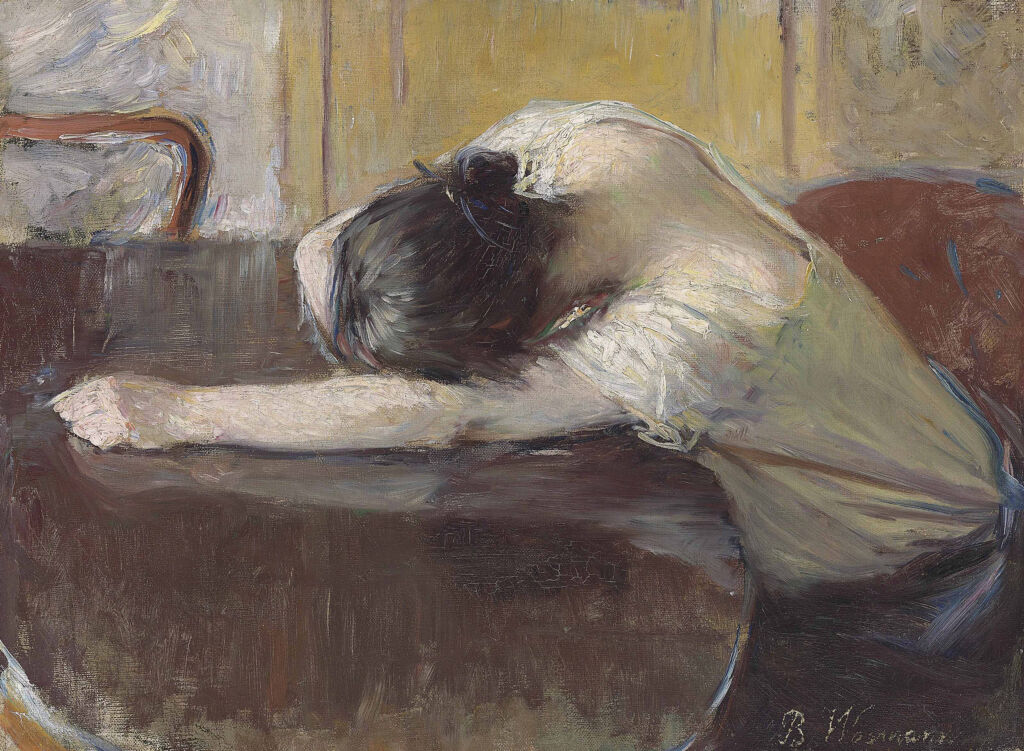
"Despair" by Bertha Wegmann

individual
|
INTERPERSONAL : SCIENCES
humanistic ------------------------------- mechanistic
SOCIOLOGY : POLITICAL
|
group
Despair by Bertha Wegmann (Danish, 1847 – 1926)


Okoro, E. A time to rest and recharge. The Art of Life: Life&Arts, FTWeekend. 17-18 May 2025. p.2.
https://www.ft.com/content/6c2d4362-a464-45e4-8288-a80d5e8a730f

See also: https://en.wikipedia.org/wiki/Bertha_Wegmann

How Bertha Wegmann communicated the 19th-century female experience. Christie's

Image: https://high.org/collection/despair/

Monday, May 05, 2025

Knowledge - Ignorance: Political leaders always seek an informed citizenry. Discuss?

c/o 'The war on knowledge' Simon Schama 
Life&Arts :: FTWeekend


individual
|
INTERPERSONAL : SCIENCES
humanistic ------------------------------- mechanistic
SOCIOLOGY : POLITICAL
|
group


'As the Founders saw it, the great driver of freedom was knowledge. Two decades before independence, the lawyer and essayist William Livingston insisted in a journal called The Independent Reflector that "knowledge among a people makes them free, enterprising and dauntless; but Ignorance enslaves, emasculates and depresses them".

Are you an 'Independent Reflector'?


MIND

'In 1779, Thomas Jefferson (who would make sure that his role as "Father of the University of Virginia would be inscribed on his tombstone) championed a Bill for the More General Diffusion of Knowledge. Its purpose would be to "illuminate ... the minds of the people at large" - excluding of course, women and the enslaved - "and more especially to give them knowledge of those facts . .. [that] they may be enabled to know ambition under all its shapes." The 1780 Constitution of the Commonwealth of Massachusetts, primarily drafted by Adams, committed itself to "The Encouragement of Literature" so that "Harvard-College in Cambridge" would be the institution through which the diffusion of "wisdom and knowledge" would ensure health of the body politic.'

BODY
PUBLIC


'The informed citizenry'


Public understanding of the sciences.


POLITIC

'As Richard D Brown's important history The Strength of a People: The Idea of an Informed Citizenry in America, 1650-1870 points out, all of America's first four presidents (including James Madison) assumed that the security of the republic depended on the "equation of virtue and knowledge". A century later, Calvin Coolidge might assert that "the chief business of the American people is business", but a rich stream of ideas flowing from the learned optimism of the Founders, through the creation of land-grant colleges and the "brain trust" administrations of Franklin Roosevelt, assumed that professors were not the "enemy" but a resource that was indispensable for the good of the nation. The true enemy of American democracy was not professors, but ignorance.'


My source:
Simon Schama. 'The war on knowledge', Life&Arts, FTWeekend, 26-27 April, 2025, pp.1-2.

Previously: 'knowledge' : 'ignorance' : 'political'

Sunday, May 04, 2025

NHS & Politics: You don't have to do 'The Hokey Cokey'

c/o Lunch with the FT - Amanda Pritchard
Life&Arts :: FTWeekend


individual
|
INTERPERSONAL : SCIENCES
humanistic ------------------------------- mechanistic
SOCIOLOGY : POLITICAL
|
group
'Another question that she says will become increasingly pressing is what "the core business" of the health service should be at a time when parts of the state and voluntary sectors have been squeezed, leaving the NHS to pick up the slack. GPs tell her that between one in four and one in five of their patients come to them for help with non-health problems.

A colleague in a mental health service recently told her it employs a housing team to support patients who couldn't otherwise be discharged from hospital. "You wouldn't say the core business of the health service is as a housing provider, but that's where we've ended up."'

She adds: "Think about how long it takes to train a doctor - you can't change your mind every five minutes. . . Think about what it requires to put new [digital] systems in place. It's not buying the tech - that's the easy bit. It's the implementation . . . and some consistency of leadership is really helpful."

'The NHS contributes between 10 and 
20 per cent to people's health, she says - a figure I find startlingly low. "The rest is what we would recognise as the wider [social] determinants, including housing, and meaningful employment, but also smoking, diet, alcohol and lack of exercise. "I know there's an anxiety sometimes about being too nanny stateish about this . . But it is going to take really bold action to set the conditions for people to then live healthier lives."'


'The abolition of NHS England marks the end of an attempt to take the politics out of the health service by placing its day-to-day running in the hands of an arm's-length body. But Pritchard suggests that if this was the intent, it was probably never realistic. "It's too important to the country [and] we spend too much public money for ... the politics not to be part of it."'


My source:
Sarah Neville, Lunch with the FT Amanda Pritchard, Life&Arts, FTWeekend, 26-27 April, 2025, p.3.

Previously: 'Nye' : 'SOCIO-technical' : 'housing'

Wednesday, April 16, 2025

AI, Beliefs, Helplessness, Misinformation ...

Viewing this debate and SDGs both as information spaces, and mental health/illness can provide some insights.

'Learned helplessness' is an established phenomenon in psychological studies and history.

Adam Grant in Life&Arts, FTWeekend 29-30 March 2025, p.2. 

( https://adamgrant.net/book/think-again/ )
writes in 'HOW TO UNLEARN HELPLESSNESS'
'Many people believe that in a world of echo chambers and misinformation, it's not possible to talk anyone out of their convictions. They`re wrong. Even a bot can do it.

In recent experiments psychologists recruited thousands of Americans who believed in unfounded conspiracy theories ranging from the moon landing being faked to 9/11 being an inside job. After the participants described their views, the psychologists randomly assigned some of them to discuss these views with an AI chatbot that was prompted to refute them.

After less than 10 minutes of conversation with a ChatGPT-based LLM, more than a quarter of participants felt uncertain about their views - and those doubts persisted two months later. Short exchanges were even enough to move the opinions of strong believers.

Why? It's not just that ChatGPT has access to infinite knowledge. It turns out that AI chatbots are better listeners than the average human. The researchers found that chatbots were persuasive because they presented information that directly challenged the reasons behind people's beliefs.'
Also helpful, as per discussion to consider AI as a new / emerging 'information space' as a literal frontier, a new territory with unknowns that businesses wish to conquer and the public must learn to trust - even as users. What knowledge - understanding is needed of what is happening in the 'box'?

Once again (within Hodges' model) we can potentially draw in (ask questions of - all) the literacies:

3Rs, information, IT, media, culture, spiritual, financial, health, sciences, civic - national, international...

This also means to what extent are existing imbalances in parity of esteem - between the mind and body dichotomy perpetuated, even increased?

It is not surprising that there is an imbalance, in the distribution of datasets - LLMs on huggingface:

https://huggingface.co/docs/hub/en/datasets

e.g. INTRA- INTERPERSONAL [MIND]

BioBert 1.1
UCI ML Drug Review dataset - Subset 
LOST arXiv:2306.05596 [cs.CL]
Mindwell https://doi.org/10.1007/978-981-97-3601-0_34

SCIENCES [BODY]

eScience kidney factomics (PubMed titles)
BioBert 1.1
SAVSNET sample (VetCN) - Important in terms of Zoonotic diseases and planetary health*.

Image datasets: 
Lung Cancer IQ-OTH/NCCD 
Surface Crack Detection 
Oxford-IIIT Pet 
BreastMNIST 
DermaMNIST 
PneumoniaMNIST 
BloodMNIST 
RetinaMNIST

There is overlap also.

Ack. *As mentioned late 2024, the datasets were discussed at: https://www.bcs-sgai.org/health2024/

'ChatGPT (40) Differentiating reliable information from misinformation (12)'

Wednesday, April 09, 2025

All Day All Night - c/o Christine Sun Kim

Source: https://whitney.org/media/61514


individual
|
INTERPERSONAL : SCIENCES
humanistic ------------------------------- mechanistic
SOCIOLOGY : POLITICAL
|
group
'synaesthetic sphere'

DEAFNESS


SOCIETY

parents signing
friends signing?

ghosting

SOCIO-


ghosting

accessibility
inclusion


-POLITICAL

Ack. Christine Sun Kim - https://christinesunkim.com/

Liverpoool Biennial 2025 - Christine Sun Kim (Look forward to this - may post again.)

My source: Budick, A. The sound of Deaf rage, Life&Arts, FT Weekend. 1-2 March 2025, p.16.

Wednesday, March 26, 2025

Objectify me by Nicola L.

Individual
|
      INTERPERSONAL    :     SCIENCES               
HUMANISTIC  --------------------------------------  MECHANISTIC      
 SOCIOLOGY  :    POLITICAL 
|
Group
'You can touch
my breasts,
caress my stomach,
my sex.
But, I repeat it,
it is the last time,'

- read a note
L. left in a drawer.


Nicola L.
 'La Femme Commode' (1969)


My source: Stoppard, L. Objectify me, House&Home, FTWeekend, 5-6 October 2024, pp.1-2.

Tuesday, March 25, 2025

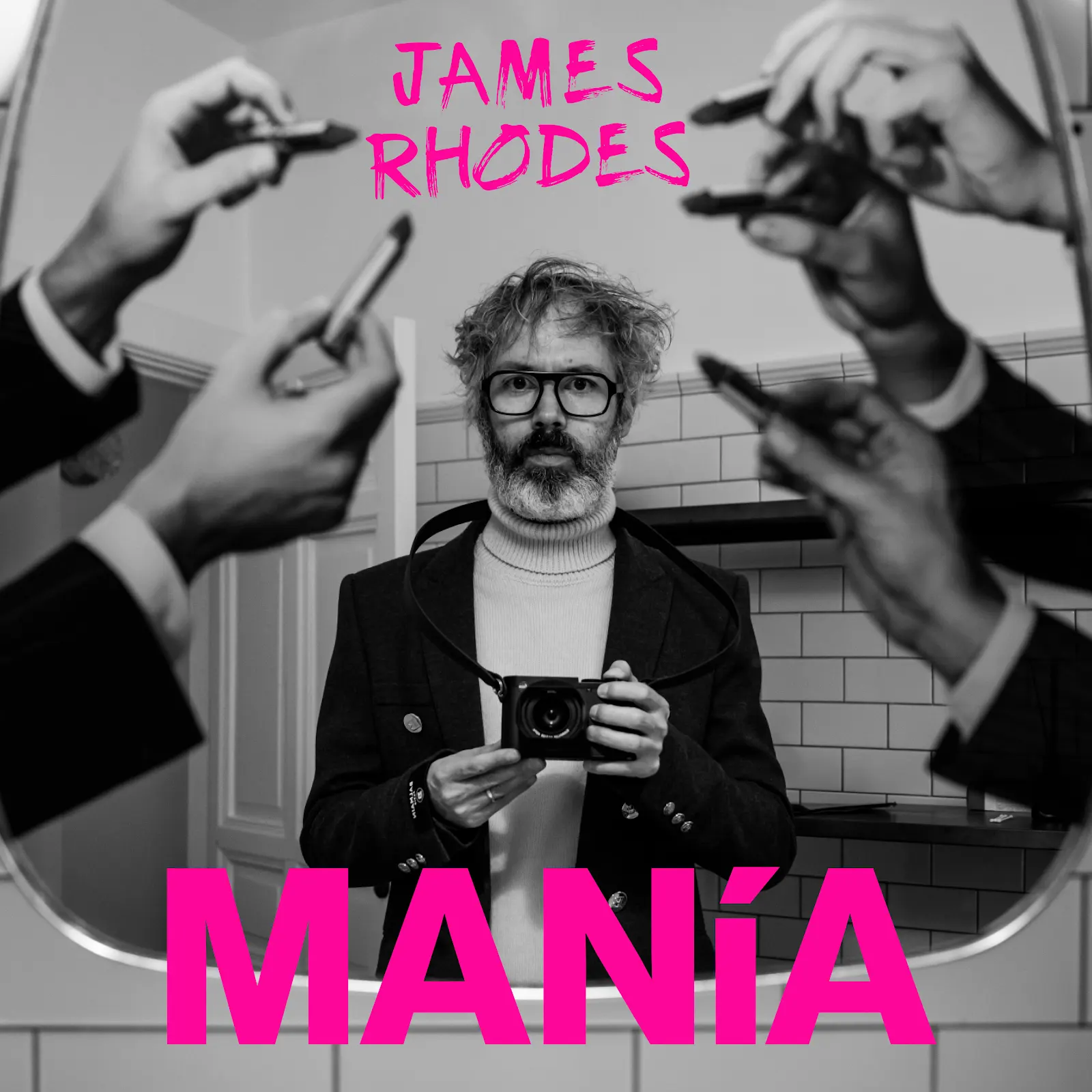
Trauma - MUSIC PRESCRIPTION - James Rhodes

 'By now we're all familiar with the idea of music as therapy. For James Rhodes, however, music can be equivalent - at times even preferable - to  medication in the management of mental health. "Obviously, I am in favour of medication when it is necessary to save lives," says the 49-year-old British-Spanish classical pianist, when I meet him at Peregrine's, an upmarket piano shop in Clerkenwell, central London. "I was on medication and it genuinely saved my life. What I'm not in favour of is medication as a kind of easy option instead of doing other things that will also have the same effect. And there's no question that music [can]." 
 Manía, Rhodes's new album, is driven by that philosophy. Traversing swaths of classical territory, from JS Bach to 20th-century Argentine composer Alberto Ginastera, it is an attempt to profile the therapeutic properties of music from all angles, "I've always loved this idea of prescribing pieces," says Rhodes. As someone who has struggled with his own mental health, he says he has selected works that "accompany me and my insomnia, my anxiety, my desperation and my fears in the middle of the night"'. p.13.


My source:
Nepilová, H. Music on prescription, Arts, Life&Arts, FTWeekend. 8-9 March 2025. p.13.


INDIVIDUAL
|
      INTERPERSONAL    :     SCIENCES               
HUMANISTIC  --------------------------------------  MECHANISTIC      
 SOCIOLOGY  :    POLITICAL 
|
GROUP
MANiA

DRUG
PRESCRIPTION

ARTS
PRESCRIPTION

...


SOCIAL
PRESCRIBING


Friday, February 14, 2025

Curtains ...

'I'm not sure many rational designers would set out to emulate, or even to echo the interiors in David Lynch's films. These are rooms that haunt us: the chevron carpets, the red velvet curtains, the peeling wallpaper suggesting that our environment is somehow theatrical, temporary, a dream - an expression of our subconscious. ...

"I don't know where it came from, but I love curtains," Lynch - famously reluctant to explain his work - said in 2014. "There is something so incredibly cosmically magical about curtains opening and revealing a new world. It resonates on a deep level with people."'


INDIVIDUAL
|
      INTERPERSONAL    :     SCIENCES               
HUMANISTIC  --------------------------------------  MECHANISTIC      
 SOCIOLOGY  :    POLITICAL 
|
GROUP

IMAGINE a curtain:
What colour is it?
Imagine opening the curtain -

<<== CURTAIN
                      [a room: LxDxH]
- is the wallpaper peeling? ...


Edwin Heathcote, Head spaces, Interiors, House&Home, FTWeekend, 1-2 February 2025. p.4.

Previously:

Sunday, February 02, 2025

Social Capital - related to Hodges' model: c/o Andy Haldane FT

'The world is more diverse and interwoven than ever before - economically, culturally, ethnically, generationally. This is largely the result of the postwar explosion in cross-border flows of:'
ME
|
      INTERPERSONAL    :     SCIENCES               
HUMANISTIC  --------------------------------------  MECHANISTIC      
 SOCIOLOGY  :    POLITICAL 
|
WE

INFORMATION*

GOODS

PEOPLE

MONEY

 *Here I am treating information as analog - attached to meaning and sense-making, human reasoning - thought; information is of course also digital and an economy in itself.

'There is no ecosystem on the planet that is not enriched by increased diversity. The complexity of rainforests and oceans explains their abundance. In social systems, the cross-pollination of ideas, cultures and practices in diverse communities has been a driver of innovation and dynamism for millennia.
Yet this is a double-edged sword. A rainforest or an ocean are vulnerable to antagonistic arrivals such as humans seeking timber or fish. If cultures clash rather than cohere, diverse communities exhibit similar fragility.
Every complex system faces this balancing act, but it can be improved by strengthening ties and trust - what Harvard political scientist Robert Putnam calls social capital. The depletion of social capital over the past half-century, documented by Putnam, has tilted the scales decisively towards fragility. Today's open, connected economies are nested in brittle, disconnected societies. Neither can flourish like this.
One policy response is to reverse economic course, tightening restrictions on cross-border flows of people, goods, technologies and information. While economists (like me) tell us that doing so would diminish economic dynamism, given these policies address the insecurities felt by many at source, it is no surprise they are gaining support - especially on immigration and trade.' 

ME
|
      INTERPERSONAL    :     SCIENCES               
HUMANISTIC  --------------------------------------  MECHANISTIC      
 SOCIOLOGY  :    POLITICAL 
|
Group

My - sense of security
My - trust

 (AFTER) -
FORETHOUGHT


... Rainforest : Ocean
Wetlands : Kelp forests ...^

Maps of Social Capital1

Spatial planning


Social capital
Social mobility
Sociable housing2
Social cohesion

Social -

Policy
Curricula
Governance, Citizen Trust
Nat. Strategy for social connection3

Capitalism

'An Office of the President or Prime Minister, charged with lacing social cohesion through policy, should be hard-wired into the machinery of governments.'

(Here, here!).

1. Raj Chetty - Social Capital Atlas: https://www.socialcapital.org/
2. Richard Sennett
3. Chris Murphy

^Sometimes perhaps the map is the territory? Discuss.

With thanks to:
Andy Haldane, How to get from the me to the we society. Opinion: FT Weekend, 14/15 December 2024, p.12.

Upswing image: 
https://www.allenandunwin.com/browse/book/Robert-D.-Putnam-and-Shaylyn-Romney-Garrett-Upswing-9781800750371

Sunday, January 12, 2025

C/o FT 'Inside the rise of the mental-health volunteer movement'

INDIVIDUAL
|
   INTERPERSONAL : SCIENCES              
humanistic ------------------------------- mechanistic
 SOCIOLOGY : POLITICAL   
|
GROUP

'Amid a surge in demand for psychological support that has been exacerbated by the Covid-19 pandemic, Blue is one of many people without formal psychiatric qualifications — including volunteers and health workers — who are stepping in to deliver interventions.'

'Sangath became one of the first projects to run a randomised control trial (RCT) of task-sharing in mental health in 2007. “It’s not a compromise,” said Nadkarni, “it’s an idea backed by solid research evidence.”' [FT]

'Known as task-shifting or task-sharing, the trend has grown across healthcare as services grapple with a stark mismatch between resources and demand. The World Health Organization estimates that there is a global average of 13 mental health workers per 100,000 people, but in low-income countries this can fall to fewer than two.

But a number of studies suggest that simple interventions, such as benches where people can sit with a sympathetic listener, can be at least as powerful as expensive clinical approaches, easing the burden on specialist workers.' [FT]

'About us - Sangath: Our vision is a world where every person has access to quality and affordable mental health care.

Our signature principles are to leverage community and health system resources to deliver psychosocial interventions for the prevention and care of mental health problems. We address a wide range of mental health concerns across the life course, from cognitive development in childhood to self-harm and depression in youth, to drinking problems, psychoses and dementia in adults.  ...

Our name: ‘Sangath’ (सांगात) means togetherness and consensus. It signals our mission – to take an integrated and participatory approach to addressing mental health challenges.'


'Health policymakers are increasingly seeking to replicate projects pioneered in the developing world, a process that has been dubbed “frugal innovation”.'

'“Every $1 invested in a service like this gives you about $9 in return — both for the individual and the society combined,” he added.'

'Initiatives such as the Friendship Bench and the Common Elements Treatment Approach devised by Johns Hopkins University, a mental health intervention that can be delivered by trained and supervised lay providers in low and middle-income countries, are collectively reaching millions of people and have proved their worth in multiple studies.

But funders still tended to focus on setting up clinical projects rather than bringing about systemic change in resource allocation or medical payment models that would drive widespread adoption.' [FT]

My source:
Sarah Neville, India inspires project saving lives in Texas. FTWeekend, 21-22 December 2024. p.4.
https://ft.com/content/a187719c-ccbb-4af9-8d22-8e70b65098cf

n.b. While these efforts are ongoing, there is a crisis and a crisis of confidence in student mental health nursing as a specialty: 


Virtual 1200-1830 25th March 2025. (Too expensive for me.)

Thursday, December 12, 2024

forms of Hygiene

A gift for Hodges' model:

 'good prose is like a windowpane'

George Orwell, WHY I WRITE


'How is it that Orwell has become the single answer to so many questions, in so many different subjects, for so many people? His name conjures an amorphous idea of fair play and “common sense”; his spare prose supposedly brings cool nonpartisanship to a world of impassioned blusterers. In keeping your sentences clean, the theory goes, you practise intellectual hygiene (“good prose is like a windowpane” and all that). A single word, “Orwellian”, evokes the great man’s foresight about the dangers of an overweening nanny state, a censorious far-left or whatever else may be getting your goat that day.'
Naoise Dolan, Why weak thinkers love Orwell, FT Weekend Magazine, October 19/20, 2024, pp.16-18.


INDIVIDUAL
|
INTERPERSONAL : SCIENCES              
humanistic ------------------------------- mechanistic
SOCIOLOGY : POLITICAL   
|
GROUP
INTELLECTUAL
MENTAL - EMOTIONAL - SPIRITUAL
(Coping with the 21st Century)

SELF-LIFE SKILLS
(control anxiety - being organised)


Health Literacy: Knowledge and aptitude for forms of HYGIENE

PERSONAL
ENVIRONMENTAL
DOMESTIC
FOOD

HANDS (How to sneeze, cough)
ORAL - DENTAL
CLOTHES
BODY
HAIR (frequency?)

Sustainability - balance


SOCIAL
COMMUNITY/RACIAL HYGIENE
Insertion of memory lest we forget
Insertion of a hook to do - think as we
tolerance for x,y,z


POLITICAL HYGIENE
aka. The Paradox
To Vote : To be counted
CIVIC


Reflecting about this in some contexts, more than others(?) I'm struck by the overlap between hygiene and literacy.

Completing, or attending to, being motivated to undertake - complete hygiene duties depends on knowledge and ability to act. Having basic needs met.
'
'Opening windows always ...'

literature : window